Archive for the ‘Antarctic’ Category

Summer in the Antarctic and expedition is trapped in thick ice

December 25, 2013

“Global sea ice area is second highest on record for the date after 1988, and closing in the #1 spot. Antarctic ice is melting very slowly this summer, due to record cold Antarctic temperatures”.Real Science, 21st December 2013

Certainly no irony would have been intended but irony there undoubtedly is when even The Guardian is forced to report that:

Antarctic expedition stranded as ship gets stuck in ice

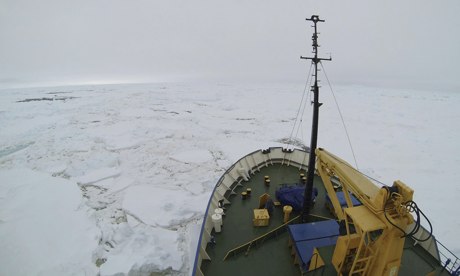
Scientists and explorers on Spirit of Mawson voyage will spend Christmas and Boxing Day awaiting rescue. Explorers are stranded near Antarctica after their ship became wedged in by thick sheets of sea ice.

The Spirit of Mawson voyage, which includes scientists, explorers, tourists and the Guardian journalists Alok Jha and Laurence Topham, is trapped in Antarctic ice floes and awaiting rescue.

But with the nearest ship with ice-breaking abilities at least two days away, the crew will spend Christmas and Boxing Day stuck about 1500 nautical miles south of Hobart.

The Australian Maritime Safety Authority received a distress call on Christmas morning, notifying the rescue co-ordination centre that the ship was trapped and would need help. …

Akademik Shokalskiy surrounded by ice

A view of the ice from the boat. Photograph: Laurence Topham

The voyage is part of a research expedition to commemorate the centenary of Douglas Mawson’s exploration.

The Australasian Antarctic Expedition leader, Chris Turney, wrote on Twitter: “Heavy ice. Beautiful; light wind. Only -1degC. All well. Merry Xmas everyone from AAE.”

Global Warming gone missing: Arctic ice back to “normal” and Antarctic ice at highest ever recorded levels

October 20, 2013

IF THE GLOBE IS WARMING, WHERE’S THE HEAT?

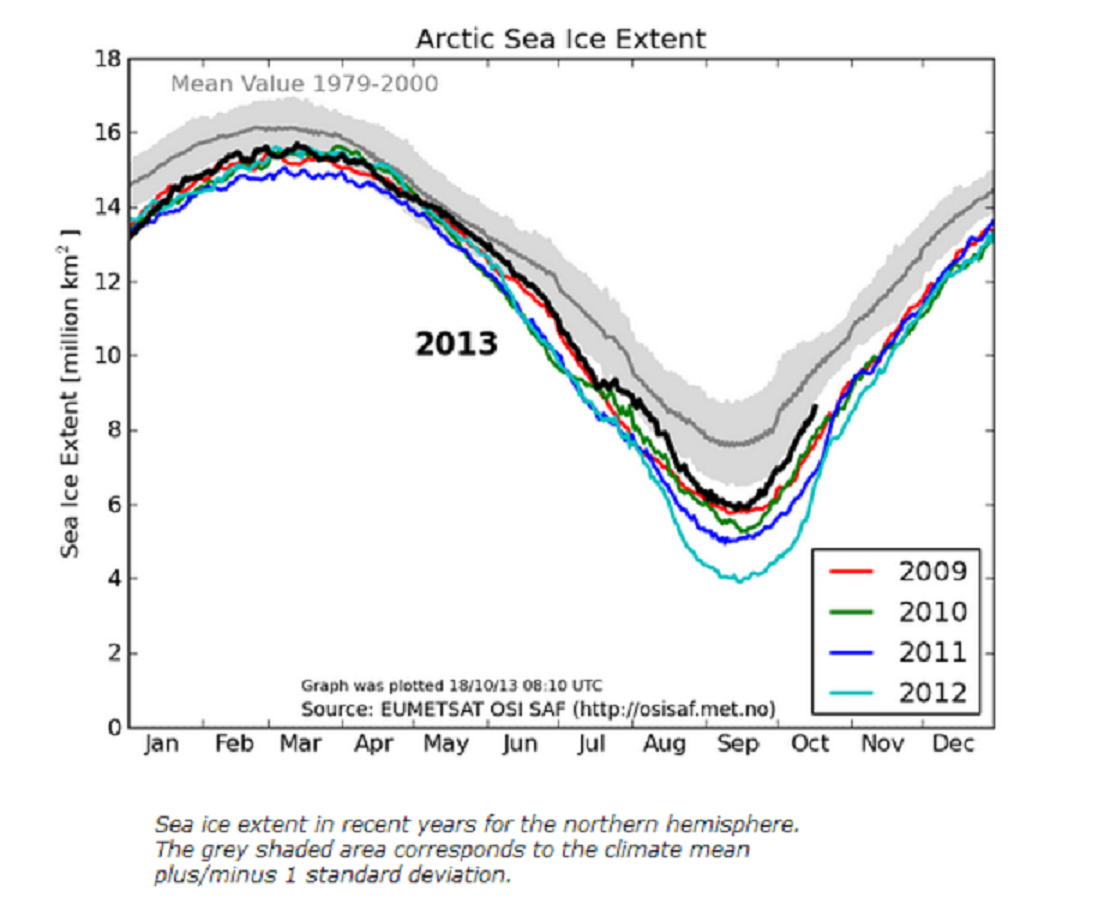
Arctic Ice levels are increasing fast and are within 1 standard deviation of the 1979-2000 mean.

Arctic Ice Extent 20131018 DMI Centre for Ocean and Ice

Arctic Ice Extent 20131018 DMI Centre for Ocean and Ice

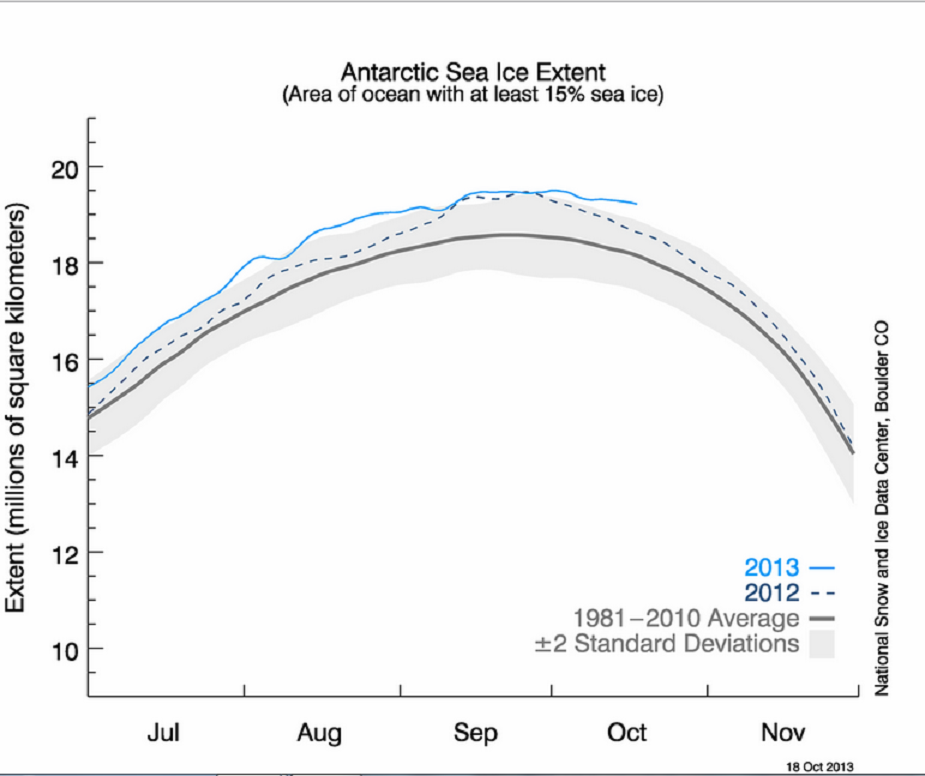
In the Anatrctic ice extent should normally have started reducing by 22nd Sepptember but kept increasing till about 1st October. At maximum it reached levels never recorded before. It is currently at a level more than 2 standard deviations higher than the long term 1981 – 2010 average.

Antarctic Ice Extent 20131018 NSIDC Boulder

Antarctic Ice Extent 20131018 NSIDC Boulder

This leads to obvious but simple conclusions:

  1. Over the last 34 years therefore, Arctic ice extent has shown great variability but is currently at values within one standard deviation of the 30 year average.
  2. Global warming – if it is taking place – has not left any significant signature in the extent of Arctic Ice which is larger than “natural variability”.
  3. Over the last 32 years Antarctic ice extent has consistently shown a small but steady increase.
  4. Global warming – if it is taking place – is completely absent in the record of the ice extent.

It could be argued – but it would stretch credulity – that heat is being stored in the deep ocean (having bypassed the surface waters by a hitherto unknown form of “deep sea radiation”)  and that this will all be released in a coming catastrophic event (to be known as the Ehrlich Rapture) in 2047.

Or, it could be argued – again with little credibility – that man-made particulate emissions from China in the Northern Hemisphere and from Indonesian forest fires in the Southern Hemisphere have reflected away the Sun’s radiation and prevented the warming that should have taken place. This argument then fails since it would appear to describe a very successful  application – if inadvertent – of geo-engineering.

Or we could choose the parsimonious explanation. There has been no global warming for the last 2 decades or so.

Any discussion about whether or how much warming is caused by carbon dioxide emissions becomes moot if there is no warming.

WHERE’S THE HEAT?

Arctic ice past minimum and growing fast and Antarctic ice reaching maximum at record level

October 5, 2013

Arctic ice extent reached its minimum about 2 weeks ago and is now growing fast.

Arctic Ice extent 20131005

Arctic Ice extent 20131005 source: COI

At the Antarctic however, the sea ice extent is just about reaching its maximum level which is at a record level.

Antarctic sea ice extent 20131004

Antarctic sea ice extent 20131004 source: cryosphere


Arctic sea ice reaches minimum for 2013 – about a week early

September 6, 2013

A late spring and a short summer has led to Arctic ice melting much slower than for many years: IS ARCTIC SEA ICE REBOUNDING? 

It would seem that the minimum ice extent in the Arctic which usually happens around the middle of September has already been reached – about a week early.

From DMI – Centre for Ocean and Ice (coastal zones masked)

Arctic Sea Ice Extent 2013 minimum

Arctic Sea Ice Extent 2013 minimum

A real rebound in the ice extent and almost back to the level of 2005.

And of course the Antarctic which is reaching its maximum ice extent seems to be at a level significantly higher than the average for 1981 -2010. (NSIDC, Boulder).

Antarctic sea ice extent 20130904

Antarctic sea ice extent 20130904

These levels of ice extent correspond to the lack of significant increase in sea levels.

There does not seem to be very much to be alarmed about.


Increasing Antarctic sea ice correlates with global cooling

August 18, 2013

A new paper shows that for the last 30 years Antarctic ice is increasing and correlates best with a cooling global temperature.

Qi Shu, Fangli Qiao, Zhenya Song and Chunzai Wang, Sea ice trends in the Antarctic and their relationship to surface air temperature during 1979–2009, Clim Dyn (2012) 38:2355–2363, DOI 10.1007/s00382-011-1143-9

Abstract: Surface air temperature (SAT) from four reanalysis/analysis datasets are analyzed and compared with the observed SAT from 11 stations in the Antarctic. It is found that the SAT variation from Goddard Institute for Space Studies (GISS) is the best to represent the observed SAT. Then we use the sea ice concentration (SIC) data from satellite measurements, the SAT data from the GISS dataset and station observations to examine the trends and variations of sea ice and SAT in the Antarctic during 1979–2009. The Antarctic sea ice extent (SIE) shows an increased trend during 1979–2009, with a trend rate of 1.36 ± 0.43% per decade. Ensemble empirical mode decomposition analysis shows that the rate of the increased trend has been accelerating in the past decade. Antarctic SIE trend depends on the season, with the maximum increase occurring in autumn. If the relationship between SIC and GISS SAT trends is examined regionally, Antarctic SIC trends agree well with the local SAT trends in the most Antarctic regions. That is, Antarctic SIC and SAT show an inverse relationship: a cooling (warming) SAT trend is associated with an upward (downward) SIC trend.

The variations of local  SIC and SAT anomalies in autumn during the past 30 years

The variations of local
SIC and SAT anomalies in
autumn during the past 30 years

Summary: ….

The SAT and SIC trends illustrate an inverse relationship in most of the Antarctic regions, especially in summer and autumn. This indicates that a cooling (warming) SAT trend is associated with an upward (downward) SIC trend in the Antarctic. The station observations also confirm the inverse relationship between SAT and SIC. In most of the Antarctic regions, a cooling trend of SAT in summer and autumn is associated with an increased trend of SIC. …

Our analyses show that the relationship between sea ice and SAT trends should be examined regionally rather than integrally.

Surprise! 99.8% of Britishers on the Falklands wish to stay British!!

March 12, 2013

While there seems to be very little merit in the Argentine claim to the Falkland Islands (they didn’t discover the islands, they didn’t settle there permanently and they haven’t invested there), the results of the vote by the Falklanders showing that 99.8% wish to remain British is little more than an exercise in packaging.

The numbers for the referendum are interesting:

  • Population – 2841
  • Registered voters – 1649
  • Turnout 92%
  • Votes counted 1517 (excluding 1 spoiled vote)
  • Votes for 1514 (99.8%)
  • Votes against 3

But this reminds me of a Sales Manager I once worked for who managed to convince his new bosses during his annual performance review that he was due a massive bonus because he had achieved a “100% market share of his market”.  He taught me a great deal about what “selling” was all about!

But there is no denying that 99.8% of Britsishers on the Falklands wish to stay British.

I don’t suppose it would be very difficult to identify the 3 people who voted against.

(Alex Salmond should learn his lesson for the referendum on Scottish independence due in the autumn of 2014. As of now only some 20% of the expected electorate are likely to support him in breaking away from the UK and having to reapply to the EU for membership. If he can just make sure that non-permanent residents (say people with less than 3 or 5 generations born in Scotland) and those who have the majority of their assets outside Scotland don’t get to vote, he could  get a much larger market share of his market. He does not stand much chance unless he manages  – more by crook than by hook – to restrict the vote to just his supporters and even if he does – he still won’t win.)

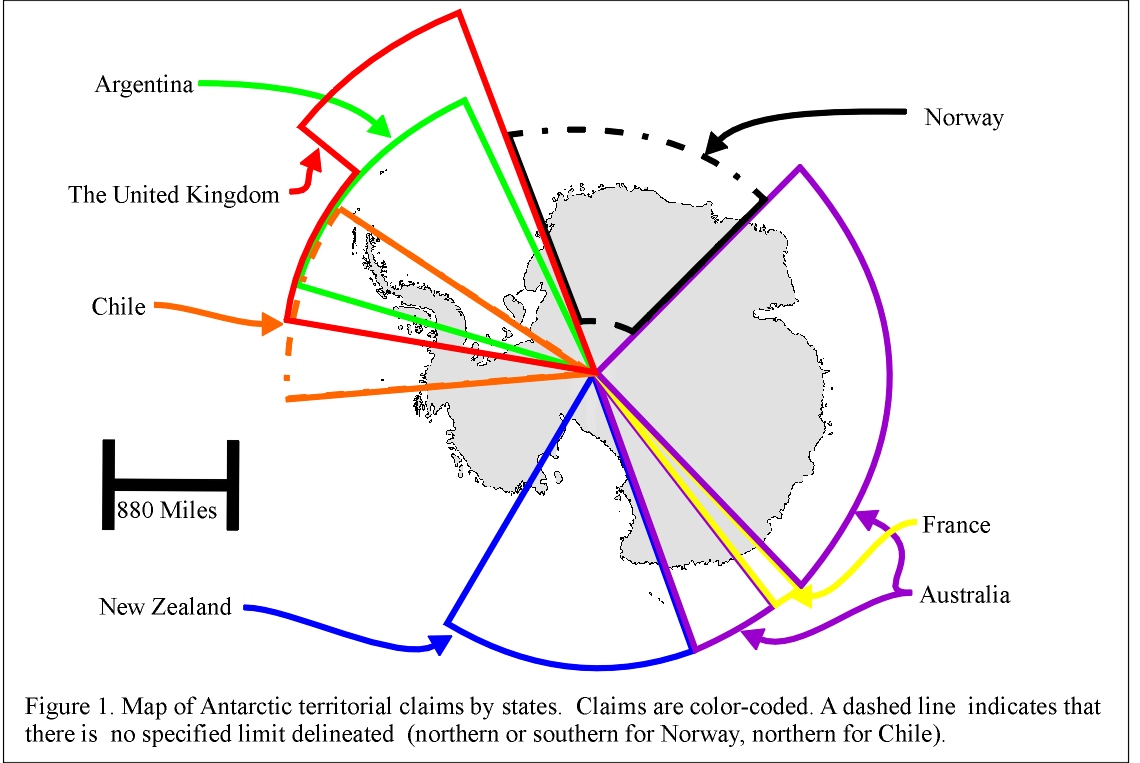
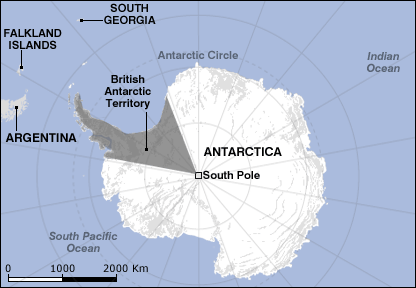
Of course the real interest in “owning” the Falklands – for Argentina and for Britain – is the proximity to Antarctica, the basis it provides for territorial claims and the access it ensures. Territorial claims in  Antarctica have been frozen since 1961 till when 7 nations had registered claims. Currently the entire Argentinian claim falls within the British Antarctic Territory and it must be terribly frustrating for Argentina to find the UK leveraging its ownership of the Falklands all the way to the South Pole.

Antarctic territorial claims(graphic - http://geography.osu.edu/grads/jdavis/fig1.jpg)

Antarctic territorial claims
(graphic – http://geography.osu.edu/grads/jdavis/fig1.jpg)

falklands and antarctica (BBC)

falklands and antarctica (BBC)

Men Wanted

November 18, 2011

I had not seen this before but a classic if ever there was one.

Men wanted from 1913

Shackleton is said to have received 5,000 applications and his Imperial Trans-Antarctic Expedition expedition finally consisted of 56 men with 28 on each of two ships.


Antarctic sea ice is increasing and rate of increase is accelerating

August 4, 2011

An instance of actual measurements over the last 30 years rather than just model results. Overall, sea ice extent is increasing in the Antarctic, contrary to climate model predictions for the 21st century, and this increase is accelerating and has strong regional and seasonal signatures.

A new paper in Climate Dynamics, DOI: 10.1007/s00382-011-1143-9 

(H/T The Hockey Schtick)

Sea Ice Trends in the Antarctic and Their Relationship to Surface Air Temperature during 1979 to 2009 by Qi Shu, Fangli Qiao, Zhenya Song and Chunzai Wang

Sea ice trends in the Antarctic and their relationship to surface air temperature during 1979–2009

Abstract: 

Surface air temperature (SAT) from four reanalysis/analysis datasets are analyzed and compared with the observed SAT from 11 stations in the Antarctic. It is found that the SAT variation from Goddard Institute for Space Studies (GISS) is the best to represent the observed SAT. Then we use the sea ice concentration (SIC) data from satellite measurements, the SAT data from the GISS dataset and station observations to examine the trends and variations of sea ice and SAT in the Antarctic during 1979–2009. The Antarctic sea ice extent (SIE) shows an increased trend during 1979–2009, with a trend rate of 1.36 ± 0.43% per decade. Ensemble empirical mode decomposition analysis shows that the rate of the increased trend has been accelerating in the past decade. Antarctic SIE trend depends on the season, with the maximum increase occurring in autumn. If the relationship between SIC and GISS SAT trends is examined regionally, Antarctic SIC trends agree well with the local SAT trends in the most Antarctic regions. That is, Antarctic SIC and SAT show an inverse relationship: a cooling (warming) SAT trend is associated with an upward (downward) SIC trend. It is also concluded that the relationship between sea ice and SAT trends in the Antarctic should be examined regionally rather than integrally.

As put by Skeptical Science – “The most common misconception regarding Antarctic sea ice is that sea ice is increasing because it’s cooling around Antarctica. The reality is the Southern Ocean surrounding Antarctica has shown strong warming over the same period that sea ice has been increasing. Globally from 1955 to 1995, oceans have been warming at 0.1°C per decade. In contrast, the Southern Ocean (specifically the region where Antarctic sea ice forms) has been warming at 0.17°C per decade. Not only is the Southern Ocean warming, it’s warming faster than the global trend. This warming trend is apparent in satellite measurements of temperature trends over Antarctica”.

Antarctic Climate and Sea Ice Variability – a Brief Review by Marilyn Raphael, UCLA Geography, WRCP Workshop on Seasonal to MultiDecadal Predictability of Polar Climate, October 2010

ABSTRACT

Antarctica’s remoteness, the difficulty of conducting research there and the paucity of observations, are some reasons why the Antarctic climate and sea ice variability are not as well understood as in the Arctic. However, research has shown that the climate of Antarctica including its sea ice is dictated by numerous influences with origins ranging from the Tropics to local atmosphere/surface interactions. Over the period of record indications are that much of Antarctica is warming, led by the Antarctic Peninsula. Regional changes in atmospheric circulation, sea surface temperatures and sea ice may explain this warming. Overall, sea ice extent is increasing, contrary to climate model predictions for the 21st century, and this increase has strong regional and seasonal signatures. Sea ice variability is strongly influenced by ENSO, Southern Hemisphere Annular Mode (SAM) and by zonal wave three (ZW3) among other large scale atmospheric circulation mechanisms. The Antarctic climate and sea ice variability are reviewed with respect to the atmospheric and oceanic mechanisms that influence them.
 

Peer review becomes incestuous when it comes to Global Warming

February 17, 2011

The Climategate emails revealed the extent to which the global warming establishment were prepared to go to pervert and doctor the peer review process to inhibit the publication of any papers challenging global warming orthodoxy.

Fraser Nelsonthe editor of the Spectator relates the story in his blog of how a critique of faults in a paper written by one of the establishment (Eric Steig) was sent to the criticised Steig himself for peer review!! He writes:

Debunking the Antarctica myths

In January 2009, Nature magazine ran the a cover story (pictured) conveying dramatic news about Antarctica: that most of it had warmed significantly over the last half-century. For years, the data from this frozen continent – with 90 percent of the world’s ice mass – had stubbornly refused to corroborate the global warming narrative. So the study, led by Eric Steig of the University of Washington, was treated as a bit of a scoop. It reverberated around the world. Gavin Schmidt, from the RealClimate blog, declared that Antarctica had silenced the sceptics. Mission, it seemed, was accomplished: Antarctica was no longer an embarrassment to the global warming narrative.

He spoke too soon. The indefatigable Steve McIntyre started to scrutinise his followings along with Nicholas Lewis. They found several flaws: Steig et al had used too few data sequences to speak for an entire continent, and had processed the data in a very questionable way. But when they wanted to correct him, in another journal, they quickly ran into an inconvenient truth about global warming: the high priests do not like refutation. To have their critique (pdf) of Steig’s work published, they needed to assuage the many demands of an anonymous ‘Reviewer A’ – whom they later found out to be Steig himself.

Lewis and Matt Ridley have joined forces to tell the story in the cover issue of this week’s Spectator.

It’s another powerful, and depressing tale of the woeful state of climate science. Real science welcomes refutation: with global warming, it is treated as a religion.

As they say in their cover story:

“Nature’s original peer-review process had let through an obviously flawed paper, and no professional climate scientist then disputed  it – perhaps because of fear that doing so might harm their careers. As the title of Richard Bean’s new play – The Heretic – at the Royal Court hints, young scientists going into climate studies these days are a bit like young theologians in Elizabethan England. They quickly learn that funding and promotion dries up if you express heterodox views, or doubt the scripture. The scripture, in this case, being the assembled reports of the Intergovernmental Panel on Climate Change. …… So has Antarctica been warming? Mostly not – at least not measurably. Retreat of the floating Antarctic ice shelves is a favourite story for the media. But, except in a very few peripheral parts, Antarctica is far too cold to lose ice by surface melting.”


Antarctic sea ice extent almost 3 SD’s higher than “average”

November 25, 2010

Source:

http://nsidc.org/data/seaice_index/images/daily_images/S_stddev_timeseries.png

The Southern Hemisphere is coming into summer but seems significantly cooler (and wetter in Australia) than usual.

The ice extent in the Antarctic is reducing much slower than normally and currently the sea ice extent is about 1.3 million sq. km or 9%  or 3 Standard Deviations higher than the 1979 – 2000 average.

The Pacific Oscillation – or La Nina – is probably responsible.