Archive for the ‘Astronomy’ Category

Asteroid 2005 YU 55 will fly-by closer than the moon on Tuesday

November 6, 2011

A very close encounter coming up on Tuesday at 6:28 pm US Eastern time.

(Reuters) – A huge asteroid will pass closer to Earth than the moon Tuesday, giving scientists a rare chance for study without having to go through the time and expense of launching a probe, officials said.

Earth’s close encounter with Asteroid 2005 YU 55 will occur at 6:28 p.m. EST (2328 GMT) Tuesday, as the space rock sails about 201,000 miles from the planet.

(more…)

“Where no man has gone before” – 50 new exoplanets discovered

September 12, 2011

Fifty New Exoplanets Discovered by HARPS

Astronomers using ESO’s world-leading exoplanet hunter HARPS have today announced a rich haul of more than 50 new exoplanets, including 16 super-Earths, one of which orbits at the edge of the habitable zone of its star. By studying the properties of all the HARPS planets found so far, the team has found that about 40% of stars similar to the Sun have at least one planet lighter than Saturn.

The HARPS spectrograph on the 3.6-metre telescope at ESO’s La Silla Observatory in Chile is the world’s most successful planet finder. The HARPS team, led by Michel Mayor (University of Geneva, Switzerland), today announced the discovery of more than 50 new exoplanets orbiting nearby stars, including sixteen super-Earths. This is the largest number of such planets ever announced at one time. The new findings are being presented at a conference on Extreme Solar Systems where 350 exoplanet experts are meeting in Wyoming, USA.

The harvest of discoveries from HARPS has exceeded all expectations and includes an exceptionally rich population of super-Earths and Neptune-type planets hosted by stars very similar to our Sun. And even better — the new results show that the pace of discovery is accelerating,” says Mayor.

In the eight years since it started surveying stars like the Sun using the radial velocity technique HARPS has been used to discover more than 150 new planets. About two thirds of all the known exoplanets with masses less than that of Neptune were discovered by HARPS. These exceptional results are the fruit of several hundred nights of HARPS observations.

Working with HARPS observations of 376 Sun-like stars, astronomers have now also much improved the estimate of how likely it is that a star like the Sun is host to low-mass planets (as opposed to gaseous giants). They find that about 40% of such stars have at least one planet less massive than Saturn. The majority of exoplanets of Neptune mass or less appear to be in systems with multiple planets.

Read the full European Southern Observatory Press Release

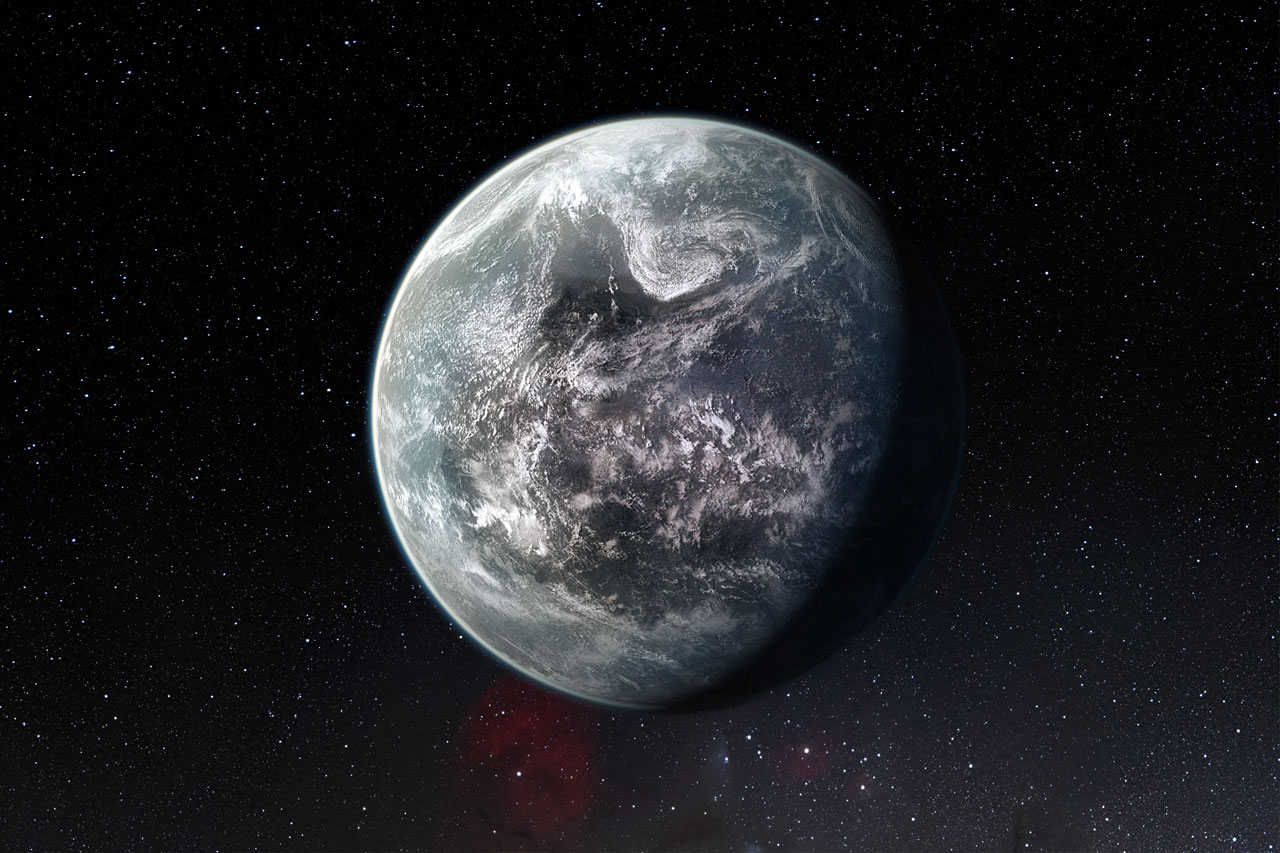
Artists’s impression of one of more than 50 new exoplanets found by HARPS: the rocky super-Earth HD 85512 b: image ESO

Perhaps there is no life on other planets

August 1, 2011

The fundamental weakness of the Drake Equation is that it starts with the assumption that life on Earth is not unique. After that it merely applies a string of probabilities to derive the number of civilizations in our galaxy with which communication might be possible. Fermi’s paradox is the apparent contradiction between high estimates of the probability of the existence of extraterrestrial civilizations (such as given by the Drake Equation) and the lack of evidence for, or contact with, such civilizations.

The paradox of course is resolved if there are no other such civilisations except on Earth which would be the case if life (as we know it) was unique to Earth.

It might not be what I would want to or like to believe but it is the simplest resolution of the apparent paradox. And if that is so then Drake’s equation starts with a false premise and is irrelevant and invalid. The existence of extraterrestrial life is still in the realms of belief and hope and is not (yet) science.

Now Bob Yirka of PhysOrg reports that

Astrophysicists apply new logic to downplay the probability of extraterrestrial life

David Spiegel and Edwin Turner of Princeton University have submitted a paper to arXiv that turns the Drake equation on its head. Instead of assuming that life would naturally evolve if conditions were similar to that found here on Earth, the two use Bayesian reasoning to show that just because we evolved in such conditions, doesn’t mean that the same occurrence would necessarily happen elsewhere; using evidence of our own existence doesn’t show anything they argue, other than that we are here.

…….. Spiegel and Turner point out, basing our expectations of life existing on other planets, for no better reason that it exists here, is really only proof that we are more than capable of deceiving ourselves into thinking that things are much more likely than they really are. ……

When taken at face value, some might conclude that such arguments hold no more logic than arguments for the existence of God, i.e. it’s more about faith, than science. At any rate, most would agree that the only concrete way to prove whether there is life out there or not is to prove it, by finding it.

Solar effects 6 times greater than assumed by IPCC

May 10, 2011

A new paper by A. I. Shapiro, W. Schmutz, E. Rozanov, M. Schoell, M. Haberreiter, A. V. Shapiro, and S. Nyeki in Astronomy & Astrophysics  – Total Solar Irradiance (TSI) Astronomy & Astrophysics 529, A67 (2011)  shows that

a total and spectral solar irradiance was substantially lower during the Maunder minimum than observed today. The difference is remarkably larger than other estimations published in the recent literature. The magnitude of the solar UV variability, which indirectly affects climate is also found to exceed previous estimates. 

We present a new technique to reconstruct total and spectral solar irradiance over the Holocene. We obtained a large historical solar forcing between the Maunder minimum and the present, as well as a significant increase in solar irradiance in the first half of the twentieth-century. Our value of the historical solar forcing is remarkably larger than other estimations published in the recent literature.

Climate Realists reports:

A recent peer-reviewed paper published in Astronomy & Astrophysics finds that solar activity has increased since the Little Ice Age by far more than previously assumed by the IPCC. The paper finds that the Total Solar Irradiance (TSI) has increased since the end of the Little Ice Age (around 1850) by up to 6 times more than assumed by the IPCC. Thus, much of the global warming observed since 1850 may instead be attributable to the Sun (called “solar forcing”), rather than man-made CO2 as assumed by the IPCC. 

article image

Kepler telescope finds two planets sharing the same orbit

February 25, 2011

Architecture and Dynamics of Kepler’s Candidate Multiple Transiting Planet Systems

by Jack J. Lissauer, Darin Ragozzine, Daniel C. Fabrycky, Jason H. Steffen, Eric B. Ford, Jon M. Jenkins, Avi Shporer, Matthew J. Holman, Jason F. Rowe, Elisa V. Quintana, Natalie M. Batalha, William J. Borucki, Stephen T. Bryson, Douglas A. Caldwell, David Ciardi, Edward W. Dunham, Jonathan J. Fortney, Thomas N. Gautier III, Steve Howell, David G. Koch, David W. Latham, Geoffrey W. Marcy, Robert C. Morehead, Dimitar Sasselov

Astrophysical Journal (arxiv.org/abs/1102.0543).

From the New Scientist:

Room for two (Image: NASA/Ames/JPL-Caltech)

Room for two (Image: NASA/Ames/JPL-Caltech)

Buried in the flood of data from the Kepler telescope is a planetary system unlike any seen before. Two of its apparent planets share the same orbit around their star. If the discovery is confirmed, it would bolster a theory that Earth once shared its orbit with a Mars-sized body that later crashed into it, resulting in the moon’s formation.

The two planets are part of a four-planet system dubbed KOI-730. They circle their sun-like parent star every 9.8 days at exactly the same orbital distance, one permanently about 60 degrees ahead of the other. In the night sky of one planet, the other world must appear as a constant, blazing light, never fading or brightening.

Gravitational “sweet spots” make this possible. When one body (such as a planet) orbits a much more massive body (a star), there are two Lagrange points along the planet’s orbit where a third body can orbit stably. These lie 60 degrees ahead of and 60 degrees behind the smaller object. For example, groups of asteroids called Trojans lie at these points along Jupiter’s orbit.

In theory, matter in a disc of material around a newborn star could coalesce into so-called “co-orbiting” planets, but no one had spotted evidence of this before. “Systems like this are not common, as this is the only one we have seen,” says Jack Lissauer of NASA’s Ames Research Center in Mountain View, California. Lissauer and colleagues describe the KOI-730 system in a paper submitted to the Astrophysical Journal (arxiv.org/abs/1102.0543).

File:Lagrange points2.svg

Lagrange Points: image Wikipedia

An active Sunday for the Sun

February 14, 2011

An unusually active Sunday for the Sun yesterday mainly from the very large sunspot 1158 with magnetic flux values not seen since 2006.

From Solarcycle24.com:

Solar Flares: Mutiple Solar flares took place around Sprawling Sunspot 1158 on Sunday, including an M6.6 Flare which was the 2nd largest of Cycle 24 thus far.  ….. . There will continue to be a chance for M-Class flares and NOAA also lists a 5% chance for an X-Class event.

Solar Flux 107: For the first time in Cycle 24, the official daily solar flux number measured in Penticton, BC closed above 100. The solar flux of 107 is the highest since September 2005. The last time the solar flux finished above 100 was in December 2006.

Solar Update: Huge sunspot 1158 which is located in the southern hemisphere will continue to be a threat for strong solar flares. Elsewhere, Sunspot 1157 which is in the northern hemisphere showed growth late on Sunday and Sunspot 1160 which rotated into view on the eastern limb has sprouted a few new spots as well. The M6.6 Solar Flare did cause a Radio Blackout on HF which was short lived.

Sunspots (Early Monday): image solarcycle24.com

NOAA forecast:

Solar Activity Forecast: Solar activity is expected to be low to moderate with a chance for a major x-ray event for days one thru three (14-16 February). Region 1158 continued growth and recent major flare make this region the most likely source for a major event. There is a slight chance for C-class activity from Region 1157 and Region 1159.

Geophysical Activity Forecast: The geomagnetic field is expected to be predominately quiet on day one (14 February). Quiet to unsettled with a chance for active conditions are expected on days two and three (15-16 February), due to a recurrent coronal hole high speed stream becoming geoeffective.

Sundog (parhelion) as seen in N. China

January 11, 2011

A parhelion (sundog) combined with a halo is seen in Changchun, capital of northeast China's Jilin Province, Jan. 8, 2011. (Xinhua/Lin Hong)


From Wikipedia:

Sundogs are formed by plate-shaped hexagonal ice crystals in high and cold cirrus clouds or, during very cold weather, by ice crystals called diamond dust drifting in the air at low levels. These crystals act as prisms, bending the light rays passing through them by 22°. If the crystals are randomly oriented, a complete ring around the sun is seen — a halo. But often, as the crystals sink through the air they become vertically aligned, so sunlight is refracted horizontally — in this case, sundogs are seen.

As the sun rises higher, the rays passing through the crystals are increasingly skewed from the horizontal plane. Their angle of deviation increases and the sundogs move further from the sun. However, they always stay at the same altitude as the sun.

Sundogs are red-colored at the side nearest the sun. Farther out the colors grade through oranges to blue. However, the colors overlap considerably and so are muted, never pure or saturated. The colors of the sundog finally merge into the white of the parhelic circle (if the latter is visible).

It is theoretically possible to predict the forms of sundogs as would be seen on other planets and moons. Mars might have sundogs formed by both water-ice and CO2-ice. On the giant gas planets — Jupiter, Saturn, Uranus and Neptune — other crystals form the clouds of ammonia, methane, and other substances that can produce halos with four or more sundogs.

Another form of life based on Arsenic?

December 2, 2010
The Arecibo message as sent 1974 from the Arec...

The Arecibo message as sent 1974: image via Wikipedia

The Telegraph  has an eye-catching headline (naturally):

‘Life as we don’t know it’ discovery could prove existence of aliens

But even without the exaggerations and the splash headlines, the possible existence of a form of life intimately connected with Arsenic would have enormous consequences on the definition and abundance of life in the universe and on how to go about searching for extra-terrestrial life.

NASA has sent the internet into a frenzy after it announced an “astrobiology finding” that could suggest alien life exists – even on earth.

The discovery could prove the theory of “shadow” creatures which exist in tandem with our own and in hostile environments previously thought uninhabitable. The “life as we don’t know it” could even survive on hostile planets and develop into intelligent creatures such as humans if and when conditions improve. In a press conference scheduled for tomorrow evening, researchers will unveil the discovery of a microbe that can live in an environment previously thought too poisonous for any life-form to survive.

The bacteria has been found at the bottom of Mono Lake in California’s Yosemite National Park which is rich in arsenic – usually poisonous to life.

Somehow the creature uses the arsenic as a way of surviving and this ability raises the prospect that similar life could exist on other planets, which do not have our benevolent atmosphere. Dr Lewis Dartnell, an astrobiologist at the Centre for Planetary Sciences in London, said: “If these organisms use arsenic in their metabolism, it demonstrates that there are other forms of life to those we knew of. “They’re aliens, but aliens that share the same home as us.”

The Brisbane Times reports:

The US space agency has created a buzz with its announcement of a press conference early tomorrow morning (Australian time) to discuss a scientific finding that relates to the hunt for life beyond the planet Earth.

“NASA will hold a news conference at 2pm EST (6am AEDT) to discuss an astrobiology finding that will impact the search for evidence of extraterrestrial life,” it said on its website.

But Nasa has declined to elaborate further on the topic, other than to say astrobiology is the ”study of life in the universe, including its origin and evolution, where it is located and how it might survive in the future”. The vague announcement has sent the blogosphere in a flurry of speculation about its potential meaning.

Blogger Jason Kottke tipped NASA would announce the discovery of arsenic on Titan, or possibly chemical evidence of bacteria utilising it for photosynthesis.

That speculation was quickly picked up and repeated by a number of other bloggers and internet sites. However Kottke theory has been rebuffed by Alexis Madrigal, senior science writer for The Atlantic, who tweeted that he had read the Science article relating to the Nasa announcement. ”I’m sad to quell some of the @kottke-induced excitement about possible extraterrestrial life. I’ve seen the Science paper. It’s not that,” he tweeted.

The American Association for the Advancement of Science, which publishes the journal in which the research will appear, told ABC News in the US that it had received numerous inquiries about the “mostly erroneous online and/or tabloid speculation about the forthcoming research”.

For NASA TV streaming video and downlink information, visit: http://www.nasa.gov/ntv at 2pm EST today (2nd December).

Nasa/University of Colorado establish Sun-Climate Research Center

November 30, 2010

The “settled science” of climate change seems to be opening up to real science  – at last. Nasa and the University of Colorado are establishing a new research centre dedicated to studying the effect of the sun on climate.

And about time too.

Perhaps they could let the 15,000 gathered in Cancun know about the importance the Sun may have!

Today the University of Colorado Laboratory for Atmospheric and Space Physics (LASP) and NASA’s Goddard Space Flight Center announced the formation of a new collaborative research center dedicated to the study of the Sun’s effect on Earth’s climate. The Press release goes on to say:

Solar Image

The newly announced Sun-Climate Research Center, a collaboration between LASP and Goddard, will focus on research areas such as how solar variations shape Earth’s atmosphere and climate. This image of the sun is from the LASP-built NSF Precision Solar Photometric Telescope (PSPT). (Courtesy NASA/GSFC Scientific Visualization Studio; source data courtesy of HAO and LASP PSPT project team)

The center, called the Sun-Climate Research Center (SCRC), will be directed by Peter Pilewskie, a LASP research scientist and CU professor, Robert Cahalan, Head of Goddard’s Climate and Radiation Branch, and Douglas Rabin, Head of Goddard’s Solar Physics Laboratory.

Pilewskie said, “The exciting thing about this collaboration is that we believe it will promote studies to help answer a key question about the climate system: how does Earth’s atmosphere respond to the sun’s variability, and how does that affect climate? This question is particularly important now, as we seek to quantify the human-induced impact on Earth’s climate.”

The SCRC, which has been made possible by a Federal Space Act Agreement, will foster collaboration between Earth-atmosphere and solar sciences at the two institutions. Opportunities will include a scientist exchange program between the organizations, the ability for post-doctoral scientists and graduate students in science, engineering, and mission operations to move between LASP and Goddard, annual international Sun-Climate research symposia, and the ability for the two institutions to collaborate more fluidly on future research opportunities.

Robert Cahalan, SCRC co-director and Goddard scientist, said, “In recent years Goddard and LASP have worked together on several Earth and Sun missions. Now we look forward to continuing to drive growth in this key interdisciplinary field of Sun-Earth research, bringing new focus to the study of multiyear changes in the Sun and their influence on Earth’s climate.”

With a limited number of such agreements between U.S. universities and any of NASA’s ten field centers, the SCRC represents a rare and innovative step, underscoring LASP’s ability to develop high-caliber research and programmatic opportunities with Goddard.

Daniel Baker, LASP Director, said, “LASP has developed some remarkable areas of expertise that are key to studying the sun and its effect on climate and on human activities. By working with our colleagues at Goddard, we can leverage our skills—and help take an important step toward greater cooperation between NASA centers and leading university research teams.”

Oxygen – carbon dioxide atmosphere found on Saturn’s moon Rhea

November 27, 2010

From The New Scientist:

On its journey around Saturn and its moons, the Cassini mission – jointly run by NASA and the European Space Agency – has made another breathtaking discovery. The findings, published in Science (DOI: 10.1126/science.1198366), show that Rhea, the second biggest moon of the giant planet, has an atmosphere that is 70 per cent oxygen and 30 per cent carbon dioxide. This adds to the picture of Rhea that Cassini has already provided by imaging its craters anddiscovering its rings.

“This really is the first time that we’ve seen oxygen directly in the atmosphere of another world”, Andrew Coates, from University College London’s Mullard Space Science Laboratory, told The Guardian. Layers containing oxygen had already been detected around the Jovian moons Europa and Ganymede in the 1990s, but only from a distance using NASA’s Hubble Space Telescope.

This time, Cassini’s instrument had the chance to “smell” that oxygen, as it flew through it over Rhea’s north pole, just 97 kilometres above the surface, according to the details given on Space.com. This layer – with an oxygen density probably about 5 trillion times less than on Earth – was “too thin to be remotely detected”, said Ben Teolis of the Southwest Research Institute in San Antonio.

These three views of Saturn's moon Rhea from NASA's Cassini spacecraft are enhanced to show colorful splotches and bands on the icy moon's surface. New observations have shown Rhea has an oxygen-rich atmosphere. Credit: NASA/JPL/SSI/LPI

Cassini Finds an Oxygen–Carbon Dioxide Atmosphere at Saturn’s Icy Moon Rhea B. D. Teolis, G. H. Jones, P. F. Miles, R. L. Tokar, B. A. Magee, J. H. Waite, E. Roussos, D. T. Young, F. J. Crary, A. J. Coates, R. E. Johnson, W.-L. Tseng and R. A. Baragiola

Science DOI: 10.1126/science.1198366, Published Online 25 November 2010

Abstract: The flyby measurements of the Cassini spacecraft at Saturn’s moon Rhea reveal a tenuous oxygen–carbon dioxide atmosphere. The atmosphere appears to be sustained by chemical decomposition of the surface water ice under irradiation from Saturn’s magnetospheric plasma. This in situ detection of an oxidizing atmosphere is consistent with remote observations of other icy bodies such as Jupiter’s moons Europa and Ganymede, and suggestive of a reservoir of radiolytic O2 locked within Rhea’s ice. The presence of CO2suggests radiolysis reactions between surface oxidants and organics, or sputtering and/or outgassing of CO2endogenic to Rhea’s ice. Observations of outflowing positive and negative ions give evidence for pickup ionization as a major atmospheric loss mechanism.