Archive for the ‘Business’ Category

Desertec Foundation deserts the Desertec project consortium

July 2, 2013

It was always too grandiose for its own good. The economics were never sound but it was “visionary” and it was riding the fashionable “renewables wave”. It seemed to be much more of a public relations exercise to win brownie points than any real project. Domestic German politics and positioning of German companies in North Africa and the Middle East was of more interest than any real commitment to the project itself.

The concept was to generate solar and wind power in the worlds deserts and the transfer them by HVDC links to populous regions upto 3000 km away! The Desertec Foundation started in January 2009 and the Desertec project consortium (Dii gmbh) was established in October 2009 to handle the specific project for generating solar and wind power in North Africa and the Middle East for export to Europe. Now the Desertec Foundation has left the consortium and it is likely that the project and the consortium will quietly disappear into the sand.

DESERTEC-Map_small

PV MagazineUncertainty shrouds the future of the Desertec project to generate energy from the world’s deserts after the foundation which developed the idea announced it had withdrawn from the scheme.

The Desertec Foundation was founded in January 2009 with the idea of generating solar and wind energy from the world’s deserts. The founding principle of the foundation is to use high voltage DC current – which loses only 3% every 1,000km it travels – to bring power to the 90% of the global population living within 3,000km of deserts.

In October 2009, the Dii GmbH consortium was founded in Munich to bring the concept to life using the deserts of the Middle East and north Africa, with the aim of supplying up to 15% of Europe’s energy from renewables by 2050.

But in an extraordinary press release, the Desertec Foundation has announced its withdrawal from the consortium, citing ‘irresolvable disputes’ with its partners over strategy, obligations, communications and ‘last but not least, the managerial style of Dii’s top management.’

(more…)

IK leaves IKEA

June 5, 2013

Had to happen of course but he did bring a revolution to household furniture. For me personally IKEA furniture has provided a stable reference point for some 35 years in 5 countries as I have moved around the world and my children have grown up with the “installation” of familiar objects, with odd names from the IKEA flat-packs. IKEA  is an acronym comprising the initials of Ingvar Kamprad, Elmtaryd (the farm where he grew up) and Agunnaryd (his hometown in Småland, South Sweden.

Decoding the language of Ikea

Now IK is 87 and is handing over:

Ingvar Kamprad, creator of Swedish furniture retailer IKEA, is to take another step back from his company as the youngest of his three sons takes a key board role in a gradual handover of power. 

Kamprad, 87, who founded the business in rural south Sweden 70 years ago, stepped down in 1986 as chief executive of IKEA, which has become the world’s biggest furniture group, famous for its flat packs and do-it-yourself assembly. 

He will now leave the board of a key company within the business – Inter IKEA Group – and his youngest son Mathias will take over as its chairman. 

“I see this as a good time for me to leave the board of Inter IKEA Group,” Kamprad said in a statement on Tuesday, referring to the company which owns the IKEA brand and which collects 3 percent of IKEA stores’ sales worldwide each year.

EU begins “repatriation of climate policy”?

April 16, 2013

It is probably the best thing that has happened for German electricity consumers for some time as German power prices fell by 3% as a reaction to the vote in the European Parliament. Even the EU Parliament – which has long been known as a “politically correct” follower of global warming orthodoxy – today balked at the  prospect of “backloading” and postponing the introduction of 900 million “carbon allowances”. This had been proposed by the climate fanatics in an effort to increase the declining price of these allowances and the possible collapse of the entire carbon trading market.

It is to be hoped that it really is the “beginning of the “repatriation of EU climate policy” which has been so wrong and so stubborn and so stupid for so long. But the religious environmentalism is still pretty fanatic and they will not give up their cherished dogma and their entrenched positions and their carbon scams so easily.

The Parliament:

Controversial ‘backloading’ proposal rejected by MEPs

The European parliament has rejected proposals for ‘backloading’ to postpone the auctioning of 900 million carbon allowances for 2013-2015, in a bid to help boost the price of ‘polluters permits’.

The proposals have been much debated, with some believing that any interference in the EU’s carbon market – the biggest in the world – could undermine confidence in the emissions trading scheme (ETS).

However, others feel that the temporary backloading solution would give the ETS, which is considered to be a flagship policy in the EU’s climate change agenda, a much needed boost, increasing carbon prices and in turn stimulating investment and innovation.

On Tuesday, parliament rejected the proposals by a narrow margin, 334 MEPs voted in favour, 315 against, and 63 abstained. Carbon prices immediately fell by 44 per cent to a record low of €2.63 following the vote.

Matthias Groote, parliament’s rapporteur on the timing of auctions, said “I deeply regret today’s vote. It is the beginning of the repatriation of climate policy.”

Reuters reports: 

Traders took the lack of political support as a signal to sell, driving the market down to its lowest yet. Immediately after the vote, carbon prices dropped by around 40 percent to 2.63 euros a tonne. They were trading at 3.15 euros, down 33.4 percent, by 1423 GMT.

“The carbon market is now in a coma, until a clear intervention takes place,” an emissions trader said. 

The Commission’s backloading proposal was meant to be a quick fix that could be agreed by the end of last year.

But it exposed deep divisions, with interest groups intensively lobbying members of the European Parliament.

Hedegaard, together with analysts and some in the energy sector have warned that failure to agree on EU steps would spur fragmentation in environmental policy as member nations move to safeguard their own green targets. Britain, for instance, already has a carbon price floor.

Of course the “loony left” were appalled:

“This kind of politics plays into the hands of climate sceptics. The rejection of the backloading proposal weakens the EU emissions trading system and puts our climate goals at risk.”

S&D deputy Linda McAvan said that the UK Tory party played an instrumental part in rejecting support for the EU’s carbon market. 
She said, “In a tight vote in the full session of the parliament in Strasbourg, most Tory MEPs chose to side with climate sceptics once again and undermine their own government’s climate strategy.” 
She continued, “They put their fanatic euro-scepticism ahead of British jobs and our environment,” adding, “This vote is a catastrophe for the environment.”
Greens MEP Keith Taylor also condemned the UK’s Tory party, as well as UKIP, saying, “Some MEPs want to leave the EU carbon market to sort itself out, but this simply won’t work.
“The ETS is flawed and leaving it alone won’t get us anywhere towards improving it. By opposing necessary steps to fix these problems Tory and UKIP MEPs are effectively signalling their desire to destroy the EU’s flagship climate change policy.”
Climate action commissioner Connie Hedegaard also expressed “regret” about the decision by parliament, and said that the proposal will now go back to the environment committee for “further consideration”. 
She added, “The commission remains convinced that backloading would help restore confidence in the EU ETS in the short term until we decide on more structural measures.
“We will now reflect on the next steps to ensure that Europe has a strong EU ETS.”
Josche Muth, secretary general of the European renewable energy council, said that the decision “renders the ETS impotent as a tool for shifting investments into less polluting generation technologies”.

But at least some sanity is returning

However, it wasn’t just the 315 MEPs who voted against the proposals that disagree with the proposals. 
BusinessEurope also welcomed the decision, with the director general Markus J. Beyrer saying that, “The European parliament expressed its support for a market-based instrument and rejected political interference. 
“It is time to move past the divisive and unhelpful debate around backloading and focus on the real priorities for the EU: how to secure a cost-competitive, secure and climate-friendly energy policy for 2030.”

Wild ride for the Bitcoin as its value crashes

April 12, 2013

I wonder whether the real reasons for the Bitcoin gyrations ( see previous posts here and here) will ever be fully known. From $9 to about $240 and now back to $69!

But this kind of behaviour does not manifest itself without someone, somewhere pulling some strings. I am inclined to think that some very “hot” money was involved in the boom and that it has “moved on”  to create the bust – but has almost certainly not moved back to where it started from.

bitcoin turbulence april 2013

bitcoin turbulence april 2013 (Mt. Gox)

There is some discussion that this has been a concerted effort from within the world-wide-web to manipulate the price but I think the coincidences with the goings-on in Cyprus are connected. And that probably means the movement of Russian money.

Norwegian goat genes in 300,000 Tanzanian goats

April 12, 2013

Now this is a project which makes sense to me unlike so many of the WWF or other so-called “conservation” projects. A project which looks forward rather than looking back, which looks to manage change by adapting livestock  for new realities rather than trying to stop change.

Science Nordic reports that 80 Norwegian dairy goats which were transplanted into Tanzania 30 years ago have bred with Tanzanian goats to create a brand new goat dairy economy where none existed.

ScienceNordic: 

Eighty Norwegian dairy goats were flown into Tanzania thirty years ago. Now there are 300,000 goats with genes from these founder animals on dairy farms in mountainous areas. 

Tanzania’s Uluguru Mountains are a green paradise, with verdant slopes that rise over 2,600 metres. But now, not far from forests populated with yellow baboons, blue monkeys and black-and-white colobus monkeys, you’ll find goats of Norwegian ancestry in the mountain towns of this East African country.

The goats live on steep terraced hills planted with corn, bananas and coffee, at altitudes that would be barren and rocky in Scandinavia. They are a result of a long-term Norwegian-Tanzanian research partnership aimed at boosting small-scale milk production. The partnership has helped many farmers diversify and has yielded tangible benefits. ….. 

….. 

Professor Lars Olav Eik has decorated his office at UMB in Ås, Norway, with Norwegian and African cowbells. As an up-and-coming agronomist he accompanied the first goat kids to Tanzania in 2009. He still coordinates the Norwegian input to the project. Professors Martin Luther Kyomo of Tanzania and Asmund Ekern and Ola Syrstad of Norway initiated the effort. The outset was a desire to boost the East African country’s dairy production. Goats were a natural choice. “Goats are known as the poor man’s cows,” says Eik.

“We discovered that Tanzania had no dairy goats and decided to send them some Norwegian kid goats,” says Eik. The first goats were transported by air, with the young goats shipped in cargo cages designed for dogs — three kids per cage. 

The animals have since interbred with local goats. There may be as many as 300,000 goats in Tanzania with Norwegian genes. That figure is just a rough estimate because no one has actually conducted a goat census. What is certain is that the popularity of the Norwegian goats expanded way beyond the framework of the research project. …..

Dairy goats with Norwegian genes are now established in the economy of many peasant farmers in Tanzania. Simforiani L. Mahenge and his wife Jovita Joseph with their favourite goat, a ten-year-old animal named Chama. (Photo: Asle Rønning, forskning.no)

Bitcoin still soaring

April 9, 2013

Updating my previous post, the Bitcoin value  continues to soar and had reached about $240 today. The Bitcoin hoard of 21 million is now worth about $5 billion.

Three months ago the value of a Bitcoin was less than $10. Simple arithmetic tells us that around an additional $4.8 billion has come into this market and  is now locked up as Bitcoins. Some of this enhanced value may be due to intentional circular trading but if that is the case this bubble will burst and some will make a killing and others are going to take a big hit. Anybody who has entered recently without a well thought out exit strategy is taking a big risk.

Last price:$235.70000, 

High:$240.11100, Low:$180.00000, 

Volume:108657 BTC 

bitcoin value 9th april 2013 in USD

bitcoin value 9th april 2013 in USD

Bitcoin value in US Dollars

Bitcoin value in US Dollars last 6 months to 7th April

Argentina joins the shale gas bandwagon

April 8, 2013

The shale gas bandwagon is now truly rolling and countries all across the globe are scrambling to catch up. The wide-spread reserves mean that, more than any other energy source, shale gas has the potential of making concerns about energy security and reliance on foreign sources a thing of the past. South America also has its share of gas bearing shale. Argentina and Brazil have substantial shale deposits which the EIA estimates could give 774 and 226 trillion cubic feet of gas respectively. Even Chile and Bolivia have substantial deposits. The Argentinian deposits are only smaller than those in the US and China.

Shale Gas deposits South America SOURCE: USGS

Shale Gas deposits South America SOURCE: USGS

In April last year Argentina nationalised the YPF unit of Spanish Grupo Repsol which in turn had been acquired by Repsol on privatisation of YPF in 1999. There is a dispute ongoing between Repsol and the Argentinian government regarding the compensation for the nationalisation. One of the reasons for the nationalisation was a perceived reluctance from Repsol to invest in Argentina. While Repsol acquired YPF in 1999 for $15 billion, the nationalised assets of YPF are now valued at only around $9 billion.

OilPrice: Argentina shale gas reserves exceed its 13.4 trillion cubic feet (tcf) conventional proven gas reserves. The largest shale play is the Neuquen basin with more than 250 TCF. YPF discovered 4.5 TCF of shale gas in the Loma de la Lata Field of Neuquen in December 2010. Gas transportation and field services infrastructure are already in place making it attractive for further development. There are also additional Argentine shale deposit reserves in Chubut and Santa Cruz provinces near the Golfo San Jorge in the Atlantic southeast part of the country.  The U.S. Energy Information Administration (EIA) says Argentina’s technically recoverable shale gas reserves are the third largest in the world after the United States and China at 774 trillion cubic feet (Tcf) with more than half of that in the Neuquén Basin on the western side of the country. ….

To exploit its shale potential Argentina needs the active participation and assistance from large international oil field services companies and deep pocket investors. … Argentina’s shale resource potential is large enough to attract the biggest companies. But in the rapidly changing world of global shale development there are many places where investors can participate in the growth of shales without the risk Argentina presents. 

In any event Argentina is looking to make YPF a flagship for the country in the Oil & Gas space (with Petrobras across the border as an example to follow). And YPF will need both fracking technology and investment if they are to make something of their vast gas shale reserves in the Neuquén basin. There are a number of potential suitors from the US and even from China who may be prepared to take on the perceived country risks of Argentina, but Dow Chemical seems to be the first:

Chemical & Engineering NewsWith eyes on what could be the first shale gas project in Argentina, Dow Chemical has signed a memorandum of understanding with the Argentinian oil company YPF to develop a gas-rich area of the country.

The memorandum envisages YPF ceding Dow a 50% stake in a shale formation in Neuquén province. Dow and YPF also would explore expanding petrochemical capacity in the country on the basis of additional raw material supply. The firms are still negotiating the terms of the deal.

In the U.S., abundant shale-based feedstocks are leading to a renaissance in the petrochemical industry. According to the U.S. Energy Information Administration and consulting firm Advanced Resources International, Argentina has 774 trillion cu ft of recoverable shale gas reserves, the third-largest amount after the U.S. and China. But energy companies are so far only drilling exploratory wells in Argentina.

Dow already operates an ethylene cracker and polyethylene plants in Bahia Blanca, Argentina. In 2001, the company completed $720 million in expansion projects at the site.

And Dow is involved in chemical feedstocks in the country. In Bahia Blanca, it has a 28% interest in Compañía Mega, a natural gas liquids fractionation joint venture with YPF and Brazil’s Petrobras. The venture takes in natural gas liquids from Neuquén and supplies the ethane to Dow to feed its ethylene cracker.

The U.S. firm has been keen to expand its polyethylene business in the region but has been stymied by feedstock supply. Dow recently delayed a plant in Brazil that would get its ethylene from sugarcane-derived ethanol.

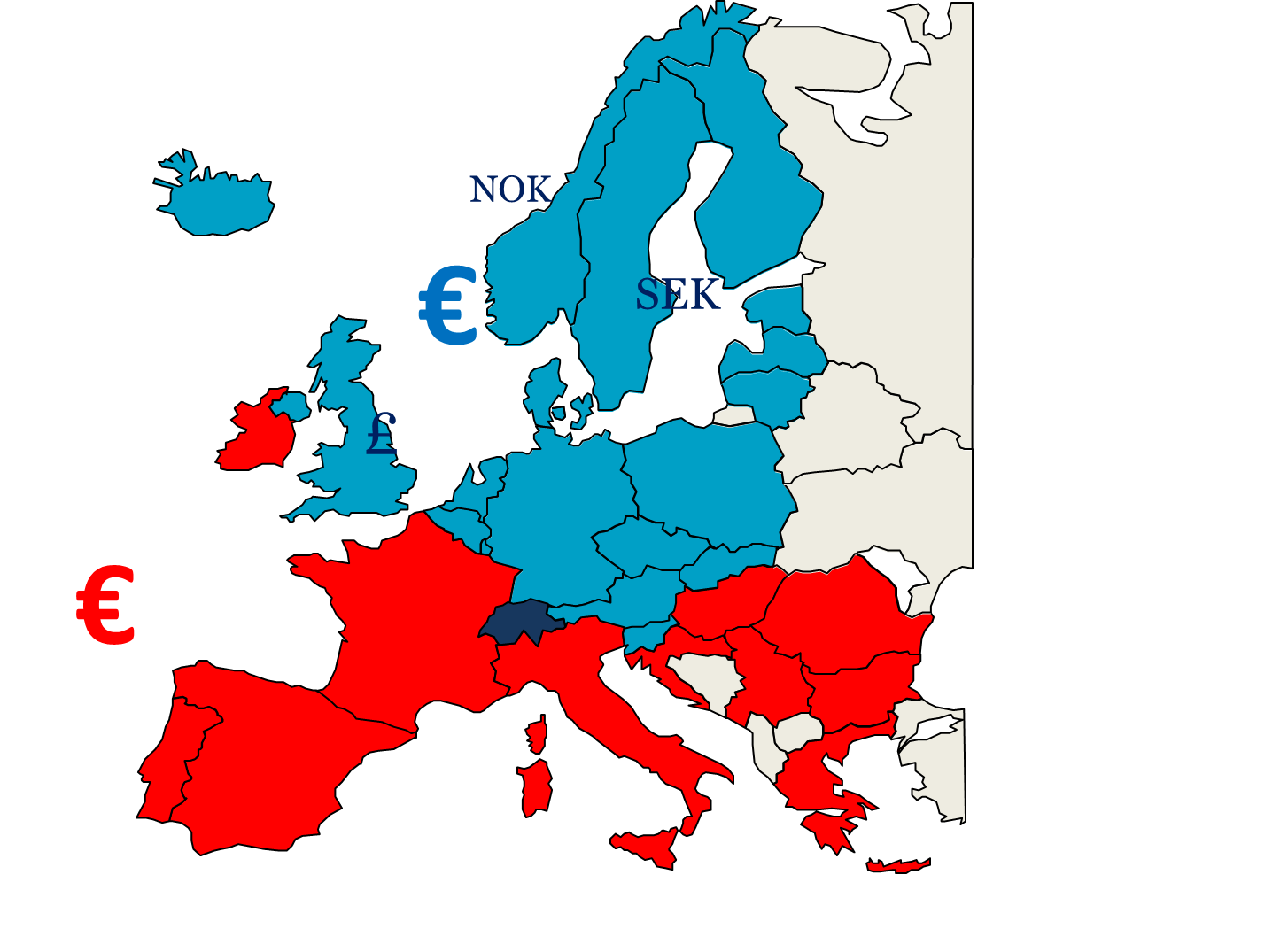
Red Euro, Blue Euro

April 5, 2013

The two-€ Europe is effectively here and it is advisable to keep any savings far away from the Red Euro zone:

Spreading Red Euro

Spreading Red Euro

Delta Airlines sues US Ex-IM for supporting Boeing sales to foreign airlines

April 4, 2013

I think Delta doth protest too much and is clutching at straws. Loss of jobs at Boeing is of much more consequence to the US economy than Delta’s dubious claim of loss of competitiveness against foreign airlines.

Of course the real problem is that Delta is weak competitively. Its costs are too high and its service is too inferior. By the end of trading session, Delta Air Lines, Inc. shares slumped 8.06% to US$14.94 with more than 41.03 million shares traded, compared to its average volume of 12.11 million shares. Delta Air Lines’s unit revenues increased only 2% in March, and most of it came from its trans-Atlantic and Latin offerings.  Delta were expecting a March growth of 4 – 5%. And they are more than a little worried by the US Air merger with American Airlines.

(Reuters)Delta Air Lines Inc has sued the Export-Import Bank of the United States over loan guarantees given to support purchases of Boeing Co’s widebody planes by certain foreign airlines, according to a court filing.

Delta are claiming that Ex-Im bank’s guarantees (to Boeing) and/or buyers credits (to foreign airlines) for aircraft sales to foreign airlines, including Emirates Airlines, Etihad Airways and Korean Air Co Ltd, amount to subsidies and would cause a loss of competitiveness and adverse economic effects on Delta and its employees.

Ex-Im Bank, a government agency, provides loan guarantees and direct loans to help companies maintain and create jobs.

In a complaint filed in federal court in Washington D.C. late on Wednesday, Delta said one of the types of exports that Ex-Im Bank subsidizes is the export of aircraft by U.S. manufacturers, especially ones made by Boeing.

“In 2012, the bank’s total exposure to outstanding financial commitments was $106.6 billion. About 46 percent of this amount was for air transportation loans and loan guarantees, more than the three next largest industrial sectors combined,” Delta said in the filing.

Delta said the Ex-Im Bank loan guarantees help lower the cost of capital for foreign airline companies.

“These foreign airlines will recoup their investment in their new aircraft faster or reduce ticket prices on competing routes without adversely impacting their relative rate of return on those investments,” Delta said in the filing.

Delta argued that unsubsidized U.S. airlines will be forced to respond by “reducing their prices and reducing or altogether eliminating their capacity to serve those routes where they compete with bank-subsidized foreign airlines.”

I don’t think I will be buying any Delta stock any time soon.


Does the solar cycle impact the global economic cycle?

April 2, 2013

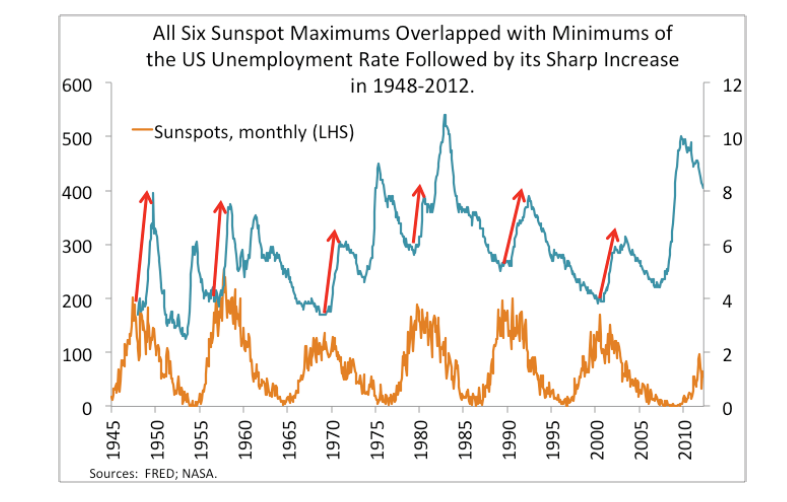
That weather and climate are affected by solar cycles is highly likely even if it is not part of the mainstream climate theories (though I think it is patently obvious). That climate and weather affect food production is clear and that this must impact the economic cycle is not so far fetched. Yet it has never been part of mainstream economic thinking that there will be a connection from the solar cycle to global economic cycles. Back in 1801 William Herschel observed the apparent connection between the sunspot cycles and the price of wheat. Since then many economists have returned at regular intervals to studying the link between the 11 year sunspot cycle and the behaviour of the global economic cycle. It is becoming increasingly clear that the economic cycle is not unconnected with solar cycles but the mechanisms are far from clear.

Mikhail Gorbanev an economist at the IMF has a fascinating new paper that became available last month at the University of Munich. He does add this Caution though!

Caution: This research is not in the “mainstream” of the economic thought. Read at your own risk!

Sunspots, unemployment, and recessions, or Can the solar activity cycle shape the business cycle?,” MPRA Paper 40271, University Library of Munich, Germany. (pdf Gorbanev Business Cycle and solar cycles MPRA_paper_40271)

Gorbanev shows some interesting correlations and  goes on to predict that “For other advanced economies, the upcoming solar maximum also suggests higher chances of recessions. The 3-year period when the recessions are most likely to occur in the G7 countries would run from early 2013 till end-2015”.

Whether there will be a sharp increase in US unemployment after the solar maximum remains to be seen. But it is not so unlikely that the world economy has another 2 – 3 tough years ahead!


Sunspot cycles and US unemployment (Gorbanev 2012)

Sunspot cycles and US unemployment (Gorbanev 2012)

Abstract 

 Over the last 77 years (from 1935), all 7 cyclical maximums of the solar activity overlapped closely with the US recessions, thus predicting (or triggering?) 8 out of 13 recessions officially identified by NBER (including one “double-deep” recession). Over the last 64 years (from 1948), all 6 maximums of the solar activity were preceded by minimums of the US unemployment rate, and the spikes in the unemployment rate followed with lags of 2-3 years. On the world scale, over the last 44 years (for which the data is available), all 4 maximums of the solar activity overlapped with minimums of the unemployment rate in the G7 countries, followed by its spikes within 2-3 years. From 1965, when consistent recession dating is available for all G7 countries, nearly 3/5 of the recessions started in the 3 years around and after the sunspot maximums. Was it a mere coincidence or a part of a broader pattern? This paper explores the correlation between the solar activity cycles (as measured by the number of sunspots on the sun surface) and the timing of recessions in the US and other economies. It finds out that the probability of recessions in G7 countries greatly increased around and after the solar maximums, suggesting that they can cause deterioration in business conditions and trigger recessions. This opens new approach for projecting recessions, which can be applied and tested with regard to the next solar maximum in 2013.