Archive for the ‘Climate’ Category

Ice Age must be imminent: UK government predicts no cooling for “several centuries”

November 1, 2013

We are in a global cooling cycle and this may be a:

  1. a regular c. 30 year warming/cooling cycle influenced heavily by the multi-decadal ocean cycles, or
  2. another Little Ice Age – dominated by the solar sunspot cycles –  with the current Landscheidt Minimum comparable to the Dalton or the Maunder Minimum, or
  3. the ending of this interglacial  with a gradual return to glacial condition.

If anything can ensure that we are in for another Ice Age it must be this rather inane statement by the UK Parliamentary Under-Secretary of State, Department of Energy and Climate Change (Baroness Verma) when answering a question in the House of Lords:

All of the climate models and policy-relevant pathways of future greenhouse gas and aerosol emissions considered in the Intergovernmental Panel on Climate Change’s (IPCC) recent Fifth Assessment Report show a long-term global increase in temperature during the 21st century is expected. In all cases, the warming from increasing greenhouse gases significantly exceeds any cooling from atmospheric aerosols. Other effects such as solar changes and volcanic activity are likely to have only a minor impact over this timescale.

With regard to future glaciation the timescales are very long. Changes in the Earth’s orbit are considered to have driven the glacial cycles that have occurred every 100,000 years approximately, during the past one million years. The British Antarctic Survey has advised that the Earth is about halfway through the current interglacial period and the onset of the next glaciation is not expected for around 10,000 years at least. Although a future extensive glaciation would have huge geopolitical consequences, the transition into such a state would be slow, allowing for adaptation over many generations.

The slow changes in the Earth’s orbit are not, however, expected to cause any net global cooling over the next several centuries, which will be dominated by a warming global climate due to greenhouse gas emissions.

Baroness Verma’s faith in the IPCC and her religious adherence to global warming orthodoxy is touching. But the only thing we can be absolutely certain about is that the UK Government and Baroness Verma have surely got it wrong. In fact, the propensity of Baroness Verma to get (all) things wrong would suggest that glaciation has already started.
Biofuels produce twice as much carbon dioxide per kWh as natural gas

October 31, 2013

Of course, carbon dioxide is proving to be of much less importance to global warming than the alarmists would have us believe. Sharply increasing carbon dioxide concentrations have had no impact on global temperatures for the last 17 – 18 years and the supposed link between man-made carbon dioxide emissions and global temperatures is looking very shaky.

It has been another “feel-good” assumption that burning wood, peat, bioethanol and biofuels in general are “carbon neutral”. But that is just wishful thinking. “… only about half as much CO2 per kWh is released when using natural gas rather than wood”.

“Both this and the original method used models of the forest. Models are by definition simplifications. The simplifications a researcher makes will vary according to the issues at hand, the questions being asked. You realise how much earlier analyses have oversimplified things when more refined models yield completely different answers.” 

ScienceNordic reports that scientists from the Cicero Centre for Climate Research and the Norwegian University of Science and Technology used a new method for quantifying the contributions of bioenergy to global warming as compared to fossil energy such as oil and gas.

But further research now indicates that the real climate effect of wood burning is less advantageous.

“By refining their method I determined that the emission of one kg of CO2 from biomass is the equivalent of about 1.25 to 1.5 kg fossil CO2.  So it’s much higher and less climate friendly,” says Bjart Holtsmark, a researcher at Statistics Norway.

In other words, if Holtsmark’s calculations are correct, the climate impact of using slow-growing forest wood for fuel is greater than the burning of fossil fuel, given a 100-year time frame.

Holtsmark says that the original method failed to account for how logging leaves behind dead tree parts. When trees are cut, a considerable amount of tree “waste” remains in the forest to rot and oxidise – and emit CO2.

“This aspect of the carbon balance sheet for bioenergy needs to be included,” he says. “The usual practice in forestry is to take out the trunks, while leaving the branches, treetops, stumps and roots. But the trunk only comprises half the tree’s living biomass.”

He explains that even if the branches and tops are taken out with the trunks, the stumps and roots will be left behind to oxidise into CO2. …… 

…. Holtsmark also asserts that the combustion of timber releases more carbon dioxide per kWh of heat energy than oil and gas.

“For example, only about half as much CO2 per kWh is released when using natural gas rather than wood. When this is taken into account, the picture for bioenergy from slow growing forests becomes even less advantageous.”

Power lines, the Army and arsonist kids helped ignite some NSW bushfires

October 29, 2013

The bushfires in New South Wales  seem – after great efforts by the fire services – to be under control. No doubt some rain has helped.

Of course some of the great unwashed immediately blamed “global warming”. The self proclaimed – and now self-employed – “Climate Council” was of course leading the charge. Tony Abbott called their claims “hogwash” but he was being rather polite. The bushfires are an annual event every spring and have occurred every year for at least the last 200 years. It may well be something that has ocurred annually for over 10,000 years.

It now transpires that in addition to natural causes, many of the fires were caused by accidents (the army’s exercises and power lines) and some were caused by juvenile delinquents – some as young as 8 years old! It could be that the power lines initiated this latest outbreak.

The Climate Council is drowning in its own self-importance and is indeed replete with hogwash –  and much of that is intentional.

  1. THE Department of Defence was last night found to have caused the State Mine Blaze near Lithgow, which has so far burnt out more than 46,000ha, led to one home being destroyed and three others damaged, and narrowly avoided turning into a “mega-fire”.

    The Rural Fire Service said an investigation had found a Department of Defence training exercise last week was responsible for the fire, west of the Blue Mountains, but the department said last night that there was still no definitive evidence that defence personnel had inadvertently started the blaze.

    “The investigation has concluded the fire started as a result of exploding ordnances on the range on (last) Wednesday,” a RFS spokesman said.

  2. POLICE detained two eight-year-old boys near East Maitland on the NSW North Coast last night after they were found trying to start a fire.Officers found the boys trying to use a lighter to set fire to dried leaves and grass on vacant land near Quarry St around 6:30pm AEST. A concerned resident called police to the scene and the lighter was later found to be “inoperable”, the law enforcement agency said in a statement.

    No charges were laid because of their age.

  3. AFTER one night in custody, the 11-year-old boy accused of lighting a 5000ha Hunter Valley bushfire walked free from court yesterday, flipping the bird to media waiting outside. …. The boy pleaded not guilty in Newcastle Children’s Court to two counts of starting a bushfire and recklessly causing its spread – a charge that carries a maximum sentence of two years’ detention for minors. But conviction records from the Bureau of Crime Statistics and Records show just one offender aged under 18 has ended up in detention for the offence in the past three years. The 11-year-old accused of lighting the October 13 Heatherbrae fire allegedly started another blaze earlier that day in the nearby suburb of Raymond Terrace.
  4. Bushfire risks posed by powerline failures are in the spotlight following last week’s crisis in New South Wales, …… In the wake of the NSW bushfire crisis, Four Corners has examined almost four decades worth of evidence into the cause and impact of major bushfires. Some of the most catastrophic bushfires in Australia’s history have been started by powerline failure. It is believed the most devastating fires in NSW last week began as a result of damaged powerlines.  In Victoria’s Murrindindi fire in 2009, which led to 40 deaths on Black Saturday, police initially focused their investigation on an alleged arsonist. However, after abandoning that line of inquiry, a case is now being made that a fallen powerline ignited the blaze. Law firm Maurice Blackburn is representing victims of the Murrindindi fire in a class action against power company SP Ausnet. The company rejects accusations its wire caused the fire. If proven, it means 93 per cent of the deaths on Black Saturday – Australia’s worst bushfire disaster – were caused by fires started by powerlines. ….. The issue of powerlines has not been at the centre of public debate. The program also found power companies have known since 1974 that their lines can cause fires. …… The Rural Fire Service, however, has said it believes fires in Salt Ash, Mount Victoria and Springwood were started by powerlines. Together, these fires destroyed 204 homes and damaged 110.

Probability of Maunder-like minimum increases

October 28, 2013

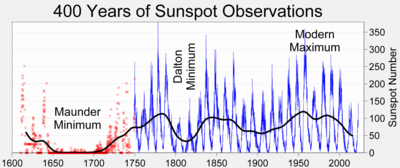
I have been of the opinion for some time now that the current Landscheidt Minimum that we are in has a reasonable probability of reaching Dalton Minimum conditions and even developing into a Maunder-like minimum. The Landscheidt Minimum has yet to be officially named. It seems increasingly probable that we are in for some 20 – 30 years of  global cooling. This has not been the view of the global warming enthusiasts who don’t  much believe in the Sun. But now some heavy-weight opinions are also giving more credence to the possibility of a Maunder-like Minimum. We have currently reached solar maximum in Solar Cycle 24 and SC24 and the coming SC25 are comparable to SC’s 4,5 and 6 which corresponded with the Dalton Minimum. Note that the numbering system for Solar Cycles only starts after the Maunder Minimum.

Paul Hudson has been talking to Professor Mike Lockwood:

It’s known by climatologists as the ‘Little Ice Age’, a period in the 1600s when harsh winters across the UK and Europe were often severe. The severe cold went hand in hand with an exceptionally inactive sun, and was called the Maunder solar minimum. 

Now a leading scientist from Reading University has told me that the current rate of decline in solar activity is such that there’s a real risk of seeing a return of such conditions. I’ve been to see Professor Mike Lockwood to take a look at the work he has been conducting into the possible link between solar activity and climate patterns. 

According to Professor Lockwood the late 20th century was a period when the sun was unusually active and a so called ‘grand maximum’ occurred around 1985. Since then the sun has been getting quieter. By looking back at certain isotopes in ice cores, he has been able to determine how active the sun has been over thousands of years. 

Following analysis of the data, Professor Lockwood believes solar activity is now falling more rapidly than at any time in the last 10,000 years. He found 24 different occasions in the last 10,000 years when the sun was in exactly the same state as it is now – and the present decline is faster than any of those 24. Based on his findings he’s raised the risk of a new Maunder minimum from less than 10% just a few years ago to 25-30%. And a repeat of the Dalton solar minimum which occurred in the early 1800s, which also had its fair share of cold winters and poor summers, is, according to him, ‘more likely than not’ to happen. He believes that we are already beginning to see a change in our climate – witness the colder winters and poor summers of recent years – and that over the next few decades there could be a slide to a new Maunder minimum. 

It’s worth stressing that not every winter would be severe; nor would every summer be poor. But harsh winters and unsettled summers would become more frequent. 

Professor Lockwood doesn’t hold back in his description of the potential impacts such a scenario would have in the UK. He says such a change to our climate could have profound implications for energy policy and our transport infrastructure. Although the biggest impact of such solar driven change would be regional, like here in the UK and across Europe, there would be global implications too. ……… 

Recent solar activity (Wikipedia) showing the Maunder and Dalton minima

Winter time is here again – but “cyclical isn’t a scientific term”!

October 27, 2013

We put the clocks back by an hour last night – as we did a year ago.

I shall change to winter tyres tomorrow  – as I did a year ago.

Tomorrow will be another day – as it is every 24 hours.

Christmas day will come again – whether it is scientific or not.

We are surrounded and dominated by cycles. Without periodicity and cycles we would have no concept of time.

Daily cycles, monthly cycles, annual cycles, solar cycles every 11 years, the earth’s precession cycle with a period of 26,000 years, the earth’s axial tilt cycle of about 41,000 years and the Milankovitch cycles of about 100,000 years, are just some of the cycles that surround us.

Whether everything derives from the vibrations within the most fundamental particles and then are manifested by the periodic motion of bodies in our cosmos or whether the motion in the cosmos is the origin of everything else, periodicity and cyclic behaviour is ingrained within us and our world.

There are many more cyclic effects that we are continuously discovering (from the eons of slow cosmic cycles to multi-decadal ocean cycles to multi -hour cycles within living cells to the periodicity of the incredibly fast vibrations of atoms).

The only man-made repeating period that seems to have no corresponding cycle in the natural world is the weekly 7-day cycle.

Almost every cycle we discover seems to impact our weather and our climate.

But Nebraska “climate scientists” don’t believe that natural cycles are worth studying. In fact only studies which start with the assumption that global warming is man-made get any funding.

For one thing, “cyclical” isn’t a scientific term, said Barbara Mayes, a meteorologist with the National Weather Service.

Oh Dear!

The only response to Barbara Mayes and climate scientists in Nebraska must be (with apologies to Lerner and Lowe)

There’ll be spring every year without you
England still will be here without you
There’ll be fruit on the tree
And a shore by the sea
There’ll be crumpets and tea without you

Without your pulling it the tide comes in
Without your twirling it, the Earth can spin
Without your pushing them, the clouds roll by
If they can do without you, ducky so can I

The “crock of sh*t” wars

October 22, 2013

There is much about global warming political correctness which is depressing

But occasionally there can be a great deal of fun – especially when a self-appointed priest gets called out and loses it.

Bishop Hill (Andrew Montford) reports on a recent lecture by Dr. Rob Wilson of the University of St Andrews where he addressed millennial temperature reconstructions and where Michael Mann and his Hockey Stick and his picky reconstructions came in for some serious criticism:

When we got onto Mann et al 2008, we learned about the silliness of the screening process, and students were invited to try screening a set of random generated timeseries in the way Mann had gone about this study. Tiljander didn’t get a mention, but I guess there are only so many flaws one can take on board, even in a two-hour lecture.

The real fireworks came when Mann’s latest papers, which hypothesise that tree ring proxies have large numbers of missing rings after major volcanic eruptions, were described as “a crock of xxxx”.

But the fun and games comes in the comments to Montford’s post.

Mann was not amused. (He never is – but now he was decidedly shirty).

Rob Wilson was himself one of the commenters and had no complaints about any inaccuracies in the post and added some explanatory comments and references.

“The sh*t then hit the proverbial fan”

Mann started tweeting and retweeting and then deleting his less than diplomatic tweets and in general started “stirring the sh*t”.

Manns deleted tweet:

Mann has already started twitter-marketing this blog post 🙂

‘Closet #climatechange #denier Rob Wilson, comes out of the closet big time: http://www.bishop-hill.net/blog/2013/10/21/wilson-on-millennial-temperature-reconstructions.html … #BadScience #DisingenuousBehavior’

Oct 21, 2013 at 1:47 PM | Unregistered CommenterEspen

That tweet has since been deleted. Commenter Skiphil added a compendium of the Mann tweets

Michael Mann’s outpourings on Twitter have dug his holes deeper, even as he struggles to explain himself. Now he is denying that Rob Wilson’s criticisms are offered in “good faith” —

@dougmcneall I have no problem w/ good faith criticism. But I don’t see Rob Wilson’s latest as falling into that category 😦 [emphasis added]

Mann tweets from more recent to earlier in the day (reverse of the order in which they appeared): 

Michael E. Mann ‏@MichaelEMann 6h

@flimsin @dougmcneall Fair enough Tamsin–lets leave it there. Apologies if I appeared to question your motives. For the record, I do not!

Michael E. Mann ‏@MichaelEMann 6h

Awful blog piece (http://www.bishop-hill.net/blog/2013/10/21/wilson-on-millennial-temperature-reconstructions.html …) may well have misrepresented Rob Wilson’s views. I suspend judgment, pending his disavowal of it..

Michael E. Mann ‏@MichaelEMann 6h

@dougmcneall @flimsin Just 2B clear, I consider Tamsin’s commentary 2B in good faith. I don’t question her integrity, just her views!

Michael E. Mann ‏@MichaelEMann 6h

@flimsin @dougmcneall No problem, didn’t mean to imply any motive Tamsin, but simply that the reinforcement mechanisms favor contrarianism..

Michael E. Mann ‏@MichaelEMann 7h

@dougmcneall @flimsin those mechanisms act regardless of motive. But often they do not serve the public discourse well (2/2).

Michael E. Mann ‏@MichaelEMann 7h

@dougmcneall @flimsin u were wrong. Was pointing out that positive reinforcement mechanisms actually favor taking contrarian position (1/2)

Michael E. Mann ‏@MichaelEMann 8h

Rob Wilson not a climate change denier but has played a contrarian role in debate…

Michael E. Mann ‏@MichaelEMann 8h

@AnsonMackay @flimsin just a statement of fact, not of motive..

Michael E. Mann ‏@MichaelEMann 8h

@dougmcneall I disagree w/ that, as do many climate change communicators

Michael E. Mann ‏@MichaelEMann 8h

@dougmcneall @flimsin Not talking about that. Talking about Rob Wilson talk. Tamsin piece was honest but misguided, as I said at the time.

Michael E. Mann ‏@MichaelEMann 8h

@dougmcneall I have no problem w/ good faith criticism. But I don’t see Rob Wilson’s latest as falling into that category 😦

Michael E. Mann ‏@MichaelEMann 8h

@flimsin nope wasn’t imputing motives.

Michael E. Mann ‏@MichaelEMann 8h

@flimsin Was widely viewed as attack on colleagues like James Hansen for speaking out publicly.

Michael E. Mann ‏@MichaelEMann 8h

Greatly uninterested in twitter was w/ those who seem far more concerned about scientists “tone” than rebutting disingenuous attacks. #Sad

Michael E. Mann ‏@MichaelEMann 8h

@flimsin No doubt your attacks on colleagues over what you call “advocacy” has raised your profile greatly in recent months.

Michael E. Mann ‏@MichaelEMann 8h

@flimsin Tamsin, I don’t need to be lectured on “tone” by you, of all people. Uninterested in a profile-raising twitter debate w/ you.

Michael E. Mann ‏@MichaelEMann 8h

@flimsin Please see the PAGES 2K link that I tweeted. That’s the most basic rebuttal to the sort of nonsense spouted by Rob Wilson.

Michael E. Mann ‏@MichaelEMann 8h

@flimsin Not for criticizing my work, but for apparently regurgitating #denialist drivel by the likes of McIntyre etc.

Oct 21, 2013 at 11:20 PM | Registered CommenterSkiphil
The smell from Mann and his “crock of sh*t” could persist.
His “Hockey Stick” has already been re-baptised as the “Hokey Stick” (though I am not sure who to credit for that).
Some further renaming is now on the cards. A “Crockety Hokey Stick” perhaps to avoid having to use “sh*tty”. Or “The Crocks of Mann”?

A new, profound insight into “climate change cooperation”

October 21, 2013

There is bad science and there is silly science and there is trivial science. There is also inane science.

And their are learned journals for all of them. This is a new paper published by Nature Climate Change. (One wonders why?). The authors though can be very pleased since they can each add another paper to their respective list of publications. “We learned from this experiment that even groups gravitate towards instant gratification” 

Wow!

Jennifer Jacquet, Kristin Hagel, Christoph Hauert, Jochem Marotzke, Torsten Röhl, Manfred Milinski. Intra- and intergenerational discounting in the climate gameNature Climate Change, 2013; DOI: 10.1038/nclimate2024

EurekAlert has this to say:

Delayed gratification hurts climate change cooperation

Time is a huge impediment when it comes to working together to halt the effects of climate change, new research suggests.

A study published today in the journal Nature Climate Change reveals that groups cooperate less for climate change mitigation when the rewards of cooperation lay in the future, especially if they stretch into future generations.

“People are often self-interested, so when it comes to investing in a cooperative dilemma like climate change, rewards that benefit our offspring – or even our future self – may not motivate us to act,” says Jennifer Jacquet, a clinical assistant professor at New York University’s Environmental Studies Program, who conducted the research while a postdoctoral fellow working with Math Prof. Christoph Hauert at the University of British Columbia.

“Since no one person can affect climate change alone, we designed the first experiment to gauge whether group dynamics would encourage people to cooperate towards a better future.”

Researchers at UBC and two Max Planck Institutes in Germany gave study participants 40 Euros each to invest, as a group of six, towards climate change actions. If participants cooperated to pool together 120 Euros for climate change, returns on their investment, in the form of 45 additional Euros each, were promised one day later, seven weeks later, or were invested in planting oak trees, and thus would lead to climate benefits several decades down the road – but not personally to the participants. Although many individuals invested initially in the long-term investment designed to simulate benefits to future generations, none of the groups achieved the target.

“We learned from this experiment that even groups gravitate towards instant gratification,” says Hauert, an expert in game theory, the study of strategic decision-making.

The authors suggest that international negotiations to mitigate climate change are unlikely to succeed if individual countries’ short-term gains are not taken into consideration.

Could there be any form of cooperation – in any field – where long-term gains are not out-weighed by instant gratification? For any investment – let alone a cooperative investment – given a choice of a short payback or a long payback, is there any case where the long payback period is chosen? 

This is so profound and so deep an insight it almost hurts!

The “Backfire Effect” and why Global Warmists ignore facts which contradict their opinions

October 21, 2013

This is about a study on how facts – especially corrective facts – are ignored when some opinion or perception is deeply held. The study is about political perceptions and it strikes me that it is very relevant to the IPCC and the alarmists for whom the Global Warming hypothesis (that man-made carbon dioxide emissions are the primary cause of Global warming) is a deeply held political belief.

Brendan Nyhan and Jason Reifler, When Corrections Fail: The persistence of political misperceptions

Abstract: We conducted four experiments in which subjects read mock news articles that included either a misleading claim from a politician, or a misleading claim and a correction. Results indicate that corrections frequently fail to reduce misperceptions among the targeted ideological group. We also document several instances of a “backfire effect” in which corrections actually increase misperceptions among the group in question.

The behaviour of the IPCC and the Global Warming coterie in ignoring or explaining away real observations in favour of their computer models has always smacked of religious fanaticism rather than scientific objectivity. They have shown a preference for coming up with ever more fanciful explanations about why their predictions are not panning out rather than accept that the basis of their predictions may be mistaken. The heat lurking in the deep oceans or Chinese pollution blocking out the sun or “old ice” declining invisibly while “new ice” increases have all been suggested as explanations for

  1. the recent lack of warming,
  2. the broken link between global temperature and carbon dioxide concentration, and
  3. increasing global ice extent.

It would seem that the global warming brigade are an “ideological sub-group” suffering from the “backfire effect”.

In this paper, we report the results of two rounds of experiments investigating the extent to which corrective information embedded in realistic news reports succeeds in reducing prominent misperceptions about contemporary politics. In each of the four experiments, which were conducted in fall 2005 and spring 2006, ideological subgroups failed to update their beliefs when presented with corrective information that runs counter to their predispositions. Indeed, in several cases, we find that corrections actually strengthened misperceptions among the most strongly committed subjects.

…. Political beliefs about controversial factual questions in politics are often closely linked with one’s ideological preferences or partisan beliefs. As such, we expect that the reactions we observe to corrective information will be influenced by those preferences. ……… Specifically, people tend to display bias in evaluating political arguments and evidence, favoring those that reinforce their existing views and disparaging those that contradict their views.

However, individuals who receive unwelcome information may not simply resist challenges to their views. Instead, they may come to support their original opinion even more strongly – what we call a “backfire effect.”

……

The backfire effects that we found seem to provide further support for the growing literature showing that citizens engage in “motivated reasoning.” While our experiments focused on assessing the effectiveness of corrections, the results show that direct factual contradictions can actually strengthen ideologically grounded factual beliefs – an empirical finding with important theoretical implications.

It is a little depressing that  just using facts (science) may not be of much use in getting people to correct their misperceptions when these take the form of religious belief.

Many citizens seem unwilling to revise their beliefs in the face of corrective information, and attempts to correct those mistaken beliefs may only make matters worse.

It is the sobering – and depressing – reality that facts (read science) are always subservient to even completely irrational religious beliefs.

Global Warming gone missing: Arctic ice back to “normal” and Antarctic ice at highest ever recorded levels

October 20, 2013

IF THE GLOBE IS WARMING, WHERE’S THE HEAT?

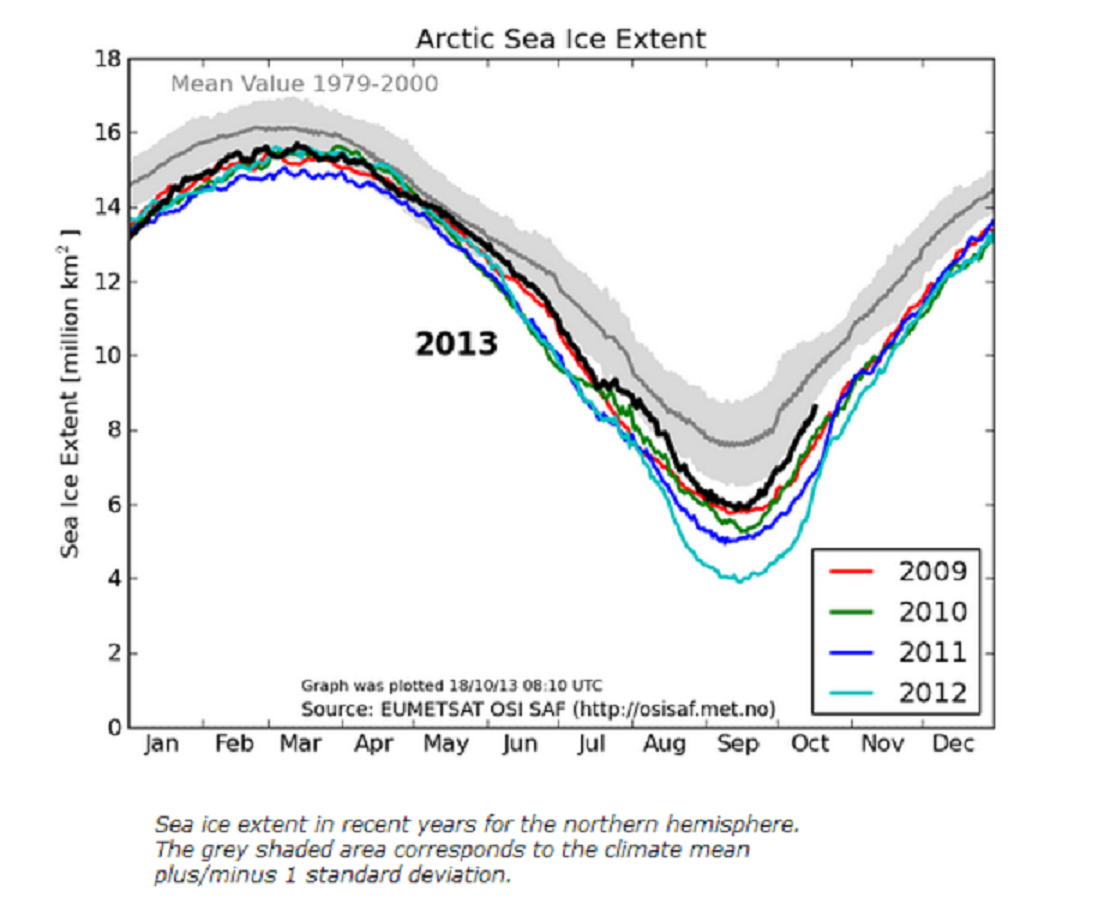
Arctic Ice levels are increasing fast and are within 1 standard deviation of the 1979-2000 mean.

Arctic Ice Extent 20131018 DMI Centre for Ocean and Ice

Arctic Ice Extent 20131018 DMI Centre for Ocean and Ice

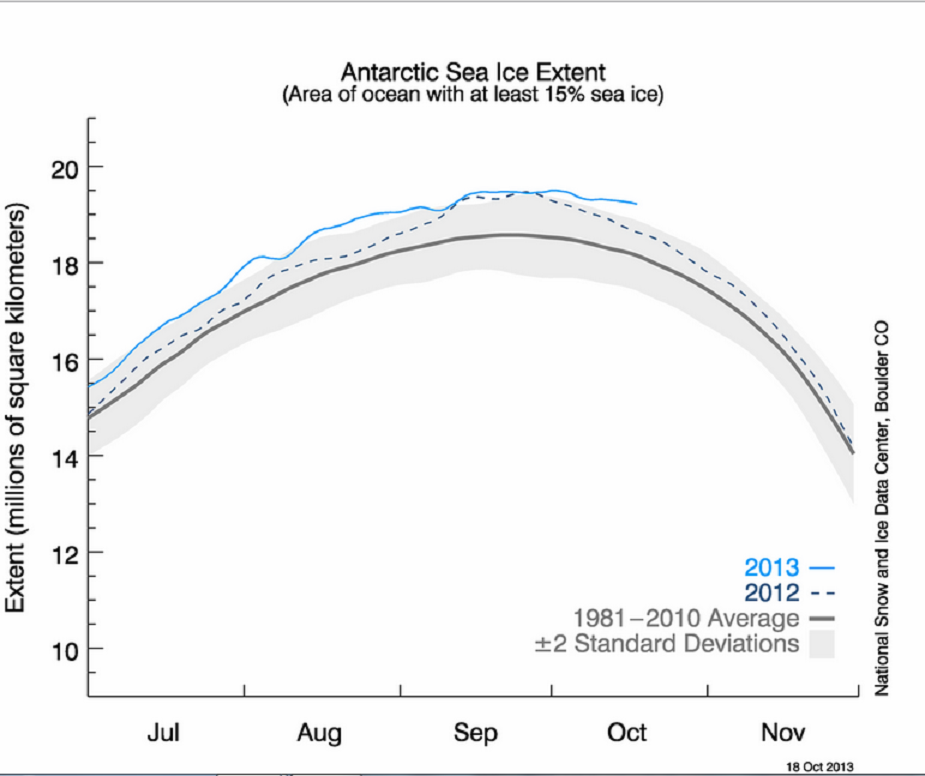
In the Anatrctic ice extent should normally have started reducing by 22nd Sepptember but kept increasing till about 1st October. At maximum it reached levels never recorded before. It is currently at a level more than 2 standard deviations higher than the long term 1981 – 2010 average.

Antarctic Ice Extent 20131018 NSIDC Boulder

Antarctic Ice Extent 20131018 NSIDC Boulder

This leads to obvious but simple conclusions:

  1. Over the last 34 years therefore, Arctic ice extent has shown great variability but is currently at values within one standard deviation of the 30 year average.
  2. Global warming – if it is taking place – has not left any significant signature in the extent of Arctic Ice which is larger than “natural variability”.
  3. Over the last 32 years Antarctic ice extent has consistently shown a small but steady increase.
  4. Global warming – if it is taking place – is completely absent in the record of the ice extent.

It could be argued – but it would stretch credulity – that heat is being stored in the deep ocean (having bypassed the surface waters by a hitherto unknown form of “deep sea radiation”)  and that this will all be released in a coming catastrophic event (to be known as the Ehrlich Rapture) in 2047.

Or, it could be argued – again with little credibility – that man-made particulate emissions from China in the Northern Hemisphere and from Indonesian forest fires in the Southern Hemisphere have reflected away the Sun’s radiation and prevented the warming that should have taken place. This argument then fails since it would appear to describe a very successful  application – if inadvertent – of geo-engineering.

Or we could choose the parsimonious explanation. There has been no global warming for the last 2 decades or so.

Any discussion about whether or how much warming is caused by carbon dioxide emissions becomes moot if there is no warming.

WHERE’S THE HEAT?

Snow sweeps in very early this year

October 19, 2013

Snow has already come to Bavaria. Parts of Russia and the US have also seen some very early snow. Now, in just the 3rd week of October, snow has swept over northern Sweden. I have not had to clear any snow yet but I have had ice to scrape of the windshield for the last few mornings. I had only planned to change to winter tyres at the end of the month but I might have to bring this forward (to prepone it).

It is only weather of course! I wish somebody could tell me of any effects of global warming that could actually be experienced.

Autumn over as winter snow sweeps Sweden

Snow and sub-zero temperatures hit widespread parts of Sweden on Thursday night and will carry on through Friday and beyond, with meteorologists warning motorists that now is the time to change to winter tyres.

The coldest temperature of the season was recorded on Thursday night in Karesuando, in far northern Sweden near the Finnish border, where the mercury dropped to -12.5ˆC. Snow fell in Västernorrland, Dalarna and Gävleborg, and in many areas further north, but experts said the snow is nothing to worry about. 
“I believe that in most places it’s only been a few centimetres of snow that have settled,” Sandra Andersson of Sweden’s weather agency SMHI told the TT news agency. SMHI issued a class 1 warning, stating that motorists should beware of slippery roads, although no damage was reported throughout the night.