Archive for the ‘Climate’ Category

Measurements show climate models get the energy balance wrong (again)

July 27, 2011

Settled science?

The deification of climate models and the development of the Global Warming religion will be remembered as one of man’s great follies.

A new paper in Remote Sensing Remote Sens. 2011, 3, 1603-1613; doi:10.3390/rs3081603 

On the Misdiagnosis of Surface Temperature Feedbacks from Variations in Earth’s Radiant Energy Balance

by Roy W. Spencer  and William D. Braswell
ESSC-UAH, University of Alabama in Huntsville, Cramer Hall, Huntsville, AL 35899, USA;  
E-Mail: danny.braswell@nsstc.uah.edu

A University of Alabama Huntsville news release (via Dr. Pielke Snr.)  

Climate models get energy balance wrong, make too hot forecasts of global warming

HUNTSVILLE, Ala. (July 26, 2011) — Data from NASA’s Terra satellite shows that when the climate warms, Earth’s atmosphere is apparently more efficient at releasing energy to space than models used to forecast climate change have been programmed to “believe.”

The result is climate forecasts that are warming substantially faster than the atmosphere, says Dr. Roy Spencer, a principal research scientist in the Earth System Science Center at The University of Alabama in Huntsville.

The previously unexplained differences between model-based forecasts of rapid global warming and meteorological data showing a slower rate of warming have been the source of often contentious debate and controversy for more than two decades.

In research published this week in the journal “Remote Sensing” http://www.mdpi.com/2072-4292/3/8/1603/pdf, Spencer and UA Huntsville’s Dr. Danny Braswell compared what a half dozen climate models say the atmosphere should do to satellite data showing what the atmosphere actually did during the 18 months before and after warming events between 2000 and 2011.

“The satellite observations suggest there is much more energy lost to space during and after warming than the climate models show,” Spencer said. “There is a huge discrepancy between the data and the forecasts that is especially big over the oceans.”

Not only does the atmosphere release more energy than previously thought, it starts releasing it earlier in a warming cycle. The models forecast that the climate should continue to absorb solar energy until a warming event peaks. Instead, the satellite data shows the climate system starting to shed energy more than three months before the typical warming event reaches its peak.

“At the peak, satellites show energy being lost while climate models show energy still being gained,” Spencer said.

This is the first time scientists have looked at radiative balances during the months before and after these transient temperature peaks.

Applied to long-term climate change, the research might indicate that the climate is less sensitive to warming due to increased carbon dioxide concentrations in the atmosphere than climate modelers have theorized. A major underpinning of global warming theory is that the slight warming caused by enhanced greenhouse gases should change cloud cover in ways that cause additional warming, which would be a positive feedback cycle.

Instead, the natural ebb and flow of clouds, solar radiation, heat rising from the oceans and a myriad of other factors added to the different time lags in which they impact the atmosphere might make it impossible to isolate or accurately identify which piece of Earth’s changing climate is feedback from manmade greenhouse gases.

“There are simply too many variables to reliably gauge the right number for that,” Spencer said. “The main finding from this research is that there is no solution to the problem of measuring atmospheric feedback, due mostly to our inability to distinguish between radiative forcing and radiative feedback in our observations.”

For this experiment, the UA Huntsville team used surface temperature data gathered by the Hadley Climate Research Unit in Great Britain. The radiant energy data was collected by the Clouds and Earth’s Radiant Energy System (CERES) instruments aboard NASA’s Terra satellite.

The six climate models were chosen from those used by the U.N.’s Intergovernmental Panel on Climate Change. The UA Huntsville team used the three models programmed using the greatest sensitivity to radiative forcing and the three that programmed in the least sensitivity.

Dr. Roy Spencer writes about his paper:

Well, our paper entitled On the Misdiagnosis of Surface Temperature Feedbacks from Variations in Earth’s Radiant Energy Balance which refutes Dessler’s claim, has just been accepted for publication. In it we show clear evidence that cloud changes DO cause a large amount of temperature variability during the satellite period of record, which then obscures the identification of temperature-causing-cloud changes (cloud feedback).

Along with that evidence, we also show the large discrepancy between the satellite observations and IPCC models in their co-variations between radiation and temperature.



Colder winters to come and solar influence on climate beginning to get its due

July 7, 2011

The BBC reports on a new paper in Environmental Research Letters which actually brings solar influence back into the climate picture.

We show that some predictive skill may be obtained by including the solar effect” says this new paper.

Yes Indeed!

But how was the sun’s influence ever discarded in climate models??

Britain is set to face an increase in harsh winters, with up to one-in-seven gripping the UK with prolonged sub-zero temperatures, a study has suggested. The projection was based on research that identified how low solar activity affected winter weather patterns.

“We could get to the point where one-in-seven winters are very cold, such as we had at the start of last winter and all through the winter before,” said co-author Mike Lockwood, professor of space environment physics at the University of Reading.

Using the Central England Temperature (CET) record, the world’s longest instrumental data series that stretches back to 1659, the team said that average temperatures during recent winters had been markedly lower than the longer-term average.

“The mean CET for December, January and February for the recent relatively cold winters of 2008/09 and 2009/10 were 3.50°C and 2.53°C respectively,” they wrote.

“Whereas the mean value for the previous 20 winters had been 5.04°C.

“The cluster of lower winter temperatures in the UK during the last three years had raised questions about the probability of more similar, or even colder, winters occurring in the future.” 

Professor Lockwood was keen to point out that his team’s paper did not suggest that the UK and mainland Europe was about to be plunged into a “little ice age” as a result of low solar activity, as some media reports had suggested.

M Lockwood et al 2011 Environ. Res. Lett. 6 034004 doi: 10.1088/1748-9326/6/3/034004

The solar influence on the probability of relatively cold UK winters in the future

M Lockwood, R G Harrison, M J Owens, L Barnard, T Woollings and F Steinhilber

Abstract: Recent research has suggested that relatively cold UK winters are more common when solar activity is low (Lockwood et  al 2010 Environ Res Lett 5 024001). Solar activity during the current sunspot minimum has fallen to levels unknown since the start of the 20th century (Lockwood 2010 Proc. R. Soc. A 466 303–29) and records of past solar variations inferred from cosmogenic isotopes (Abreu et al 2008 Geophys Res Lett. 35 L20109) and geomagnetic activity data (Lockwood et al 2009 Astrophys. J. 700 937–44) suggest that the current grand solar maximum is coming to an end and hence that solar activity can be expected to continue to decline. Combining cosmogenic isotope data with the long record of temperatures measured in central England, we estimate how solar change could influence the probability in the future of further UK winters that are cold, relative to the hemispheric mean temperature, if all other factors remain constant. Global warming is taken into account only through the detrending using mean hemispheric temperatures. We show that some predictive skill may be obtained by including the solar effect.

The BBC report continues:

Depiction of the 1683 Thames' frost fair (Getty Images)

Depiction of the 1683 Thames' frost fair (Getty Images)

Professor Lockwood said it was a “pejorative name” because what happened during the Maunder Minimum “was actually nothing like an ice age at all”.

“There were colder winters in Europe. That almost certainly means, from what we understand about the blocking mechanisms that cause them, that there were warmer winters in Greenland,” he observed. “So it was a regional redistribution and not a global phenomenon like an ice age. It was nothing like as cold as a real ice age – either in its global extent or in the temperatures reached. “The summers were probably warmer if anything, rather than colder as they would be in an ice age.” He added that the Maunder Minimum period was not an uninterrupted series of cold, harsh winters.

Data from the CET showed that the coldest winter since records began was 1683/84 “yet just two year later, right in the middle of the Maunder Minimum, is the fifth warmest winter in the whole record, so this idea that Maunder Minimum winters were unrelentingly cold is wrong”.

He explained that a similar pattern could be observed in recent events: “Looking at satellite data, we found that when solar activity was low, there was an increase in the number of blocking events of the jetstream over the Atlantic. “That led to us getting colder weather in Europe. The same events brought warm air from the tropics to Greenland, so it was getting warmer. “These blocking events are definitely a regional redistribution, and not like a global ice age.  


Reducing sulphur emissions caused post-1970 global warming!!!!

July 5, 2011

Whether warming or cooling it would seem that anthropogenic effects and man’s burning of coal is responsible.

“The post 1970 period of warming, which constitutes a significant portion of the increase in global surface temperature since the mid 20th century, is driven by efforts to reduce air pollution in general and acid deposition in particular”.

That’s the conclusion of a new paper from the “peer-reviewed” literature confirming the obvious that global temperatures have plateaued since 1998.

Reconciling anthropogenic climate change with observed temperature 1998–2008

Robert K. Kaufmann, Heikki Kauppi, Michael L. Mann, James, H. Stock

pnas. 201102467

PDF from WUWT

And though the paper cuts off  data in 2008 this temperature stability certainly continues till 2010 and it seems – on my own empirical observations  – even in 2011.

As the paper title shows this real stabilisation of temperatures which is not predicted by any climate model and which may well be a precursor of a few decades of global cooling is of some concern to the Anthropogenic Global Warming enthusiasts. The presumption is that the model results are supreme and that reality must be reconciled by invoking further anthropogenic effects.

Needless to say any global cooling is not acknowledged since that would be heretical and instead short-term anthropogenic factors (sulphur emissions from coal burning in China)  are blamed for this cessation of global warming!!

Given the widely noted increase in the warming effects of rising greenhouse gas concentrations, it has been unclear why global surface temperatures did not rise between 1998 and 2008. We find that this hiatus in warming coincides with a period of little increase in the sum of anthropogenic and natural forcings. Declining solar insolation as part of a normal eleven-year cycle, and a cyclical change from an El Nino to a La Nina dominate our measure of anthropogenic effects because rapid growth in short-lived sulfur emissions partially offsets rising greenhouse gas concentrations. As such, we find that recent global temperature records are consistent with the existing understanding of the relationship among global surface temperature, internal variability, and radiative forcing, which includes anthropogenic factors with well known warming and cooling effects.

The conclusion is formulated to avoid any semblance of heresy and to ensure publication no doubt.

The finding that the recent hiatus in warming is driven largely by natural factors does
not contradict the hypothesis: “most of the observed increase in global  average temperature since the mid 20th century is very likely due to the observed increase in anthropogenic greenhouse gas concentrations (14)”. As indicated in Figure 1, anthropogenic activities that warm and cool the planet largely cancel after 1998, which allows natural variables to play a more significant role. ……   

The post 1970 period of warming, which constitutes a significant portion of the increase in global surface temperature since the mid 20th century, is driven by efforts to reduce air pollution in general and acid deposition in particular, which cause sulfur emissions to decline while the concentration of greenhouse gases continues to rise. 

That reality is being acknowledged is heartening but relying on the anthropogenic effects effects of coal burning alone (carbon dioxide emissions causing warming and sulphur emissions causing cooling) with only a passing reference to solar effects is not just naive – it is denying the obvious.

Related:

http://wattsupwiththat.com/2011/07/04/a-peer-reviewed-admission-that-global-surface-temperatures-did-not-rise-dr-david-whitehouse-on-the-pnas-paper-kaufmann-et-al-2011/

Nature editorial chastises IPCC for conflict of interest policy

June 30, 2011

The Nature editorial  published today will be unwelcome criticism for the IPCC from a normally very friendly quarter. “Shot with its own gun” is the headline and the editorial chastises Pachauri and the IPCC for failing “to make clear when this new conflict-of-interest policy will come into effect and whom it will cover. It needs to do so — and fast”.

Allowing Greenpeace to ‘dictate’ the IPCC’s renewable-energy report was particularly inept and as one Nature reader puts it “The IPCC has become a Centre of Criticism”. But the fundamental problem with the IPCC is of course that it has become an advocacy group with a pre-determined agenda where scientific evidence has been replaced by dubious results from scenarios. Claiming that model results of a chaotic and imperfectly understood system are “settled science” is the travesty.

But criticism coming from Nature is friendly fire indeed.

Nature 474, 541 (30 June 2011) doi:10.1038/474541a

Shot with its own gun

In the past two years, the IPCC has displayed a talent for manoeuvring itself into embarrassing situations, making itself an easy target for critics and climate sceptics.

The problems began in late 2009, when it was reported that the IPCC’s fourth assessment report, published two years earlier, mistakenly claimed that all Himalayan glaciers could melt by 2035. The subsequent fallout seriously damaged the IPCC’s credibility, and was exacerbated by the inept attempts of the group’s chairman, Rajendra Pachauri, to contain the crisis. A subsequent review of the organization’s governance and policies saw it commit to a number of wide-ranging reforms.

This month, the IPCC is in the crosshairs again. The revelation that a Greenpeace energy analyst helped to write a key chapter in the IPCC’s Special Report on Renewable Energy Sources and Climate Change Mitigation, released last month, sparked widespread criticism across the blogosphere. Compared with the glacier faux pas, the latest incident is trivial. But it should remind the IPCC that its recently reworked policies and procedures need to be implemented, visibly and quickly.

In response to the glacier blunder, the IPCC pledged greater caution in the processes it uses to select scientific experts and to evaluate grey literature, and to make sure that (unpaid) work for the panel does not clash with interests arising from the professional affiliations of its staff and contributing authors (see Nature473, 261; 2011). But it has failed to make clear when this new conflict-of-interest policy will come into effect and whom it will cover. It needs to do so — and fast. 

This is the only way that the organization can counter recurring claims that it is less policy-neutral than its mandate from the United Nations obliges it to be. In particular, it needs to make clear the position for the working groups on climate-change impacts and adaptation (the science group adopted a rigid conflict-of-interest policy last year). Pachauri is on record as saying that the new conflict-of-interest policy will not apply retrospectively to the hundreds of authors already selected for the IPCC’s fifth assessment report, due in 2014. This is unacceptable. He should make it a priority to ensure that the rules cover everyone involved — including himself. …

The IPCC’s vulnerability to such attacks should also prompt it to reconsider how it frames its findings. Journalists and critics alike gravitate towards extreme claims. So when the IPCC’s press material for the May report prominently pushed the idea that renewables could provide “close to 80%” of the world’s energy needs by 2050, it was no surprise that it was this figure that made headlines — and made waves. The IPCC would have saved itself a lot of trouble and some unwarranted criticism had it made the origins of this scenario explicit.

Now with the natural death of the Kyoto Protocol and with a few decades of cooling in front of us it is time for the IPCC to be disbanded.

Landscheidt Minimum could be a grand solar minimum lasting till 2100

June 20, 2011

It is noticeable that the upsurge of evidence that a solar minimum – and maybe a grand minimum – is upon is causing many of the global warming enthusiasts to try and rationalise the effects of the sun. Suddenly they begin to acknowledge that the sun may have some small effect on climate but rush to point out that the solar influence on climate is not yet understood (indeed!) and in any case it will be much too small to be significant compared to the effects of man.

The belated acknowledgement of the possible influence of the sun is welcome but  the belief that man made effects can overcome the power of the sun is just arrogant.

hockeyschtick

Dr. Cornelis de Jager is a renowned Netherlands solar physicist, past General Secretary of the International Astronomical Union, and author of several peer-reviewed studies examining the solar influence upon climateIn response to the recent press release of three US studies indicating the Sun is entering a period of exceptionally low activity, Dr. de Jager references his publications of 2010 and prior indicating that this Grand Solar Minimum will be similar to the Maunder Minimum which caused the Little Ice Age, and prediction that this “deep minimum” will last until approximately the year 2100. 

“The new episode is a deep minimum. It will look similar to the Maunder Minimum, which lasted from 1620 to 1720…This new Grand Minimum will last until approximately 2100.”


Related: 

  1. http://www.scostep.ucar.edu/archives/scostep11_lectures/de%20Jager.pdf 
  2. Solar activity and its influence on climate  
  3. Major Drop In Solar Activity Predicted: Landscheidt Minimum is upon us and a mini-ice age is imminent

Now IPCC becomes just a lobby for Greenpeace!

June 16, 2011

There seems to be an incestuous relationship between the IPCC and a number of advocacy groups with the parties lobbying for each other. In the latest episode the IPCC has become the vehicle for publishing conclusions from a Greenpeace advocacy report on renewables:

The Independent:

Climate change panel in hot water again over ‘biased’ energy report 

The world’s foremost authority on climate change used a Greenpeace campaigner to help write one of its key reports, which critics say made misleading claims about renewable energy, The Independent has learnt. 

The Intergovernmental Panel on Climate Change (IPCC), set up by the UN in 1988 to advise governments on the science behind global warming, issued a report last month suggesting renewable sources could provide 77 per cent of the world’s energy supply by 2050. But in supporting documents released this week, it emerged that the claim was based on a real-terms decline in worldwide energy consumption over the next 40 years – and that the lead author of the section concerned was an employee of Greenpeace. Not only that, but the modelling scenario used was the most optimistic of the 164 investigated by the IPCC.

Critics said the decision to highlight the 77 per cent figure showed a bias within the IPCC against promoting potentially carbon-neutral energies such as nuclear fuel. One climate change sceptic said it showed the body was not truly independent and relied too heavily on green groups for its evidence. 

Yesterday, after the full report was released, the sceptical climate change blog Climate Audit reported that the 77 per cent figure had been derived from a joint study by Sven Teske, a climate change expert employed by Greenpeace, which opposes the use of nuclear power to cut carbon emissions.

Last night, the IPCC said it had been made clear that the 77 per cent figure was only one of the estimates made from the models and that Mr Teske was just one of 120 researchers who had worked on the report. John Sauven, executive director of Greenpeace UK, said: “Exxon, Chevron and the French nuclear operator EDF also contribute to the IPCC, so to paint this expert UN body as a wing of Greenpeace is preposterous.” But Mark Lynas, a climate change writer in favour of using nuclear and renewables to combat global warming, said: “It is stretching credibility for the IPCC to suggest that a richer world with two billion more people will use less energy in 2050. Campaigners should not be employed as lead authors in IPCC reports.”

The IPCC must urgently review its policies for hiring lead authors – and I would have thought that not only should biased ‘grey literature’ be rejected, but campaigners from NGOs should not be allowed to join the lead author group and thereby review their own work. There is even a commercial conflict of interest here given that the renewables industry stands to be the main beneficiary of any change in government policies based on the IPCC report’s conclusions. Had it been an oil industry intervention which led the IPCC to a particular conclusion, Greenpeace et al would have course have been screaming blue murder.

Climate Audit: IPCC WG3 and the Greenpeace Karaoke

The basis for this claim is a Greenpeace scenario. The Lead Author of the IPCC assessment of the Greenpeace scenario was the same Greenpeace employee who had prepared the Greenpeace scenarios, the introduction to which was written by IPCC chair Pachauri.

The public and policy-makers are starving for independent and authoritative analysis of precisely how much weight can be placed on renewables in the energy future. It expects more from IPCC WG3 than a karaoke version of Greenpeace scenario.

It is totally unacceptable that IPCC should have had a Greenpeace employee as a Lead Author of the critical Chapter 10, that the Greenpeace employee, as an IPCC Lead Author, should (like Michael Mann and Keith Briffa in comparable situations) have been responsible for assessing his own work and that, with such inadequate and non-independent ‘due diligence’, IPCC should have featured the Greenpeace scenario in its press release on renewables.

Everyone in IPCC WG3 should be terminated and, if the institution is to continue, it should be re-structured from scratch.

Major Drop In Solar Activity Predicted: Landscheidt Minimum is upon us and a mini-ice age is imminent

June 15, 2011

The stunning announcement made at the annual meeting of the American Astronomical Society exceeded the expectations from the advance publicity!

The results of new studies were announced today (June 14) at the annual meeting of the solar physics division of the American Astronomical Society, which is being held this week at New Mexico State University in Las Cruces. 

The results of three separate studies seem to show that even as the current sunspot cycle (SC24) moves toward the solar maximum, the sun could be heading into a more-dormant period, with activity during the next 11-year sunspot cycle (SC25) greatly reduced or even eliminated.

The indicators have been  growing for some time that we are in for a a new solar minimum – the Landscheidt minimum – which could be similar to the Dalton Minimum and may even approach the Maunder Minimum. This could mean a cooling period for the earth of 20 – 30 years or for as long as 60 – 70 years. In any event the signs will be unambiguous and inescapable within a decade.

It is reasonable to assume that climatic conditions over the next 20 – 30 years will resemble those prevailing between 1790 and 1820. But SC24 has a way to go yet and it could be that solar activity for SC24 and 25 will be even lower than during the Dalton minimum and perhaps closer to the Spörer minimum but perhaps not as deep as the Maunder minimum.

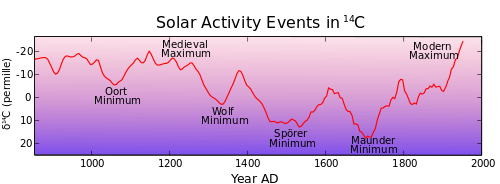
But in either case the solar activity to come following the Modern maximum may well resemble the 500 years of decline in solar activity which followed the Medieval maximum.

Solar activity events recorded in radiocarbon. Present period is on left. Values since 1950 not shown: Wikipedia

The three papers are: 

  1. “Large-Scale Zonal Flows During the Solar Minimum — Where Is Cycle 25?” by Frank Hill, R. Howe, R. Komm, J. Christensen-Dalsgaard, T.P. Larson, J. Schou & M. J. Thompson.
  2. “A Decade of Diminishing Sunspot Vigor” by W. C. Livingston, M. Penn & L. Svalgard.
  3. “Whither Goes Cycle 24? A View from the Fe XIV Corona” by R. C. Altrock.

 Spacedaily reports:

Major Drop In Solar Activity Predicted

As the current sunspot cycle, Cycle 24, begins to ramp up toward maximum, independent studies of the solar interior, visible surface, and the corona indicate that the next 11-year solar sunspot cycle, Cycle 25, will be greatly reduced or may not happen at all.

“This is highly unusual and unexpected,” Dr. Frank Hill, associate director of the NSO’s Solar Synoptic Network, said of the results. “But the fact that three completely different views of the Sun point in the same direction is a powerful indicator that the sunspot cycle may be going into hibernation.”

Hill is the lead author on one of three papers on these results being presented this week. Using data from the Global Oscillation Network Group (GONG) of six observing stations around the world, the team translates surface pulsations caused by sound reverberating through the Sun into models of the internal structure.

One of their discoveries is an east-west zonal wind flow inside the Sun, called the torsional oscillation, which starts at mid-latitudes and migrates towards the equator. The latitude of this wind stream matches the new spot formation in each cycle, and successfully predicted the late onset of the current Cycle 24.

“We expected to see the start of the zonal flow for Cycle 25 by now,” Hill explained, “but we see no sign of it. This indicates that the start of Cycle 25 may be delayed to 2021 or 2022, or may not happen at all.”

In the second paper, Matt Penn and William Livingston see a long-term weakening trend in the strength of sunspots, and predict that by Cycle 25 magnetic fields erupting on the Sun will be so weak that few if any sunspots will be formed. Spots are formed when intense magnetic flux tubes erupt from the interior and keep cooled gas from circulating back to the interior.

For typical sunspots this magnetism has a strength of 2,500 to 3,500 gauss (Earth’s magnetic field is less than 1 gauss at the surface); the field must reach at least 1,500 gauss to form a dark spot.

Using more than 13 years of sunspot data collected at the McMath-Pierce Telescope at Kitt Peak in Arizona, Penn and Livingston observed that the average field strength declined about 50 gauss per year during Cycle 23 and now in Cycle 24.

They also observed that spot temperatures have risen exactly as expected for such changes in the magnetic field. If the trend continues, the field strength will drop below the 1,500 gauss threshold and spots will largely disappear as the magnetic field is no longer strong enough to overcome convective forces on the solar surface.

Moving outward, Richard Altrock, manager of the Air Force’s coronal research program at NSO’s Sunspot, NM, facilities has observed a slowing of the “rush to the poles,” the rapid poleward march of magnetic activity observed in the Sun’s faint corona. Altrock used four decades of observations with NSO’s 40-cm (16-inch) coronagraphic telescope at Sunspot.

“A key thing to understand is that those wonderful, delicate coronal features are actually powerful, robust magnetic structures rooted in the interior of the Sun,” Altrock explained. “Changes we see in the corona reflect changes deep inside the Sun.”

Altrock used a photometer to map iron heated to 2 million degrees C (3.6 million F). Stripped of half of its electrons, it is easily concentrated by magnetism rising from the Sun. In a well-known pattern, new solar activity emerges first at about 70 degrees latitude at the start of a cycle, then towards the equator as the cycle ages. At the same time, the new magnetic fields push remnants of the older cycle as far as 85 degrees poleward.

“In cycles 21 through 23, solar maximum occurred when this rush appeared at an average latitude of 76 degrees,” Altrock said.

“Cycle 24 started out late and slow and may not be strong enough to create a rush to the poles, indicating we’ll see a very weak solar maximum in 2013, if at all. If the rush to the poles fails to complete, this creates a tremendous dilemma for the theorists, as it would mean that Cycle 23’s magnetic field will not completely disappear from the polar regions (the rush to the poles accomplishes this feat). No one knows what the Sun will do in that case.”

All three of these lines of research to point to the familiar sunspot cycle shutting down for a while. “If we are right,” Hill concluded, “this could be the last solar maximum we’ll see for a few decades. That would affect everything from space exploration to Earth’s climate.”

That last may be the understatement of the century!!!

A photo of a sunspot taken in May 2010, with Earth shown to scale. The image has been colorized for  aesthetic reasons. This image with 0.1 arcsecond resolution from the Swedish 1-m Solar  Telescope represents the limit of what is currently possible in te

A photo of a sunspot taken in May 2010, with Earth shown to scale.This image with 0.1 arcsecond resolution from the Swedish 1-m Solar Telescope represents the limit of what is currently possible in terms of spatial resolution. CREDIT: The Royal Swedish Academy of Sciences, V.M.J. Henriques (sunspot), NASA Apollo 17 (Earth)

Climate change teaching to get back to science but High Priest Bob Ward wants the brainwashing to continue

June 13, 2011

The phenomenon of climate change will someday get back to science and leave the alarmist dogma behind. But we can expect that any moves in this direction will be resisted bitterly by the high priests of global warming and the carbon trading cabal.

The Guardian reports:

Climate change should be excluded from curriculum

Climate change should not be included in the national curriculum, the government adviser in charge of overhauling the school syllabus in England has said. 

Tim Oates, whose wide-ranging review of the curriculum for five- to 16-year-olds will be published later this year, said it should be up to schoolsto decide whether – and how – to teach climate change, and other topics about the effect scientific processes have on our lives. 

In an interview with the Guardian, Oates called for the national curriculum “to get back to the science in science”. “We have believed that we need to keep the national curriculum up to date with topical issues, but oxidation and gravity don’t date,” he said. “We are not taking it back 100 years; we are taking it back to the core stuff. The curriculum has become narrowly instrumentalist.”

But this is The Guardian and it must have been painful to report such a radical step!! Needless to say they provide ample space for global warming High Priest Bob Ward to voice his objections:

But Bob Ward, policy and communications director of the Grantham Research Institute on Climate Change and the Environment at the London School of Economics, warned that Oates’ ideas might not be in pupils’ best interests and could make science less interesting for children.

“An emphasis on climate change in the curriculum connects the core scientific concepts to topical issues,” he said. “Certain politicians feel that they don’t like the concept of climate change. I hope this isn’t a sign of a political agenda being exercised.”

He said leaving climate change out of the national curriculum might encourage a teacher who was a climate change sceptic to abandon teaching the subject to their pupils. “This would not be in the best interests of pupils. It would be like a creationist teacher not teaching about evolution. Climate change is about science. If you remove the context of scientific concepts, you make it less interesting to children.”

But perhaps Bob Ward needs to be reminded that climate change has been happening for ever and will continue without caring very much about what our science purports to understand – or fails to understand. There is little science left in present day “climate science” – which has degenerated to be a dogma with the “consensus scientists” being little more than an advocacy group – and any return to science regarding the climate is welcome and long overdue.

Nothing new under the sun: Global warming in the 80’s followed by global cooling after 2000 was predicted back in 1979

June 1, 2011

From JoNova

St Petersburg Times, Jan 1, 1979

Drs Leona Libby and Louise Pandolfi projected world temperatures in 1979 for the next 70 years and got results that, 30 years later, appear to have been broadly correct if out by 5 – 7 years. Ironically, they used, of all things, … tree ring data (going back 1,800 years). The critical difference was they assumed that the climate changes in natural cycles.

Visit Steven Goddard’s blog to read the full news story.

Climate Predictions 1979

St Petersburg times news 1979

http://joannenova.com.au/2009/04/global-warming-a-classic-case-of-alarmism/

Solar effects 6 times greater than assumed by IPCC

May 10, 2011

A new paper by A. I. Shapiro, W. Schmutz, E. Rozanov, M. Schoell, M. Haberreiter, A. V. Shapiro, and S. Nyeki in Astronomy & Astrophysics  – Total Solar Irradiance (TSI) Astronomy & Astrophysics 529, A67 (2011)  shows that

a total and spectral solar irradiance was substantially lower during the Maunder minimum than observed today. The difference is remarkably larger than other estimations published in the recent literature. The magnitude of the solar UV variability, which indirectly affects climate is also found to exceed previous estimates. 

We present a new technique to reconstruct total and spectral solar irradiance over the Holocene. We obtained a large historical solar forcing between the Maunder minimum and the present, as well as a significant increase in solar irradiance in the first half of the twentieth-century. Our value of the historical solar forcing is remarkably larger than other estimations published in the recent literature.

Climate Realists reports:

A recent peer-reviewed paper published in Astronomy & Astrophysics finds that solar activity has increased since the Little Ice Age by far more than previously assumed by the IPCC. The paper finds that the Total Solar Irradiance (TSI) has increased since the end of the Little Ice Age (around 1850) by up to 6 times more than assumed by the IPCC. Thus, much of the global warming observed since 1850 may instead be attributable to the Sun (called “solar forcing”), rather than man-made CO2 as assumed by the IPCC. 

article image