Archive for the ‘Climate’ Category

A voice of sanity in “climate science”

April 6, 2011

Prof. Dr. Vincent Courtillot Präsentation

This needs no comment but should be required watching for anybody who claims to be a “climate scientist” or wants to pontificate about global warming.

Dr. Vincent Courtillot is a professor of geophysics at the University Paris-Diderot and Chair of paleomagnetism and geodynamics of the Institut Universitaire de France.

In the recent lecture below he explains how solar cycles control the climate by influence on cloud formation (the cosmic ray theory of Svensmark et al) and via influence on ocean oscillations and length of day. Dr. Courtillot notes that IPCC climate computer models do not correlate with observations and that temperature trends vary substantially between North America and Europe (which is contrary to IPCC computer model predictions).

He also notes that while the total solar irradiance (TSI) only varies by about .1% over a solar cycle, the solar UV varies by about 10% and that secondary effects on cloud formation may vary up to 30% over solar cycles. The IPCC computer models dismiss the role of the sun by only considering the small variations of the TSI and ignore the large changes in the most energetic and influential part of the solar spectrum – the ultraviolet.


h/t wuwt

European Climate Action: Don’t know what it will cost, don’t know what it will achieve

March 10, 2011

They don’t know why and what it will cost and they don’t know what it will achieve but, The European Commission on Tuesday unveiled a roadmap for building a low-carbon economy by 2050, proposing an 80 percent to 95 percent cut of greenhouse gas emissions from the 1990 levels.

“We need to start the transition towards a competitive low-carbon economy now. The longer we wait, the higher the cost will be,” Connie Hedegaard, European Commissioner for Climate Action, said when presenting the roadmap to European Union (EU) lawmakers in Strasbourg, France.

The roadmap described the cost-effective pathway to reach the EU’s objective of cutting greenhouse gas emissions by 80 percent to 95 percent of the 1990 levels by 2050. It recommended Europe should achieve it largely through domestic measures since by mid-century international credits to offset emissions will be less widely available than today.

In the meantime Jill Duggan from the European Commission’s Directorate General of Climate Action and the EC’s National Expert on Carbon Markets and Climate Change is in Australia to tell them how good Europe’s emission trading system is and why they should do something similar.  In a radio interview she demonstrated her ignorance.

Jill Duggan

Andrew Bolt

Thursday, March 10, 2011 at 01:38pmDuggan’s utter inability to answer is a scandal – an indictment of global warming politics today. (Listen here):

AB:  Can I just ask; your target is to cut Europe’s emissions by 20% by 2020?

JD:  Yes.

AB:  Can you tell me how much – to the nearest billions – is that going to cost Europe do you think?

JD:  No, I can’t tell you but I do know that the modelling shows that it’s cheaper to start earlier rather than later, so  it’s cheaper to do it now rather than put off action.

AB:  Right.  You wouldn’t quarrel with Professor Richard Tol – who’s not a climate sceptic – but is professor at the Economic and Social Research Institute in Dublin?  He values it at about $250 billion.  You wouldn’t quarrel with that?

JD:  I probably would actually.  I mean, I don’t know.  It’s very, very difficult to quantify.  You get different changes, don’t you?  And one of the things that’s happening in Europe now is that many governments – such as the UK government and the German government – would like the targets to be tougher because they see it as a real stimulus to the economy.

AB:  Right.  Well you don’t know but you think it isn’t $250 billion.

JD:  I think you could get lots of different academics coming up with lots of different figures.

AB:  That’s right.  You don’t know but that’s the figure that I’ve got in front of me.  For that investment.  Or for whatever the investment is.  What’s your estimation of how much – because the object ultimately of course is to lower the world’s temperatures – what sort of temperature reduction do you imagine from that kind of investment?

JD:  Well, what we do know is that to have an evens chance of keeping temperature increases globally to 2°C – so that’s increases – you’ve got to reduce emissions globally by 50% by 2050.

AB:  Yes, I accept that, but from the $250 billion – or whatever you think the figure is – what do you think Europe can achieve with this 20% reduction in terms of cutting the world’s temperature?  Because that’s, in fact, what’s necessary.  What do you think the temperature reduction will be?

JD:  Well, obviously, Europe accounts for 14% of global emissions.  It’s 500 or 550 million people.  On its own it cannot do that.  That is absolutely clear.

AB:  Have you got a figure in your mind?  You don’t know the cost.  Do you know the result?

JD:  I don’t have a cost figure in my mind. Nor, one thing I do know, obviously, is that Europe acting alone will not solve this problem alone.

AB:  So if I put a figure to you – I find it odd that you don’t know the cost and you don’t know the outcome – would you quarrel with this assessment:  that by 2100 – if you go your way and if you’re successful – the world’s temperatures will fall by 0.05°C?  Would you agree with that?

JD:  Sorry, can you just pass that by me again?  You’re saying that if Europe acts alone?

AB:  If just Europe alone – for this massive investment – will lower the world’s temperature with this 20% target (if it sustains that until the end of this century) by 0.05°C.  Would you quarrel with that?

JD:  Well, I think the climate science would not be that precise.  Would it?

AB:  Ah, no, actually it is, Jill.  You see this is what I’m curious about;  that you’re in charge of a massive program to re-jig an economy.  You don’t know what it costs.  And you don’t know what it’ll achieve.

JD:  Well, I think you can look at lots of modelling which will come up with lots of different costs.

AB:  Well what’s your modelling?  That’s the one that everyone’s quoting.  What’s your modelling?

JD:  Well, ah, ah. Let me talk about what we have done in Europe and what we have seen as the benefits.  In Europe, in Germany you could look at, there’s over a million new jobs that have been created by tackling climate change, by putting in place climate policies.  In the UK there’s many hundreds of thousand of jobs.

Full article and transcript is here.

The demonisation of carbon dioxide will probably continue for another 5 to 10 years until it becomes apparent that we are actually in a cooling period and therefore that man-made carbon dioxide is irrelevant and immaterial.

2010 was coldest year in Sweden in 23 years and coldest in Norway since 1941

March 8, 2011

The 2010 winter cold can be coupled to the NAO and to large blocking high pressure areas: image smhi

My actual experiences during 2010 (in Asia and in Northern Europe) and my very real electricity bills are far more compelling than fudged statistics and Hockey Stick Illusions from the global warming alarmists. The reality is that we are in for 2 or 3 decades of cooling courtesy of the sun and man-made carbon dioxide is of little consequence. The sun drives the ocean currents and the North Atlantic Oscillation was negative as it was for the 2009/10 winter.

The global warming / carbon dioxide scare is driven not only by carbon trading scams and catastrophe promoting insurance companies but also by so-called climate scientists who have lost the scepticism that is at the heart of science and developed a Nostradamus complex.

From Stockholm News:

Most people who live in Sweden most certainly remember some really cold months last year, particularly the winter months of January, February and December. There was for certain a serious heat wave in July. But that did not help out: 2010 was the coldest year in Sweden in 23 years.

The Swedish Weather Agency’s preliminary estimations show that Sweden as a whole had around one degree Celsius below normal temperatures last year.

Since 1987, all years have been warmer than normal, except in 1996, which had a small temperature deficit. “Normal” in this context is the average for the years 1961-1990.

The coldest part of the country was in the west, and consequently the western neighbouring country of Norway also had a cold last year. Their general temperature was likewise one degree Celsius below normal. This made last year the coldest in Norway since 1941 and the tenth coldest year since 1900, writes the Norwegian Meteorological Institute.


Australia – A country “of droughts and flooding rains”

March 5, 2011
Page 1 of My Country (Core of my Heart) by Dor...

page 1 of Core of my Heart (My Country): Image via Wikipedia

A lovely little essay by Clive James in Standpoint gently chiding the pretension of the alarmists who see global warming in every weather event and bringing some much needed perspective into weather and climate after the decade of Murray-Darling droughts and the recent Queensland floods:

The Drumming of an Army

…….. Before the floods, proponents of the CAGW view had argued that there would never be enough rain again, because of Climate Change. When it became clear that there might be more than enough rain, the view was adapted: the floods, too, were the result of Climate Change. In other words, they were something unprecedented. Those opposing this view — those who believed that in Australia nothing could be less unprecedented than a flood unless it was a drought — took to quoting Dorothea Mackellar’s poem “My Country”, which until recently every Australian youngster was obliged to hear recited in school. In my day we sometimes had to recite it ourselves, and weren’t allowed to go home until we had given evidence that we could remember at least the first four lines of the second stanza, which runs like this.

I love a sunburnt country,
A land of sweeping plains,
Of ragged mountain ranges,
Of droughts and flooding rains……

…. It was Green pressure that stymied the construction of dams. Probably, from now on, dams will come back into favour, in recognition of the fact that the climate of the sunburnt country, in all her beauty and her terror, is still the way it always was. After the First World War, the desirability of up-river flood control was already well understood. Indeed Australia pioneered such engineering, and the Tennessee Valley Authority borrowed the idea from Australia, not the other way about.

If, from now on, dams are built instead of desalination plants — which in recent years have been proved to yield a fraction of the water at a multiple of the cost — then we will be able to tell that sanity has returned to at least one section of the vast area covered by the pretensions of the climatologists.

Dorothea Mackellar’s poem “My Country” was published in 1908 and her description of the Australia “of droughts and flooding rains” remains just as accurate a century later and is quite indifferent to global warming. .

“My Country” is an iconic patriotic poem about Australia, written by Dorothea Mackellar (1885-1968) at the age of 19 while homesick in England. After travelling through Europe extensively with her father during her teenage years she started writing the poem in London in 1904 and re-wrote it several times before her return to Sydney. The poem was first published in the London Spectator in 1908 under the title “Core of My Heart”. It was reprinted in many Australian newspapers, quickly becoming well known and establishing Mackellar as a poet.


Baltic sea ice highest in 25 years

February 26, 2011

From The Local:

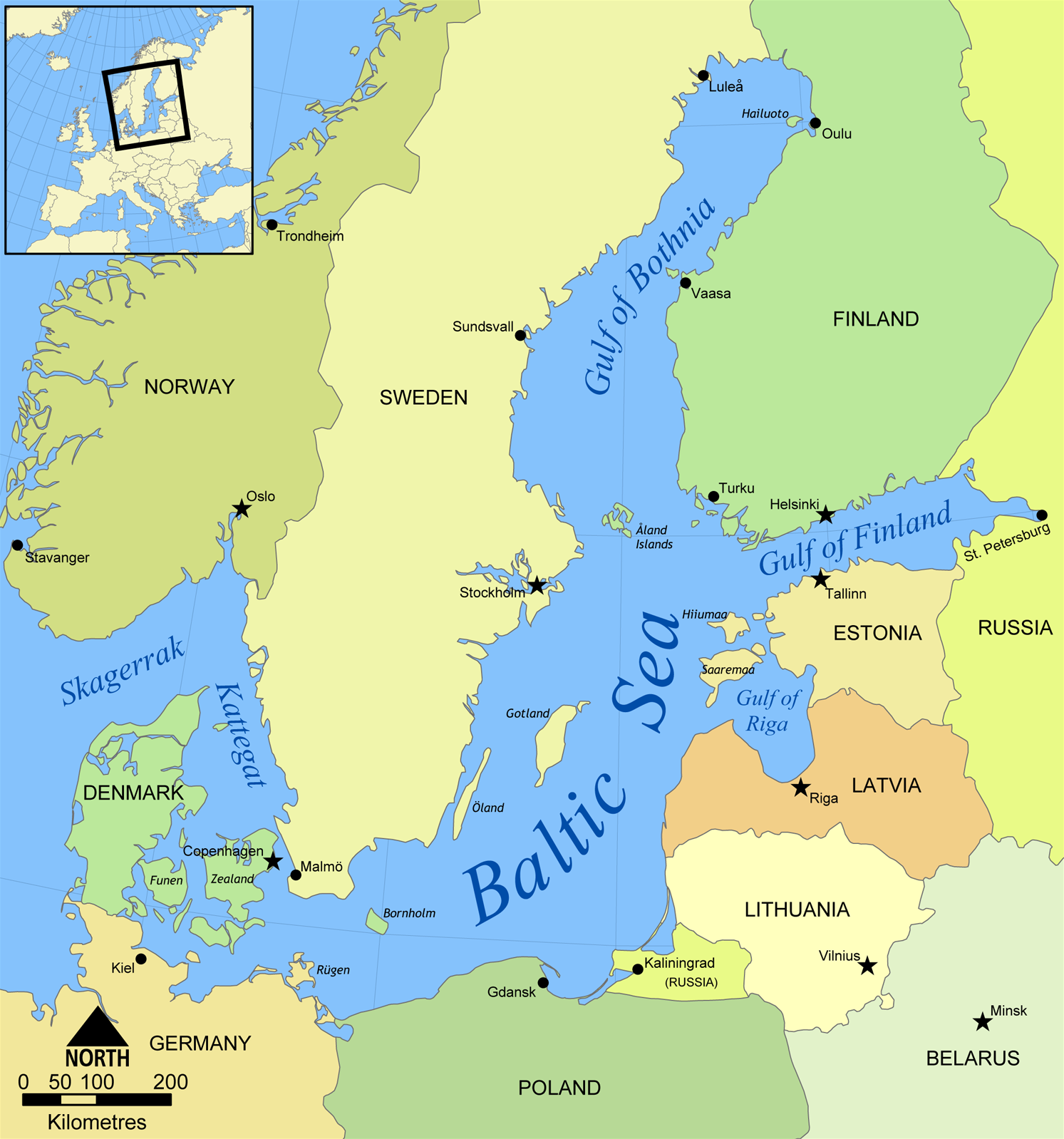
Baltic Sea: image Wikipedia

Deep freeze puts Baltic on track for record ice

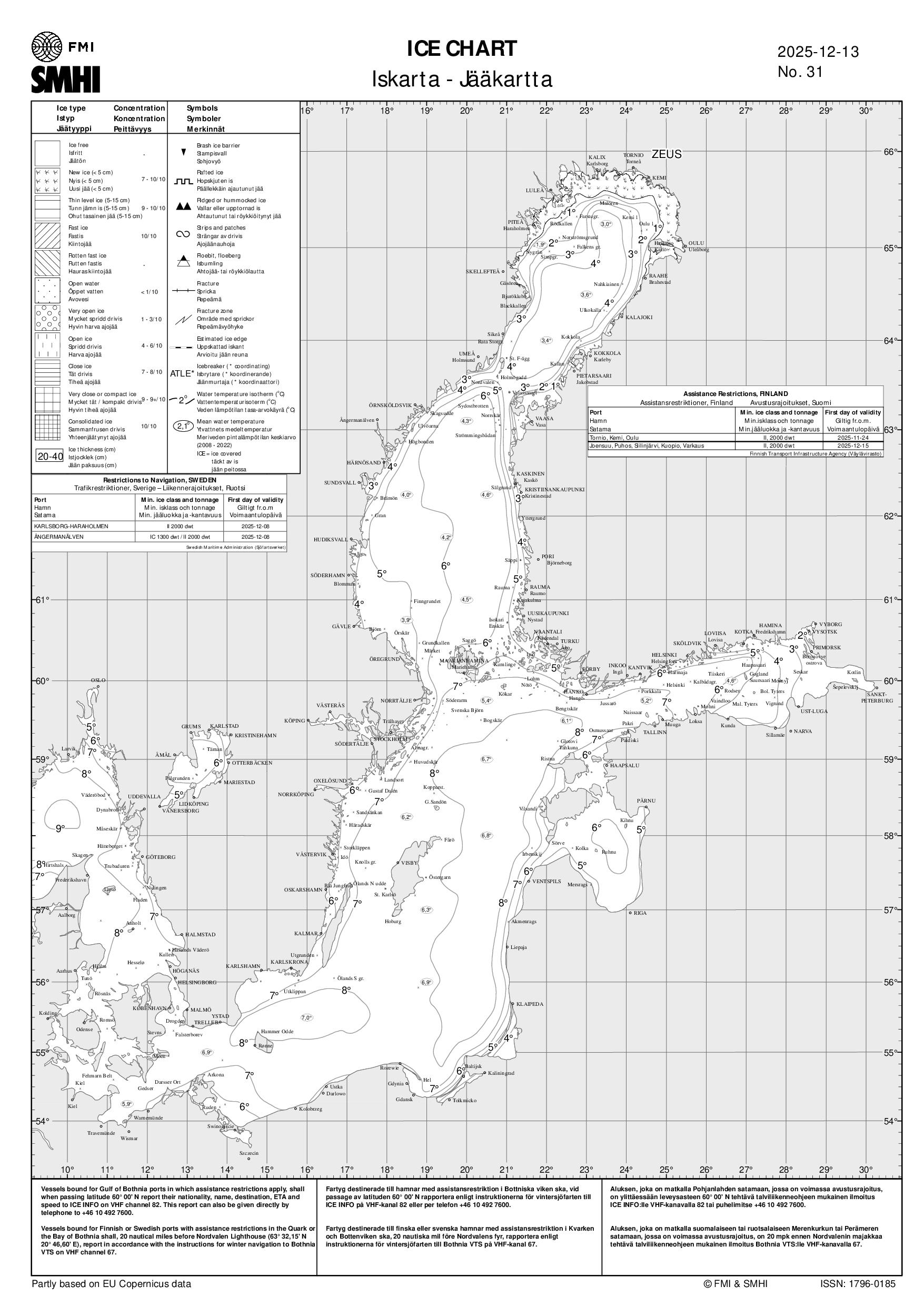
Following another extended stretch of sub-zero temperatures, ice coverage on the Baltic Sea is greater than it’s been in nearly a quarter century, Sweden’s meteorological agency reports. About 250,000 square kilometres of the Baltic Sea are now covered in ice according to the Swedish Meteorological and Hydrological Institute (SMHI).

The last time so much of the Baltic was frozen was the winter of 1986-87, when ice covered nearly 400,000 square kilometres of the sea’s surface.

SMHI warns that ice coverage on the Baltic could expand further in the coming days, possibly setting a new record. “The surface water is cold and if winter-like temperatures continue in the region a few more weeks, we’ll probably get an icy winter on par with 1984-85, one of the toughest winters in the 1980s,” SMHI oceanographer Amund E. B. Lindberg said in a statement.

According to SMHI’s estimates, ice may eventually connect the Swedish mainland all the way out to the Baltic island of Gotland, which lies about 90 kilometres off of Sweden’s eastern coast.

Baltic ice cover is not only unusually wide this winter, but also unusually thick, especially in Gulf of Bothnia off Sweden’s northeastern coast, where air temperatures have consistently hovered around -30 degrees Celsius in recent months.

In some areas far out at sea, ice is more than 60 centimetres thick in the northern parts of the gulf. Recent cold temperatures near the southern areas of the Gulf of Bothnia have resulted in ice thickness growing by 30 centimetres in just two weeks.

Icebreakers from the Swedish Maritime Administration (Sjöfartsverket) have been working round the clock to ensure that sea routes on the Baltic remain open, but strong winds expected at the weekend may complicate their work.

SMHI’s daily ice report says:

During the next two days  heavy ice drifting and ridge forming is expected in all waters of the Baltic Sea north of N58 °.

A detailed sea ice map is available here:

Baltic Sea ice levels 20110225: image smhi

Solar effects will give increased volcanic and earthquake activity in the next 2 years

February 22, 2011

Solar effects are much more profound than many so-called climate scientists like to admit. It seems entirely plausible to me that earthquakes and volcanism are connected to solar events. This paper by Zhang from 1998 also associates increased Earthquakes with general increases in solar proton events.

http://www.springerlink.com/content/buvw2tq081013210/fulltext.pdf?page=1

Relationship between global seismicity and solar activities

Gui-Qing ZHANG

Vol. 11 No.4 (495~500)  ACTA SEISMOLOGICA SINICA  July, 1998

Beijing Astronomical Observatory, Chinese Academy of  Sciences, Beijing 100101, China

Abstract :

The  relations  between  sunspot  numbers and earthquakes  (M>6), solar 10.7cm  radio flux  and  earthquakes,  solar  proton events and earthquakes have been  analyzed in this  paper. It has been found that:

  1. Earthquakes occur frequently around the minimum years  of  solar activity. Generally, the  earthquake  activities are  relatively less during the peak value years of  solar activity, some  say, a round the period when magnetic polarity  in the  solar polar regions  is reversed.
  2. The earthquake frequency in the minimum period of  solar activity is closely related to the  maximum annual means of sunspot numbers, the maximum annual means of solar 10.7 cm radio flux and solar proton events of a whole solar cycle, and the relation between earthquake and solar proton events is closer than others.
  3. As judged by above interrelationship, the period from 1995 to 1997 will be the years while earthquake activities are frequent. In the paper, the simple physical discussion has been carried out.

Piers Corbyn at WeatherAction comments:

“We now think that it is not just general solar proton event levels which point towards more earthquakes but that individual solar proton events exacerbate immediate earthquake (and associated volcanism) risk either directly or due to consequent storm activity and related surface pressure changes such as caused by our solar triggered and predicted Tropical Cyclone Atu which is currently centred North of New Zealand and heading closer.

There are also additional lunar effects on storm development and earthquakes & volcanism and for solar drivers it appears that the odd-even minima, particularly the later part i.e. the rising phase of even solar cycles – WHICH IS WHERE WE ARE NOW (early Solar Cycle 24) – are the most dangerous.

Prediction of individual Earthquakes is very hard but we are very confident of a continuing period of significantly enhanced earthquake and volcanic activity as well as extreme weather events for the coming one or two years, probably exceeding the levels of the most active extended periods in at least the last 100 years.”

Floods and Global Warming is fashion not science

February 18, 2011

There is the attempt to link current weather to long term climate, to use computer models to achieve the evidence, and to alarm the public and policy makers that climate change is real and here.

Roger Pielke Jr. points out:

Nature published two papers yesterday that discuss increasing precipitation trends and a 2000 flood in the UK.  I have been asked by many people whether these papers mean that we can now attribute some fraction of the global trend in disaster losses to greenhouse gas emissions, or even recent disasters such as in Pakistan and Australia. I hate to pour cold water on a really good media frenzy, but the answer is “no.”  Neither paper actually discusses global trends in disasters (one doesn’t even discuss floods) or even individual events beyond a single flood event in the UK in 2000.  But still, can’t we just connect the dots?  Isn’t it just obvious?  And only deniers deny the obvious, right? ….

In short, the new studies are interesting and add to our knowledge.  But they do not change the state of knowledge related to trends in global disasters and how they might be related to greenhouse gases.  But even so, I expect that many will still want to connect the dots between greenhouse gas emissions and recent floods.  Connecting the dots is fun, but it is not science.

And Andrew Revkin goes to town in his New York Times blog about how uncertainties and caveats disappear when a political corner is being fought:

….. In scientific literature you rarely see statements so streamlined and definitive. For climate science, this is the equivalent of a smoking gun. News indeed. Add in the extreme floods last year (a period not included in the study) and you have more relevance, although Roger Pielke Jr. this morning notes the importance of distinguishing between analysis of certain kinds of extreme precipitation events and disastrous flooding.

The problem is that the Nature paper is not definitive at all, as you’ll see below.

None of this detracts from the importance of this work, or the overall picture of an increasingly human-influenced climate, with impacts on the frequency of gullywashers.

But this does raise big questions about the standards scientists and journals use in summarizing complex work and the justifiable need for journalists — and readers — to explore such work as if it has a “handle with care” sign attached.

This is not about “ false balance.” This is about responsible reporting.

A previous instance occurred in 2006, when a paper in Science on frog die-offs in Costa Rica included this firm and sobering statement:

Here we show that a recent mass extinction associated with pathogen outbreaks is tied to global warming.

Things were far more complicated, of course, as you can read in my 2008 piece on Vanishing Frogs, Climate and the Front Page.

Carbon dioxide rip-off has cost Australia $5.5 billion – so far

February 14, 2011

With easy money like this floating around and waiting to be siphoned off it is not difficult to see why the global warming fraud continues! And of course these $5.5 billion are small change compared to the amounts that have been scammed in Europe.

And to make it worse, carbon dioxide emissions are a little less than insignificant for global temperatures.

The Sydney Morning Herald:

Billions blown on carbon schemes

SUCCESSIVE federal governments have spent more than $5.5 billion over the past decade on climate change programs that are delivering only small reductions in greenhouse gas emissions at unusually high costs for taxpayers and the economy.

An analysis by the Herald of government schemes designed to cut emissions by direct spending or regulatory intervention reveals they have cost an average of $168 for each tonne of carbon dioxide abated. ……

The analysis of 17 programs with a total cost of $5.62 billion shows many of the schemes are at odds with the goal of tackling climate change at the lowest cost to the economy. ………

The weighted average cost of the 17 programs was $168 a tonne. They will deliver about 25 million tonnes of carbon abatement in 2020 – less than 10 per cent of that needed to meet the government’s target of reducing emissions in 2020 by 5 per cent on 2000 levels.

The worst offenders have included Labor’s rebates for rooftop solar panels, which cost $300 or more for every tonne of carbon abated, and the Howard government’s remote renewable power generation scheme, which paid up to $340 for each tonne.

Read the article.

Heaviest snowfall in a century in South Korea

February 14, 2011

An excavator removes snow from a road in Gangneung, Gangwon Province, Sunday. The heaviest snowfall in a century hit Gangneung and other cities in the eastern part of the province between Friday and Saturday, with hundreds of people stranded on roads and causing property damage. / Korea Times photo by Kim Joo-young

While all the snow and ice covering a large part of the Northern hemisphere does not prove anything about climate, in the style of the global warmists we could say that it is entirely consistent with the coming of a new Dalton-like solar minimum and a coming ice-age!!

From the BBC:

The heaviest snowfall in more than a century on South Korea’s east coast is causing widespread chaos. Hundreds of houses have collapsed under the weight of the snow. One newspaper described it as a snow bomb. The South Korean government has deployed 12,000 soldiers to rescue stranded residents.

The worst weather has been in Gangwon province. Weather experts say there will be more snowfall in the area in the coming hours. “I am 83 years old. It’s the heaviest snow in my life. I am really grateful for the soldiers’ help,” said Park Chae-ran. …..

….. January was the coldest since the 1960s. In Gangwon on the eastern coast, one city recorded 80cm (2.6 feet) of snow in a single day – the heaviest fall in 24 hours since records began there back in 1911.

The Han River in the capital, Seoul, iced over for the first time in years – but the latest snowfalls have left the capital unaffected so far.

More snow is forecast.

Rivers in the sky

February 12, 2011

Weather (and climate) which are contained within the thin chaotic layer around the earth’s surface are very far away from being “settled science” in spite of what Al Gore and those of his ilk like to pretend.

Unmanned aircraft are now being used in a new programme to study the “atmospheric rivers” which transport vast quantities of rain around the globe.

They’re called atmospheric rivers – narrow regions in Earth’s atmosphere that transport enormous amounts of water vapor across the Pacific or other regions. Aptly nicknamed “rivers in the sky,” they can transport enough water vapor in one day, on average, to flood an area the size of Maryland 0.3 meters (1 foot) deep, or about seven times the average daily flow of water from the Mississippi River into the Gulf of Mexico. The phenomenon was the subject of a recent major emergency preparedness scenario led by the U.S. Geological Survey, “ARkStorm,” which focused on the possibility of a series of strong atmospheric rivers striking California – a scenario of flooding, wind and mudslides the USGS said could cause damages exceeding those of Hurricane Katrina in 2005.

JPL airborne sensor to study 'Rivers in the Sky'

NASA's Global Hawk soars aloft from Edwards Air Force Base, Calif., on a functional check flight of the WISPAR aircraft payload system and science instruments. Credit: NASA Dryden Flight Research Center

While atmospheric rivers are responsible for great quantities of rain that can produce flooding, they also contribute to beneficial increases in snowpack. A series of atmospheric rivers fueled the strong winter storms that battered the U.S. West Coast from western Washington to Southern California from Dec. 10 to 22, 2010, producing 28 to 64 centimeters (11 to 25 inches) of rain in certain areas. The atmospheric rivers also contributed to the snowpack in the Sierras, which received 75 percent of its annual snow by Dec. 22, the first full day of winter.

To improve our understanding of how atmospheric rivers form and behave and evaluate the operational use of unmanned aircraft for investigating these phenomena, NASA scientists, aircraft and sensors will participate in a National Oceanic and Atmospheric Administration-led airborne field campaign slated to begin Feb. 11.

Called Winter Storms and Pacific Atmospheric Rivers, or WISPAR, the field campaign, which continues through the end of February, is designed to demonstrate new technology, contribute to our understanding of atmospheric rivers and assist NOAA in potentially conducting offshore monitoring of atmospheric rivers to aid in future weather predictions.

Read original article.