Archive for the ‘Development’ Category

Oil reserves to rival Saudi Arabia’s found in the Russian Arctic

September 28, 2014
Kara Sea - Arctic  Google maps

Kara Sea – Arctic Google maps

So much for peak oil!

And that’s even without taking shale oil and shale gasand methane hydrates into account.

World BulletinA joint venture between Rosneft and ExxonMobil has discovered a huge amount of oil under the Arctic. The state-run Russian oil company announced on Saturday that the University-1 well struck oil in the Kara Sea.

Igor Sechin, the head of Rosneft, said the “oil trap” has 338 billion cubic meters of gas and more than 100 million tonnes (733 million barrels) of oil. The total resources in the area are estimated at 13 billion tonnes (87 billion barrels) of oil equivalent, according to the Rosneft statement. According to experts, the amount of oil and gas is comparable to the resource base of Saudi Arabia.

Rosneft and ExxonMobil started drilling the University-1 well, the world’s northernmost well, in August. The field will be named Pobeda, which means “victory” in Russian

Sanctions against Russia could deprive ExxonMobil of some of the benefits due to them. Even if sanctions are relatively short-lived the Russians will surely extract their pound of flesh while they can.

ExxonMobil announced last Friday that the U.S. Treasury Department has granted it a licence to “wind down” operations at the well, in response to U.S. and EU sanctions imposed on Russia over the unrest in Ukraine.

However the Russians are still dependent on technology from the large oil companies for drilling and exploitation in these frigid conditions. They also have vast quantities of oil and gas shale in Siberia the value of which needs to be protected. The timing for the development of Arctic reserves then becomes a geopolitical and economic strategy call. It makes most sense for Russia not to flood the market and to keep gas prices to Europe high and growing. But the potential availability of this Arctic reserve – even if production is at least a decade away – adds another arrow in the Russian quiver.

But the doomsday scenarios of “peak oil” or catastrophic depletion of gas and oil reserves have vanished over the horizon – at least for the foreseeable future,


Adapting to climate change requires the further development and use of fossil fuels

July 31, 2014

The single thing that differentiates the human species from every other known species on earth has been the control and use of fire.The step change then from primitive to modern humans has been due not least to the control and development of the combustion process and the utilisation of fossil fuels. This in turn has multiplied many times the intensity of energy available to be harnessed by man. I would suggest that the human capability of handling change is largely a function of the power intensity available.

power intensity

power intensity

Fossil fuels have been demonised (by association with carbon dioxide emissions) for the last 30 years. In spite of that most  of the growth in the developing world has been – and continues to be – powered by fossil fuels. Fortunately the lack of evidence of any significant linkage between man-made carbon dioxide and global warming  (which is still the politically correct ideology) is beginning to be realised. The unnecessary, misplaced and ineffective increase of electricity prices in countries which have curtailed their use of fossil fuels has prolonged the recession and has cost many millions of jobs.

We have now had almost 20 years with the highest level ever of fossil fuel utilisation but “global temperature” has remained stubbornly static. In the last decade global temperatures have declined slightly. The hypothesised link between man-made carbon dioxide (which constitutes only about 3% of carbon dioxide emissions) and global temperature is well and truly broken. All the various climate computer models – which build on this link being amplified – have failed miserably.

The indicators of a global cooling cycle having started are piling up.

  1. There is more ice in the antarctic than has ever been measured
  2. There is more ice in the arctic than about a decade ago
  3. Total ice cover is higher now than has ever been measured
  4. Ice cover on the Great Lakes reached levels not seen for over 50 years and has persisted into the spring (even summer) later than has been observed for at least 40 years.
  5. The expected super El Nino forecast for this year has been dampened by a cooling Pacific and only a mild El Nino event – if at all – is now to be expected
  6. Sea level rises are no different to the long term average for sea level recovery since the last glacial minimum and may even have slowed.
  7. The deep oceans are cooling and are no repository of “hidden heat”
  8. The net cooling effect of clouds has been underestimated in nearly all models and cloud cover over the world is increasing (slightly).
  9. Man made water vapour is of greater significance than man made carbon dioxide for climate effects. But man made water vapour is almost insignificant compared to the water vapour flux due to evaporation and respiration.
  10. Solar effects are virtually ignored by all climate models but the sun does not much care for models and is reaching a low level of activity comparable to the Dalton or Maunder Minima.

Crying wolf about global warming has been the politically correct thing to do for 3 decades. Before that it was politically correct to be alarmist about the coming ice age. No doubt all the old fears about an ice age can be dusted off and recycled.

Climate change has been the most powerful force which has shaped human evolution and expansion. Sea level changes and patterns of precipitation and desertification have driven both evolution and migrations. Sea level during an ice age is about 120 m lower than it is today. More land is exposed in equatorial and tropical regions during a glacial period while land is rendered uninhabitable by the ice sheets of the north. But even primitive humanity survived during the glacials.

It is the global cooling cycles and not global warming cycles which will place the greatest demands on farming and energy. The greatest sea level change that humanity has had to – and will have to – adapt to  is the 120 m difference between glacial and interglacial conditions. During an ice age precipitation will drop sharply and river water flows will decline. Hydro power will all but dry up. It is the inevitable coming of the next ice age that will pose the real challenge – not the 1 m sea level rise that may come with another warming cycle. And when the ice age comes again it will be fossil fuels which will keep the home fires burning. It is the further exploitation of nuclear energy and fossil fuels in all its forms – coal, oil, natural gas, shale gas, gas from methane hydrates – that will be needed. It is the availability of power at the intensities provided by nuclear power and fossil fuel combustion which is what will provide humans with the wherewithal to cope with climate change, whether warming or cooling, but especially when the next ice age begins.

Whatever the alarmists would have us do in the short term, reality will eventually bite. The use of fossil fuels will – thankfully – continue as will the exploration for new sources of gas. The next generation of nuclear power plant will be developed – even though nuclear alarmism has led to a dearth of nuclear engineers. No doubt some market niches will be filled by wind and solar power but that will not be very significant in the large picture.


Toilets before temples – lack of toilets stunts growth in India

June 15, 2014

I tend to take anything coming out of the UN with a very healthy dose of salt. As long as it is separated from policy, not all information from the UN is worthless. Such as this report from UNICEF India from November 2013. Lack of sanitation exemplified by the lack of toilets and open defecation is strongly correlated with stunted growth of children. If Narendra Modi can make good his promise of “toilets before temples”, he will have done very well indeed. To get past the innate conservatism of rural India and get toilets to take a higher priority than the mushrooming (pun intended) shrines and temples is easier said than done.

Of the 1.1 billion people globally who defecate in the open, nearly 60 percent live in India, which means they make up more than half of the population of India. Around 55% of all households in India have no access to a toilet or even a latrine. (But 63% of all households have telephones.) Children in India are shorter, on average, than children in Africa who are poorer, on average and this paradox is called “the Asian enigma”.

UNICEF Report: Madhya Pradesh is also home to some of the most undernourished children in India with 58 per cent of under three’s suffering from malnutrition (compared with 45 per cent nationally). 50 per cent of children under-five also suffer from stunting, an indicator of long-term persistent malnutrition, associated with a child’s low height relative to its age. Stunting is also associated with an under-developed brain and low IQ.

The effects of stunting are said to result in a 10 per cent decrease in future income over the lifetime of stunted adults – with tragic implications for child survival, growth and development, seriously impeding India’s development. The implications for stunted mothers giving birth to stunted children are very real. 

Economists have long debated the ‘Asian Enigma’ of why Indians are more stunted – shorter in height – compared to relatively poorer children in Sub Saharan Africa for example. Now, new research has shown a correlation between long-term under-nutrition with its resultant stunted children in India, and the lack of access to toilets and hygiene. Provide children with the right nutrition at the right time, and ensure an environment free of excreta, and there will be no Asian Enigma.

“The height of Indians is not simply about genetics or down to poverty – there is a strong correlation to the poor sanitation environment many live in. India’s lack of sanitation with its high population density, stunts its children through both the loss of food, and the reduced absorption of nutrients,” says Dean Spears, of the Delhi School for Economics.

Dean Spears, How much international variation in child height can sanitation explain ?, World Bank Policy Research working paper ; no. WPS 6351, May 2013.

PDF (55 pages)

Summary: Physical height is an important economic variable reflecting health and human capital. Puzzlingly, however, differences in average height across developing countries are not well explained by differences in wealth. In particular, children in India are shorter, on average, than children in Africa who are poorer, on average, a paradox called “the Asian enigma” which has received much attention from economists. This paper provides the first documentation of a quantitatively important gradient between child height and sanitation that can statistically explain a large fraction of international height differences. This association between sanitation and human capital is robustly stable, even after accounting for other heterogeneity, such as in GDP. The author applies three complementary empirical strategies to identify the association between sanitation and child height: country-level regressions across 140 country-years in 65 developing countries; within-country analysis of differences over time within Indian districts; and econometric decomposition of the India-Africa height differences in child-level data. Open defecation, which is exceptionally widespread in India, can account for much or all of the excess stunting in India.

Can Modi break down the Indian millstone of caste and clan?

June 12, 2014

If Narendra Modi manages to break – or even to weaken – the debilitating stranglehold that caste and clan have on Indian life, he stands some chance of releasing the huge potential that is still buried deep in the country. Paradoxically, his brand (now mellowing) of Hindu nationalism may allow him the freedom not only to challenge the shackles of caste and clan but also to keep in check the extravagant expectations engendered by the pampering of minority groups (which was unavoidable with a coalition government).

The caste system in India probably represents the oldest surviving form of institutionalised racism in the world. It predates Hinduism and probably started first by classifying specialists by the virtue of their professions. That was possibly 5,000 years or 250 generations ago. But with sons following fathers in their professions heredity entered into the social classification. In due course – the caste system was probably hijacked by Hinduism and then evolved into a genetic classification defining social status and even “permissible” professions for each caste.

The caste system is so prevalent and so insidious that it can even survive religious conversions. I know of some Christian families – who converted to Christianity some 200 years (10 generations) ago – but where the pre-conversion caste still survives and comes into play when arranging a marriage.

Whatever and whenever the origin, the caste system is still so ingrained that the vast majority of Hindu marriages still conform to caste rules. In many parts of rural India, close to 50% of marriages may be consanguineous (first cousins) but this drops to less than 30% in urban areas. In many communities the level of inbreeding is reaching worrying levels. Development and improvement of living standards has given a slow reduction in these numbers. But very often the castes and clans are perpetuated by the very “affirmative actions” that were supposed to eliminate them. The advantages and privileges afforded by many of these programmes has led to whole communities fighting to retain their caste differentiation. They are committed to protecting – genetically – the purity of their “low caste” to retain the privileged status they enjoy within “affirmative action” programmes for education and employment.. The caste system still dominates political life in many areas and can lead to local and state governments often being dominated by a particular caste or clan. And when one particular caste or clan is in power they regress to a medieval feudalism and see the territory they govern as their fiefdom.

Modi made all the right noises when he addressed Parliament for the first time as Prime Minister and acknowledged that casteism and regional differences had damaged India. But the difficulties he will face in trying to root out the racism inherent in the caste system cannot be underestimated. An entire political party may be dominated by a particular caste or clan. The recent barbarism in central India is a case in point. Currently Uttar Pradesh has a government – it seems  – “of the Yadvas, by the Yadavs for the Yadavs”!!

FirstPost: The rape and murder of two girls in Badaun seems to have triggered a shake-up in the Uttar Pradesh government machinery which even the near-decimation of the party in the recent Lok Sabha election could not do. Not only has Chief Minister Akhilesh Yadav transferred hundreds of officers, suspended more than half a dozen, withdrawn security or armed guards from dozens of individuals and dismissed dozens of nominated officials, but the Samajwadi Party president Mulayam Singh Yadav has disbanded party units at various levels.

But what the SP leadership has been unable to shake off is the popular perception that all the moves are more political in nature rather than an honest effort to actually change the way the state is being governed.  …….. the feeling has grown that the establishment is trying to protect the alleged culprits in the Badaun case despite the international outrage at the rape and murder of two cousins aged 15 and 14, whose bodies were found hanging from a mango tree in a village in Badaun district on 27 May. Preliminary post-mortem investigation had revealed that both had been gangraped and then hanged from a tree, and that the cause of death was hanging.

….. Mulayam’s nephew Dharmendra Yadav is the MP from Badaun and most of the police stations in the district – as well in the state – have Yadavs on the force. This phenomenon is typical of the Samajwadi Party’s reign in Uttar Pradesh and had been seen during the 2004-2007 SP regime also. “The ruling family in the SP has always been protective and supportive of the Yadavs, regardless of the criticism it attracts. The police recruitment in 2004 also reflected this. The perception among the Yadav community is very strong that the ruling family would go to any extent to protect their clansmen,” says a non-Yadav SP sympathizer. “In the Lok Sabha election the party lost all seats contested by non-family members, and it is now critical for it to consolidate whatever Yadav support it has in the community in view of the coming by-elections in the state, including Mainpuri which is close to Badaun.”

Preventing extremism: Why stop European jihadists from going to Syria?

June 8, 2014

The Financial Times (paywalled) reports that “Western intelligence agencies have handed Turkish authorities the names of nearly 5,000 people they fear are attempting to travel to Syria to join al-Qaeda linked groups, in a stark illustration of the escalating terror threat posed by homegrown jihadis”.

Turkey has already deported between 1,000 and 2,000 “jihadists” back to their home countries in Europe where they then become a virulent threat.

DailyBeast: It is a scenario that counter-terrorism experts have been warning about for the past two years: a European citizen who travelled to Syria in order to join up with jihadist groups returns to Europe in order to carry out a terrorist attack. It is something we all knew eventually would become a reality and, more worryingly, knew we could not prevent.

“Moderate Islam” in European countries is conspicuous by its complete absence in holding back the extremists and the idiot fanatics. I have no doubt that most Muslims are moderate. But they have been too passive for far too long against their own extremists.  In Europe, in Africa and even in China. They have – for example – allowed the extremists to take over parts of the school system in Birmingham in the UK. But it is not just “moderate Islam” which has abdicated its responsibilities. The political establishment in Europe (mainly) has to take its share of the blame. Political correctness in Europe involves allowing all fanatics and extremists – whether from the neo-Nazis as in Ukraine or Greece or from the religious Islamic fanatics in France and the UK or from the ecofascism of the hard-left green activists – to flourish unchecked.

But I wonder why the intelligence agencies don’t just let these jihadists reach Syria? Why warn Turkey and then have them all deported back to carry out their mayhem? If the US could revoke Snowden’s passport while he was travelling, surely it would be most effective for the US and EU countries to merely revoke those of the 5,000 known to be on their way to Syria? And concentrate on preventing their return? Like it or not, in the current situation Bashar al-Assad could be best equipped to handle these fanatics.

In the long run of course the alienated youth who are then radicalised have to be addressed at home. And the best bet is if “moderate Islam” is encouraged to defuse and neutralise their idiot fanatics. The position of the political centre defines the extremes. A passive centre allows the political spectrum to be skewed towards one extreme or the other or even to reach a bifurcation. The way to prevent unacceptable extremism lies then, I think, not in trying to prevent the extreme views from forming (which is futile) but in having a sufficiently pro-active centre which effectively starves the extremists of recruits.

Never trust a politician who is “thinking about your children’s children”

May 13, 2014

My grandfathers died around 80 years ago. They could not have conceived of the world their grandchildren would live in and the challenges they and their world would face. They would surely have been able to recognise our behavioural characteristics but they would not have been able to imagine the society we live in. The values of current society would have been difficult for them to understand.

My father died 26 years ago. Not so very long ago. Yet he would not have been able to predict – let alone address – the kinds of challenges my children and the world they live in will face in the next 20 – 30 years. His values were those of having fought in WW2 and the hope of the 1950’s. He would not have been able to predict the pace of life and the networks maintained by my children. He could not have forecast the day-to-day problems they will face or the “big problems” their world will face over the next 50 or 60 years.

Around 100 years ago my grandfathers could not have foreseen the Second World War or the spread of easily available and affordable electrical power, or of the second industrial revolution or the digital revolution. Even if they could have foreseen the future they would have had the intelligence but not the knowledge or the technology to better address the challenges of today. In fact they would have been very stupid to have tried to forecast and then plan for their choice of problems to be faced by their grandchildren.

Our children’s children will live into the 22nd century. Any forecast I try to make of the development of technologies and knowledge and societies and values 100 years from now is going to be wrong. For the last 50 or 60 years we have lived with the perception of the problem of population rise and limitation of resources. Actions have been taken – and very successfully – to reduce the number of births, to improve food production and in finding new and alternate resources. In another 50 years populations will decline and the pressure on resources will decline further as new technologies are developed and new resources are found (who would have predicted the abundance of shale gas 50 years ago?).

We may expect that in the 22nd century, one of the major challenges will be that of population decline and aging. It will be a challenge faced and solved by the humans of a hundred years hence and it may or may not be a problem. I have no idea of what genetic and medical advances may bring or of how societies will develop and of the value systems that may prevail then. To use today’s knowledge and technologies and values to address these presumed challenges of the future is both ineffective and wasteful. These challenges – if challenges – will be faced by our children’s children using the knowledge and technology that will have become available to them.

It would have been ridiculous for my parents or my grandparents to have given up advances in their own well-being or their careers or their world – as they saw them then – for the sake of  some unknown problem that would be faced by their children’s children.

And so I am deeply suspicious of any politician or environmentalist who wants me to do something  – or not do something – against my current best interests as I see them – for the sake of my children’s children.

Our grandchildren will always be better placed to define their challenges than we can possibly forecast. They will be better equipped to solve the problems of their age with the tools and knowledge and technologies of their age. And they too would be stupid if they gave up their own well-being in order to solve a problem they choose to forecast for their children’s children.

Another meaningless Earth hour to ignore today

March 29, 2014

For the same reasons as last year, and all previous years, I shall not be turning down the heat or switching off any lights today.

Earth hour is a morally bankrupt, self-indulgent, “feel-good” gesture. It is a “cheap” and mean action. It does a disservice to humanity. It diverts attention from the real issues of development that face the world’s poor. And the availability of electric power is fundamentally necessary to this development.

Switching off power during Earth hour manifests a self-righteous and a morally bankrupt arrogance. I shall not though respond in kind by the equally arrogant gesture of  turning on all the lights in my house.

The numbers tell the tale:

The world per capita consumption of energy(in tons of oil equivalent – toe)  is about 1.85 toe in 2013 and varying from about 7 toe in the US to 0.2 in the least developed parts of the world. In Europe it is about 3.5 toe with India at about 0.5 toe and China at 0.6 toe.

World population will increase from 7 billion now and stabilise at about 10 billion by 2100. Assuming that most of the world can reach an average level of development commensurate with a total per capita energy consumption of around 3 toe, then total energy production (all sources) has to increase by a factor of 2.3 between now and 2100. There is no shortage of energy availability. Shale gas has removed even the perceived – but false – threat of that. Peak oil and peak gas have disappeared over the horizon. If the developing world is to develop, then this energy has to be consumed and will be produced.

Global warming is a mirage and Earth hour is meaningless.

On when speech may have originated

March 3, 2014

A new paper suggests that the Kebara 2 Neanderthals, some 60,000 years ago, not only had the capability but also used speech. The capability for speech itself has now been pushed back to the common ancestors of Anatomically Modern Humans, Neanderthals and Denisovans to about 500,000 years ago. The picture we have of Neanderthals is now of a fairly sophisticated and complex species:

  1. Neanderthals may have spoken in a similar way to modern humans.
  2. Neanderthals are our closest extinct human relatives.
  3. Neanderthal DNA is over 99% identical to modern human DNA.
  4. Several theories for Neanderthal extinction exist, including impacts of climate change, competition with human beings, and the possibility that Neanderthals and humans interbred and were ‘absorbed’ into the human species.
  5. Neanderthals lived in Eurasia 200,000 – 30,000 years ago in the Pleistocene Epoch
  6. Neanderthals and our human ancestors lived on Earth at the same time.
  7. Neanderthals lived in family groups and looked after their sick and infirm. 
  8. Neanderthals used tools made from bone, stone, antlers and other materials. 
  9. Neanderthals used fire, and even ate cooked vegetables. 

Moreover it is clear that all non-Africans carry some 3% of Neanderthal genes. And so – in my speculation – it would be perfectly consistent with not only the Neanderthals of the Kebara 2 study having speech, but also with all Neanderthals from about 200,000 years ago, having some form of – at least – rudimentary speech.

I have no doubt that speech originated from an intense need to communicate and developed in complexity and sophistication as the complex needs of the societies that developed required more nuanced communication. And if this happened 500,000 years ago then I find it not implausible that there are connections between the controlled use of fire, the growth of complex social interactions, the need for nuanced communications and the development of speech.

Visions arise of camp fires and a society with time for gatherings and then – inevitably – for story-telling! And for tall tales. Lying after all is a construct of language!

But speech was probably invented many times and only became language when some critical mass of people shared the same sounds for the same meanings. Within a single tribe or troop this critical mass for the beginnings of a rudimentary language was probably no more than a handful of individuals. What the first words ever spoken were can only be a matter of speculation. A case can be made for the “ma”, “ba” and “pa” sounds being the first to be repeated but also among the earliest ever words for communication would have been danger, here, there, up, down, you, me, stop, come and go.

From graphene to borophene

January 29, 2014

Technology development waves

The discovery of graphene is leading to a new excitement in materials research. I have a notion that technology advances take place in step waves, where each step is both enabled and constrained by the materials available. Each time a new material (or material family is discovered), technology development starts very fast and then tapers off until another material comes along and ignites a new development wave.

Boron is Carbon’s neighbour in the periodic table and the discovery of graphene has ignited studies to see if a similar variation of boron would be possible.

Boron is a Group 13 element that has properties which are borderline between metals and non-metals (semimetallic). It is a semiconductor rather than a metallic conductor. Chemically it is closer to silicon than to aluminium, gallium, indium, and thallium. Crystalline boron is inert chemically and is resistant to attack by boiling HF or HCl. When finely divided it is attacked slowly by hot concentrated nitric acid.

Boron, Symbol: B, Atomic number: 5, Atomic weight: 10.811, solid at 298 K

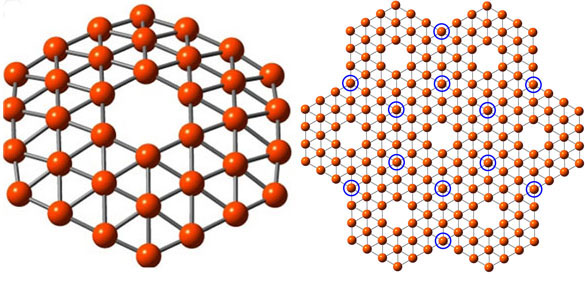
“Boron has one fewer electron than carbon and as a result can’t form the honeycomb lattice that makes up graphene. For boron to form a single-atom layer, theorists suggested that the atoms must be arranged in a triangular lattice with hexagonal vacancies — holes — in the lattice.”

A new paper shows that borophene is possible – now it just has to be made!

Zachary A. Piazza, Han-Shi Hu, Wei-Li Li, Ya-Fan Zhao, Jun Li, Lai-Sheng Wang.Planar hexagonal B36 as a potential basis for extended single-atom layer boron sheetsNature Communications, 2014; 5 DOI: 10.1038/ncomms4113

Brown University Press Release:

Unlocking the secrets of the B36 cluster
A 36-atom cluster of boron, left, arranged as a flat disc with a hexagonal hole in the middle, fits the theoretical requirements for making a one-atom-thick boron sheet, right, a theoretical nanomaterial dubbed “borophene.” Credit: Wang lab/Brown University

Graphene, a sheet of carbon one atom thick, may soon have a new nanomaterial partner. In the lab and on supercomputers, chemical engineers have determined that a unique arrangement of 36 boron atoms in a flat disc with a hexagonal hole in the middle may be the preferred building blocks for “borophene.”

Researchers from Brown University have shown experimentally that a boron-based competitor to graphene is a very real possibility.

Lai-Sheng Wang, professor of chemistry at Brown and his research group, which has studied boron chemistry for many years, have now produced the first experimental evidence that such a structure is possible. In a paper published on January 20 in Nature Communications, Wang and his team showed that a cluster made of 36 boron atoms (B36) forms a symmetrical, one-atom thick disc with a perfect hexagonal hole in the middle.

“It’s beautiful,” Wang said. “It has exact hexagonal symmetry with the hexagonal hole we were looking for. The hole is of real significance here. It suggests that this theoretical calculation about a boron planar structure might be right.”

It may be possible, Wang said, to use B36 basis to form an extended planar boron sheet. In other words, B36 may well be the embryo of a new nanomaterial that Wang and his team have dubbed “borophene.”

“We still only have one unit,” Wang said. “We haven’t made borophene yet, but this work suggests that this structure is more than just a calculation.” ……..

Wang’s experiments showed that the B36 cluster was something special. It had an extremely low electron binding energy compared to other boron clusters. The shape of the cluster’s binding spectrum also suggested that it was a symmetrical structure. ……..

…… That structure also fits the theoretical requirements for making borophene, which is an extremely interesting prospect, Wang said. The boron-boron bond is very strong, nearly as strong as the carbon-carbon bond. So borophene should be very strong. Its electrical properties may be even more interesting. Borophene is predicted to be fully metallic, whereas graphene is a semi-metal. That means borophene might end up being a better conductor than graphene.

“That is,” Wang cautions, “if anyone can make it.”

AbstractBoron is carbon’s neighbour in the periodic table and has similar valence orbitals. However, boron cannot form graphene-like structures with a honeycomb hexagonal framework because of its electron deficiency. Computational studies suggest that extended boron sheets with partially filled hexagonal holes are stable; however, there has been no experimental evidence for such atom-thin boron nanostructures. Here, we show experimentally and theoretically that B36 is a highly stable quasiplanar boron cluster with a central hexagonal hole, providing the first experimental evidence that single-atom layer boron sheets with hexagonal vacancies are potentially viable. Photoelectron spectroscopy of B36 reveals a relatively simple spectrum, suggesting a symmetric cluster. Global minimum searches for B36 lead to a quasiplanar structure with a central hexagonal hole. Neutral B36 is the smallest boron cluster to have sixfold symmetry and a perfect hexagonal vacancy, and it can be viewed as a potential basis for extended two-dimensional boron sheets.

Without immigration OECD populations will be in decline and in crisis

January 17, 2014

In times of high unemployment the anti-immigration voices are raised very high everywhere and especially in many European countries. Much of the sentiment is rooted in racist views whether against those of Asian or African or East European origin. In Japan it is seen as threatening the homogeneity of the country. But what every politician well knows – but which some will not dare to admit for fear of losing their populist base – is that  without net immigration in, OECD countries will face an increasing crisis of declining populations, declining labour force and an increase in the  proportion of the aged. They are all very well aware that expanding the working population to at least match the increase in the “aged” proportion is critical to maintaining the standard of welfare and health care that they have become accustomed to. Increasing the retirement age – which is already on the table as trial balloons – is unavoidable because even with immigration the proportion of the working population relative to the “aged” is in decline.

In OECD countries fertility rates are already well below the replacement level of 2.1 per woman. It is higher only in Israel, Iceland and New Zealand, and in India, South Africa and Indonesia. China is already down at 1.6 and India is down to 2.63 and declining fast.

The Local

France’s fertility rate has fallen below the symbolic level of two babies per woman and 2013 saw the slowest population growth in the country for well over a decade, new data revealed this week.

The 280,000 births in 2013 marked a 1.3 percent decline from 2012 with France’s fertility rate falling from 2.03 children per woman in 2010 to 1.99 children last year, according to the France’s national statistics agency INSEE. …… 

Despite the drop in the birth rate, France remains second only to Ireland when it comes to Europe’s most fertile nations. Women in Ireland, where the population is 4.6 million, had on average 2.01 children each in 2013.

These figures stand in stark contrast to Germany and Portugal, which had the lowest fertility rates on the continent. Germany recorded a rate of 1.38 per woman, followed by Portugal with 1.28 offspring per woman.

Korea, Hungary, Spain and Japan are the other countries where fertility rates are less than 1.4.

Fertility rates (2010 data) by country is here: OECD Total fertility rates 1970, 2010

Statistics are from the OECD Library:

Total fertility rates in OECD countries have declined dramatically over the past few decades, falling on average from 2.7 in 1970 to 1.7 children per woman of childbearing age in the 2000s. In all OECD countries, fertility rates declined for young women and increased at older ages. A modest recovery in total fertility rates started in the early 2000’s, to an average level of 1.7 in 2010. The total fertility rate is below its replacement level of 2.1 in most OECD countries except Israel, Iceland and New Zealand, and in India, South Africa and Indonesia.

The last few years have seen various trends emerge in fertility rates. A drop in fertility rates has occurred, for example in Australia, New Zealand, Spain and the United States, while rates have continued to rise in Iceland, Israel, Sweden, and Switzerland. The increase in fertility stopped in many other countries. The effect of the economic downturn is as yet unknown, but persistent economic uncertainties can impact downward the number of children women may have over their reproductive life.

OECD Fertility trends

OECD Fertility trends

OECD fertility table

The difference between the decline in fertility rates between India and China is of particular interest. While some of the difference is due to different rates of development, most of the difference can be attributed to the draconian one-child policy in China. But that is now being relaxed as the coming decline in the Chinese population becomes obvious..

The shortages of the proportion of working population – unless immigration is used to mitigate the shortfall – is inevitable and will really begin to bite over the next twenty years or so.