Archive for the ‘Engineering’ Category

From graphene to borophene

January 29, 2014

Technology development waves

The discovery of graphene is leading to a new excitement in materials research. I have a notion that technology advances take place in step waves, where each step is both enabled and constrained by the materials available. Each time a new material (or material family is discovered), technology development starts very fast and then tapers off until another material comes along and ignites a new development wave.

Boron is Carbon’s neighbour in the periodic table and the discovery of graphene has ignited studies to see if a similar variation of boron would be possible.

Boron is a Group 13 element that has properties which are borderline between metals and non-metals (semimetallic). It is a semiconductor rather than a metallic conductor. Chemically it is closer to silicon than to aluminium, gallium, indium, and thallium. Crystalline boron is inert chemically and is resistant to attack by boiling HF or HCl. When finely divided it is attacked slowly by hot concentrated nitric acid.

Boron, Symbol: B, Atomic number: 5, Atomic weight: 10.811, solid at 298 K

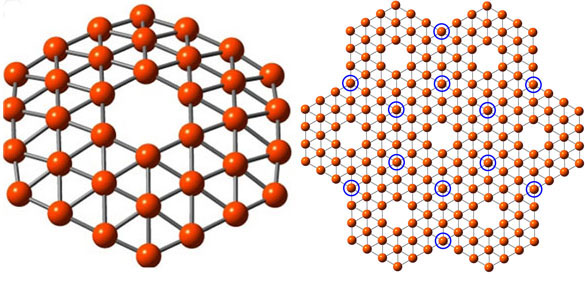
“Boron has one fewer electron than carbon and as a result can’t form the honeycomb lattice that makes up graphene. For boron to form a single-atom layer, theorists suggested that the atoms must be arranged in a triangular lattice with hexagonal vacancies — holes — in the lattice.”

A new paper shows that borophene is possible – now it just has to be made!

Zachary A. Piazza, Han-Shi Hu, Wei-Li Li, Ya-Fan Zhao, Jun Li, Lai-Sheng Wang.Planar hexagonal B36 as a potential basis for extended single-atom layer boron sheetsNature Communications, 2014; 5 DOI: 10.1038/ncomms4113

Brown University Press Release:
Unlocking the secrets of the B36 cluster
A 36-atom cluster of boron, left, arranged as a flat disc with a hexagonal hole in the middle, fits the theoretical requirements for making a one-atom-thick boron sheet, right, a theoretical nanomaterial dubbed “borophene.” Credit: Wang lab/Brown University

Graphene, a sheet of carbon one atom thick, may soon have a new nanomaterial partner. In the lab and on supercomputers, chemical engineers have determined that a unique arrangement of 36 boron atoms in a flat disc with a hexagonal hole in the middle may be the preferred building blocks for “borophene.”

Researchers from Brown University have shown experimentally that a boron-based competitor to graphene is a very real possibility.

Lai-Sheng Wang, professor of chemistry at Brown and his research group, which has studied boron chemistry for many years, have now produced the first experimental evidence that such a structure is possible. In a paper published on January 20 in Nature Communications, Wang and his team showed that a cluster made of 36 boron atoms (B36) forms a symmetrical, one-atom thick disc with a perfect hexagonal hole in the middle.

“It’s beautiful,” Wang said. “It has exact hexagonal symmetry with the hexagonal hole we were looking for. The hole is of real significance here. It suggests that this theoretical calculation about a boron planar structure might be right.”

It may be possible, Wang said, to use B36 basis to form an extended planar boron sheet. In other words, B36 may well be the embryo of a new nanomaterial that Wang and his team have dubbed “borophene.”

“We still only have one unit,” Wang said. “We haven’t made borophene yet, but this work suggests that this structure is more than just a calculation.” ……..

Wang’s experiments showed that the B36 cluster was something special. It had an extremely low electron binding energy compared to other boron clusters. The shape of the cluster’s binding spectrum also suggested that it was a symmetrical structure. ……..

…… That structure also fits the theoretical requirements for making borophene, which is an extremely interesting prospect, Wang said. The boron-boron bond is very strong, nearly as strong as the carbon-carbon bond. So borophene should be very strong. Its electrical properties may be even more interesting. Borophene is predicted to be fully metallic, whereas graphene is a semi-metal. That means borophene might end up being a better conductor than graphene.

“That is,” Wang cautions, “if anyone can make it.”

AbstractBoron is carbon’s neighbour in the periodic table and has similar valence orbitals. However, boron cannot form graphene-like structures with a honeycomb hexagonal framework because of its electron deficiency. Computational studies suggest that extended boron sheets with partially filled hexagonal holes are stable; however, there has been no experimental evidence for such atom-thin boron nanostructures. Here, we show experimentally and theoretically that B36 is a highly stable quasiplanar boron cluster with a central hexagonal hole, providing the first experimental evidence that single-atom layer boron sheets with hexagonal vacancies are potentially viable. Photoelectron spectroscopy of B36 reveals a relatively simple spectrum, suggesting a symmetric cluster. Global minimum searches for B36 lead to a quasiplanar structure with a central hexagonal hole. Neutral B36 is the smallest boron cluster to have sixfold symmetry and a perfect hexagonal vacancy, and it can be viewed as a potential basis for extended two-dimensional boron sheets.

China’s Jade Bunny apparently stuck on the moon

January 26, 2014

(I see that Chinese news reports usually translate “Yutu” as “Jade Rabbit” but from this version of the legend I prefer “Jade Bunny” as being more appropriate to the lunar creatures who went to Chang’e’s assistance and where the reincarnation of her husband Hou Yi was the Jade Bunny)

In a setback – apparently due to the difficult lunar terrain, the Jade Bunny lunar rover has suffered a “mechanical control abnormality” – which I take to mean that it is stuck and not responding to commands. China Daily has the story

China’s moon rover, Yutu (Jade Rabbit), has experienced a mechanical control anomaly, and scientists are organizing repairs. The abnormality occurred due to “complicated lunar surface environment,” the State Administration of Science, Technology and Industry for National Defence (SASTIND) said on Saturday, without giving further details. The abnormality emerged before the rover entered its second dormancy at dawn on Saturday asthe lunar night fell, according to SASTIND.

The lander, another part of the Chang’e-3 probe, also “fell asleep” earlier on Friday. The pair went dormant for two weeks about one month ago when the first lunar night of the mission occurred.

 ….. The Chang’e-3 lunar probe soft-landed on the Moon on December 14. Yutu separated from the lander hours later.

The success of the Chang’e-3 mission makes China the third country to soft-land a spacecraft on lunar soil after the United States and the former Soviet Union.

Lunar panorama: Chang’e 3 lander in Out of this World

Jade Bunny on the moon on 22nd December 2013 (photo Xinhua)

Jade Bunny on the moon on 22nd December 2013
(photo Xinhua)

Leaking fuel from the wing captured by Norwegian Dreamliner passengers

January 24, 2014

Following on from my previous post, Norwegian’s troubles with Boeing Dreamliner planes continue. This report from Nordlys.no is about a cancelled Norwegian Dreamliner flight from Bangkok to Oslo on 19th January where passengers took pictures and video of fuel pouring out of the aircraft’s wing while it was taxiing at take-off! The take-off was aborted and the flight cancelled – fortunately

...

Fuel leaking from the wing of a Norwegian Dreamliner at Bangkok Airport – photo Ann Kristin Balto

Nordlys.no: Ann Kristin Balto of Tromso was one of the 285 passengers waiting 19 hours for the delayed flight from Bangkok to Oslo.

She took the photo which shows how large amounts of fuel flowed out of the right wing of the Boeing 787-8 Dreamliner aircraft, …..

“When they discovered the error, they asked us not to take pictures because of the explosion hazard. Those who had already taken pictures were asked by the cabin crew if they could delete them”, said Balto.

Lasse Hagerupsen, a bank manager from Harstad was in a group of six and also noticed fuel leaking from the aircraft during taxiing.

“As the plane taxied to the runway and was about to take off, more passengers began to smell gasoline. The passengers alerted flight attendants who in turn reported to the cockpit. When the fuel ran out of the wing a half a meter long puddle of fuel was left by plane”. …. 

The bank manager confirmed that the attendants did not like that it was photographed. It was described by Norwegian as being due to defects in a valve.

The flight was canceled and the nearly 300 passengers were bussed to different hotels.

This one gives me some goose-bumps. I have seen the devastation from fuel-leak explosions and this could have gone really bad.

But all’s well ……

Dreamliner reliability is still short of the mark

January 24, 2014

Whether an aircraft is “available” to fly – whether a flight is scheduled or not –  is a measure – mainly – of the intrinsic soundness of that aircraft and its maintenance. The “dispatch reliability” of an aircraft or a type of aircraft is a composite measure of the performance of both the aircraft and the operator.

Aircraft availability and dispatch reliability and availability are two vital signs of any aviation operation. Availability refers to whether the aircraft is available for a flight, whether scheduled or not. An aircraft in for maintenance cannot be flown, and thus is not available. …. At its most basic, aircraft dispatch reliability accounts for whether the aircraft took-off on time and if not, why? If the dispatch performance and/or reliability of the aircraft is poor, then so is the level of service. …….

(more…)

Rosetta awakes

January 21, 2014

The European Space Agency is – justifiably – feeling pleased with itself:

Rosetta wake-up signal

It was a fairy-tale ending to a tense chapter in the story of the Rosetta space mission this evening as ESA heard from its distant spacecraft for the first time in 31 months.

Rosetta is chasing down Comet 67P/Churyumov-Gerasimenko, where it will become the first space mission to rendezvous with a comet, the first to attempt a landing on a comet’s surface, and the first to follow a comet as it swings around the Sun.

Since its launch in 2004, Rosetta has made three flybys of Earth and one of Mars to help it on course to its rendezvous with 67P/Churyumov-Gerasimenko, encountering asteroids Steins and Lutetia along the way.

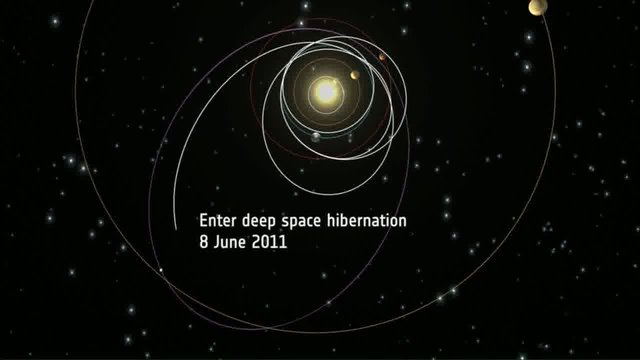
Operating on solar energy alone, Rosetta was placed into a deep space slumber in June 2011 as it cruised out to a distance of nearly 800 million km from the warmth of the Sun, beyond the orbit of Jupiter.

Now, as Rosetta’s orbit has brought it back to within ‘only’ 673 million km from the Sun, there is enough solar energy to power the spacecraft fully again.

Thus today, still about 9 million km from the comet, Rosetta’s pre-programmed internal ‘alarm clock’ woke up the spacecraft. After warming up its key navigation instruments, coming out of a stabilising spin, and aiming its main radio antenna at Earth, Rosetta sent a signal to let mission operators know it had survived the most distant part of its journey.

The signal was received by both NASA’s Goldstone and Canberra ground stations at 18:18 GMT/ 19:18 CET, during the first window of opportunity the spacecraft had to communicate with Earth. It was immediately confirmed in ESA’s space operations centre in Darmstadt and the successful wake-up announced via the @ESA_Rosetta twitter account, which tweeted: “Hello, World!”

Rosetta will be woken up Monday at 1000GMT after a two-and-a-half year sleep

January 19, 2014

The European Space Agency will try and wake-up its sleeping Rosetta spacecraft on Monday at 1000 GMT. The spacecraft entered deep space hibernation in June 2011 when it was too far away from the sun to capture much solar energy. If this works it will be a considerable achievement considering that Rosetta was launched 10 years ago  and the communications technology on board is effectively at least two  “generations” old!

Rosetta trajectory till June 2011

ESA:

At 10:00 GMT on Monday, the most important alarm clock in the Solar System will wake up ESA’s sleeping Rosetta spacecraft.

Rosetta is chasing comet 67P/Churyumov–Gerasimenko and, since its launch in 2004, has made three flybys of Earth and one of Mars to build up enough speed and get on a trajectory towards the comet. It has also encountered asteroids Steins and Lutetia along the way.

Operating on solar energy alone, the spacecraft was placed into a deep space slumber in mid-2011 as it cruised far from the Sun and out towards the orbit of Jupiter. To prepare for its long sleep, Rosetta was oriented so that its solar arrays faced the Sun and put into a once per minute spin for stability.

The only devices left running were its computer and several heaters.

Thirty-one months later, Rosetta’s orbit has brought it back to within ‘only’ 673 million kilometres of the Sun, and there is finally enough solar energy to power the spacecraft fully again. It is time to wake up.

Rosetta’s computer is programmed to carry out a sequence of events to re-establish contact with Earth on 20 January, starting with an ‘alarm clock’ at 10:00 GMT.

Immediately after, the spacecraft’s startrackers will begin to warm up, taking around six hours.

Then its thrusters will fire to stop the slow rotation. A slight adjustment will be made to Rosetta’s orientation to ensure that the solar arrays are still facing directly towards the Sun, before the startrackers are switched on to determine the spacecraft’s attitude.

Once that has been established, Rosetta will turn directly towards Earth, switch on its transmitter and point its high-gain antenna to send its signal to announce that it is awake.

Because of Rosetta’s vast distance – just over 807 million kilometres from Earth – it will take 45 minutes for the signal to reach the ground stations. The first opportunity for receiving a signal on Earth is expected between 17:30 GMT and 18:30 GMT.

Graphic of mission

Rosetta Mission (ESA via BBC)

A garbage disposal system for space junk

January 17, 2014

NASA keeps track of all the debris in orbit. About 13,000 known objects are bigger than 10 centimeters in diameter and there are more than 100,000 pieces of orbital debris between 1 cm and 10 cm. Pieces smaller than 1 cm number in the tens of millions. All pieces of debris larger than 10 cm are carefully tracked using radar and telescopes.

Many schemes have been proposed for trying to get rid of space debris orbiting the Earth. The schemes have ranged from space harpoons, clouds of of ballistic gas, housekeeping, robotic satellites and laser cannon. The Japanese have a plan for an electrodynamic tether to be attached to the debris by a robot arm. the tether then generates an electric field as it orbits around the Earth and the magnetic field then encourages the debris to drop into lower orbits and eventually burn up. A tether is going to be sent up into space at the end of February for a trial.

Electrodynamic tether

SpaceDaily: Researchers at The Japan Aerospace Exploration Agency (JAXA) have developed what they called an electrodynamic tether made from thin wires of stainless steel and aluminium.

The idea is that one end of the strip will be attached to one of the thousands of dead satellites or bits of rocket that are jamming up space and endangering working equipment.

The electricity generated by the tether as it swings through the Earth’s magnetic field is expected to have a slowing effect on the space junk, which should, scientists say, pull it into a lower and lower orbit.

Eventually the detritus will enter the Earth’s atmosphere, burning up harmlessly long before it has chance to crash to the planet’s surface.

“The experiment is specifically designed to contribute to developing a space debris cleaning method,” said Masahiro Nohmi, associate professor at Kagawa University, who is working with JAXA on the project, told AFP. Nohmi said a satellite developed by the university is expected to be launched into space on February 28, with the tether aboard.

“We have two main objectives in the trial next month,” he said. “First, to extend a 300-metre (1,000-foot) tether in orbit and secondly to observe the transfer of electricity.” The actual reeling in of orbiting rubbish will be the objective of future experiments, he said. A spokesman for JAXA said the agency also plans to conduct its own trial on a tether in 2015.

More than 20,000 bits of cast off equipment, including old satellites, pieces of rocket and other fragments are uselessly orbiting the Earth in a band 800-1,400 kilometres (500-900 miles) from the surface of the planet at terrific speed. 

JAXA write:

If we are able to calculate the motion of debris, we can attach a propulsion system for removal. As the propulsion system, we have envisioned an “electrodynamic tether”, which is extremely efficient because it does not require fuel. The end of an electrically conductive cord (tether) is attached to the debris, transferring it to a lower orbit through the Lorentz force generated by the interference between Earth’s magnetic field and the current flowing through the tether, causing it to re-enter the atmosphere. Two methods are being considered for attaching the tether. One is a method of using a robot arm, for example, to hook the end of the tether into a 1-meter-diameter hole in a payload attachment fitting used as a base for mounting the satellite onto the rocket.  Another is a method where the side of the rocket stage, which is extremely thin for reduced weight, is approached and harpooned by the tether end to attach it. This method is considered to be a safer operation since the tether can be attached from a distance of 10 to 20m.

Dreamliner battery fix fails as Tesla recalls 29,000 cars for battery charger fault

January 14, 2014

The overheating problems of lithium-ion batteries and their chargers seem to more serious than just teething problems. Boeing and Tesla continue to have issues with thermal runaway and permanent fixes are proving elusive.

Boeing’s problems with the Dreamliner batteries are not yet over. The fix for its battery problem in March  does not seem to have worked for yet another Japan Airlines aircraft. The lithium-ion batteries are now having issues even with Tesla who have recalled “29,000 Model S vehicle 240-volt charging adapters that could overheat and cause a fire. The company will update software in the electric vehicles and send owners replacement adapters.”

The Telegraph: 

Japan Airlines has temporarily grounded one of its 787 Dreamliners after white smoke was spotted outside the plane, warning lights in the cockpit indicated possible faults with the main battery and charger, and one battery cell appeared to be leaking.

Boeing said it was “aware of the 787 issue that occurred Tuesday afternoon at Narita, which appears to have involved the venting of a single battery cell”.

The incident comes nearly a year to the day after Japan Airlines and All Nippon Airways grounded their 787 fleets after two 787 batteries overheated on two different planes in less than two weeks.

Global regulators grounded the worldwide fleet on January 16, 2013. The planes remained grounded for more than three months while Boeing redesigned the battery, charger and containment system to ensure battery fires would not put the airplane at risk. The cause of the battery problems has not been determined.

On Tuesday, Japan Airlines said maintenance engineers who were in the cockpit saw white smoke from the cockpit. When they went outside the aircraft the smoke had dispersed.

Detroit News:

…. The Palo Alto, Calif., automaker told the National Highway Traffic Safety Administration that its review found that defective or improperly installed wall receptacles that the adapter plugged into could cause problems, including melted adapters and or a fire. While the number of incidents remains small, and Tesla’s review to date points to the building or wiring as the primary cause of failed adapters, “the company has determined that a voluntary recall is appropriate as a precautionary measure,” Tesla said.

Since late 2012, Tesla said 2.7 percent of universal mobile connector adapters have been returned and “showed signs of internal damage only and that stopped vehicle charging.” …

….. In November, NHTSA opened a formal investigation into 13,100 Tesla Motors Model S electric cars after three reports of battery fires that occurred after accidents. ……. The announcement of the investigation came after NHTSA had said in October it would not open a formal investigation after a fire in Kent, Wash., occurred when debris struck the underside of a Model S and caused the battery to catch fire. After a fire in Mexico and a fire earlier this month near Smyrna, Tenn., NHTSA decided to open an investigation.

NHTSA said in both of the incidents in the U.S., fires occurred after the undercarriage of the cars hit metal debris on the road, which damaged the battery tray and caused “thermal runaway.” “In each incident, the vehicle’s battery monitoring system provided escalating visible and audible warnings, allowing the driver to execute a controlled stop and exit the vehicle before the battery emitted smoke and fire,” NHTSA said.

Jaguar Land Rover now the jewel in the Tata Motors crown

January 12, 2014

When the Tata Group acquired Jaguar Land Rover from Ford Motors in 2008 there were many voices in the UK which were highly sceptical. Shareholders in India were concerned that group debt would be too high. They were scared that managing JLR from India could be too big a mouthful and would jeopardise the growth of Tata Motors and its core business in India. In the UK there were fears that the British automotive tradition and history would be threatened.

But five years on, this acquisition has been a resounding success. So much so that it is JLR and its growth which is now providing the bulk of the revenue (72%) and the profit (88%) for Tata Motors and which has more than compensated for the Indian operations which are stagnating in the current downturn.

It is JLR which is now truly the jewel in the Tata Motors crown.

The all-aluminum F-TYPE Coupe range will deliver, in production form, the uncompromised design vision of the Jaguar C-X16 concept, and will complement the existing  F-TYPE Convertible, winner of the 2013 ‘World Car Design of the Year’ award.

The all-aluminum F-TYPE Coupe range will deliver, in production form, the uncompromised design vision of the Jaguar C-X16 concept, and will complement the existing F-TYPE Convertible, winner of the 2013 ‘World Car Design of the Year’ award.

Bloomberg: 

Jaguar Land Rover, the luxury-vehicle division of India’s Tata Motors Ltd. (TTMT), reported record global sales last year, driven by growth in the Asia Pacific and China region.

Jaguar Land Rover’s total worldwide sales rose 19 percent last year to 425,006 vehicles, according to an e-mailed statement. Jaguar brand sales jumped 42% to 76,668 vehicles, the most since 2005, while Land Rover increased 15% for an annual record of 348,338 vehicles, the company said.

Jaguar Land Rover, which Mumbai-based Tata Motors bought from Ford Motor Co. in 2008 for $2.5 billion, accounted for 72 percent of group revenue and 88 percent of operating profit for the year ended March 31. In the quarter ended in September, Tata Motors posted profit that beat analyst estimates as rising Jaguar Land Rover sales outweighed a loss at the parent company’s Indian business. …… 

…. Sales in Asia Pacific and the China region jumped 30 percent during 2013, North America rose 21 percent, the U.K. grew 14 percent, Europe 6 percent and other overseas markets increased 23 percent, according to the statement. 

Under Tata, Jaguar and Land Rover have targeted emerging markets such as China and Russia for growth. In 2013, Jaguar Land Rover had record sales in 38 markets, including Russia, Brazil, Korea and Canada.

The sales growth in 2013 was driven by Jaguar’s F-Type convertible and Land Rover’s Range Rover and Range Rover Evoque models, it said. The F-Type began shipping in May.

It was “a great year in which we have seen some incredibly exciting new models launched to customers across the world,” Andy Goss, Jaguar Land Rover Group sales operations director, said in the statement. “The Range Rover Sport, F-Type, new engines and drivetrains, and a number of 14 Model Year enhancements to our existing lineup have seen Jaguar Land Rover continue to build strong sales momentum in every global region.”

Flawless launch of ISRO’s GSLV

January 5, 2014

ISRO is riding high.

After a flawless launch of the GSLV-D5 using an indigenous cryogenic engine for the first time, it now remains to insert the GSAT-14 satellite into its operational orbit. In three orbit raising manoeuvres, using the Liquid Apogee Motor, on board, GSAT-14 will reach the intended circular Geo-stationary orbit.

Graphic ISRO

“It is a tough job to understand and master cryogenic technology. It is ultimate and we have put in a lot of efforts and made it possible. Today, we can say and prepare with more confidence for the next mission of C-25 stage with 25 tonnes of propellant and 20 tonnes of cryogenic engine thrust for the GSLV MK-3 D-1 mission in early 2017. The high-end cryogenic engine is slated for completion and testing by 2015,” Vikram Sarabhai Space Centre director S Ramakrishnan told TOI minutes after the lift-off of GSLV-D5.