Archive for the ‘Engineering’ Category

Final Mars Orbiter orbit increase successfully completed 15th November 2110 CET

November 15, 2013

ISRO has announced via Facebook that the next burn to raise the earth orbit (apogee) to close to 200,000 km will be carried out at 0127 IST (2057 CET 15th November). If this goes as planned the next manoeuver is expected to be to inject the probe into a Trans-Mars trajectory on 1st December.

2130 CET: Just reported to have been successfully completed The observed change in Apogee is from 118642 km to 192874 km”.

Updates here as they become available.

UPDATES:  

  • 2045 CET Forward rotation to prepare for burn completed. 
  • 2058 CET: 440N Liquid Engine started firing to raise the apogee to about 192,000 km in this 5th Manoeuver
  • Craft at perigee. Awaiting post burn report.
  • 2110 Burn reported completed
  • It may be a while before tracking data can confirm the new orbit
  • The fifth orbit raising manoeuvre of Mars Orbiter Spacecraft, starting at 01:27:00 hrs (IST) on Nov 16, 2013, with a burn Time of 243.5 seconds has been successfully completed.The observed change in Apogee is from 118642km to 192874km.

===================================

Tonight is going to be the culmination of the various baby steps MOM has been taking by gradually soaring to higher apogees around Mother Earth. This manoeuver, scheduled at 01:27 hrs IST, will take the spacecraft to – almost half the way to moon – about two lakh (200,000) kilometers.

The distance to the moon is 384,400 km (and I make 200,000 to be a little more than half-way)!

mangalyaan final earth orbit increase - isro

mangalyaan final earth orbit increase – isro

At this distance Deep Space Tracking will become necessary.

The Indian Deep Space Network consists of a 18-m and a 32-m antennae that are established at the IDSN campus, Byalalu, Bangalore. The Network is augmented with a couple of stations in the western hemisphere in addition to the 64-m antenna in Bearslake, Russia to improve the visibility duration and to provide support from the antipodal point. …..

External network stations APL, JPL (Goldstone, Canberra, Madrid), Hawaii, Brazil (Alcantara, Cuiaba) are requisitioned in for the purpose of extended visibility of Launch and Early Orbit Phase (LEOP) operations, as well as to gain the near continuous visibility during the normal phase operations. All the external stations will ensure the required compatibility to communicate with the spacecraft.

The network as used for Chandrayaan and expected to be used for Mangalyaan is shown below.

Indian Deep Space Network used for Chandrayaan - isro

Indian Deep Space Network used for Chandrayaan – isro
India Mars Orbiter Mission Update – 14th November and ISRO is silent

November 14, 2013

In spite of a great deal of ballyhoo about ISRO’s heightened and improved publicity, their website is remarkably short of information or updates. There has been nothing new since they reported that the earth orbit correction had succeeded and that was 48 hours ago. They have not even put out a revised mission plan. No doubt they have to be a typical Indian Government bureaucratic organisation but they have much to learn about public relations. They are still stuck in the paradigm of “No news is good news” and haven’t quite realised that “No news, when news is expected, is bad news”.

I would have thought that they could at least have put out a daily bulletin. The long silence from ISRO suggests that something may be amiss. (The FB page contains virtually no forward looking information – except the pre-mission plans and photographs). 

Indian science journalists apparently just wait for official press releases and have no updates and little background to offer. Their lack of pro-active coverage and apparent lack of interest leaves much to be desired.

The next scheduled burn is supposed to be on 18th November (according to the original mission plan) to raise the orbit (apogee) to about 200,000km. That would then be sufficient for the injection into a Trans-Mars trajectory with the scheduled sixth burn (actually seventh including the corrective burn 2 days ago). But the mission plan must have been revised. Yet ISRO has not released any information. I can understand their fear of putting out a plan and not being able to keep to it but they will one day realise that being up-front with the plan and its critical parts for an R & D program is by far the best way of keeping on top of communications. And in keeping messages on track.

In the meantime the ToI reports that:

After having successfully tackled a momentary glitch in Mangalyaan’s orbital manoeuvres on Monday, Isro scientists have postponed a crucial exercise. The exercise is to test the five instruments aboard the Mangalyaan before the orbiter embarks on its long journey to Mars in early December. The instruments were to be activated on Monday this week for a brief while to ensure that they work fine. But this procedure will now be carried out next week.

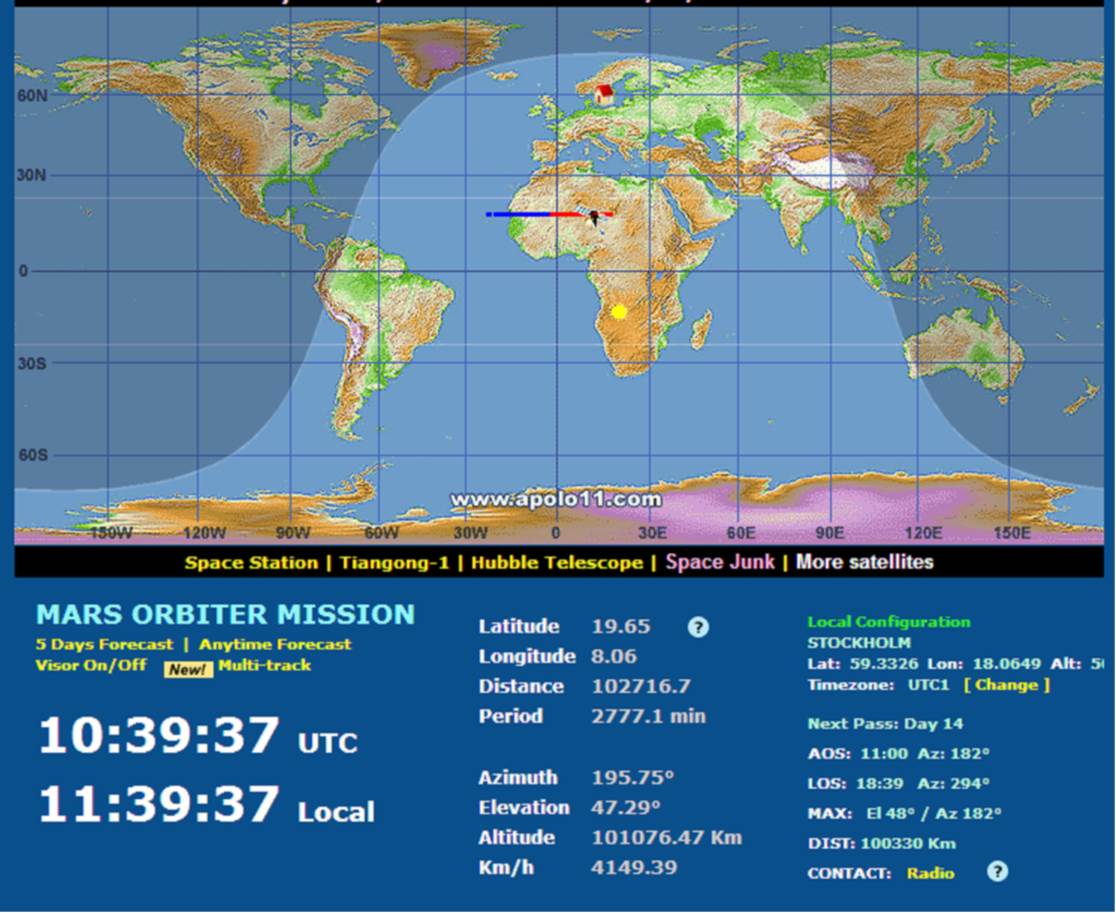
I have been trying to follow the mission via the live satellite tracking websites (satview.org and n2yo.com) but I am a little dubious as to how “live” they actually are. I noted that after the corrective burn 48 hours ago, both sites took almost 24 hours before they showed any change to the orbit.

Right now satview is showing a position over Africa at an altitude over 100,000 km but this data needs to be taken with a pinch or two of salt.

Live track Mars Orbiter satview.org

Live track Mars Orbiter satview.org

n2yo.com also shows the same position and gives the following data. Note that both sites give the same location and now also give much the same altitude. They do not match on “speed”. Satview gives a speed of about 4149km/h which is about 1.15km/s whereas n2yo gives a “speed” of 6.9 km/s. I am not quite sure what “speed” is being reported.

MARS ORBITER MISSION

LOCAL TIME:
12:13:56
UTC:
11:13:56
LATITUDE:
19.09
LONGITUDE:
-0.1
ALTITUDE [km]:
103132.47
ALTITUDE [mi]:
64083.55
SPEED [km/s]:
6.91
SPEED [mi/s]:
4.29
AZIMUTH:
204
SSW
ELEVATION:
+48.9
RA:
14h 45m 32s
DEC:
17° 1′ 12”
The satellite is in day light
PERIOD:  1434m


UPDATE! Indian Mars orbiter supplementary firing successful

November 12, 2013

The supplementary burn made this morning to correct for the incompleteness of the 4th burn yesterday appears to have been successful. The objective was to reach an orbit (apogee) of 100,000 km and this seems to have been achieved with some margin to spare. The observed change is to an orbit with an apogee of 118,462 km. The next step on 18th November is to raise the apogee to just under 200,000 km and then insert the craft into the Trans-Mars trajectory on 1st December.

So far, so good and the success of the correction by the supplementary burn is both impressive and encouraging.

ISRO: 

  • Fourth supplementary orbit raising manoeuvre of Mars Orbiter Spacecraft, starting at 05:03:50 hrs(IST) on Nov 12, 2013, with a burn Time of 303.8 seconds has been successfully completed.The observed change in Apogee is from 78276km to 118642km.

The launch and subsequent orbit manoeuvre burns so far are summarised here:

  1. The Mars Orbiter Spacecraft, India’s first interplanetary spacecraft, was launched into an elliptical earth orbit with a perigee of 248.4 km and an apogee of 23,550 km, inclined at an angle of 19.27 deg to the equator by India’s Polar Satellite Launch Vehicle in its twenty fifth flight (PSLV-C25). The achieved orbit was very close to the intended one. The launch was conducted from Satish Dhawan Space Centre (SDSC) SHAR, Sriharikota on November 05, 2013. The launch of Mars Orbiter Spacecraft occurred as scheduled from the First Launch Pad at 2:38 pm IST after a fifty six and a half hour count down. 
  2. The first orbit-raising manoeuvre of India’s Mars Orbiter Spacecraft was performed at 01:17 hrs Indian Standard Time (IST) early this morning (November 07, 2013) when the 440 Newton Liquid Engine of the spacecraft was fired for 416 seconds by commanding it from Spacecraft Control Centre (SCC) at ISRO Telemetry, Tracking and Command Network (ISTRAC) at Peenya, Bangalore. With this engine firing, the spacecraft’s apogee (farthest point to Earth) has been raised to 28,825 km, while its perigee (nearest point to Earth) is at 252 km. 
  3. The second orbit raising manoeuvre of Mars Orbiter Spacecraft, starting at 02:18:51 hrs(IST) on Nov 08, 2013, with a burn time of 570.6 seconds has been successfully completed.The observed change in Apogee is from 28814 km to 40186 km.
  4. The third orbit raising manoeuvre of Mars Orbiter Spacecraft, starting at 02:10:43 hrs(IST) on Nov 09, 2013, with a burn time of 707 seconds has been successfully completed.The observed change in Apogee is from 40186km to 71636km.
  5. In the fourth orbit-raising operation conducted on Nov 11, 2013, the apogee (farthest point to Earth) of Mars Orbiter Spacecraft was raised from 71,623 km to 78,276 km by imparting an incremental velocity of 35 metres/second (as against 130 metres/second originally planned to raise apogee to about 100,000 [1 lakh] km). The spacecraft is in normal health. A supplementary orbit-raising operation is planned for November 12, 2013, at 0500 hrs IST to raise the apogee to nearly 1 lakh km. 
mangalyaan trajectory

mangalyaan trajectory: image ISRO

Related posts: 

Indian Mars orbiter’s fourth burn in earth orbit only partially succesful

India’s frugal Mars orbiter mission completes 3rd burn in earth orbit

Frugal engineering for India’s Mars mission

Indian Mars orbiter’s fourth burn in earth orbit only partially succesful

November 11, 2013
The Indian Mars Orbiter Mission met its first setback last night when the planned 4th burn in earth orbit was achieved but did not or could not impart the extra velocity that was planned. The orbit rose from about 71,000 km (apogee) to 78,000 km instead of the planned 100,000 km. A supplementary burn is planned for the early hours of 12th November (burns are scheduled for when the spacecraft is near perigee and within clear and easy range of tracking stations).
The current position of the spacecraft is between India and Saudi Arabia

ISRO Press Release:

In the fourth orbit-raising operation conducted this morning (Nov 11, 2013), the apogee (farthest point to Earth) of Mars Orbiter Spacecraft was raised from 71,623 km to 78,276 km by imparting an incremental velocity of 35 metres/second (as against 130 metres/second originally planned to raise apogee to about 100,000 [1 lakh] km). The spacecraft is in normal health. A supplementary orbit-raising operation is planned tomorrow (November 12, 2013) at 0500 hrs IST to raise the apogee to nearly 1 lakh km. 

During the orbit-raising operations conducted since November 7, 2013, ISRO has been testing and exercising the autonomy functions progressively, that are essential for Trans-Mars Injection (TMI) and Mars Orbit Insertion (MOI).  

During the first three orbit-raising operations, the prime and redundant chains of gyros, accelerometers, 22 Newton attitude control thrusters, attitude and orbit control electronics as well as the associated logics for their fault detection isolation, and reconfiguration have been exercised successfully. The prime and redundant star sensors have been functioning satisfactorily. The primary coil of the solenoid flow control valve was used successfully for the first three orbit-raising operations. 

During the fourth orbit-raising operations held today (November 11, 2013), the redundancies built-in for the propulsion system were exercised, namely, (a) energising the primary and redundant coils of the solenoid flow control valve of 440 Newton Liquid Engine and (b) logic for thrust augmentation by the attitude control thrusters, when needed. However, when both primary and redundant coils were energised together, as one of the planned modes, the flow to the Liquid Engine stopped. The thrust level augmentation logic, as expected, came in and the operation continued using the attitude control thrusters. This sequence resulted in reduction of the incremental velocity. 

While this parallel mode of operating the two coils is not possible for subsequent operations, they could be operated independently in sequence.

Mangalyaan current position 20131111 0830CET

Mangalyaan current position 20131111 0830CET

TOIThe first orbit-raising manoeuvre of India’s Mars Orbiter Mission was performed at 01:17 hrs Indian Standard Time (IST) early on November 07, 2013) when the 440 Newton Liquid Engine of the spacecraft was fired for 416 seconds by commanding it from Spacecraft Control Centre (SCC) at Isro Telemetry, Tracking and Command Network (ISTRAC) at Peenya, Bangalore. With this engine firing, the spacecraft’s Apogee (the farthest point to Earth) was raised to 28,825km.

The second orbit raising manoeuvre of MOM was at 02:18:51 hrs(IST) on Nov 8, 2013.The change observed in Apogee was from 28,814km to 40,186km. 

The third orbit raising manoeuvre of Mars Orbiter Mission spacecraft, starting at 02:10:43 hrs on Nov 09, 2013, was successful. The change observed in the Apogee was from 40,186 km to 71,636km.

India’s frugal Mars orbiter mission completes 3rd burn in earth orbit

November 9, 2013

There has been some criticism  (within and outside India) from the usual suspects about the frugally-engineered, Indian, Mangalyaan Mars Orbiter mission as “being too expensive” for a developing country like India. I tend to discount these voices which merely continue the long, retrograde and shameful tradition of the Luddites. Some of these voices are of those who would like humankind to return to the trees. Others are of those who feel threatened by the idea of “backward nations” moving into space.

Reaching Mars is not that easy. More missions have failed than have succeeded. The full list of Mars missions is here. There are many crucial steps left for the Mangalyaan mission to achieve and success is far from assured.

TOI: India’s Mars Rover Mission (MOM) named ‘Mangalyaan’ is the 42nd mission aimed at understanding Mars. Out of the 41 missions so far, 25 have been declared failures and only 16 have been a success. Even the latest Phobos-Grunt/Yinghuo-1 launched by Russia/China was a failure as it got stranded in the earth’s orbit. 

Close on the heels of ‘Mangalyaan’ being sent into space by India, the United States (US) is also gearing up for the MAVEN mission to be launched on November 18, 2013. The mission is intended to be a step towards ‘unravelling the planetary puzzle about Mars’. The US is also gearing up for the Mars Rover 2020 mission to understand ‘Martian atmosphere’.

Underlying all missions is the vision of Mars one day being inhabited by humans. And that vision transcends the petty and mean criticism of those who can only see a “glass half empty”.

Last night the 3rd of five rocket burns was completed to lift the earth orbit of Mangalyaan from 40,186 km to 71,636 km (apogee). The fourth and fifth burns are planned for November 11th and 16th to raise the apogee to 100,000 km and then to 192,000 km. The 6th burn will be to leave Earth’s orbit and  insert the spacecraft into a trajectory towards Mars. The Trans-Mars injection is expected around 12.42 AM on December 1st.

ISRO: The third orbit raising manoeuvre of Mars Orbiter Spacecraft, starting at 02:10:43 hrs(IST) on Nov 09, 2013, with a burn time of 707 seconds has been successfully completed. The observed change in Apogee is from 40186km to 71636km.

ISRO’s Mission Profile.

The Launch Vehicle – PSLV-C25 will inject the Spacecraft into an Elliptical Parking Orbit with a perigee of 250 km and an apogee of 23,500 km. With six Liquid Engine firing, the spacecraft is gradually maneuvered into a hyperbolic trajectory with which it escapes from the Earth’s Sphere of Influence (SOI) and arrives at the Mars Sphere of Influence. When spacecraft reaches nearest point of Mars (Peri-apsis), it is maneuvered in to an elliptical orbit around Mars by firing the Liquid Engine. The spacecraft then moves around the Mars in an orbit with Peri-apsis of 366 km and Apo-apsis of about 80000 km. 

The mission consists of following three phases:

1. Geo Centric Phase
The spacecraft is injected into an Elliptic Parking Orbit by the launcher. With six main engine burns, the spacecraft is gradually maneuvered into a departure hyperbolic trajectory with which it escapes from the Earth’s Sphere of Influence (SOI) with Earth’s orbital velocity + V boost. The SOI of earth ends at 918347 km from the surface of the earth beyond which the perturbing force on the orbiter is mainly due to the Sun. One primary concern is how to get the spacecraft to Mars, on the least amount of fuel. ISRO uses a method of travel called a Hohmann Transfer Orbit – or a Minimum Energy Transfer Orbit – to send a spacecraft from Earth to Mars with the least amount of fuel possible. 

2. Helio Centric Phase
The spacecraft leaves Earth in a direction tangential to Earth’s orbit and encounters Mars tangentially to its orbit. The flight path is roughly one half of an ellipse around sun. Eventually it will intersect the orbit of Mars at the exact moment when Mars is there too. This trajectory becomes possible with certain allowances when the relative position of Earth, Mars and Sun form an angle of approximately 44o. Such an arrangement recur periodically at intervals of about 780 days. Minimum energy opportunities for Earth-Mars occur in November 2013, January 2016, May 2018 etc. 

3. Martian Phase
The spacecraft arrives at the Mars Sphere of Influence (around 573473 km from the surface of Mars) in a hyperbolic trajectory. At the time the spacecraft reaches the closest approach to Mars (Periapsis), it is captured into planned orbit around mars by imparting ∆V retro which is called the Mars Orbit Insertion (MOI) manoeuvre. The Earth-Mars trajectory is shown in the above figure. ISRO plans to launch the Mars Orbiter Mission during the November 2013 window utilizing minimum energy transfer opportunity.

Frugal engineering for India’s Mars mission

November 6, 2013

India has been struggling to bridge the gap to more developed nations without necessarily having to follow exactly the same path as that followed by other nations. Especially to achieve the development objectives in less time than it has taken those who did it first. Doing more with less is the name of the game and “Frugal engineering” (or “frugal innovation”) is defining a new paradigm for development.

There may perhaps not be any better example of the dictum that necessity is the mother of invention than can be found in India. Whether it is a refrigerator, ECG device or an automobile, Indian engineers have brought innovative products to market by designing them outside-in. …….

It may seem a contradiction, but some infrastructure gaps in India have positively affected Indian innovation: they have forced entrepreneurs and companies to adopt technologies that make relying on existing infrastructure (creaking and unreliable as it is in many ways) simply irrelevant. Indian engineers have invented a battery-powered, ultra-low-cost refrigerator resistant to power cuts; an automatic teller machine for rural areas; and even a flour mill powered by a scooter. People in the West, with its constant access to electricity, have little motivation to pursue such innovations. The Indian mobile phone industry is the poster child for leapfrogging over infrastructural constraints. A limited fixed-line infrastructure created an opportunity for mobile phones to reach many more people. Mobile telephony is also relatively cheap, sharable, and easily repaired. And thus, a new frontier of global innovation opened in India. …… 

The Indian mission to Mars which launched yesterday is another example of frugal engineering at work.

Hindustan Times:

India’s successful Mangalyaan launch is as much a financial accomplishment as a technical milestone. The entire Mars mission has cost the Indian Space Research Organisation a mere around Rs. 450 crore ($75 million) and took 15 months to put together. Much of the Martian price tag is for ground stations and relay upgrades that will be used for other Isro projects. The actual satellite costs a mere $25 million ( Rs. 153 crore), says Pallav Bagla of Science magazine. Comparison: Nasa’s similar MAVEN Mars project will cost 10 times more and will take three times longer.

Isro is widely cited as an example of “frugal engineering” …..  A US state department scientific adviser once said that Isro had reduced satellite assembly costs to a tenth of Nasa’s.

Isro’s accomplishments are remarkable given its tiny budget: $700 million ( Rs. 4,270 crore) in 2012-13. Despite a space programme whose financial base is the ninth largest, India is generally rated the world’s number six space power.

Of this, only 7% is allotted for planetary exploration. Isro’s prime directive has and continues to be the finding of technical means to support socio-economic goals such as education, medicine, water and disaster management.

Isro also defrays government support through a commercial arm, Antrix. Through the sale of satellite imagery, satellite launches and so on, Antrix earned a pre-tax Rs. 2 billion in 2010 alone. …..

Nightmare continues: Panel falls off Air India Dreamliner in flight

October 15, 2013

A new problem every few days for Boeing with their Dreamliner but their share price does not seem to be much affected:

The Hindu: 

An Air India Boeing 787 Dreamliner. File photo

An Air India Boeing 787 Dreamliner. File photo

A large panel in the belly of a Bangalore-bound Dreamliner of Air India fell off mid-air, putting about 150 passengers on board at a grave risk, but the aircraft landed safely.

The DGCA is probing the incident which occurred on Saturday when an 8X4 feet panel in the fuselage fell off while the plane was on its way to Bangalore from Delhi, leaving a gaping hole in the cargo hold, official sources said.

There were 148 persons, including the crew, on board flight AI-803 which landed safely at the Bangalore airport, the sources said, adding that the hole was noticed by the ground staff when they came to inspect the aircraft for its return journey.

A spare panel was flown to Bangalore and fitted on the Boeing 787, which was later declared fit to fly. But the return flight was delayed by over nine hours, they said.

Confirming the incident, airline officials said a panel had fallen off but was replaced and the aircraft was cleared for flights.

“Yes, there was a gaping hole. During the normal transit inspection, it was observed. Engineers immediately rectified it,” an AI official said requesting anonymity.

“It was not an emergency. There was no safety problem,” he added.

Besides long-haul international operations, Air India operates the Dreamliners on domestic routes like from Delhi to Chennai, Bangalore and Kolkata.


Norwegian returns a Dreamliner to Boeing to be fixed

September 28, 2013

I suppose it must be under guarantee. It is further publicity that Boeing could well do without. Boeing have been asked to take back one of Norwegian’s two Dreamliners currently stuck in Bangkok with a hydraulic pump failure. Boeing will carry out the repairs in Stockholm. But what must be particularly galling for Boeing is that Norwegian is leasing an Airbus A340 while the Dreamliner is being fixed. No doubt the leasing cost will be billed to Boeing but EADS will be pleased that the Airbus has the better perception of reliability.

The Dreamliner runs the risk of becoming  a Nightmareliner if Boeing cannot get the plane away from its many “teething” troubles.

Boeing 787-8JP Dreamliner

Norwegians first Dreamliner Air Team Images : Photo by Lee A. Karas

Boeing 787-8JP Dreamliner

Manufacturer: Boeing   Type/Model: 787-8 Dreamliner   Registration: LN-BKA   Colour Scheme: Norwegian Air Shuttle
Location: Everett, United States  Taken By: Lee A. Karas   Date Taken: 3rd April 2013
Reuters: Budget airline Norwegian Air Shuttle  is returning one of its brand new Dreamliners to Boeing demanding repairs after the jet has suffered repeated breakdowns, it said on Saturday.Norwegian Air Shuttle will instead lease an Airbus A340 from HiFly to keep its long-haul business going and will not take back the Boeing 787 Dreamliner until it is more reliable, a spokesman said.“The aircraft’s reliability is simply not acceptable, our passengers cannot live with this kind of performance,” spokesman Lasse Sandaker-Nielsen told Reuters.“We are returning the aircraft to Boeing to improve its reliability.” ….Norwegian launched long-haul operations this year and hoped to capitalize on Dreamliner’s lower operating cost as the jet’s lighter-weight engines promised a 20 percent savings on fuel.

But its first two Dreamliners, part of a planned fleet of eight, broke down over half a dozen times in September, forcing it to lease back-up planes on short notice or cancel flights.

Norwegian summoned Boeing’s management this week and the aircraft manufacturer promised to locate spare parts centers at all of the airline’s long-haul destinations and send a team of engineers to the Nordics to monitor the planes.

The aircraft that will be returned is still stuck in Bangkok after a hydraulic pump failure this week and will be flown back to Stockholm where Boeing will carry out the work.

2,000 year old thin film coating technology

July 25, 2013

Ancient gold and silversmiths used empirical methods with little knowledge of physics and chemistry to gild (silver and gold) statues and other works of art. It was an art – generally involving the use of mercury – which was also used by counterfeiters. Many of their techniques are still unknown. Some of the quality they achieved has still not been matched. A new paper is published in Accounts of Chemical Research (paywalled).

ACS Press ReleaseGabriel Maria Ingo and colleagues point out that scientists have made good progress in understanding the chemistry of many ancient artistic and other artifacts — crucial to preserve them for future generations. Big gaps in knowledge remained, however, about how gilders in the Dark Ages and other periods applied such lustrous, impressively uniform films of gold or silver to intricate objects. Ingo’s team set out to apply the newest analytical techniques to uncover the ancients’ artistic secrets.

They discovered that gold- and silversmiths 2,000 years ago developed a variety of techniques, including using mercury like a glue to apply thin films of metals to statues and other objects. Sometimes, the technology was used to apply real gold and silver. It also was used fraudulently, to make cheap metal statues that look like solid gold or silver. The scientists say that their findings confirm “the high level of competence reached by the artists and craftsmen of these ancient periods who produced objects of an artistic quality that could not be bettered in ancient times and has not yet been reached in modern ones.

Gabriel Maria Ingo, Giuseppe Guida, Emma Angelini, Gabriella Di Carlo, Alessio Mezzi, Giuseppina Padeletti.Ancient Mercury-Based Plating Methods: Combined Use of Surface Analytical Techniques for the Study of Manufacturing Process and Degradation PhenomenaAccounts of Chemical Research, 2013; : 130705111206005 DOI: 10.1021/ar300232e


Abstract

Abstract Image

Fire gilding and silvering are age-old mercury-based processes used to coat thesurface of less precious substrates with thin layers of gold or silver. In ancient times, these methods were used to produce and decorate different types of artefacts, such as jewels, statues, amulets, and commonly-used objects. Gilders performed these processes not only to decorate objects but also to simulate the appearance of gold or silver, sometimes fraudulently. From a technological point of view, the aim of these workmen over 2000 years ago was to make the precious metal coatings as thin and adherent as possible. This was in order to save expensive metals and to improve the resistance to the wear caused by continued use and circulation.

Without knowledge about the chemical–physical processes, the ancient crafts-men systematically manipulated these metals to create functional and decorative artistic objects. The mercury-based methods were also fraudulently used in ancient times to produce objects such as jewels and coins that looked like they were made of silver or gold but actually had a less precious core. These coins were minted by counterfeiters but also by the official issuing authorities. The latter was probably because of a lack of precious metals, reflecting periods of severe economic conditions.

In this Account, we discuss some representative cases of gold- and silver-coatedobjects, focusing on unique and valuable Roman and Dark Ages period works of art, such as the St. Ambrogio’s altar (825 AD), and commonly used objects. We carried out the investigations using surface analytical methods, such as selected area X-ray photoelectron spectroscopy and scanning electron microscopy combined with energy-dispersive spectroscopy. We used these methods to investigate the surface and subsurface chemical features of these important examples of art and technology, interpreting some aspects of the manufacturing methods and of disclosing degradation agents and mechanisms. These findings may contribute to cultural heritage preservation, thus extending the applicability of the surface analytical techniques.


IKEA’s flat-pack refugee shelter

July 2, 2013

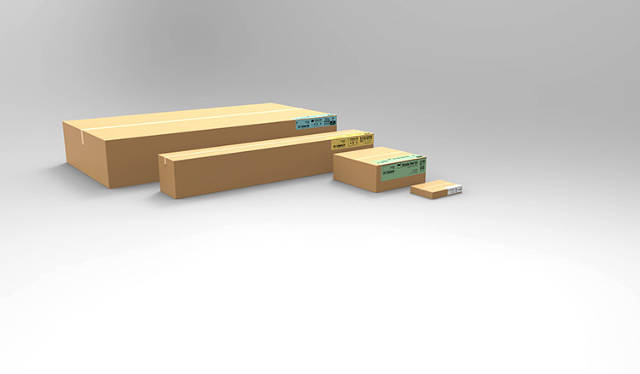
This is a project by the IKEA Foundation together with the UNHCR. The target is to produce these refugee shelters for less than $1000 each. Each flat-pack includes a solar panel which powers a built-in lamp and a USB outlet. Each shelter takes 4 hours to assemble, would house 5 people and last 3 – 5 years compared to the 6 months of a conventional refugee tent.

The shelter as a flat pack: image via Fast Company

The Ikea refugee shelter designed to provide refugees with better living conditions

The Ikea refugee shelter via gizmag.com

(more…)