Archive for the ‘Environment’ Category

China: Cutting power generation to cut emissions makes things worse

November 7, 2010


The Skyline of the City

Guiyang-skyline: Image via Wikipedia


Xinhua reports on a diesel shortage because electricity consumers are forced to use diesel generators as authorities shut down power generation to reach “emissions targets”. Needless to say the emissions from the diesel generators are a lot worse than the forced power shut-downs they replace!

An unprecedented diesel shortage is sweeping through Chinese cities, as numerous enterprises have to resort to diesel fuel to generate electricity to continue operation during periods of forced power outages. Local governments are rushing to switch off electricity as part of their commitment to the central government on energy conservation and emissions reductions.

However, the blackouts have apparently led to the linking effect of the diesel shortage. Long queues of cars and even “Sold-out” signs at gas stations are increasingly common scenes in many cities. Additionally, the market monitoring of the China Chamber of Commerce for the Petroleum Industry has acknowledged that more than 2,000 privately-owned gas stations in southern China had shut down due to their not having diesel fuel to sell.

During the period of the 11th Five-Year Plan (2006-2010), China sought to reduce energy consumption per GDP unit by 20 percent. In the first four years of the 11th five-year plan, a 15.6 percent reduction (compared to between year 2005 and year 2009) was reached. But energy consumption per unit of GDP increased 0.09 percent in the first half of 2010, year on year. In a hurry to meet their regional targets assigned by the central government, many local governments chose the blackout method for enterprises in the remaining two months. This method quickly spread to many provinces around China.

In Wenzhou city of Zhejiang Province, with China’s most prosperous private economy, power supplies for some enterprises will be cut for two to four days following one day with electricity. “My company’s electricity consumption is about 150,000 kw-hr, but the local government’s allotment is only 60,000 kw-hr.” said the owner of an export-oriented farm products deep-processing company, who only gave his surname, Ye. Just as is being done by many of his peers, Ye had to purchase a diesel generator with 200,000 yuan (about 30,000 U.S. dollars). It will cost him an additional 10,000 yuan (about 1,500 U.S. dollars) to generate electricity, twice the normal cost for electricity.

“The irrational blackout policy by some local governments is contrary to the energy conservation and emissions reduction target as was set by China’s 11th Five-Year Plan,” said Dr.Zhang Jianyu, China Program manager of the U.S. Environmental Defense Fund. Also, more emissions and fuel consumption might be produced by the diesel generators. “The blackout is not a wise choice. What the local governments need to do now is to pay attention to change the mode of economic growth with high efficiency and low energy consumption,” said Zhong Yongsheng, deputy director of the Center for China’s Urban-Rural Development Studies.

Environmentalism gone mad.

Iceland volcano watch stands down

November 6, 2010

Jökulhlaup from Grímsvötn subsides

The earlier concern about meltwater flooding from the Grimsvotn glacial lake in Iceland which could have signalled that the volcano underneath was about to erupt has subsided.

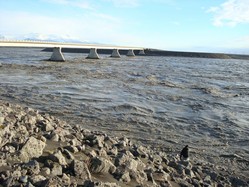
Bridge over Gígjukvísl

Figure 1. The jökulhlaup from Grímsvötn: image vedur.is

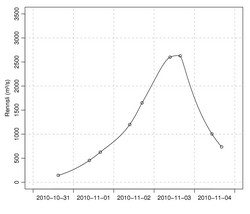
The jökulhlaup (glacial outburst flood) from Grímsvötn that began near the end of October is now coming to an end. The flood reached a maximum level shortly after noon on November 3, and scientists from IMO visited the site on that day to study the effects of the flood on the region adjacent to the ice margin. Two IMO technicians have performed regular discharge measurements on the bridge over the river Gígjukvísl throughout this week (Figure 1) and the results from their measurements are shown in Figure 2.

Figure 2. Discharge (m3/s) measurements at Gígjukvísl bridge: From the curve the total amount of floodwater is estimated 0.45 km3

The discharge curve is typical for jökulhlaups from Grímsvötn that do not result from volcanic activity: Over the course of several days, the amount of water flowing through an ice tunnel at the glacier bed steadily increases. Loss of frictional heat from the floodwater causes melting of the tunnel walls, thereby increasing the flow capacity of the tunnel.

In past centuries, most jökulhlaups from Grímsvötn have entered the course of the river Skeiðará. This time, however, floodwater that emerged from beneath the eastern part of the glacier went westwards along the glacier margin and then entered the river Gígjukvísl. Skeiðará has deposited very large amounts of sediment on the eastern part of Skeiðarársandur plains over the centuries, increasing the elevation of the sandur area there relative to the central part. In addition, the glacier has carved a trench during times of advance. Thus, it was clear that retreat of the glacier over the past 15 years would sooner or later lead to a drastic shift in the direction of meltwater flow from this part of the glacier. In the summer of 2009, this shift occurred and water has ceased to enter the course of Skeiðará.


Mount Merapi ash cloud leads to cancellation of flights to Jakarta

November 6, 2010

Mount Merapi volcano lies 431 km from Jakarta. But the continuing eruptions over the last two weeks have pumped sufficient ash sufficiently high into the atmosphere that flights to Jakarta are beginning to be cancelled. Flights to Yogyakarta, the nearest large airport to Mount Merapi, were suspended a few days ago.

The Guardian reports:

Several airlines have suspended flights into Indonesia’s capital Jakarta after Mount Merapi’s worst eruption in a century spewed volcanic ash up to five miles (8km) into the air.

The move came as number of people killed by Mount Merapi in the last two weeks climbed to 138 after the volcano unleashed a surge of searing gas yesterday that torched houses and trees and incinerated villagers.

Officials at Singapore Airlines, Japan Airlines, Malaysia Airlines, Lufthansa, Cathay Pacific and AirAsia fear the ash is a safety threat and could damage aircraft.

“The volcanic ash presence in the airways surrounding Jakarta could cause severe damage to our aircraft and engines which could impair the safety of our operations including passengers and crew,” said Azharuddin Osman, director of operations for Malaysia Airlines.


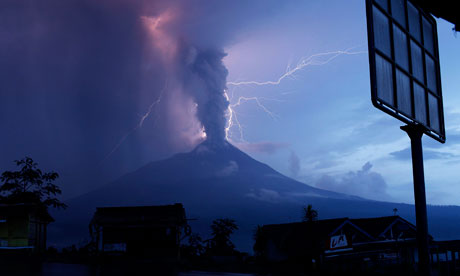
mt merapi erupting

Lightning strikes as Mount Merapi volcano erupted today, spewing out towering clouds of hot gas and debris, as seen from Ketep village in Magelang, Indonesia's Central Java province. Photograph: Beawiharta/Reuters


“What the Green Movement got wrong” (cont’d)

November 6, 2010

A follow up to the post about the Channel 4 programme with environmentalists beating their breasts is this very succinct cartoon from Josh which encapsulates the whole story very nicely:


Mt. Merapi eruptions continue into second week

November 5, 2010

AFP reports:

Merapi eruption

ARGOMULYO, Indonesia: At least 49 people were killed and scores injured Friday when Indonesia’s Mount Merapi volcano erupted again, incinerating villages as far as 18 kilometres (11 miles) away, officials said. The latest deaths bring the total toll to more than 90 since the country’s most active volcano started erupting on October 26. Ash, deadly heat clouds and molten debris gushed from the mouth of the 2,914-metre (9,616-foot) mountain and shot high into the sky for most of the night and into the morning.

The ranks of evacuees swelled past 100,000 people, with 30,000 moved into a sports stadium about 25 kilometres away from the peak. “The emergency shelters are now overcrowded,” emergency response field coordinator Widi Sutikno said.

The international airport at Yogyakarta was closed as ash clouds billowed to the altitude of cruising jetliners and the runway was covered in gray soot, officials said. The exclusion zone was widened from 15 to 20 kilometres around the mountain and everyone living in the area was ordered to evacuate their homes and shelters immediately, he said. Indonesia’s transport ministry has told pilots to stay at least 12 kilometres away from the rumbling volcano and several flights linking central Java to Singapore and Malaysia have been cancelled this week.

Government volcanologist Surono said Friday’s blasts were the largest yet.

Mt. Merapi: map credit hobotraveler.com

“Renewable energy keeps oil price high”- Saudi Oil Minister

November 5, 2010

It would seem that the current oil price is determined by the level at which renewable energy costs are politically acceptable. The conclusion then must be that if the “renewables” go out of fashion and become less politically correct then the oil price could be significantly lower than it is!

The Financial Times carries the story:

Ali Naimi, the oil minister of Saudi Arabia, was in mischievous mood on Monday night, positing an oil price of $70 to $90 for the foreseeable future, and suggesting that oil consumers should be happy with such a settlement – because a price of more than $70 was needed to justify investments in renewable energy.

His remarks, which came in response to questions from the Financial Times at a dinner hosted by the Singapore International Energy Week, did not go down well with all sections of the audience – some were unhappy that the world’s biggest oil producer should suggest they be content with an oil price they felt was unnecessarily high.

Mr Naimi justified his $70 to $90 prediction, which he called a “comfortable zone” that should be welcomed by oil producers and consumers alike, by reference to renewable energy, which he suggested gave oil an “anchor” price. If the oil price were to fall below $70, then renewable energy would not be competitive, he said.

In other words, he seemed to be implying, governments and companies that have invested in renewable energy are at least partly responsible for setting a de facto minimum price for oil of $70 per barrel.

Nothing to do with those oil-producing countries wanting a price more than $70 and “less than $90”, and tailoring their production accordingly, then.

In fact, Mr Naimi said, the world’s oil market was already “a little bit oversupplied”, which he suggested proved that it was renewable energy that was keeping prices up.

By the way, that $90 – an upper limit of the range that he carefully dropped into the conversation – was $10 a barrel more than Mr Naimi had previously suggested was the range of the “comfort zone”. Oil markets took note, and prices nudged up: Nymex December West Texas Intermediate, a US benchmark, rose $1.88 to $83.31 a barrel just after the remarks.

COP10 was much noise and no substance – thank goodness!

November 4, 2010


Flag of Nagoya City

Flag of Nagoya: Image via Wikipedia


My first impressions after the COP10 UN conference on biodiversity held in Nagoya was of a jamboree involving 5,000 people mouthing diffuse platitudes and woolly goals which had little to do with the further development of the human species. The Japanese hosts came up with 2 billion $ in the last few days of the conference to assuage some of the demands being made by developing countries and to be able to mount a PR exercise about the great success it had all been.

I don’t often agree with George Monbiot of The Guardian but this time I think he gets it right. It was a con. There was no substance in the declarations made at the end of the conference. The only point of difference is that I am profoundly thankful that there was no substance to something which has no real objectives whereas Monbiot believes that this was a minor tragedy. He writes:

We’ve been conned. The deal to save the natural world never happened

The so-called summit in Japan won’t stop anyone trashing the planet. Only economic risks seem to make governments act.

‘Countries join forces to save life on Earth”, the front page of the Independent told us. “Historic”, “a landmark”, a “much-needed morale booster”, the other papers chorused. The declaration agreed last week at the summit in Japan to protect the world’s wild species and places was proclaimed by almost everyone a great success. There is one problem: none of the journalists who made these claims has seen it.

I checked with as many of them as I could reach by phone: all they had read was a press release which, though three pages long, is almost content-free. The reporters can’t be blamed for this – it was approved on Friday but the declaration has still not been published. I’ve pursued people on three continents to try to obtain it, without success. Having secured the headlines it wanted, the entire senior staff of the convention on biological diversity has gone to ground, and my calls and emails remain unanswered. The British government, which lavishly praised the declaration, tells me it has no printed copies. I’ve never seen this situation before. Every other international agreement I’ve followed was published as soon as it was approved.

The evidence suggests that we’ve been conned. The draft agreement, published a month ago, contained no binding obligations. Nothing I’ve heard from Japan suggests that this has changed. The draft saw the targets for 2020 that governments were asked to adopt as nothing more than “aspirations for achievement at the global level” and a “flexible framework”, within which countries can do as they wish. No government, if the draft has been approved, is obliged to change its policies.

Read the whole article

Bats among the windmills

November 3, 2010

New “research” has shown that if wind turbines operate for less time – then the number of bat deaths at wind turbines would be reduced!

Paradoxically, it is the bats’ sophisticated sonar -based flying ability which enables them to avoid the spinning blades of a wind turbine, but which kills them.

Many large birds are killed by impact with the whirling blades of wind turbines but the large number of bats that are killed die because the blood vessels in their lungs explode as their sonar helps them to avoid the blades themselves but which lands them in the low pressure zone behind the blades.

The latest independent reports estimate the number of birds killed by wind turbines at about 100,000 per year. That’s according to a 2007 report from the National Research Council called “Environmental Impacts of Wind-Energy Projects. The American Bird Conservancy estimated in 2003 that between 10,000 and 40,000 birds were killed each year at wind farms across the country, about 80 percent of which were songbirds and 10 percent birds of prey. “With the increased capacity over the last seven years, we now estimate that 100,000 – 300,000 birds are killed by wind turbines each year,” said Conservancy spokesman Robert Johns.


Brazos Wind Farm in the plains of West Texas

BAT KILLER: The zone of low pressure behind wind turbine blades seems to be responsible for killing migrating bats:Image via Wikipedia


Wind Turbine blades are airfoils and there is an air pressure drop across the blade width of 5 – 10 kiloPascals. The low pressure zone behind the blades does not persist for very long and the air pressure quickly equalises a few metres behind the blades. The greater the power output of a turbine, the greater its height, the greater the pressure drop and the larger the low-pressure zone. But it is this low pressure zone which is a death trap for bats.

Scientific American: Scientists have known since 2004 that wind farms kill bats, just as they kill birds, even though the flying mammals should be able to avoid them. Many biologists thought that the bats, like their avian counterparts, might be falling victim to the fast-spinning turbine blades. But an examination of 188 hoary and silver-haired bats killed at a wind farm in southwestern Alberta in Canada between July and September in 2007 showed that nearly half showed no external injuries—as would be expected if the giant blades had smashed the flying mammals to the ground.
Instead, 90 percent of the 75 bats the researchers ultimately dissected had been killed by burst blood vessels in their lungs, according to results presented in Current Biology—suggesting that the air pressure difference created by the spinning windmills had terminated them, not contact with the blades. “As turbine height increases, bat deaths increase exponentially,” says ecologist Erin Baerwald of the University of Calgary in Alberta, who led research into the deaths as part of her master’s project. “What we found is a lot of internal hemorrhaging.”

Pressure drops of as low as 4.4 kilopascals kill common lab rats and all the bats autopsied showed internal damage and bleeding consistent with this type of death, known as barotrauma. “If bats have a lungful of air as they fly through the air-pressure change, there’s nowhere for the air to go,” Baerwald explains. “The small blood vessels around the lungs burst and fill the lungs with fluid and blood.”

This may also explain why, although some birds are killed by wind farms, the majority of casualties are bats.

Recently research has suggested that the colour of a turbine can affect the attraction exercised on insects which seem to like congregating at wind turbines. The gathering of insects is thought to be the reason why so many bats make their way to these locations. The research suggested that insects do not like the colour purple and it has been proposed that painting all wind turbines purple could save some bats.

Now new research published online November 1, 2010 in Frontiers in Ecology and the Environment has come to the not very unsurprising conclusion that if wind turbines operate for less of the time less bats will be killed!!

Via EurekAlert we learn that:

In a study to be published online November 1, 2010 in Frontiers in Ecology and the Environment (e-View), a journal of the Ecological Society of America, Edward Arnett from Bat Conservation International in Austin, Texas and colleagues examined the effects of changes in wind turbine speed on bat mortality during the low-wind months of late summer and early fall.

Currently, most wind turbines in the U.S. are programmed to begin rotating and producing power once wind speed has reached approximately 8 to 9 miles per hour (mph)—the wind speed at which turbines begin generating electricity to the power grid is known as the cut-in speed. Wind turbines with a low cut-in speed run more frequently than those set at higher cut-in speeds since they begin rotating at lower wind speeds.

The researchers found that, by raising the cut-in speed to roughly 11 mph, bat fatalities were reduced by at least 44 percent, and by as much as 93 percent, with an annual power loss of less than one percent. That is, programming the turbines to rotate only when the wind reached approximately 11 mph or higher caused the turbines to rotate less frequently and, therefore, killed significantly fewer bats. Because this was performed during months with seasonably low wind speeds already, the overall energy loss was marginal when the researchers calculated the annual power output.

“This is the only proven mitigation option to reduce bat kills at this time,” said Arnett. “If we want to pursue the benefits associated with wind energy, we need to consider the local ecological impacts that the turbines could cause. We have already seen a rise in bat mortality associated with wind energy development, but our study shows that, by marginally limiting the turbines during the summer and fall months, we can save bats as well as promote advances in alternative energy.”

Of course it does not need a great deal of research to conclude that if the wind turbine did not rotate at all no bats would be killed, and if the contraption did not even exist then all  bird collisions with the stationary towers could be eliminated.


US wind power installations down by 72%

November 1, 2010

The New York Times


broken wind turbine: image thetechherald.com


In July, the American Wind Energy Association reported that it was having a lousy year. It appears the third quarter of 2010 wasn’t much better.

According to an analysis released on Friday, the trade group reports having its slowest quarter since 2007, adding just 395 megawatts of wind power capacity. For the year to date, new installations were down 72 percent.

Natural gas, the chief fossil-fuel competitor to renewable sources of electricity, is also dirt cheap these days, making wind power a tougher sell for cost-conscious utilities and state regulators. Despite lots of talk on Capitol Hill about the hazards of fossil fuels, their contribution to climate change and the need for broad, long-term supports for the renewables industry, legislators have failed to reach agreement on what that might look like.

But then the lobbying  gets going

“If federal policymakers do not act quickly to provide investment certainty through a Renewable Electricity Standard, and longer-term tax policy like our competitors enjoy,” Denise Bode, the chief executive of the wind association, said in a prepared statement, “the U.S. wind industry will continue to stall out.”

Elizabeth Salerno, director of industry data and analysis with the American Wind Energy Association, said in a phone call that state-level policies have helped. Roughly 30 states have mandatory targets for diversifying their energy portfolios with more renewable power. “They’ve been doing a great job leading the effort to get renewables installed over the past decade,” Ms. Salerno said.

The trade group reported some interesting developments — including Oregon’s emergence as the leader in new wind installations for the third quarter, eclipsing Texas, which has long held the top slot. The reason, the group suggests, is that Texas has hit a transmission wall and is trying to sort out how to get its west Texas wind resources to the load centers in the center of the state.

“What the Green Movement got wrong” – Channel 4

October 31, 2010


green = nuclear


Channel 4 in the UK is running a documentary this week called “What the Green Movement got wrong”.

A group of environmentalists are challenging the movement they helped to create. These life-long diehard greens advocate radical solutions to climate change, including GM crops and nuclear energy.

In this film, these life-long diehard greens advocate radical solutions to climate change, which include GM crops and nuclear energy. They argue that by clinging to an ideology formed more than 40 years ago, the traditional green lobby has failed in its aims and is ultimately harming its own environmental cause.

As author and environmentalist Mark Lynas says, ‘Being an environmentalist was part of my identity and most of my friends were environmentalists. We were involved in the whole movement together. It took me years to actually begin to question those core, cherished beliefs. It was so challenging it was almost like going over to the dark side. It was a like a horrible dark secret you couldn’t share with anyone.’

The Telegraph reports on the change of heart:

Mark Lynas, a campaigner who has been a member of action groups on GM foods and climate change, said the environmental lobby was losing the battle for public opinion on climate change because it had made too many apocalyptic prophecies and exaggerated claims.

He said: “We have got to find a more pragmatic and realistic way of engaging with people.”

Stewart Brand, an American activist and former editor of Whole Earth Catalog, said: “I would like to see an environmental movement that says it turns out our fears about genetically engineered food crops were exaggerated and we are glad about that. It is a humble and modest stance to take to the real world. Environmentalists did harm by being ignorant and ideological and unwilling to change their mind based on actual evidence. As a result we have done harm and I regret it.”

What the Green Movement Got Wrong will be broadcast on Thursday 4 November at 9pm and will be followed by a live studio debate hosted by Channel 4 News presenter Krishnan Guru-Murthy.