Archive for the ‘History’ Category

Colour photographs from the Russia of 1909

October 16, 2013

This is from Kuriositas. A magnificent collection of colour photographs from a Russia of a century ago.

The Century Old Color Photographs of Prokudin-Gorsky

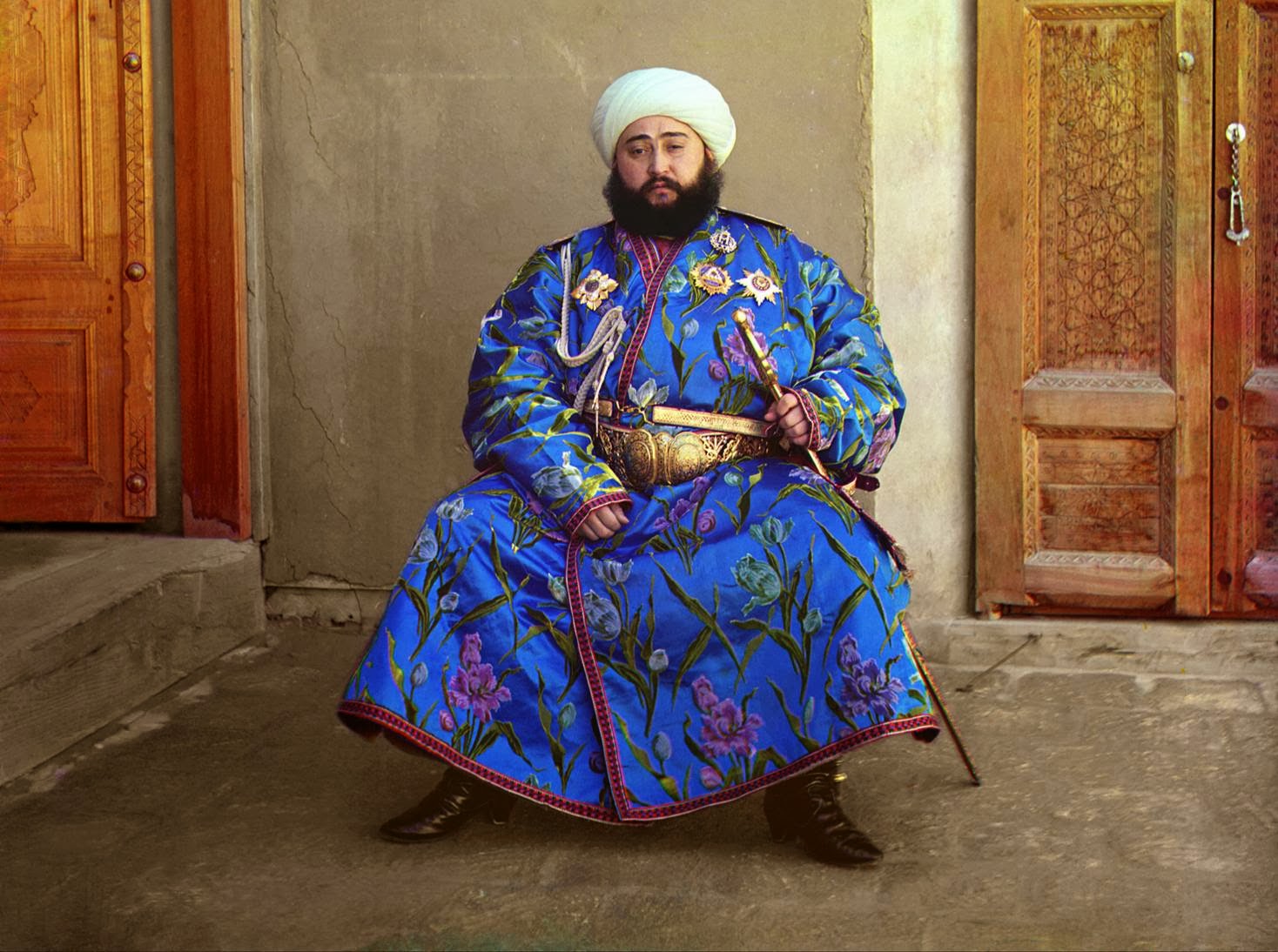
In 1909 a remarkable project was initiated by Russian photographer Sergey Mikhaylovich Prokudin-Gorsky. His mission was to record – in full and vibrant color – the vast and diverse Russian Empire. Here, with his story, is a selection of his amazing century old full color pictures. …

The colors are quite remarkable – a technique which Prokudin-Gorsky developed himself. However, his travels through the Russian Empire were never a fait accompli. They were the culmination of a long and arduous struggle. Thanks to the tenacity of the photographer we now have a record of times a century ago, so clear and vivid that one feels it is almost possible to jump in to the picture …….. Prokudin-Gorsky came from a long line of Russian nobles who mostly enjoyed careers in the Russian army. Prokudin-Gorsky had a more cerebral bent and he studied chemistry in Saint Petersburg at the Institute of Technology in the city. He also studied painting and music at the Imperial Academy of Arts. Chemistry and the Arts may not immediately spring to mind as a happy marriage of subjects to many, but Prokudin-Gorsky’s interest in both would come together eventually. In 1889, at the age of twenty six he travelled to Berlin to study Photochemistry at the Technical University of the German capitol. There he met and studied under Adolf Miethe who was experimenting with three color photography. ……. 

The process used involved a camera that would take a set of three photographs. These pictures would be monochrome but each picture would be taken using a filter of a different color. When all three monochrome pictures were projected (using light which had to be specifically colored) then the original color scene could be reconstructed. However, this took some time to take ….. 

Here are just a couple of a quite remarkable collection which spans the mighty and the miserable:

Prokudin-Gorsky 40 Emir of Bukhara

Prokudin-Gorsky 40 Emir of Bukhara

Prokudin-Gorsky 25 Hard labour at the Bakalskiy Mine

Prokudin-Gorsky 25 Hard labour at the Bakalskiy Mine

Prokudin-Gorsky is credited with the first ever colour photograph in Russia – a portrait of Leo Tolstoy – in 1908.

Prokudin-Gorsky L.N.Tolstoy 1908 Wikimedia

Prokudin-Gorsky L.N.Tolstoy 1908 Wikimedia

William Sermon’s remedies from 1673

October 15, 2013

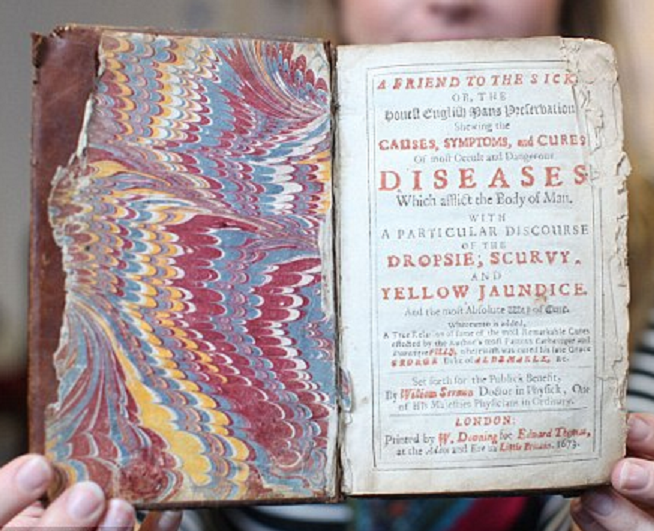
A paperback version is available here but an ancient copy found during a house clearance in Derbyshire is to be auctioned reports the Daily Mail.

Sermon 1673 (via Daily Mail -Caters News Agency)

Sermon 1673 (via Daily Mail -Caters News Agency)

It was written in 1673 by Royal Physician, William Sermon, who was a physician of Charles II. ….. 

Dr Sermon, who first gained medical experience in the Army and went on to become a physician for King Charles II, died six years after his book was published at the age of 50.

He was described by 17th century historian Anthony Wood as ‘that forward, vain and conceited person.’

Dr Sermon was apparently a great believer in alcohol to combat illness.
For ‘pain in the head through cold’, he suggested: ‘Abstain from taking milk which is cool in operation and drink thin wine or such liquors.’

And for a patient suffering from toothache, Dr Sermon writes: ‘To make rotten teeth sound, take the juice of water cresses and white wine in equal measure, mix them together and rub the teeth and gums therewith.’ 

He adds that ‘the ashes of tobacco is of excellent use to cleanse the teeth and to make them white’.

sermon 1673 paperback

sermon 1673 paperback

A Friend to the Sick, Or, the Honest Englishman’s Preservation Shewing the Causes, Symptoms, and Cures of the Most Occult and Dangerous Diseases Which affect the body of Man (1673)

by William Sermon

ISBN-13: 9781240842629
Publisher: EEBO Editions, ProQuest
Publication date: 1/28/2011

Some of Sermon’s remedies might not pass muster today:

  • For the sickness bug… ‘Taking young swallows, burn them in their feathers, altogether in a new earthenware pot, covered very close, add thereto as much castor and beat them well together and put in to a glass vessel and let it stand three days after which distill it in a glass for patient to take.’
  • For earache… ‘Take a loaf made with one part of caraway seeds, and cut it through the middle and apply it to the ears.’
  • For  toothache… ‘Take the juice of water cresses and white wine in equal measure, mix them together and rub the teeth and gums therewith.’ 
  • To whiten teeth… ‘The ashes of tobacco is of excellent use to cleanse the teeth and to make them white’.’
  • For a headache… ‘Abstain from taking milk which is cool in operation and drink thin wine or such liquors.’

The book will be sold at Hansons Auctioneers in Derby on October 24 and is expected to sell for about £500.

The Histomap

September 3, 2013

I have only just come across this.

The “Histomap,”  was a tour-de-force of his time, created by John B. Sparks, an amateur historian and was 5 feet long and covered 4,000 years of global history. It was first printed by Rand McNally in 1931 and was marketed for just $1.00. Inevitably his “map” is Occidental-centric but it is still a quite remarkable piece of work.

Histomap advertisement (Yale Library)

Histomap advertisement (Yale Library)

The map itself – fully zoomable – can be found at the David Rumsey Map Collection

Histomap by John B Sparks

Histomap by John B Sparks

As Musings on Maps writes:

One would assume the map effaces singularities or any singular historical narrative–the selective condensation of information to an image five feet in length in the Histomap can’t be beat for charting a balance of power among world cultures, reifying the state and racial difference as the metric by which to map world history.

HistoMap Upper Rubric

Convenience and efficiency are both premiums in its design.  As other early twentieth-century compendia of knowledge, the map glories in positivist  presumptions of mappability:  rather than offering narrative, the map offers the inverse, apparently obliterating any local meanings:  it homogenizes four thousand years not by relinquishing narrative structures, but using a racial rubric to map states’ “relative power.”

Histomap Rubric

Sparks devised the Histomap as both more ecumenical and empyrean in its economic individuation of purified vision of history, and more global.  Its color-keyed streams are readily comprehensible consultation of the lay reader, but the green dust jacket assured prospective they would be overwhelmed by “the fresh realization of the very recent insignificant contribution to history of those we are accustomed to call great men,” as the map would leave them ”enthralled.”

The Start of the Histomap

Starting from the Minoans and the Settlement of the Nile Delta, this occidentalist condensation of some four-thousand years “relative powers of contemporary states, nations, and empires,” is the distillation of an era of state-building–a narrative to which it accommodates the dynastic division of time among the Egyptians Ammorites, and Chinese, to digest their otherness in a river of time.  By erasing the Neolithic, as it were, the streams contemporaneously arise, like Athena from Zeus’ head, with the force of a declarative statement.

Each stream is distinctly separate, and as one wanes another takes its place to expand, in the uniform frame of mankind:

Each stream is separate

Geography (as globalism) is a big casualty in this visualization of time, indeed, as one stream–here the Roman–comes to fill the viewer’s field of vision from around 150 BC, as it fills not only the historical record, but the balance of world powers.  Although this was long before the notion of such a balance existed or was understood, this was the optic in which Sparks so skillfully visualized a universal history, and, more to the point, made sense to lay readers of the 1920s and 30s.

John Sparks followed up with a historical map of evolution in 1932.

Before the Sandwich came the snowy chocolatti

September 1, 2013

The use of the word “sandwich” to describe sliced meat between two slices of bread is supposed to originate after John Montagu, 4th Earl of Sandwich, (13 November 1718 – 30 April 1792). But the invention of the sandwich as a dish probably goes back to the first use of flat breads and of wrapping other edible foods within the breads. As far as we know flat breads originate at least from 4,000 BCE as they were known in Sumeria and Ancient Egypt.

“Sandwich”: It was named after John Montagu, 4th Earl of Sandwich, an 18th-century English aristocrat, although he was neither the inventor nor sustainer of the food. It is said that he ordered his valet to bring him meat tucked between two pieces of bread, and because Montagu also happened to be the Fourth Earl of Sandwich, others began to order “the same as Sandwich!”. It is said that Lord Sandwich was fond of this form of food because it allowed him to continue playing cards, particularly cribbage, while eating without getting his cards greasy from eating meat with his bare hands.

But it would seem from research by Kate Loveman that Admiral Sir Edward Montagu, the first Earl of Sandwich (1625 -1672) has an even greater claim to culinary fame than his great, great, grandson. Of course chocolate has been in use for at least some 800 years for pleasure and as a medicine but the first iced chocolate – or is it a chocolate ice? – is still a culinary milestone.The Earldom was created in 1660 and this recipe for a “snowy chocolatti” dates from 1668 or earlier.

The Earl’s iced chocolate recipe

  1. Prepare the chocolatti (to make a drink)
  2. Putt the vessell that hath the chocolate in it, into a jaraffa (carafe) of snow stirred together with some salt
  3. Shake the snow together sometyme and it will putt the chocolatti into tender curdled ice
  4. Soe eate it with spoons

Kate LovemanThe Introduction of Chocolate into England: Retailers, Researchers, and Consumers, 1640–1730,  Journal of Social History (Fall 2013) 47 (1): 27-46. doi: 10.1093/jsh/sht050

Abstract: 

In the mid-seventeenth century chocolate was a new and fascinating product in England, often grouped with two equally exotic drinks, coffee and tea. This article focuses on the early history of chocolate, examining how it was marketed, perceived, and consumed. Chocolate sellers, who included coffee-houses proprietors, frequently made use of print to educate potential customers: the 1640s and 1650s saw chocolate-drinking promoted as medicinal, excitingly foreign, and pleasurable. Further insights into the scientific, governmental, and social factors that drove interest in chocolate during the Restoration can be found in the manuscripts of the first Earl of Sandwich (1625–72).

Despite evidence of considerable industry on the part of chocolate consumers, in the 1690s the success of a new breed of elite chocolate houses led to chocolate becoming strongly associated with leisure and decadence. These cultural associations were promoted in succeeding decades by periodicals, drama, and satirical poems. Throughout the late seventeenth and early eighteenth centuries, consumers’ experimentation with chocolate took place in the context of succeeding government’s fiscal experiments with cacao and chocolate: new tax measures influenced the cost of chocolate and its availability. By consulting a range of sources, from customs records to recipe books, we can track the ways chocolate was used across the decades and the factors in its adoption by different groups of consumers.

BBC News writes:

Dr Kate Loveman, from the University of Leicester, said she found the recipes in manuscripts which belonged to the Earl of Sandwich in 1668.

At the time, the chocolate treats came with a health warning for damaging the stomach, heart and lungs. The research also shows some of the regular themes in chocolate advertising across the centuries.

Dr Loveman, a senior lecturer in 17th and 18th Century English literature, said she was looking through a Samuel Pepys journal when she came across a 30-page section on chocolate.

Dr Kate Loveman
Dr Kate Loveman said the recipe was for a very solid, dark version of iced chocolate drinks. “It struck me as quite an unusual, odd thing because I have never come across anything quite like this before,” she said. “So I thought I would look into it further to find out how unusual it actually was.

“It’s not chocolate ice-cream, but more like a very solid and very dark version of the iced chocolate drinks you get in coffee shops today. Freezing food required cutting-edge technology in 17th Century England, so these ices were seen as great luxuries.”

The Earl’s recipe was written about 100 years before his great-great-grandson allegedly invented the sandwich. Dr Loveman said: “In the 1660s, when the Earl of Sandwich collected his recipes, chocolate often came with advice about safe consumption. 

“The papers included quite stern warnings about the dangers. It was a drug as far as people of the 17th Century were concerned.

“One physician cautioned that the ingredients in hot chocolate could cause insomnia, excess mucus, or haemorrhoids. People worried that iced chocolate in particular was ‘unwholesome’ and could damage the stomach, heart, and lungs.”

Dr Loveman’s research also shows some of the continuities in chocolate advertising across the centuries, such as links between chocolate and women, pleasure and sexuality.

Faroe Islands were colonised 300-500 years before the Vikings

August 20, 2013

Somebody got there before the Vikings did – some 300 and 500 years earlier. Norse settlers reached Iceland in the 9th century and probably reached Greenland around the 11th century. But the archaeological evidence is that some unknown colonists had already reached the Faroes in the 4th- 6th century and again between the 6th -8th centuries. There is a theory that they could have been monks from Ireland (St. Brendan?) but I think it is still highly likely that these early explorers/colonists were sea-faring peoples out of Scandinavia.

Mike J. Church, Símun V. Arge, Kevin J. Edwards, Philippa L. AscoughJulie M. Bond, Gordon T. Cook, Steve J. Dockrill, Andrew J. DugmoreThomas H. McGovernClaire Nesbitt and Ian A. Simpson, The Vikings were not the first colonizers of the Faroe Islands, Quaternary Science Reviews (2013)

dx.doi.org/10.1016/j.quascirev.2013.06.011

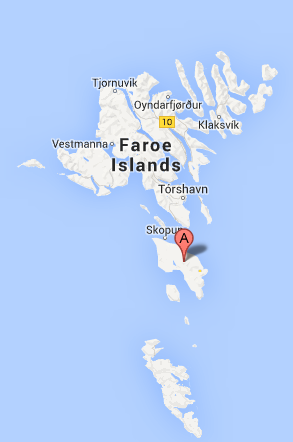
Faroe Islands -Google Earth

Faroe Islands -Google Earth

Abstract

We report on the earliest archaeological evidence from the Faroe Islands, placing human colonization in the 4th–6th centuries AD, at least 300–500 years earlier than previously demonstrated archaeologically. The evidence consists of an extensive wind-blown sand deposit containing patches of burnt peat ash of anthropogenic origin. Samples of carbonised barley grains from two of these ash patches produced 14C dates of two pre-Viking phases within the 4th–6th and late 6th–8th centuries AD. A re-evaluation is required of the nature, scale and timing of the human colonization of the Faroes and the wider North Atlantic region.

Durham University Press Release:

The Faroe Islands were colonised much earlier than previously believed, and it wasn’t by the Vikings, according to new research.

New archaeological evidence places human colonisation in the 4th to 6th centuries AD, at least 300-500 years earlier than previously demonstrated. 

The research, directed by Dr Mike J Church from Durham University and Símun V Arge from the National Museum of the Faroe Islands as part of the multidisciplinary project “Heart of the Atlantic”, is published in the Quaternary Science Reviews.

The research challenges the nature, scale and timing of human settlement of the wider North Atlantic region and has implications for the colonisation of similar island groups across the world.

Sandoy, Faroes - Google Maps

Sandoy, Faroes – Google Maps

The Faroes were the first stepping stone beyond Shetland for the dispersal of European people across the North Atlantic that culminated on the shores of continental North America in the 11th century AD, about 500 years before Columbus made his famous voyage.

The research was carried out on an archaeological site at Á Sondum on the island of Sandoy. 

Analysis showed an extensive windblown sand deposit containing patches of burnt peat ash from human activity, dating human settlement to pre-Viking phases. These ash spreads contained barley grains which were accidentally burnt in domestic hearths and were then spread by humans onto the windblown sand surface during the 4th-6thcenturies and 6th-8th centuries, a common practice identified in the North Atlantic during this period to control wind erosion.

Lead author Dr Mike Church, from Durham University’s Department of Archaeology, said: “There is now firm archaeological evidence for the human colonisation of the Faroes by people some 300-500 years before the large scale Viking colonisation of the 9th century AD, although we don’t yet know who these people were or where they came from.

“The majority of archaeological evidence for this early colonisation is likely to have been destroyed by the major Viking invasion, explaining the lack of proof found in the Faroes for the earlier settlement. This also raises questions about the timing of human activity on other islands systems where similarly evidence may have been destroyed.”

Co-author, Símun V Arge from the National Museum of the Faroe Islands, said: “Although we don’t know who the people were that settled here and where they came from, it is clear that they did prepare peat for use, by cutting, drying and burning it which indicates they must have stayed here for some time.

The BANŪ SĀSĀN – a fraternity of medieval Islamic poets, rogues and charlatans

August 16, 2013

It could be a tale told by Scheherazade from the 1001 nights and set in the times of the Great Abbasid Caliph Haroun al-Rashid.  A tale of the Banu Sasan. A tale of poets and rogues, of vagabonds and bandits and of charlatans and disinherited second sons.

Fraternities of criminals and outlaws have probably existed from the earliest time when “laws” were first invented and “outlaws” were banished. Of course “laws” were established by whoever was strong enough to enforce them and the label of “criminality” applied to a group only as long as the group was not dominant. (Once a gang was strong enough it became legitimate and would now be called a “political party”). Organised crime and criminal fraternities that we might recognise as “gangs” therefore date back at least to the initial formation of cities and the exclusion of people outside those early city walls. The origin of gangs probably lies in the loose cooperation between such “outsiders” and “outlaws” and probably goes back some 5,000 years. In Ancient Greece, in the 7th and 8th centuries BCE, “criminal gangs” – for want of a better term – had to be put down when the city states were established.  There are suggestions of “criminal fraternities” / rebels in the Roman Empire, in Byzantium and even among the Aztecs.

The romanticism of Robin Hood and his ilk comes later but is still alive today. The success of The Godfather would suggest that even the Mafia can be seen through romanticised eyes. Certainly modern day gangs – whether in the Balkans or in Los Angeles or in Afghanistan or in the jungles of Chattisgarh – still succeed in recruiting young members who see themselves as “freedom fighters” or rebels against an unjust society. As Kings and Vagabonds.

The Smithsonian’s Past Imperfect Blog carries the story of the Banu-Sasan.

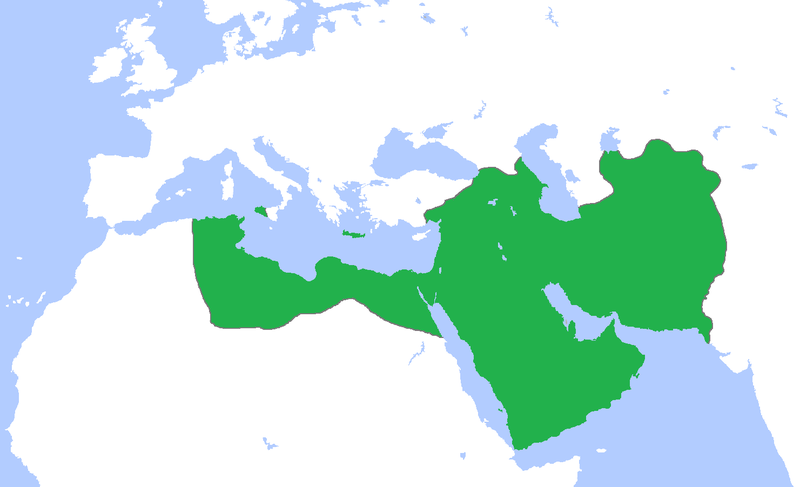
Abbasid Caliphate at its greatest extent, c. 850: Wikipedia

Islam’s Medieval Underworld

The year is—let us say—1170, and you are the leader of a city watch in medieval Persia. Patrolling the dangerous alleyways in the small hours of the morning, you and your men chance upon two or three shady-looking characters loitering outside the home of a wealthy merchant. Suspecting that you have stumbled across a gang of housebreakers, you order them searched. From various hidden pockets in the suspects’ robes, your men produce a candle, a crowbar, stale bread, an iron spike, a drill, a bag of sand—and a live tortoise.

The reptile is, of course, the clincher. There are a hundred and one reasons why an honest man might be carrying a crowbar and a drill at three in the morning, but only a gang of experienced burglars would be abroad at such an hour equipped with a tortoise. It was a vital tool in the Persian criminals’ armory, used—after the iron spike had made a breach in a victim’s dried-mud wall—to explore the property’s interior.

We know this improbable bit of information because burglars were members of a loose fraternity of rogues, vagabonds, wandering poets and outright criminals who made up Islam’s medieval underworld. This broad group was known collectively as the Banu Sasan, and for half a dozen centuries its members might be encountered anywhere from Umayyad Spain to the Chinese border. Possessing their own tactics, tricks and slang, the Banu Sasan comprised a hidden counterpoint to the surface glories of Islam’s golden age. They were also celebrated as the subjects of a scattering of little-known but fascinating manuscripts that chronicled their lives, morals and methods..

According to Clifford Bosworth, a British historian who has made a special study of the Banu Sasan, this motley collection of burglars’ tools had some very precise uses:

The thieves who work by tunneling into houses and by murderous assaults are much tougher eggs, quite ready to kill or be killed in the course of their criminal activities. They necessarily use quite complex equipment… [The iron spike and an iron hand with claws] are used for the work of breaking through walls, and the crowbar for forcing open doors; then, once a breach is made, the burglar pokes a stick with a cloth on the end into the hole, because if he pokes his own head through the gap, [it] might well be the target for the staff, club or sword of the houseowner lurking on the other side.    

The tortoise is employed thus. The burglar has with him a flint-stone and a candle about as big as a little finger. He lights the candle and sticks it on the tortoise’s back. The tortoise is then introduced through the breach into the house, and it crawls slowly around, thereby illuminating the house and its contents. The bag of sand is used by the burglar when he has made his breach in the wall. From this bag, he throws out handfuls of sand at intervals, and if no-one stirs within the house, he then enters it and steals from it; apparently the object of the sand is either to waken anyone within the house when it is thrown down, or else to make a tell-tale crushing noise  should any of the occupants stir within it.    

Also, the burglar may have with him some crusts of dry bread and beans. If he wishes to conceal his presence, or hide any noise he is making, he gnaws and munches at these crusts and beans, so that the occupants of the house think that it is merely the cat devouring a rat or mouse.

The Iranica informs us:

BANŪ SĀSĀN, a name frequently applied in medieval Islam to beggars, rogues, charlatans, and tricksters of all kinds, allegedly so called because they stemmed from a legendary Shaikh Sāsān. A story frequently found in the sources, from Ebn al-Moqaffaʿ onward, states that Sāsān was the son of the ancient Persian ruler Bahman b. Esfandīār, but, being displaced from the succession, took to a wandering life and gathered round him other vagabonds, thus forming the “sons of Sāsān.” 

The Smithsonian continues:

Who were they, then, these criminals of Islam’s golden age? The majority, Bosworth says, seem to have been tricksters of  one sort or another,

who used the Islamic religion as a cloak for their predatory ways, well aware that the purse-strings of the faithful could easily be loosed by the eloquence of the man who claims to be an ascetic or or mystic, or a worker of miracles and wonders, to be selling relics of the Muslim martyrs and holy men, or to have undergone a spectacular conversion from the purblindness of Christianity or Judaism to the clear light of the faith of Muhammad.

Amira Bennison identifies several adaptable rogues of this type, who could “tell Christian, Jewish or Muslim tales depending on their audience, often aided by an assistant in the audience who would ‘oh’ and ‘ah’ at the right moments and collect contributions in return for a share of the profits,” and who thought nothing of singing the praises of both Ali and Abu Bakr—men whose memories were sacred to the Shia and the Sunni sects, respectively. Some members of this group would eventually adopt more legitimate professions—representatives of the Banu Sasan were among the first and greatest promoters of printing in the Islamic world—but for most, their way of life was something they took pride in. One of the best-known examples of the maqamat (popular) literature that flourished from around 900 tells the tale of Abu Dulaf al-Khazraji, the self-proclaimed king of vagabonds, …

“I am of the company of beggar lords,” Abu Dulaf boasts in one account,

the cofraternity of the outstanding ones,

One of the Banu Sasan…

And the sweetest way of life we have experienced is one spent in sexual indulgence and wine drinking.

For we are the lads, the only lads who really matter, on land and sea.

Scheme of Indo-European migrations from ca. 4000 to 1000 BCE according to the Kurgan hypothesis.

Scheme of Indo-European migrations from ca. 4000 to 1000 BCE according to the Kurgan hypothesis. Wikipedia

The ethnic composition of the Banu Sasan is the subject of much speculation. The nomadic Banu Sasan are said by some to have been one of the drivers of the spread of “indo-European”peoples and languages. Perhaps the Banu Sasan may have had links with the ancient Tocharians. But it is more likely that the Banu Sasan was more a fraternity of occupation(s) and not of ethnicity. There are suggestions that there may be genetic connections between those of the Banu Sasan to present-day Roma (the Boyash or the Rudari) and to Parsis and even some Jews. That of course is quite possible for no doubt these vagabond poets and beggar-lords had their share of girl-friends at every caravanserai to be found.
2,000 year old thin film coating technology

July 25, 2013

Ancient gold and silversmiths used empirical methods with little knowledge of physics and chemistry to gild (silver and gold) statues and other works of art. It was an art – generally involving the use of mercury – which was also used by counterfeiters. Many of their techniques are still unknown. Some of the quality they achieved has still not been matched. A new paper is published in Accounts of Chemical Research (paywalled).

ACS Press ReleaseGabriel Maria Ingo and colleagues point out that scientists have made good progress in understanding the chemistry of many ancient artistic and other artifacts — crucial to preserve them for future generations. Big gaps in knowledge remained, however, about how gilders in the Dark Ages and other periods applied such lustrous, impressively uniform films of gold or silver to intricate objects. Ingo’s team set out to apply the newest analytical techniques to uncover the ancients’ artistic secrets.

They discovered that gold- and silversmiths 2,000 years ago developed a variety of techniques, including using mercury like a glue to apply thin films of metals to statues and other objects. Sometimes, the technology was used to apply real gold and silver. It also was used fraudulently, to make cheap metal statues that look like solid gold or silver. The scientists say that their findings confirm “the high level of competence reached by the artists and craftsmen of these ancient periods who produced objects of an artistic quality that could not be bettered in ancient times and has not yet been reached in modern ones.

Gabriel Maria Ingo, Giuseppe Guida, Emma Angelini, Gabriella Di Carlo, Alessio Mezzi, Giuseppina Padeletti.Ancient Mercury-Based Plating Methods: Combined Use of Surface Analytical Techniques for the Study of Manufacturing Process and Degradation PhenomenaAccounts of Chemical Research, 2013; : 130705111206005 DOI: 10.1021/ar300232e


Abstract

Abstract Image

Fire gilding and silvering are age-old mercury-based processes used to coat thesurface of less precious substrates with thin layers of gold or silver. In ancient times, these methods were used to produce and decorate different types of artefacts, such as jewels, statues, amulets, and commonly-used objects. Gilders performed these processes not only to decorate objects but also to simulate the appearance of gold or silver, sometimes fraudulently. From a technological point of view, the aim of these workmen over 2000 years ago was to make the precious metal coatings as thin and adherent as possible. This was in order to save expensive metals and to improve the resistance to the wear caused by continued use and circulation.

Without knowledge about the chemical–physical processes, the ancient crafts-men systematically manipulated these metals to create functional and decorative artistic objects. The mercury-based methods were also fraudulently used in ancient times to produce objects such as jewels and coins that looked like they were made of silver or gold but actually had a less precious core. These coins were minted by counterfeiters but also by the official issuing authorities. The latter was probably because of a lack of precious metals, reflecting periods of severe economic conditions.

In this Account, we discuss some representative cases of gold- and silver-coatedobjects, focusing on unique and valuable Roman and Dark Ages period works of art, such as the St. Ambrogio’s altar (825 AD), and commonly used objects. We carried out the investigations using surface analytical methods, such as selected area X-ray photoelectron spectroscopy and scanning electron microscopy combined with energy-dispersive spectroscopy. We used these methods to investigate the surface and subsurface chemical features of these important examples of art and technology, interpreting some aspects of the manufacturing methods and of disclosing degradation agents and mechanisms. These findings may contribute to cultural heritage preservation, thus extending the applicability of the surface analytical techniques.


Life on land four times older than previously thought

July 23, 2013

“Settled science” has had it that life on land dates from about 500 million years ago. But fossils of something rather simpler than plants or animals found in South Africa provide evidence that life on land could be 2.2 billion years old.

Gregory J. Retallack, Evelyn S. Krull, Glenn D. Thackray, Dula Parkinson. Problematic urn-shaped fossils from a Paleoproterozoic (2.2Ga) paleosol in South AfricaPrecambrian Research, 2013; 235: 71

DOI:10.1016/j.precamres.2013.05.015

Science Daily

Conventional scientific wisdom has it that plants and other creatures have only lived on land for about 500 million years, and that landscapes of the early Earth were as barren as Mars.

A new study, led by geologist Gregory J. Retallack of the University of Oregon, now has presented evidence for life on land that is four times as old — at 2.2 billion years ago and almost half way back to the inception of the planet.

That evidence, which is detailed in the September issue of the journal Precambrian Research, involves fossils the size of match heads and connected into bunches by threads in the surface of an ancient soil from South Africa. They have been named Diskagma buttonii, meaning “disc-shaped fragments of Andy Button,” but it is unsure what the fossils were, the authors say.

“They certainly were not plants or animals, but something rather more simple,” said Retallack, professor of geological sciences and co-director of paleontological collections at the UO’s Museum of Natural and Cultural History. The fossils, he added, most resemble modern soil organisms called Geosiphon, a fungus with a central cavity filled with symbiotic cyanobacteria.

“There is independent evidence for cyanobacteria, but not fungi, of the same geological age, and these new fossils set a new and earlier benchmark for the greening of the land,” he said. “This gains added significance because fossil soils hosting the fossils have long been taken as evidence for a marked rise in the amount of oxygen in the atmosphere at about 2.4 billion to 2.2 billion years ago, widely called the Great Oxidation Event.”

By modern standards, in which Earth’s air is now 21 percent oxygen, this early rise was modest, to about 5 percent oxygen, but it represented a rise from vanishingly low oxygen levels earlier in geological time. …

Read the whole article

Going East the Vikings were seen as “handsome but filthy”

July 18, 2013

ScienceNordic reports on a new doctoral thesis by an Icelandic historian:

The Icelandic historian Thorir Jonsson Hraundal has studied comments about what we call Vikings in original texts by Arab historians and geographers. The texts described Arab encounters with Scandinavians in areas around the Caspian Sea and the Volga River. 

Their depictions differ radically from images of fearsome Viking conquerors handed down from the British Isles and France in the same era. 

“A major difference between the Scandinavians who travelled eastwards and those who sailed west was that in the East they were far more subordinated in societies they came to,” says Jonsson Hraundal.

He recently presented his doctoral dissertation at the University of Bergen about the so-called Rus ― Scandinavian merchants and warriors who travelled to Eastern Europe, Central Asia and the Middle East.

“The Scandinavians appear to have been versatile people who were really good at adapting to diverse regions and participating in various power structures,” he says. …

…. For a number of reasons, the East-bound Vikings have been neglected by scholars in comparison to those who headed west. Political problems hampered Western archaeologists for decades. During much of the 20th century it was hard for West European researchers to access artefacts collected behind the Iron Curtain.

“We have a lot more source information from the West because of the linguistic and writing culture that dominated there,” adds Archaeology Professor Jan Bill of the University of Oslo.

“This doesn’t mean that the contact in the East was unimportant, but perhaps we haven’t had as much opportunity to study it.”

There are exceptions and Bill mentions that Arab silver coins and other artefacts from Kazakhstan and neighbouring areas have been found at Heimdalsjordet, a former marketplace not far from the Gokstad Viking Ship Mound in Sandefjord, southwest of Oslo.

“They come from the Silk Road and show that the Vikings definitely had contact with Islamic areas,” he says.

He draws on and analyses the writings of Ahmad ibn Fadlān ibn al-Abbās ibn Rāšid ibn Hammād.

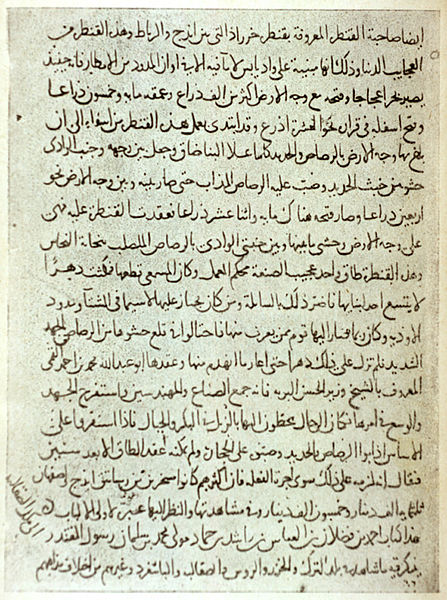
He was a 10th-centuryArab traveler, famous for his account of his travels as a member of an embassy of the Abbasid Caliph of Baghdad to the king of the Volga Bulgars. His account is most known for providing a description of the Volga Vikings, including an eyewitness account of a ship burial.

File:Ibn Fadhlan manuscript.jpg

Ibn Fadhlan manuscript

Elements of Ibn Fadlān’s account are used in the novel Eaters of the Dead  by Michael Crichton (adapted to film in The 13th Warrior with Antonio Banderas as Ibn Fadlan), in which the Arab ambassador is taken even further north and is involved in adventures inspired by the Old English epic Beowulf.

Some excerpts from Ahmad ibn Fadlān:

They are the filthiest of all Allah’s creatures: they do not purify themselves after excreting or urinating or wash themselves when in a state of ritual impurity after coitus and do not even wash their hands after food.

I have never seen more perfect physical specimens, tall as date palms, blond and ruddy; they wear neither tunics nor kaftans, but the men wear a garment which covers one side of the body and leaves a hand free. Each man has an axe, a sword, and aknife, and keeps each by him at all times. Each woman wears on either breast a box of iron, silver,copper, or gold; the value of the box indicates the wealth of the husband. Each box has a ring from which depends a knife. The women wear neck-rings of gold and silver. Their most prized ornaments are green glass beads. They string them as necklaces for their women.

In the case of a rich man, they gather together his possessions and divide them into three portions, one third for his household, one third with which to cut funeral garments for him, and one third with which they ferment alcohol which they drink on the day when his slave-girl kills herself and is burned together with her master.

Facebook copies social networking concept from 600 years ago

January 21, 2013

The Facebook concept was anticipated some 600 years ago.

A collaborative research project is ongoing between Royal Holloway, University of London, the British Library and Reading University, in which a team of academics are cataloguing and investigating the works of the Italian Academies, dating from 1525 to 1700.One of the major outcomes of the project is a comprehensive database of information on Academies from across the Italian peninsula, detailing their membership and publications. This is publicly accessible through the British Library on-line catalogue

Learned Academies represent a vital and characteristic dimension of early modern culture. There were ca. 600 Academies in Italy in the period 1525-1700. In the 16th and 17th centuries the Italian Academies were responsible for promoting debate and discussion in many different disciplines from language and literature, through the visual and performing arts to science, technology, medicine and astronomy.

And the researchers have also found that scholars at the Italian Academies were networking socially with satirical nicknames while sharing comments on topical events and exchanging poems and plays and music.

The project provides information about the academies, their members, publications, activities and emblems. Researchers were surprised to realise just how similar the activities of these sixteenth and seventeenth century scholars were with society today. 

Professor Jane Everson, Principal-investigator, said: “Just as we create user names for our profiles on Facebook and Twitter and create circles of friends on Google plus, these scholars created nicknames, shared – and commented on – topical ideas, the news of the day, and exchanged poems, plays and music. It may have taken a little longer for this to be shared without the internet, but through the creation of yearbooks and volumes of letters and speeches, they shared the information of the day.” 

The scholars created satirical names for their academies such as Gelati  and Intronati. Professor Everson explains: “They are jokey names, which really mean the opposite of what they say. Intronati has nothing to do with thrones; it means dazed, stunned, knocked out and so not able to think straight – but really the Intronati were engaged in serious study, debates, dramatic performances and the like from the moment they were founded in the 1520s – and they are still as active as ever in their home city of Siena. The Gelati were not going around singing just one cornetto. Gelati means the frozen ones – so a pun on the fact that these academicians far from being totally inactive through being frozen cold, were busy debating, exploring ideas, challenging received opinions and changing the cultural world of their home city of Bologna, and indeed of Italy and far beyond.”

Just as the names of the academies and the nicknames of the individual members were fun, so are the emblems and mottos which illustrate the name of the academy. The scholars took great delight in creating puzzling emblems with hidden meanings. Professor Everson adds: “They do sometimes take some working out, but it is great fun when you can see the hidden meanings in the images.”