“Climate has not changed.
We have changed.
Our habits have changed.
Our habits have got spoiled.”
Narendra Modi, India Today, 5th September 2014
“Climate has not changed.
We have changed.
Our habits have changed.
Our habits have got spoiled.”
Narendra Modi, India Today, 5th September 2014
With one month to go for the “official” 4 month-long monsoon season, rainfall has been 18% deficient so far. At the half-way mark most states were deficient in rainfall. However about half the states have now crept back to “normal” rainfall. With any El Nino only expected to be weak – if it even actually develops – a catastrophic monsoon can now be ruled out. Rainfall will be below normal but the last month of the monsoon holds some hope for further recovery. There is also some hope that the monsoon – which developed about 10 days late – may also be delayed in withdrawing giving some rainfall into the first two weeks of October. It will still be a “poor” monsoon but may not be labelled “bad” or “catastrophic”.
IMD’s chart covering the 3 months so far is below. Green is “normal”, red is “deficient”, yellow is “scanty” and blue is “excess”:

Monsoon 2014 75%
There is still some risk that a poor monsoon will hold back the industrial recovery somewhat. The growth in the last quarter has been the highest for 2 years as sentiment has turned positive, and is not likely to be reversed by this “poor” monsoon.
India’s economy grew by 5.7% in the three months to June, its fastest pace in two-and-a-half years, according to an official estimate. The economy was helped by strong growth in electricity, gas and water supply, and financial services, the Ministry of Statistics said.
The growth figure was higher than analysts had been expecting. …
….. Ever since the Narendra Modi government took charge, business sentiment has improved on the ground. Investors have started pumping in money again, capital markets have been roaring, consumer demand has revived & hiring has picked up.
But this euphoria is primarily driven by sentiment and more steps would be required to sustain this optimism.
Madras Day was celebrated yesterday as the 375th anniversary of the founding of the city now known as Chennai on the Coromandel coast.
Andrew Cogan and Francis Day’s factory site on an uninhabited sandy strip eventually grew to become one of India’s renowned metropolises, and the capital city of Tamil Nadu. Every year, August 22 is celebrated as Madras Day, and this year, 2014, is Chennai’s 375 birthday.
Excerpt from Edward Lear’s The Courtship of the Yonghi-Bonghi-Bo (this should be read in its entirety and only be read aloud)
On the Coast of Coromandel Where the early pumpkins blow, In the middle of the woods Lived the Yonghy-Bonghy-Bo.………….
“On this Coast of Coromandel Shrimps and watercresses grow, Prawns are plentiful and cheap,” Said the Yonghy-Bonghy-Bo. “You shall have my chairs and candle, And my jug without a handle! Gaze upon the rolling deep (Fish is plentiful and cheap); As the sea, my love is deep!” Said the Yonghy-Bonghy-Bo, Said the Yonghy-Bonghy-Bo. ………. “Lady Jingly! Lady Jingly! Sitting where the pumpkins grow, Will you come and be my wife?” Said the Yonghy-Bònghy-Bò. ………. Down the slippery slopes of Myrtle, Where the early pumpkins blow, To the calm and silent sea Fled the Yonghy-Bonghy-Bo. ……… From the Coast of Coromandel Did that Lady never go; On that heap of stones she mourns For the Yonghy-Bonghy-Bo. ………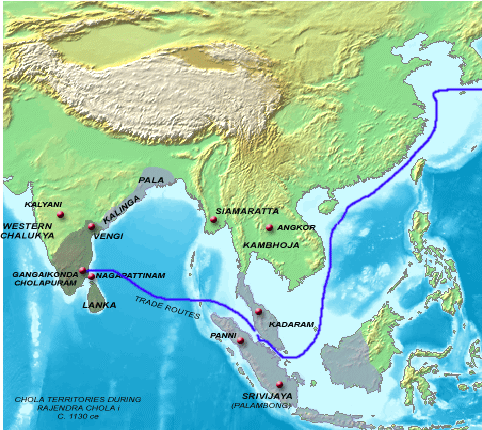
Chola trade under Rajendra Chola c. 1130 Wikimedia
The earliest known settlements in South India date back to more than 2 million years ago in the form of Acheulian stone tools (Lower Paleolithic from about 2.6 million to 300,000 years ago). The oldest human remains (probably homo erectus or archaic homo sapiens) found is a fossilised infant skull from about 200,000 years ago. The unfortunate and love-sick Yonghi-Bonghi-Bo was never destined to win his Lady Jingly Jones but the Coromandel coast has seen a continuous settlement of humans for over 2 million years. Homo sapiens probably came in two waves; one before the Toba eruption of 74,000 years ago and another perhaps around 50,000 years ago. The Toba eruption was possibly the greatest catastrophe ever visited on humans on that coast. In due course, hunter-gatherers gave way to farmers and the evidence shows that the Neolithic was long established by around 2,600 BCE (4,700 years ago). The early Chola-dynasty rule was established by 100 CE in the Sangam era. They lost power to the Pallavas around 300 CE who in turn were replaced by Pandyas around 600 CE but then the Cholas returned around 900 CE. Whether these medieveal Cholas were truly descendants of the early Cholas is uncertain but they certainly claimed to be. By 1,000 years ago at the height of the Chola Empire, their territories extended well into South-east Asia. Chola traders were finding their way up to today’s Korea, protected by a Navy which even had some blue-water capabilities. The later Cholas were again replaced by the Pandyas in 1279 but the rule of the great Tamil dynasties came to an end with the establishment of the short-lived Madurai Sultanate in 1335 and its many subsequent successors. Then came the colonists. The Portuguese, the Dutch, the British, the Danes and the French. The Portuguese were first. The “realm of the Cholas” in Tamil was “Cholamandalam” and from this came the Portuguese corruption to “C(h)oro-mandel”. Vasco da Gama reached the Western Indian Malabar coast on 20th May 1498. In 1522 they established São Tomé de Meliapore named after St. Thomas who was supposed to have preached at St. Thomas’ Mount between 52 and 70 CE. The legend is that St. Thomas died here and by 1523, the Portuguese had built a shrine there. “By late 1530 the Coromandel Coast was home to three Portuguese settlements at Nagapattinam, São Tomé de Meliapore, and Pulicat”. The Dutch reached the Coromandel Coast by 1606 and built their Geldria Fort near Pulicat (where the Portuguese were already present) as a staging post to the East Indies. The first British trading post was established in 1610 at Masulipatnam which had been abandoned by the Portuguese. The Danes reached in 1620 in Tranquebar and established a protestant mission. The French were late out and their first permanent colony was not established till they purchased Pondicherry in 1673.
By 1825, the Dutch had lost the last of their trading posts in India. The Danes left Tranquebar in 1845. The British left with Independence in 1947. By 1954 the French had ceded all colonies in India (though not ratified by the French Parliament till 1962). The Portuguese lost all footholds on the Coromandel coast by 1749 and were finally pushed out of India by military action in 1961.
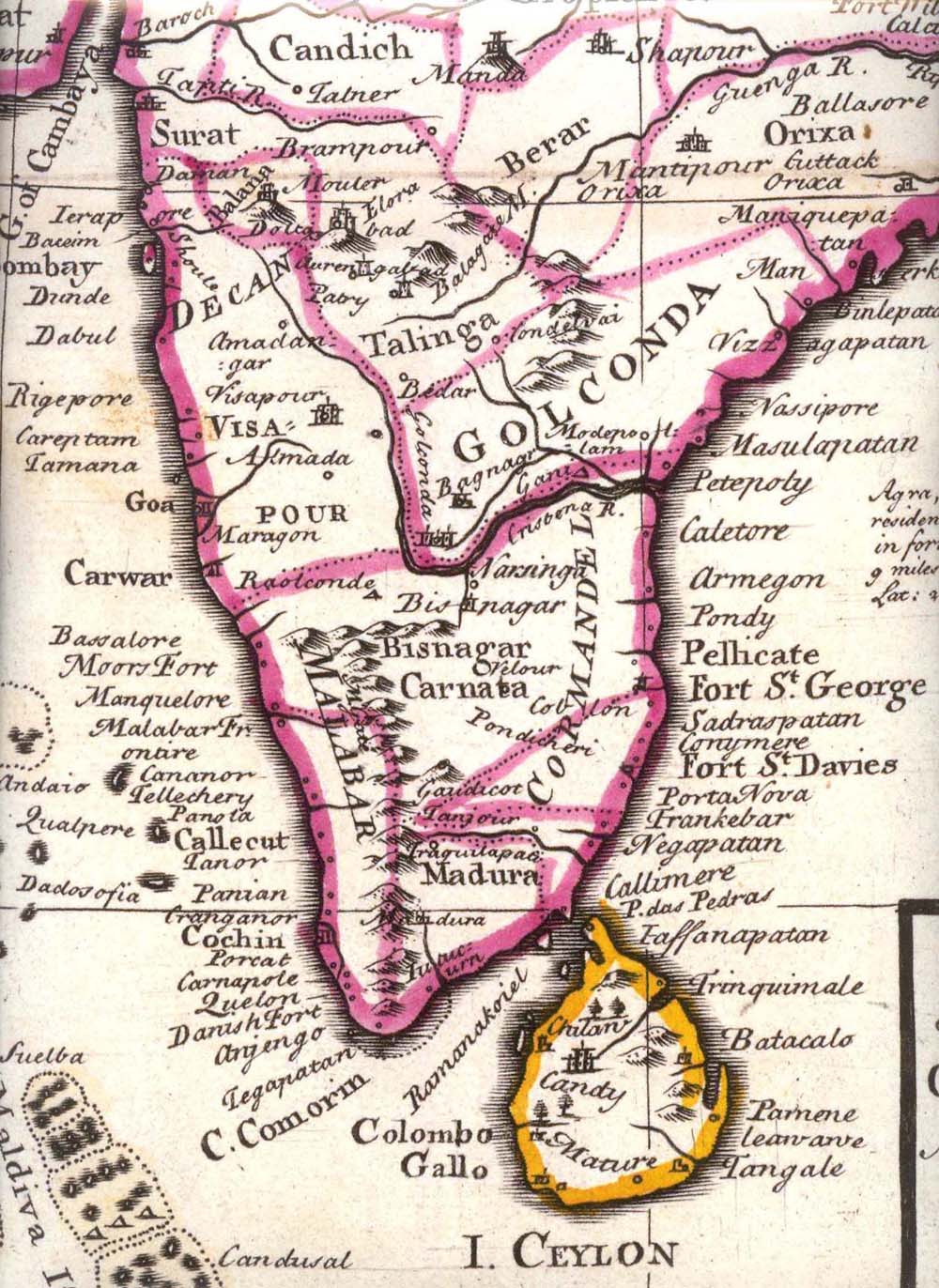
coromandel coast 1715 by moll
The British East India Company was quite desperate to find a foothold on the Coromandel coast but their efforts at Pulicat were defeated by the Dutch. They tried at to settle at Peddapalli and Nizampatnam but were laid low by the climate and by disease. The English, after some effort, secured the privilege of building a factory at Masulipatam port.
But they later abandoned their factory and crept away in a small boat to Durgarazpatnam (otherwise known as Armagaon) situated about 35 miles to the north of Pulicat. This place was a miserable port and was too poor to supply the calico cloth which the English wanted for export to Europe. But it was the only safe shelter for the English at the time and here they built a small fort and mounted a few pieces of cannon upon it. But trade did not thrive and the miserable English traders planned to go back to Masulipatam under the protection of a Golden Firman which the Sultan of Golconda was kind enough to give them. But Masulipatam was in the throes of a famine just then …..
With Masulipatam unprosperous and Armagaon hopeless, the English traders anxiously looked out for a new site that would be more propitious for them. Mr. Francis Day, the future founder of Madras, who was then a Member of the Masulipatam Council and the Chief of the Armagaon Factory, made a voyage of exploration in 1637 down the coast as far as Pondicherry with a view to choose a site for a new settlement.
Damarla Venkatapathy Nayak ruled all the coast country from Pulicat to the Portuguese settlement of San Thome now included within the City of Madras. He had his head-quarters at Wandiwash and his brother Ayyappa Nayak resided at Poonamallee, a few miles to the west of Madras, and looked after the affairs of the coast.
And so it was in August 1639 that Francis Day and Andrew Cogan on behalf of the East India Company purchased a 2 year grant from the Nayak for the village of Madraspattnam and with permission to build a fort and a factory. That became Fort St. George with the village of Madraspattnam just to the south and a village – called Chennaipattnam by the locals – to the north.
And the rest is history.
Day and Cogan are commemorated nowhere — except by Madras Day on 22nd August every year. But what is not really known is how the village of Madraspattnam, which clearly existed before Day and Cogan turned up, got its name. In one story it was named after a Christian fisherman named Madresan and in another after a Muslim madrassa in the vicinity. Another story speculates that it was because of the nearby Madre de Dios Church built by the Portuguese in São Tomé de Meliapore. But the story I like best is that it comes from the name of the wealthiest Portuguese family of the time in São Tomé de Meliapore – the Madeiros.
And that is the tale of Chennai on the Coromandel coast which once went by the name of a Portuguese family, where prawns are still plentiful and cheap and where the Yonghy-Bonghy-Bo broke his heart over the Lady Jingly Jones.
UPDATE!
The Rajasthan University website is suddenly “not available” – whatever that may imply.
A cached version of the page referred to below is here. (under the tab “Associate Professors”)
Update 2: The University website is up again and now updated. Presumably they went down to make the update.
=============================
The University of Rajasthan has a reputation of being very feudal (even if it is ranked 41 in a list of 511 Indian Universities). On anecdotal evidence they allow quite vicious ragging of first-year students and harassment of female students is quite common. Clearly all is not well at the University and specifically in the Department of Physics. Not just the academic misconduct evident from the manipulation and fabrication of data leading to multiple retractions, but also nasty charges of sexual misconduct and blackmail against the same professors.
1. Academic misconduct. Associate Professor RK Singhal has the dubious distinction of having achieved his own “category” at Retraction Watch as reward for his four (five?) retractions (so far). In his latest transgression Retraction Watch reports:
Here’s a physics retraction whose use of an exclamation point — the only one we’ve ever seen in a retraction notice! — makes the editors’ exasperation palpable.
It’s also the the fourth retraction for R. K. Singhal, of the University of Rajasthan, Jaipur, India. Behold the notice for “Magnetic behavior of functionally modified spinel Ni0.4Ca0.6Fe2O4 nanoferrite,” in the International Journal of Modern Physics B:
The editorial board discovered that the data points in several sections of the Moss-bauer spectra as given in Figs 3.(a) and 3(b) are exactly identical. This is impossible and nonphysical for the measurement of two different samples (or for that matter not even for the same sample!). The only conclusion we can draw from this figure is that some of the data is fabricated. As a result, the results and conclusions as described in the paper are unacceptable. This article is retracted from its publication in Int. J. Mod. Phys. B.
Prof. Singhal had to retract a 2010 paper and then he had to retract a correction to that retraction in 2013!!
Singhal and colleagues have another retraction — or two, depending how you look at it — in the Journal of Applied Physics. The journal has retracted a 2010 study, “Study of defect-induced ferromagnetism in hydrogenated anatase TiO2:Co,” but first they had to retract a 2013 correction of that study:
AIP Publishing LLC retracts this erratum because it was submitted and published without the knowledge of all the co-authors. Upon further investigation, it was found that the article that this erratum addressed warranted a retraction. Please also see the Retraction 1 associated with the original article.
Singhal’s colleague, Associate Professor SN Dolia of the same Department of Physics, was a co-author on the 4 Singhal papers retracted so far. They are both present as current faculty on Rajasthan University’s website. They have even had a physics paper retracted because their data was “unphysical”!!
2. Sexual Misconduct: But Singhal and Dolia have other problems to contend with. They are charged with extortion of sexual favours from a PhD student as a condition for being awarded her degree. They are said to have also fabricated obscene photographs to blackmail the student.
NDTV News: 30th June 2011.
In a huge embarrassment for teachers across the country, a professor at the Rajasthan University has been arrested for allegedly demanding sexual favours from his student.
The victim has alleged that her research guide Dr R K Singhal of the Physics department was harassing her for months.The professor asked the girl to have sexual relations with him if she wanted to complete her PhD. Besides molesting her in February, Singhal and his colleague S N Dolia allegedly even blackmailed the student by morphing her face onto some obscene pictures.
“While submitting her PhD thesis, the victim was asked for sexual favours by the teacher. Our preliminary investigation has found that the allegations are true and so we have arrested the Professor,” said BL Soni, Commissioner of Police, Jaipur. ….. Shockingly, despite the victim complaining about the teacher’s misconduct, the university authorities took no action initially. It was only after the girl lodged a police complaint that the accused teacher was arrested. Both Singhal and his colleague Dolia were later suspended from the university.
Besides suspending the two teachers, the university has also asked two retired Judges of the High Court to probe this shocking issue.
The legal mills in India grind on slowly and the case reached court in October 2013.
TOI: 16th October 2013.
JAIPUR: A court here on Tuesday framed charges against two assistant professors of University of Rajasthan (RU) who were accused of demanding sexual favours from a PhD student preparing thesis under their guidance.
The court of chief metropolitan magistrate (CMM) Bharat Bhushan Gupta, on Tuesday, framed charges against Dr Rishi Kumar Singhal and Dr S N Dolia under Sections 354, 341, 292 of the Indian Penal Code (IPC) and Section 4/6 of the Indecent Representation of en (Prohibition) Act.
On June 27, 2011 a girl belonging to Bharatpur, registered an FIR against the two professors at the Gandhi Nagar police station. In her complaint, the girl alleged that her research guide, RK Singhal, from the Physics department was harassing her and forcing her to have sexual relations with him. He allegedly used to threaten the girl that if she did not do as she was told, he would not let her complete her PhD.
While charges have been framed, the court hearings have not yet – apparently – commenced.
But there is no news of any results from the University investigation or of any actions being taken by the University. Interestingly the supposed University investigation reported is about the sexual misconduct charges. Nothing is reported from the University about the academic misconduct.
My expectation is that the University will not have the courage to actually do anything or to take any kind of moral or ethical position themselves. They will merely slip-stream behind the legal proceedings to avoid having to do anything.
During the period when Suresh Prabhu and Anant Geete were Ministers of Power in India I used to have to follow up any discussions with them about power projects with visits to the head of their party, Bal Thackeray, in Bombay. (They were in their posts as representatives of the Shiv Sena Party in the then BJP led coalition but had little freedom to act on their own. The Shiv Sena was embodied in Bal Thackeray and he always had the final word). Bal Thackeray and the Shiv Sena had led the very vocal, sometimes violent and parochially nationalist movement to change the name of “Bombay” to “Mumbai” in 1995. I have found all these “nationalist” movements – whether in Bombay or Madras or Calcutta or Delhi or Bangalore – to be small-minded, rooted in insecurity and representing a deeply-felt – but real – inferiority.
On my first meeting with Bala-saheb I was given strict protocol instructions by one of his aides before being ushered into the sanctum sanctorum at Mathoshree. I was to make sure that I always referred to “Mumbai” and not to “Bombay”. At the end of the audience I was expected to end my taking leave of him with the words “Jai Maharashtra” (long live Maharashtra). I remember asking the aide then whether, if I said “Bombay”, he would not understand what I meant. As he spluttered and I entered, I remember telling him that while I had no desire to insult anybody, I used language and words and names to best communicate my meaning.
In the event, in about 6 or 7 meetings over a number of years with Bal Thackeray, I never once used the terms “Mumbai” or “Jai Maharashtra“. But I did not go out of my way to use “Bombay” excessively or to provoke. I do not recall that Bala-saheb was ever discomfited or upset at my use of language (or non-use of “Mumbai”), or that we had any difficulty in getting our messages across to each other.
I grew up with “Bombay” and it evokes for me a world of glamour and wealth but also of modernity and substance and rectitude. As a child we lived in Poona (not Pune) and travelled through Bombay regularly. Bombay was avant-garde. “Mumbai” for me conjures up an old dirty village. A picture of slums and unfinished construction and uncollected garbage and rotting mill buildings. All very subjective of course but names and language are about communicating meanings. I note that the international airport designation of Bombay remains “BOM”. Since it takes an Act of Parliament to change it, the “High Court of Bombay” remains the “High Court of Bombay” in Mumbai. The Bombay Electric Supply & Tramways Company Limited (B.E.S. & T Co.Ltd) remains BEST but the “B” now stands for “Brihanmumbai” (meaning Greater Bombay). The name of the main railway station Victoria Terminus (VT) was changed to Chatrapati Shivaji Terminus but it is still referred to by everybody as VT. “Bollywood” remains “Bollywood” and I see no moves to make that “Mullywood”. Bombay Gin would not taste the same as Mumbai Gin. Bombay duck is far superior to Mumbai duck. In the 2000’s I used to stay at a guest house on Malabar Hill. Taxi drivers know exactly what I mean when I refer to Flora Fountain or Cuffe Parade or Kemp’s Corner or Napean Sea Road. The magic of Marine Drive on a misty evening is still untouched. Bombay, Meri Jaan is still the original song with Dev Anand in the movie CID.
The politically correct name is “Mumbai” and foreigners – especially – are very concerned about being politically correct. When I use “Bombay” I have no fear of being misunderstood. And even ardent Marathi nationalists understand exactly what I mean when I say “Bombay”, and the cleverer ones (there are not many of them) may even understand that I don’t think much of their rabid parochialism.
I finished my schooling in Calcutta and my image of the city has to mirror that reality. I am not misunderstood today when I still refer to Calcutta rather than Kolkata. The Calcutta High Court is still going strong. The international airport code is still CCU. Back in 1963 the British Council Library on Theatre Road was one of my favourite haunts. The name of the road was changed to Shakespeare Sarani but when I was there earlier this year – 50 years on – taxi drivers still referred to Theatre Road (and did not even know that there was any other name). School was on Park Street and Park Circus is just as congested as it always was. Lansdowne Road and many others have been renamed, but the old names live on. Bangalore remains Bangalore for me and Bengaluru does not trip off my tongue very easily – if at all. In Delhi CP is the supposedly defunct Connaught Place but it is still CP and not Rajiv Gandhi Chowk. Madras airport remains MAA and the Madras High Court is now located in Chennai. Mount Road is still Mount Road and everybody knows where Parry’s corner is.
I am told that Mumbai and Chennai and Kolkata and Bengaluru are the only “correct” forms but that is just a rather empty political statement. There are no rights or wrongs with language. There are only successful communications or misunderstood ones. There is no correctness about grammar – only compliance with a prevailing usage. My point is that as with grammar so with names. Inventing words or rules of grammar – or names – is of little account if the invented terms are not used.
Maybe the old names will be forgotten in a generation or two – or maybe not. The reality of usage always trumps the desires of “political correctness”.
It is nothing new that the modus operandi of a trade union is founded on discriminating against non-members. But a Bollywood trade union – the Cine Costume, Make-up Artists and Hair Dressers Association – has for the last 55 years forbidden women from being make-up artists or hair-dressers. But they are now being challenged in court and the Indian Supreme Court is expected to hand down its decision on August 26th.
The union’s defense – that allowing women into the profession would lead to all men losing their jobs – is particularly stupid. I expect the union will lose – as it should.
As an aside, the contemptuous attitude to women demonstrated by newly urbanised Indian youth is – I think – at least partially a consequence of the portrayal of women in Bollywood movies.
The National: Charu Khurana, 32, a make-up artist who trained at the Cinema Makeup School in Los Angeles in 2008 and returned to India with dreams of working in Bollywood. But Khurana found herself being confined to doing bridal make-up, fashion shows and commercials in New Delhi and unable to find work in Mumbai because the Cine Costume, Make-up Artists and Hair Dressers Association turned down her application in 2009.
“They rejected me, saying only men could work as make-up artists. It’s my basic human right to work in any field I wish. They can’t exclude women. I, too, have children and a family to support,” says Khurana.
Indignation prompted her to contact the New Delhi lawyer Jyotika Kalra, who took up the case and also asked the National Commission for Women – the state organisation that protects women’s rights – for support.
Kalra says she did not know whether to laugh or cry at the explanation she received from the Association.
“They wrote saying that the rule was intended to protect a man’s livelihood because, if women were allowed to do make-up, no actor would ever choose a man to do it. What kind of logic is that?” asks Kalra.
Both the Indian Mars Orbiter Mission (MOM – Mangalyaan, budget $70 million) and NASA’s MAVEN (budget $672 million) are now approaching Mars. Both are doing well according to their latest status updates.
MOM was launched on 5th November last year and MAVEN on 18th November, 2013. Whereas MAVEN on its Atlas 5 rocket could directly enter into a Hohmann Transfer Orbit with periapsis at Earth’s orbit and apoapsis at the distance of the orbit of Mars, MOM had to take the low-cost, scenic route. Because of the relatively low payload capability of the PSLV launch rocket, MOM had to spend 26 days in ever-increasing earth orbits. MOM had to fire its Liquid Motor six times to work its way up to departing Earth orbit using a standard Hohmann Transfer Orbit on 1st December.
Alternate paths to Mars: NASA’s MAVEN compared to India’s MOM

MAVEN – MOM trajectories
When they were launched MAVEN was expected to reach Mars on 22nd September 2014 and MOM 2 days later on 24th September 2014. The time lines have shifted slightly subsequent to the mid-course corrections carried out and MOM is now expected to reach Mars orbit about a week ahead of MAVEN. I suspect that the time of Mars Orbit Insertion is still a little fluid, but both are about 1 month away. MOM is currently about 6 minutes away in radio signal distance.
India’s Mars Orbiter Mission (MOM) is more than 80 percent of the way to Mars and performing well, according to a Facebook update posted July 21 by the Indian Space Research Organization. MOM is expected to enter orbit on Sept. 14.
The second craft, NASA’s Mars Atmosphere and Volatile EvolutioN (MAVEN), is also performing well. MAVEN is scheduled to embark on its final approach to the Red Planet on Sept. 21, one week after MOM’s arrival, principal investigator Bruce Jakosky said. After months of checkouts and tests, the spacecraft will now be left quiet until close to the big day.
NASA’s MAVEN has now gone into a “pre-Mars Orbit Insertion moratorium.” All systems required for a safe Mars Orbit Insertion remain powered on. But other systems like the instruments are shut down until late September because they are not needed for a successful MOI. We want the spacecraft system to be as “quiet” as possible and in the safest condition during the critical event on September 21st”.
The biggest credibility challenge that Narendra Modi faces is to convince Indians – and the outside world – that he represents something much larger, secular and inclusive than the narrow, religiously-bigoted and exclusive position espoused by the RSS and some even more extreme Hindu nationalist groups. But he has to do this equitably but without giving the perception of appeasing the Muslim fanatics.
And he has to clean his own house first. His ally in Maharashtra, the Shiv Sena, is now an embarrassment and a liability. Within his own party also there is no dearth of intellectually retarded loud-mouths. They are all now a burden and unless he cuts them down to size they have the potential to negate all his efforts to be inclusive.
The Shiv Sena is a special case and I think Modi can afford to dump them. They have just made utter fools of themselves:
IBN: A video has now surfaced showing Shiv Sena Thane MP Rajan Vichare forcing a Maharashtra Sadan Muslim staffer to eat during his Ramzan fast. CNN-IBN has accessed footage which shows Vichare force feeding the staffer.
The video gives credence to the allegations that Shiv Sena MPs abused the employee and forced him to eat, even as the Shiv Sena continues to deny the claims. Shiv Sena MP Anant Geete in the Lok Sabha on Wednesday said that the claims being made by the Opposition are false.
DNA: Taking law and order into his own hands is not something new for Rajan Vichare, the Shiv Sena MP from Thane who force-fed a Muslim catering supervisor to break his Ramzan fast at Maharashtra Sadan last week. In the last 25 years, around 24 cases have been registered against the senior Sena leader in various police stations of Thane.
Defending his recent act, Vichare said, “I was protesting against the quality of food at Maharashtra Sadan.” Later, Vichare was forced to apologise and issued a statement saying, “I regret if anyone’s religious sentiments were hurt. I did not know that the employee was a Muslim. I respect all religions and have even attended roza as well as iftar parties.
The Shiv Sena party leader, Uddhav Thackeray, has been engaged in some verbal contortions while apologising – but not seeming to apologise – and has been reduced to mumbling that it was all about the food quality and nothing to do with religion. But Shiv Sena is not the force it was when his father Bal Thackeray was in charge. Neither intellectually nor politically. When no party member dared to deviate from the party line as determined by Bal Thackeray. (I recall when I regularly used to meet the Minister of Power – who was then a Shiv Sena nominee in the coalition government of the time. First it was Suresh Prabhu and later it was Anant Geete. After every substantive meeting, I usually had to go to Bombay to meet Bal Thackeray and reconfirm whatever had been discussed with the Minister). Uddhav Thackeray does not have that sort of iron control over his party members and they are now apparently rushing around – the analogy is headless chickens – all doing their own thing. The Shiv Sena remains a force – if only in Maharashtra – but they are in a declining spiral and my reading is that it would be least damaging for Modi to dump them now – early on in his term – and cap his losses.
With his own party members Modi will just have to lay down the law and get rid of the intellectually challenged. And there are quite a few of them.
The BJP leader in Telegana, a certain K Laxman, of no great intellectual stature (and not to be confused with VVS Laxman), has been stupid enough to attack a leading Indian sports star – because she happens to be Muslim and is married to a Pakistani. He was idiot enough to attack Sania Mirza the tennis player. If there is one thing that unites Indians and transcends politics and religion and caste, it is sport. And cricket and tennis lead all the rest.
FirstPost: In a statement that could almost have been designed to reclaim the ‘pointlessly offensive’ tag from Shiv Sena MP Rajan Vichare, Telangana BJP leader K Laxman on Wednesday slammed the TRS government’s decision to appoint tennis star Sania Mirza as brand ambassador of Telangana, terming her a “daughter-in-law of Pakistan”.
“Sania was born in Maharashtra and settled in Hyderabad only later and, hence, is a non-local”, he told reporters, pointing out that she is married Pakistani cricketer Shoaib Malik. “If 1956 is the criteria for deciding the nativity of Telangana, where was Sania born and when did she come to Hyderabad? And whom she married should also be a criterion for selecting her.”
So much for aman ki asha.
The comment has predictably created an uproar with members of the TRS, the Congress and other opposition figures falling over each other to criticise it, and for good reason. The statement reflects a toxic combination of anti-Muslim bigotry and sexism that is the preserve of rightwing ideologues.
Yesterday the monsoon covered the entire country but while this is only 2 days later than the “long term average”, the progress of the monsoon across south and central India has been around a week or 10 days late. Until last week the rainfall was in deficit by over 40%, but heavy rains this week are beginning to eat into this deficit. In the meantime the possibility of a strong El Niño this year, which could have further depressed the monsoon rainfall, is receding.
With 2½ months of the monsoon season left, there is now a reasonable – and improving – probability that the shortfall will end up at less than 10% of the long term average and that the hit to the Indian GDP will not be too severe.
Climate alarmists (mainly the environmental mafia) have been hoping – and praying – for a strong El Niño, a disastrous monsoon, a strong blow to the agricultural sector and an increase in farmer suicides. They are increasingly likely to be disappointed. Fortunately the cost to consumers usually reduces and the good of society usually increases with the increasing disappointment of the loony green mafia.
The best thing to have happened for Australia in years is probably the recent repeal of the Carbon tax which has – surprise, surprise – caused great disappointment to the loony green mafia.

Monsoon covers entire country 17 July 2014 – IMD
ET:The monsoon delivered this season’s heaviest showers on Tuesday, drenching southern and central India with 50 per cent more rainfall than normal, while international forecasters said the rain-disrupting El Nino phenomenon would be weaker than feared.
The northern and western parts of the country remained relatively dry, but for the country as a whole, Tuesday’s rainfall was 10 per cent above normal, reducing the season’s rain deficit to 40 per cent. The deficit is still abnormally high, but two days of heavy rainfall is expected to speed up crop planting, which was half of last year’s mid-July level.
The weather office has forecast good rainfall in many parts of the country in the days ahead. Further, the latest forecast of Australia’s weather department could bring some relief to policy-makers as it has suggested that the El Nino weather phenomenon that curtails June-September rains is unlikely to be intense this year.
The Australian Bureau of Meteorology writes in its ENSO wrap-up:
Warming of the tropical Pacific Ocean over the past several months primed the climate system for an El Niño in 2014. However, a general lack of atmospheric response over the last month has resulted in some cooling of the tropical Pacific Ocean.
While the majority of climate models suggest El Niño remains likely for the spring of 2014, most have eased their predicted strength. If an El Niño were to occur, it is increasingly unlikely to be a strong event.
Changes are also occurring in the Indian Ocean. The Indian Ocean Dipole (IOD) index has been below −0.4 °C (the negative IOD threshold) since mid-June, but it would need to remain negative into August to be considered as an event. Negative values are rare when the central Pacific is warmer than average. Model outlooks suggest the IOD is likely to return to neutral by spring. Conditions in the Indian Ocean may have contributed to the above-average rainfall experienced in southeast Australia during June.
I have been traveling this week on an assignment .
Today the monsoon rains reached Delhi – about 7 days later than the long term average but not an unusual occurrence. A quarter of the 4 month monsoon season is over and so far there is a heavy shortfall in the rainfall received.
Rainfall in July will be crucial in determining whether this monsoon will turn out to be a “bad” one or just somewhat “low”. The risk of this year being a super El Niño year has reduced and with it the risk of a disastrous monsoon has also declined. Nevertheless contingency plans for a “bad” monsoon are being prepared.
Conventional wisdom is that the difference between a good monsoon and a bad one is about 2% points for GDP.

 The k2p blog