Archive for the ‘Media’ Category

Number of citations and excellence in science

February 10, 2014

Scientific excellence can only truly be judged by history. But history has eyes only for impact and if excellent science causes no great change to science orthodoxy, it is soon forgotten. For a scientist the judgements of history long after he performs his science are of no real significance. Even where academic freedom is the main motivator for the scientist,  the degrees of freedom available are related to academic success. An academic or scientific career depends increasingly on contemporaneus judgements – and here social networking, peer review and bibliometric factors are decisive. There may well be some correlation between academic success and the “goodness” of the scientist but it is not the success or the bibliometrics which are causative.

As Lars Walloe puts it: Walloe-on-Exellence

In the evaluation process many scientists and nearly all university and research council administrators love all kind of bibliometric tools. This has of course a simple explanation. The “bureaucracy” likes to have a simple quantitative tool, which can be used with the aid of a computer and the internet to give an “objective” measure of excellence. However, excellence is not directly related either to the impact factor of the journal in which the work is published, or to the number of citations, or to the number of papers published, or even to some other more sophisticated bibliometric indices. Of course there is some correlation, but it is in my judgement weaker than what many would like to believe, and uncritical use of these tools easily leads to wrong conclusions. For instance the impact factor of a journal is mainly determined by the very best papers published in it and not so much by the many ordinary papers published. We know well that even in high impact factor journals like Science and Nature or high impact journals in more specialized fields, from time to time not so excellent papers are being published. 

…..  I often meet scientists for whom to obtain high bibliometric factors serve as a prime guidance in their work. Too many of them are really not that good, but were just lucky or work in a field where it was easier to get many citations. …..If you are working with established methods in a popular field you can be fairly sure to get your papers published. I can mention in details some medical fields were I know that this has happened or is happening today. The scientists in such fields get a high number of publications and citations, but the research is not necessarily excellent. 

And getting your paper published has now become so important in the advancement of an academic career that journals are proliferating. Many of the new journals have now shifted their business models to be based on author’s fees and not on volume of readership. This is a very “safe” business model since profits are ensured before the journal has even been published and if the journal is an on-line journal then costs are minimal. It is virtually the “self-publishing” of papers. You pay your money and get your paper published.

The reality today is that more papers are being published by more authors in more journals than ever before. But fewer are being actually read. Papers are cited without having been read – let alone understood.

Skeptical Scalpel:

Another reason could be that publishers, particularly those who charge authors fees for publishing, are in the business of making money.

Authoring journal articles is not only enhancing to one’s CV (the old “publish or perish” cliché), it is required by Residency Review Committees as evidence of “scholarly activity” in training programs. Maybe it’s good for attracting referrals too.

The publish or perish ethos has led to a proliferation of the number of authors per paper!

First noted in 1993 by a paper in Acta Radiologica and a letter in the BMJ, the number of authors per paper has risen dramatically over the years. 
study of 12 radiology journals found the number of authors per paper doubled from 2.2 in 1966 to 4.4 in 1991.  A review of Neurosurgery and the Journal of Neurosurgery spanned 50 years. the average went from 1.8 authors per article in 1945 to 4.6 authors in 1995. 
Of note, the above two articles were each written by a single author. 
Three psychiatrists from Dartmouth analyzed original scientific articles in four of the most prestigious journals in the United States—Archives of Internal Medicine, Annals of Internal Medicine, Journal of the American Medical Association, and the New England Journal of Medicine—from 1980 to 2000. They found that the mean number of authors per paper increased from 4.5 to 6.9. The same is true for two plastic surgery journals, which saw the average number of authors go from 1.4 to 4.0 and 1.7 to 4.2 in the 50 years from 1955 to 2005. The number of single-author papers went from 78% to 3% in one journal and 51% to 8% another.
In orthopedics, a 
review of the American and British versions of the Journal of Bone and Joint Surgery for 60 years from 1949 to 2009 showed an increase of authors per paper from 1.6 to 5.1.
An impressive  rise in the number of authors took place in two leading thoracic surgery
 journals. For the Journal of Thoracic and Cardiovascular Surgery the increase was 1.4  in 1936 to 7.5 2006 and for Annals of Thoracic Surgery it was 3.1 in 1966 to 6.8 in 2006. 

And the winner is a paper with 3171 authors! Needles to say it comes from Big Science and the Large Hadron Collider:

the paper with the most authors is “Observation of a new particle in the search for the Standard Model Higgs boson with the ATLAS detector at the LHC” in a journal called “Physics Letters B” with 3171. The list of authors takes up 9 full pages.

Too many journals, too many papers, too many authors and too many citations. But that does not mean there is more excellence in science.

Intrusive ads are counter-productive – at least with me

February 6, 2014

I must be representative of some consumers since I do buy stuff.

I even buy quite a lot of stuff on-line. Tickets of any kind (theatre, airline, museum, train, football, hockey bus ……), books, music, electrical and electronic gadgets and a host of small articles capable of being delivered by post. We book hotels on-line and sometimes pay on-line as well. We generally don’t buy food or clothes on-line but we do sometimes (at least my wife does) respond to the flyers dropped into our letter box by local retailers. Nearly all automotive products or materials for house repairs are bought physically and not on-line though we may have searched on-line.

But what I observe is that when I buy-on line it is from sites that I know or for which I have searched on-line. Never by clicking on an ad at another site. Even when I search I always hop over the paid ads which show up at the top of the search results. For a store to show up in a search result is much more important in getting my custom than in their advertising having been seen on another site. I cannot recall a single instance in the last year of buying something in response to an on-line ad. But what I also observe is that there is some threshold level of intrusiveness which leads me to remove sites from my bookmarks. If a site directs me first to full-page ads which I have to click away – and especially if they make it difficult to find the “close” button – then those sites get removed from my bookmark lists. I don’t watch videos on-line if their ads don’t disappear within 5 seconds. If my mouse, when hovering over text, brings up too many intrusive ads then the entire site gets onto my “black-list”. I don’t mind registering for some services at some sites but if that process takes longer than about 30 seconds (perhaps a minute) then that site never gets visited again.  Of course it could be that some of the on-line ads are having a subliminal effect and reinforce my perceptions when I search for on-line stores – but it is not very likely.

Even on TV and especially since the break for commercials is so long (in Sweden a commercial break lasts 6 minutes and there are not many ads of high quality), the commercial break either leads me to surf other channels or to go do something else. In the last year or two I notice that there are more TV programmes that I watch only up to the first commercial break because I then go and do something else and never get back in time to watch the rest of the programme. If it is a sporting or political event, then I may well return to the programme – after the commercial break. In any event the people paying vast sums for making and airing the commercials do not capture my attention. If anything they create a resentment in me since I am either a “captive audience” or am being coerced to view their “nonsense”. And it is the resentment which leads to the content being classified in my mind as “nonsense”. I never watch TV shopping channels but they clearly don’t have me as their target audience. The very existence of the commercials is leading me to strategies to avoid them!

My behaviour is surely influenced by the presence of ads on-line and commercials on TV. However, the behaviour engendered in me is nearly always counter-productive from the viewpoint of the advertiser. Maybe I am an untypical consumer – but I doubt it.  Which makes me wonder how effective some of this advertising is?

Certainly advertising agencies and the industry in general will never admit that there can be too much advertising. They get paid for exposure (or apparent exposure) and not for sales achieved. They don’t suffer any penalty for resentment caused or customers driven away. But I would suggest that there is a threshold – very low in my case – at which on-line advertising and commercials on TV become counter-productive.

I get virtually no text ads on my phone. I stopped using Facebook and Twitter some months ago so at least I am not harassed by their ads. But from what I hear, the intrusiveness of the ads on the social media are now leading to some people reducing their use and, in some cases, ending their use of social media. Social media and their business models are still evolving but the assumption that advertising revenues can keep increasing forever is fundamentally flawed.

BBCTwitter reports $645m loss for 2013

Microblogging site Twitter has reported a net loss of $645m (£396m) for 2013, just three months after its flotation on the New York Stock Exchange. The loss was expected by analysts, who highlighted Twitter’s revenues, which rose 110% last year to reach $665m.

But a reported slow growth in user numbers was a bigger concern for investors. Twitter averaged 241 million monthly users in the last quarter of the year, up just 3.8% on the previous quarter. That represents a slowdown compared with a growth rate of 10% seen at the beginning of 2013. Timeline views were down nearly 7%, suggesting users were refreshing their feeds less often.

“What this report will do is it will question how mainstream is Twitter as a platform,” said Arvind Bhatia, an analyst at Sterne, Agee & Leach.

Shares fell as much as 12% in after-hours trading on Wednesday.

Climate – the second derivative

January 14, 2014

Change changes.

We take global temperature (which exists nowhere and is merely a numerical construct) as climate. When global temperature is not constant we call it climate change. When “climate change” starts to change (as now from warming to cooling) we are into the second derivative. The turbulence at the time of the change of climate change we call “extreme events”.

Changing climate change

Changing climate change

These articles do not say very much new but they are quite extraordinary in that they are carried by the Sydney Morning Herald and Real Clear Politics, who have been staunch supporters of global warming orthodoxy.

The Ship of Fools in the Antarctic seems to have been a “tipping point” – not for climate or for climate change or for the change in climate change – but maybe for bringing some reality back into how climate is reported. (Incidentally, the Akademik Shokalskiy managed to get free of the ice and reached New Zealand but Turney’s tourists who were so dramatically rescued are still stuck at Casey station in the Antarctic and are not due back home for another 10 days!!!!!)

Sydney Morning HeraldGame finally up for carboncrats

It was promoted as the voyage to study the melting of ice sheets in the South Pole as well as to retrace Douglas Mawson’s perilous expedition a century ago. Yet the Australasian Antarctic Expedition, led by UNSW climatologist Chris Turney, has become a comedy goldmine. …..

Real Clear PoliticsShip of Fools in the Antarctic

In the mega-bestseller of the 15th century, “Das Narrenschiff,” Swiss lawyer Sebastian Brant satirized the pretensions, delusions and follies of his day through descriptions of passengers on a ship bound for “Narragonia.” Brant’s depiction of humanity as a ship of fools sailing without rudder or compass captured the imagination, inspiring a painting by Hieronymous Bosch, a song by the Grateful Dead.

So when the research ship Akademik Shokalskiy got stuck in the ice about 40 miles from Antarctica, some who knew the purpose of its voyage dubbed it the “Ship of Fools.” ……

Real Clear PoliticsFreezing Is the New Warming

This is looking like another bad year for global warming.

The year began with the news that an Australian “climate researcher” leading a tourist expedition to Antarctica got his ship trapped in the sea ice. Which is embarrassing, because the purpose of his expedition was to study the melting of sea ice supposedly caused by 20th-century global warming. The current expedition was meant to retrace the route Douglas Mawson took in 1912—but they were stopped 70 kilometers short of where Mawson landed. So they needed to have an icebreaker ship sent to rescue them. Then the icebreaker got caught in the ice, and someone had to rescue the rescuers. You can’t make this stuff up. …… 

The New York Times and Der Spiegel have started backing away from the orthodoxy towards reality – but very slowly. The Guardian, Washington Post and the BBC are among those who are still stuck in a fantasy world.

“Climate” brainwashing at the BBC

January 12, 2014

I like BBC News. They are usually faster than CNN with breaking news though not as fast as the blogosphere. But they are generally very reliable for straight news. Their breadth and depth of coverage is – I think – unmatched by any other news organisation. Facts are well checked and the BBC serves as verification of news from the blogsosphere and other sources. For me they are a key “media of record” and the BBC is freely available. Together with Reuters (rather than AP) I think they are a vital part of the protections of “freedom” in today’s world.

But when it comes to opinion the BBC is inherently unsound. They always take the “politically correct” line. That the view from the left is usually over-represented in their opinions is no secret – and it is just a matter of fact that most “politically correct”  issues derive from the left of the political divide. And for such issues the BBC loses its impartiality.

That the BBC is – and has been – one of the high priests of the “global warming” faith is also no secret. That Roger Harrabin has been one of the high priests of the religion has also been rather obvious. But what is new is that the BBC has spent a great deal of money in brainwashing their journalists and presenters in the dogma of this new catholicism. And that Cardinal Harrabin – as has long been suspected – has had some commercial interests in the propagation of the religion within the BBC. A pensioner has apparently forced the BBC by means of the Freedom of Information Act into revealing how some of the brainwashing was carried out.

This report is from the Daily Mail  (which itself is more than a little biased) but is reasonably reliable as to fact as long as its “opinions” are discounted:

The BBC has spent tens of thousands of pounds over six years trying to keep secret an extraordinary ‘eco’ conference which has shaped its coverage of global warming. …. The controversial seminar was run by a body set up by the BBC’s own environment analyst Roger Harrabin and funded via a £67,000 grant from the then Labour government, which hoped to see its ‘line’ on climate change and other Third World issues promoted in BBC reporting.

At the event, in 2006, green activists and scientists – one of whom believes climate change is a bigger danger than global nuclear war  – lectured 28 of the Corporation’s most senior executives. 

A lobby group with close links to green campaigners, the International Broadcasting Trust (IBT), helped to arrange government funding for both the climate seminar  and other BBC seminars run by  Mr Harrabin – one of which was attended by then Labour Cabinet Minister Hilary Benn. Applying for money from Mr Benn’s Department for International Development (DFID), the IBT promised Ministers the seminars would influence programme content for years to come.

The BBC began its long legal battle to keep details of the conference secret after an amateur climate blogger spotted a passing reference to it in an official report. Tony Newbery, 69, from North Wales, asked for further disclosure under the Freedom of Information Act. The BBC’s resistance to revealing anything about its funding and the names of those present led to a protracted struggle in the Information Tribunal. The BBC has admitted it has spent more than £20,000 on barristers’ fees. However, the full cost of their legal battle is understood to be much higher.

In a written statement opposing disclosure in 2012, former BBC news chief and current director of BBC radio Helen Boaden, who attended the event, admitted: ‘In my view, the seminar had an impact on a broad range of BBC output.’ She said this included news reports by Mr Harrabin, and a three-part BBC  2 series presented by geologist Iain Stewart, who told viewers global warming was ‘truly scary’. According to Ms Boaden, ‘Editors and executives who attended were inspired to be more ambitious and creative in their editorial coverage of this slow-moving and complex issue.’ She claimed the seminar sought to  ‘identify where the main areas of debate lie’. However, there were no expert climate sceptics present. 

In an internal report, the IBT boasted that the seminars organised with Mr Harrabin had had ‘a significant impact on the BBC’s output’.

All four scientists present were strong advocates of the dangers posed by global warming. They were led by Lord May, former president of the Royal Society, who, though not a climate expert, has argued that warming is a greater threat than nuclear war. Other non-BBC staff who attended included Blake Lee-Harwood, head of campaigns at Greenpeace, John Ashton from the powerful green lobby group E3G, Andrew Simms of the New Economics Foundation, who argued there were only 100 months left to save the planet through radical emissions cuts, and Ashok Sinha of Stop Climate Chaos.

Mr Harrabin was the seminar’s principal organiser. He ran it through the Cambridge Media Environment Programme, an outfit he set up with Open University lecturer Joe Smith. …… by teaming up with the IBT,  an avowed lobby group trying to influence coverage, and accepting government funds when Labour was advocating radical policies to combat global warming, Mr Harrabin exposed himself to the charge he could be compromising the Corporation’s impartiality. During the legal battle, the BBC tried to airbrush both the IBT and its approach to the Government for funding from the record. Submissions and witness statements made no mention of it. …. 

David Rose comments:

Last week was a big one for weather news: the storms and floods in Britain, and the end of the bizarre saga which saw the Akademik Shokalskiy, the ship carrying climate scientists, tourists and a BBC reporter to inspect the ravages of global warming, trapped in Antarctic ice.

In both cases, the BBC stuck closely to its skewed, climate alarmist agenda. ……. 

Google funded study implies that Google Trends is a valid and rigorous behavioural indicator

January 8, 2014

I find that this disclaimer at the end of this study effectively invalidates the method of the study and its results.

This project was supported by a Google.org grant from 2012, although Google.org played no role in designing or conducting this study.

The results of the study (that more people searched for health issues on Google during the recession) are trivial and – with the best will in the world – of little value except for providing a plug for Google Search and Google Trends. Of course a Google Trend means something but to imply – as this study does – that a Google Trend for selected search items  is a rigorous and valid representation of a human behavioural pattern is more than a little fanciful.

Benjamin M. Althouse et al, Population Health Concerns During the United States’ Great Recession, Am J Prev Med 2014;46(2):166–170

Press Release: 

The group examined Americans’ Google search patterns and discovered that during the recent Great Recession, people searched considerably more frequently for information about health ailments. The kinds of problems indicated by the queries weren’t life threatening, but they could keep someone in the bed a few days, like ulcers, headaches, and back pain. 

In total, the team found there were more than 200 million excess queries of this kind during the Great Recession than expected.

“While it’s impossible to uncover the motives for increased searches, they likely indicate a person being ill, and ill enough to seek out online information or remedies,” Ayers said. The same group previously published a report showing that queries for anxiety and depression also increased substantially during the Great Recession.

The authors themselves write:

google search

Without first a study on whether the usage of Google search is actually representative of any part of the population, and whether a trend in such usage permits conclusions regarding the motives for such usage, this study is little more than an advertisement for Google Search and Google Trends.

Just as with Facebook surveys and profound conclusions, I am not at all sure that this “study” can even be considered science  – let alone good science. It is published  – believe it or not – in a journal of preventive medicine,  but it has little to do with medicine and more to do with PR and  Google’s image.

Nature/Turney defend the Ship of Fools and their Antarctic pleasure cruise

January 7, 2014

Chris Turney, his global warming pilgrims (called scientists), his pet journalists and his tourists are due to reach Tasmania on 22nd January after being “rescued” (from what?) after their chartered ship Akademik Shokalskiy (ice-strengthened but no icebreaker) was trapped in the Antarctic ice on December 24th.

Nature (much to their discredit) have hurriedly published a defence by Chris Turney of his tourist trip on his Ship of Fools.  It amazes me that Nature would – so quickly – publish such an obviously self-serving and narcissistic article. Almost as if they had a higher agenda of defending the larger global warming community so grievously opened up to ridicule by Turney and his tourists.

“It was no pleasure cruise” he whines (though he seems to have taken his family along for this jaunt). He claims the ship was an icebreaker – which it was not – and that the event could not have been anticipated  – which it could. He claims to have advanced the frontiers of science – which is mere hyperbole. He even tries to take credit for rekindling public interest! 

“… the value of our expedition must be judged by the quality of the research it always intended to produce, and the remarkable rekindling of public interest in science and exploration that has come with it”.

But his attempt to salvage something from his PR disaster does not go down well judging by some of the comments that his self-serving “defence” elicits:

Roger Corbett 2014-01-07 04:46 AM

How does a couple of hours shoveling snow to get inside Mawson’s Huts reported at the time by Professor Turney http://www.abc.net.au/science/photos/2013/11/26/3897110.htm become “important conservation work” a few days later? When he is trying to boost the scientific credentials of a tourism exercise. When you are in a hole, stop digging. These little exaggerations add up to make it hard to believe the bigger things. “Never before has a science expedition reached out live to so many people from such a remote location”….er, “one small step for a man…” It’s a definite pattern in the accounts coming from the AAE-2 people. Reading as much as I can, I conclude that the tourism activities delayed return to the ship, despite increasing concern from the ship’s Master. The claims that the weather closed in so suddenly and unexpectedly by Professor Turney are exaggerated (like so many things he says and writes), either to deliberately deflect from his responsibilities as tour leader, or because ego doesn’t allow him to admit it even to himself.

Charles Rotter 2014-01-07 12:41 AM

…  I have been following the writings of the various blogs documenting this trip, and as far as I can tell, the only scientific discovery/conclusion/finding you have documented so far is that, if the food source for a population of penguins becomes much harder to reach due to added physical obstacles, then that penguin population will probably reduce in number. I am in awe at this insight.

Richard Tol 2014-01-06 04:09 PM

The way it turned out, this was indeed no pleasure cruise. At the same time, Chris Turney has yet to answer questions about the research purpose of this expedition. The Spirit of Mawson website is vague and many of the aims listed there cannot be achieved by a single, short trip. The successes listed above are from the first leg of the trip, rather than from the now-infamous second leg. If the second leg aimed to launch Argo floats, why did it sail on? And why were there so many people on board? There were 18 PhD students on the expedition. Only 6 have a research connection with Antarctica (the other 12 studying the North Atlantic, Australia’s coastal waters, brain injury, Iceland, New Zealand’s North Island, urban climates, pedagogy, the Equatorial Undercurrent, pharmaceuticals, time series statistics, microbiology, and Siberia), but only one of those has an obvious reason to visit Mawson’s Huts and even she would have collected more data in the same time had she flown there. Forgive me for asking, what research purposes were served by this expedition? Was this really the best way to spend the available funds?

NSA covers less than 10% of the world’s mobile communications!

December 5, 2013

It’s only arithmetic!

The NSA has much room for improvement and probably needs to increase its budget by a factor of 10.

  1. The National Security Agency is gathering nearly 5 billion records a day on the whereabouts of cellphones around the world.
  2. The ITU expects the number of cell phone accounts to rise from 6 billion now to 7.3 billion in 2014, compared with a global population of 7 billion.
  3. (NSA) records feed a vast database that stores information about the locations of at least hundreds of millions of devices.
  4. People make, receive or avoid 22 phone calls every day.
  5. The NSA has a budget (secret) of about $52 billion (estimate).

Number of records available to be spied on = 6 billion x 22 /2 = 66 billion.

Five billion records may seem like a big number but it is not as comprehensive as one would expect to see from anybody aspiring to be “Big Brother”. The NSA records only 7.58% of the world’s mobile communications.

If the NSA (and Obama)  truly aspire to being the “Big Brother” of this Brave New World, they are going to have to step up their game. They need to increase their surveillance of mobile communications by at least a factor of 10. Moreover they need to start recording more of the content and not just the location of these devices.

Clearly the NSA needs a budget of about $500 billion per year just to come close to this goal!

Will buying “likes” on Facebook and Twitter translate into votes?

November 29, 2013

Perception can be reality. And fake “likes” are being used to generate fake perceptions of popularity and goodness. Whether humans are dumb enough to be taken in by fake perceptions and whether perceptions can be converted into real voters and customers remains to be seen.

The assumption within the public relations and advertising industry is that  buying “likes” on social media actually leads to some advantage for the person/thing/company being liked. Clearly some companies perceive “likes” as being an effective – if unproven -advertising form. There seems to be no shortage of people offering ways of buying and boosting “likes”. Offers are readily available to arrange “2000 Facebook likes for only $17, or 5000 for $35 or 100,000 for $500”. Carlo De Micheli and Andrea Stroppa have been looking at Twitter and the underground market

De Micheli and Stroppa

De Micheli and Stroppa


We estimated fake accounts make up for 4% of Twitter’s user base

Does this make sense?

  • Facebook makes it harder to create fake accounts yet openly declares: “As of June 30, 2012, we estimate user-misclassified accounts may have represented approximately 2.4% of our worldwide MAUs and undesirable accounts may have represented approximately 1.5% of our worldwide MAUs. 
  • Every account can follow up to 2000 people. 
  • By statistically excluding overlapping fake accounts, just on the 12 main marketplaces (Fiverr, SeoClerks, InterTwitter, FanMeNow, LikedSocial, SocialPresence, SocializeUk,  ViralMediaBoost), it turns out there are around 20M fake followers on sale right now. 
  • Followers are sold at an average price of $18/1000 followers (barracudalabs). 
  • Sellers can make between $2 and $36 per fake account 
  • Multiplying it out definitely shows a multi-million-dollar market

Apart from entertainment figures wanting to boost their apparent popularity, the buying of “likes” has now become a routine matter for politicians facing elections. They are relying on the herd mentality to lead  to an increase of votes in their favour. The risk they take is that humans – when acting as a mob or a herd – don’t like acknowledging or being accused of acting like dumb animals. But the risk of this backlash is being taken as being small. Politicians in India are now all rushing to buy “likes” – as just another legitimate advertising ploy. They have been paying for favourable articles about themselves and negative articles about their opponents in the print media for many years. But even the most socially illiterate politicians – who wouldn’t know a tweet from a twit – are spending a great deal of money to be able to show huge numbers of “likes”!

What part fake likes and dislikes are going to have in the Delhi elections next week and the national elections next year, remains to be seen. It could be quite effective in a city like Delhi where the penetration of social media among the new urban population is high  but among whom political awareness is still relatively new.

FirstPostIn a new sting operation, Cobrapost has revealed how certain IT companies in India are working to manipulate social media campaigns by buying fake FB likes and followers on Twitter, and running negative campaigns against rivals of their clients and also engaging in creating panic among minority groups. The report states that the most of these companies are working on the behest of BJP and Modi, but also work for Congress sometimes, and in addition manage campaigns for multinational firms, corporations etc as well. …….  In a statement to Firstpost, Facebook said that where fake likes and profiles are concerned, “It’s a violation of our policies to use a fake name or operate under a false identity, and we encourage people to report anyone they think is doing this.

CobrapostOperation Blue Virus also makes certain stunning revelations. If the claims of the companies exposed are to be believed, among political parties, BJP is at the forefront in social media campaign, so is its Prime Ministerial candidate Narendra Modi, with scores of companies working overtime for him. This puts a question mark on the claims of the BJP leadership that there is a wind blowing in favour of their party and Narendra Modi. The larger-than-life-image that Team Modi has assiduously carved out for Modi over the past one decade may not be that real, rather invented, and is reminiscent of the Goebbellian propaganda, to sway the opinion of gullible public. It is no surprise then that even a milder criticism of the BJP’s star campaigner invites scathing attacks from his followers on social media, claimed to be in millions in count. 

Paul Joseph Goebbels would have been in his element.


A liking for alcohol is genetic

November 28, 2013

Yet another paper which purports to show that bad behaviour is due to genetic compulsions. In this case a faulty gene is supposed to cause compulsive consumption of alcohol. If all bad behaviour can be shown to be due to genetic compulsions, it follows that nobody can be held accountable for their behaviour.

The press release is from Newcastle University but the researchers come from five universities. It is a 10 year project funded by the Medical Research Council to study genetic effects on alcohol dependence. “.. we don’t understand about how and why consumption progresses into addiction, but the results of this long-running project suggest that, in some individuals, there may be a genetic component”  says Professor Hugh Perry (MRC), “…. it could help us to identify those most at risk of developing an addiction and ensure they receive the most effective treatment.”

Genetic screening of the foetus and abortion of the alcoholicly inclined perhaps! Prevention being better than an impossible cure.

Quentin M. Anstee, Susanne Knapp, Edward P. Maguire, Alastair M. Hosie, Philip Thomas, Martin Mortensen, Rohan Bhome, Alonso Martinez, Sophie E. Walker, Claire I. Dixon, Kush Ruparelia, Sara Montagnese, Yu-Ting Kuo, Amy Herlihy, Jimmy D. Bell, Iain Robinson, Irene Guerrini, Andrew McQuillin, Elizabeth M.C. Fisher, Mark A. Ungless, Hugh M.D. Gurling, Marsha Y. Morgan, Steve D.M. Brown, David N. Stephens, Delia Belelli, Jeremy J. Lambert, Trevor G. Smart, Howard C. ThomasMutations in the Gabrb1 gene promote alcohol consumption through increased tonic inhibitionNature Communications, 2013; 4 DOI:10.1038/ncomms3816

Newcastle University Press Release

Researchers have discovered a gene that regulates alcohol consumption and when faulty can cause excessive drinking. They have also identified the mechanism underlying this phenomenon.

The study showed that normal mice show no interest in alcohol and drink little or no alcohol when offered a free choice between a bottle of water and a bottle of diluted alcohol.

However, mice with a genetic mutation to the gene Gabrb1 overwhelmingly preferred drinking alcohol over water, choosing to consume almost 85% of their daily fluid as drinks containing alcohol – about the strength of wine.

The consortium of researchers from five UK universities – Newcastle University, Imperial College London,  Sussex University, University College London and University of Dundee – and the MRC Mammalian Genetics Unit at Harwell, funded by the Medical Research Council (MRC), Wellcome Trust and ERAB, publish their findings today in Nature Communications.

Dr Quentin Anstee, Consultant Hepatologist at Newcastle University, joint lead author said: “It’s amazing to think that a small change in the code for just one gene can have such profound effects on complex behaviours like alcohol consumption.

“We are continuing our work to establish whether the gene has a similar influence in humans, though we know that in people alcoholism is much more complicated as environmental factors come into play. But there is the real potential for this to guide development of better treatments for alcoholism in the future.”

…. a team led by Professor Howard Thomas from Imperial College London introduced subtle mutations into the genetic code at random throughout the genome and tested mice for alcohol preference. This led the researchers to identify the gene Gabrb1 which changes alcohol preference so strongly that mice carrying either of two single base-pair point mutations in this gene preferred drinking alcohol (10% ethanol v/v – about the strength of wine), over water.

The group showed that mice carrying this mutation were willing to work to obtain the alcohol-containing drink by pushing a lever and, unlike normal mice, continued to do so even over long periods. They would voluntarily consume sufficient alcohol in an hour to become intoxicated and even have difficulty in coordinating their movements.

So my preference for scotch rather than Newcastle Brown Ale is probably also genetic!.

India Mars Orbiter Mission Update – 14th November and ISRO is silent

November 14, 2013

In spite of a great deal of ballyhoo about ISRO’s heightened and improved publicity, their website is remarkably short of information or updates. There has been nothing new since they reported that the earth orbit correction had succeeded and that was 48 hours ago. They have not even put out a revised mission plan. No doubt they have to be a typical Indian Government bureaucratic organisation but they have much to learn about public relations. They are still stuck in the paradigm of “No news is good news” and haven’t quite realised that “No news, when news is expected, is bad news”.

I would have thought that they could at least have put out a daily bulletin. The long silence from ISRO suggests that something may be amiss. (The FB page contains virtually no forward looking information – except the pre-mission plans and photographs). 

Indian science journalists apparently just wait for official press releases and have no updates and little background to offer. Their lack of pro-active coverage and apparent lack of interest leaves much to be desired.

The next scheduled burn is supposed to be on 18th November (according to the original mission plan) to raise the orbit (apogee) to about 200,000km. That would then be sufficient for the injection into a Trans-Mars trajectory with the scheduled sixth burn (actually seventh including the corrective burn 2 days ago). But the mission plan must have been revised. Yet ISRO has not released any information. I can understand their fear of putting out a plan and not being able to keep to it but they will one day realise that being up-front with the plan and its critical parts for an R & D program is by far the best way of keeping on top of communications. And in keeping messages on track.

In the meantime the ToI reports that:

After having successfully tackled a momentary glitch in Mangalyaan’s orbital manoeuvres on Monday, Isro scientists have postponed a crucial exercise. The exercise is to test the five instruments aboard the Mangalyaan before the orbiter embarks on its long journey to Mars in early December. The instruments were to be activated on Monday this week for a brief while to ensure that they work fine. But this procedure will now be carried out next week.

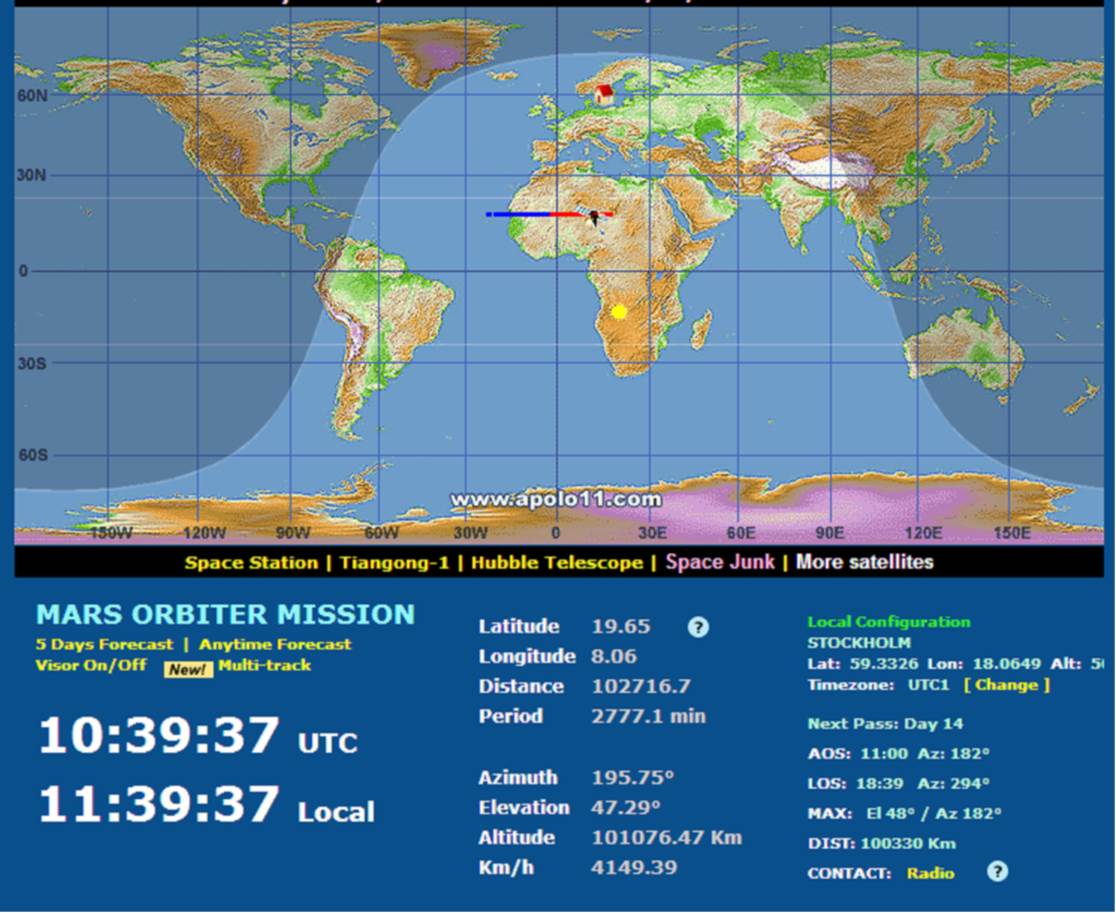
I have been trying to follow the mission via the live satellite tracking websites (satview.org and n2yo.com) but I am a little dubious as to how “live” they actually are. I noted that after the corrective burn 48 hours ago, both sites took almost 24 hours before they showed any change to the orbit.

Right now satview is showing a position over Africa at an altitude over 100,000 km but this data needs to be taken with a pinch or two of salt.

Live track Mars Orbiter satview.org

Live track Mars Orbiter satview.org

n2yo.com also shows the same position and gives the following data. Note that both sites give the same location and now also give much the same altitude. They do not match on “speed”. Satview gives a speed of about 4149km/h which is about 1.15km/s whereas n2yo gives a “speed” of 6.9 km/s. I am not quite sure what “speed” is being reported.

MARS ORBITER MISSION

LOCAL TIME:
12:13:56
UTC:
11:13:56
LATITUDE:
19.09
LONGITUDE:
-0.1
ALTITUDE [km]:
103132.47
ALTITUDE [mi]:
64083.55
SPEED [km/s]:
6.91
SPEED [mi/s]:
4.29
AZIMUTH:
204
SSW
ELEVATION:
+48.9
RA:
14h 45m 32s
DEC:
17° 1′ 12”
The satellite is in day light
PERIOD:  1434m