Archive for the ‘Philosophy’ Category

The fundamentals of physics are just magic

September 1, 2015

Physicists would like to think that they deal in reality and are cold, rational, objective observers of the physical universe we live in. But deep, deep down, they just rely on magic. The Universe is nothing but a place of pervasive magic. Gravity is just a magical attraction. Spacetime is just an attractiferous aether. Physicists are thus practitioners of magic and may even be able to use the forces of magic, but they have no inkling as to why the magical forces exist.

Replace

  1. “gravity” or “gravitation” by “magical attraction”
  2. “spacetime” by “the attractiferous aether”
  3. “electromagnetic” by “electromagical”
  4. the “strong force” by the “strong magic force”
  5. the “weak force” by the “weak magic force”

and the Wikipedia entry for Gravity then reads as follows:

Magical attraction is a natural phenomenon by which all things are brought towards one another – irrespective of size, i.e. stars, planets, galaxies and even light and sub-atomic particles. Magical attraction has an infinite range, and it cannot be absorbed, transformed, or shielded against. Magical attraction is responsible for the formation of structures within the universe (namely by creating spheres of hydrogen, igniting them with enough pressure to form stars and then grouping them together into galaxies), as without magical attraction, the universe would be composed only of equally spaced particles. On Earth, magical attraction is commonly recognized in the form of weight where physical objects are harder to pick-up and carry the ‘heavier’ they are.

Magical attraction is most accurately described by the general theory of relativity (proposed by Albert Einstein in 1915) which describes the force of magical attraction, not as a force, but as a consequence of the curvature of the attractiferous aether caused by the uneven distribution of mass/energy; and resulting in time dilation, where time lapses more slowly under strong magical attraction. However, for most applications, magical attraction is well approximated by Newton’s law of Universal Magical Attraction, which postulates that magical attraction is a force where two bodies of mass are directly drawn to each other according to a mathematical relationship, where the attractive magical force is proportional to the product of their masses and inversely proportional to the square of the distance between them. This is considered to occur over an infinite range, such that all bodies (with mass) in the universe are drawn to each other no matter how far they are apart.

Magical attraction is the weakest of the four fundamental magical interactions of nature. The force of magical attraction is approximately 10−38 times the strength of the strong magic force (i.e. gravity is 38 orders of magnitude weaker), 10−36 times the strength of the electromagical force, and 10−29 times the strength of the weak magic force. As a consequence, magical attraction has a negligible influence on the behavior of sub-atomic particles, and plays no role in determining the internal properties of everyday matter (but see quantum magical attraction). On the other hand, magical attraction is the dominant force at the macroscopic scale, that is the cause of the formation, shape, and trajectory (orbit) of astronomical bodies, including those of asteroids,comets, planets, stars, and galaxies. It is responsible for causing the Earth and the other planets to orbit the Sun; for causing the Moon to orbit the Earth; for the formation of tides; for natural convection, by which fluid flow occurs under the influence of a density gradient and magical attraction; for heating the interiors of forming stars and planets to very high temperatures; for solar system, galaxy, stellar formation and evolution; and for various other phenomena observed on Earth and throughout the universe.

In pursuit of a theory of everything magical, the merging of general relativity and quantum mechanics (or quantum field theory) into a more general theory of quantum magical attraction has become an area of research.

Of course it is still not clear if magic is a continuous thing or composed of discrete magical quanta. One theory has it that all things are connected by invisible, undetectable magical strings and it is the elastic nature of these strings which gives rise to the forces of magical attraction.

The reality is that the Universe came into being by magic and the fundamental forces which have governed, and still govern, are all magical. If there ever was a Big Bang it was a magical event. And every sunrise and sunset which occurs is just due to the magical forces of attraction which apply. We live in a world of magic. Magic is normal.

Dark energy and dark matter are just fudge factors for cosmic models that don’t work

September 1, 2015

A mathematical model of the physical world, which doesn’t work, can always be made to work by introducing a “fudge factor” which just compensates for the “error” displayed by the model results. The “error” is of course just the difference between real observations and the model results. The “fudge factors” thus introduced are then often used to project the model results into the future – but such forecasts are meaningless. The only valid conclusion is that the model is incorrect and needs to be changed,

These “fudge factors” can be given fancy names and imaginary properties such that they just remove all that cannot be explained. It does not make them real. And so it is with cosmic models and the invention of imaginary parameters with just those properties necessary to correct the error exhibited by the models.

In ancient times, new gods with new properties were invented to “explain” eclipses and earthquakes and volcanic eruptions. Before oxygen was discovered, alchemists – on their way to becoming chemists – invented “phlogiston”. That was superseded by the “caloric theory” which soon became obsolete. “Aether” was invented as pervading space to provide a medium for the transmission of light and through which “action at a distance” could be explained (gravity, magnetism). “Space-time” is analogous to aether and was invented to match observations with the theory of relativity. In fact Einstein refers to “space-time” as a kind of aether.

The Steady State theory of cosmology considered an expanding universe but which was in a steady state, and had no beginning. That became obsolete when the Big Bang theory came along which put the Big Bang singularity 13.8 billion years ago and which provided the energy for the expanding universe. (Imagining 15 billion years ago is just as valid as imagining a time 13.8 billion years ago but the Big Bang theory is silent about what came before). But the expansion – since the energy all came at the time of the Big Bang – was expected to gradually slow down and come to a stop after which either a steady state would prevail or a compression (implosion) would occur. But recent observations indicate that the expansion of the universe is (apparently) accelerating. Clearly that is not possible if the energy is fixed. A new source of energy needed to be invented. It couldn’t be detected so better call it “dark energy”. The apparent mass of the Universe was much less than calculations indicated it should be. The solution was simple. Along came “dark matter”.

Wikipedia: …. dark energy is an unknown form of energy which is hypothesized to permeate all of space, tending to accelerate the expansion of the universe. ………. the best current measurements indicate that dark energy contributes 68.3% of the total energy in the observable universe; the mass-energy of dark matter and ordinary matter contribute 26.8% and 4.9%, respectively; and other components such as neutrinos and photons contribute a very small amount.

Dark matter is a hypothetical kind of matter that cannot be seen. ……. Dark matter neither emits nor absorbs light or any other electromagnetic radiation at any significant level.

Needless to say, “among cosmologists, dark matter is composed primarily of a not yet characterized type of subatomic particle”. Naturally.  The magnitude of the four fundamental forces of the universe (gravity, magnetism, weak force, strong force) are known but we still have no idea why or how they exist. We can just as well call them the four fundamental forces of Magic.

Dark energy and dark matter are not real. We might as well call them “magic energy” and “magic matter”. They are merely parameters invented and given just the right properties to fit the errors between observations and theory. Fudge factors. Nothing wrong with that of course. Theories, observed errors, fudge factors capable of removing errors and then the search to remove the necessity of the fudge factors is a powerful way of doing science. But making forecasts based on existing fudge factors without any idea of how the fudges need to change is invalid and – worse – is self-delusional.

(I observe that it is the “fudge factor” phenomenon which permeates what is called climate science. The real problem is that the “scientists” and their politicians believe the forecasts made with the “fudge factor” theories even though the error between model results and reality continues to increase.)

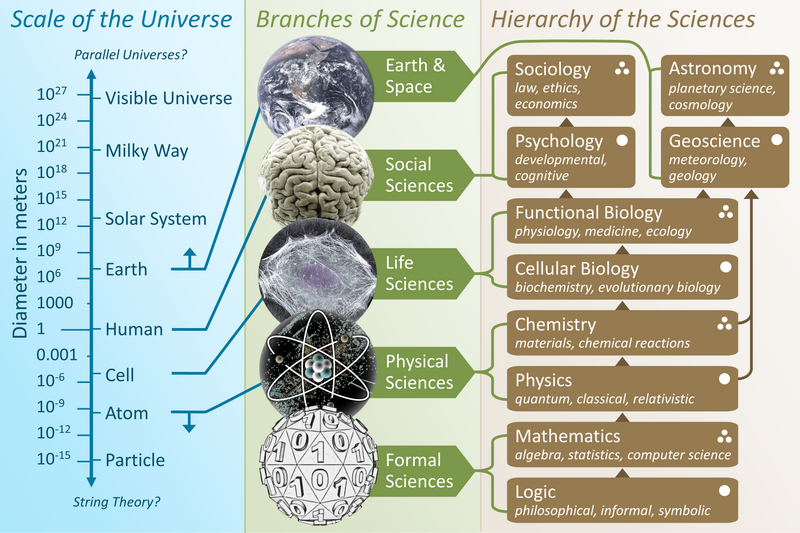
Physics came first and then came chemistry and later biology

August 19, 2015

I generally take it that there are only 3 basic sciences, physics, chemistry and biology. I take logic to be the philosophical framework and the background for the observation of the universe. Mathematics is then not a science but a language by which the observations of the universe can be addressed. All other sciences are combinations or derivatives of the three basic sciences. Geology, astronomy, cosmology, psychology, sociology, archaeology, and all the rest derive from the basic three.

I was listening to a report today about some Japanese researchers  who generated protein building blocks by recreating impacts by comets containing water, amino acids and silicate. Some of the amino acids linked together to form peptides (chained molecules). Recurring lengths of peptide chains form proteins and that leads to life. What interested me though was the element of time.

Clearly “chemistry” had to exist before “biology” came into existence. Chemistry therefore not only comes first and “higher” in the hierarchy of the existence of things but is also a necessary, but insufficient, requirement for “biology” to exist. Chemistry plus some “spark” led to biology. In that case the basic sciences are reduced to two since biology derives from chemistry. I cannot conceive of biology preceding chemistry. The elements and atoms and molecules of chemistry had to exist before the “spark” of something brough biology into existence.

chemical reactions (chemistry) + “spark of life”(physics?) = biology

By the same token, does physics precede chemistry? I think it must. Without the universe existing (physics) and all the elements existing within it (which is also physics) and without all the forces acting upon the elements (still physics), there would be no chemistry to exist. Or perhaps the Big Bang was physics and the creation of the elements itself was chemistry? But considering that nuclear reactions (fusion or fission) and the creation of new elements are usually considered physics, it would seem that the existence of physics preceded the existence of chemistry. The mere existence of elements would be insufficient to set in motion reactions between the elements. Some other forces are necessary for that (though some of these forces are even necessary for the existence of the elements). Perhaps physics gives the fundamental particles (whatever they are) and then chemistry begins with the formation of elements? Whether chemistry starts with elements or with the fundamental particles, physics not only must rank higher as a science, it must have come first. Particles must first exist before they can react with each other.

Particles (physics) + forces (physics) = chemistry.

In any event, and by whatever route I follow, physics preceded chemistry, and physics must exist first for chemistry to come into being. That makes chemistry a derivative of physics as biology is a derivative of chemistry.

We are left with just one fundamental science – physics.

by elfbrazil wikipedia

Entropy of belief will keep increasing in a post-religion world

August 12, 2015

If the space of ignorance is infinite then increasing knowledge cannot reduce the real extent of the space of ignorance. However, whether the space of ignorance is infinite or not, increasing our quantum of knowledge always increases the perimeter of what we know that we don’t know.

The space of ignorance

Belief and faith can only exist in the space of ignorance. Whether the human psyche needs to have beliefs – which by definition are in the realm of ignorance – is an open question. I strongly suspect that humans do need to make some assumptions – call them beliefs – about areas of behaviour and motivation and appreciation, the reasons for which lie in the space of ignorance.  However, it is not clear to me that these assumptions are necessary to live our lives. I “believe” that they do help in achieving a better “quality” of life – but even that is just a belief – an assumption in my space of ignorance. The level of “beliefs” that any individual needs, I think, must vary with the individual.

Religions exist as an organised set of beliefs in the space of ignorance. Organised religions take it upon themselves to impose those set of beliefs on their followers and even to expand the numbers of their followers. Followers can argue interminably about the superiority of their particular ignorances over the ignorance of others. This applies to their gods as well. “My unknown god is better than your unknown god” maps to “My ignorance is better than your ignorance”.

In a post-religion world I expect that we would have moved beyond “organised religions” where sets of beliefs are imposed on others. “Freedom of choice of religion” would come to its logical conclusion to become “freedom of belief”. I can see that individuals would be free to select which beliefs or sets of beliefs they preferred to use as assumptions. They would be free to mix and match components from different belief sets – as it suited them or they judged to be beneficial for their own lives. They would be free to change their beliefs at will. After all they would merely be swapping one item of ignorance for another.

But my point is that the human psyche needs to make assumptions about the unknown (whether unknowable or not). The choice of these beliefs influence our values and then our behaviour our aesthetics and our motivations. The need for such assumptions/beliefs will not reduce in a post-religion world. But our selection of these beliefs will be less constrained. Sets of belief will not be as rigidly enforced by “organised religions”. We will choose those that suit as. Individuals may choose to believe in reincarnation if they wish to; or in the Daughter of God if they prefer or in no god at all. They can believe in a God of Dark Energy or his Son, the God of Dark Matter in an infinite Universe with a Paradise – or a Hades – lying beyond. There will be more beliefs than ever before – all in the space of ignorance. Maybe the Law is that the entropy of belief can only increase.

But there will still be psychopaths and sociopaths who will try to impose their particular ignorant assumptions on others

“Infinite” is of a lower order than “boundless”

May 23, 2015

In common usage, “boundless” is often used as a synonym for “infinite”. But of course the two words represent two quite different properties and, I think, are unnecessarily conflated: to the detriment of both language and understanding. I generally assume “infinite” to apply to quantifiable or countable (i.e capable of being counted) things, whereas I take  “boundless” to apply to both qualitative concepts and “countable” things.

“Infinite” is thus of a lower order than “boundless” since it can be applied only to the subset of “countable” things in the set of all things.

The infinite” is patently impossible since the application of the definite article can only apply to the finite. Of course, “the Infinite” is often used to describe “the divine” which only serves to illustrate the paradox inherent in divinity.

So I sometimes find the use of “infinite” as an adjective a little grating. A specific number is not “countable”, it is itself the “count”. So I find the use of “infinite numbers” or “infinite sets” somewhat misleading. Each and every number or set of numbers is – and has to be – finite. It is only the number of terms in the set which may be infinite. Each set once specified is fixed and distinct from any other set. It may contain an infinite number of terms but the set is finite. You could also say that such a set “extends to infinity” or that the set is “boundless”. The number of such sets can also be said to be infinite or boundless.

The distinction between boundless (or endless) and infinite is of no great significance except when the two properties need to be distinguished. For example, the Koch snowflake is an example of a set of lines of increasing length being drawn within a bounded space. It is only the length of the line – being quantifiable – which tends to the infinite with an infinite number of iterations. Note that every iteration only produces a line of finite length but the number of terms in the set is infinite.

Koch's snowflake

Koch’s snowflake – 4 iterations

The Koch curve has an tends to an infinite length because the total length of the curve increases by one third with each iteration. Each iteration creates four times as many line segments as in the previous iteration, with the length of each one being one-third the length of the segments in the previous stage. Hence the length of the curve after n iterations will be (4/3)n times the original triangle perimeter, which is unbounded as n tends to infinity.

I am told that the universe is expanding and may be infinite but bounded. Or it may be infinite and boundless. Or it may be finite and bounded. Whether the universe is infinite is a different question to whether it is bounded. In fact the term “infinite” can only be applied to some quantifiable property of the Universe (its mass, its diameter, its density, the number of stars or galaxies it contains …), whereas its boundedness can be applied to any qualitative or quantitative property. In one sense the universe where we assume that the fundamental laws of nature apply everywhere must be bounded – if nothing else – at least by the laws of nature that we discern.

Currently the thinking regarding the shape of the universe is:

NASA:

  • If space has negative curvature, there is insufficient mass to cause the expansion of the universe to stop. In such a case, the universe has no bounds, and will expand forever. This is called an open universe.
  • If space has no curvature (i.e, it is flat), there is exactly enough mass to cause the expansion to stop, but only after an infinite amount of time. Thus, the universe has no bounds and will also expand forever, but with the rate of expansion gradually approaching zero after an infinite amount of time. This is termed a flat universe or a Euclidian universe (because the usual geometry of non-curved surfaces that we learn in high school is called Euclidian geometry).
  • If space has positive curvature, there is more than enough mass to stop the present expansion of the universe. The universe in this case is not infinite, but it has no end (just as the area on the surface of a sphere is not infinite but there is no point on the sphere that could be called the “end”). The expansion will eventually stop and turn into a contraction. Thus, at some point in the future the galaxies will stop receding from each other and begin approaching each other as the universe collapses on itself. This is called a closed universe.

A universe with some infinite property in a bounded space only begs the question as to what lies in the space beyond the bounds. It also occurs to me that an endlessly expanding universe has to first assume that empty space – which should contain nothing – must actually contain the property of distance. That too is a bound, for if space did not even contain the property of distance, any expansion would be undefined. (And what does distance mean between two points in truly empty space?).

Imagination can be boundless – rather than infinite – and can even extend beyond the bounds of what we can perceive. In reality even our imaginations are often bounded by the limitations of our modes of expression of language and music and painting. Our emotions can be said to be boundless though they too are bounded by physiological limits.

A bounded universe of boundless infinities it would seem, rather than one of infinite infinities, and certainly not one of infinite boundlessnesses.

Immortality of identity

February 26, 2015
The winner spermatazoon - Gabriel Sancho

The winner spermatozoon – Gabriel Sancho

The human reproductive process is remarkably inefficient. A male produces sperm throughout his life from puberty on. The quality and quantity deteriorates with age but he probably produces between 500 billion and 1 trillion sperm during a lifetime. Most get nowhere near where they are supposed to go, are very badly directed and eventually die. Unexpelled sperm are reabsorbed. Some few tens of millions find their way into a female reproductive system but the vast majority of these never meet a mature egg and wander around aimlessly until they die, unrequited and unfulfilled. On average a male fathers between 2 and 3 children. Each such instance requires just one sperm. There is little evidence to suggest that the successful sperm is the “best” of the bunch. It is more a case of which lucky one was at the right place at the right time. The “hit rate” for male sperm is thus – quite pathetically in process terms – around one in 300 billion. Things are much more focused on the female side. The success rate for mature eggs is very much higher than for sperm, but still quite low. A woman has a total of some 400 – 500 mature eggs, released singly during each menstrual cycle over a child-bearing period of 30 – 40 years. Of these, on average, with widespread contraception, between 2 and 3 will be fertilised by a sperm to result in a child. A hit rate of around one child for every 200 eggs. Perhaps twice that without contraception.

The inefficiency of the process is a commentary on evolution but it is still sufficient to produce more births than the replenishment rate needed to keep the total population stable. (Evolution never looks for “excellence” since it is always satisfied with what is “good enough”). In fact the resultant population growth rate has been so high that humankind has had to apply methods to further restrict the already low hit rate. In the last 100 years, globally, fertility rates have declined from over 6 to the current 2.5 per woman. Contraception, sterilisation and abortion are the methods of choice (and infanticide is now very rare but not unknown). Contraception has had the largest impact on this decline in fertility rate.

I was listening to a politician recently spouting politically correct platitudes about abortion and got to wondering how to describe the various human attitudes, in spite of a commonality of purpose (the avoidance of a child), between contraception and abortion and, by extension, infanticide.  It would certainly be incorrect to claim that a sperm or an egg are not “living”. They show in fact that “life” is a continuum from the parents, and then through their eggs and sperm to the fertilised egg, its birth and then its life as an independent individual. So why should it be that preventing an egg being fertilised, which would otherwise go on to become a foetus, causes no moral qualms but aborting that same foetus after it has been conceived is so disturbing to some? Extending that thought, what is it that makes aborting a foetus and preventing a child from being born much less disturbing than terminating the existence of that same child after birth?

I suspect that it is our concept of “identity” rather than “life” which determines.

Contraception and sterilisation prevent conception. Prior to that we cannot attribute any clear identity to one sperm within a swarm of millions. An ovum is much closer to having identity but it still only has the identity of a “component part”. In fact the sperm and eggs live under the umbrella of the identity of their originating individuals. Only one sperm in 300 billion and one egg in 200 succeed in combining and developing into a child. All the rest die unrequited. But when they die or produce a fertilised egg, they do not diminish the identity of the individuals they came from. The component identities cease when the sperm or eggs cease to be. About 70-80% of all foetuses conceived would normally come to term. After about 10-12 weeks of pregnancy this is closer to 90%. (Currently around 20 – 25% of conceptions are aborted globally). The moment of conception is unique in that it is when a new identity is formed. It is a discontinuity in the playing field of identities. It is an additional identity, connected to but separate from the identities of the parents. There is a strong case, I think, for considering the fertilised egg as the start of a new, recognisable, unique human identity even though the life of that identity is not (yet) independently viable. Many societies set a limit of 22 or 24 weeks after conception as being the point when a foetus acquires the “right” to live but this boundary is irrational. This time is based on when a foetus – if born prematurely – is considered to be viable. I don’t find this very useful since the alternative to an abortion is not usually a premature birth. I note also that the probability of a foetus reaching full term changes very little after the first 10-12 weeks of a pregnancy. A 12 week old foetus has almost the same chance of being born as a 30 week old foetus. An abortion at any time after about the first 12 weeks effectively eliminates a birth which – with a 90% probability – would otherwise occur. After birth, infant mortality rates today are generally around 5% (ranging from close to 15% in the poorest parts of Africa to less than 2% in well developed societies).

Looking at probabilities, and based on all the sperm and all the eggs that are produced by humans, contraception halves what is already a very low chance of conception. The probability of an egg being fertilised reduces from about 1:100 (1%)  – of an unidentifiable egg being fertilised by an even less identifiable sperm  – to be about 1:200. Abortion however terminates a 70-80% probability of an independent, identifiable entity coming into being. Infanticide eliminates a 95-98% probability of an independent human life continuing. Could it be that our sense of outrage is related to the probability of an independent entity coming into being? When the probability is very low we see no great harm in reducing it still further but when the probability is high we feel it “unnatural” and “immoral” to intervene?

It is possible that we intuitively assess probabilities but I don’t think that we connect “morality” to probability. I suspect that it is primarily identity and the point at which we are prepared to recognise or assign an independent identity that is the key. It is probably the same cognitive process which leads to our lack of engagement when many thousands of people – but without recognisable identities – perish in a tsunami and the close emotional engagement when somebody known suffers harm. And why it is said to be emotionally easier to drop a bomb on an unknown, unidentifiable mass of people than to be a sniper who can see his target in his sights.

A unique identity is recognisable first when an egg is fertilised. That identity cannot be foretold but it may be remembered long after the individual dies. It may in due course be forgotten. But whether or not it is forgotten, the fact of the creation of that identity remains. Forever. It is identity, once created, which remains unique and immortal.


On the legitimacy and morality of taxation

February 16, 2015

These are two questions that I have been wrestling with. First whether the concept of taxation of individuals by a state is legitimate and moral, and second, what basis of taxation is the least unjust. Here I just consider the legitimacy and morality of the concept of taxation.

Anarchists and libertarians see taxation as theft. They see it as the oppression of the individual (private or corporate) by the greater society – ostensibly for the “common good”. Communists and socialists see it otherwise. For them there is no individual ownership of property and all wealth is owned by the masses. It is a manifestation of the conflict interface between an individual and the larger society. Some – libertarians for example – suggest that the “greater society” cannot abrogate to itself an authority which is not delegated to it by its individual members. And the power to confiscate the property or wealth of some of its members is not an authority that originates with the individual “victim”. Liberal democrats would argue that taxation is merely the membership fee for individuals to be part of the “club” represented by the “greater society”.

There have been many headlines in the last week about HSBC and the manner in which it has assisted its clients to avoid and evade taxation (where avoidance is legal whereas evasion is illegal). The indignation of politicians rings rather hollow. That the poor resent the rich is not surprising. It is inevitable that in a “democracy” the majority poor will seek to oppress the rich minority. But the bottom line is that all taxation is a confiscation of an individual’s property or wealth by a society (state). It is confiscation by force or under the threat of force. But much of the recent turbulence is based on envy and resentment and of various socialist politicians attempting to create a populist wave out of such resentment and envy. (Of course they conveniently forget that the poor are not poor because the rich are rich. Most are poor because they do not, or do not have the opportunity to, create wealth).

I am persuaded that the concept of taxation as practised today is immoral. It is fundamentally a coercion of an individual by a larger (stronger) society. It is an enforced confiscation (by threat of legal action) of an individual’s property or wealth. It cannot be seen as a membership fee for being a member of the society because leaving (or being expelled from) the society is not an option. It is closer to the extortion of “protection money” than to the membership dues for a golf club. The use to which the funds are put is irrelevant. The key point is whether the payment is voluntary or coerced. When early Christians paid a “tithe” to the Church voluntarily it was not immoral. But when the payment was coerced and no longer voluntary, the system became immoral. Similarly Islam requires the payment of zakat on individual wealth over the minimum nisab and this also shifted from a quite unexceptionable and moral voluntary payment to become an obligatory and immoral coercive confiscation.

I don’t quarrel with the need for any society to generate “common funds” to improve the well being of that society. But the legitimacy of appropriating the funds lies only in that the society (state) is stronger than the individual. Might becomes right. I come to the conclusion that a tax code by which the amount a “good citizen” should contribute to society is calculated is quite moral as long as the payment is then voluntary. There would be no moral issue if all taxation was voluntary. The immorality lies in the use of threat or force to confiscate the payment. It is the oppression of the minority by the majority which is immoral. (I observe that all democracies use the very fact of being a “democracy” as being a justification for the oppression of minorities when that is the will of the majority. As if being in the majority – by and of itself – ensures proper behaviour). But, the good socialist will argue, compulsory payment of tax is necessary to ensure the funds for the common good. Without coercion society as a whole would suffer. The common good – as seen by the majority – is worth the oppression of the minority who do not pay their dues.

And so we come full circle. The end justifies the means. Oppression of the minority by a majority is acceptable for the good of the majority. A society must be able to use force and coercion against its own minorities for the greater good. Taxation is made legitimate only because the state is stronger than the individual.

But that does not alter the fact that involuntary taxation is fundamentally immoral.

Whether a tax code should be based on wealth creation or wealth consumption is a question for another day.

Fate? destiny? Drunken snowplow driver causes death of Total CEO

October 21, 2014

Following on from my previous post about the season of birth having some effect on temperament, this news item got me to wonder about how much of our lives is – or can be – “fixed” by our genes, our place of birth or our time of birth. How much “free will” and freedom of behaviour and freedom of action do we actually have?

Vnukovo plane crash: Snowplow driver drunk in collision with Total CEO’s aircraft

It was determined in the course of the investigation into the Moscow plane crash that killed the CEO of French oil giant Total that the driver of the snowplow which likely caused the crash was drunk.

“It has been determined that the driver of the snowplow was under the influence of alcohol,” head of Russia’s Investigative Committee Vladimir Markin told the reporters on Tuesday.

Markin added that “there is a possibility that a number of airport staff will be suspended from carrying out their duties pending criminal investigation.”

During the taxiing before take-off, at around 0:10 am Moscow time on Tuesday, the Falcon 50 business jet hit a snow-clearing machine. Although previous reports indicated otherwise, the plane did not leave ground following the collision. The CEO of France’s oil and gas giant Total, Christophe de Margerie, was the only passenger in the jet, while three crew members who were also French citizens perished as well.

Psychologists seem to find that more and more of our behaviour is due to our genes. This seems to be used increasingly often as a mitigating factor – if not as an excuse – in court cases where socially unacceptable behaviour and actions are judged. Our sexual preferences and our positions on the bi-modal gender scale are also increasingly put down to genes rather than upbringing – nature rather than nurture. Intelligence is thought to be at least 50% due to genetic factors. Our adult heights are said to be 80% genetic and 20% due to nurture. Mental and physical abilities and disabilities are increasingly said to be due to our genes. Our moods and our temperaments are said to affected by when we were born.

I have little doubt that – at some macro level – it is our genes that define the envelope of our possible behaviours. It is clearly predetermined by our genes that we cannot – however much we wanted to – behave like a whale or a bird. Our genes constrain us to behave within the narrow envelope of behaviour open to humans. To that extent we are surely “fated” or “destined” to behave within the envelope of possibilities open to us as determined by our individual genetic make-up at birth as humans. Even aspects of nurture can said to be pre-determined. The parents we are born to – pre-determined – in turn determine the education we get, our nutrition and the religions we follow. To that extent our decisions through life which we believe are a consequence of our individual characteristics and who we are and our exercise of our “free will” are already constrained and channeled by parameters fixed at birth.

If two individuals having predetermined behaviour interact, then the envelope of possible results of that interaction are also “fated” or “destined”. It may be an intractable problem with our current state of knowledge to predict the results of such interactions, but that does not mean that the “result” is any less pre-determined. The butterfly problem is also intractable but that does not mean that it may not exist. Extending that thought leads to the conclusion that all the possible results of all our interactions – between humans and with other species and with our surrounding environment – are already largely constrained and predetermined.

I would like to think I have free will and everything is not determined in advance — but it also seems self-evident that everything that happens is caused by what happened immediately before. If not we would have to be able to explain how some event does not have to be dependent upon the preceding events. And that would require that we redefine the nature of time. What comes afterwards cannot escape what came before.

So was the death of Christophe de Margerie a random, unfortunate and “unlucky” accident, or was it fate? A “fate” already determined with his birth and the birth of the drunken snowplow driver?

The purpose of argument …

September 16, 2014

The purpose of argument and the art of disputation

In disputes upon moral or scientific points, let your aim be to come at truth, not to conquer your opponent. So you never shall be at a loss in losing the argument, and gaining a new discovery.”

Arthur Martine 1866 guide to the art of conversation,

If only ….

This post from Judith Curry is well worth reading: How to  criticize with kindness where she refers to this article by Maria Popova in brainpickings.

How to compose a successful critical commentary:

  1. You should attempt to re-express your target’s position so clearly, vividly, and fairly that your target says, “Thanks, I wish I’d thought of putting it that way.
  2. You should list any points of agreement (especially if they are not matters of general or widespread agreement).
  3. You should mention anything you have learned from your target.
  4. Only then are you permitted to say so much as a word of rebuttal or criticism.

No sentience without sapience

June 26, 2014

There was a great deal of publicity last week but I am not very convinced that the computer program Eugene Goostman actually passed the Turing test. But whether it did or not, I got to wondering how to distinguish sapience from sentience.

I find that I tend to use “sapience” to imply the capability for thought while I take “sentience” to be a quality of consciousness of self. Which of course leaves rather diffuse and undefined what precisely “thought” involves and what “consciousness of self” consists of. But is sapience linked to sentience? Can one have one without the other? Or does the quality of being conscious only become possible once thought exists?

Rene Descartes’ Cogito ergo sum (I think therefore I am) should perhaps be modified to be Cogito ergo, ego ut sit (I think therefore I may be). “I think therefore I am” requires a pre-conception of individuality, of the “I”. To be aware of the “I”, to be conscious of oneself and to be able to articulate that consciousness would suggest that thought is already present before consciousness of self can come into play. Clearly my computer “thinks” in a fashion, as do many animals – in their fashion. But while some minimum capability for thought may be necessary for consciousness, it is also clearly not sufficient. A certain level of sapience may be necessary for sentience but sapience does not necessarily lead to sentience. Some other attribute or quality is required for a thinking entity to be said to have the level of consciousness necessary for sentience.

The Turing test is, I think, a test of reaching a particular level of sapience but it is not a test of sentience. But I also think that there is a scale of sapience. All  “artifical intelligences” show varying levels of applying “thought” and could be said to be sapient to some degree. Sapience would seem therefore to be on a continuous scale. Many animals and birds also exhibit some level of thought and clearly exhibit different degrees of sapience. But chimpanzees and gorillas and dolphins and even elephants seem to recognise themselves in a mirror while monkeys do not. They would seem to have different levels of self-consciousness and – it would seem – different levels of sentience. I take gorillas and chimpanzees and maybe elephants to be sentient – just – but not dogs or cats. Is there then a scale of sentience which is constrained (or enabled) by, and depends upon, an entity’s position on a scale of sapience?  I suspect that whatever it is I intuitively consider to be sentient depends upon a combination of sapience and the level of consciousness of self of an entity.

Therefore my tentative definitions / conclusions become

  1. Entities may be “alive” or “inert”.
  2. Only some entities are sapient to any significant degree but sapience is independent of being alive.
  3. There is no sentience without sapience.
  4. Only some “living”, sapient entities are sentient.
  5. Sentience is a composite quality and – I propose – depends on the level of sapience and the level of consciousness exhibited by an entity.


sapience and sentience

sapience and sentience