Archive for the ‘Physics’ Category

The blackest of them all..

August 5, 2014

Vantablack (from Vertically Aligned Nano Tube Array) absorbs upto 99.965% of all radiation it receives and is now the blackest material known. It is blacker than NASA’s “super-black” (99%) and, I suppose, will be the start of ultra-black.

The uncoated part of this foil remains three-dimensional but the coated part reflects virtually no light and appears flat.
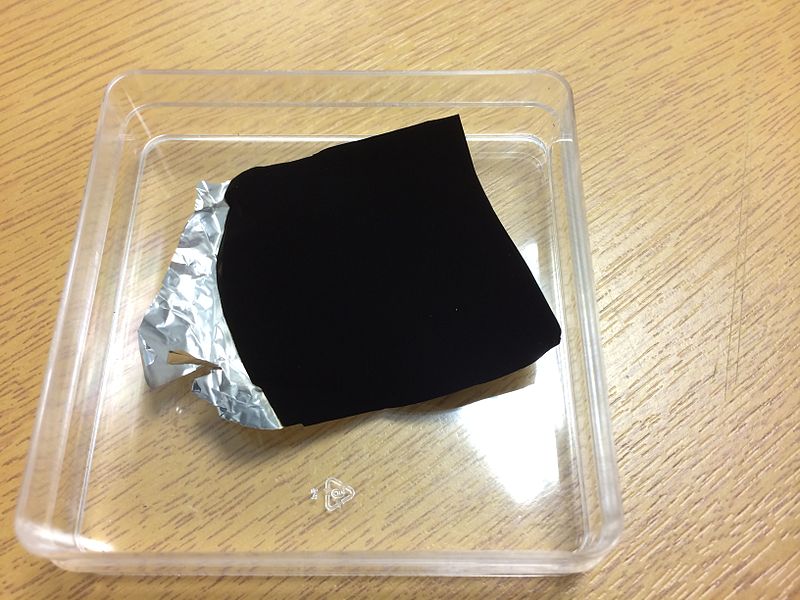
Piece of foil partially coated with Vantablack

Vantablack is manufactured by Surrey Nano Systems and is already in production.

The Engineer: Vantablack, a so-called ‘super black’ coating from Surrey Nanosystems, combines exceptionally low mass, thermal stability and an ability to absorb 99.96 per cent of incident radiation. Consequently, the coating is suited to applications including apertures, baffles, cold shields and Micro Electro Mechanical Systems (MEMS)–type optical sensors.

The material also overcomes limitations encountered in the manufacture of super-black carbon nanotube-based materials, where high temperatures precluded direct application to sensitive electronics or materials with relatively low melting points. This, along with poor adhesion, prevented their application to space and airborne instrumentation.

There is no established blackness scale. Black paint reflects almost 10% of incident light. Newly laid asphalt reflects 2 – 5% depending upon surface composition. Carbon black (polycrystalline carbon resulting from incomplete combustion) reflects only 1% of incident light. Though we take blackness to be the absence of reflection of radiation, material may reflect radiation at a different wave-length to the incident radiation. All light photons that are absorbed must eventually become heat and all bodies will radiate heat (infra-red) dependent upon only their surface temperature. In physics, a black body is theoretical and absorbs all incident electromagnetic radiation, at all wavelengths and all angles of incidence. In practice such a body can’t exist.

NASA SuperblackNASA engineers have produced a material that absorbs on average more than 99 percent of the ultraviolet, visible, infrared, and far-infrared light that hits it — a development that promises to open new frontiers in space technology. …… 

The nanotech-based coating is a thin layer of multi-walled carbon nanotubes, tiny hollow tubes made of pure carbon about 10,000 times thinner than a strand of human hair. They are positioned vertically on various substrate materials much like a shag rug. The team has grown the nanotubes on silicon, silicon nitride, titanium, and stainless steel, materials commonly used in space-based scientific instruments. (To grow carbon nanotubes, Goddard technologist Stephanie Getty applies a catalyst layer of iron to an underlayer on silicon, titanium, and other materials. She then heats the material in an oven to about 1,382 degrees Fahrenheit. While heating, the material is bathed in carbon-containing feedstock gas.)

The tests indicate that the nanotube material is especially useful for a variety of spaceflight applications where observing in multiple wavelength bands is important to scientific discovery. One such application is stray-light suppression. The tiny gaps between the tubes collect and trap background light to prevent it from reflecting off surfaces and interfering with the light that scientists actually want to measure. Because only a small fraction of light reflects off the coating, the human eye and sensitive detectors see the material as black.

In particular, the team found that the material absorbs 99.5 percent of the light in the ultraviolet and visible, dipping to 98 percent in the longer or far-infrared bands. “The advantage over other materials is that our material is from 10 to 100 times more absorbent, depending on the specific wavelength band,” Hagopian said.

Currently, instrument developers apply black paint to baffles and other components to help prevent stray light from ricocheting off surfaces. However, black paints absorb only 90 percent of the light that strikes it. The effect of multiple bounces makes the coating’s overall advantage even larger, potentially resulting in hundreds of times less stray light.

In addition, black paints do not remain black when exposed to cryogenic temperatures. They take on a shiny, slightly silver quality, said Goddard scientist Ed Wollack, who is evaluating the carbon-nanotube material for use as a calibrator on far-infrared-sensing instruments that must operate in super-cold conditions to gather faint far-infrared signals emanating from objects in the very distant universe. If these instruments are not cold, thermal heat generated by the instrument and observatory, will swamp the faint infrared they are designed to collect.


Mystical threes and magic scaling number of the Efimov State

June 3, 2014

The number three has long been attributed with mystical and divine properties.

trinityTime and Life itself is a matter of threes. Birth, life and death. The past, the present and the future. Third time lucky. Three wishes. The Holy Trinity. Three daughters. The Good, the Bad and the Ugly. The three primary colours. A Troika. Brahma,Vishnu, Shiva. The Creator, the Preserver, the Destroyer. Three monkeys. Three wise men. Three Kings.

Three has its place in Physics as well. Pascal’s triangle and the Golden Number and the Fibonacci series. A theoretical prediction that fundamental particles in sets of three give rise to stable arrangements of infinitely scaleable, nesting sets has now been shown to be real – the Efimov State.

WiredMore than 40 years after a Soviet nuclear physicist proposed an outlandish theory that trios of particles can arrange themselves in an infinite nesting-doll configuration, experimentalists have reported strong evidence that this bizarre state of matter is real. 

n 1970, Vitaly Efimov was manipulating the equations of quantum mechanics in an attempt to calculate the behavior of sets of three particles, such as the protons and neutrons that populate atomic nuclei, when he discovered a law that pertained not only to nuclear ingredients but also, under the right conditions, to any trio of particles in nature.

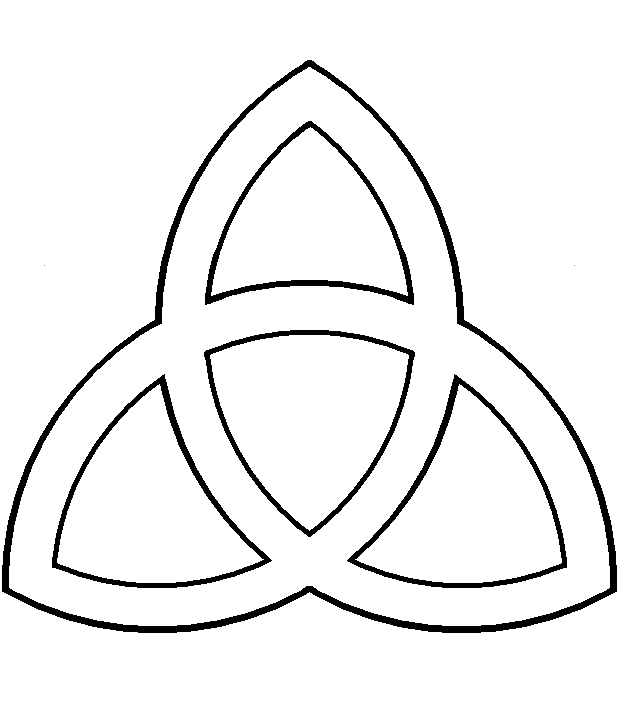
While most forces act between pairs, such as the north and south poles of a magnet or a planet and its sun, Efimov identified an effect that requires three components to spring into action. Together, the components form a state of matter similar to Borromean rings, an ancient symbol of three interconnected circles in which no two are directly linked. The so-called Efimov “trimer” could consist of a trio of protons, a triatomic molecule or any other set of three particles, as long as their properties were tuned to the right values. And in a surprising flourish, this hypothetical state of matter exhibited an unheard-of feature: the ability to range in size from practically infinitesimal to infinite. 

Efimov had shown that when three particles come together, a special confluence of their forces creates the Borromean rings effect: Though one is not enough, the effects of two particles can conspire to bind a third. The nesting-doll feature — called discrete scale invariance — arose from a symmetry in the equation describing the forces between three particles. If the particles satisfied the equation when spaced a certain distance apart, then the same particles spaced 22.7 times farther apart were also a solution. This number, called a “scaling factor,” emerged from the mathematics as inexplicably as pi, the ratio between a circle’s circumference and diameter.

Now it seems 3 different research teams have shown the existence of Efimov nesting.

“With just one example, it’s very difficult to tell if it’s a Russian nesting doll,” said Cheng Chin, a professor of physics at the University of Chicago who was part of Grimm’s group in 2006. The ultimate proof would be an observation of consecutive Efimov trimers, each enlarged by a factor of 22.7. “That initiated a new race” to prove the theory, Chin said. 

Eight years later, the competition to observe a series of Efimov states has ended in a photo finish. “What you see is three groups, in three different countries, reporting these multiple Efimov states all within about one month,” said Chin, who led one of the groups. “It’s totally amazing.”

Read the article.

Related: Physicists Prove Surprising Rule of Threes

Universe may be getting more massive rather than expanding

May 25, 2014

Not being Sheldon Cooper I have difficulty with the theory of an Expanding Universe. A finite Universe expanding into an infinite nothingness would be bad enough. But an infinite. ever-expanding Universe becomes incomprehensible. This expansion apparently consists of the scale of space itself expanding, such that galaxies are moving away from each other but where – for some other incomprehensible reasons – this does not apply at less than galactic scale (and certainly not at the scale of the puny earth or our human bodies)!

Skyserver: …. other physicists and mathematicians working on Einstein’s theory of gravity discovered the equations had some solutions that described an expanding universe. In these solutions, the light coming from distant objects would be redshifted as it traveled through the expanding universe. The redshift would increase with increasing distance to the object. ……

When he (Hubble) plotted redshift against relative distance, he found that the redshift of distant galaxies increased as a linear function of their distance. The only explanation for this observation is that the universe was expanding.

Once scientists understood that the universe was expanding, they immediately realized that it would have been smaller in the past. At some point in the past, the entire universe would have been a single point. This point, later called the big bang, was the beginning of the universe as we understand it today.

But now a new paper suggests that the red shift may be due to the Universe increasing in mass rather than expanding.  The Big Bang singularity – says the paper – turns out to be a consequence of choosing “a singular set of field coordinates”But the paper has still to run the gauntlet of peer review.

C. Wetterich, A Universe without expansion, arXiv:1303.6878  arxiv.org/abs/1303.6878/

Abstract
We discuss a cosmological model where the universe shrinks rather than expands during the radiation and matter dominated periods. Instead, the Planck mass and all particle masses grow exponentially, with the size of atoms shrinking correspondingly. Only dimensionless ratios as the distance between galaxies divided by the atom radius are observable. Then the cosmological increase of this ratio can also be attributed to shrinking atoms. We present a simple model where the masses of particles arise from a scalar “cosmon” field, similar to the Higgs scalar. The potential of the cosmon is responsible for inflation and the present dark energy. Our model is compatible with all present observations. While the value of the cosmon field increases, the curvature scalar is almost constant during all cosmological epochs. Cosmology has no big bang singularity. There exist other, equivalent choices of field variables for which the universe shows the usual expansion or is static during the radiation or matter dominated epochs. For those “field coordinates“ the big bang is singular. Thus the big bang singularity turns out to be related to a singular choice of field coordinates.

Just as an expanding Universe -in reverse – leads to a Big Bang where some pre-existing mass “explodes” from a zero size, a Universe getting more massive – in reverse – must lead to a an initial mass-less state. Just about as incomprehensible as the Expanding Universe.

Nature: 

But, as Wetterich points out, the characteristic light emitted by atoms is also governed by the masses of the atoms’ elementary particles, and in particular of their electrons. If an atom were to grow in mass, the photons it emits would become more energetic. Because higher energies correspond to higher frequencies, the emission and absorption frequencies would move towards the blue part of the spectrum. Conversely, if the particles were to become lighter, the frequencies would become redshifted.

Because the speed of light is finite, when we look at distant galaxies we are looking backwards in time — seeing them as they would have been when they emitted the light that we observe. If all masses were once lower, and had been constantly increasing, the colours of old galaxies would look redshifted in comparison to current frequencies, and the amount of redshift would be proportionate to their distances from Earth. Thus, the redshift would make galaxies seem to be receding even if they were not.

Work through the maths in this alternative interpretation of redshift, and all of cosmology looks very different. The Universe still expands rapidly during a short-lived period known as inflation. But prior to inflation, according to Wetterich, the Big Bang no longer contains a ‘singularity’ where the density of the Universe would be infinite. Instead, the Big Bang stretches out in the past over an essentially infinite period of time. And the current cosmos could be static, or even beginning to contract.

Cosmology uses real mathematics and is – of course – much more respected than astrology. However the modern invocation of dark energy and dark matter by physicists and cosmologists is quite as magical as the invocation of the aether or of various elixirs by alchemists. In fact even gravity – though calculable and predictable – is just another “magical” term with no proper explanation.

Half of Newton’s papers were on religion, 10% on alchemy and only 30% on science and math

May 16, 2014

Unlike Alfred Nobel who I posted about recently, Isaac Newton left no will when he died in 1727. But he left behind him a mass of papers estimated to run to about 10 million words. But most of the notes he left behind dealt with religious subjects and alchemy and his views were not just politically incorrect but potentially embarrassing if not dangerous to his heirs.

Wired has interviewed Sarah Dry who has just published her book on The Newton Papers.

WiredHe wrote a forensic analysis of the Bible in an effort to decode divine prophecies. He held unorthodox religious views, rejecting the doctrine of the Holy Trinity. After his death, Newton’s heir, John Conduitt, the husband of his half-niece Catherine Barton, feared that one of the fathers of the Enlightenment would be revealed as an obsessive heretic. And so for hundreds of years few people saw his work. It was only in the 1960s that some of Newton’s papers were widely published.

Now of course The Newton Project is putting all of his papers online and they have so far transcribed about 6.4 million words:

The Newton Project is a non-profit organization dedicated to publishing in full an online edition of all of Sir Isaac Newton’s (1642–1727) writings — whether they were printed or not. The edition presents a full (diplomatic) rendition featuring all the amendments Newton made to his own texts or a more readable (normalised) version. We also make available translations of his most important Latin religious texts.

Although Newton is best known for his theory of universal gravitation and discovery of calculus, his interests were much broader than is usually appreciated. In addition to his celebrated scientific and mathematical writings, Newton also wrote many alchemical and religious texts.

Sarah Dry traces the history of the Newton papers and how they languished over the years. It was not perhaps by conspiracy but there was some clear apprehension that sorting and cataloguing them would be embarrassing because there was so much of a “heretical” nature:

Sarah Dry in WiredThere’s roughly 10 million words that Newton left. Around half of the writing is religious, and there are about 1 million words on alchemical material, most of which is copies of other people’s stuff. There are about 1 million words related to his work as Master of the Mint. And then roughly 3 million related to science and math.

…… one of the messages of the book is that getting too involved in the papers can be hazardous to your health. One of the first editors of the papers said an older man should take up the task, because he’d have less to lose than a younger man.

This is highly technical stuff. The alchemical stuff is technical, the scientific stuff is technical, the religious stuff is technical. I was more interested in the papers and the characters that worked on them. One person was David Brewster, who wrote a biography of Newton during the Victorian Era. He fought long and hard to resuscitate Newton’s reputation. But he was also one of these Victorians that had to tell the truth. So when he published his biography [in 1855], it included much of the heresy and alchemy, despite the fact that Brewster was a good orthodox Protestant.

…. When the papers came to Cambridge in the late 1800s, they were unsorted and chaotic. And the two men given to sorting them were John Couch Adams and George Stokes. Adams was the co-discoverer of Neptune. He famously never wrote anything down. And Stokes was just as great a physicist, but he wrote everything down. He in fact wrote 10,000 letters. So these two guys get the papers, and then they sit on them for 16 years; they basically procrastinate.

When actually confronted with Newton’s paper, they were horrified and dismayed. Here was this great scientific hero. But he also wrote about alchemy and even more about religious matters. Newton spent a long time writing a lot of unfinished treatises. Sometimes he would produce six or seven copies of the same thing. And I think it was disappointing to see your intellectual father copying this stuff over and over. So the way Adams and Stokes dealt with it was to say that, “His power of writing a beautiful hand was evidently a snare to him.” Basically, they said he didn’t like this stuff, he just liked his own writing.

There’s also Grace Babson, who created the largest collection of Newton objects and papers in America. She was married to a man who got rich predicting the crash of 1929. And Roger Babson [her husband] based his market research on Newtonian principles, using the idea that for every action there is an equal an opposite reaction. The market goes up so it must come down. Interestingly, he thought of gravity as an evil scourge.

Clearly people felt that tarnishing Newton’s image was a heresy in itself and they felt that publicising his stranger writings could do such damage to their icon. But the time since his death is critical here. Newton’s image  is now immune to such damage. I think that no matter how weird his views may have been about the Bible and prophecies and the occult and alchemy, they cannot – now – detract from his work on maths and physics and motion.

But his catalogers have a point. If one part of his work had been  debunked or ridiculed soon after his death, it could have damaged his reputation and even the credibility of his work in Physics and Maths. It is common practice now – as it was common practice then – for detractors to attack an opponent’s views on one subject obliquely, by denigrating his views or work in some other field. Wrong thinking in one field – by association – becomes wrong thinking in all fields.

It may have been different if they had TV in those days. For if Newton had lived in today’s world it could well be that his eminence in Physics and Maths  would have made him an instant TV pundit on all subjects. We would be suffering the pain of listening him to expound on his other weird and wonderful ideas. As we all must endure when we have to listen to actors pontificating about environmental science or psychiatrists excusing errant behaviour or politicians pretending they understand economics!!

A multiverse model of the Universe from 800 years ago

May 6, 2014

Bishop Robert Grosseteste, detail of a window on the South transept Westernmost. St Paul’s Parish Church, Morton, Near Gainsborough. 1896

Robert Grosseteste (ca. 1168–1253), Bishop of Lincoln from 1235 to 1253, was one of the most prominent and remarkable figures in thirteenth-century English intellectual life. His views on light and matter were some 800 years in advance of his time.

If a single leitmotif runs through Grosseteste’s works, it is that of light. The notion of light occupies a prominent place in Grosseteste’s commentaries on the Bible, in his account of sense perception and the relation of body and soul, in his illuminationist theory of knowledge, in his account of the origin and nature of the physical world, and, of course, in his writings on optics. 


His treatise De Luce (meaning “Concerning Light”), written in 1225, describes a Universe created via a Big Bang-like explosion of light before forming into a series of nine celestial spheres.

Past Horizons:

The Ordered Universe Project, which brings together physicists, psychologists, cosmologists, Latin experts and medieval historians, has been studying the texts of Robert Grosseteste, one-time Bishop of Lincoln. The team created a fresh Latin translation, aided by other experts with knowledge of the medieval mindset and its context, before applying modern mathematical and computational techniques to Grosseteste’s equations. ….

Dr Giles Gasper, the Ordered Universe Project’s Principal Investigator and Associate Director of Durham University’s Institute of Medieval and Early Modern Studies, said: “De Luce is the earliest known attempt to describe the Universe using a coherent set of physical laws, centuries before Sir Isaac Newton.

“It proposes that the same physics of light and matter, which explain the solidity of ordinary objects, could be applied to the cosmos as a whole. In doing so it also suggests, although this was probably not apparent to Grosseteste at the time, a series of ordered universes reminiscent of the modern “multiverse” concept.

“Grosseteste’s calculations are very consistent and precise. Had he had access to modern calculus and computing methods, he surely would have used them, so that is what the team has done.”

Richard G. Bower, Tom C. B. McLeish, Brian K. Tanner, Hannah E. Smithson , Cecilia Panti, Neil Lewis, Giles E. M. Gasper, A Medieval Multiverse: Mathematical Modelling of the 13th Century Universe of Robert Grosseteste, Royal Society Journal, Proceedings of the Royal Society A, arXiv:1403.0769

Abstract: In his treatise on light, written in about 1225, Robert Grosseteste describes a cosmological model in which the Universe is created in a big-bang like explosion and subsequent condensation. He postulates that the fundamental coupling of light and matter gives rises to the material body of the entire cosmos. Expansion is arrested when matter reaches a minimum density and subsequent emission of light from the outer region leads to compression and rarefaction of the inner bodily mass so as to create nine celestial spheres, with an imperfect residual core. In this paper we reformulate the Latin description in terms of a modern mathematical model. The equations which describe the coupling of light and matter are solved numerically, subject to initial conditions and critical criteria consistent with the text. Formation of a universe with a non-infinite number of perfected spheres is extremely sensitive to the initial conditions, the intensity of the light and the transparency of these spheres. In this “medieval multiverse”, only a small range of opacity and initial density profiles lead to a stable universe with nine perfected spheres. As in current cosmological thinking, the existence of Grosseteste’s universe relies on a very special combination of fundamental parameters.

Seventeen equations that changed the world

March 20, 2014

I just came across this summarising Ian Stewart’s book on 17 Equations That Changed The World at Business Insider: 

seventeen equations

seventeen equations

I have used all of these up to Equation 12. I have never used the equations on Relativity or Schrodinger’s equation or those on Chaos or Information theory or the Black-Scholes Equation. But, I wouldn’t disagree with Equations 12 – 17, but considering the amount of time I spent applying it at University and during my working life I would have liked to see Bernoulli’s Equation on the list:

Bernoulli's Equation

where:

v\, is the fluid flow speed at a point on a streamline,
g\, is the acceleration due to gravity,
z\, is the elevation of the point above a reference plane, with the positive z-direction pointing upward – so in the direction opposite to the gravitational acceleration,
p\, is the pressure at the chosen point, and
\rho\, is the density of the fluid at all points in the fluid.

Going nuclear for a nanowatt battery life of 20+ years

February 28, 2014

Tritium batteries are now available commercially and can have a life exceeding 20 years (Tritium has a half-life of 12.3 years). These thumb-size batteries can produce enough nanowatt (1 nW = 10−9 watt) power to keep micro-electronics going. An 8-bit PIC microcontroller chip when in “sleep” mode consumes around 10 nW. The cost is still in thousands of Dollars but should come down fast. It appears that they could be scaled up to the microwatt (1 µW = 10−6 watt) range which would be enough to power a wristwatch.

Commercial nanoTritium battery by City Labs

Commercial nanoTritium battery by City Labs

Tritium (symbol T or 3H, also known as hydrogen-3) is a radioactive isotope of hydrogen. The nucleusof tritium (sometimes called a triton) contains one proton and two neutrons, whereas the nucleus of protium (by far the most abundant hydrogen isotope) contains one proton and no neutrons. Naturally occurring tritium is extremely rare on Earth, where trace amounts are formed by the interaction of the atmosphere with cosmic rays. The name of this isotope is formed from the Greek word “tritos” meaning “third”.

Tritium is produced in nuclear reactors by neutron activation of lithium-6. This is possible with neutrons of any energy, and is an exothermic reaction yielding 4.8 MeV. In comparison, the fusion of deuterium with tritium releases about 17.6 MeV of energy. High-energy neutrons can also produce tritium from lithium-7 in an endothermic reaction, consuming 2.466 MeV. This was discovered when the 1954 Castle Bravo nuclear test produced an unexpectedly high yield.

Gizmag reports:

(Tritium) although occurring naturally in the upper atmosphere, it’s also produced commercially in nuclear reactors and used in such self-luminescent products as aircraft dials, gauges, luminous paints, exit signs in buildings and wristwatches. It’s also considered a relatively benign betavoltaic, providing a continuous flow of low-powered electrons for a good many years.

According to the Environmental Protection Agency, tritium has a half-life of 12.3 years and the Model P100a NanoTritium betavoltaic power source from Toronto’s City Labs is claimed to be capable of providing juice to low-power micro-electronic and sensor applications for over 20 years. It’s described as robust and hermetically sealed, and the tritium is incorporated in solid form.

Independent testing undertaken by Lockheed Martin during an industry-wide survey also found the technology to be resistant to broad temperature extremes (-50° C to 150° C/-58° F to 302° F), as well as extreme vibration and altitude.

Examples of possible applications for the technology offered by City Labs include environmental pressure/temperature sensors, intelligence sensors, medical implants, trickle charging lithium batteries, semi-passive and active RFID tags, deep space probes, silicon clocks, SRAM memory backup, deep-sea oil well electronics, and lower power processors.

It is still a long way from microwatts to the kilowatts needed to power a home or to drive electric vehicles and the Megawatts needed for small scale power generation. Central power generation requires Gigawatts.

It is easier to convert nuclear radiation into heat and only some materials are betavoltaics which generate current. If only all low-grade radioactive waste from nuclear plants could be converted into batteries! Perhaps nuclear batteries are the breakthrough that electric cars are waiting for!! With current battery technology they are not going anywhere very fast.

Academic backstabbing, misconduct, conspiracy and much, much more at Purdue University

February 7, 2014

The Purdue University School of Nuclear Engineering is the unlikely location for a tangled, sordid tale which I cannot make much sense of.

Professor Rusi Taleyarkhan is either a somewhat naive victim of a nasty conspiracy or he is guilty of academic misconduct and has received his just deserts. But his primary anatgonist was Professor Lefteri Tsoukalas once the head of the School of Nuclear Engineering but who was forced to resign as head by Purdue. Purdue removed Taleyarkhan’s endowed professorship, reduced his salary, and limited his duties with students. There is a murky connection between a journalist Eugenie Reich and Tsoukalas while Reich was promoting her book about scientific misconduct and there was some form of cooperation between them and a number of others to accuse Taleyarkhan.

Once I got this far I gave up.

There is quite obviously a great deal of muck in the Purdue University School of Nuclear Engineering. The University is probably vacillating between support for the warring academics. The role of  the journalist is what adds to the possibility of a nasty conspiracy.

It seems too tawdry to waste much time on though, of course, some careers are being destroyed and someone is – or both are – indulging in defamation.

The New Energy Times has a whole series of articles on the subject. They seem to feel that Talayarkhan has been badly wronged. This article in TwoCircles also takes that position. Tsoukalas puts his position in a letter provided to the New York Times (in 2007).

Oh what a tangled web they weave. It’s all about low-energy, table-top fusion — so it is all probably a hurricane in a thimble. I cannot help observing that cold fusion and claims of misconduct generally seem to go hand-in-hand!

“Black holes don’t exist” – Hawking applied to climate

February 3, 2014

Stephen Hawking’s recent paper is causing much consternation as Geraint Lewis describes in  The Conversation.

But could it be that it is Hawking’s non-existent black holes – located at the bottom of the oceans – which have swallowed up all the heat predicted by climate models and which has gone missing?

Grey is the new black hole: is Stephen Hawking right?

Over the past few days, the media has cried out the recent proclamation from Stephen Hawking that black holes, a mystery of both science and science fiction, do not exist.

Such statements send social media into conniptions, and comments quickly degenerate into satirical discussions of how you should never believe anything scientists say, as they just make it up anyway.

S. W. Hawking, Information Preservation and Weather Forecasting for Black Holes, arXiv:1401.5761v1

Abstract: It has been suggested [1] that the resolution of the information paradox for evaporating black holes is that the holes are surrounded by firewalls, bolts of outgoing radiation that would destroy any infalling observer. Such firewalls would break the CPT invariance of quantum gravity and seem to be ruled out on other grounds. A different resolution of the paradox is proposed, namely that gravitational collapse produces apparent horizons but no event horizons behind which information is lost. This proposal is supported by ADS-CFT and is the only resolution of the paradox compatible with CPT. The collapse to form a black hole will in general be chaotic and the dual CFT on the boundary of ADS will be turbulent. Thus, like weather forecasting on Earth, information will effectively be lost, although there would be no loss of unitarity.

But while Geraint Lewis considers whether “black” is actually “grey”, I think it is no more complicated than a zero-sum game of arcane physics. Whereas zero divided by zero may be indeterminate it seems to me that zero multiplied by zero must be a double zero.

Apart from the obvious that a “black hole” – by its very naming – must therefore mean a double-dose of nothingness it is worth noting that Hawking – being the ultimate authority for Sheldon Cooper – distinguishes between “apparent horizons” which are not real “event horizons” and that he compares the chaos of collapse to a black hole to “weather forecasting”!!

Or did he mean “climate forecasts” and “climate modelling”? After all the hidden heat could well have been swallowed up into the fathomless pit of climatic black holes.

Maybe the abstract should read:

Chaotic climate and the black holes of climate modelling

It has been suggested that the resolution of the climate paradox for hidden heat is that the oceans are surrounded by firewalls, bolts of outgoing radiation that would destroy any infalling climatologist. Such firewalls would break the fundamental laws of thermodynamics and seem to be ruled out on other grounds. A different resolution of the paradox is proposed, namely that climate models produces apparent warming but the warming is a negative warming where heat is lost. This proposal is supported by the reality of the hiatus in global temperatures and is the only resolution of the paradox compatible with CS (common sense). The collapse to enter the new glacial will in general be chaotic and the approach of such a condition will be turbulent. Thus, like weather forecasting on Earth, information will effectively be lost, although there would be no loss of unitarity.

From graphene to borophene

January 29, 2014

Technology development waves

The discovery of graphene is leading to a new excitement in materials research. I have a notion that technology advances take place in step waves, where each step is both enabled and constrained by the materials available. Each time a new material (or material family is discovered), technology development starts very fast and then tapers off until another material comes along and ignites a new development wave.

Boron is Carbon’s neighbour in the periodic table and the discovery of graphene has ignited studies to see if a similar variation of boron would be possible.

Boron is a Group 13 element that has properties which are borderline between metals and non-metals (semimetallic). It is a semiconductor rather than a metallic conductor. Chemically it is closer to silicon than to aluminium, gallium, indium, and thallium. Crystalline boron is inert chemically and is resistant to attack by boiling HF or HCl. When finely divided it is attacked slowly by hot concentrated nitric acid.

Boron, Symbol: B, Atomic number: 5, Atomic weight: 10.811, solid at 298 K

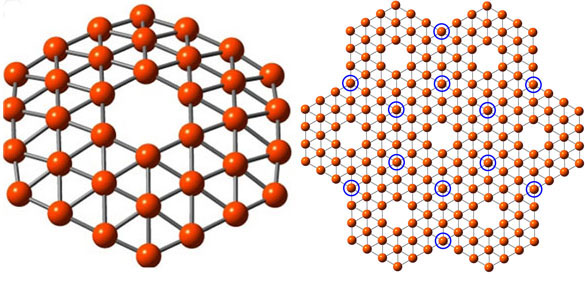
“Boron has one fewer electron than carbon and as a result can’t form the honeycomb lattice that makes up graphene. For boron to form a single-atom layer, theorists suggested that the atoms must be arranged in a triangular lattice with hexagonal vacancies — holes — in the lattice.”

A new paper shows that borophene is possible – now it just has to be made!

Zachary A. Piazza, Han-Shi Hu, Wei-Li Li, Ya-Fan Zhao, Jun Li, Lai-Sheng Wang.Planar hexagonal B36 as a potential basis for extended single-atom layer boron sheetsNature Communications, 2014; 5 DOI: 10.1038/ncomms4113

Brown University Press Release:

Unlocking the secrets of the B36 cluster
A 36-atom cluster of boron, left, arranged as a flat disc with a hexagonal hole in the middle, fits the theoretical requirements for making a one-atom-thick boron sheet, right, a theoretical nanomaterial dubbed “borophene.” Credit: Wang lab/Brown University

Graphene, a sheet of carbon one atom thick, may soon have a new nanomaterial partner. In the lab and on supercomputers, chemical engineers have determined that a unique arrangement of 36 boron atoms in a flat disc with a hexagonal hole in the middle may be the preferred building blocks for “borophene.”

Researchers from Brown University have shown experimentally that a boron-based competitor to graphene is a very real possibility.

Lai-Sheng Wang, professor of chemistry at Brown and his research group, which has studied boron chemistry for many years, have now produced the first experimental evidence that such a structure is possible. In a paper published on January 20 in Nature Communications, Wang and his team showed that a cluster made of 36 boron atoms (B36) forms a symmetrical, one-atom thick disc with a perfect hexagonal hole in the middle.

“It’s beautiful,” Wang said. “It has exact hexagonal symmetry with the hexagonal hole we were looking for. The hole is of real significance here. It suggests that this theoretical calculation about a boron planar structure might be right.”

It may be possible, Wang said, to use B36 basis to form an extended planar boron sheet. In other words, B36 may well be the embryo of a new nanomaterial that Wang and his team have dubbed “borophene.”

“We still only have one unit,” Wang said. “We haven’t made borophene yet, but this work suggests that this structure is more than just a calculation.” ……..

Wang’s experiments showed that the B36 cluster was something special. It had an extremely low electron binding energy compared to other boron clusters. The shape of the cluster’s binding spectrum also suggested that it was a symmetrical structure. ……..

…… That structure also fits the theoretical requirements for making borophene, which is an extremely interesting prospect, Wang said. The boron-boron bond is very strong, nearly as strong as the carbon-carbon bond. So borophene should be very strong. Its electrical properties may be even more interesting. Borophene is predicted to be fully metallic, whereas graphene is a semi-metal. That means borophene might end up being a better conductor than graphene.

“That is,” Wang cautions, “if anyone can make it.”

AbstractBoron is carbon’s neighbour in the periodic table and has similar valence orbitals. However, boron cannot form graphene-like structures with a honeycomb hexagonal framework because of its electron deficiency. Computational studies suggest that extended boron sheets with partially filled hexagonal holes are stable; however, there has been no experimental evidence for such atom-thin boron nanostructures. Here, we show experimentally and theoretically that B36 is a highly stable quasiplanar boron cluster with a central hexagonal hole, providing the first experimental evidence that single-atom layer boron sheets with hexagonal vacancies are potentially viable. Photoelectron spectroscopy of B36 reveals a relatively simple spectrum, suggesting a symmetric cluster. Global minimum searches for B36 lead to a quasiplanar structure with a central hexagonal hole. Neutral B36 is the smallest boron cluster to have sixfold symmetry and a perfect hexagonal vacancy, and it can be viewed as a potential basis for extended two-dimensional boron sheets.