Archive for the ‘Science’ Category

Sasquatch (“Bigfoot”) DNA study has the makings of a hoax intended to be found out

November 27, 2012

A press release was issued on Saturday 24th November. A team of scientists can verify that their 5-year long DNA study, currently under peer-review, confirms the existence of a novel hominin hybrid species, commonly called “Bigfoot” or “Sasquatch,” living in North America.

It feels like a PR campaign to me rather than any scientific study. It has all the makings of a hoax for publicity purposes where the inevitable debunking of the hoax is expected – but where criminal fraud cannot be proved.

The critical weakness lies in the purported samples from Bigfoot which have apparently been undergoing genetic study. The “scientists” are decoupled from the authenticity or the contamination/manipulation of the samples and are protected from charges of fraud. Of course nothing has been peer-reviewed or published yet. No data has been made available either. Where the samples came from and how they were “prepared” also remains to be seen. And the “study”  has a rather obvious commercial interest (The scientist leading the study, Dr. Melba Ketchum is the founder of DNA Diagnostics). I have a strong suspicion that the objective of the hoax is simply publicity and the main objectives of the hoax will be to keep the story going for as long as “genetically”  possible. The results and data leaked must therefore also be stage-managed to be difficult to debunk or disprove so that the assertions can live as long as possible.
(more…)

Idle thoughts: Disciplines, sciences and pseudosciences

November 4, 2012

There is virtually nothing in the physical universe around us that is not worthy of study. Most study begins with observations. We can term any such area of study where observations are made and knowledge accumulated as being a “discipline”. The social “sciences”, environmentalism and even astrology and palmistry could be considered disciplines.

But when does a discipline become a science?

(more…)

Could Chemistry Nobel today go to evolutionary genetics?

October 10, 2012

UPDATE! Awarded to Robert J Lefkowitz and to Brian K Kobilka for studies of G-protein-coupled receptors“.

==================================

Thomson Reuters predicts conventional areas of research for the Chemistry Nobel

1. Louis E. Brus

For discovery of colloidal semiconductor nanocrystals (quantum dots)

2. Akira Fujishima

For the discovery of photocatalytic properties of titanium dioxide (the Honda-Fujishima Effect)

and

3. Masatake Haruta and Graham J. Hutchings

For independent foundational discoveries of catalysis by gold

But Swedish Radio is predicting / hoping that it might be awarded to a Swedish scientist Svante Pääbo who is himself the son of a Nobel laureate. He is Director, Department of Genetics at the Max Planck Institute for Evolutionary Anthropology. In February 2009 the Max Planck Institute completed the first draft version of the Neanderthal genome. In 2010 they discovered the Denisovan genome. The techniques developed by Pääbo and his team for the DNA analysis of ancient specimens is what might be acknowledged.

Physics Nobel today – update — awarded to Haroche and Wineland

October 9, 2012

UPDATE 2!

Well the rumours were wrong and the prize has been awarded to Serge Haroche of France and David Wineland of the US.

UPDATE: There is a rumour doing the rounds in Sweden this morning that the Physics prize will go to Alain Aspect of France and Anton Zeilinger of Austria.

============================================

There is still some speculation that the Physics Nobel to be announced today could go to Higgs and CERN scientists for the much-hyped,  “non-discovery” of the Higgs Boson but somehow I doubt it.

 Thomson Reuters proposes three possible winners:

1. Charles H. Bennett, Gilles Brassard and William K. Wootters

For their pioneering description of a protocol for quantum teleportation, which has since been  experimentally verified

2. Leigh T. Canham

For discovery of photoluminescence in porous silicon

 3.Stephen E. Harris and Lene V. Hau

For the experimental demonstration of electromagnetically induced transparency (Harris) and of  ‘slow light’ (Harris and Hau)

There is an outside chance that it may be awarded for work straddling Physics and Chemistry – in the world of  nano-particles perhaps.

At least 275 water molecules needed to form an ice crystal

September 24, 2012


In idle moments I contemplate on strange things such as the origins of water on earth (which is largely unknown) and the life-span of water molecules (in the order of milliseconds) and the manner  in which water molecules are added to or lost from the apparently constant amount of water on earth. None of these questions are illuminated further but this interesting paper by researchers in Germany and the Czech Republic describes a technique for studying clusters of water molecules and provides some answers on the formation of ice crystals.

A Fully Size-Resolved Perspective on the Crystallization of Water Clusters by Christoph C. Pradzynski, Richard M. Forck, Thomas Zeuch, Petr Slavíček, Udo Buck . Science 21 September 2012:
Vol. 337 no. 6101 pp. 1529-1532 DOI: 10.1126/science.1225468

ABSTRACT

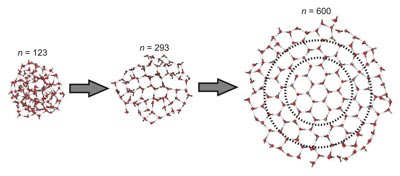
The number of water molecules needed to form the smallest ice crystals has proven challenging to pinpoint experimentally. This information would help to better understand the hydrogen-bonding interactions that account for the macroscopic properties of water. Here, we report infrared (IR) spectra of precisely size-selected (H2O)n clusters, with n ranging from 85 to 475; sodium doping and associated IR excitation–modulated photoionization spectroscopy allowed the study of this previously intractable size domain. Spectral features indicating the onset of crystallization are first observed for n = 275 ± 25; for n = 475 ± 25, the well-known band of crystalline ice around 3200 cm−1 dominates the OH-stretching region. The applied method has the potential to push size-resolved IR spectroscopy of neutral clusters more broadly to the 100- to 1000-molecule range, in which many solvents start to manifest condensed phase properties.

Illustrations of the molecular structure of three water clusters

Illustrations of the molecular structure of three water clusters : from http://physicsworld.com/cws/article/news/2012/sep/21/how-many-water-molecules-does-it-take-to-make-ice


22nd IgNobel awards – 2012

September 21, 2012

“The Stinker”, the official mascot of the Ig Nobel Prizes.

Researchers who worked on statistics which show brain activity in dead salmon, changed height perceptions when leaning to the left, a “speech-jammer” and a report that recommends the preparation of a report about the report about reports about reports are some of the winners of this years IgNobel awards.  

The Guardian

The 22nd Ig Nobel awards, organised by the humour magazine Annals of Improbable Research and awarded on Thursday at Harvard University, are a spoof of the Nobel prizes, to be announced next month. They honour achievements that “first make people laugh, and then make them think”. …….

….. This year’s Ig Nobels were handed out by five Nobel laureates including the 2009 physics laureate Roy Glauber, 2009 physiology or medicine winner Jack Szostak, and 2007 economics winner Eric Maskin.

Marc Abrahams, editor of the Annals of Improbable Research, and founder of the Ig Nobels, ended the ceremony with the traditional goodbye: “If you didn’t win an Ig Nobel prize tonight – and especially if you did – better luck next year.”

Psychology prize:Anita EerlandRolf Zwaan and Tulio Guadalupe, for their study entitiled Leaning to the Left Makes the Eiffel Tower Seem Smaller.

Peace prize: The SKN company, for using technology to convert old Russian ammunition into new diamonds.

Acoustics prize:Kazutaka Kurihara and Koji Tsukada for creating the SpeechJammer, a machine that disrupts a person’s speech by making them hear their own spoken words at a very slight delay.

Neuroscience prize:Craig BennettAbigail BairdMichael Miller, andGeorge Wolford, for demonstrating that brain researchers, by using complicated instruments and simple statistics, can see meaningful brain activity anywhere – even in a dead salmon.

Chemistry prize: Johan Pettersson for solving the puzzle of why, in certain houses in the town of Anderslöv, Sweden, people’s hair turned green.

Literature prize: The US government general accountability office, forissuing a report about reports about reports that recommends the preparation of a report about the report about reports about reports.

Physics prize:Joseph KellerRaymond GoldsteinPatrick Warren andRobin Ball, for calculating the balance of forces that shape and move the hair in a human ponytail.

Fluid dynamics prize:Rouslan Krechetnikov and Hans Mayer, for studying the dynamics of liquid sloshing, to learn what happens when a person walks while carrying a cup of coffee.

Anatomy prize:Frans de Waal and Jennifer Pokorny, for discovering that chimpanzees can identify specific other chimpanzees from seeing photographs of their rear ends.

Medicine prize: Emmanuel Ben-Soussan, for advising doctors who perform colonoscopies how to minimise the chance of their patients exploding.

World population by latitude >>the world of unusual map projections

September 13, 2012

With both landmass and population concentrated in the Northern hemisphere, a northern-centric view of the world in most things is inevitable.

I was looking for some information on population distribution by latitude and came across this graph on Chris Blattman’s site. However he was not the source of the diagram but had obtained the image from Paul Kedrosky’s page which still exists but no longer has the image. He in turn referred to a Bill Rankin whose page no longer exists. The diagram is said to be from 2000 data but I have not been able to find the source or anything more recent. An excellent diagram.

UPDATE: The original seems to be here: http://www.radicalcartography.net/index.html?histpop

POPULATION HISTOGRAMS 
Bill Rankin, 2008 

More fun with numbers! Roughly 88% of the world’s population lives in the northern hemisphere, and about half the world’s population lives north of 27°N.

Taking the northern and southern hemispheres together, on average the world’s population lives 24 degrees from the equator.

World population by latitude and longitude: source unknown (via chrisblattman)

Trying to trace some of the data on which this diagram is based I came across the fascinating work of Waldo Tobler. Professor Emeritus. Geography Department. University of California. In his presentation from 1999 on Unusual Map Projections I found two diagrams which – I think – must be the source (perhaps updated) for the diagram above. Unusual Map Projections Tobler 1999

(more…)

2012 Nobel prize speculations begin

September 12, 2012

UPDATE – 8th October

(The Physiology / Medicine awards are to be announced today)

The 2012 Thomson Reuters predictions are here: http://www.reuters.com/article/2012/09/19/idUS36510+19-Sep-2012+HUG20120919

==========================================

Every year around this time with about a month to go before the awards are announced the predictions and speculation begin about potential Nobel prize laureates. I don’t believe there is as much lobbying / marketing involved in the Nobel speculations as for the Oscars – but certainly some institutions and laboratories do try – much earlier in the year – to get some appropriate publicity for “their candidate”. This year the CERN publicity machine – which made much ado about their discovery – or not – of the Higgs boson – has been in full swing. Perhaps the hype was just to ensure funding but I am sure the possibility of a Nobel was not very far from their thoughts.

Dates for the Announcements

The prize awarding institutions have set the following dates for their announcements of 2012 prize decisions:

PHYSIOLOGY OR MEDICINE– Monday 8 October, 11:30 a.m. at the earliest
PHYSICS – Tuesday 9 October, 11:45 a.m. at the earliest
CHEMISTRY – Wednesday 10 October, 11:45 at the earliest
PEACE – Friday 12 October, 11:00 a.m.
ECONOMIC SCIENCES – Monday 15 October, 1:00 p.m. at the earliest
LITERATURE – The date will be set later

The Thomson Reuters Citation Laureates will probably be announced in another 10 days or so.

Each year, Thomson Reuters uses data from its research solution, Web of Knowledge, to quantitatively determine the most influential researchers in the Nobel categories of Physiology or Medicine, Physics, Chemistry, and Economics. Based on a thorough review of citations to their works, the company names these high-impact researchers as Thomson Reuters Citation Laureates and predicts them to be Nobel Prize winners, either this year or in the near future.   

Thomson Reuters is the only organization to use quantitative data to make annual predictions of Nobel Prize winners. Since 2002, 21 Citation Laureates have gone on to win Nobel Prizes.

A few of the early predictions are out in the blogosphere:

Chemistry, Chemistry and PhysicsEconomics, Literature.

Global temperature dependence on CO2 concentration goes missing

September 12, 2012

That climate changes and will continue to change is obvious. That this is primarily due to solar effects via the oceans also seems obvious to me. It seems the height of arrogance when – like Canute attempting to hold back the tides – climate-politicians attempt to hold back the sun and its effects. The sun cannot be carbon-taxed into submission.

That CO2 concentration in the atmosphere has little impact on climate is the reality that climate-politicians continue to deny. That the effects of man-made carbon dioxide emissions are of even less significance is becoming increasingly obvious.

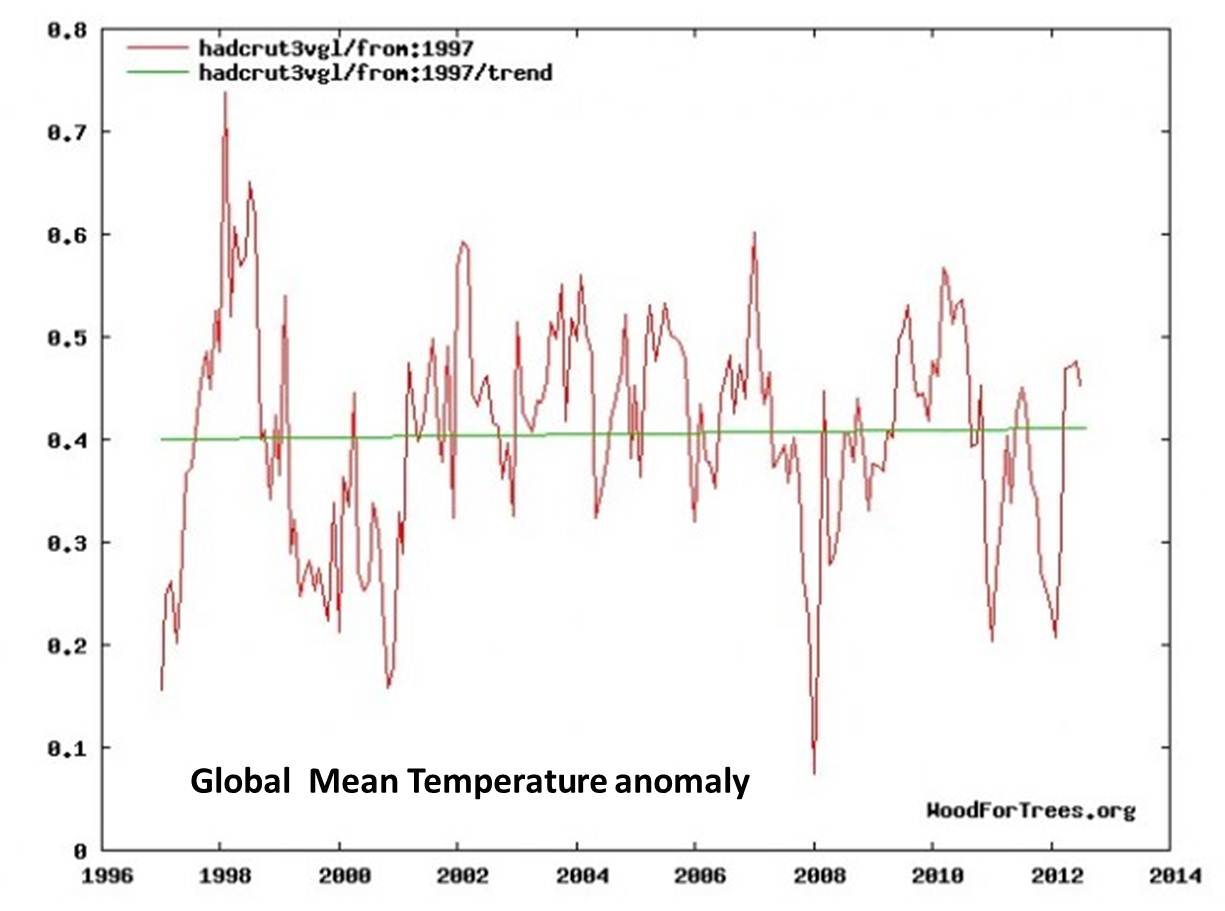
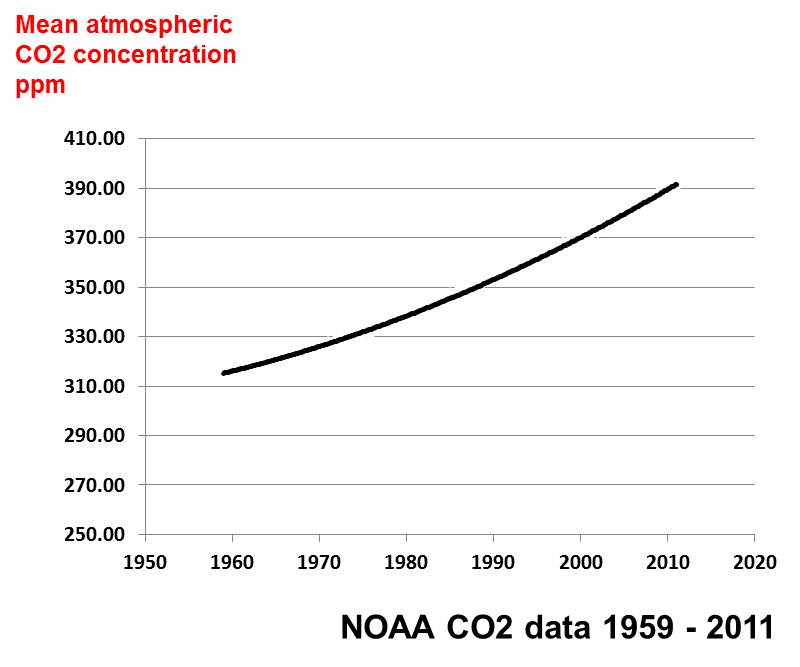
Over the last 16 years global temperatures have been pretty flat (actually the trend is very slightly downwards). During this same time  the atmospheric mean CO2 concentration has continued its increasing trend of between 1.5 and 2.5 ppm /year.

The data show no causality between CO2 concentration  and global mean temperature. How much or how little man-made emissions of CO2 contribute to the global mean concentration is still open to much question.

Global mean temperatures from woodfortrees.org

Global temperature anomaly hardcrut3vgl (via http://www.woodfortrees.org)

The following plot of mean annual atmospheric CO2 concentrations is from NOAA data 

(ftp://ftp.cmdl.noaa.gov/ccg/co2/trends/co2_annmean_mlo.txt)

NOAA ESRL data

ORI finds misconduct by Marc Hauser in 4 NIH grants

September 6, 2012

Psychology is an academic discipline but it is not (yet) a science.

The Hausergate affaire followed by the Diedrik Stapel affaire only confirmed my view that psychology as an academic discipline is permeated by confirmation bias (and sometimes just plain fraud). Now the Marc Hauser affaire reaches some kind of a conclusion (at least until he has served his “sentence” and is then “rehabilitated”) with the Office of Research Integrity’s report.

Retraction Watch comments on the ORI report:

Two years after questions surfaced about work by former Harvard psychology professor Marc Hauser, an official government report is finally out.

It’s not pretty.

The findings by the Office of Research Integrity were first reported by the Boston Globe, which was also first to report the issues in Hauser’s work. They’re extensive, covering misconduct in four different NIH grants ……..

As I had posted at the end of last year, psychology as an academic discipline needs to start introducing some intellectual rigour:

That psychology is a discipline and a field of study is indisputable. That the study of human (or animal) behaviour is a worthy field and that experimentation and research are well worth pursuing is also obvious. But I am of the view that it is far from being a science.  Psychology can be considered to be a pre-science similar to alchemy. And the practitioners of psychology are similar to priests and shamans and witch-doctors and other practitioners of magic. Inevitably the field contains many charlatans.  …… In the various fields of psychology, the null hypothesis is rarely if ever brought into play. …..

…. As Paul Lutus so well puts it

…. psychology can make virtually any claim and offer any kind of therapy, because there is no practical likelihood of refutation – no clear criteria to invalidate a claim. This, in turn, is because human psychology is not a science, it is very largely a belief system similar to religion.