Archive for the ‘Science’ Category

Kepler telescope finds two planets sharing the same orbit

February 25, 2011

Architecture and Dynamics of Kepler’s Candidate Multiple Transiting Planet Systems

by Jack J. Lissauer, Darin Ragozzine, Daniel C. Fabrycky, Jason H. Steffen, Eric B. Ford, Jon M. Jenkins, Avi Shporer, Matthew J. Holman, Jason F. Rowe, Elisa V. Quintana, Natalie M. Batalha, William J. Borucki, Stephen T. Bryson, Douglas A. Caldwell, David Ciardi, Edward W. Dunham, Jonathan J. Fortney, Thomas N. Gautier III, Steve Howell, David G. Koch, David W. Latham, Geoffrey W. Marcy, Robert C. Morehead, Dimitar Sasselov

Astrophysical Journal (arxiv.org/abs/1102.0543).

From the New Scientist:

Room for two (Image: NASA/Ames/JPL-Caltech)

Room for two (Image: NASA/Ames/JPL-Caltech)

Buried in the flood of data from the Kepler telescope is a planetary system unlike any seen before. Two of its apparent planets share the same orbit around their star. If the discovery is confirmed, it would bolster a theory that Earth once shared its orbit with a Mars-sized body that later crashed into it, resulting in the moon’s formation.

The two planets are part of a four-planet system dubbed KOI-730. They circle their sun-like parent star every 9.8 days at exactly the same orbital distance, one permanently about 60 degrees ahead of the other. In the night sky of one planet, the other world must appear as a constant, blazing light, never fading or brightening.

Gravitational “sweet spots” make this possible. When one body (such as a planet) orbits a much more massive body (a star), there are two Lagrange points along the planet’s orbit where a third body can orbit stably. These lie 60 degrees ahead of and 60 degrees behind the smaller object. For example, groups of asteroids called Trojans lie at these points along Jupiter’s orbit.

In theory, matter in a disc of material around a newborn star could coalesce into so-called “co-orbiting” planets, but no one had spotted evidence of this before. “Systems like this are not common, as this is the only one we have seen,” says Jack Lissauer of NASA’s Ames Research Center in Mountain View, California. Lissauer and colleagues describe the KOI-730 system in a paper submitted to the Astrophysical Journal (arxiv.org/abs/1102.0543).

File:Lagrange points2.svg

Lagrange Points: image Wikipedia

Space shuttle Discovery sets of on her last mission

February 25, 2011

Shuttle Discovery sets out on last voyage

Space shuttle Discovery

Space shuttle Discovery lifts off from the Cape Canaveral. Photograph: Chris O'Meara/AP

The US shuttle Discovery has launched from the Kennedy Space Center for the last time. The orbiter roared into a bright blue Florida sky, leaving the pad at 1653 local time (2153 GMT).

Its 11-day mission will see it deliver a new store room and a sophisticated humanoid robot to the International Space Station (ISS). Only two further flights remain by Endeavour and Atlantis, which Nasa is trying to see concluded this year.

The orbiter fleet is then expected to retire to museums.

….. First launched in 1984, this is its 39th outing. When it lands back on Earth in nearly two weeks’ time it will have covered a cumulative career distance of 230 million km (143 million miles). That’s further than the distance from the Earth to the Sun (149 million km).

Once the shuttles are retired, the plan is for US astronauts to fly to the space station on Russian Soyuz rockets until perhaps the middle of the decade.

Related:

Space shuttle Discovery prepares for final mission

A quiet sun flexes its muscles

February 17, 2011

Update: February 18th 0700 CET

http://www.spaceweather.com/

A CME hit Earth’s magnetic field at approximately 0100 UT on Feb. 18th (8:00 pm EST on Feb. 17th). The impact was not as strong as expected considering the cloud’s X-class origin.

Solar Cycle 24 is generally exhibiting a very low level of activity but the sun occasionally does flex its muscles just to show what it is capable of.

http://solarcycle24.com/

Geomagnetic Storm Watch – From the Space Weather Prediction Center: February 16, 2011 — The calm before the storm. Three CMEs are enroute, all a part of the Radio Blackout events on February 13, 14, and 15 (UTC). The last of the three seems to be the fastest and may catch both of the forerunners about mid to late day tomorrow, February 17.

http://www.swpc.noaa.gov/

February 17, 2011 — The first interplanetary shock, driven by the CME from Sunday, is expected any time. Soon thereafter, the shock from Monday evening’s R3/CME is due. Look for G1-G2 (and maybe periods of G3 if the following shock compresses and enhances the CME magnetic field). Geomagnetic storming should persist 24- 48 hours. Back at the Sun, Region 1158 is still hot and fast-growing, Region 1161 is producing small flares.

image NOAA

3-day Solar-Geophysical Forecast issued Feb 16 22:00 UTC

Solar Activity Forecast: Solar activity is expected to be moderate with a chance for an isolated major flare for the next three days (17-19 February). Region 1158 is expected to produce more M-class flares and still has the potential for producing an M5 or greater x-ray event. There is a chance for isolated M-class activity from Region 1161.

Geophysical Activity Forecast: The geomagnetic field is expected to be predominately quiet on day one (February 17). An increase to unsettled to active conditions, with a chance for minor storm periods is expected late on day one into day two (18 February). The increased activity is forecast due to the expected arrival of the CME associated with the X2 flare that occurred on 15/0156Z. Day three (19 February) is expected to be quiet to active as the disturbance subsides.


Dark chocolate is a “super-food”

February 13, 2011
Dark chocolate.

Dark chocolate: Image via Wikipedia

Cacao seeds are a super-fruit and dark chocolate is a super-food with health giving properties superior to many fruit juices.

This comes from a peer reviewed paper in Chemistry Central Journal even if the study was conducted by scientists at the Hershey Centre for Health & Nutrition. To satisfy my own preferences for dark chocolate I am willing to overlook the fact that the Hershey Centre for Health and Nutrition has probably never found any negative effects of chocolate!!

However heating chocolate destroyed its health giving properties.

Cacao seeds are a “Super Fruit”: A comparative analysis of various fruit powders and products by Stephen J Crozier, Amy G Preston,  W Jeffrey Hurst , Mark J Payne , Julie Mann, Larry Hainly  and Debra L Miller, Chemistry Central Journal 2011, 5:5

doi:10.1186/1752-153X-5-5

The Telegraph reports:

Researchers found that chocolate contains more healthy plant compounds, gram-for-gram, than many fruit juices.

In a test, they found that powdered dark chocolate contained more antioxidants and polyphenols – all of which are thought to protect the body from diseases such as cancer, and heart conditions.

Superfoods are usually classed as those high in antioxidants – compounds which prevent oxidisation and can stop healthy cells from being damaged.

Researchers made comparisons between single servings of dark chocolate, cocoa, hot chocolate mix, and fruit juices including acai berries, cranberries and pomegranates

The research showed that both dark chocolate and cocoa had more antioxidant activity and more flavonols than fruit.

Dr Debra Millar, the lead author, said that the results showed that chocolate should be labelled a “superfruit”.

“Cacao seeds should be considered a ‘super fruit’ and products derived from cacao seed extracts, such as natural cocoa powder and dark chocolate, as ‘super foods’,” she said. …….  However heating chocolate destroyed any health giving properties, they discovered.


Rivers in the sky

February 12, 2011

Weather (and climate) which are contained within the thin chaotic layer around the earth’s surface are very far away from being “settled science” in spite of what Al Gore and those of his ilk like to pretend.

Unmanned aircraft are now being used in a new programme to study the “atmospheric rivers” which transport vast quantities of rain around the globe.

They’re called atmospheric rivers – narrow regions in Earth’s atmosphere that transport enormous amounts of water vapor across the Pacific or other regions. Aptly nicknamed “rivers in the sky,” they can transport enough water vapor in one day, on average, to flood an area the size of Maryland 0.3 meters (1 foot) deep, or about seven times the average daily flow of water from the Mississippi River into the Gulf of Mexico. The phenomenon was the subject of a recent major emergency preparedness scenario led by the U.S. Geological Survey, “ARkStorm,” which focused on the possibility of a series of strong atmospheric rivers striking California – a scenario of flooding, wind and mudslides the USGS said could cause damages exceeding those of Hurricane Katrina in 2005.

JPL airborne sensor to study 'Rivers in the Sky'

NASA's Global Hawk soars aloft from Edwards Air Force Base, Calif., on a functional check flight of the WISPAR aircraft payload system and science instruments. Credit: NASA Dryden Flight Research Center

While atmospheric rivers are responsible for great quantities of rain that can produce flooding, they also contribute to beneficial increases in snowpack. A series of atmospheric rivers fueled the strong winter storms that battered the U.S. West Coast from western Washington to Southern California from Dec. 10 to 22, 2010, producing 28 to 64 centimeters (11 to 25 inches) of rain in certain areas. The atmospheric rivers also contributed to the snowpack in the Sierras, which received 75 percent of its annual snow by Dec. 22, the first full day of winter.

To improve our understanding of how atmospheric rivers form and behave and evaluate the operational use of unmanned aircraft for investigating these phenomena, NASA scientists, aircraft and sensors will participate in a National Oceanic and Atmospheric Administration-led airborne field campaign slated to begin Feb. 11.

Called Winter Storms and Pacific Atmospheric Rivers, or WISPAR, the field campaign, which continues through the end of February, is designed to demonstrate new technology, contribute to our understanding of atmospheric rivers and assist NOAA in potentially conducting offshore monitoring of atmospheric rivers to aid in future weather predictions.

Read original article.

Solar Cycle 24 forecast reduced yet again

February 10, 2011

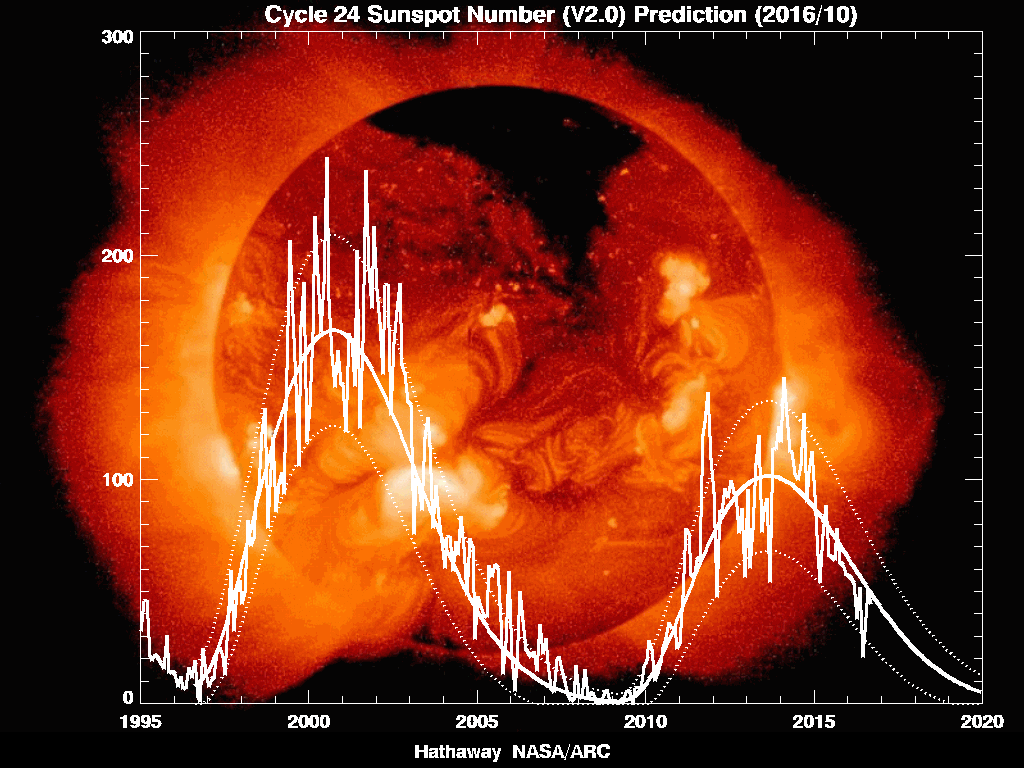
We had a reduced forecast from NASA just a month ago and it has reduced yet again.

The peak is now expected in July 2013 but this could well slip a month or two. This Landscheidt Minimum continues to look like a Dalton Minimum.

December 2010 forecast smoothed sunspot number maximum of 64 in June 2013

January 2011 forecast smoothed sunspot number maximum of 59 in June/July 2013

February 2011

Current prediction for the next sunspot cycle maximum gives a smoothed sunspot number maximum of about 58 in July of 2013. We are currently two years into Cycle 24 and the predicted size continues to fall.

The latest forecasts for sunspot number and 10.7 Radio flux and Ap progression are here: http://www.swpc.noaa.gov/SolarCycle/

Related:

https://ktwop.wordpress.com/2010/12/23/is-the-landscheidt-minimum-a-precursor-for-a-grand-minimum/

Space shuttle Discovery prepares for final mission

February 1, 2011

Only 3 more flights – money permitting – for an iconic series of space craft before they are retired.

BBC:

The US shuttle Discovery has rolled out for what should be its final mission. The orbiter completed its slow journey to the Kennedy Space Center’s Launch Pad 39A overnight, Monday into Tuesday.

Discovery’s flight to the space station is scheduled to begin on 24 February. With its crew of six astronauts, the ship will deliver a storeroom to be attached to the 350km-high platform, along with further supplies and spares.

NASA last tried to launch the vehicle in November but technical hitches, including cracks on its giant external fuel tank, kept the ship on the ground. The agency said engineers had now fixed those defects and carried out further work to strengthen the tank.

President Barack Obama and the US Congress have determined that the shuttle fleet should be retired this year. Discovery is the oldest of the three surviving orbiters. First launched in 1984, it has since completed 38 missions, travelling some 230 million km in the process. Endeavour is expected to fly to the station in April. Atlantis will go no earlier than June, if Nasa has sufficient money left in its shuttle programme budget.

Following the fleet’s retirement, the plan is for US astronauts to fly to the space station on Russian Soyuz rockets until perhaps the middle of the decade.

Discovery

Space shuttle Discovery : image NASA


Molybdenite to challenge graphene?

January 31, 2011
Mineral molybdenite from collection of Nationa...

Mineral molybdenite: Image via Wikipedia

A new paper from researchers at Ecole Polytechnique Federale de Lausanne about a new material which could challenge graphene for transistors.

Single-layer MoS2 transistors, by B. Radisavljevic, A. Radenovic, J. Brivio, V. Giacometti & A. Kis, Nature Nanotechnology (2011) doi:10.1038/nnano.2010.279

Physorg reports:

Smaller and more energy-efficient electronic chips could be made using molybdenite. In an article appearing online January 30 in the journal Nature Nanotechnology, EPFL’s Laboratory of Nanoscale Electronics and Structures (LANES) publishes a study showing that this material has distinct advantages over traditional silicon or graphene for use in electronics applications.

A model showing how molybdenite can be integrated into a transistor. Credit: EPFL

Research carried out in the Laboratory of Nanoscale Electronics and Structures (LANES) has revealed that molybdenite, or MoS2, is a very effective semiconductor. This mineral, which is abundant in nature, is often used as an element in steel alloys or as an additive in lubricants. But it had not yet been extensively studied for use in electronics.

“It’s a two-dimensional material, very thin and easy to use in nanotechnology. It has real potential in the fabrication of very small transistors, light-emitting diodes (LEDs) and solar cells,” says EPFL Professor Andras Kis, whose LANES colleagues M. Radisavljevic, Prof. Radenovic et M. Brivio worked with him on the study. He compares its advantages with two other materials:silicon, currently the primary component used in electronic and computer chips, and graphene, whose discovery in 2004 earned University of Manchester physicists Andre Geim and Konstantin Novoselov the 2010 Nobel Prize in Physics.

One of molybdenite’s advantages is that it is less voluminous than silicon, which is a three-dimensional material. “In a 0.65-nanometer-thick sheet of MoS2, the electrons can move around as easily as in a 2-nanometer-thick sheet of silicon,” explains Kis. “But it’s not currently possible to fabricate a sheet of silicon as thin as a monolayer sheet of MoS2.” Another advantage of molybdenite is that it can be used to make transistors that consume 100,000 times less energy in standby state than traditional silicon transistors. A semi-conductor with a “gap” must be used to turn a transistor on and off, and molybdenite’s 1.8 electron-volt gap is ideal for this purpose.

The existence of this gap in molybdenite also gives it an advantage over graphene.

Read Article


Canine jobs threatened by explosive sniffing plants!

January 29, 2011

Canine explosives detectors may soon be unemployed as they are replaced by plants. A new paper in PLos One

Antunes MS, Morey KJ, Smith JJ, Albrecht KD, Bowen TA, et al. (2011) Programmable Ligand Detection System in Plants through a Synthetic Signal Transduction Pathway. PLoS ONE 6(1): e16292. doi:10.1371/journal.pone.0016292

Coclusions:

Our system is modular and PBPs can theoretically be designed to bind most small molecules. Hence our system, with improvements, may allow plants to serve as a simple and inexpensive means to monitor human surroundings for substances such as pollutants, explosives, or chemical agents.

From dvice.com

Forget those intrusive airport security scanners, within a few years genetically modified plants could be detecting bombs at airports. Developed by Colorado State University biology professor June Medford, the plants have been manipulated so that they turn white almost instantly when certain types of explosives are in the air around them. Medford says that the goal is to make the plants as sensitive as a dogs nose.

Funding for the project has come from DARPA and the Defense Threat Reduction Agency, who see the plants as an additional line of defense at airports, sports stadiums and government buildings. Medford says that the plants could be in use within four years.

Bomb detecting plants coming soon to an airport near you

Plants turn white on detecting explosives: image dvice.com

25 years since Challenger exploded; almost 8 years since Columbia was destroyed

January 28, 2011

The Space Shuttle Challenger’s maiden flight was on 4th April, 1983, and it completed nine missions before breaking apart 73 seconds after the launch of its tenth mission, STS-51-L on 28th January, 1986.

A sombre anniversary today.

A special ceremony is taking place at the Kennedy Space Center’s visitor complex this morning. Members of the NASA family and the public will gather to honor those who died aboard space shuttle Challenger.

Twenty-five years ago the STS-51L crew boarded Challenger for a six-day flight. It was just after liftoff when things went wrong. Challenger was in the air for 73 seconds before the orbiter exploded. …. According to investigators’ findings, the cause of the explosion was an O-ring that failed in one of the solid rocket boosters. Cold weather was cited as a contributing factor.

File:Challenger explosion.jpg

The breakup of the space shuttle Challenger: 28th January 1986: Wikipedia

Challenger crew; El Onizuka,Christa McAuliffe, Greg Jarvis, Judy Resnik, Mike Smith, Dick Scobee, Ron McNair: image christa.org

Today is also 4 days short of 8 years since the space shuttle Columbia was destroyed during rentry.

Space Shuttle Columbia (NASA Orbiter Vehicle Designation: OV-102) was the first spaceworthy Space Shuttle inNASA’s orbital fleet. First launched on the STS-1 mission, the first of the Space Shuttle program, it completed 27 missions before being destroyed during re-entry on February 1, 2003 near the end of its 28th, STS-107. All seven crew members were killed.

The investigation found that 82 seconds after launch a large piece of foam insulating material from the external tank broke free and struck the leading edge of the shuttle’s left wing, damaging the protective carbon heat shielding panels. This damage allowed super-heated gases to enter the wing structure during re-entry into the Earth’s atmosphere and caused the destruction of the Columbia.

Columbia was commanded by Rick Husband and piloted by William McCool. The mission specialists were Michael Anderson, Kalpana Chawla, David Brown, Laurel Clark; and the payload specialist was Israeli astronaut Ilan Ramon: image NASA

Currently the 3 operational orbiters are the

Space Shuttles Discovery, Atlantis anEndeavour.