Archive for the ‘Technology’ Category

Indian Minister: Indian IT companies have created 250,000 jobs in US

September 15, 2010
DAVOS/SWITZERLAND, 27JAN10 - Anand Sharma, Min...

Image via Wikipedia

While it is clearly political positioning just before bilateral trade talks between the US and India to be held next week in India, the “global outsourcing” alarmism is not as one-sided as it is made out by opportunistic politicians.

In my own experience transfer of technology across countries within the same company is more likely to lead to an increase in jobs – but not the same jobs – in the country exporting technology.

The Times of India reports that:

Indian IT companies created 7,000 jobs in the US last month and 2.5 lakh (250,000) jobs over the last three years, commerce minister Anand Sharma has said, indicating that recent protectionist measures taken by the US such as hiking professional visa fees and clamping down on outsourcing could hamper such economic activities.

“In times of crisis, countries tend to look inwards but protection can be counter productive. This is the time to encourage global trade flows,” the minister said on Tuesday. The bilateral trade policy forum meeting scheduled next week to be chaired by Mr Sharma and US trade representative Ron Kirk will focus on both issues.

The minister is optimistic that the issues could be sorted out through discussions. “We remain optimistic about the whole scenario but responses need to be calibrated,” he said.

Read more: Indian IT cos created 7,000 jobs in US in Aug – The Times of India http://timesofindia.indiatimes.com/business/india-business/Indian-IT-cos-created-7000-jobs-in-US-in-Aug/articleshow/6557684.cms#ixzz0zaEmNB00

Of course it was not so very long ago when US and EU trade officials were berating India, China and other developing countries about the sins of protectionism and closed markets. With the growth in India and China now leading the way out of recession it would be wiser to keep global trade flows open rather than to wave the protectionist flag.

Yvo de Boer: “Emissions targets and timetables are irrelevant”

September 15, 2010

I am an optimist and maybe I am over-reacting but I see clear signals that the “establishment” is beginning to back away from the hype and hysteria surrounding Global Warming and carbon dioxide. The reduction of temperatures in the last decade while carbon dioxide concentration has increased but where the increase is less than half of that which should have been caused by man-made emissions is beginning to bring common sense back into play.

Yesterday it was Caroline Spelman the new UK Environment Secretary. Today Yvo de Boer the former head of the UN climate negotiations, has acknowledged that the long debate over targets and timetables for the reduction of carbon dioxide emissions is irrelevant. Asked by Bloomberg about emissions reductions targets in the context of the upcoming climate negotiations in Cancun, de Boer replied:

“Discussions about targets have become largely irrelevant in the context of the Copenhagen outcome. I don’t think that we’re going to see a dramatic increase in the level of ambition.”

image: treehugger.com

The failure of both the UN climate negotiations and domestic cap-and-trade policies has opened up new opportunities for progress on our long-stalled climate and energy goals. That progress will be driven primarily by direct public investment in energy technology, not by carbon markets, and will focus explicitly on making clean energy cheap through innovation.

Even though I don’t believe that carbon dioxide has any significant impact on Climate change I can only agree that innovation and technology development – rather than carbon trading scams or futile subsidies for renewables (which can never be more than intermittent) is the way to go.

Microbes ate the BP oil plume

September 12, 2010

There is still some oil left of course but “the micro-organisms were apparently stimulated by the massive oil spill that began in April, and they degraded the hydrocarbons so efficiently that the plume is now undetectable, said Terry Hazen of Lawrence Berkeley National Laboratory”. These so-called proteobacteria — Hazen calls them “bugs” — have adapted to the cold deep water where the big BP plume was observed and are able to biodegrade hydrocarbons much more quickly than expected, without significantly depleting oxygen as most known oil-depleting bacteria do. Long before humans drilled for oil, natural oil seeps in the Gulf of Mexico have put out the equivalent of an Exxon Valdez spill each year, Hazen said.

NewsDaily reports that “A Manhattan-sized plume of oil spewed deep into the Gulf of Mexico by BP’s broken Macondo well has been consumed by a newly discovered fast-eating species of microbes”.

http://www.mcclatchydc.com/2010/07/13/97433/heres-some-hope-for-gulf-spill.html

The hysteria surrounding the BP accident (almost as if it had been intentionally engineered) has focused on the photo opportunities presented by oil-coated birds and beaches and has almost obscured the fact that 11 people were killed. The accident has been dubbed “the greatest environmental disaster ever” and has been used as evidence of the evils of technology. It has not suited the environmental “do gooders” to acknowledge that “green” activities cause more damage in the Gulf of Mexico than accidental oil spills.

In the media, blame and the allocation of blame has been the order of the day rather than  analysis of the mistakes made and the engineering and technical lessons to be learnt.

That doesn’t mean there is no oil left from the 4.9 million barrels of crude that spilled into the Gulf after the April 20 blowout at BP’s Deepwater Horizon rig. The U.S. government estimated on August 4 that 50 percent of the BP oil is gone from the Gulf and the rest is rapidly degrading.

A reprieve for incandescent bulbs?

September 2, 2010

I still have hope that the Edison bulb will survive – in spite of all the do-gooders who want to be Nanny.

New research may provide the answer.

http://www.greenzer.com/blog/blog_image_store/2009/09/eu-bans-incadescent-light-bulbs.jpg

According to an article in The New York Times,

Incandescent Bulbs Return to the Cutting Edge

“Researchers across the country have been racing to breathe new life intoThomas Edison’s light bulb, a pursuit that accelerated with the new legislation. Amid that footrace, one company is already marketing limited quantities of incandescent bulbs that meet the 2012 standard, and researchers are promising a wave of innovative products in the next few years.

“There’s a massive misperception that incandescents are going away quickly,” said Chris Calwell, a researcher with Ecos Consulting who studies the bulb market. “There have been more incandescent innovations in the last three years than in the last two decades.”

For lighting researchers involved in trying to save the incandescent bulb, the goal is to come up with one that matches the energy savings of fluorescent bulbs while keeping the qualities that many consumers seem to like in incandescents, like the color of the light and the ease of using them with dimmers.

“Due to the 2007 federal energy bill that phases out inefficient incandescent light bulbs beginning in 2012, we are finally seeing a race” to develop more efficient ones, said Noah Horowitz, senior scientist with the Natural Resources Defense Council.

Some of the leading work is under way at a company called Deposition Sciences here in Santa Rosa. Its technology is a key component of the new Philips bulb line.

Normally, only a small portion of the energy used by an incandescent bulb is converted into light, while the rest is emitted as heat. Deposition Sciences applies special reflective coatings to gas-filled capsules that surround the bulb’s filament. The coatings act as a sort of heat mirror that bounces heat back to the filament, where it is transformed to light.

Despite a decade of campaigns by the government and utilities to persuade people to switch to energy-saving compact fluorescents, incandescent bulbs still occupy an estimated 90 percent of household sockets in the United States. Aside from the aesthetic and practical objections to fluorescents, old-style incandescents have the advantage of being remarkably cheap”.

There is still hope.

Wind Turbine blades a security threat?

August 31, 2010

Wind turbines are not without their problems –they are expensive, have to be shut down for strong winds, don’t like freezing weather, need back-up, weaken the grid they are connected in to, are dangerous to transport, can be very noisy and can be dangerous for large birds.

In addition it seems they pose a threat to the military.

The New York Times reports that Dr. Dorothy Robyn, deputy under secretary of defense, has declared that wind turbines pose an unacceptable risk to national security and military training in some areas–because  moving turbine blades can cause “blackout zones” where planes disappear from radar. And in certain cases,  turbine blades are indistinguishable from approaching planes.

http://graphics8.nytimes.com/images/2008/08/19/timestopics/windpower_395.jpg

Moving turbine blades can be indistinguishable from airplanes on many radar systems, and they can even cause blackout zones in which planes disappear from radar entirely. Clusters of wind turbines, which can reach as high as 400 feet, look very similar to storm activity on weather radar, making it harder for air traffic controllers to give accurate weather information to pilots.

Although the military says no serious incidents have yet occurred because of the interference, the wind turbines pose an unacceptable risk to training, testing and national security in certain regions, Dr. Dorothy Robyn, deputy under secretary of defense, recently told a House Armed Services subcommittee.

In 2009, about 9,000 megawatts of proposed wind projects were abandoned or delayed because of radar concerns raised by the military and the Federal Aviation Administration, according to a member survey by the American Wind Energy Association. That is nearly as much as the amount of wind capacity that was actually built in the same year, the trade group says.

As a result of the military’s opposition, Horizon Wind Energy recently withdrew three project applications in the area. AES Wind Generation said it found out in May, after nine years of planning, that the military had objections to its proposal to build a 82.5-megawatt, 33-turbine wind farm.

Wind Power apart from its cost and technical issues is not as benign as it might seem.


How can we – if we should – prepare for a new Little Ice Age?

August 22, 2010

It seems that we are in a Solar Cycle Minimum – a Landscheidt Minimum which will perhaps be comparable to the Maunder Minimum.

The last decade has seen flat or declining global temperatures.

The Ocean temperature oscillations could indicate 20 or 30 years cooling ahead of us.

If these are all indicators of a coming Little Ice Age, then it may be time to take some preparatory actions to help humans adapt. I think adaptation to Climate Change when it happens is the key not some mis-guided and futile attempt to prevent the Climate Change from happening (as being proposed by the IPCC and other global warming fanatics).

image: http://t2.gstatic.com/images?q=tbn:TtpOoja-ueuOLM:http://www.wilsonsalmanac.com/images3/frost_fair_C18.jpg

The question which is more for engineers rather than for scientists is “What are the actions that could be taken to prepare and help for such an adaptation?”

Applying Asimov’s Laws of Robotics

August 21, 2010

Isaac Asimov published his first short story about robotics in 1942 and his I Robot in 1950. The three laws of robotics he developed have now become the de facto basis for most science fiction dealing with robots and even in engineering:

First Law: A robot may not injure a human being, or, through inaction, allow a human being to come to harm, unless this would violate a higher order law.
Second Law: A robot must obey orders given it by human beings, except where such orders would conflict with a higher order law.
Third Law: A robot must protect its own existence as long as such protection does not conflict with a higher order law.

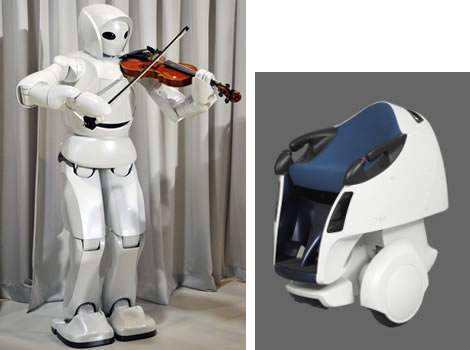
image: http://www.geekalerts.com/u/toyota-robots.jpg

Later as Asimov integrated his Robot series with his Foundation series he added a Zeroth Law:

Zeroth Law: A robot may not injure humanity, or, through inaction, allow humanity to come to harm.

A modern counterpart to Asimov’s fictional character is Eliza. Eliza was created in 1966 by Professor Joseph Weizenbaum of Massachusetts Institute of Technology who wrote Eliza — a computer program for the study of natural language communication between man and machine. She was initially programmed with 240 lines of code to simulate a psychotherapist by answering questions with questions.

Robotics and robot design has now advanced to the stage that engineers are now having to re-look at Asimov’s laws for practical implementation. David Woods, professor of integrated systems engineering at Ohio State University says “The philosophy has been, ‘sure, people make mistakes, but robots will be better — a perfect version of ourselves.’ We wanted to write three new laws to get people thinking about the human-robot relationship in more realistic, grounded ways.” He addresses the practical issues in his article: Beyond Asimov: The Three Laws of Responsible Robotics in IEEE Intelligent Systems by Robin Murphy , David D. Woods, July 2009, pp. 14-20. “Go back to the original context of the stories,” Woods says, referring to Asimov’s I Robot among others. “He’s using the three laws as a literary device. The plot is driven by the gaps in the laws — the situations in which the laws break down. For those laws to be meaningful, robots have to possess a degree of social intelligence and moral intelligence, and Asimov examines what would happen when that intelligence isn’t there.”

“His stories are so compelling because they focus on the gap between our aspirations about robots and our actual capabilities. And that’s the irony, isn’t it? When we envision our future with robots, we focus on our hopes and desires and aspirations about robots — not reality.”

In reality, engineers are still struggling to give robots basic vision and language skills. These efforts are hindered in part by our lack of understanding of how these skills are managed in the human brain. We are far from a time when humans can agree on a universal ethical or moral code and even further away from imbuing such a code into robots.

Woods and his coauthor, Robin Murphy of Texas A&M University, composed three laws that tries to put the responsibility back on humans.

The three new laws that Woods and Murphy propose are:

  • A human may not deploy a robot without the human-robot work system meeting the highest legal and professional standards of safety and ethics.
  • A robot must respond to humans as appropriate for their roles.
  • A robot must be endowed with sufficient situated autonomy to protect its own existence as long as such protection provides smooth transfer of control which does not conflict with the First and Second Laws.

Woods admits that one thing is missing from the new laws: the romance of Asimov’s fiction — the idea of a perfect, moral robot that sets engineers’ hearts fluttering.

Wind Power Sector struggles

August 21, 2010

Wind Power is still a long way from being commercial and is  still critically dependent upon subsidies. Austerity packages resulting from the financial crisis have sharply reduced subsidy programs and there have been a spate of cancelled and delayed projects. There is also some disillusionment evident as wind turbines demonstrated their weaknesses during the last cold winter when many had to be shut down in Europe for fear of ice on the turbine blades. The requirement for back-up power and the instability they add to the grid has not helped either. The Spanish support for renewables has dried up as the financial crisis has hit hard.

An injection of realism and common sense to the the use of renewable energy is long overdue. Wind and Solar and tidal and geothermal energies all have their place but they will not – and cannot – provide the base load power generation that coal, nuclear and hydro power have provided.

The FT reports that shares in Vestas Wind Systems lost more than a fifth of their value on Wednesday after the world’s largest wind turbine manufacturer slumped to its second consecutive quarterly loss and cut its profit guidance for the year.

image: http://www.pcdistrict.com/modules/productcatalog/product_images/132027-Windmill-3D-Screensaver.jpg

image. http://37signals.com/svn/images/dutch_windmill.jpg

Vestas warned that some expected orders from Europe and the US had been delayed as banks take longer to approve financing and deficit-laden governments review their support for wind power. Analysts highlighted regulatory uncertainty in Spain, which recently cut subsidies for renewable energy as part of its fiscal austerity programme, and the US, where legislation to promote clean energy has stalled on Capitol Hill. Low natural gas prices, caused in part by the surge in supplies from newly exploited US shale gas reserves, was another factor deterring investment in more costly renewable energy, analysts said.

New wind power installation in the US declined by more than two-thirds in the first half and fell below new coal power capacity for the first time in five years.

IBM is second largest private employer in India

August 18, 2010

In 2006 IBM had 53,000 employees in India which grew to 73,000 employees in 2007. Since then, the company has maintained that it is a global company and geographic numbers do not have any meaning in that context. In 2010 IBM employees in India exceeded 100,000 and may be as many as 130,000.

IBM still employs the most people in the US but almost one in three of IBM’s total workforce of over 400,000 is now in India.

http://www.accessnorthga.com/img/stories/205230/ibm-india_medium.jpg

The Times of India reports that

The fact that IBM has over one lakh (100,000)  people on its rolls in this country is one of India Inc’s best-kept secrets.
Tata Consultancy Services is the largest private sector employer in the country. It had 163,700 employees as on June 30.

No one in US-headquartered IBM will admit that it employs such a large number of people in India — for fear of a backlash at home. There’s been rising anger in the US over the transfer of `American jobs’ to lower cost havens, particularly India. Faced with an economic slowdown and a politically-damaging high employement rate, Barack Obama himself has begun to sound jingoistic. He has issued barely-veiled threats against US companies that ship out work and promised candies to those who stay patriotic.Even as an IBM spokesperson declined comment when contacted, a source within the company said that in a couple of years, the India employee strength could cross that in the US, where it employs about 1,55,000 people, and where the pace of hiring is substantially slower than in India. IBM globally has a little over 4,00,000 employees. So, close to 1 in 3 of its employees is already an Indian.

Its staff strength is more than four times that of India’s biggest private sector company, Reliance Industries, which employs about 23,000 people. It is bigger than the combined employee base of the two Tata Group’s crown jewels, Tata Steel (81,000) and Tata Motors (24,000).

A cross-section of industry analysts and manpower recruitment firms TOI spoke with not only put IBM’s India workforce (including that of its wholly-owned subsidiary IBM Daksh) at over one lakh, some even went to the extent of saying it might be 1.3 lakh — well over Infosys’ 1.14 lakh as on June 30. Infosys is India’s second largest IT firm by revenue and third, it now transpires, by employees.

Since 2007, the company has stopped disclosing the geographic break-up of its employee numbers. The last time it provided figures was in 2007, when it said it had 73,000 employees in India. Since then, the company has maintained that it’s a global company and geographic numbers do not have any meaning in that context.
(more…)

Hayabusa returns — Ion engine spacecraft back after 7 years

August 4, 2010

The Japanese asteroid exploration spacecraft Hayabusa returned miraculously on 13th June from a seven-year, trouble-filled journey  powered by ion engines.

Hayabusa’s main engine failed due to fuel leaks, but the probe was able to complete its odyssey by relying on ion engines developed by  NEC. The Japanese firm’s unique method of using microwaves can extend the lifespan of an ion engine to more than twice that of conventional engines. Hayabusa’s successful return “has boosted the credibility of ion engines,” an NEC official said.

image: http://www.jpl.nasa.gov/missions/missiondetails.cfm?mission=Hayabusa

Japan is planning for the launch of the “Hayabusa-2” asteroid probe sometime between July 2014 and 2015.

(more…)