UPDATE!
Bloomberg: General Electric Co.’s Jeffrey Immelt is set to meet with the European Union’s antitrust chief Tuesday as the U.S. company seeks approval for its acquisition of Alstom SA’s energy business.
The session in Brussels between GE’s chief executive officer and Margrethe Vestager is part of regulators’ “ongoing merger review,” Lucia Caudet, a European Commission spokeswoman, said in an e-mail.
On February 23rd this year the European Commission announced that its preliminary investigation into the proposed acquisition of Alstom’s power businesses by GE had highlighted Heavy Duty Gas Turbines (HDGTs) as a potential area of concern. Therefore an in-depth investigation would be carried out. This investigation was due to have been completed by 8th July but has been extended – apparently at GE’s request – till August 6th.
The European Commission has opened an in-depth investigation to assess whether General Electric’s (GE) proposed acquisition of the Thermal Power, Renewable Power & Grid businesses of Alstom is in line with the EU Merger Regulation. The Commission’s preliminary investigation indicates potential competition concerns in the market for heavy-duty gas turbines which are mainly used in gas-fired power plants.
Since GE already has HDGTs in direct competition with Alstom’s GT24 and GT26 engines and even with Alstom’s GT11N2 and GT13E2 engines, I expect that the Alstom range of machines will have to be discontinued. (It would be quite irrational for GE to continue to offer Alstom’s portfolio except for a very restricted time period or for some very particular application. It is not much appreciated by a buyer either when a supplier appears so confused as to offer different machines for the same purpose). The discontinuation of some engines is “no big deal”. But, as I have written previously, it would be a shame if the line of technology for HDGTs within Alstom – which carried forward the lines of technology emanating from BBC, GEC, Asea and ABB (including sequential combustion technology) – were to be entirely lost.
I would summarise the EC’s potential areas of concern as being:
- If the European HDGT market can be said to be distinct from the global market, then the number of HDGT suppliers would effectively reduce in Europe from three to two.
- Reduced competition in Europe could lead to supplier(s) having greater than 40% market share and could lead to an increase in prices.
- GE together with Alstom could have greater than 50% market share and not only in Europe.
- In Europe, fundamental R & D on combustion, emissions and materials and innovation regarding HDGTs would be hurt, and
- Competition in the HDGT service business would be impacted since Alstom currently is an alternate supplier of service to older GE HDGTs (since Alstom was a GE licencee prior to 1999).
The market for HDGTs is characterised by high technological and financial barriers to entry, leading to a concentrated market with only four globally active competitors: GE, Alstom, Siemens and Mitsubishi Hitachi Power Systems (MHPS). The fifth player, Ansaldo, appears to be a niche player with a more limited geographic reach. The margins in the market for HDGTs appear to be higher than those of neighbouring markets for power generation equipment such as steam turbines.
The HDGTs market worldwide is divided into two frequency regions, namely those operating at 50 Hz and those at 60 Hz. All thecountries in the European Economic Area (EEA) operate at 50 Hz frequency.
Since MHPS seems to be less active in the EEA than in the rest of the world, the transaction would bring together the activities of two of the three main competitors in the EEA.The transaction would eliminate Alstom from the market, leaving European customers without an important competitor of GE and Siemens. Indeed, in the market for the sale of new 50 Hz frequency HDGTs, the merged entity would reach high market shares in the range of around 50 %, both in the EEA and at worldwide level excluding China.
Furthermore, the transaction might significantly reduce R&D and customer choice in the HDGT industry. After the merger there is a risk that GE would discontinue the production of certain Alstom HDGT models and that advanced HDGT technology developed by Alstom would not be brought to the market.
Finally, in the market for the servicing of General Electric’s mature technology HDGT frames, the transaction eliminates competition by Alstom’s subsidiary Power System Manufacturing.
Overall, the Commission is at this stage concerned that the transaction may lead to an increase in prices, a reduction in customer choice and a reduction of R&D in the HDGT industry, leading to less innovation.
I note that GE have taken on a very-high powered lawyer to help in dealing with anti-trust issues,
Sharis Pozen, a former acting assistant U.S. attorney general for antitrust who joined Skadden, Arps, Slate, Meagher & Flom in July 2012, left the firm this month to become vice president for global competition and antitrust at General Electric. Pozen is the latest high-profile Am Law 100 partner to join the in-house legal ranks of the Fairfield, Conn.-based conglomerate, which has tapped Skadden to advise on its pending $17 billion buy of the energy unit of French engineering giant Alstom.
However, my own opinion is that these potential EC concerns are not sufficient to disallow the proposed acquisition. I believe the market concerns are more theoretical than real.
1. While the EC tends to look at market share rather than market size, the EU market currently (before the advent of shale gas in Europe) is so small that it cannot be considered a market distinct from the global market. No HDGT manufacturer could survive on the strength of the European market alone. A simple test question is very revealing. Could Alstom’s HDGT business be sold as an independent stand-alone business to anybody else with only Europe as the designated market? The answer is a resounding NO and, I think, should eliminate any consideration of the European market as being distinct from the global market.
In fact, even with a global market available, the Alstom HDGT business is of little value to any manufacturer who does not already have high temperature cooling technology and who does not already have a heavy rotating machinery manufacturing background. And I don’t see any such parties around.
2. It should be remembered also that Mitsubishi (formerly MHI now Mitsubishi Hitachi Power Systems – MHPS) is absent from Europe as a matter of their own choice – not because they cannot. It is part of the remains of the old “unofficial” arrangement where the Japanese didn’t come into Europe and the Europeans didn’t enter Japan. This “arrangement” for steam turbines, gas turbines, boilers and generators held quite well through till the 1980s but broke down in the 1990s. Note that the Japanese gas turbine market had a special relationship with the US manufacturers with TEPCO providing GE with a protected “home” market for 60 Hz gas turbines. The Westinghouse relationship with MHI for gas turbines was effectively taken over by MHI. The Siemens equity engagement with Furukawa to create Fuji Electric (Fu- for Furukawa and Ji for Siemens in japanese, jiimensu) was ended after WW 2. The ABB (later Alstom) JV for gas turbines with Kawasaki which I headed for a time was only set up in the 1990s and was eventually discontinued.
To enter a new market for HDGTs, it must either be a growing market or it must have a large fleet of existing machines which can be served. Europe provides neither for MHPS at the present time. If shale gas takes off in Europe and the gas turbine market starts to grow (which I predict will happen), it will not take very long for MHPS to enter. For MHPS the market size and growth for new equipment must be sufficient to justify the cost of setting up the necessary service network. There is no guarantee either that Alstom – without GE – could continue with a product range rapidly becoming uncompetitive against the “J” class machines, without access to high temperature cooling technology. The Ansaldo/Shanghai Electric tie-up is still in its infancy and – in the event of market growth in Europe – would surely become a significant 4th player. (Even a 5th global player could emerge as a consequence of a particularly strong market growth and my guess would be that it could be Doosan or BHEL, Harbin or from Russia). But as far as the EC is concerned, the key point should be that if the market grows there will be certainly three, probably four and eventually five players. And if the market does not grow then the objection is moot.
3. The risk of one player having 50% (or greater than 40%) market share is not to be trivialised but, in my opinion, is not a real threat. When the market (in Europe) has been as low as it has been and only one or two machines are sold in a year it is a quirk of arithmetic that one player may have a 100% market share in one year or that two may have 50% each. Customers are very well aware of the dangers of having only 2 suppliers. The fact is that if the market were large enough, MHPS and Ansaldo and others would be strongly encouraged to quote by the European buyers. We would probably then have a global market share split of GE/Alstom – 30%, Siemens – 30%, MHPS -20, other (Ansaldo, BHEL, Russians, new players ….) – 20%. When a market is small, market share is misleading and meaningless. In a strong market some of the manufacturers of small gas turbines would also try and follow their customers into larger sizes – a “Honda” strategy.
4. R & D is where I began my career and safeguarding innovation is rather special for me. There is a valid point regarding R&D and innovation and I think it would be perfectly justified for the EC to give approval conditional on some kind of assurance from GE that R &D centres (and possibly R & D jobs and budgets) in Europe would be maintained for some period of time. I don’t believe that innovation can be mandated, but I do see a potential benefit for GE – in time – in absorbing and – even adopting – some sequential combustion elements in their mid-range (rather than their largest) engines (see diagrams below). But that is a call for GE to take in about a decade from now. (It is probably just wishful thinking on my part).
Alstom (as BBC) developed the sequential combustion cycle in 1948 and (as ABB) the GT24 and GT26 engines in the 1990s, when GE moved beyond the “F” class machines to their “FA” machines. The choice was a forced one for ABB, and they had to follow the sequential combustion path because they did not have access to the high temperature blade cooling technology which was available to their competitors. All their attempts to acquire such technology from Russia failed. A technology agreement with Rolls Royce gave no technology ownership and had very strict limitations. Sequential combustion eventually converted a weakness into a virtue and allowed ABB (later Alstom) to maintain efficiency and compete with “G” class machines even though they were effectively limited to an “F” class inlet temperature as a maximum. If ABB had not developed the GT24 and the GT26 – in spite of all their early challenges – Alstom would not have acquired ABB’s power generation business after their GE licence was terminated. (In fact the challenges were so large that ABB had to compensate Alstom through the acquisition price for the power business for all the problems that had to be fixed by Alstom in the field).
Taking a very cynical view, ABB had reached the end of their road with GT development when they divested to Alstom. Alstom in their turn made devlopments that ABB could not but have also reached the end of their road for development of sequential combustion technology – again because of a lack of high temperature cooling technology – and wish now to divest to GE.

GT cycles – conventional and sequential combustion
Now as GE, Siemens and Mitsubishi have moved on to even higher inlet temperatures, the “G” class has gone on to become the “J” class. (The “H” class was Mitsubishi attempting to use steam cooling for the turbine blades which didn’t really catch on and “I” has been passed over for the designation of turbine class). Alstom, with its limitations on temperature have successfully squeezed the sequential combustion technology to approach a “G+” performance with temperatures slightly lower than a “G” class from the others. But Alstom now also has reached its temperature limits and, I suspect, it was the lack of a way forward for their machines to compete with “J” class machines which has been part of their decision to get out of power generation.
But I like the concept of sequential combustion which is elegant and fundamentally sound and I look forward to the day when maybe it can be applied together with the high temperatures that GE knows how to handle. Then maybe we will someday see an “M” class gas turbine with 1600ºC and sequential combustion?
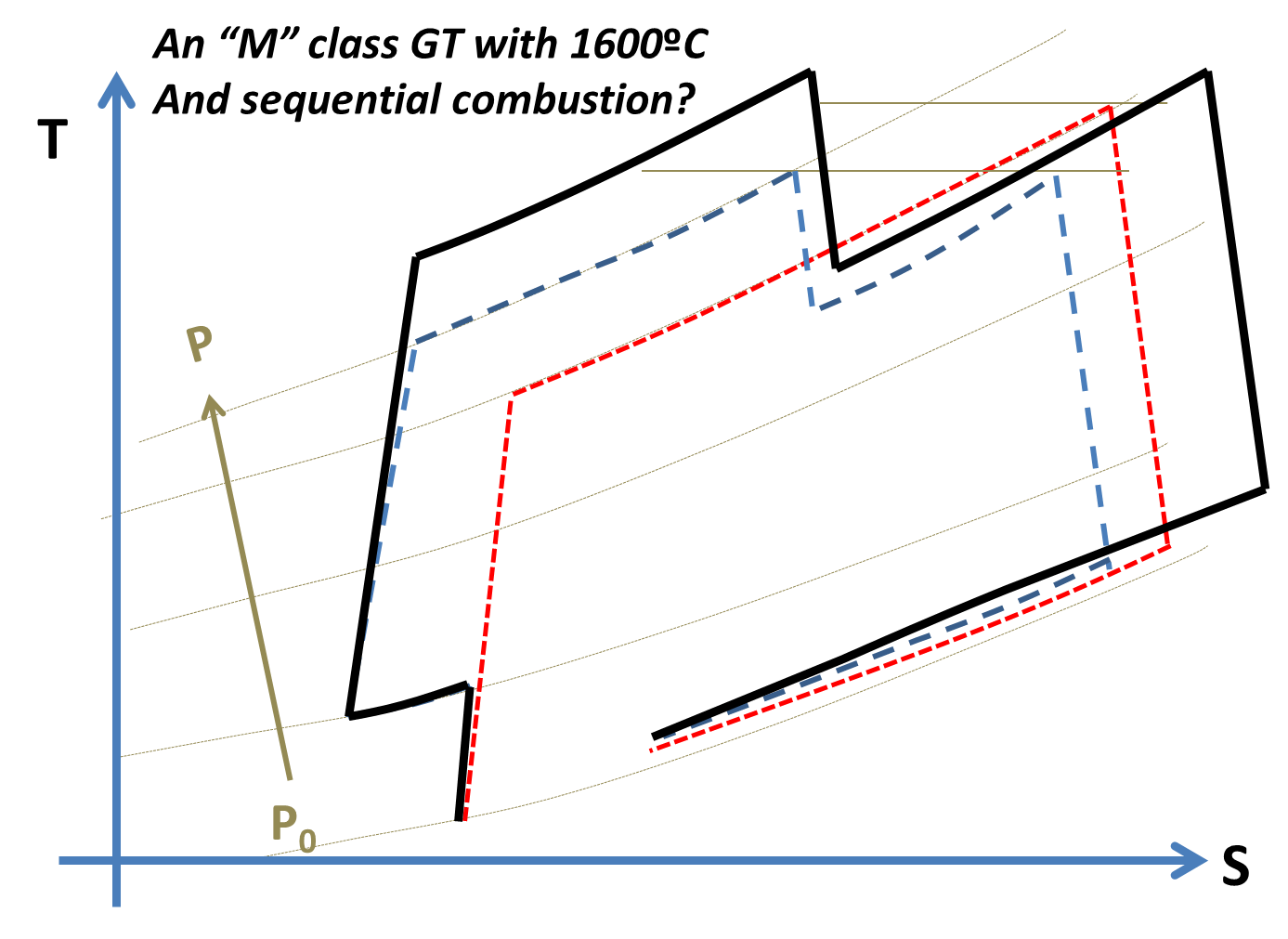
M Class GT?
It can be argued therefore that the acquisition is what may actually keep R & D alive instead of it coming to a stop in the cul-de-sac in which it is stuck with Alstom.
And without R & D and high temperatures and new competitive “J” class products, Alstom’s days as a cutting-edge HDGT supplier would have been limited anyway.
5. The older GE machines are still serviced by GE licencees and former licencees around the world – including in this case by Alstom (for GE machines prior to 1999). This Alstom does by means of a special subsidiary set up for the purpose. This unit – Power Systems Manufacturing – specialises in formerly licenced GE machines and also acts as a “pirate” for Siemens and Mitsubishi machines.
PSM’s product line includes … parts for GE Frame 6B, 7E/EA, 9E and 7FA machines, the Siemens/Westinghouse 501F (SGT6-5000F) engine and the Mitsubishi 501F engine.
Siemens also has such a subsidiary unit – Turbo Care – to service – where they can – the machines of competitors. This used to be a separate Siemens entity but has now been approved by the EC as a JV with the Wood Group. The “pirate” service business is important to each manufacturer – for intelligence and competition purposes – but the volume is quite small. No customer would select a “pirate” rather than the OEM, except for older machines past their prime or perhaps to teach the OEM “a lesson”. The “pirate” business is just not possible on relatively new machines and really only applies to machines installed more than about 10 years previously – when all liabilities and potential liabilities of the OEM have fallen away. No GT owner would take the risk of resorting to a “pirate” for a relatively new machine. A customer would usually resort to “pirates” only when all investment costs have been fully written off and he is no longer looking for – or particularly needs – any performance or availability guarantees. Even design and manufacturing warranties to be provided are strictly limited since the “pirate” has to rely on reverse engineering. “Pirates” only come into the picture when the perceived risk levels are low.
The EC concern that if PSM is merged into GE, that some competition for the older GE machines will disappear is not correct I think, because for these older machines the competition for service business is far more with other “pirates” than with the OEM. And there are plenty of “pirates” around.
In the long run I judge that this acquisition is good for the customer, may even be good for R & D and even good for Siemens (and also for Mitsubishi). I imagine that any objections from Siemens are more for the sake of form (and because there is no love lost between Patrick Kron and Siemens).
In any event, I expect that the deal will go through, but I will not be surprised to see an approval conditional on some assurances from GE regarding R & D centres, R & D jobs and/or R & D budgets in Europe. I think it highly unlikely – and a little meaningless – if the EC were to ask for divestment of Alstom’s HDGT business to a third party (if any such exists). The bottom line is, I think, that Alstom’s HDGT technology has come to a dead-end and can not be developed any further in their own hands. While the business can continue in a diminishing way for some years, Alstom technology has no long-term value except to another party which has access to high temperature cooling technology. To have Alstom continue with the HDGT business as an unwilling and reluctant player does no one any service at all.






 The k2p blog