Confirmed: Antarctic has been gaining ice mass (even while fossil fuel use has been increasing)

November 1, 2015

One again, very clear evidence that the IPCC reports are mere advocacy for lobby groups. They are not scientific reports.

A new study by NASA confirms their finding of 2012 that the Antarctic is gaining in ice mass. The paper is published in the Journal of Glaciology.

Zwally, H. Jay, ; Li, Jun; Robbins, John W.; Saba, Jack L.; Yi, Donghui; Brenner, Anita C. Mass gains of the Antarctic ice sheet exceed losses. Journal of Glaciology, 2015 DOI: 10.3189/2015JoG15J071

Antarctic ice accumulation not only provides no evidence of any global warming, it is also direct evidence that the global warming hypothesis itself is flawed. This ice accumulation has been taking place while carbon dioxide concentration in the atmosphere has been increasing. Leaving aside how much of this increase may be due to human use of fossil fuel, the ice accumulation shows that carbon dioxide concentration is not a significant factor.

As the French mathematicians recently charged:

no sensible, high-quality journal would publish the IPPC‘s work. The IPPC‘s conclusions go against observed facts; the figures used are deliberately chosen to support its conclusions (with no regard for the most basic scientific honesty), and the natural variability of phenomena is passed over without comment. The IPPC‘s report fails to respect the fundamental rules of scientific research and could not be published in any review with a reading panel.

The new NASA paper shows that in recent times the Antarctic gains about 200 billion tons of ice a year while losing about 65 billion tons. Which also means that the Antarctic is responsible for about 135 million tons of water leaving the water cycle and being locked up as ice. This water can only come from the moisture concentration in the atmosphere (including clouds) or from the sea. There is no measurable change in the moisture in the atmosphere and that leaves the seas.

Rather than Antarctic melting causing sea level rise, Antarctic ice accumulation is most likely reducing the rate of sea level rise due to the recovery from the last glacial.

Of course the global warming orthodoxy will now tell us with impressive modelling results, that ice increasing at the Antarctic is perfectly consistent with the warming of the planet.

Go pull the other one.

This and the 2012 paper are in direct contradiction to the IPCC’s 2013 report which claimed that the Antarctic was losing ice. But as the French mathematicians noted the IPCC reports would not meet the normal publishing standards for scientific reports.

I don’t suppose anybody will take any notice of this during the Paris wealth transfer discussions. When will any politician or government have the courage to challenge the religious orthodoxy?

Abstract:

Mass changes of the Antarctic ice sheet impact sea-level rise as climate changes, but recent rates have been uncertain. Ice, Cloud and land Elevation Satellite (ICESat) data (2003–08) show mass gains from snow accumulation exceeded discharge losses by 82 ± 25 Gt a–1, reducing global sea-level rise by 0.23 mm a–1. European Remote-sensing Satellite (ERS) data (1992–2001) give a similar gain of 112 ± 61 Gt a–1. Gains of 136 Gt a–1 in East Antarctica (EA) and 72 Gt a–1 in four drainage systems (WA2) in West Antarctic (WA) exceed losses of 97 Gt a–1 from three coastal drainage systems (WA1) and 29 Gt a–1 from the Antarctic Peninsula (AP). EA dynamic thickening of 147 Gt a–1 is a continuing response to increased accumulation (>50%) since the early Holocene. Recent accumulation loss of 11 Gt a–1 in EA indicates thickening is not from contemporaneous snowfall increases. Similarly, the WA2 gain is mainly (60 Gt a–1) dynamic thickening. In WA1 and the AP, increased losses of 66 ± 16 Gt a–1 from increased dynamic thinning from accelerating glaciers are 50% offset by greater WA snowfall. The decadal increase in dynamic thinning in WA1 and the AP is approximately one-third of the long-term dynamic thickening in EA and WA2, which should buffer additional dynamic thinning for decades.

This map shows the rates of mass changes from ICESat 2003-2008 over Antarctica. Sums are for all of Antarctica: East Antarctica (EA, 2-17); interior West Antarctica (WA2, 1, 18, 19, and 23); coastal West Antarctica (WA1, 20-21); and the Antarctic Peninsula (24-27). Credit: Jay Zwally/ Journal of Glaciology

This map shows the rates of mass changes from ICESat 2003-2008 over Antarctica. Sums are for all of Antarctica: East Antarctica (EA, 2-17); interior West Antarctica (WA2, 1, 18, 19, and 23); coastal West Antarctica (WA1, 20-21); and the Antarctic Peninsula (24-27).
Credit: Jay Zwally/ Journal of Glaciology

Science Daily reports:

A new NASA study says that an increase in Antarctic snow accumulation that began 10,000 years ago is currently adding enough ice to the continent to outweigh the increased losses from its thinning glaciers.

The research challenges the conclusions of other studies, including the Intergovernmental Panel on Climate Change’s (IPCC) 2013 report, which says that Antarctica is overall losing land ice.

According to the new analysis of satellite data, the Antarctic ice sheet showed a net gain of 112 billion tons of ice a year from 1992 to 2001. That net gain slowed to 82 billion tons of ice per year between 2003 and 2008.

“We’re essentially in agreement with other studies that show an increase in ice discharge in the Antarctic Peninsula and the Thwaites and Pine Island region of West Antarctica,” said Jay Zwally, a glaciologist with NASA Goddard Space Flight Center in Greenbelt, Maryland, and lead author of the study, which was published on Oct. 30 in the Journal of Glaciology. “Our main disagreement is for East Antarctica and the interior of West Antarctica — there, we see an ice gain that exceeds the losses in the other areas.” Zwally added that his team “measured small height changes over large areas, as well as the large changes observed over smaller areas.” 

Scientists calculate how much the ice sheet is growing or shrinking from the changes in surface height that are measured by the satellite altimeters. In locations where the amount of new snowfall accumulating on an ice sheet is not equal to the ice flow downward and outward to the ocean, the surface height changes and the ice-sheet mass grows or shrinks.

But still the authors find it necessary to bow down to orthodoxy. That’s probably necessary to get published and to avoid being labelled climate heretics. “It might only take a few decades for Antarctica’s growth to reverse”. Right, and then again it might not.

But it might only take a few decades for Antarctica’s growth to reverse, according to Zwally. “If the losses of the Antarctic Peninsula and parts of West Antarctica continue to increase at the same rate they’ve been increasing for the last two decades, the losses will catch up with the long-term gain in East Antarctica in 20 or 30 years — I don’t think there will be enough snowfall increase to offset these losses.”

In any event, reducing carbon dioxide emissions by cutting the use of fossil  fuels is of no significance to Antarctic ice accumulation – and therefore, of no significance either to any global warming that may be occurring.

Go Norrköping! Crunch day today for IFK

October 31, 2015

It is the last day of the 2015 football season in Sweden.

It could be IFK Norrköping’s day and my local team could win the Allsvenskan title again after a gap of 26 years. It has been 30 years since I watched my first home match at Norrköping and I have been supporting them – off and on, and sometimes from very far away – ever since then.

IFK

  1. They are playing Malmö away and need a win to be absolutely sure of winning the title.
  2. If Norrköping draw, then they need second placed Göteborg to draw or lose at home to Kalmar.
  3. If Norrköping lose then they need that Göteborg also lose. A draw  would then be enough for Göteborg to snatch the title on goal difference.
  4. If both Norrköping and Göteborg lose today, third placed AIK has a theoretical – buit infinitesimal – chance of winning the title. If they win against Örebro away today, they still need a sufficiently large goal difference, large enough to overcome the 5 goal difference they are behind before todays matches.

IFK Norrköping have so far scored more goals than any other team (58). But Göteborg have let in fewer goals – by a large margin – than any other team (20). The simple conclusion would be that Norrköping have had the most successful attack and Göteborg the most successful defence this season.

For the good of attacking football, Norrköping ought to win.

IFK table

Go Norrköping.


UPDATE! Norrköping won 2-0, Göteborg drew and Norrköping are the champions.


If space is not empty, what is? The ultimate void?

October 30, 2015

As I grew up, the concept of “space” was of an area devoid of matter (and we had not heard about “dark matter” then). The science fiction I was addicted to usually used terms such as the vacuum of space, or the cold emptiness of space or the void of space. But the concept was of physical space with our conventional, and comfortable,  3-dimensions. Space was always something things could move into. The known laws of physics applied there, if there was something there to be applied to. It was to be the exciting, new frontier for the expansion of human thoughts and in due course of humans and the human spirit.

Somewhere along the way, the insight developed that being devoid of matter did not mean being devoid of properties. I think it must have been in my pre-thermodynamics days, that it occurred to me that the lack of matter must still leave the space with dimensions. Distance must still be measurable across the empty space. Gravity must, logically, still apply between masses on either side of empty space and therefore the space must also have the ability to propagate the force across it. Presumably it also had the ability to allow light to traverse it. Then, as I first encountered thermodynamics, I began to think of temperature as the energy level of vibrating atoms and molecules and realised that the coldness of space was meaningless in the absence of any particles. I grappled with the concept of absolute zero on the temperature scale and came to the conclusion that without matter first existing, temperature was an undefined property. Cold space was just plain wrong if temperature was not defined.

Then along came my awareness of Einstein and his space-time (which he himself compared with the aether). There was no longer anything which could be called empty space. The universe was, without any doubt, expanding. But then I had to grapple with whether the universe was expanding into a space (or space-time) already extant, or which created its own space as it went along its merry, expansive way. That still left the question: What was there before the universe expanded into the new when-and-where of the space-time it was creating? The expanding universe is itself mind-blowing, since it applies to galaxies but not apparently to our bodies, or even to bodies within the solar system. That led me to wonder about the nature of the expansion of the universe itself. It is observed (inferred) by astronomers and physicists, but only from within the universe. Would an observer external to the universe, if such an observer could exist, also observe that the universe was expanding? Of course, that leads to the question of the nature of the space to be occupied by such an external observer, and the properties which that space or space-time or space-time-magic continuum might have? Or was the universe, by definition, such that nothing – and no thing – could be external to it? What would expansion in our space-time mean to an observer who transcended our dimensions? Could a fish in its pond conceive of the empty space beyond the water surface?

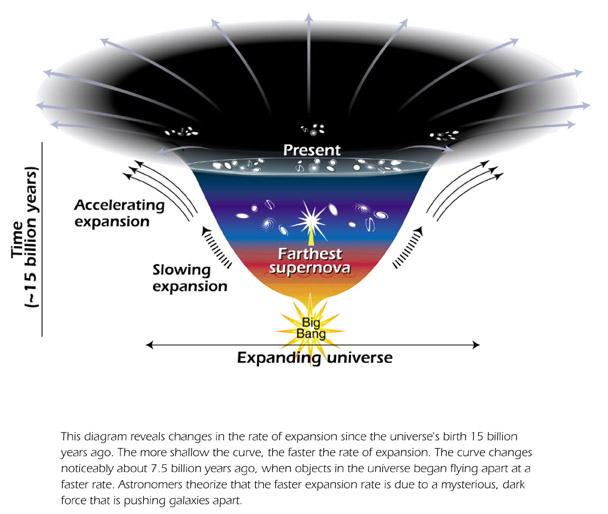
Expanding Universe - hubblesite.org

Expanding Universe – hubblesite.org

Now the expansion of the universe is not proceeding as it should with the known forces and energy-levels that exist. The expansion of the Universe is apparently accelerating. It is not slowing due to gravity as it should. Therefore dark matter and dark energy must exist. To fit the theories, the universe is apparently made up of 68% dark energy, 27% dark matter and just 5% of normal matter that we can observe. But this only leads to more questions. If 95% of the known universe is of unknown, magical stuff, then how representative of anything is what we infer from the 5% we can observe?

It is easy to draw a picture of an expanding universe on a piece of paper. But note that the “space” on the paper outside the universe is not labelled. It is just “empty space” and merely the backdrop for the diagram. The moment we imbue space or space-time with any properties, we inevitably define also the conception of the non-existence of those properties. And I still have difficulty getting my head around this M-space (magic space) which is truly empty and which is devoid of all matter and all possible properties, attributes or characteristics. M-space then must be the ultimate void, the magical non-thing, which is the backdrop for the universe.

But my real problem is that I cannot even conceive of M-space without giving it some property – even if only the property of having no properties or that it is not of this universe. Which only leaves Magic as the backdrop for everything.

Birth and the 116 other things which increase cancer risk

October 29, 2015

The good old WHO.

I suppose they do do some good, but they also make some horrible blunders as with the UN introduced cholera epidemic in Haiti, or with the initial downplaying of the Ebola outbreak in some African countries, or when their panel members take money from vaccine manufacturers to recommend mass flu vaccination programs. As with all UN organisations the staff are a mixture of professionals, surrounded by bureaucrats with political agendas from their home countries, and with some members from partisan lobby groups who promote their own causes and self-interests. WHO panels which recommend certain drugs or mass vaccination programs always seem to contain members with commercial ties to the pharmaceutical industry. Many in the WHO justify their alarmist tactics as a means to stimulate or trigger actions and – inevitably – many of these actions are totally unnecessary (but they are often very lucrative for some members of the WHO and their sponsors).

Now the WHO are going after processed and even red meat as causing cancer. But they have had to torture their data to calculate the risk. They forget that living is risk. Not being born, however, carries no risk of dying of anything. Therefore, the risk of cancer due to being born is far, far greater than that introduced by any other parameter or substance.  I won’t be changing my meat eating habits just yet.

Their list of 116 other things – besides birth – that increase the risk of cancer are taken from the Daily Mail.

1. Tobacco smoking

2. Sunlamps and sunbeds

3. Aluminium production

4. Arsenic in drinking water

5. Auramine production

6. Boot and shoe manufacture and repair

7. Chimney sweeping

8. Coal gasification

9. Coal tar distillation

10. Coke (fuel) production

11. Furniture and cabinet making

12. Haematite mining (underground) with exposure to radon

13. Secondhand smoke

14. Iron and steel founding

15. Isopropanol manufacture (strong-acid process)

16. Magenta dye manufacturing

17. Occupational exposure as a painter

18. Paving and roofing with coal-tar pitch

19. Rubber industry

20. Occupational exposure of strong inorganic acid mists containing sulphuric acid

21. Naturally occurring mixtures of aflatoxins (produced by funghi)

22. Alcoholic beverages

23. Areca nut – often chewed with betel leaf

24. Betel quid without tobacco

25. Betel quid with tobacco

26. Coal tar pitches

27. Coal tars

28. Indoor emissions from household combustion of coal

29. Diesel exhaust

30. Mineral oils, untreated and mildly treated

31. Phenacetin, a pain and fever reducing drug

32. Plants containing aristolochic acid (used in Chinese herbal medicine)

33. Polychlorinated biphenyls (PCBs) – widely used in electrical equipment in the past, banned in many countries in the 1970s

34. Chinese-style salted fish

35. Shale oils

36. Soots

37. Smokeless tobacco products

38. Wood dust

39. Processed meat

40. Acetaldehyde

41. 4-Aminobiphenyl

42. Aristolochic acids and plants containing them

43. Asbestos

44. Arsenic and arsenic compounds

45. Azathioprine

46. Benzene

47. Benzidine

48. Benzo[a]pyrene

49. Beryllium and beryllium compounds

50. Chlornapazine (N,N-Bis(2-chloroethyl)-2-naphthylamine)

51. Bis(chloromethyl)ether

52. Chloromethyl methyl ether

53. 1,3-Butadiene

54. 1,4-Butanediol dimethanesulfonate (Busulphan, Myleran)

55. Cadmium and cadmium compounds

56. Chlorambucil

57. Methyl-CCNU (1-(2-Chloroethyl)-3-(4-methylcyclohexyl)-1-nitrosourea; Semustine)

58. Chromium(VI) compounds

 59. Ciclosporin

60. Contraceptives, hormonal, combined forms (those containing both oestrogen and a progestogen)

61. Contraceptives, oral, sequential forms of hormonal contraception (a period of oestrogen-only followed by a period of both oestrogen and a progestogen)

62. Cyclophosphamide

63. Diethylstilboestrol

64. Dyes metabolized to benzidine

65. Epstein-Barr virus

66. Oestrogens, nonsteroidal

67. Oestrogens, steroidal

68. Oestrogen therapy, postmenopausal

69. Ethanol in alcoholic beverages

70. Erionite

71. Ethylene oxide

72. Etoposide alone and in combination with cisplatin and bleomycin

73. Formaldehyde

74. Gallium arsenide

75. Helicobacter pylori (infection with)

76. Hepatitis B virus (chronic infection with)

77. Hepatitis C virus (chronic infection with)

78. Herbal remedies containing plant species of the genus Aristolochia

79. Human immunodeficiency virus type 1 (infection with)

80. Human papillomavirus type 16, 18, 31, 33, 35, 39, 45, 51, 52, 56, 58, 59 and 66

81. Human T-cell lymphotropic virus type-I

82. Melphalan

83. Methoxsalen (8-Methoxypsoralen) plus ultraviolet A-radiation

84. 4,4′-methylene-bis(2-chloroaniline) (MOCA)

85. MOPP and other combined chemotherapy including alkylating agents

86. Mustard gas (sulphur mustard)

87. 2-Naphthylamine

88. Neutron radiation

89. Nickel compounds

90. 4-(N-Nitrosomethylamino)-1-(3-pyridyl)-1-butanone (NNK)

91. N-Nitrosonornicotine (NNN)

92. Opisthorchis viverrini (infection with)

93. Outdoor air pollution

94. Particulate matter in outdoor air pollution

95. Phosphorus-32, as phosphate

96. Plutonium-239 and its decay products (may contain plutonium-240 and other isotopes), as aerosols

97. Radioiodines, short-lived isotopes, including iodine-131, from atomic reactor accidents and nuclear weapons detonation (exposure during childhood)

98. Radionuclides, α-particle-emitting, internally deposited

99. Radionuclides, β-particle-emitting, internally deposited

100. Radium-224 and its decay products

101. Radium-226 and its decay products

102. Radium-228 and its decay products

103. Radon-222 and its decay products

104. Schistosoma haematobium (infection with)

105. Silica, crystalline (inhaled in the form of quartz or cristobalite from occupational sources)

106. Solar radiation

107. Talc containing asbestiform fibres

108. Tamoxifen

109. 2,3,7,8-tetrachlorodibenzo-para-dioxin

110. Thiotepa (1,1′,1′-phosphinothioylidynetrisaziridine)

111. Thorium-232 and its decay products, administered intravenously as a colloidal dispersion of thorium-232 dioxide

112. Treosulfan

113. Ortho-toluidine

114. Vinyl chloride

115. Ultraviolet radiation

116. X-radiation and gamma radiation

From the Daily Mail.


Senility at the GOP: A pity and a shame

October 29, 2015

I only watched some extracts of last night’s “debate”.

It was badly organised (CNBC) and the moderators were not very good. (Couldn’t organise a p***up in a brewery). But even so they were better than a sorry bunch of “candidates”. There wasn’t much shock and awe here. For the Republicans, it was a pity and a shame. The sad part for the Republicans is that – based on the “debate” – one of this pitiful bunch is going to be their flag-bearer and their candidate for President.

There wasn’t much entertainment either. Trump’s clown make-up needs refreshing. Jeb Bush was convinced he was going to lose. Ben Carson said nothing of any import as usual – probably intentionally. Carly Fiorina demonstrated she was a one-debate woman. The establishment figures were the two sitting Senators, Rubio and Cruz, and maybe the GOP will back them as those most likely to stop a Trump or Carson bid. They were possibly the least worst of a pretty awful bunch.

Are these really the best that the Republicans can come up with?

The Grand Old Party is showing signs of senility.


Maybe immigration increases because of the anti-immigration parties

October 28, 2015

It is normally thought the rise in support for the Sweden Democrats (a right-wing, one-issue, anti-immigration party) is a consequence of high immigration rates.

I am not so sure about cause and effect here.

You can just as well argue that the increase of SD support causes a reaction such that the very thing they oppose is enhanced.

What is certainly true is that immigration has increased sharply ever since the SD came into parliament in 2010 with 20 seats. In 2014 they won 49 seats and became the 3rd largest party in parliament. They have been pushing their single-issue for the last 26 years but have only achieved the opposite of what they set out to do. Even in the UK the rise of UKIP coincides with an increase of immigration.

So, paradoxically, it may be that immigration increases because of the backlash reaction to the anti-immigrant parties themselves.

Sweden Democrat support and immigration numbers

Sweden Democrat support and immigration numbers

French Mathematical Society “Battle against global warming an absurd,costly and pointless crusade”

October 27, 2015

The French Society of Mathematical Calculation (Société de Calcul Mathématique SA) has released a white paper entitled

The battle against global warming: an absurd,costly and pointless crusade

French Mathematical Calculation Society White Paper

The crusade is absurd

There is not a single fact, figure or observation that leads us to conclude that the world‘s climate is in any way disturbed‘. It is variable, as it has always been, but rather less so now than during certain periods or geological eras. Modern methods are far from being able to accurately measure the planet‘s global temperature even today, so measurements made 50 or 100 years ago are even less reliable. Concentrations of CO2 vary, as they always have done; the figures that are being released are biased and dishonest. Rising sea levels are a normal phenomenon linked to upthrust buoyancy; they are nothing to do with so-called global warming. As for extreme weather events – they are no more frequent now than they have been in the past. We ourselves have processed the raw data on hurricanes. We are being told that ‗a temperature increase of more than 2ºC by comparison with the beginning of the industrial age would have dramatic consequences, and absolutely has to be prevented‘. When they hear this, people worry: hasn‘t there already been an increase of 1.9ºC? Actually, no: the figures for the period 1995-2015 show an upward trend of about 1ºC every hundred years! Of course, these figures, which contradict public policies, are never brought to public attention. 

…..

We are not in a position to question the composition of the IPPC, or its legitimacy and policy decisions, and we shall not do so. However, as mathematicians, we have every right to respond to the following question: if the IPPC‘s work were to be submitted for publication in a reputable scientific journal, would it be accepted? This decision is the task of a referee, in a procedure that is common practice in the sciences. The answer is very simple: no sensible, high-quality journal would publish the IPPC‘s work. The IPPC‘s conclusions go against observed facts; the figures used are deliberately chosen to support its conclusions (with no regard for the most basic scientific honesty), and the natural variability of phenomena is passed over without comment. The IPPC‘s report fails to respect the fundamental rules of scientific research and could not be published in any review with a reading panel.

Of course these mathematicians could not possibly be part of the great 97%.

The 97% reminds me of how we used to present “market share” when we were looking to increase the marketing budget. Whenever necessary we could always show that we had 100% market share for the machines we had sold, or that we had virtually zero market share of a market defined sufficiently wide. And any number in-between was a simple matter of defining the market.

Thus, 97% of those who believe in man-made global warming, believe in man-made global warming

Female Bishop of Gloucester wants to neuter God

October 27, 2015

Since God is made in the image that man (or woman) decides, I suppose it does not really matter.

But there is something quite delicious about the female Bishop of Gloucester wanting, not to make God female, but to neuter Him/She/It. Now if God did have a gender, He (and any Goddesses He might have) could be a little upset.

At least as a Him or a Her, 50% of the world could be in His or Her image. But as an It, there would be very few. I suppose all references by Jesus to his Father in the Bible could be easily edited to be about his genderless Parent.

The Independent:

The Church of England should stop using male pronouns when referring to God in order to counter the erroneous belief that the Almighty has a gender, the first female bishop to sit in the House of Lords has said.

The Bishop of Gloucester, the Rt Rev Rachel Treweek, the Church’s most senior clergywoman, was being introduced to the Upper House today as one of Parliament’s 26 Lords Spiritual. 

Speaking before the event, the bishop raised the issue of God’s gender, saying: “We’re told that God created human beings in God’s likeness… If I am made in the image of God, then God is not to be seen as male. God is God.”

Instead of using either “He” or “She” to describe God, Bishop Treweek said she  prefers simply to use the word “God”. 

Of course the Bishop of Gloucester was only trying to establish a modicum of feminist credentials, though she stopped short of claiming that gender was obsolete:

“If it means I believe that men and women were created by God as equal but different, then yes I’m a feminist. But if it means women wanting to be men – and sometimes that’s a slight feeling of being loud and domineering – then I would reject that.”

Hinduism took care of this by having available a half-male, half-female God, Ardhanarisvara.

Whenever the priests of some religion determine the nature of their God, it’s a little bit like a bunch of manufactured robots deciding, among themselves, that they were not man-made but woman-made. And it becomes really stupid (or intelligent depending upon your point of view) when robots who think they are man-made go to war against robots who think they are woman-made.

Hindus were eating beef for much longer than they haven’t been

October 26, 2015

For Hinduism, the cow is not an object of worship (it attracts no gods or goddesses) but it has become both a symbol (of what exactly?) and a taboo. In any urban environment, cows in India provide ready examples of how ill-fed and ill-nurtured they actually are. My grandmother was a strict – but quite normal – vegetarian (no fish, meat or eggs). Unlike the Jains she had no problem with dairy products or root vegetables or honey. I once tried to convince her that beef, coming from complete herbivores, was “more fundamentally vegetarian” than poultry, who were known to relish worms and insects when they were available. She was not amused. (She was not amused either by my arguments that whiskey was strictly vegetarian).

In the current political circus in India where all the ardent, self-styled Hindu fanatics (BJP, Shiv Sena, RSS, VHP ….) are castigating the eating of beef and all beef-eaters, they are attempting to rewrite a history which they conveniently forget. They have gone so far – and have fallen as low – as to justify the lynching of a Muslim for slaughtering and eating a cow.

Eating of beef only began to be discouraged when the Brahmins became significant land-owners and cattle-owners from about 500- 600 CE. The “general” ban on the killing of cows and the eating of beef by Hindus only goes back to about 1200 CE. Taking the roots of Hinduism as having first germinated at the time of the Indus-Saraswati Valley Civilisation, that would have been about 3,000 BCE (5,000 years ago). Which of course means that Hindus were eating beef for some 4,200 years while they have abstained from the practice for only about 800 years. As the practice of eating beef declined, cow-slaughter for religious sacrifice was increasingly restricted to very special and rare events. Inevitably the resulting beef was insufficient for all the multitude and so was reserved for just the most important Brahmins present. So the Brahmins were probably the last of the castes to give up the practice. Others couldn’t afford it anyway.

Holy Cow

Back in 2001, Professor D N Jha published “the best-kept secret in Indian history — the beef-eating habits of ancient Hindus, Buddhists and even early Jains” in his book Holy Cow—Beef in Indian Dietary Conditions. His scholarly work is probably the most definitive work ever on the subject. It is not available in India of course. A civil court in Hyderabad banned it. Some Government Ministers (BJP, who else) demanded ritualised book burnings. He was threatened and had to have police protection for a while. It was reprinted as the The Myth of the Holy Cow and can still be obtained – with some difficulty – outside India.

There were a few favourable reviews in 2001 and 2002 but generally his book was ignored by academia and kept hidden for fear of “hurting Hindu sensibilities” or of other reprisals. The Indian academic establishment is not known for its political bravery. Their views are incredibly supple and bend with whichever political wind is blowing strongest. Many of the reviews are still available on the internet but many from that time have been removed. Jha retired in 2007. Jha was a socialist and that has also been used as a stick to criticise his views on communalism and the BJP’s saffronisation program. But it seems to me that his arguments are generally correct on the subject of beef in Hindu history  As Outlook reported in 2002

“Old and tired out” Jha may call himself, but there’s something irrepressible about him. Bans and fatwas haven’t stopped him from beginning work on his next book. “It will be called,” says Jha with deadpan face, “Adulterous Gods and their Inebriated Women”.

A few quotes from his final chapter:

“Although Manu (200Bc – 200 AD) extols the virtue of ahimsa, he provides a list of creatures whose flesh was edible. He exempts the camel from being killed for food but does not grant this privilege to the cow.”

“The Mahabharata also makes a laudatory reference to the king Rantideva in whose kitchen, 2000 cows were butchered each day …. being distributed among the brahmanas.”

“Sita assures the Yamuna .. that she would worship the river with a 1000 cows and a hundred jars of wine when Rama accomplishes his vow.”

Reviews:

  1. The Hindu – Beef eating: strangulating history
  2. Outlook – A Brahmin’s Cow Tales
  3. The Guardian – One man’s beef …..

A few days ago the Wall Street Journal conducted an email interview with DN Jha.

The killing of an Indian Muslim man allegedly lynched last month by a Hindu mob who suspected him of having slaughtered and eaten a cow, has refocused attention on attitudes toward the animal in a constitutionally secular country with a Hindu majority.

Historian Dwijendra Narayan Jha, who has drawn fire from Hindu nationalists for writing that Hinduism hasn’t always regarded beef-eating as an offense, said the recent cow-related violence was part of a “dangerous trend of increasing intolerance  in the country.”

The former Delhi University professor, who is now retired, says he received death threats after the publication of a 2001 book about beef in Indians’ dietary traditions and based on ancient texts, “The Myth of the Holy Cow. 

In an email interview with The Wall Street Journal, Mr. Jha discussed the emergence of the cow as a sacred animal and the politics of meat among conservative Hindus.

Mr. Jha: It was only in the early Christian centuries, around the middle of the first millennium A.D., that the Brahminical texts began to discourage and even disapprove of cow slaughter.

This change of attitude can be understood against the general background of the transformation of the rural society in post -Mauryan centuries, especially from around the middle of the first millennium A.D., which ushered in a phase of unprecedented agrarian expansion.  Brahmins emerged as  a feudal land owning class and, unlike in the earlier period, became more and more involved in agriculture. This led to the recognition of the pivotal role of animal husbandry, and the disapproval of killing of cattle by the Brahmins. All this is encapsulated in the concept of kali age in which many age-old  practices came to be  forbidden.  

WSJ: Is eating cow meat incompatible with Hinduism today?

Mr. Jha: There is substantial evidence in ancient Indian texts which testify to the prevalence of the practice of beef eating for many centuries in ancient India. The practice gradually disappeared in those regions, which are now called the “cow belt.” But it has continued in many other parts of the country, especially Kerala and north eastern states. In Kerala, 72 communities eat beef and many of them are Hindus. So, I would not say that beef eating is incompatible with Hinduism. But, at the same time there are many Hindus who would not even touch beef or even meat or fish.

What may be unacceptable to one set of Hindus may be acceptable to another. …..

The discouragement of cow-slaughter and the eating of beef was essentially an economic necessity of the time and had little to do with religion then. It came in when the value of a living cow far exceeded the value of a dead one, and when the wealth of the Brahmins was counted in cows. What easier way of maintaining their wealth than by introducing a regulation beneficial to themselves and justifying it on the grounds of the religion that they were the custodians of?

Poland demonstrates that the EU is not one country – yet

October 26, 2015

Poland has moved quite decisively to the right and towards an anti-EU stance. It demonstrates once again that the dreams of a New Holy Roman Empire in the form a single European nation state are more than a little premature. A single state can only follow a levelisation of living standards and a natural homogenisation of fiscal and monetary policies. Brussels has to learn (and so do Hollande and Merkel) that a single EU state cannot be imposed by dictat or by fiscal and monetary coercion. The Euro has to be a consequence of levelisation. As a tool for levelisation, it is a very blunt and ineffective instrument.

Colours of the EU

Colours of the EU

BBC:

Poland’s conservative opposition Law and Justice party has won parliamentary elections. Exit polls suggest it has enough seats to govern alone, with an anticipated 39% of the vote.

Its eurosceptic leader Jaroslaw Kaczynski has claimed victory, and the outgoing Prime Minister, Ewa Kopacz of the centrist Civic Platform party, has admitted defeat.

Law and Justice has strong support in Poland’s rural areas. If the numbers suggested by the exit poll are confirmed, it will be the first time since democracy was restored in Poland in 1989 that a single party has won enough seats to govern alone, the BBC’s Adam Easton in Warsaw says.