Will the EC approve GE’s acquisition of Alstom’s power business?

May 3, 2015

UPDATE! 

Bloomberg: General Electric Co.’s Jeffrey Immelt is set to meet with the European Union’s antitrust chief Tuesday as the U.S. company seeks approval for its acquisition of Alstom SA’s energy business.

The session in Brussels between GE’s chief executive officer and Margrethe Vestager is part of regulators’ “ongoing merger review,” Lucia Caudet, a European Commission spokeswoman, said in an e-mail.


On February 23rd this year the European Commission announced that its preliminary investigation into the proposed acquisition of Alstom’s power businesses by GE had highlighted Heavy Duty Gas Turbines (HDGTs) as a potential area of concern. Therefore an in-depth investigation would be carried out. This investigation was due to have been completed by 8th July but has been extended – apparently at GE’s request – till August 6th.

The European Commission has opened an in-depth investigation to assess whether General Electric’s (GE) proposed acquisition of the Thermal Power, Renewable Power & Grid businesses of Alstom is in line with the EU Merger Regulation. The Commission’s preliminary investigation indicates potential competition concerns in the market for heavy-duty gas turbines which are mainly used in gas-fired power plants.

Since GE already has HDGTs  in direct competition with Alstom’s GT24 and GT26 engines and even with Alstom’s GT11N2 and GT13E2 engines, I expect that the Alstom range of machines will have to be discontinued. (It would be quite irrational for GE to continue to offer Alstom’s portfolio except for a very restricted time period or for some very particular application. It is not much appreciated by a buyer either when a supplier appears so confused as to offer different machines for the same purpose). The discontinuation of some engines is “no big deal”. But, as I have written previously, it would be a shame if the line of technology for HDGTs within Alstom – which carried forward the lines of technology emanating from BBC, GEC, Asea and ABB (including sequential combustion technology) – were to be entirely lost.

I would summarise the EC’s potential areas of concern as being:

  1. If the European HDGT market can be said to be distinct from the global market, then the number of HDGT suppliers would effectively reduce in Europe from three to two.
  2. Reduced competition in Europe could lead to supplier(s) having greater than 40% market share and could lead to an increase in prices.
  3. GE together with Alstom could have greater than 50% market share and not only in Europe.
  4. In Europe, fundamental R & D on combustion, emissions and materials and innovation regarding HDGTs would be hurt, and
  5. Competition in the HDGT service business would be impacted since Alstom currently is an alternate supplier of service to older GE HDGTs (since Alstom was a GE licencee prior to 1999).

The market for HDGTs is characterised by high technological and financial barriers to entry, leading to a concentrated market with only four globally active competitors: GE, Alstom, Siemens and Mitsubishi Hitachi Power Systems (MHPS). The fifth player, Ansaldo, appears to be a niche player with a more limited geographic reach. The margins in the market for HDGTs appear to be higher than those of neighbouring markets for power generation equipment such as steam turbines. 

The HDGTs market worldwide is divided into two frequency regions, namely those operating at 50 Hz and those at 60 Hz. All thecountries in the European Economic Area (EEA) operate at 50 Hz frequency.

Since MHPS seems to be less active in the EEA than in the rest of the world, the transaction would bring together the activities of two of the three main competitors in the EEA.The transaction would eliminate Alstom from the market, leaving European customers without an important competitor of GE and Siemens. Indeed, in the market for the sale of new 50 Hz frequency HDGTs, the merged entity would reach high market shares in the range of around 50 %, both in the EEA and at worldwide level excluding China.

Furthermore, the transaction might significantly reduce R&D and customer choice in the HDGT industry. After the merger there is a risk that GE would discontinue the production of certain Alstom HDGT models and that advanced HDGT technology developed by Alstom would not be brought to the market.

Finally, in the market for the servicing of General Electric’s mature technology HDGT frames, the transaction eliminates competition by Alstom’s subsidiary Power System Manufacturing.

Overall, the Commission is at this stage concerned that the transaction may lead to an increase in prices, a reduction in customer choice and a reduction of R&D in the HDGT industry, leading to less innovation.

I note that GE have taken on a very-high powered lawyer to help in dealing with anti-trust issues,

Sharis Pozen, a former acting assistant U.S. attorney general for antitrust who joined Skadden, Arps, Slate, Meagher & Flom in July 2012, left the firm this month to become vice president for global competition and antitrust at General Electric. Pozen is the latest high-profile Am Law 100 partner to join the in-house legal ranks of the Fairfield, Conn.-based conglomerate, which has tapped Skadden to advise on its pending $17 billion buy of the energy unit of French engineering giant Alstom.

However, my own opinion is that these potential EC concerns are not sufficient to disallow the proposed acquisition. I believe the market concerns are more theoretical than real.

1. While the EC tends to look at market share rather than market size, the EU market currently (before the advent of shale gas in Europe) is so small that it cannot be considered a market distinct from the global market. No HDGT manufacturer could survive on the strength of the European market alone. A simple test question is very revealing. Could Alstom’s HDGT business be sold as an independent stand-alone business to anybody else with only Europe as the designated market? The answer is a resounding NO and, I think, should eliminate any consideration of the European market as being distinct from the global market.

In fact, even with a global market available, the Alstom HDGT business is of little value to any manufacturer who does not already have high temperature cooling technology and who does not already have a heavy rotating machinery manufacturing background. And I don’t see any such parties around.

2. It should be remembered also that Mitsubishi (formerly MHI now Mitsubishi Hitachi Power Systems – MHPS) is absent from Europe as a matter of their own choice – not because they cannot. It is part of the remains of the old “unofficial” arrangement where the Japanese didn’t come into Europe and the Europeans didn’t enter Japan. This “arrangement” for steam turbines, gas turbines, boilers and generators held quite well through till the 1980s but broke down in the 1990s. Note that the Japanese gas turbine market had a special relationship with the US manufacturers with TEPCO providing GE with a protected “home” market for 60 Hz gas turbines. The Westinghouse relationship with MHI for gas turbines was effectively taken over by MHI. The Siemens equity engagement with Furukawa to create Fuji Electric (Fu- for Furukawa and Ji for Siemens in japanese, jiimensu) was ended after WW 2. The ABB (later Alstom) JV for gas turbines with Kawasaki which I headed for a time was only set up in the 1990s and was eventually discontinued.

To enter a new market for HDGTs, it must either be a growing market or it must have a large fleet of existing machines which can be served. Europe provides neither for MHPS at the present time. If shale gas takes off in Europe and the gas turbine market starts to grow (which I predict will happen), it will not take very long for MHPS to enter.  For MHPS the market size and growth for new equipment must be sufficient to justify the cost of setting up the necessary service network. There is no guarantee either that Alstom – without GE – could continue with a product range rapidly becoming uncompetitive against the “J” class machines, without access to high temperature cooling technology. The Ansaldo/Shanghai Electric tie-up is still in its infancy and – in the event of market growth in Europe – would surely become a significant 4th player. (Even a 5th global player could emerge as a consequence of a particularly strong market growth and my guess would be that it could be Doosan or BHEL, Harbin or from Russia). But as far as the EC is concerned, the key point should be that if the market grows there will be certainly three, probably four and eventually five players. And if the market does not grow then the objection is moot.

3. The risk of one player having 50% (or greater than 40%) market share is not to be trivialised but, in my opinion, is not a real threat. When the market (in Europe) has been as low as it has been and only one or two machines are sold in a year it is a quirk of arithmetic that one player may have a 100% market share in one year or that two may have 50% each. Customers are very well aware of the dangers of having only 2 suppliers. The fact is that if the market were large enough, MHPS and Ansaldo and others would be strongly encouraged to quote by the European buyers. We would probably then have a global market share split of GE/Alstom – 30%, Siemens – 30%, MHPS -20, other (Ansaldo, BHEL, Russians, new players ….) – 20%. When a market is small, market share is misleading and meaningless. In a strong market some of the manufacturers of small gas turbines would also try and follow their customers into larger sizes – a “Honda” strategy.

4. R & D is where I began my career and safeguarding innovation is rather special for me. There is a valid point regarding R&D and innovation and I think it would be perfectly justified for the EC to give approval conditional on some kind of assurance from GE that R &D centres (and possibly R & D jobs and budgets) in Europe would be maintained for some period of time. I don’t believe that innovation can be mandated, but I do see a potential benefit for GE – in time – in absorbing and – even adopting – some sequential combustion elements in their mid-range (rather than their largest) engines (see diagrams below). But that is a call for GE to take in about a decade from now. (It is probably just wishful thinking on my part).

Alstom (as BBC) developed the sequential combustion cycle in 1948 and (as ABB) the GT24 and GT26 engines in the 1990s, when GE moved beyond the “F” class machines to their “FA” machines. The choice was a forced one for ABB, and they had to follow the sequential combustion path because they did not have access to the high temperature blade cooling technology which was available to their competitors. All their attempts to acquire such technology from Russia failed. A technology agreement with Rolls Royce gave no technology ownership and had very strict limitations. Sequential combustion eventually converted a weakness into a virtue and allowed ABB (later Alstom) to maintain efficiency and compete with “G” class machines even though they were effectively limited to an “F” class inlet temperature as a maximum. If ABB had not developed the GT24 and the GT26 – in spite of all their early challenges – Alstom would not have acquired ABB’s power generation business after their GE licence was terminated. (In fact the challenges were so large that ABB had to compensate Alstom through the acquisition price for the power business for all the problems that had to be fixed by Alstom in the field).

Taking a very cynical view, ABB had reached the end of their road with GT development when they divested to Alstom. Alstom in their turn made devlopments that ABB could not but have also reached the end of their road for development of sequential combustion technology – again because of a lack of high temperature cooling technology – and wish now to divest to GE.

GT cycles - conventional and sequential combustion

GT cycles – conventional and sequential combustion

Now as GE, Siemens and Mitsubishi have moved on to even higher inlet temperatures, the “G” class has gone on to become the “J” class. (The “H” class was Mitsubishi attempting to use steam cooling for the turbine blades which didn’t really catch on and “I” has been passed over for the designation of turbine class). Alstom, with its limitations on temperature have successfully squeezed the sequential combustion technology to approach a “G+” performance with temperatures slightly lower than a “G” class from the others. But Alstom now also has reached its temperature limits and, I suspect, it was the lack of a way forward for their machines to compete with “J” class machines which has been part of their decision to get out of power generation.

But I like the concept of sequential combustion which is elegant and fundamentally sound and I look forward to the day when maybe it can be applied together with the high temperatures that GE knows how to handle. Then maybe we will someday see an “M” class gas turbine with 1600ºC and sequential combustion?
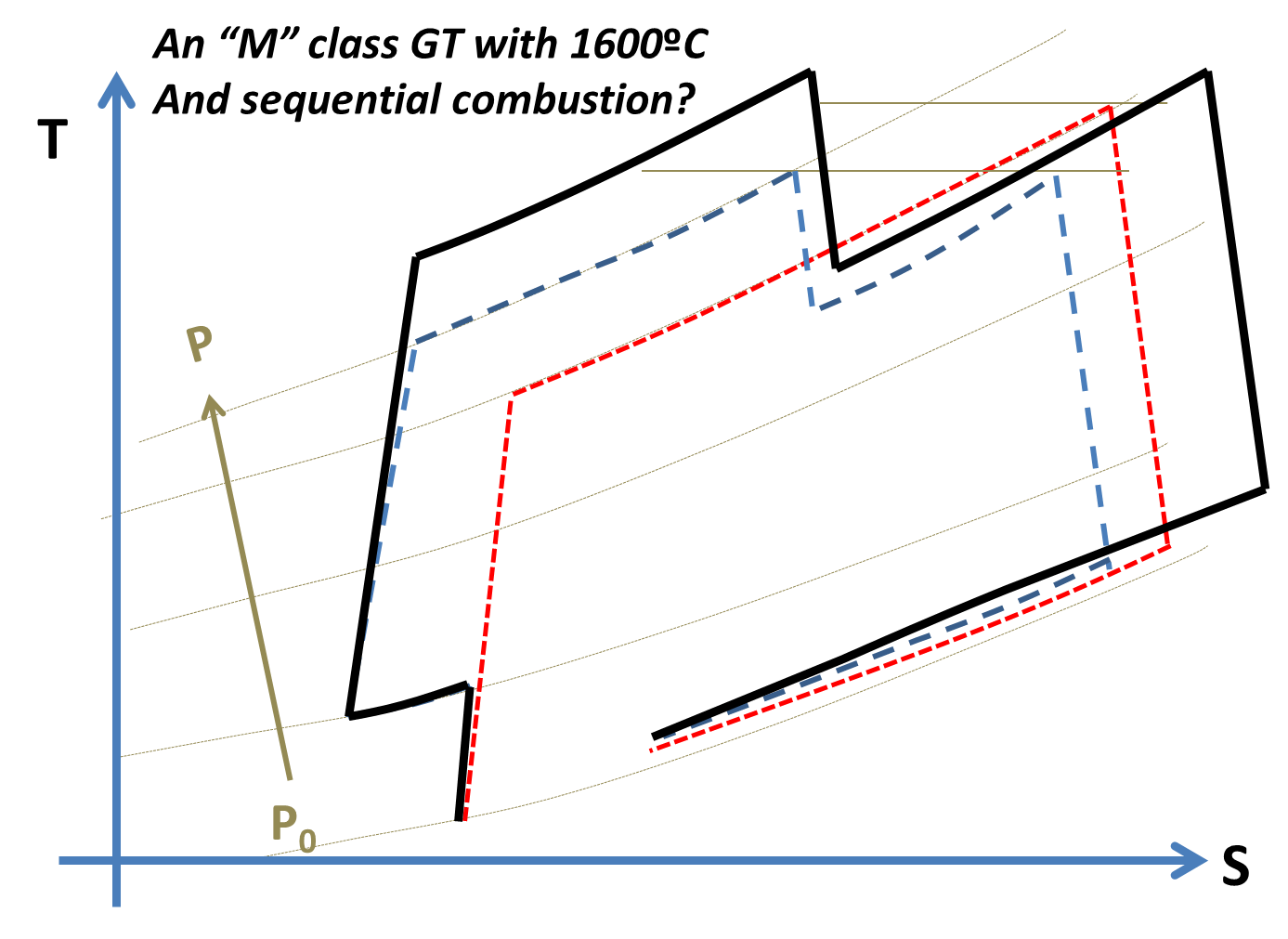
M Class GT?

M Class GT?

It can be argued therefore that the acquisition is what may actually keep R & D alive instead of it coming to a stop in the cul-de-sac in which it is stuck with Alstom.

And without R & D and high temperatures and new competitive “J” class products, Alstom’s days as a cutting-edge HDGT supplier would have been limited anyway.

5. The older GE machines  are still serviced by GE licencees and former licencees around the world – including in this case by Alstom (for GE machines prior to 1999). This Alstom does by means of a special subsidiary set up for the purpose. This unit – Power Systems Manufacturing – specialises in formerly licenced GE machines and also acts as a “pirate” for Siemens and Mitsubishi machines.

PSM’s product line includes … parts for GE Frame 6B, 7E/EA, 9E and 7FA machines, the Siemens/Westinghouse 501F (SGT6-5000F) engine and the Mitsubishi 501F engine.

Siemens also has such a subsidiary unit – Turbo Care – to service – where they can – the machines of competitors. This used to be a separate Siemens entity but has now been approved by the EC as a JV with the Wood Group. The “pirate” service business is important to each manufacturer – for intelligence and competition purposes – but the volume is quite small. No customer would select a “pirate” rather than the OEM, except for older machines past their prime or perhaps to teach the OEM “a lesson”. The “pirate” business is just not possible on relatively new machines and really only applies to machines installed more than about 10 years previously – when all liabilities and potential liabilities of the OEM have fallen away. No GT owner would take the risk of resorting to a “pirate” for a relatively new machine. A customer would usually resort to “pirates” only when all investment costs have been fully written off and he is no longer looking for – or particularly needs – any performance or availability guarantees. Even design and manufacturing warranties to be provided are strictly limited since the “pirate” has to rely on reverse engineering.  “Pirates” only come into the picture when the perceived risk levels are low.

The EC concern that if PSM is merged into GE, that some competition for the older GE machines will disappear is not correct I think, because for these older machines the competition for service business is far more with other “pirates” than with the OEM. And there are plenty of “pirates” around.

In the long run I judge that this acquisition is good for the customer, may even be good for R & D and even good for Siemens (and also for Mitsubishi). I imagine that any objections from Siemens are more for the sake of form (and because there is no love lost between Patrick Kron and Siemens).

In any event,  I expect that the deal will go through, but I will not be surprised to see an approval conditional on some assurances from GE regarding R & D centres, R & D jobs and/or R & D budgets in Europe. I think it highly unlikely – and a little meaningless – if the EC were to ask for divestment of Alstom’s HDGT business to a third party (if any such exists). The bottom line is, I think, that Alstom’s HDGT technology has come to a dead-end and can not be developed any further in their own hands. While the business can continue in a diminishing way for some years, Alstom technology has no long-term value except to another party which has access to high temperature cooling technology. To have Alstom continue with the HDGT business as an unwilling and reluctant player does no one any service at all.

Iceland revokes law allowing Basques to be killed on sight

May 2, 2015

In autumn 1615, Ari Magnússon, Sheriff of  Ögur, decided at a meeting in Súðavík  that it was free for Icelanders to kill Basque sailors. It resulted in a bloodbath and 32 Basques were killed. Now 400 years later, this provision is formally being revoked.

Basques can now visit Iceland freely without any fear of being lynched on the streets.

Islandsbloggen has the story:

It has been called Iceland’s only mass murder. But after 400 years Basques and Icelanders will now conclude a symbolic peace. At the same time, a small monument will be raised in Hólmavík to honor the memory of the 32 Basque sailors who were killed in autumn 1615 under the leadership of Ari Magnússon, Sheriff of Ögur. Relatives as well as the Minister of Culture Illugi Gunnarsson will attend the ceremony.

As whaling became increasingly important – both for oil and for meat –  Basque whalers journeyed far from home to chase their prey. Their travels took them, among other places, to Newfoundland on the east coast of Canada and to Svalbard.

In early 1600 Basque whalers found themselves  in Iceland and the Westfjords. However, it was not to become a long-standing tradition. In Autumn 1615, 86 whalers were ready to return home with huge catches loaded aboard three ships. But a sudden storm in Reykjarfjörður in Strandirregionen crushed all their boats. Three sailors died in the storm.

Using a smaller boat they rounded the Hornstrandir to search for ships that could sail home together with their catches. At Dynjandi in Jökulfjörður they stole a bigger boat and captured the former crew.

The news spread like wildfire in the region. Not so very long before, in 1579, pirates had attacked the farm at Rauðisandur in the West Fjords. The attack had led Judge Magnús Jónsson to require all adult Icelanders in the region to bear arms.

He was probably reminded of this fear of the earlier pirates when Ari Magnússon, Sheriff of Ögur, at a meeting in Súðavík decided that it was free to kill the Basque sailors. The Sheriff was in fact a relative of one of the earlier victims, Eggert Hannesson whose home had been looted.

The Basques had made camp at Sandeyri on Snæfjallaströnd. As they were busy with their catches Ari Magnússon went on the attack attack. In all 18 people were killed at Sandeyri and on the island Æðey. The other Basques were killed in Dýrafjörður where they had broken into the Danish trading house in Þingeyri.

In reality, it was a bloodbath. Fifty of the shipwrecked Basques managed to escape to Patreksfjörður. When spring’s first English ship arrived in the fjord, the Basques seized it – and never returned more to Iceland.

File:Painting of Ari Magnusson and his wife.jpg

District Commissioner Ari Magnusson of Ögur and his wife Kristín Guðbrandsdóttir


The memory of those Basques was commemorated at a ceremony in Hólmavík on April 22nd. A memorial stone with a plaque unveiled in honor of the victims is located outside the Witchcraft Museum. Relatives of both perpetrators and victims were at the ceremony. A ‘symbolic reconcillation’ was acted out by Xabier Irujo, descendant of one of the murdered Basque whale hunters, and Magnús Rafnsson, descendant of one of the murderers.

An account of the events is available here: Spánverjavígin – Slaying of the Spaniards

Hypocrisy files: Leonardo DiCaprio

May 2, 2015

I am always amazed at how the hypocrisy of the rich, the famous, the politically correct and all those who believe they can dictate how others behave is glossed over. I used to think that being “two-faced” or “speaking with a forked tongue” was about as low as it was possible to get. But I hadn’t realised then that being a hypocrite was a fundamental human right.

“Do as I say (not as I do)”. “I know better what is best for you”. “It is for your own good”. “It’s for the common good”. “It’s what the majority wants”.

Di Caprio, he of the “Titanic”, is a high-school dropout but fancies himself as an environmental activist. He gets invited by fawning “groupies” to give evidence to the UN on environmental matters.

BUT

Showbiz411:

Leonardo DiCaprio with his friends and family used the private Sony jet to fly back and forth Los Angeles to New York last year as if it were a yellow taxi.

Amy Pascal approved hundreds of thousands of dollars to ferry Leo, his mother, his manager, his manager’s brother, and Leo’s posse pals in and out of New York. They left a carbon footprint the size of Godzilla’s left foot.

Leo also got the Sony jet to fly from Las Vegas to Los Angeles for $12,000. The flight lasts 1 hour. (Actually $26,000 round trip.)

The irony is that Leo does not make movies for Sony Pictures. His films have almost all been with Warner Bros., Paramount, and Miramax/Weinstein. His current film, “The Revenant,” is with Fox. Sony wanted him to play Steve Jobs in a film that never came to be. Michael Fassbender is playing Jobs at Universal.

The other irony is that DiCaprio waxes on and on about the environment. His whole gang could have gotten on a JetBlue flight for considerably less. And they would have had TV and extra legroom.

Sony emails regarding billing approvals for different trips in amounts including $59,000; $37,206; and $63,600. The trips include catering and ground transportation.

Ban Ki-moon and the UN lose it as they try to hide sexual exploitation of children by UN troops

May 1, 2015

I find Ban Ki-moon embarrassing as the Secretary General of the UN. More often than not, I find his pronouncements generally lacking any indication of personal moral fibre. He parrots the prepared statements of his aides and advisors and his own values are invisible. Certainly the UN, and this Secretary General in particular, have little moral authority left. I find him an even sorrier figure than Kurt Waldheim – and Waldheim with his tacit support of Idi Amin’s applause for the Munich massacre – still leaves a bitter taste. In a sense, what else can we expect? The UN is not an organisation for the dissemination of best practices. Just like in the EU, it is the worst behaviour of a member state which becomes the common standard. The best of the UN, like that of the EU, can only be as good as that of its worst member state. When all UN personnel enjoy immunity from any liability for incompetence, gross negligence and even criminal acts, it is hardly surprising that the “bad apples” get away with it. Not everybody who serves on UN missions is a “bad apple” but there is no shortage of such people. Personnel on UN missions – be they scientists or doctors or peace-keeping troops or administrators – have no incentive from the UN to act responsibly. Nobody will be held accountable for introducing cholera to Haiti just as Dutch troops will not have to face any liability for the massacres in Srebrenica (and a Dutch court refused to act against the Dutch general just a few days ago).

And in the case of the sexual exploitation of children by French soldiers (and soldiers from Chad) in the Central African Republic, there will be many fine speeches from the UN and from the French government, but nobody will be held responsible or brought to account. But in this case where the abuse was known in July 2014 and covered up by the UN, the UN is throwing the book at the whistle-blower. Anders Kompass leaked the internal report on sexual abuses by French troops to French prosecutors. But Ban Ki-moon is talking about the procedural crimes of the Swedish whistle-blower rather than why the UN has kept this hidden for so long. Even the French PM has made a fine speech about pursuing wrong-doers but he has done nothing about this case which the French first knew about 9 months ago.

Expressen:

The Swedish Foreign Ministry’s legal chief Anders Rönquist and Swedish Ambassador Olof Skoog have both defended the whistle-blower Anders Kompass. 
But now the UN Secretary General has come out criticizing the Swede who leaked the report on sexual abuse. “Our preliminary assessment is that the behavior is not the same as whistle-blowing”, says Ban Ki-moon’s spokesperson.
Anders Kompass is still employed at the United Nations in Geneva, Switzerland on the OHCHR, Office of the UN High Commissioner for Human Rights. But he will be absent from his job till 31st July.

Presumably he has been suspended by the UN. His suspension is with the knowledge – if not at the instigation – of the UN  high commissioner for human rights, Zeid Ra’ad al-Hussein.

The Guardian:

The United Nations is guilty of “reckless disregard for serious allegations of wrongdoing” in its treatment of a whistleblower who disclosed details of alleged child abuse by French peacekeepers in Africa, according to a former staff member.

James Wasserstrom, a veteran US diplomat who was sacked and arrested by UN police when he exposed suspicions of corruption by senior officials in Kosovo, said the case of Anders Kompass revealed how the organisation turned on the whistleblower rather than dealing with the wrongdoing he had revealed.

Kompass, director of field operations at the office of the high commissioner for human rights in Geneva, has been suspended for passing to prosecutors in Paris an unredacted internal UN report detailing allegations of the sexual exploitation of boys in the Central African Republic by French peacekeepers.

When the Guardian revealed details of the allegations this week, the French authorities admitted publicly for the first time that they had begun an investigation after receiving the report last July. It details accounts from children as young as eight and nine of serious sexual abuse at a centre for internally displaced people in the capital Bangui.

At the time, the French troops stationed there were part of their country’s peacekeeping mission run independently of the new UN operation Minusca. The UN had commissioned the report following claims on the grounds of sexual misconduct. It was completed in June last year but not passed on until Kompass leaked it directly to the French.

On Thursday, the French president, François Hollande, vowed to pursue the allegations vigorously. “If some soldiers have behaved badly, I will show no mercy,” he said. French judicial authorities said more than a dozen soldiers were under investigation. ………. In France, the claims against more than a dozen soldiers who were part of the peacekeeping mission in CAR continue to cause shockwaves.

The report contains interviews with six children who disclose sexual abuse predominantly at the hands of French peacekeepers. Some children indicated that several of their friends were also being sexually exploited.

The interviews were carried out by an official from the OHCHR justice section and a member of Unicef between May and June last year. The children, who are aged between eight/nine and 15, disclosed abuse dating back to December 2013.

But of course nobody will be held accountable.

And the behaviour of the UN and Ban Ki-moon is – once again – not very edifying.

Earth has too many failed species and 30% need to go extinct

May 1, 2015

There is a biodiversity myth that “more species” is better than “fewer species”. Even when the species are failed or useless species. The myth counts the 5 mass extinctions of the past as “bad events”, even though many current species (including humans) could not have evolved without the mass extinctions creating the space for new species. Every mass extinction has provided a cleansing (though not always effective) process for removing the failures of evolution.

The alarmist brigade are publicising a paper which claims that 1 in 6 species will go extinct due to global warming. (I note that the paper refers to global warming but all the publicity quotes “climate change”. What if the climate change was a global cooling?) The paper published in Science is a nonsense speculation and the abstract begins “Current predictions of extinction risks from climate change vary widely depending on the specific assumptions and geographic and taxonomic focus of each study.” He then goes on to selectively review the literature and chooses just those papers which support his conclusion. The author, Mark Urban, really has no value to add to anything about the climate and has just used the most “politically correct” opinion which ensures his funding and his publication. He uses “politically correct” assumptions to come to – surprise, surprise! – “politically correct” conclusions. He is a biologist but his “suggestions” about species and species extinction are equally valueless. He concludes that if global temperatures rises by 4ºC then up to 1 in 6 existing species will go extinct.

There are two things wrong with this example of bad science:

  1. Both the magnitude of global warming and the effect of warming are assumed (by the author and the papers he chooses to cite). The argument is circular.
  2. He assumes that the extinction of 1 in 6 species is a “bad thing”, even though there are more species now than ever before.

The sheer number of species in existence today is an indicator of how inefficient the process of evolution is. There are more failed species struggling along today and which need to go extinct, than ever before. It is my thesis that there is an optimum number of interconnected species to suit any given conditions. Evolution does not go for the optimum and because of the ineffectiveness of the process produces a great deal of “rubbish”. It is my contention that the Earth desperately needs another mass extinction to clean out the accumulated and accumulating muck of the “rubbish” of failed species.

Evolution fails in over 99% of its attempts to create species that can survive. The 1%  of species that do and have survived may seem to be perfectly tailored for the prevailing conditions but that is putting the cart before the horse. Evolution has no direction and does not seek excellence. It only throws up a plethora of species where just 1% of those species happen to suit the prevailing conditions.

The “conservation” movement and its blind worship of “biodiversity” borders on the stupid. Failed and useless species are given as much weight (sometimes more weight) than successful and useful species. Failing species are protected and successful species are persecuted. Useful species are hunted and useless species are coddled.

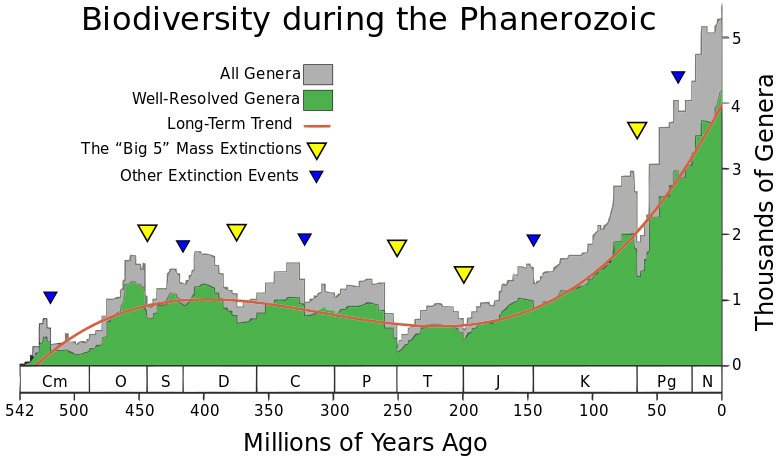
The fossil record shows that biodiversity in the world has been increasing dramatically for 200 million years and is likely to continue. The two mass extinctions in that period (at 201 million and 66 million years ago) slowed the trend only temporarily. Genera are the next taxonomic level up from species and are easier to detect in fossils. The Phanerozoic is the 540-million-year period in which animal life has proliferated. Chart created by and courtesy of University of Chicago paleontologists J. John Sepkoski, Jr. and David M. Raup.

The 3rd and 5th mass extinctions probably reduced the then existing number of species by about 50%. More than 30% of the species alive today (plant and animal) could be considered failed species – where a “failed species” is one which cannot cope with current change, or provides no benefit to any other species, or is in an evolutionary cul-de-sac. These species need to be allowed to go extinct or – when they are harmful to human or other life – to be terminated.

Plastic in the oceans grossly exaggerated: How the UN spreads bad science

April 30, 2015

It is widely assumed that about 10% of annual plastic production ends up in the oceans. That would mean that about 30 million tonnes end up in our seas every year. But this is just a myth and has been spread by a UN mistake as reported by Nordic Science. The actual number is 2 – 4%. The UN knows it is a mistake but it serves their “political” goals to go slow with any correction. I would go so far as to say that the UN mistake (by a consultant – of course) was quite deliberate. Which advocacy group did that consultant come from – I wonder?

It is tempting to beat our largest drums when fighting pollution. … One of science’s cardinal virtues is accuracy. Despite that, scientists are contributing to the dissemination of numbers with rather nebulous sources.

When ScienceNordic’s Norwegian partner forskning.no recently wrote about new calculations quantifying the plastic debris in the sea, we wondered why the new figures were so much lower than previous findings.

A number of researchers stated that the new calculation methods were the best they had seen to date. So we tried to find out how other scientists had ended up with a much higher figure –ten percent of the world’s plastic output. This was no easy task. The one-tenth figure cropped up ubiquitously, but no one could say what research it was based on. Apparently it didn’t come from research at all.

Some still claim that ten percent of the plastic produced annually ends up in marine environments. In 2013 alone that would equate to 30 million tonnes. This is a staggering amount of plastic for the oceans of the world and the marine life in these seas to cope with.

The latest calculations decrease this share of plastic debris to two to four percent of annual output.

We started searching for the source of the ten-percent figure.

Each reference pointed to another, which in turn referred to another article or paper in an apparent endless chain. Where was the original source?

A UN document for a workshop of international experts on marine debris also referred to a scientific paper. But when we checked that paper there we found no trace of this ten percent estimate.

We contacted the Secretariat of the UN Convention on Biological Diversity, which had commissioned the document from the UN Environment Programme (UNEP). They would not put us in touch with the author of the document, but Jihyun Lee in the Secretariat sent us an e-mail:

“Our consultant quoted the reference in good faith as it was cited in a peer-reviewed paper as being the source of the information. A robust review of this paper by the consultant when he quoted this information could have avoided this mistake. Unfortunately he did not go back to the source reference in this case to double-check the original source.”

The UN document was a draft. The mistake had already been pointed out by a scientist at the workshop and checked out. Jihyun Lee explains that the number will now be deleted from the final report.

But the number had already spread internationally, including to Norway, where the expert on plastics Geir Wing Gabrielsen of the Norwegian Polar Institute quoted it in the media.

“When I read a scientific article or a UN report, I expect the references made to be correct and they should be possible to confirm. It is unfortunate when, as in this case, numbers are impossible to track down,” he writes in an e-mail.

Read the whole article

Forskning.no finally traced the 10% number through many a false citation to a non-peer-reviewed conference presentation by a Professor Richard Thompson of Plymouth University who now admits he had no basis for the number but says it was based on “grey” literature. Which advocacy group did his “respected source” come from?

“ It was from a respected source, it seemed credible and I believed it as did others,” he writes in an e-mail to forskning.no. But he doesn’t answer the question of why he neglected to investigate the reference which the number comes from.

Thompson writes that he relied on grey literature, in other words, information from the authorities, organisations or academics who have not been peer reviewed through formal scientific publications. Typically, this could be a report, a work note or a presentation. 

“On further digging there is no substance to them – they were guesses and I should not have used them. I have not used the quote again,” he writes.

No doubt the consultant and the grey literature were from some advocacy group, such as Greenpeace, who have no qualms about making up information when it suits their purpose. Lies are justified as necessary because their “ends are good”. I note that the UN bureaucracy believe that the end justifies the means and their means include disseminating “grey information” as if it was gospel. It is not so surprising then that the UN IPCC reports on climate are full of highly dubious grey literature.

The UN’s scientific panels are little better than advocacy groups. Accuracy and truth have just become collateral damage in the furthering of their political goals. And the IPCC leads all the rest.

Swedish names in English for pronunciation by an American

April 30, 2015

An American friend was complaining that pronouncing Swedish names correctly was a pain – and he used Göteborg, Göran, Håkan and Norrköping as his “evidence”.

I bet him that I could write all Swedish names phonetically in English such that he would have no choice – even in his deep South drawl – but to pronounce them correctly. We enlisted another friend to be judge. He was – unlike me – a native Swedish speaker whose own name caused some problems for Americans – Jönsson.

I think I won more than a whiskey or two that night.

A few examples below. It seems to be possible also with Hindi words rendered phonetically in English for pronunciation by an American (even one from Boston). And getting someone with a Boston twang to even pronounce English correctly is an achievement in itself.

Swedish Name Rendered phonetically in English
Göteborg Yette-bor-ye
Göran Yo-rahn
Håkan Ho-kahn
Jönsson Yuhn-sson
Norrköping Nor-scher-ping
Östergötland Oester-yert-land
Kjell Schell
Agneta Ahg-nyet-a


UK longevity increasing faster than national statistics forecasts

April 30, 2015

The rule-of-thumb is that average longevity in a developed country increases by about 1 year every 25 (4 years every century). So in the year 2500 an average longevity should be well over 100 years. It has been postulated that that this rate of longevity increase will decrease as we approach some kind of asymptotic “maximum possible” age – variously proposed to be 100, 150 or even 200 years. But it seems that the understanding of how telomeres affect cell aging and cancer is also fast increasing. If medical science develops to the extent that key cells can be encouraged to renew themselves in a controlled manner (by not reducing the telomere tail in a cell’s DNA with every replication) and yet not succumbing to the risk of uncontrolled growth (cancer), then a human longevity of even 500 years  does not seem impossible.

After 2100 the world will be faced with a fertility rate below replenishment levels and one way of mitigating the effects of a declining population will be an increasing longevity and a corresponding increase in the span of the “child-bearing” years (which in turn will correct the fertility decline). The challenge is going to be in arresting the decline of human faculties. If that is achieved it will automatically increase the “productive life span” and balance the critical and currently declining ratio of productive population to supported population.

A new paper in The Lancet suggests that official statistics in the UK are underestimating the rate at which longevity is increasing. 

J.E. Bennett et al. ‘The future of life expectancy and life expectancy inequalities in England and Wales: Bayesian spatial forecasting of population health.’ Lancet, 2015. http://dx.doi.org/10.1016/

Imperial College has put out a press release:

A new study forecasting how life expectancy will change in England and Wales has predicted people will live longer than current estimates.

The researchers say official forecasts underestimate how long people will live in the future, and therefore don’t adequately anticipate the need for additional investments in health and social services and pensions for the elderly.

The new study, published in the Lancet, also predicts that regional inequality in life expectancy will increase, highlighting a need to help deprived districts catch up with affluent areas.

Researchers at Imperial College London developed statistical models using death records, including data on age, sex, and postcode, from 1981 to 2012 to forecast life expectancy at birth for 375 districts in England and Wales.

They predict that life expectancy nationally will increase for men from 79.5 years in 2012 to 85.7 in 2030, and for women from 83.3 in 2012 to 87.6 in 2030. The longevity gap between men and women has been closing for nearly half a century and will continue to get narrower.

The forecasts for 2030 are higher than those by the Office of National Statistics, by 2.4 years for men and 1.0 year for women. …

During my life-time, “middle age” has shifted from 40 years to be now around 50. For my children “middle age” will probably be at around 60.

The MiliBrand & Sturgeon Show

April 29, 2015

The rise of the new M & S.

Could these be the new rulers of the United Kingdom?

Mili-Brand

Ed Miliband savaged for Russell Brand video stunt

Mili-Brand


and Sturgeon

Ed Miliband shakes hands with Nicola Sturgeon at the end of the BBC debate on 16 April 2015

Mili-Sturgeon


Australian “bullying” gave Indonesia no chance to exercise clemency

April 29, 2015

I sometimes felt that Australia’s attitude and rhetoric about the execution of the Bali 9 was going to be counter-productive but generally assumed that governments must have exercised their collective minds and knew what they were doing. I did wonder sometimes why Indonesia was always being painted into a corner with no exit route. I assumed that some quiet diplomacy was ongoing but apparently it was not.

The drug-runners were initially arrested following an Australian police tip-off to their Indonesian counterparts. And when the Australian police sent the tip-off they were very well aware of

  1. Indonesia’s hard-line and death sentences for convicted drug dealers, and
  2. that Australian citizens were the subject of their tip-off.

In fact the chain of event which led to the death penalty and the executions were started by Australia.

But now this from the New Zealand Minister of Internal Affairs suggests that the Australian strategy – if there ever was a strategy – and their rhetoric may not have been very well thought through. They made it almost impossible by their public noise for Indonesia to exercise clemency without also being humiliated.

Stuff: Peter Dunne, the Minister of Internal Affairs, is accusing Australia of “playing international bully” in its handling of Indonesia’s execution of two of the Bali nine.

In his regular newsletter, Dunne Speaks, the MP for Ohariu said Australia seemed more interested in pushing Indonesia around than saving the lives of two of its citizens.

Andrew Chan and Myuran Sukumaran were executed by firing squad early Wednesday morning (NZ time) on drug smuggling charges.

Australia has led international condemnation of the executions, two of a number of foreign nationals killed in Indonesia today, but Dunne turned attention on Australia’s diplomatic efforts.

“While nothing excuses the barbarism of Indonesia’s actions, the various interventions by Australia… all served to make it virtually impossible for Indonesia to get off its high horse with any semblance of dignity,” he wrote.

“From the crass linking of Australian aid after the Boxing Day tsunami to favourable consideration of this case, through to independent commentary in Australia on the eve of the executions that the actions of President Widodo actually showed his political impotence, Australia appeared hell-bent on humiliating Indonesia into submission, rather than saving the lives of its two citizens.”

Dunne said the episode could provide a lesson for New Zealand, with Antony de Malmanche currently on trial on drugs charges in Indonesia.

“We need to be talking quietly to the Indonesians now, letting them know our views, and working with them to see if a reasonable solution can be effected. The process needs to be ongoing, not just left until the last few months.”

Foreign Minister Murray McCully’s office pointed to comments he had made on Wednesday about the executions.

“While we respect Indonesia’s right to set and apply its own laws, and understand the immense harm the country suffers from drug trafficking, we are dismayed that these executions have proceeded in the face of continued appeals from some of Indonesia’s closest friends.”

What did the government of the Philippines do that Australia did not?