Obama and the UN recycle 25 year old alarmist propoganda

September 24, 2014

At the UN summit on climate change Obama has been recycling the same alarmist propaganda that was coming out of the UN 25 years ago.

Reblogged from Real Science:

September 23rd, 2014

Dire warning on climate

President Obama on Tuesday delivered a call to arms against climate change at the United Nations, telling 125 leaders that they are “the last generation” with the power to prevent a global catastrophe.

Dire warning on climate | TheHill

Obama’s teleprompter is recycling identical UN propaganda from 25 years ago.

June 30, 1989

GRIM FORECAST

A senior environmental official at the United Nations, Noel Brown, says entire nations could be wiped off the face of the earth by rising sea levels if global warming is not reversed by the year 2000. Coastal flooding and crop failures would create an exodus of “eco-refugees,” threatening political chaos, said Brown, director of the New York office of the U.N. Environment Program. He said governments have a 10-year window of opportunity to solve the greenhouse effect before it goes beyond human control

San Jose Mercury News (CA) Mercury News: Search Results

Twenty five years of screeching while global warming has been absent for at least the last 18!! Twenty five years of proposing an ineffective solution to the wrong problem. Twenty five years of proposing actions which have no measurable objectives.

Australian climate science

September 24, 2014

These are Climate activists in Australia, hard at work studying the atmosphere in the Northern Hemisphere. The action was to show their support for the UN talkshop.

It is Down Under after all.

It could be the BOM.

crankycurfew productions

Heads Down, Bums Up! Studying the climate Down Under  – crankycurfew productions

first seen at JoNova.

MOM successfully enters Mars orbit – first time ever on a maiden Mars mission

September 24, 2014

In what appears to have been a remarkably flawless and precise operation ISRO’s MOM has entered Mars orbit. It is the first time that a country has succeeded to get a spacecraft to enter Martian orbit on its maiden attempt.

“We have the signal.

1099 m/s.

Expected – 1098.7 m/s”

(The Mars Orbit Insertion burn had a planned duration of 24 minutes and 14 seconds, slowing the spacecraft down by 1,098.7 meters per second to be captured in an elliptical orbit around Mars.)

The operations took place while the spacecraft was behind Mars. It seemed an endless wait for it to reappear. It was then a seemingly endless 12.5 minutes from when telemetry was reactivated and the signals were received confirming that the maneuvers had been successful.

The precise orbit achieved now awaits further tracking information.

Foto

Prime Minister Narendra Modi arrived at ISRO in time to witness the critical and historical phases of the orbit insertion procedures (and he is to be highly commended for preferring real things to the meaningless, pointless and futile climate change talkshop at the UN).

He was more than a little pleased.

Narendra Modi at ISRO after MOM achieved orbit — screen grab by The Hindu

A major step not just for India’s confidence in its technological capabilities but also for its geopolitical positioning against China.

BBC: If all goes well and the satellite orbits the Red Planet, India’s space agency will become the fourth in the world after those of the United States, Russia and Europe to undertake a successful Mars mission. …..

…… After India’s successful unmanned Chandrayaan mission to the Moon in 2008 that brought back the first clinching evidence of the presence of water there, the Mars mission, according to K Radhakrishnan, chairman of the Indian Space Research Organisation (Isro), is a “natural progression”. …….

India sees the Mars mission as an opportunity to beat its regional rival China in reaching the planet, especially after a Russian mission carrying the first Chinese satellite to Mars failed in November 2011. Japan also failed in a similar effort in 1998.

China has beaten India in space in almost every aspect so far: it has rockets that can lift four times more weight than India’s, and in 2003, successfully launched its first human space flight which India has not yet embarked on. China launched its maiden mission to the Moon in 2007, ahead of India.

So if India’s mission succeeds, it will have something to feel proud about.

Culmination nears for India’s Mars Orbiter Mission

September 23, 2014

In 8 hours – if everything goes as planned – the MOM would have been inserted into Mars orbit of 423 km at periareion and 80,000 Kilometers at apoareion  at an inclination of 150 degrees and with an orbital period of a little more than three days. Though a number of experiments are planned, the most important objectives of the mission – to demonstrate technology and capability – will largely have been accomplished on getting into orbit.

Frugal engineering and with a cost of about 10% of that of NASA’s MAVEN will have taken ISRO’s MOM into Mars orbit – and at the first attempt.

But the next few hours will be tense and nervous not only for ISRO mission staff but for the many millions of Indians who will be following the live webcast at http://webcast.isro.gov.in/. The critical operations will take place while the MOM spacecraft is occluded on the far side of Mars and when signals will be taking over 12 minutes to reach earth.

Spaceflight101: 

The critical Mars Orbit Insertion Burn Sequence will begin three hours ahead of the planned maneuver time when the spacecraft automatically switches over to its Medium Gain Antenna for communications since the High Gain Antenna will be pointing away from Earth during the retrograde burn.
21 minutes ahead of ignition, the spacecraft will begin the re-orientation to the proper attitude for the burn, pointing LAM to the direction of travel. The re-orientation is accomplished using the vehicle’s Reaction Wheels. Five minutes and 13 seconds ahead of the burn, the spacecraft passes into darkness – for the first time since leaving Earth last year. In advance, MOM will fully charge its battery to be in a safe configuration for the eclipse.
Three minutes ahead of the burn, the vehicle’s eight 22-Newton thrusters are enabled to start providing attitude control which they will continue to do throughout the main engine burn, keeping MOM pointing forward. Ignition of the Liquid Apogee Motor is planned at 1:47:32 UTC on Wednesday, September 24, 7:17 Indian Standard Time. The Mars Orbit Insertion burn has a planned duration of 24 minutes and 14 seconds, slowing the spacecraft down by 1,098.7 meters per second to be captured in an elliptical orbit around Mars. During the burn, the engines will consume 249.5 Kilograms of propellant leaving only about 40 Kilograms of propellant for the rest of the mission.
Should something go wrong during the burn, MOM is programmed to react appropriately in order to achieve a stable orbit around Mars – even if that means to spend all the vehicle’s propellant to do so. In the event the Liquid Apogee Motor is not ignited or its burn is cut short, MOM would automatically switch to the 22-Newton thrusters to supply as much delta-v as possible. Due to their lower thrust, the 22N thrusters would need to fire much longer than LAM along a greater stretch around the periapsis pass which will increase propellant consumption and leave MOM in a higher orbit.
MOI timeline

Graphic ISRO (via spaceflight101)

From threats to bomb Assad, Obama bombs Assad’s enemies a year later

September 23, 2014

What a difference a year makes.

In September last year Barack Obama and John Kerry were drawing red lines in the sand and threatening to bomb Bashar al-Assad. They never did.

And Obama – with his coalition against evil – is now bombing Assad’s enemies in Syria.

NYT:

The United States and allies launched airstrikes against Sunni militants in Syria early Tuesday, unleashing a torrent of cruise missiles and precision-guided bombs from the air and sea on the militants’ de facto capital of Raqqa and along the porous Iraq border.

American fighter jets and armed Predator and Reaper drones, flying alongside warplanes from several Arab allies, struck a broad array of targets in territory controlled by the militants, known as the Islamic State. American defense officials said the targets included weapons supplies, depots, barracks and buildings the militants use for command and control. Tomahawk cruise missiles were fired from United States Navy ships in the region.

The strikes are a major turning point in President Obama’s war against the Islamic State and open up a risky new stage of the American military campaign. Until now, the administration had bombed Islamic State targets only in Iraq, and had suggested it would be weeks if not months before the start of a bombing campaign against Islamic State targets in Syria.

Bahrain, Jordan, Qatar, Saudi Arabia and the United Arab Emirates took part in the strikes, American officials said, although the Arab governments were not expected to announce their participation until later Tuesday. The new coalition’s makeup is significant because the United States was able to recruit Sunni governments to take action against the Sunni militants of the Islamic State. The operation also unites the squabbling states of the Persian Gulf. ….. 

Assad will surely spin this as support for his regime. That may not be the primary intention of the air strikes but he will surely be strengthened by the attacks on the most potent of his many enemies

I think ISIS does need eradicating but it needs to be by the Sunni Muslim world in the first instance. I cannot help but wonder which of Obama’s moving red lines was crossed now by ISIS which was not crossed earlier by Assad. The difference of course is that bombing ISIS is – politically – almost risk-free for the US President. Vladimir Putin will not protest and neither will Netanyahu. Even Iran will be quite happy with this attack on Sunni extremists opposed to Assad. Even the EU will support – though the position of the EU is largely irrelevant for the US. But air strikes alone will not eradicate ISIS or bring much greater order to the chaos in Iraq and Syria.There is a real risk of the chaos being extended – geographically and in time – but Obama’s final term has not long left to run.

The entropy of the chaos increases.

Barack Obama will be remembered not  as a leader with any clear principles but merely as the first black President of the US and for whom principles were always subordinated to his fear of risks. Courage will not be associated with his terms in office.

“Yes. We can” will become “Well, I tried..”.

Norwegian lake Galggojávri emptied by mistake

September 23, 2014

Great Flopping Fish!!!

Somebody pulled the wrong plug.

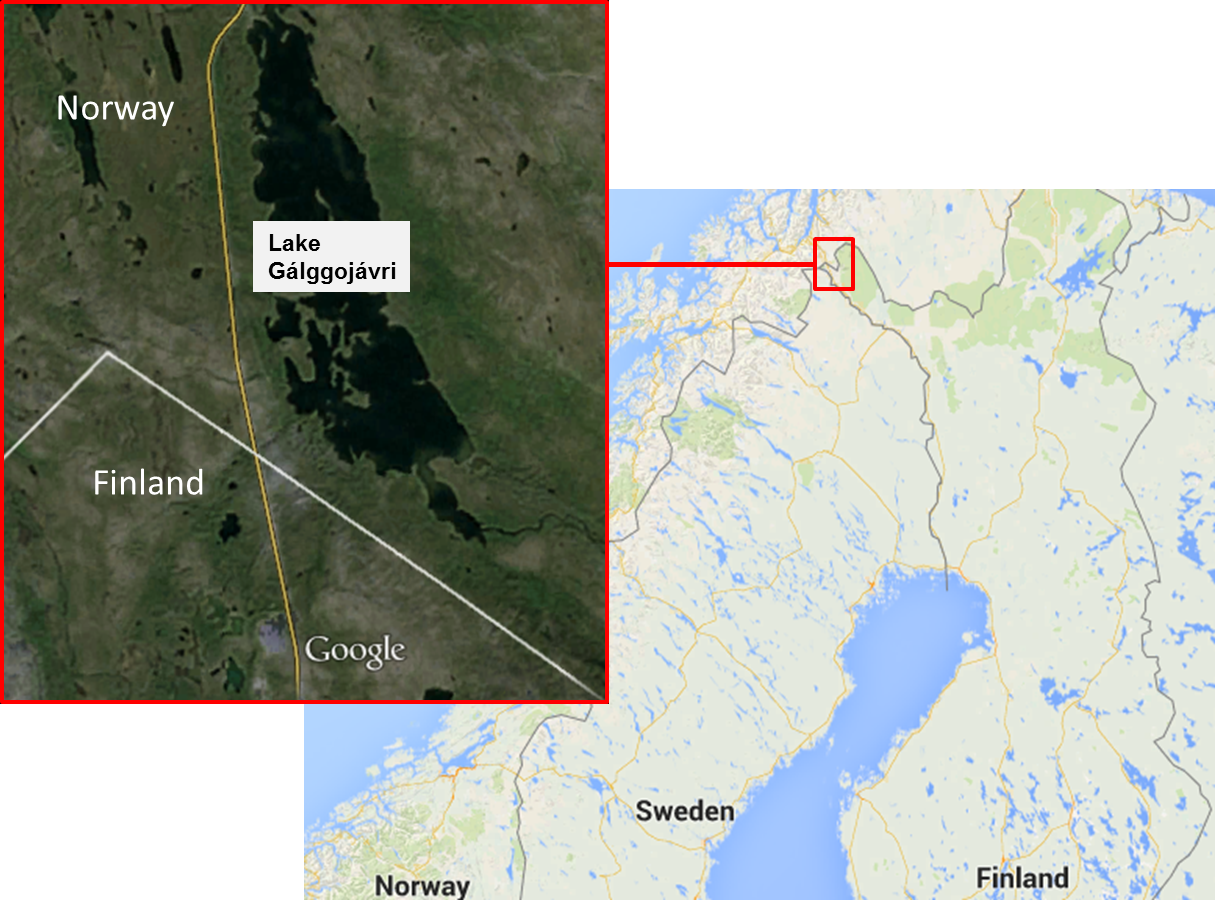
The entire lake Gálggojávri in Samisk Norway near the boundary between Norway, Finland and Sweden has been emptied of water. The Skibotnelva river flows from the lakes Rihpojávri and Gálggojávri and empties into the fjord at Skibotn.

Galggojávri. Foto: Ingir Nango Baal / Privat

Galggojávri empty. Foto: Ingir Nango Baal / Privat via SR

A floodgate was opened in error according to Troms Kraft, who operate the power station at Skibotn which is partly fed by water from the lake. The 440m waterfall produces 70 MW.

Skibotn is a hydro power station on the Skibotn river system in Storfjord in North Norway. Skibotn lies in the midst of the Lyngen Alps, an attractive area for skiing in winter and walking in summer. The power station uses water from several rivers and streams and lake Gálggojávri, as well as the dammed reservoir Rihpojavri. The river runs out into the Storfjord.

Lake Gálggojávri

Lake Gálggojávri


MOM test fires liquid motor for orbit insertion on Wednesday

September 22, 2014

A sigh of relief today as the liquid fueled motor was successfully test fired for 4 seconds after having last been used 9 months ago.

The 440 Newton Liquid Apogee Motor (LAM) of India’s Mars Orbiter Spacecraft, last fired on December 01, 2013, was successfully fired for a duration of 3.968 seconds at 1430 hrs IST today (September 22, 2014). This operation of the spacecraft’s main liquid engine was also used for the spacecraft’s trajectory correction and changed its velocity by 2.18 metre/second. With this successful test firing, Mars Orbiter Insertion (MOI) operation of the spacecraft is scheduled to be performed on the morning of September 24, 2014 at 07:17:32 hrs IST by firing the LAM along with eight smaller liquid engines for a duration of about 24 minutes.

The MOM is now in (or just entering) Mars’ sphere of influence and is effectively falling freely towards Mars. The orbit insertion procedure is described here.

Mars Orbit Insertion for MAVEN and MOM

graphic: indiaspaceactivity

On 24th 0127 GMT, even as it is falling with speed of 4 kms/sec, the craft is reoriented so that the thrusters face forward  ( for the next orbit maneuver of retro thrust to reduce the speed and to direct it in the required orbit ). The re-orientation is completed @ 0147 GMT. MOM would by this time be falling with a speed of  4.48Km/sec.

After the disturbances due to reorientation have died, i.e. 5 seconds later,  the Retro action starts with the firing of  LAM using 8 thrusters ..  the fall speed by now is 4.68 km/s. Even as the thrusters start their effort to reduce the speed of MOM, the fallingspeed continues to increase due to the gathered momentum upto 5.89 km/s and thenspeed  starts falling. The LAM firing also directs the craft in the desired direction so that it achieves the required orbit around Mars. The LAM operation ends @0216GMT.

As shown in figure there the MOM speed would increase from 3.18 Kms/sec to 5.89Kms/sec @  0216GMT.

Now notice that MOM approached Mars parellel to  equator unlike MAVEN which approached over North pole.  The reason for these two approaches is that the final orbits of MAVEN and MOM are inclined @ 75 deg and @ 19 deg respectively. This is evident from the ‘ cross roads ‘ seen between MOM and MAVEN release in the combination diagram shown above.

In the above flow of sequence we did not have time to  mention a couple of more chilling facts: @ nearly the same time when LAM operation starts MOM would go behind Mars as seen from Earth. Secondly , even if it was visible, whatever happens at MOM will be known to Earth only after 12 minutes due to the distance between Earth and MOM. So all this (and next described operations ) are being done under the unsupervised pre-loaded command sequences. So the success indicates how well are we in anticipating the situation through modelling.

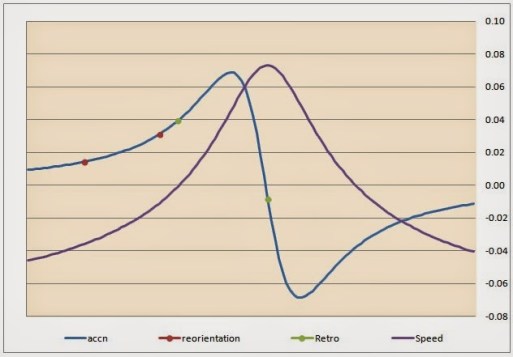
A detailed look at dynamics of acceleration during this critical operation is shown in this graphic. (numbers are in kms/sec/sec ) corrosponding to sky blue curve. (X axis is time axis from 0110GMT to 0310GMT of 24 Sep. )
Violet curve is the speed normalized to fit in this graph with that of acceleration. Actual speed variation shown corresponds to 3.88 km/sec at left to 5.89km/s at peak near center which falls to 4 km/s at lsft edge.

We have also marked the events of reorientation (between red dots) and retro rocket firing (between Green dots ) on acceleration curve.

Notice that the LAM retro action started at first green dot on left ( 0152 GMT ) ..  it has tried to reduce the speed but the fall is more powerful, so MOM speed continues to increase despite retro action. This continues and for sometime eventhough the acceleration has started reducing ( blue line coming down ), the gathered momentum  makes the craft to increase its speed for sometime. Finally however the thrusters succeed in reducing the speed ( reversal near center of violet line ) ..  the thrusters are also turned off at that moment.(green dot near the center of graph ). Now the total operation of MOI is over.

Incidentally, the point where speed reversal has taken space forms the lowest point near the surface of MOM prior to first perigee which would occur after the craft completes one revolution.

Climate models demolished as Arctic ice recovers, Antarctic ice reaches new maximum and global temperatures drift downwards

September 22, 2014

The Royal Society (which is one of the institutional high priests of the global warming cult) is holding a meeting on the Arctic today. It is quite revealing to see how climate models – which are being steadily demolished by reality – continue to be defended by the global warming establishment. Denying reality while defending imperfect, obsolete, climate models seems to be the name of the game.

Someday the Royal Society may display healthy scientific skepticism again. But right now they are entirely focused on finding excuses for why reality is wrong.

Models before data.

These graphs of ice extent from SunshineHours.

Arctic ice extent has passed its minimum and is growing again.

arctic_Sea_Ice_Extent_2014_Day_263_1981-2010

Arctic Ice extent has passed minimum for 2014

Antarctic ice is reaching extents never before seen in the satellite age.

antarctic_Sea_Ice_Extent_2014_Day_263_1981-2010

Antarctic ice extent has not quite reached maximum for 2014

Zoomed Antarctic ice extent

antarctic_Sea_Ice_Extent_Zoomed_2014_Day_263_1981-2010

Antarctic ice extent Zoomed

South East Asia vary of Chinese nationalism and a return of the Maritime Silk Road

September 22, 2014

The Chinese vision of a Maritime Silk Road is based on the seven great voyages of Admiral Zheng He in the time of the the Yongle Emperor (1360 – 1424), the third Emperor of the Ming dynasty.

The admiral of all seven fleets was Zheng He, the great-grandson of a Mongol warrior. His original name was Ma Ho, the Chinese version of Muhammad, for his father was a Muslim who had made the pilgrimage to Makkah. In 1404, the emperor conferred on him the honorific Zheng, and he was appointed Grand Eunuch, thenceforth to be known as Zheng He. ….

From the point of view of geographical discovery, the Ming voyages must rank as the earliest state-sponsored effort to seek out new lands, markets and spheres of political influence. That the same idea occurred to the rulers of both the Far East and the “Far West” almost simultaneously is intriguing, and it shows that—long before the emergence of a “global economy” in the late 20th century—East and West were responding to the same rhythms of political and economic change.

Zheng He 7 voyages - National Geographic

Zheng He 7 voyages – National Geographic

The reestablishment of the Chinese Maritime Silk Road is said to be a pet project of President Xi Jinping who is a scholar of Chinese maritime history and an admirer of Admiral Zheng He. Even before the Ming dynasty there was extensive maritime and cultural commerce between South India and China during the Song and Yuan dynasties. But the maritime routes withered after Zheng He and left the area open for the Potuguese in the 16th century and later for the French, Dutch and the British who followed. The Maritime Silk Road was among the items to be discussed by President Xi with Narendra Modi on his recent visit to India.

New Delhi is abuzz with speculation that President Xi Jinping could raise the issue of Maritime Silk Road (MSR) during his visit to India this week and explore business, investments and trade opportunities for China in India. At least three reasons can be identified to uphold the above assumption; first, the issue of MSR was raised during President Hamid Ansari’s visit to China in July this year and the Indian side had indicated that New Delhi would examine the idea. The Chinese would be keen for a response from the Indian side and India may push for the BCIM (Bangladesh, China, India and Myanmar) corridor to which it has offered wholehearted support and it serves the interests of all the partners.

The second reason is that the MSR is a pet project of the Chinese President and is believed to have been driven by his knowledge of ancient Chinese cultural and trade connections with the outside world. Apparently, between 1985 and 2002, Xi had personally taken interest in the Quanzhou Maritime Museum, and according to the curator, Xi had perused through the ancient historical records, artifacts and exhibits at the museum and may have ‘learnt a lot about China’s maritime history’ which could have been the driver for his interest in MSR. Xi even secured substantial government grants for the museum. Incidentally, Quanzhou is home to several ancient shrines and temples built by Tamil communities who had established trading contacts with the Chinese during the Song (960-1279) and Yuan (1279-1368) periods. Given his knowledge of ancient maritime trade and cultural connections between India and China, Xi may recall the cultural and Buddhist connections between the two countries. It is pertinent to mention that China has committed US $1 million for the Nalanda University.

While India is not averse to some parts of the Maritime Silk Road being reestablished, others – and especially Vietnam – are very suspicious of Chinese intentions.

Maritime Silk Route

Maritime Silk Route

Most countries have maritime disputes with China in the South China Sea, but also see a threat to liberty, security and maritime safety at sea.

The restoration of “Silk Road on the Sea” is both an ancient ambition of the leaders in Beijing, and a symbol of Chinese nationalism. So it hides a lot under what seems beneficial to the surrounding neighbors of China. The essence of Chinese intentions in the idea of ​​building “new silk road” at sea are:

Firstly , create a new order in which coastal neighbors follow a trajectory operated and dominated by the Chinese. The “Silk Road on the Sea” is part of the  “string of pearls” master plan to transform China into a maritime power and compete with American superpower.

Secondly , “Silk Road on the Sea” is a diplomatic tool to execute foreign policy with China’s neighbors. Through the use of “Silk Road on the Sea”, the Chinese are trying to create a soft image, useful for the rise and expansion of its influence.

Thirdly , “Silk Road on the Sea” provides an opportunity for China to promote its policy of “setting aside dispute and pursuing joint development” so as to exploit marine resources in the region, especially energy resources of oil and gas. 

Fourth , the initiative “Silk Road on the Sea” is to further the territorial claims on islands by China. Successful implementation of the initiative “Silk Road on the Sea” will create conditions favorable for the presence of the Chinese coast guard  especially the South China Sea, the Strait Malacca, Indian Ocean, and help to expand Chinese maritime influence and enhance the influence of its military on the sea. … As with ancient Zheng He’s voyage the objective is “to establish and enforce sovereignty “over the Paracels and Spratlys (of Vietnam). To justify its claims to sovereignty. China will continue to use the “Silk Road on the Sea” for aggressive actions in the South China Sea make the situation hotter and more physical.

Fifth , China will use initiative “Silk Road on the Sea” to implement a divide and rule policy of the neighboring countries. There may be the possibility that some countries will be attracted to the immediate economic benefits, are willing to overlook the problem rules and norms of international law to support the initiative “Silk Road of the Sea ​​”of China that will harm the interests of the country which has sovereignty disputes with China over some island. On the other hand, this does not exclude the possibility that China will increase the pressure and aggression with countries that do not support the initiative “Silk Road on the Sea”.

Sixth , the initiative “Silk Road on the Sea” also aims to push the United States and the Western countries out of the area. This initiative is important in order for the policy to “rebalancing strategy in Asia – Pacific region” of America. On the economic front, “Silk Road on the Sea” is to fight Agreement Trans-Pacific economy (TPP) of the United States. Thus, one can see “Silk Road on the Sea” China will make competition between the United States and China increasingly fierce.

Once the “Silk Road on the Sea” is formed China will set out new rules to force other countries to comply; China will act unilaterally ignore international law. The actual situation in the South China Sea has proven time over this. Seen from this perspective, the “Silk Road on the Sea” is not only a threat to the security and territorial sovereignty of neighboring countries, especially countries with maritime disputes with China in the South East, but also a threat to freedom, security and safety of navigation at sea.

China has officially put the materials to build the concept of “Silk Road on the sea at a meeting of Senior Officials (SOM) ASEAN – China. ASEAN countries have not yet responded. …..

For Vietnam, the initiative “Silk Road on the Sea” is a challenge to the sovereignty of the islands of Vietnam just as Zheng’s ships in ancient times were used as an argument concerning the sovereignty of archipelagos Sa and Truong Sa of Vietnam.

But Malaysia, while still vary, is tempted by the possibilities of development on the relatively under-developed East coast in Kuantan.

More than 600 years ago, the legendary Ming Dynasty diplomat Admiral Zheng He made seven epic journeys to the West via a route known as the maritime Silk Road.

First used in the Qin and Han Dynasties (AD 25-220), the nautical passageway connected the ports of south China to Southeast Asia, India, Arabia and Africa. Silk, china, tea and spices exchanged hands from Guangzhou, the starting point, to the countries around the Gulf. 

Now, China is proposing to rebuild this centuries-old seaway into a 21st century maritime Silk Road. Kuantan, on the east coast of Peninsular Malaysia, is hoping that modern day Chinese vessels will share Zheng’s assessment when he landed here in the 15th century: that this city facing the South China Sea is an ideal gateway to the region and beyond.

Located 250 kilometers from the capital city of Kuala Lumpur, Kuantan is the east coast’s economic hub and its most modern city; although by no means as cosmopolitan as its west coast sisters. The capital of the state of Pahang is being developed into an integrated logistics and industrial hub for the East Coast Economic Region (ECER), a major project by the Malaysian government to decentralize economic activities.

Crucially, it provides fast access to China through its namesake port. The multipurpose, deep-sea port serves the resource-rich hinterland of the east coast and is a leading petrochemical hub port and container terminal for that part of the peninsula.

Swedish investment in wind power collapses while waiting for new subsidies

September 22, 2014

The simple fact is that wind power investment depends upon subsidies. The greater the subsidy offered the greater the investment. The higher the electricity price the greater the value of any subsidies and the greater the investment.

Subsidies just don’t work.

And in the meantime the world has begun to cool.

From Swedish Radio:

During the second quarter of this year, decisions were made to invest in future wind power totaling 37 megawatts, down 83 percent compared with the same period last year according to statistics from the Swedish Federation of Wind Energy.

One reason for the decline is the low price of electricity, another is that the industry is waiting for next year’s so-called checkpoint in parliament on changes to the certificate system, a decision which, according to Annika Helker Lundström, CEO of Swedish Wind Energy, will be of great importance for Swedish wind power company.

……

The certificate system was introduced in 2003 and means that the government supp…orts producers of renewable electricity by handing out certificates worth one megawatt per piece which can then be sold to electricity suppliers. Electricity suppliers are in turn obliged to buy a certain amount of renewable electricity.

The current system is certified to award equivalent to 25 terawatt-hours by 2020, and already has a certificate for over 20 terra watt hours distributed. The Agency has proposed to the government that more certificates to be awarded and the dividend period is extended to 2030.

This should increase the willingness to invest in the electricity generators.