How Sohlman and 3 white Russian stallions ensured the establishment of the Nobel prizes

May 15, 2014
Björkborn Manor (photo kkp)

Björkborn Manor (photo k2p)

Yesterday we visited the Nobel Museum at the Björkborn Manor and Estate in Karlskoga. Björkborn was Alfred Nobel’s last “residence” but he never really lived in it except as a sort of guest house. In fact he died at his villa in Italy. But Björkborn was critical in ensuring that the Nobel prizes even exist at all.  A visit I would now strongly recommend to any visitor to Sweden. For me personally it was memorable on many levels, but primarily for teaching me so much new and in such a dramatic fashion. Till this visit, I knew very little about Alfred Nobel’s last will and testament and what a close run thing it was that it was ever implemented.

This quite remarkable, but little known, story of Ragnar Sohlman and the 3 white Russian stallions which ensured that Nobel’s will could be followed and that the Nobel Foundation and its 5 prizes could be established was something quite new for me. Ragnar Sohlman who, at the age of 26 spent five years against formidable opposition in at least 3 countries to establish the Nobel prizes in accordance with Nobel’s wishes, is the real unsung hero of the creation of the brand equity which is today the hallmark of the Nobel prizes.

But more of Ragnar Sohlman later.

Read the rest of this entry »

The Descent of Air India

May 14, 2014

I have just acquired the ebook “The Descent of Air India” by Jitender Bhargava and which was first published by Bloomsbury Publishing in October 2013. However Praful Patel the former Civil Aviation Minister sued the publishers for defaming him and applied pressure to prevent the distribution of the book. The publisher – without consulting the author – withdrew the book and apologised to Praful Patel.

So much for the courage of publishers.

DNA: Publishing giant Bloomsbury in a decision, unprecedented for its abject surrender, has withdrawn former AI top honcho Jitender Bhargava’s book The Descent of Air India, agreed to destroy copies of the book left in its stocks and tendered an apology to former civil aviation minister Praful Patel, who has been pilloried in the book as the man who caused the downfall of the airline.

I shall review the book in a few days when I have read it through.

Bhargava wrote on his Facebook page:

After the book, ‘The Descent of Air India’ was formally released on October 11, 2013 in Delhi, attempts were made by Praful Patel to obstruct its distribution. Besides ensuring that the books were not sold at airport book stores (he still appears to wield clout with airport operators); had TV channels to drop scheduled programmes relating to the book – in the case of one news channel even after the interview had been recorded; he served a legal notice, alleging that the book contents were defamatory.
He filed a case in the court of the metropolitan magistrate, Mumbai. While I told the judge on January 6, 2014, that everything stated in the book about Praful Patel is true, backed by documented evidence and will be duly justified and contested in the honourable court, the publishers, Bloomsbury, on whom also the notice was served, decided on not pursuing it, and instead agreeing to offer an apology to Praful Patel.
This decision of Bloomsbury was unilateral, and without discussing with me, as an author. Their stand thus naturally came to me as a surprise. And it may surprise you too when you see the apology of Bloomsbury published in the newspapers.
As everything stated in the book is true, based on documents, I will have the book, ‘The Descent of Air India’ reprinted either on my own or through a new publisher. Simultaneous action is being initiated to bring out ‘ The Descent of Air India’, as an ebook. I am told this can take up to four-five weeks.
Please bear the absence of the book from the book stores for a few weeks. I will be back soon because neither can I be bulldozed into submission nor can facts be allowed to be suppressed. In today’s environment, corrupt practices of all people, howsoever powerful, must be exposed.
I look forward to your understanding of the situation and support.

Through the 1970’s and 1980’s Air India was one of my preferred airlines. But since the early 1990’s it has been – for me – an airline to avoid.


Never trust a politician who is “thinking about your children’s children”

May 13, 2014

My grandfathers died around 80 years ago. They could not have conceived of the world their grandchildren would live in and the challenges they and their world would face. They would surely have been able to recognise our behavioural characteristics but they would not have been able to imagine the society we live in. The values of current society would have been difficult for them to understand.

My father died 26 years ago. Not so very long ago. Yet he would not have been able to predict – let alone address – the kinds of challenges my children and the world they live in will face in the next 20 – 30 years. His values were those of having fought in WW2 and the hope of the 1950’s. He would not have been able to predict the pace of life and the networks maintained by my children. He could not have forecast the day-to-day problems they will face or the “big problems” their world will face over the next 50 or 60 years.

Around 100 years ago my grandfathers could not have foreseen the Second World War or the spread of easily available and affordable electrical power, or of the second industrial revolution or the digital revolution. Even if they could have foreseen the future they would have had the intelligence but not the knowledge or the technology to better address the challenges of today. In fact they would have been very stupid to have tried to forecast and then plan for their choice of problems to be faced by their grandchildren.

Our children’s children will live into the 22nd century. Any forecast I try to make of the development of technologies and knowledge and societies and values 100 years from now is going to be wrong. For the last 50 or 60 years we have lived with the perception of the problem of population rise and limitation of resources. Actions have been taken – and very successfully – to reduce the number of births, to improve food production and in finding new and alternate resources. In another 50 years populations will decline and the pressure on resources will decline further as new technologies are developed and new resources are found (who would have predicted the abundance of shale gas 50 years ago?).

We may expect that in the 22nd century, one of the major challenges will be that of population decline and aging. It will be a challenge faced and solved by the humans of a hundred years hence and it may or may not be a problem. I have no idea of what genetic and medical advances may bring or of how societies will develop and of the value systems that may prevail then. To use today’s knowledge and technologies and values to address these presumed challenges of the future is both ineffective and wasteful. These challenges – if challenges – will be faced by our children’s children using the knowledge and technology that will have become available to them.

It would have been ridiculous for my parents or my grandparents to have given up advances in their own well-being or their careers or their world – as they saw them then – for the sake of  some unknown problem that would be faced by their children’s children.

And so I am deeply suspicious of any politician or environmentalist who wants me to do something  – or not do something – against my current best interests as I see them – for the sake of my children’s children.

Our grandchildren will always be better placed to define their challenges than we can possibly forecast. They will be better equipped to solve the problems of their age with the tools and knowledge and technologies of their age. And they too would be stupid if they gave up their own well-being in order to solve a problem they choose to forecast for their children’s children.

Alarmists wail – “Collapse” of Antarctic ice is nigh (but it could take 1000 years)

May 13, 2014

There is much wailing and gnashing of teeth.

The headlines would suggest an impending catastrophe. The Western Atlantic ice sheet is “collapsing”. Sea level could rise 1.2m.

The end of the world is nigh. And it is all due to global warming!!

Yes indeed – except that the melting has been going on for centuries. The so called “collapse” may take upto 1,000 years! Measurements over 9 years are projected over a millenium. Computer models have forecast that the loss of the glaciers is unstoppable and will occur sometime in the next 1,000 years.

The Guardian: Western Antarctic ice sheet collapse has already begun, scientists warn

BBC: ‘Nothing can stop retreat’ of West Antarctic glaciers

A collapse in very slow motion!

The alarmist headlines are are based on two papers. Note that one is based on 9 years of measurement and the other is a computer forecast about a “collapse” that is potentially underway.

1. E. Rignot, J. Mouginot, M. Morlighem, H. Seroussi and B. Scheuchl, Widespread, rapid grounding line retreat of Pine Island, Thwaites, Smith and Kohler glaciers, West Antarctica from 1992 to 2011, Geophysical Research LettersDOI: 10.1002/2014GL060140

AbstractWe measure the grounding line retreat of glaciers draining the Amundsen Sea Embayment of West Antarctica using Earth Remote Sensing (ERS-1/2) satellite radar interferometry from 1992 to 2011. Pine Island Glacier retreated 31 km at its center, with most retreat in 2005–2009 when the glacier un-grounded from its ice plain. Thwaites Glacier retreated 14 km along its fast-flow core and 1 to 9 km along the sides. Haynes Glacier retreated 10 km along its flanks. Smith/Kohler glaciers retreated the most, 35 km along its ice plain, and its ice shelf pinning points are vanishing. These rapid retreats proceed along regions of retrograde bed elevation mapped at a high spatial resolution using a mass conservation technique (MC) that removes residual ambiguities from prior mappings. Upstream of the 2011 grounding line positions, we find no major bed obstacle that would prevent the glaciers from further retreat and draw down the entire basin.

2. Ian Joughin, Benjamin E. Smith and Brooke Medley,  Marine Ice Sheet Collapse Potentially Underway for the Thwaites Glacier Basin, West AntarcticaScience,     DOI: 10.1126/science.1249055

Abstract: Resting atop a deep marine basin, the West Antarctic Ice Sheet has long been considered prone to instability. Using a numerical model, we investigate the sensitivity of Thwaites Glacier to ocean melt and whether unstable retreat is already underway. Our model reproduces observed losses when forced with ocean melt comparable to estimates. Simulated losses are moderate (<0.25 mm per year sea level) over the 21st Century, but generally increase thereafter. Except possibly for the lowest-melt scenario, the simulations indicate early-stage collapse has begun. Less certain is the timescale, with onset of rapid (> 1 mm per year of sea-level rise) collapse for the different simulations within the range of two to nine centuries.


The Antarctic glaciers may well be retreating (as glaciers are often wont to do), but Antarctic ice cover is at an all time high and the processes being forecast are being projected over millenia. And there is absolutely no evidence that these processes have anything whatever to do with any man-made effects. That connection is inferred  or assumed.

Related: The Guardian’s Suzanne Goldenberg jumps the shark again – gets called out by NYT


Markets surge as Indian exit polls are awaited after close of polls today

May 12, 2014

UPDATE!

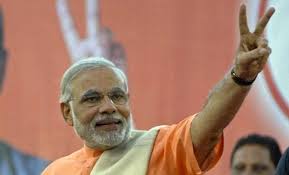
Narendra Modi - The next Indian Prime Minister (photo Forbes)

Narendra Modi – The next Indian Prime Minister (photo Forbes)

The real results have to wait till Friday but early exit poll results suggest that

  • the BJP led alliance (NDA) will get over 280 seats in the Lok Sabha (272 needed for majority) while the Congress led alliance (UPA) will get less than 120 seats. 
  • BJP will be the largest single party
  • the AAP may get 5 seats
  • Narendra Modi will be the next Prime Minister

The markets rose over 3% today.

Turnout was a record at just over 66% (of an electorate of over 800 million voters).

========================================

The Indian markets are reacting to rumours and “inside information” as to what the exit polls will reveal when they are published later today. The Election Commission has confirmed that the results of exit polls – which have been carried out over the last 6 weeks of polling and are prepared and waiting to be released – can be released after the polls close at 1830 local time (1500 CET) on the last day of the last phase of voting today.

Exit polls don’t have a very good record in predicting the result of Indian elections – especially when they are extrapolated. But we have the peculiar situation of markets being driven by the expectations of what the exit polls will say and where the actual results will not be known till Friday. Capital inflow from overseas has been particularly high and there is a feeling that this cannot be just on the advice of local investors without any special knowledge. There is a suggestion – not at all implausible – that some large investors and their overseas partners may well have carried out their own, private, exit polls. And, the story goes, these show that Narendra Modi and the BJP will get close to an absolute majority.

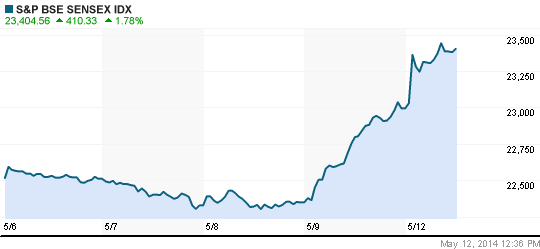
On Friday the BSE Sensex rose over 3% and so far today has risen another 2+%  – over 1000 points in a day and a half of trading.

BSE Sensex 12th May noon

BSE Sensex 12th May noon (Reuters)

NDTV

It seems that investors are betting that the BJP-led NDA will emerge victorious on May 16, when results are announced, analysts say.

“There is a lot of political hope that has got baked in valuations. Markets are factoring numbers close to 230-240 seats for the BJP alone, and if that is the case, the NDA will get a majority on its own. That will lead to pro-growth, right of central, stable formation, which is enthusing for the investors,” said Manishi Raychaudhri, strategist and head of research at BNP Paribas Securities.

Polls have consistently shown the BJP and its prime ministerial candidate Narendra Modi ahead, raising expectations that the opposition party, which is seen by markets as being more investor- and business-friendly, will either win or come close to an outright majority. The surprising part, however, is markets seem to be factoring in the best possible scenario (stable government led by Mr Modi) even before exit poll results, due later in the day. 

 One possibility why markets have not waited for exit poll results might have to do with speculation that big investors have already got a whiff of what results would be. In fact, overseas investors bought shares worth Rs. 1,268.78 crore in the cash market on Friday, their biggest purchase since March 28. Friday’s gains came at a time when markets had shed 2 per cent after hitting a record high of April 25. Clearly, smart money had some information. 

Deven Choksey, managing director of brokerage KR Choksey told NDTV that somewhere from the media, numbers suggesting that the BJP will get 260-270 seats, came out. It was in circulation on social media and markets took advantage of that, he said.


Israel is not immune from the neo-Nazi disease

May 12, 2014

Most countries in Europe have an enormous guilt complex – both singly and collectively – over the persecution of Jews in their countries for many hundreds of years and the indifference to what was happening in Germany which allowed Hitler’s Holocaust to take place. This persecution started at least 2,000 years ago but was organised  and well established by the time of the First Crusade in 1096 as the European nation-states developed and practiced enforced conversions. The Spanish Inquisition in 1478 was primarily directed at Jews (and Muslims) forced to convert to Catholicism. Much of this guilt now devolves to the credit of the nation-state of Israel even though this nation-state exists only as a consequence of  a very successful terrorist campaign carried out by Irgun and Hagganah. In a sense the creation of the nation-state of Israel was an attempt by the European countries to do what Hitler had tried to do with the Holocaust  – export the “Jewish Question” to somewhere else.

With that history of persecution of their fore-fathers, it could be expected that Jews in Israel would be especially sensitive to the persecution of minorities. But the nation-state of Israel is not synonymous with the persecuted Jews of Europe. More than 90% of Israel’s population of 8.1 million was born after the country was formed. Since the formation of Israel in 1948 (14th May), Israel and Israelis have been more of persecutors than persecuted against. And the youth of Israel have never actually experienced any persecution themselves.Their religious fanatics are just as “radicalised” and just as bent on “revenge” or Holy war as the European Muslim youth now keeping the Syrian civil war alive. Past persecution is clearly no defence against idiocy.

Right-wing neo-Nazism is alive and well all over Europe and even in Israel. And just as idiot- Mullahs radicalise Muslim youth. idiot-Rabbis drive the Israeli neo-Nazis.

HaaretzThe writer and Israel Prize laureate Amoz Oz said on Friday that those responsible for hate crimes against Arabs and Christians are “Hebrew neo-Nazis.”

Speaking at a Tel Aviv event marking his 75th birthday, Oz said that terms like “hilltop youth” and “price tag” are “sweet names for a monster that needs to be called what it is: Hebrew neo-Nazis groups.”

Oz added that in his mind, perhaps the only difference between neo-Nazis around the world and perpetrators of hate crimes in Israel is that “our neo-Nazi groups enjoy the support of numerous nationalist or even racist legislators, as well as rabbis who give them what is in my view pseudo-religious justification.”

Of course Amoz Oz is now being castigated for even using the word “Nazi” in relation to Jews. But the reality is that Israeli politicians and religious leaders give tacit support to the persecution of and discrimination against Muslims. The indignation at the use of the word “Nazi” is the same as that against Kerry for calling Israel an apartheid state.

But, I think, their indignation is misplaced and they protest too much.

Indian business hoping for/predicting a Modi/BJP landslide

May 10, 2014

The Great Indian Election Tamasha comes to an end on Monday and the results will be announced by the Election Commission on Friday, May 16th.

The Indian Stock Exchange (BSE Sensex) is riding very high. On Friday the index reached record levels and rose almost 3%. Business is looking for a stable and effective government. The last term of the Congress led government was one of the most ineffective terms of any government. Not least due to the coalition government which was virtually paralysed in the arms of its many and varied partners. Each of the regional coalition partners were more interested in cashing-in (politically and economically) than in governing or governance. The BJP in opposition was a party of disruption and their objective was to ensure and show that the government was ineffective. Parliament was more often disrupted than in session.

Insofar as the Stock Exchange reflects the hopes and predictions of the business community, a Narendra Modi / BJP government is certain. Two years ago I would have thought this was not possible but by December 2012, I became convinced that Narendra Modi would be the next Prime Minister.  As the election has progressed and the Modi wave has been sustained, the stock exchange has moved inexorably upwards. The new kids on the block – the Aam Admi Party – had threatened to be a spoiler for Modi (and it could still happen) but they are increasingly looking lost. Their leader’s resignation as Chief Minister of Delhi has only strengthened the view that the party lacks substance. They can make a noise and oppose anybody and anything, but they are scared of – and incapable of – governing.

Back in February this year it became clear that the election would be held at the end of the government’s mandate in April. The actual dates were announced by the Election Commission on March 7th. The optimism in the markets has grown steadily.

Sensex after election announcement 2014 (chart from Bloomberg)

Sensex after election announcement 2014 (chart from Bloomberg)

Indian business, in my experience, is more concerned about the stability and rationality and continuity of government rather than the manifestos of the various parties. They dislike subsidy policies introduced just to woo voters – but are expert at milking subsidies when available. They prefer the slightly more free-market approach of the BJP and are suspicious of ideological socialism and protectionism. But they have had no difficulty with working with Congress led governments as well. What they just don’t want is another government which cannot overcome the internal strains of a coalition and cannot govern. Uncertainty is the prime enemy.

So if the stock exchange is a predictor of the election result then we can expect that Narendra Modi and his BJP will not only win but may even come close to an outright majority. If that happens we can expect a sharp index spike on Monday 19th May – perhaps +4-5%. But if there is no overall majority for Narendra Modi, then we could see the markets fall also very sharply. The Sensex reached 23,000 last Friday. By next Friday it could have crept upto about 24,000. Then depending upon Modi’s majority it could spike to over 25,000. But if Modi has no clear majority and another wishy-washy government is in prospect, it could drop to around 22,000 (-10%).

India has 13 of the world’s 20 most polluted cities with New Delhi as the worst

May 9, 2014

The WHO has released the 2014 update of its Ambient Air Pollution database.

The database contains results of ambient (outdoor) air pollution monitoring from almost 1600 cities in 91 countries. Air quality is represented by annual mean concentration of fine particulate matter (PM10 and PM2.5, i.e. particles smaller than 10 or 2.5 microns).

The database covers the period from 2008 to 2013, with the majority of values for the years 2011 and 2012. The primary sources of data include publicly available national/subnational reports and web sites, regional networks such as the Asian Clean Air Initiative and the European Airbase, and selected publications. The database aims to be representative for human exposure, and therefore primarily captures measurements from monitoring stations located in urban background, residential, commercial and mixed areas.

The world’s average PM10 levels by region range from 26 to 208 ug/m3, with a world’s average of 71 ug/m3.

India has the dubious distinction of having 6 of the ten worst polluted, 13 of the 20 worst polluted cities and 20 of the 50 most polluted. Needless to say New Delhi is the worst. Delhi, Patna, Gwalior and Raipur are the 4 worst polluted cities in the world. 

50 most polluted cities WHO 2014 (pdf)

Delhi’s preeminent position in the pollution stakes was also reported by the Yale 2014 Environmental Performance Index which I posted about in February. I wrote then:

Whether Delhi is worse or better than Beijing is irrelevant. The point is that Delhi is as bad as it is.

I visit Delhi 5 or 6 times every year and it has the worst air quality that I experience. It is dust particles in the main – and a lot of that is from the ubiquitous building rubble and  building materials lying in piles (some small and some large) all over the city. The diesel engine particulates have – I think – reduced after the introduction of Compressed Natural Gas (CNG) for taxis and autos but they build up every night when the long-distance trucks roll through the city (they are banned during the day).

But Delhi is essentially a huge building site. In new building projects (many for domestic dwellings), building materials (bricks, sand, cement, tiles, sewer pipes….) are all brought and dumped in open piles on the street long before any building actually commences. Even completed building projects leave behind their piles of sand and bricks and rubble on the street which are never cleaned up. If a road is dug up for any reason the remaining mud and rubble is never actually cleared up . it is usually just pushed to one side. The last mile syndrome applies and nothing ever gets finally or properly finished.

But the real issue is one of attitude and behaviour. .. 

Delhi’s atmosphere is what it is because the citizens of Delhi do not give any value to it being any better.

I travel to Delhi 5 or 6 times a year and can vouch for the muck and grime both in the air and on the ground. The problem is not one of money or of technology but of attitudes. The population of Delhi – on average – just does not give much value to the quality of the environment they live in. The politicians are followers rather than leaders and none have the courage to follow a vision of what Delhi could be like

The Indian General Election results are due out in a week.

Toilets before temples may win the day. 

When it comes to climate change, “hot” = “cold”!

May 9, 2014

Why climate change is “bad” when nobody really knows what static climate is to be desired, and where climate stagnation would mean that the earth was dead, escapes me.

Taking pot shots at The Guardian on climate change is not very intellectually challenging, but sometimes the temptation cannot be resisted.

June 2011: Britain’s hot spring could be result of shrinking Arctic

March 2013: Scientists link frozen spring to dramatic Arctic sea ice loss

The first article was written by Robin Mckie, “Science Editor” and the second by John Vidal, “Environment Editor”. Which leads to the inevitable conclusion that for The Guardian, “hot” may be synonymous with “cold” but “environment” and “science” have entirely different values.

arctic ice guardian 2


arctic ice guardian 1


(h/t NOT A LOT OF PEOPLE KNOW THAT)

Conclusion that Förster manipulated data is “unavoidable”

May 8, 2014

Retraction Watch has now obtained and translated the report of the investigation by the Dutch National Board for Scientific Integrity (LOWI) into the suspicions about Jens Förster’s research. The conclusions are unavoidable that data manipulation must have taken place and could not have been the result of “sloppy science”.

Here are some of the highlights from the document, which we’ve had translated by a Dutch speaker:

“According to the LOWI, the conclusion that manipulation of the research data has taken place is unavoidable […] intervention must have taken place in the presentation of the results of the … experiment”

“The analyses of the expert … did add to [the Complainant’s report] that these linear patterns were specific for the primary analyses in the … article and did not show in subsets of the data, such as gender groups. [The expert stated that] only goal-oriented intervention in the entire dataset could have led this result.”

“There is an “absence of any form of accountability of the raw data files, as these were collected with questionnaires, and [there is an] absence of a convincing account by the Accused of the way in which the data of the experiments in the previous period were collected and processed.”

“[T]he assistants were not aware of the goal and hypotheses of the experiments [and] the LOWI excludes the possibility that the many research assistants, who were involved in the data collection in these experiments, could have created such exceptional statistical relations.”

What is particularly intriguing is the method of statistical investigation that was applied. Suspicions were not only because the data showed a remarkable linearity but that sub-sets of the data did not. The first suggests confirmation bias (cherry picking) but the second brings data manipulation into play. Non-linearity in sub-sets of data cannot just neatly cancel themselves out giving – fortuitously for the hypothesis – a linearity in the complete data set. The investigation methods are of more value than the Förster paper to be retracted.

I have an aversion to “science” based on questionnaires and “primed” subjects. They are almost as bad as the social psychology studies carried out based on Facebook or Twitter responses. They give results which can rarely be replicated. (I have an inherent suspicion of questionnaires due to my own “nasty” habit of “messing around” with my responses to questionnaires – especially when I am bored or if the questionnaire is a marketing or a political study).

Psychology Today:

Of course priming works— it couldn’t not work. But the lack of control over the information contained in social priming experiments guarantees unreliable outcomes for specific examples.  ..  

This gets worse because social priming studies are typically between-subject designs, and (shock!) different people are even more different from each other than the same people at different times! 

Then there’s also the issue of whether the social primes used across replications are, in fact, the same. It is currently impossible to be sure, because there is no strong theory of what the information is for these primes. In more straight forward perceptual priming (see below) if I present the same stimulus twice I know I’ve presented the same stimulus twice. But the meaning of social information depends not only on what the stimulus is but also who’s giving it and their relationship to the person receiving it, not to mention the state that person is in.

… In social priming, therefore, replicating the design and the stimuli doesn’t actually mean you’ve run the same study. The people are different and there’s just no way to make sure they are all experiencing the same social stimulus, the same information

And results from such studies, if they cannot be replicated, and even if they are the honest results of the study, have no applicability to anything wider than that study.