The proper exercise of power

March 5, 2014

While Obama and Kerry and Putin all have “power”, I am not sure how expert they are at “the proper exercise of power”. The examples of Syria and now the Ukraine convince me that they – by virtue of their positions – wield power but they are a long way from being practitioners of the “proper” exercise of power. For Managers in the work-place I described “the proper exercise of power” as below and it applies also I think to politicians and leaders and heads of state.

Edmund Burke: “Do the thing and you will have the power. But they that do not the thing – had not the power”.

Consider our appointed manager …….. 

“He does the thing”.

No missing players. No missed actions.

No extra players. No wasted actions.

No misdirection. No collateral damage.

No dissipation of energy.

No cheers. No jeers. No fuss, no “muss”.

No turbulence. No noise! 

Just the music of the proper exercise of power!

(Extracted from Essence of a Manager)

Why insurance companies love alarmism

March 5, 2014

A fundamental for all insurance companies is that their profits are highest when perceived risk is higher than actual risk. There is a double benefit when the perceived risk can be hyped by alarmism  – whether about hurricanes or earthquakes or epidemics. The greater the alarmist meme, the higher the premiums that can be charged for the perceived risk. It is not surprising therefore that there is no insurance company which will publish a report – any report – about decreasing risks. It’s bad for business. But any alarmist report helps put up premiums for no increased risk. It is why many of them (and Munich Re comes easily to mind) employ many academics to produce alarmist reports. They find new risks to be alarmist about so that new insurance products can be invented.

And as Warren Buffet points out climate change alarmism has simply made hurricane insurance more profitable, driving up premiums without increasing risk”.

CNSNews: Any climate alarmist will tell you that climate change is increasing extreme weather events, but liberal billionaire Warren Buffett easily destroyed that argument.

Buffett told CNBC March 3, that extreme weather events haven’t increased due to climate change, saying that weather events are consistent with how they were 30-50 years ago. Buffett, who is heavily invested in various insurance markets, said that climate change alarmism has simply made hurricane insurance more profitable, driving up premiums without increasing risk

Buffett said the supposed increase in extreme weather “hasn’t been true so far, Joe. We always think it’s cold. We always think it’s cold in Omaha. But, it was cold in Omaha 50 years ago.”

CNBC’s Becky Quick asked Buffett on March 3’s “Squawk Box” if extreme weather events have increased, affecting insurance markets. Buffett responded that “the effects of climate change, if any, have not affected our – they have not affected the insurance market.”

Specifically, Buffett rejected claims that hurricanes have increased due to climate change, citing his experience in hurricane insurance. He said “we’ve been remarkably free of hurricanes in the United States in the last five years.” He added “If you are writing hurricane insurance, it has been all profit.”

Buffett compared the climate to previous decades, dismissing claims that weather events have been more unusual. He said “I think that the public has the impression that because there has been so much talk about climate, that events of the last 10 years, from an insured standpoint on climate, have been unusual. The answer is, they haven’t.”


Election Commission is the unsung hero of Indian democracy

March 5, 2014

The Indian Election Commission (EC) is one of the institutions which has maintained its autonomy, integrity and independence even though various political parties have from time to time tried to politicise it. It has been the unsung hero of establishing a solid tradition of the Indian style of  “democracy” and of orderly transitions between governments. There was a period during the 1980’s when the respect commanded by the EC among politicians and political parties diminished and election violence increased. But the advent of TN Seshan in 1991 as the Election Commissioner and his tough actions brought the political parties back into line and restored much of the EC’s position.

As the Chief Election Commissioner of Election Commission of India he introduced major electoral reforms and redefined the status and visibility of the Election Commission of India. He was largely successful in curbing electoral malpractices in India and his name became synonymous with transparency and efficiency.

Seshan was not popular with politicians but received enthusiastic support from the public. Governments tried to dilute the Chief Election Commissioner’s powers by appointing additional Commissioners but in 1993 the Supreme Court confirmed the CEC’s supremacy and reaffirmed his constitutional position. Constitutional amendments to alter his position require a two-thirds majority in Parliament. The Congress Party when in government made some half-hearted attempts to introduce constitutional amendments to curb his powers but gave up these attempts because of public opposition and lack of support in parliament.

The EC has just announced the dates of polling and counting for the next general election. The Election Commission on Wednesday announced the schedule for Lok Sabha polls 2014. Polling will be held in nine phases, starting on April 7th and the counting of votes will be held on May 16th. These general elections will see 814 million voters eligible to vote, about 100 million more than at the last general election. The term of the current Lok Sabha (lower house of Parliament) expires on June 1st and the new House has to be constituted by May 31st. This will be a fascinating election with a number of new forces in play – but more of that later.

The EC – rather than governments or political parties – has become the de facto guardian of free and fair elections in India and must be credited with much of the “success” of the establishment of a sort of “democracy” in India. The robustness of this “democracy” can be judged by the strength of the institution of the Election Commission and the independence of the Chief Election Commissioner.

Ice cover on the Great Lakes at an unprecedented (since 1980) high

March 4, 2014

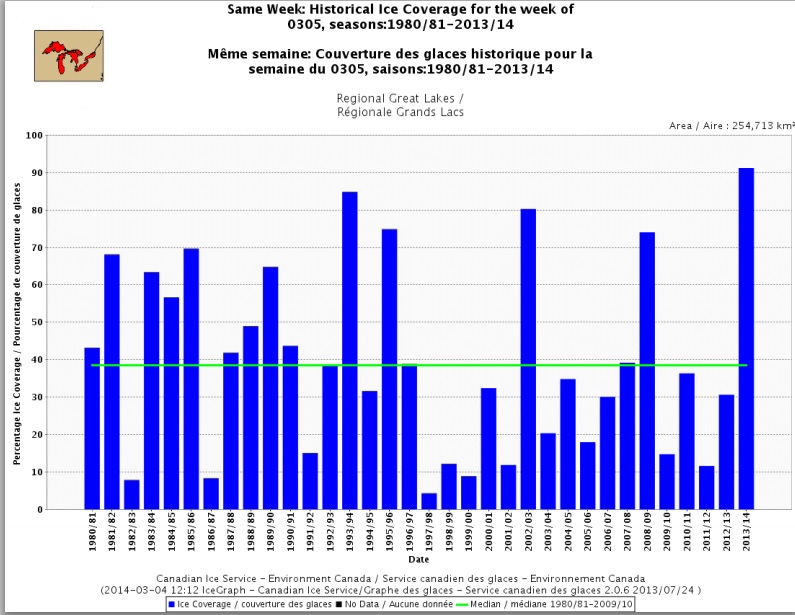
Ice cover on the Great lakes typically reaches maximum in the second week of March and the median since 1980 is at about 40%.

This week ice cover reached over 90%. Maximum in a “normal” year would be reached in the second week of March.

Both the diagrams below are from the Canadian Ice Service with the first showing ice cover historically for this week (since 1980) and the second showing the ice cover for this season (2013/2014) with the median for 1980-2010. This season ice cover is running at more than twice the median values.

Historical Great lakes Ice Cover  week of 0304 Canadian Ice Service

Historical Great lakes Ice Cover week of 0304
Canadian Ice Service

Great Lakes Ice Cover Season 2013 - 2014 Canadian Ice Service

Great Lakes Ice Cover Season 2013 – 2014 Canadian Ice Service

Global warming contortionists will no doubt find strange and convoluted explanations to show that this massive increase of ice cover is not inconsistent with global warming. The missing heat could be hiding in the deep waters around the world and Nessie is probably running a fever.

Of course this massive increase of ice cover is also not inconsistent with the start of another Little Ice Age.

The most parsimonious explanation is that the climate and weather are going through their “natural variations” (due directly or indirectly to the Sun) and that there is no missing heat. Which leads to the obvious – but politically incorrect – conclusion that man-made global warming is – at most – insignificant.

Berlin by night and where the wall was

March 4, 2014

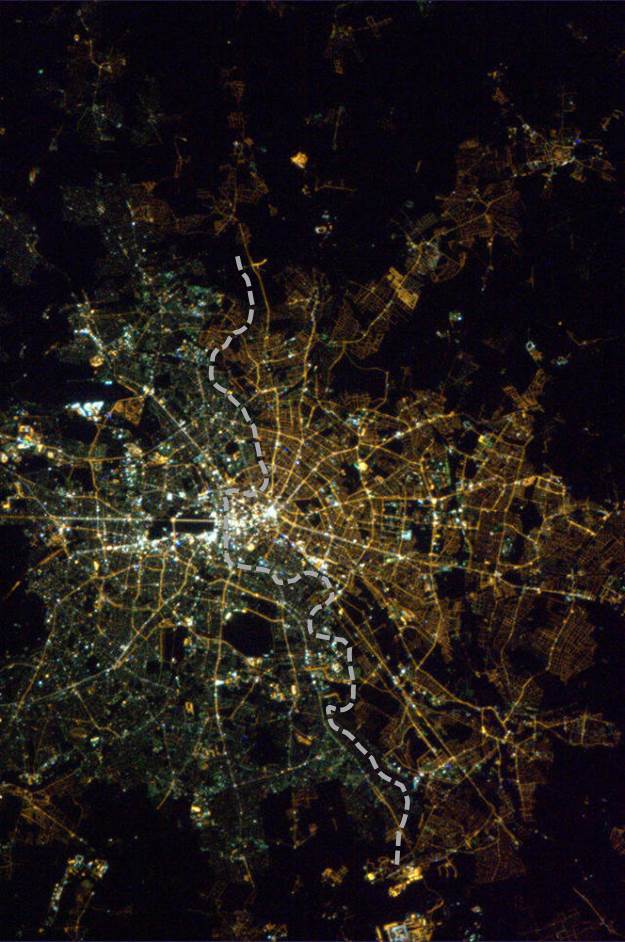
This image of Berlin by night is via Chris Hadfield/Twitter.

The different colour light bulbs in the West and the East still show up 22 years after the Wall fell.

I have superimposed where I think the Wall actually was (approximately) with the grey dotted line.

Berlin by night and where the wall was

Berlin by night and where the wall was

The sun dances to its own tune with unexpectedly high activity in February

March 4, 2014

There is more we don’t know that we don’t know that we don’t know. (with apologies to Donald Rumsfeld).

While Solar Cycle 24 is still showing the lowest sunspot activity in 100 years, its activity during February was unexpectedly high.  And we don’t really know why.

SC24 Feb 2014 graphic NOAA data from informthpundits

SC24 Feb 2014 graphic NOAA data from informthepundits

The increased activity in February was certainly not expected but SC24 still remains at a very low activity level compared to recent Solar Cycles.

SC21 - SC24 from solen.info

SC21 – SC24 from solen.info

It is a little too early to see if the similarities with Solar Cycles 5 and 6 (during the time of the Dalton Minimum) will hold up and lead us into another Little Ice Age. Or whether this Landscheidt Minimum will just lead to a 30 year cooling period without quite producing a Little Ice Age.

Interesting times.

The Sun will continue to dance to its own tune and we will make believe that we know what it is doing.

But we ignore the Sun at our peril.

Plant and virus life revived after 30,000 years in the Siberian permafrost

March 4, 2014

Two years ago we heard about plants being grown from seeds and pods preserved for 30,000 years in the Siberian permafrost. And now comes the news that a giant virus of that time has also been revived and is still capable of infecting other life.

This would have been about 1,500 generations ago. 30,000 years ago the Neanderthals had just disappeared, mammoths, woolly rhinoceros and long-horned bison roamed in Siberia. Modern humans had reached Europe but had not reached the Americas. It was at the peak of the last glacial and the spread of agriculture was still some 15,000 years in the future.

A prehistoric plant resurrected from frozen tissue. S. Yashina et al. Proc. Natl Acad. Sci. USA

1. Wild flower blooms again after 30,000 years on ice 

During the Ice Age, Earth’s northern reaches were covered by chilly, arid grasslands roamed by mammoths, woolly rhinoceros and long-horned bison. That ecosystem, known by palaeontologists as the mammoth steppe, vanished about 13,000 years ago. It has no modern counterpart.

Yet one of its plants has reportedly been resurrected by a team of scientists who tapped a treasure trove of fruits and seeds, buried some 30,000 years ago by ground squirrels and preserved in the permafrost 

The plant would be by far the most ancient ever revived; the previous record holder was a date palm grown from seeds roughly 2,000 years old. ….. . took samples of placental tissue from S. stenophylla fruits. The plant placenta — an example of which is the white matter inside a bell pepper — gives rise to and holds the seeds. The tissue produced shoots when it was cultivated in vitro, and the scientists used these to propagate more plants. They are the oldest living multicellular organisms on Earth, the team says.

The plants have already blossomed to produce fertile seeds, which were grown into a second generation of fertile plants. During propagation, the ancient form of the wild flower produced more buds but was slower to put out roots than modern S. stenophylla, which is found along the banks of the Kolyma. This suggests that the original has a distinct phenotype, adapted to the extreme environment of the Ice Age.

(S. Yashina et al. Proc. Natl Acad. Sci. USA http://dx.doi.org/10.1073/pnas.1118386109; 2012).

2. Giant virus resurrected from 30,000-year-old ice

In what seems like a plot straight out of a low-budget science-fiction film, scientists have revived a giant virus that was buried in Siberian ice for 30,000 years — and it is still infectious. Its targets, fortunately, are amoebae… The newly thawed virus is the biggest one ever found. At 1.5 micrometres long, it is comparable in size to a small bacterium. Evolutionary biologists Jean-Michel Claverie and Chantal Abergel, the husband-and-wife team at Aix-Marseille University in France who led the work, named it Pithovirus sibericum, inspired by the Greek word ‘pithos’ for the large container used by the ancient Greeks to store wine and food. “We’re French, so we had to put wine in the story,” says Claverie. The results are published in Proceedings of the National Academy of Sciences.

Legendre, M. et al. Proc. Natl Acad. Sci. USA http://dx.doi.org/10.1073/pnas.1320670111(2014).

Under a microscope, Pithovirus appears as a thick-walled oval with an opening at one end, much like the Pandoraviruses. But despite their similar shapes, Abergel notes that “they are totally different viruses”. …. Pithovirus has a ‘cork’ with a honeycomb structure capping its opening (see electron-microscope image). It copies itself by building replication ‘factories’ in its host’s cytoplasm, rather than by taking over the nucleus, as most viruses do. Only one-third of its proteins bear any similarity to those of other viruses. And, to the team’s surprise, its genome is much smaller than those of the Pandoraviruses, despite its larger size. ….

While “cloning” of ancient and extinct species is not really possible, it is not too fanciful to imagine that ancient DNA and modern hosts could give rise to creatures having characteristics beneficial during an ice age. And perhaps that could be of some interest when this interglacial ends – as it must – and we do enter into another glacial period.

Cold resistant, woolly cattle and well trained sabre-tooth tigers to mange the wandering herds perhaps. Maybe we might then even want some extra Neanderthal DNA injected into us!! Finally a use for biodiversity!

On when speech may have originated

March 3, 2014

A new paper suggests that the Kebara 2 Neanderthals, some 60,000 years ago, not only had the capability but also used speech. The capability for speech itself has now been pushed back to the common ancestors of Anatomically Modern Humans, Neanderthals and Denisovans to about 500,000 years ago. The picture we have of Neanderthals is now of a fairly sophisticated and complex species:

  1. Neanderthals may have spoken in a similar way to modern humans.
  2. Neanderthals are our closest extinct human relatives.
  3. Neanderthal DNA is over 99% identical to modern human DNA.
  4. Several theories for Neanderthal extinction exist, including impacts of climate change, competition with human beings, and the possibility that Neanderthals and humans interbred and were ‘absorbed’ into the human species.
  5. Neanderthals lived in Eurasia 200,000 – 30,000 years ago in the Pleistocene Epoch
  6. Neanderthals and our human ancestors lived on Earth at the same time.
  7. Neanderthals lived in family groups and looked after their sick and infirm. 
  8. Neanderthals used tools made from bone, stone, antlers and other materials. 
  9. Neanderthals used fire, and even ate cooked vegetables. 

Moreover it is clear that all non-Africans carry some 3% of Neanderthal genes. And so – in my speculation – it would be perfectly consistent with not only the Neanderthals of the Kebara 2 study having speech, but also with all Neanderthals from about 200,000 years ago, having some form of – at least – rudimentary speech.

I have no doubt that speech originated from an intense need to communicate and developed in complexity and sophistication as the complex needs of the societies that developed required more nuanced communication. And if this happened 500,000 years ago then I find it not implausible that there are connections between the controlled use of fire, the growth of complex social interactions, the need for nuanced communications and the development of speech.

Visions arise of camp fires and a society with time for gatherings and then – inevitably – for story-telling! And for tall tales. Lying after all is a construct of language!

But speech was probably invented many times and only became language when some critical mass of people shared the same sounds for the same meanings. Within a single tribe or troop this critical mass for the beginnings of a rudimentary language was probably no more than a handful of individuals. What the first words ever spoken were can only be a matter of speculation. A case can be made for the “ma”, “ba” and “pa” sounds being the first to be repeated but also among the earliest ever words for communication would have been danger, here, there, up, down, you, me, stop, come and go.

Kerry to lead the charge of the G-7 light brigade

March 3, 2014

Washington (AFP)US Secretary of State John Kerry will travel to Kiev this week in a show of support for the embattled leadership, as Washington and its allies slammed Moscow for violating Ukraine’s sovereignty.

kerry to lead the charge on kiev

kerry to lead the charge on kiev

The Crimea has seen its full share of wars, progroms, forced displacements and ethnic cleansing. It has been “ceded” to Ukraine since 1954. And now, as the Ottomans once allied with France and the UK  against Russia,  the Neo-Nazis of Ukraine are finding allies among the US, NATO and the EU  (G-7).

But Crimea contains 60% Russians!

With apologies to Alfred, Lord Tennyson:

Half a step, half a brain,
 Half a plan given,
All into the valley of Fools
 Rode the G-seven.
“Forward, the Light Brigade!
“It’s for Democracy” he said:
Into the valley of Fools
 Rode the G-seven!

“Forward, the Light Brigade!”
Was there no one  dismayed?
Tho’ every single member knew
 He had no discretion:
Barack Obama had made reply
Kerry had his own fish to fry
Theirs not to question why,
As into the valley of Fools
 Rode the G-seven!

“Peer review is a regression to the mean. ….. a completely corrupt system” – Sydney Brenner

March 2, 2014
Sydney Brenner

Sydney Brenner, CH FRS (born 13 January 1927) is a biologist and a 2002 Nobel prize laureate, shared with H. Robert Horvitz and John Sulston. Brenner made significant contributions to work on the genetic code, and other areas of molecular biology at the Medical Research Council Unit in Cambridge, England.

A fascinating interview with Professor Sydney Brenner by Elizabeth Dzeng in the Kings Review.

I find his comments on Academia and publishing and peer review  particularly apposite. Peer review – especially where cliques of “peers” determine “correct thinking” – can not provide sufficient room for the dissenting view, for the challenging of orthodoxy. Orthodox but incorrect views thus persist for much longer than they should. Completely new avenues are effectively blocked and ideas are still-born.

Some extracts here but the whole conversation is well worth a read.

How Academia and Publishing are Destroying Scientific Innovation: A Conversation with Sydney Brenner

by Elizabeth Dzeng, February 24th

I recently had the privilege of speaking with Professor Sydney Brenner, a professor of Genetic medicine at the University of Cambridge and Nobel Laureate in Physiology or Medicine in 2002. ….

SB: Today the Americans have developed a new culture in science based on the slavery of graduate students. Now graduate students of American institutions are afraid. He just performs. He’s got to perform. The post-doc is an indentured labourer. We now have labs that don’t work in the same way as the early labs where people were independent, where they could have their own ideas and could pursue them.

The most important thing today is for young people to take responsibility, to actually know how to formulate an idea and how to work on it. Not to buy into the so-called apprenticeship. I think you can only foster that by having sort of deviant studies. ……..

…… I think I’ve often divided people into two classes: Catholics and Methodists. Catholics are people who sit on committees and devise huge schemes in order to try to change things, but nothing’s happened. Nothing happens because the committee is a regression to the mean, and the mean is mediocre. Now what you’ve got to do is good works in your own parish. That’s a Methodist. 

ED: …….. It is alarming that so many Nobel Prize recipients have lamented that they would never have survived this current academic environment. What is the implication of this on the discovery of future scientific paradigm shifts and scientific inquiry in general? I asked Professor Brenner to elaborate.

SB: He wouldn’t have survived. It is just the fact that he wouldn’t get a grant today because somebody on the committee would say, oh those were very interesting experiments, but they’ve never been repeated. And then someone else would say, yes and he did it a long time ago, what’s he done recently?  And a third would say, to top it all, he published it all in an un-refereed journal.

So you know we now have these performance criteria, which I think are just ridiculous in many ways. But of course this money has to be apportioned, and our administrators love having numbers like impact factors or scores. ….

……. And of course all the academics say we’ve got to have peer review. But I don’t believe in peer review because I think it’s very distorted and as I’ve said, it’s simply a regression to the mean.

I think peer review is hindering science. In fact, I think it has become a completely corrupt system. It’s corrupt in many ways, in that scientists and academics have handed over to the editors of these journals the ability to make judgment on science and scientists. There are universities in America, and I’ve heard from many committees, that we won’t consider people’s publications in low impact factor journals.

Now I mean, people are trying to do something, but I think it’s not publish or perish, it’s publish in the okay places [or perish]. And this has assembled a most ridiculous group of people.

…….. I think there was a time, and I’m trying to trace the history when the rights to publish, the copyright, was owned jointly by the authors and the journal. Somehow that’s why the journals insist they will not publish your paper unless you sign that copyright over. It is never stated in the invitation, but that’s what you sell in order to publish. And everybody works for these journals for nothing. There’s no compensation. There’s nothing. They get everything free. They just have to employ a lot of failed scientists, editors who are just like the people at Homeland Security, little power grabbers in their own sphere.

If you send a PDF of your own paper to a friend, then you are committing an infringement. Of course they can’t police it, and many of my colleagues just slap all their papers online. I think you’re only allowed to make a few copies for your own purposes. It seems to me to be absolutely criminal. When I write for these papers, I don’t give them the copyright. I keep it myself. That’s another point of publishing, don’t sign any copyright agreement. That’s my advice. I think it’s now become such a giant operation. I think it is impossible to try to get control over it back again. …….. Recently there has been an open access movement and it’s beginning to change. I think that even NatureScience and Cell are going to have to begin to bow. I mean in America we’ve got old George Bush who made an executive order that everybody in America is entitled to read anything printed with federal funds, tax payers’ money, so they have to allow access to this. But they don’t allow you access to the published paper. They allow you I think what looks like a proof, which you can then display.

Elizabeth Dzeng is a PhD candidate conducting research at the intersection of medical sociology, clinical medicine and medical ethics at the University of Cambridge. She is also a practising doctor and a fellow in General Internal Medicine at the Johns Hopkins School of Medicine.