Pointless, Reblogged from Science is Beauty
Scientific excellence can only truly be judged by history. But history has eyes only for impact and if excellent science causes no great change to science orthodoxy, it is soon forgotten. For a scientist the judgements of history long after he performs his science are of no real significance. Even where academic freedom is the main motivator for the scientist, the degrees of freedom available are related to academic success. An academic or scientific career depends increasingly on contemporaneus judgements – and here social networking, peer review and bibliometric factors are decisive. There may well be some correlation between academic success and the “goodness” of the scientist but it is not the success or the bibliometrics which are causative.
As Lars Walloe puts it: Walloe-on-Exellence
In the evaluation process many scientists and nearly all university and research council administrators love all kind of bibliometric tools. This has of course a simple explanation. The “bureaucracy” likes to have a simple quantitative tool, which can be used with the aid of a computer and the internet to give an “objective” measure of excellence. However, excellence is not directly related either to the impact factor of the journal in which the work is published, or to the number of citations, or to the number of papers published, or even to some other more sophisticated bibliometric indices. Of course there is some correlation, but it is in my judgement weaker than what many would like to believe, and uncritical use of these tools easily leads to wrong conclusions. For instance the impact factor of a journal is mainly determined by the very best papers published in it and not so much by the many ordinary papers published. We know well that even in high impact factor journals like Science and Nature or high impact journals in more specialized fields, from time to time not so excellent papers are being published.
….. I often meet scientists for whom to obtain high bibliometric factors serve as a prime guidance in their work. Too many of them are really not that good, but were just lucky or work in a field where it was easier to get many citations. …..If you are working with established methods in a popular field you can be fairly sure to get your papers published. I can mention in details some medical fields were I know that this has happened or is happening today. The scientists in such fields get a high number of publications and citations, but the research is not necessarily excellent.
And getting your paper published has now become so important in the advancement of an academic career that journals are proliferating. Many of the new journals have now shifted their business models to be based on author’s fees and not on volume of readership. This is a very “safe” business model since profits are ensured before the journal has even been published and if the journal is an on-line journal then costs are minimal. It is virtually the “self-publishing” of papers. You pay your money and get your paper published.
The reality today is that more papers are being published by more authors in more journals than ever before. But fewer are being actually read. Papers are cited without having been read – let alone understood.
Another reason could be that publishers, particularly those who charge authors fees for publishing, are in the business of making money.
Authoring journal articles is not only enhancing to one’s CV (the old “publish or perish” cliché), it is required by Residency Review Committees as evidence of “scholarly activity” in training programs. Maybe it’s good for attracting referrals too.
The publish or perish ethos has led to a proliferation of the number of authors per paper!
First noted in 1993 by a paper in Acta Radiologica and a letter in the BMJ, the number of authors per paper has risen dramatically over the years.
A study of 12 radiology journals found the number of authors per paper doubled from 2.2 in 1966 to 4.4 in 1991. A review of Neurosurgery and the Journal of Neurosurgery spanned 50 years. the average went from 1.8 authors per article in 1945 to 4.6 authors in 1995.
Of note, the above two articles were each written by a single author.
Three psychiatrists from Dartmouth analyzed original scientific articles in four of the most prestigious journals in the United States—Archives of Internal Medicine, Annals of Internal Medicine, Journal of the American Medical Association, and the New England Journal of Medicine—from 1980 to 2000. They found that the mean number of authors per paper increased from 4.5 to 6.9. The same is true for two plastic surgery journals, which saw the average number of authors go from 1.4 to 4.0 and 1.7 to 4.2 in the 50 years from 1955 to 2005. The number of single-author papers went from 78% to 3% in one journal and 51% to 8% another.
In orthopedics, a review of the American and British versions of the Journal of Bone and Joint Surgery for 60 years from 1949 to 2009 showed an increase of authors per paper from 1.6 to 5.1.
An impressive rise in the number of authors took place in two leading thoracic surgery journals. For the Journal of Thoracic and Cardiovascular Surgery the increase was 1.4 in 1936 to 7.5 2006 and for Annals of Thoracic Surgery it was 3.1 in 1966 to 6.8 in 2006.
And the winner is a paper with 3171 authors! Needles to say it comes from Big Science and the Large Hadron Collider:
the paper with the most authors is “Observation of a new particle in the search for the Standard Model Higgs boson with the ATLAS detector at the LHC” in a journal called “Physics Letters B” with 3171. The list of authors takes up 9 full pages.
Too many journals, too many papers, too many authors and too many citations. But that does not mean there is more excellence in science.
One wonders what the purpose of the Copenhagen Zoo is? First they breed them. Then if they don’t like them or find them surplus to requirements they kill them. They invite zoo visitors to the autopsy. Why not to the executions? A healthy, 18 month old giraffe bred by the Copenhagen Zoo was killed off for being surplus to requirements (genetically)! Why breed it in the first place? And apparently this is standard practice.
If it had been culled in the wild because of an excess population it might have felt different. And the zoo had been offered alternatives.

Marius the giraffe bred to be killed by Copenhagen Zoo
I hope visitors to the Copenhagen Zoo dry up.
From the Copenhagen Post:
An online petition to save the life of a young giraffe at Copenhagen Zoo is currently accumulating close to 2,000 votes an hour. But all the votes are in vain because the unfortunate animal was destroyed this morning in accordance with the zoo’s policy on in-breeding.
The zoo said it has taken the decision to kill the 18-month-old male giraffe Marius and feed him to some of his fellow animals at the zoo in order to keep the giraffe population “genetically sound”.
“Giraffes today breed very well, and when they do you have to choose and make sure the ones you keep are the ones with the best genes,” Bengt Holst, the scientific director at the zoo, explained to the BBC.
Between 20 and 30 animals are put down in a similar fashion every year, added Holst. According to Ekstra Bladet tabloid, this has included bears, tigers and zebras.
…. Marius was killed by a bolt gun instead of a lethal injection, which would have contaminated the meat.
While most of him will be fed to the carnivores at the zoo, part of his carcass will be used for scientific research. Visitors to the zoo on Sunday were invited to attend the autopsy.
Ottawa Citizen: Copenhagen Zoo turned down offers from other zoos and 500,000 euros ($680,000) from a private individual to save the life of a healthy giraffe before killing and slaughtering it Sunday to follow inbreeding recommendations made by a European association.
The 2-year-old male giraffe, named Marius, was put down using a bolt pistol and its meat will be fed to carnivores at the zoo, spokesman Tobias Stenbaek Bro said. Visitors, including children, were invited to watch while the giraffe was dissected.
Marius’ plight triggered a wave of online protests and renewed debate about the conditions of zoo animals. Before the giraffe was killed, an online petition to save it had received more than 20,000 signatures.
Stenbaek Bro said the zoo, which now has seven giraffes left, was recommended to put down Marius by the European Association of Zoos and Aquaria because there were already a lot of giraffes with similar genes in the organization’s breeding program.
The Amsterdam-based EAZA has 347 members, including many large zoos in European capitals, and works to conserve global biodiversity and to achieve the highest standards of care and breeding for animals.
Bengt Holst is the scientific director of Copenhagen Zoo who has implemented this policy of the EAZA.
Zoos are of course just places of entertainment for humans and I don’t really think they perform any other useful function. And I don’t much believe that their much vaunted “conservation” which consists of freezing an unsuccessful species in an artificial habitat does that species any service at all.
Meanwhile in the UK: lioness and cubs who were the pride of Longleat are put down
Graphic pictures of Marius being cut up and fed to the lions.
Ole Einar Bjørndalen, 40 years old, 6th consecutive Olympic Games, 20 years of competition at the highest level, 12 Olympic medals, 7 Olympic Golds (so far), all in the biathlon. Wow! On only the second day of the Sochi games and my “sense of Wow” has been well and truly engaged.
I watched the 10km biathlon sprint yesterday at Sochi and Bjørndalen, in spite of missing one target in the shooting, was strong enough in the skiing sections to win. He was not the favorite since his results this season have not been spectacular and he has generally been considered the veteran in the twilight of his competitive career. Wow!
His Olympics career has been both long and spectacular:

Bjoerndalen Olympics medals (2014-02-09) Wikipedia
He still has the chance of winning a few more medals.
BBC: Norway’s Ole Einar Bjoerndalen equalled the record for most medals won at the Winter Olympics as the 22nd Games got under way in Sochi, Russia. Bjoerndalen, 40, won the biathlon 10km sprint to take his tally to 12 medals, matching compatriot Bjoern Daehlie.
Bjoerndalen finished ahead of Austria’s Dominik Landertinger and Czech biathlete Jaroslav Soukup to claim the seventh Olympic gold medal of his career.
“This victory has been a four-year job and it has been many years since I won (an individual gold medal), but life is too short to give up,” said Bjoerndalen. “I think this is one of my most important victories.” The Norwegian will get the chance to break Daehlie’s record in the men’s pursuit on Monday, but he played down comparisons between the pair. “It’s difficult to compare us at this time because Bjorn was some years ago and now we have a lot more disciplines,” he said.
The only faint shadow I perceive is that the achievements at Sochi not be later spoilt by revelations about doping. Whether or not Lasse Viren ever indulged in blood doping, some other Finnish athletes of his day did but it was not illegal at the time (1970’s). The Norwegian ski team in the 1990’s have also been accused of dirty tricks. The intense Alpine skiing events have had their share of rumours. Marit Bjoergen also won a gold yesterday in the skiathlon. She takes asthma medicine and has had dispensation to do so when it contained a banned substance (which is no longer banned upto certain quantities). In any event she has also faced accusations from her peers that her asthma inhaler was performance enhancing. I suppose being able to breathe is performance enhancing. But I thought that Pistorius being allowed to use blades to run in the summer Olympics was ridiculous. Why not allow a javelin thrower with a weak arm to use a “spear-thrower” attachment to his arm?
Usain Bolt generates a sense of Wow and there are no indications that he is anything but “clean”. But so did Ben Johnson generate the same sense of Wow when he won. And even Lance Armstrong. More often than not rumours of dirty tricks have – much later – been found to be true and sometimes banned.
I have a feeling that athletic team directors and doctors are continuously looking for legal performance enhancing methods and it takes a little time before any new methods discovered become widely known, spread and are then banned (like blood doping). For an armchair spectator like me it is “the sense of Wow” which attracts and captures my imagination. I just hope that my “sense of Wow” – not just at Bjørndalen’s fantastic achievements– are not deflated and destroyed by later revelations of dirty tricks – even if they are not illegal for now.
A new paper suggests that the biomass of mesopelagic fish which dominate the total biomass of fish in the ocean is 10 times higher than previously assumed. Instead of being about 1,000 million tens the researchers suggest it could be 10,000 million tons or even more.
Fish are a critical link in the Carbon cycle and especially the removal – by “fixing” as carbonates – of the carbon dioxide in sea water. They act to neutralise acidity and increase alkilinity. The level of carbon dioxide dissolved in sea water itself affects the capacity of the ocean surface waters to absorb more carbon dioxide. A change – by a factor of 10 – in the fish biomass is a not insignificant change to the carbon fluxes through the ocean and to the carbon cycle.
Xabier Irigoien et al, Large mesopelagic fishes biomass and trophic efficiency in the open ocean. Nature Communications, 2014; 5 DOI:10.1038/ncomms4271
EurekAlert: With a stock estimated at 1,000 million tons so far, mesopelagic fish dominate the total biomass of fish in the ocean. However a team of researchers ….. has found that their abundance could be at least 10 times higher. The results, published in Nature Communications journal, are based on the acoustic observations conducted during the circumnavigation of the Malaspina Expedition. … Mesopelagic fishes, such as lantern fishes (Myctophidae) and cyclothonids (Gonostomatidae), live in the twilight zone of the ocean, between 200 and 1,000 meters deep. They are the most numerous vertebrates of the biosphere, but also the great unknowns of the open ocean, since there are gaps in the knowledge of their biology, ecology, adaptation and global biomass.
… Xabier Irigoien, researcher from AZTI-Tecnalia and KAUST (Saudi Arabia) and head of this research, states: “The fact that the biomass of mesopelagic fish (and therefore also the total biomass of fishes) is at least 10 times higher than previously thought, has significant implications in the understanding of carbon fluxes in the ocean and the operation of which, so far, we considered ocean deserts”.
Mesopelagic fish come up at night to the upper layers of the ocean to feed, whereas they go back down during the day in order to avoid being detected by their predators. This behaviour speeds up the transport of organic matter into the ocean, the engine of the biological pump that removes CO2 from the atmosphere, because instead of slowly sinking from the surface, it is rapidly transported to 500 and 700 meters deep and released in the form of feces.
Irigoien adds: “Mesopelagic fish accelerate the flux for actively transporting organic matter from the upper layers of the water column, where most of the organic carbon coming from the flow of sedimentary particles is lost. Their role in the biogeochemical cycles of ocean ecosystems and global ocean has to be reconsidered, as it is likely that they are breathing between 1% and 10% of the primary production in deep waters”.
According to researchers, the excretion of material from the surface could partly explain the unexpected microbial respiration registered in these deep layers of the ocean. Mesopelagic fishes would act therefore as a link between plankton and top predators, and they would have a key role in reducing the oxygen from the depths of the open ocean.
The mechanisms by which fish create carbonates and contribute to the “fixing” of carbon dioxide is through feces.
Fish feces reduce ocean CO2 levels
.. when fish drink seawater they excrete calcium as calcium carbonate — a chalky substance that can make seawater more alkaline and diminish the carbon dioxide in the water. ….. the bulk of the world’s fish species, excluding sharks and rays, produced the carbonate to counter the salt they ingested in seawater. The carbonate binds to the salt and is expelled as pellets, which dissolve in the ocean. … (We) knew before that something in the water was producing carbonate, but believed it came from other sources, such as microscopic marine plankton near the bottom of the food chain. But (we) didn’t understand why they were seeing so much of the carbonate at shallower depths. ……. most conservative estimates suggest three to 15 per cent of the oceans’ carbonates come from fish, but this range could be up to three times higher.

Oceanic divisions (Wikipedia)
The Great Lakes ice cover on 7th February had reached 78% and will continue increasing in the coming days – at least until the 3rd week of February (Source: NOAA).
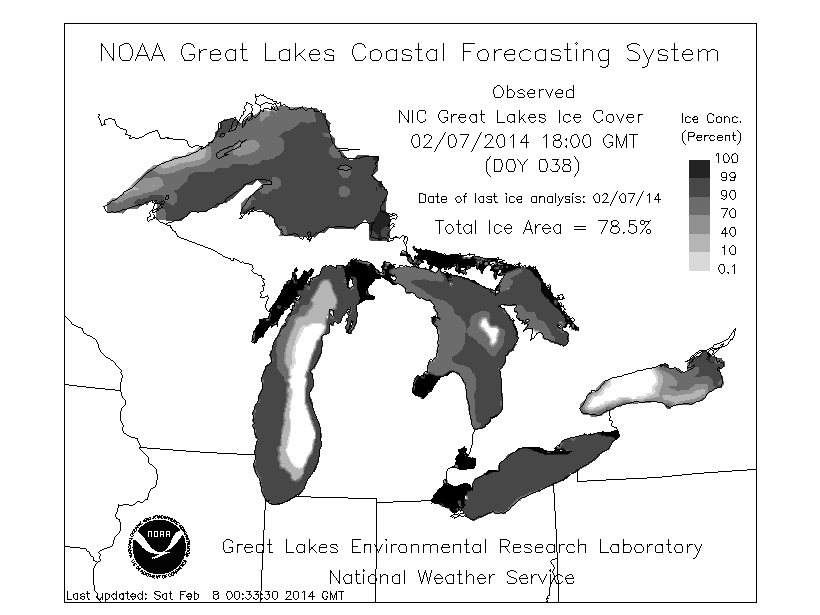
Gl Ice 7th February 2014 NOAA
Having a high ice cover is apparently a “good thing” . Jeff Masters writes:
The increased ice coverage on the Great Lakes this winter is good news for water levels on the lakes, which are still struggling to recover from some record lows recorded at this time last year. During January 2013, water levels on Lake Michigan and Lake Huron fell to their all-time lowest values since record keeping began in 1918, 29 inches below the long-term average. While the water levels recovered substantially during 2013, which was one of the wettest years in Michigan’s history, water levels were still a foot below average at the beginning of 2014. The above average ice cover this winter will reduce evaporation from the Great Lakes, keeping water loss lower than in recent winters.
I suppose one can have too much of a good thing and that being completely frozen for too long a time is not a “good thing”.
Historically the ice cover is approaching the highest levels seen for over 20 years. (From Canadian Ice Service)

Great Lakes Ice february 4th 2014 – Canadian Ice Service
If there is a global warming (or global cooling) signal in this chart – I can’t see it. The natural variations are of an amplitude which hides any such signal – if it exists. Whenever weather observations – however extreme – are still within the envelope of what has been observed before it only shows that such observations are not unprecedented and must be taken as to be within natural variations. And if what is observed has also been observed before the industrial revolution – say 200 years ago – then industrialisation cannot be blamed.
Meteorologist Mark Torregrossa writes:
Ice continued to build this past week on the Great Lakes due to the cold air and temperatures staying below freezing, and Lake Superior’s new record shows it.
The lake is 92 percent frozen, toppling a 20-year-old record of 91 percent set on Feb. 5, 1994. That statistic helped total Great Lakes ice cover soar, and we can expect to see more form in coming days.
The air temperatures this past week averaged around five degrees below normal for the Great Lakes area. This amount of deviation from normal means it was a fairly cold week.
…..
Lake Superior
Lake Superior is almost frozen over as of yesterday February 5, 2014. Lake Superior is 92 percent covered with ice now. The ice has increased rapidly in the past week, from 76 percent ice cover on January 30, 2014. The high resolution satellite picture from February 3, 2014 shows all of the ice cover on Lake Superior. The current ice cover on Lake Superior is the highest amount ever for February 5. In 1994, Lake Superior was reportedly 91 percent covered in ice.
Lake Michigan
Lake Michigan is now 51 percent covered with ice, as opposed to 42 percent at this time last week. Coyotes were seen walking on the ice just offshore of Chicago this week. This makes us wonder if the lakes freeze over totally, will animals from Canada be able to cross over Lake Huron or Lake Superior, and enter Michigan. It is thought that this is how the last wolverine spotted in Michigan made it into Michigan. Lake Michigan has been covered with more ice on this date in the past. In 1977 and 1996, Lake Michigan was up to 74 percent ice covered.
Lake Huron
Ice cover on Lake Huron rocketed up an additional 14 percent this week, climbing to a total ice cover of 86 percent. If the ice continues to build at that rate in this next week, Lake Huron could be almost frozen over, or frozen over by the end of next week. People ice fishing are reporting 24 inches of ice on Saginaw Bay near Bay City. Lake Huron has been as much at 95 percent covered in ice on this date back in 1981 and 1994.
Lake Erie
Lake Erie is the shallowest of the Great Lakes, with an average depth of 62 feet and a maximum depth of 210 feet. It also has the least volume of any Great Lake, with 116 cubic miles of water. So it should come as no surprise that Lake Erie currently has the highest percentage of ice cover. Lake Erie is 96 percent covered with ice. Last week at this time Lake Erie had 94 percent ice cover. Erie was entirely ice covered on February 5, 1996.
Lake Ontario
Lake Ontario is an interesting lake. It is the smallest Great Lake when it comes to surface area, but actually holds more than three times the amount of water when compared to Lake Erie. The average depth of Lake Ontario is 283 feet, making it the second deepest Great Lake behind Lake Superior. The deepest spot in Lake Ontario is 802 feet. The ice cover on Lake Ontario is the lowest of any of the Great Lakes, with only 32 percent covered in ice. Last week at this time, Lake Ontario had 27 percent ice cover. Lake Ontario has been covered with as much as 79 percent ice up to this point in the winter in 1994.
The Purdue University School of Nuclear Engineering is the unlikely location for a tangled, sordid tale which I cannot make much sense of.
Professor Rusi Taleyarkhan is either a somewhat naive victim of a nasty conspiracy or he is guilty of academic misconduct and has received his just deserts. But his primary anatgonist was Professor Lefteri Tsoukalas once the head of the School of Nuclear Engineering but who was forced to resign as head by Purdue. Purdue removed Taleyarkhan’s endowed professorship, reduced his salary, and limited his duties with students. There is a murky connection between a journalist Eugenie Reich and Tsoukalas while Reich was promoting her book about scientific misconduct and there was some form of cooperation between them and a number of others to accuse Taleyarkhan.
Once I got this far I gave up.
There is quite obviously a great deal of muck in the Purdue University School of Nuclear Engineering. The University is probably vacillating between support for the warring academics. The role of the journalist is what adds to the possibility of a nasty conspiracy.
It seems too tawdry to waste much time on though, of course, some careers are being destroyed and someone is – or both are – indulging in defamation.
The New Energy Times has a whole series of articles on the subject. They seem to feel that Talayarkhan has been badly wronged. This article in TwoCircles also takes that position. Tsoukalas puts his position in a letter provided to the New York Times (in 2007).
Oh what a tangled web they weave. It’s all about low-energy, table-top fusion — so it is all probably a hurricane in a thimble. I cannot help observing that cold fusion and claims of misconduct generally seem to go hand-in-hand!
For once it was not the NSA bugging some European leader. Presumably it was the Russians bugging US diplomats. Victoria Nuland the US diplomat for European and Eurasian affairs reportedly said ‘Fuck the EU’ while speaking of the Ukraine crisis with the US ambassador to Ukraine Geoffrey Pyatt.
I will not be surprised if this recording disappears from You Tube if the US applies pressure – through the horse has bolted.
The US like many others may be frustrated with the EU but what is fairly clear is that the US is very actively advising – if not directing – the Ukraine opposition.The modern version of the Great Game being played out in Syria and Ukraine.
BBC: A voice resembling that of Assistant Secretary of State Victoria Nuland refers to the EU using a graphic swear word, in a conversation apparently with to the US ambassador to Ukraine. The US said Ms Nuland had “apologised for these reported comments”.
The EU and US are involved in talks to end months of unrest in Ukraine. ….
Russia has been widely accused of intervening in Ukraine, using its economic clout to persuade Mr Yanukovych to abandon closer ties with Brussels. Russia has itself accused Washington and the EU of meddling in Ukraine.
The 4min 10sec video was entitled “Maidan’s puppets” in Russian – a reference to the square in the Ukrainian capital, Kiev, where pro-EU protests have been held for months. A transcription of the whole conversation was also posted in Russian.
At one point, the female speaker mentions the UN and its possible role in trying to find a solution to the Ukraine stand-off.
She says: “So that would be great, I think, to help glue this thing and have the UN help glue it and you know…” she then uses the graphic swear word about the EU.
The male replies: “We’ve got to do something to make it stick together, because you can be pretty sure that if it does start to gain altitude the Russians will be working behind the scenes to try to torpedo it.”
The two officials also discuss frankly the merits of the three main Ukrainian opposition leaders – Vitaly Klitschko, Arseniy Yatseniuk and Oleh Tyahnybok.
In November last year I posted about this paper which used economic factors to develop a model for Olympics medal results and then used the model to predict medals won at the Sochi Winter Olympics starting today. Today Price Waterhouse Coopers (PwC) have with great fanfare made their predictions for the winter Olympics. In their press release they make no mention of this earlier paper
W Andreff, Economic development as major determinant of Olympic medal wins: predicting performances of Russian and Chinese teams at Sochi Games, in Int. J. Economic Policy in Emerging Economies, 2013, 6, 314-340.
The PwC predictions are slightly different but remarkably similar to the results published by Andreff. They claim to have looked at the same factors as Andreff did. They make the same prediction of home advantage for Russia as Andreff did. I don’t have access to their full report but their press release makes absolutely no reference to the earlier paper and seeks to take credit for the analysis. If their report makes no acknowledgement of the work by Andreff then it does look very much like plagiarism by PwC. Even if their “econometric” model has been developed independently, it is still a plagiarism of ideas if an acknowledgement of Andreff’s analysis has not been made.
Andreff Result Predictions:
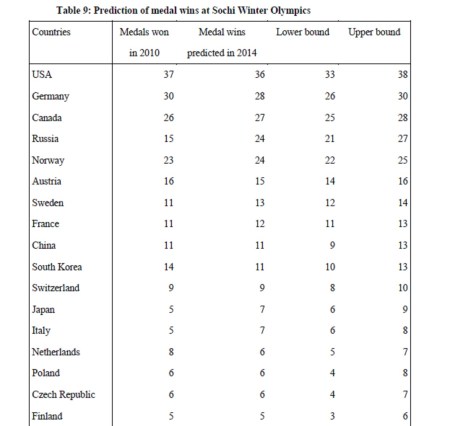
Medal predictions Sochi 2014 – M Andreff
PWC Medal Predictions

PWC sochi predictions
Press Release via ConsultantNews:
London, 31 Jan 2014As with the Summer Olympics, home advantage could play a key part in how the Winter Olympics medals are shared out next month – with hosts Russia looking set to capture a record haul.
But the hosts – along with close rivals Germany, Canada, Austria and Norway – will have their work cut out to catch the US team. Further down the table, after their London 2012 Olympics success, the GB team may have to settle for just a couple of medals. And unfortunately the cool Jamaican bobsled team don’t even make it into the running.
Once again, economists at PwC have used their skills to project the likely medal tally – this time for the Olympic Winter Games at Sochi starting on 7 February. Their analysis is based on econometric modelling, testing the historic correlation between a range of socio-economic metrics and historic medal success.
The modelling results show that the size of the economy is significant in determining success, with total GDP appearing as a significant variable. However, a large economy is not sufficient on its own for a strong performance. Climate is an important factor, with snow coverage and the number of ski resorts per head having a significant and positive impact on medal shares.
Larger, developed countries with the right climate dominate the top of the projected medals table; but Austria and Norway demonstrate that a smaller economy is not a barrier to success, with a greater estimated medal haul than countries such as China and France.
William Zimmern, PwC economist, said: “While this is a light-hearted analysis, it makes an important point of how organisations can use economic techniques to help make better business decisions. The purpose of our model is not to forecast medal totals with complete accuracy, but rather to increase the predictive power of medal projections over and above using historic medal results alone.
The model allows us to make better, more confident and more informed forecasts. Businesses can use similar techniques to do the same.”

Home advantage – PwC
We used regression analysis to produce the results in Table 1, employing a Tobit model to estimate medal share for the 28 countries which have won at least one medal in the last three Winter Olympics. The variables used were total GDP, ski resorts per head, level of snow coverage, medal shares in the previous two Winter Olympics, and dummies for countries with a “tradition” of winter sports and for host countries.
I have worked with PwC many times during my career. They are very effective but they are not slow in trying to take credit wherever they can – even if it is undeserved. And their ethics are generally as lacking as is endemic in their industry (audit/consultancy). A little bit of plagiarism by PwC – and not for the first time – would not be a great surprise.
Among xkcd‘s better ones.
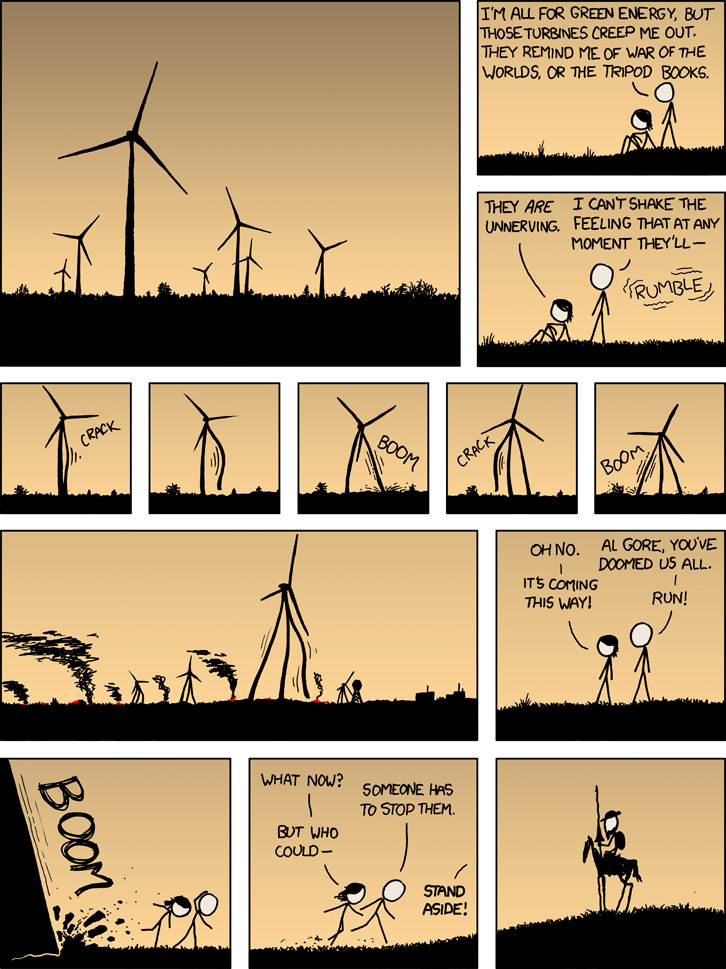
Alternative Energy Revolution
But who can take the role of Don Quixote?
and will he repair the turbines or just kill them all off?

 The k2p blog