Minus 42°C – back to a normal winter after a mild Christmas

January 21, 2014

This Christmas was the mildest in about 10 years but things are getting back to normal winter conditions. We have now had plenty of snow and are currently going through another cold wave. In the north of Sweden temperatures dropped to minus 42°C.

The usual chaos on the roads and with train traffic. My back hurts – as usual – after clearing snow from our garden path. Its only minus 12°C at the moment but thank goodness for electricity.

It’s just weather and we may even come up – temporarily – to a high of 0°C sometime next week. But the days are getting longer and summer is surely on its way.

Photo: Björn Lindgren/TT

The Local

Sunday night saw the lowest temperature of the season when Karesuando in the far north hit -41.9°C, but the mercury didn’t stop there.

“It was -42.5°C in the early morning hours,” said Lisa Frost, meteorologist at Sweden’s weather agency SMHI. “The high pressure system is still hanging over northern Scandinavia. These temperatures are here to stay for the coming days.

Photo: Johan Nilsson/TT

Greens are close to Trotskyites

January 21, 2014

I have always felt that the Green movement was penetrated and then effectively taken over by the extreme left who had no place to go after the fall of communism. This takeover by the extreme left – whether they were Maoists, Trotskyites or Leninists – coincides with when the Green movement moved from local environmental issues (where they did a great job) to large “global” issues – where they have been remarkably ineffective and terribly destructive. These global issues (climate, GM crops…) are ostensibly about large abstract (but non-existent)  threats but really concerned with furthering the communistic ideals of wealth redistribution.

Now Lord Deben (the former John Gummer) – who has not himself been above making money from “green” policies – labels the Greens openly as Trotskyites (though it may have more to do with the money he stands to make by promoting the fracking of shale). Gummer has been quite happy to be allied with the Trotskyites when it has suited him to promote renewable energy. But now it is not sustainable for Europe to perpetuate its lack of competitivity against the US with gas prices 3 times higher and electricity prices twice as high as in the US. And these high costs are almost entirely due to the misguided “green” policies in the EU (which have only succeeded in replacing nuclear power with coal). Fracking is inevitable and while Gummer is just ensuring his own future, it suits him to expose the undoubted extremism of the “Greens”.

The Guardian:

Lord Deben, who is chairman of the Committee on Climate Change, said those who condemn fracking as extremely damaging are taking a “nonsensical position” and called on environmentalists who take a more “sensible” view to disassociate themselves from these groups.

In an interview with the Guardian, the Conservative ex-cabinet minister, formerly known as John Gummer, argued that the best way of protecting the planet is broad agreement about practical solutions, including exploitation of Britain’s shale gas reserves. 

He said the fight against climate change will not be won if moderates allow their position to be associated with campaigners who have “extremist” views close to Trotskyism that are not really connected to the environment.

The chairman’s remarks are likely to prove controversial with groups that strongly oppose fracking, such as Greenpeace, Friends of the Earth, and the Green Party, whose MP Caroline Lucas was arrested during an anti-shale protest in Balcombe in August. They have raised worries about the carbon emissions and potential for water contamination, air pollution, flaring and visual impact on the landscape.

However, David Cameron and many other Conservatives have hailed the technology as a way of possibly bringing down bills and boosting growth, while insisting it will be properly regulated. The prime minister declared last week that he was “going all out for shale”.

Deben would not single out any particular green groups in the UK, but criticised what he called the “Christine Milne school of thought” in the environmental movement – a reference to the leader of the Australian green party, who is a senator for Tasmania.

Poltergeists on Mars

January 21, 2014

Mysterious forces and poltergeists are at work  on Mars (which in due course will be found not to be so mysterious after all). But stories about moving rocks, and possible aliens are not new. The latest however is just doing the rounds based on the pictures SOL 3528 and 3540.

Rock appears mysteriously in front of Mars Opportunity rover

Rock appears mysteriously in front of Mars Opportunity rover

(Phys.org)The lead scientist for NASA’s Mars rover exploration team (Steve Squyres) has announced that recent images beamed back by the Opportunity rover show a rock sitting in a place nearby where there wasn’t one just twelve days prior. The image, he says, has caused quite a commotion with the rover team as possible explanations for the sudden appearance of the rock are bandied about. The announcement was part of a meeting at California Institute of Technology to celebrate a decade of service by the tiny rover. …… 

….. How it got there has NASA’s best scratching their heads. Thus far, they have two main likely explanations: either the rock was tossed to that spot after a meteorite impact nearby, or far more likely, it came to rest there as a result of clumsy maneuvering by Opportunity itself. The rover is having trouble getting around these days as one of its actuators has failed. This means one wheel winds up scrapping the ground during turns, producing what Squyres described as “chatter” which he said could have caused some debris to be flung to where the rock is now.

But these stories have been appearing since – at least – about 2009 (based for example on pictures SOL 1833 onwards). Moving rocks on Mars have a long history of fanciful – and some not so fanciful – notions. A whole bunch can be found here and here. But it would seem that most of the conspiracy theories and “Life on Mars” stories are connected to the selling of particular books.

As far as stories are concerned, the first ever fictional account of Mars was probably Across the Zodiac (1880) by Percy Greg. But for me, The War of the Worlds (published in 1898) by H. G. Wells  and Edgar Rice Burroughs and his Martian Trilogy – published between 1912 and 1943 and which I first read in 1959 – are not easily surpassed.

Rosetta awakes

January 21, 2014

The European Space Agency is – justifiably – feeling pleased with itself:

Rosetta wake-up signal

It was a fairy-tale ending to a tense chapter in the story of the Rosetta space mission this evening as ESA heard from its distant spacecraft for the first time in 31 months.

Rosetta is chasing down Comet 67P/Churyumov-Gerasimenko, where it will become the first space mission to rendezvous with a comet, the first to attempt a landing on a comet’s surface, and the first to follow a comet as it swings around the Sun.

Since its launch in 2004, Rosetta has made three flybys of Earth and one of Mars to help it on course to its rendezvous with 67P/Churyumov-Gerasimenko, encountering asteroids Steins and Lutetia along the way.

Operating on solar energy alone, Rosetta was placed into a deep space slumber in June 2011 as it cruised out to a distance of nearly 800 million km from the warmth of the Sun, beyond the orbit of Jupiter.

Now, as Rosetta’s orbit has brought it back to within ‘only’ 673 million km from the Sun, there is enough solar energy to power the spacecraft fully again.

Thus today, still about 9 million km from the comet, Rosetta’s pre-programmed internal ‘alarm clock’ woke up the spacecraft. After warming up its key navigation instruments, coming out of a stabilising spin, and aiming its main radio antenna at Earth, Rosetta sent a signal to let mission operators know it had survived the most distant part of its journey.

The signal was received by both NASA’s Goldstone and Canberra ground stations at 18:18 GMT/ 19:18 CET, during the first window of opportunity the spacecraft had to communicate with Earth. It was immediately confirmed in ESA’s space operations centre in Darmstadt and the successful wake-up announced via the @ESA_Rosetta twitter account, which tweeted: “Hello, World!”

Pfizer writes off $725 million – were they a victim of scientific fraud?

January 20, 2014

Whether it is just error or bad judgement or fraud we will never know. Perhaps all three.

NewsObserver: In 2008, Pfizer paid $725 million for the rights to a Russian cold medicine called Dimebon. The pharmaceutical giant thought the drug could help ameliorate the symptoms of Alzheimer’s. Several clinical trials showed the medicine had no more impact than a placebo. Pfizer has largely abandoned the project.

Earlier this week came the news that Pfizer have now written off the entire $725 million.

The last flickering hope that Medivation’s Dimebon could help Alzheimer’s disease patients has just been extinguished. The biotech announced this morning that a 12-month study of the drug failed to register significant improvements for patients, mirroring two shorter Phase III studies in which Dimebon failed to outperform a sugar pill. Pfizer took the opportunity to bow out of its partnership, writing off its $225 million upfront and $500 million milestone program for what proved to be another embarrassing pipeline failure.

In 2008, Dimebon looked like an odds-on success, with positive data from a Russian study and 10 years of sales experience to underscore its safety. But Medivation was shaken to the core when its first late-stage study ended in failure, with an additional pratfall for Huntington’s disease to cap the disaster.

In the end, Dimebon’s failure helped tarnish the reputation of Russian drug studies while raising severe doubts about Medivation.

It is not only Pfizer which has been forced to make costly write-offs. Not long ago  GlaxoSmithKline was forced to shut down Sirtris Pharmaceuticals which it had acquired in 2008 for $720 million:

Xconomy:

Glaxo paid $720 million to acquire Sirtris in April 2008, to get ahold of technology that generated lots of breathless media coverage as a modern-day fountain of youth. The company sought to make drugs that act on sirtuins, a class of proteins that scientists believe play a role in aging, programmed cell death, and other key cell processes.

Even though the company is closing the Sirtris site, Stubbee says Glaxo remains confident in the drug candidates it got from that acquisition. ….

…. Sirtuins are known to be active when the body is in a calorie-restricted state, which scientists have shown contributes to longer lifespan. The idea at Sirtris was to make small-molecule chemical compounds that activated sirtuins as a way of fighting diseases that develop as people age—including Type 2 diabetes and cancer. ….. The research into the biological role of sirtuins, from Sirtris co-founder David Sinclair, has attracted its share of skeptics. Just last week, Sinclair, a researcher at Harvard Medical School, sought to buttress his early work with a new article in Science that says resveratrol and related compounds can activate sirtuins. One critic, quoted by the Boston Globe last week, said the role of one sirtuin called SIRT1 in aging, “is still as clear as mud.”

GSK is putting a brave face on all of this.

But for many medical and biotech researchers, the path to fame and fortune is by starting a start-up with some new compound or technique and by “leveraging the promise”. For pharma and biotechnology start-ups the objective is to be bought up by one of the majors for as exorbitant an amount as can be managed. And it seems that one way to inflate the value is by making preliminary data and trials show very optimistic results. Negative results never see the light of day and the positive aspects are exaggerated and at worst manipulated.

The ten-fold growth of retractions in medicine related fields since 1975 is mainly due to misconduct according to this report in Nature where “fraud or suspected fraud was responsible for 43% of the retractions”.

For Big Pharma this is simply a consequence of having “outsourced” part of their research. They can afford a few failures it could be thought. Of course the final cost is eventually borne by the consumers but some start-ups make a killing along the way.

Vultures judge probability of mortality of their prey

January 20, 2014

Vultures, it seems, weigh up the probability of prey mortality before selecting the prey they will follow. But is this innate sense of statistical probability inherent in their genes or is it just a behaviour taught from one generation to the next?

I suspect it is a learned behavioural pattern which is reinforced by success and which would be given up if it failed. Just habit then and probably not  a genetic knowledge of ststistical probability.

A new paper in PLOS ONE:

Corinne J. Kendall, Munir Z. Virani, J. Grant C. Hopcraft, Keith L. Bildstein and Daniel I. Rubenstein, African Vultures Don’t Follow Migratory Herds: Scavenger Habitat Use Is Not Mediated by Prey Abundance, Published: January 08, 2014, DOI: 10.1371/journal.pone.0083470

vulture

RUPPELL’S GRIFFON VULTURE

Science News: …  if you’re a vulture, following a bunch of fat and happy wildebeest probably means you’re going to go hungry. These carrion-eating birds usually follow the wildebeest herd only during the dry season, when there’s more likely to be dead animals along the migration trail, reports Corinne Kendall of Princeton University and her colleagues in a study published January 8 in PLOS ONE.

Kendall and her colleagues kitted out 39 vultures (15 Ruppell’s vultures, 12 white-backed vultures and 12 lappet-faced vultures) from the Masai Mara National Reserve in Kenya with GPS transmitters and tracked them for months as the birds flew across East Africa. The three bird species each had slightly different patterns of flight — with similar lifestyles, they have to figure out how to not get in each other’s way — but they all showed a preference for visiting the wildebeest herds in Kenya in the dry season, July to October.

That suggests that the vultures take into consideration not only their potential prey’s location but also how likely it is that the prey will die and provide the vultures with a meal. These birds are specialized for eating dead things, after all. Because low rainfall should result in less food for wildebeest and more wildebeest deaths, the best time to find dead wildebeest is during the dry season.

During other times of the year, the vultures took different paths to finding meals. Some went to areas outside the migratory paths, probably trying to find dead animals among the region’s nonmigratory populations. Some headed for other areas of Kenya, such as the Tsavo National Parks. One Ruppell’s vulture took off for three months to a region in Sudan and Ethiopia where a species of antelope, the white-eared kob, follows its own migratory route.

“Despite the fact that migratory wildebeest herds consistently represent the greatest prey abundance in this landscape, vultures selectively associate with them only during the dry season,” the researchers write. “Our study suggests that prey mortality may be a more important driver of vulture habitat use than prey abundance.”

I am but a prisoner of my genes

January 20, 2014

I’d like to fly but but my genes don’t agree

And they determine how tall I will be,

I am but a lowly prisoner of my genes,

My apparent freedom is not quite what it seems.

But thanks to my genes I’m not a chimpanzee.

All abnormal behaviour is illness, says DSM-five,

Just following precisely what our genes do contrive.

Our genomes hold us tightly captive,

As slaves in their battle to survive,

So it matters not how much we strive.

Rosetta will be woken up Monday at 1000GMT after a two-and-a-half year sleep

January 19, 2014

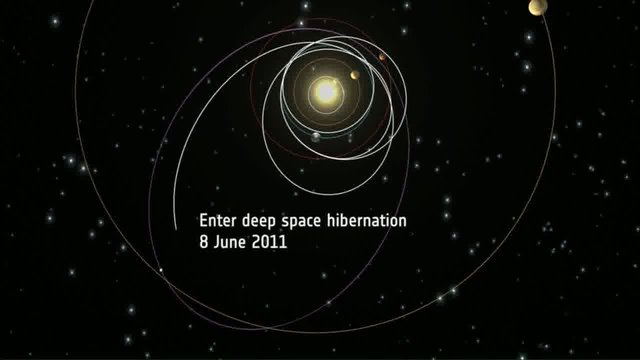
The European Space Agency will try and wake-up its sleeping Rosetta spacecraft on Monday at 1000 GMT. The spacecraft entered deep space hibernation in June 2011 when it was too far away from the sun to capture much solar energy. If this works it will be a considerable achievement considering that Rosetta was launched 10 years ago  and the communications technology on board is effectively at least two  “generations” old!

Rosetta trajectory till June 2011

ESA:

At 10:00 GMT on Monday, the most important alarm clock in the Solar System will wake up ESA’s sleeping Rosetta spacecraft.

Rosetta is chasing comet 67P/Churyumov–Gerasimenko and, since its launch in 2004, has made three flybys of Earth and one of Mars to build up enough speed and get on a trajectory towards the comet. It has also encountered asteroids Steins and Lutetia along the way.

Operating on solar energy alone, the spacecraft was placed into a deep space slumber in mid-2011 as it cruised far from the Sun and out towards the orbit of Jupiter. To prepare for its long sleep, Rosetta was oriented so that its solar arrays faced the Sun and put into a once per minute spin for stability.

The only devices left running were its computer and several heaters.

Thirty-one months later, Rosetta’s orbit has brought it back to within ‘only’ 673 million kilometres of the Sun, and there is finally enough solar energy to power the spacecraft fully again. It is time to wake up.

Rosetta’s computer is programmed to carry out a sequence of events to re-establish contact with Earth on 20 January, starting with an ‘alarm clock’ at 10:00 GMT.

Immediately after, the spacecraft’s startrackers will begin to warm up, taking around six hours.

Then its thrusters will fire to stop the slow rotation. A slight adjustment will be made to Rosetta’s orientation to ensure that the solar arrays are still facing directly towards the Sun, before the startrackers are switched on to determine the spacecraft’s attitude.

Once that has been established, Rosetta will turn directly towards Earth, switch on its transmitter and point its high-gain antenna to send its signal to announce that it is awake.

Because of Rosetta’s vast distance – just over 807 million kilometres from Earth – it will take 45 minutes for the signal to reach the ground stations. The first opportunity for receiving a signal on Earth is expected between 17:30 GMT and 18:30 GMT.

Graphic of mission

Rosetta Mission (ESA via BBC)

The true size of Africa

January 18, 2014

Amazing.

Even little Madagascar (22 million population) is as large as the UK in area!

Behold: major countries of the world, overlaid atop an outline of the positively giant African continent.

If this is your first time seeing this comparison (click here to see it in hi-res), you might be surprised by Africa’s immensity.

The True Size of Africa

Ohio execution fails the humane animal slaughter test

January 18, 2014

Leaving aside the rights and wrongs of capital punishment, the botched execution of Dennis McGuire on January 16th in Ohio leaves me feeling very uneasy.

The most powerful State in today’s world – in the name of the citizens of that State – took almost 25 minutes to execute a condemned man. Ohio plans 5 more executions this year and the State Assistant Attorney General Thomas Madden has argued that while the U.S. Constitution bans cruel and unusual punishment, “you’re not entitled to a pain-free execution.” U.S. District Judge Gregory Frost apparently agrees with that. Thomas Madden and Gregory Frost would seem to hold that humans – unlike animals – are not entitled to be executed humanely.

The US has a Law for the humane slaughter of animals – The Humane Methods of Livestock Slaughter Act. This law requires as follows:

7 U.S.C.A. § 1902. Humane methods ….. Either of the following two methods of slaughtering and handling are hereby found to be humane:

(a) in the case of cattle, calves, horses, mules, sheep, swine, and other livestock, all animals are rendered insensible to pain by a single blow or gunshot or an electrical, chemical or other means that is rapid and effective, before being shackled, hoisted, thrown, cast, or cut; or

(b) by slaughtering in accordance with the ritual requirements of the Jewish faith or any other religious faith that prescribes a method of slaughter whereby the animal suffers loss of consciousness by anemia of the brain caused by the simultaneous and instantaneous severance of the carotid arteries with a sharp instrument and handling in connection with such slaughtering.

Contrast this with the AP report of the execution:

A condemned man appeared to gasp several times and took an unusually long time to die — more than 20 minutes — in an execution carried out Thursday with a combination of drugs never before tried in the U.S. …….  McGuire’s lawyers had attempted last week to block his execution, arguing that the untried method could lead to a medical phenomenon known as “air hunger” and could cause him to suffer “agony and terror” while struggling to catch his breath. McGuire, 53, made loud snorting noises during one of the longest executions since Ohio resumed capital punishment in 1999. Nearly 25 minutes passed between the time the lethal drugs began flowing and McGuire was pronounced dead at 10:53 a.m. Executions under the old method were typically much shorter and did not cause the kind of sounds McGuire made. ………. Prison officials gave intravenous doses of two drugs, the sedative midazolam and the painkiller hydromorphone, to put McGuire to death for the 1989 rape and fatal stabbing of a pregnant newlywed, Joy Stewart. The method was adopted after supplies of a previously used drug, the powerful sedative pentobarbital, dried up because the manufacturer declared it off limits for capital punishment. ……… What was particularly unusual Thursday was the five minutes or so that McGuire lay motionless on the gurney after the drugs began flowing, followed by a sudden snort and then more than 10 minutes of irregular breathing and gasping. Normally, movement comes at the beginning and is followed by inactivity.

The key point for “humaneness” would appear to be that the victim be first rendered insensible or unconscious very quickly and by methods that are “rapid and effective”. That seems to have been missing here. Presumably the sanctity of “the process” of execution prevented any of the assembled crowd from doing anything to correct the situation. Everybody just waited the full 25 minutes and watched!

I take barbarism to be inelegance of behaviour. Beheading would have been less barbaric. If a firing squad or a guillotine were not appropriate, couldn’t someone have just hit him on the head or otherwise “rendered him insensible” first?