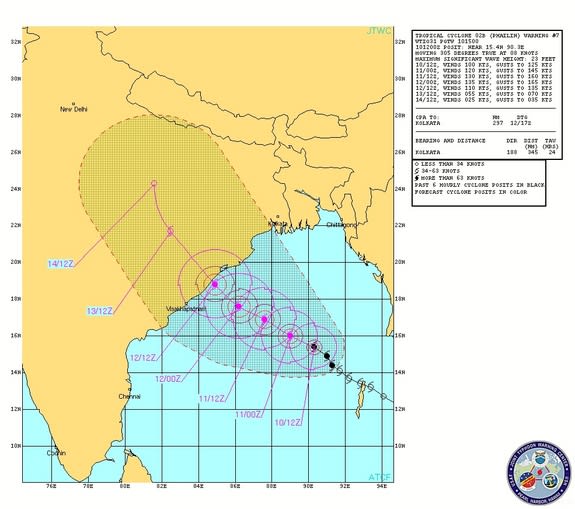
Cyclone Phailin will test Indian preparedness

October 12, 2013

UPDATE!

Saturday 12th, 6:30pm Indian Standard Time: Landfall is expected at any time now. So far some 600,000 people have been evacuated or have moved out of harms way. It has been the largest evacuation in India for 23 years.

______

The Bay of Bengal is no stranger to severe weather and severe cyclonic storms occur almost annually. However super cyclones (corresponding to an Atlantic Category 5 Hurricane) occur every 10 -20 years. Fatalities (direct and indirect by subsequent disease) have been huge in this heavily populated area. Super cyclones are defined as having wind speeds in excess of 220km/h and the current Cyclone Phailin is on the edge of that level with winds currently at about 210km/h. The Indian Meteorological Depratment expects the wind speeds to stay at the 210-220 km/h level.

ToI: Foreign agencies claimed Indian authorities are underestimating Phailin, quoting London-based Tropical Storm and US Navy’s joint typhoon warning centre as forecasting winds up to 315 kmph. Indian agencies, however, said wind speeds are much lower.

Super or Severe Cyclone Phailin is expected to make landfall this evening (about 6pm local time Saturday 12th October) somewhere along the Odisha coast. Warnings have been issued and about 200,000 have been asked to evacuate their coastal homes. Relief personnel and police are on alert. The Army has been deployed in some areas. Some 200 tourists have been assisted to leave the area and tourist bookings have been cancelled for upto a week.

Large improvements in the early warning and relief infrastructure have taken place since the catastrophic death toll in the super cyclone of November 1970. But Cyclone Phailin could be the biggest test for Indian preparedness since 1999.

Major super cyclones the region have been:

The projected path of Tropical Cyclone Phailin towards India as of 11:30 a.m. ET on Oct. 10, 2013.

Yahoo News: Experts say that the enormous and powerful storm, with maximum sustained winds of more than 160 mph (260 km/h), will bring a “catastrophic” storm surge, the water that a storm’s winds push in front of it and that inundate a coastline as the storm makes landfall, said Hal Needham, a climatologist at Louisiana State University. The storm surge is expected to reach heights of 20 feet (6 meters), Needham told LiveScience. The storm is likely to be “as bad or worse” than a cyclone that followed a similar trajectory in 1999, called Odisha cyclone for the area it hit.

Times of India: Touching wind speeds of 210-220 km an hour, Cyclone Phailin is set to hit the Odisha coast between Paradip and Kalingapatnam with full fury on Saturday evening, whipping up a storm surge up to 10 feet above the tide level posing a threat to low-lying villages.

Anticipating the cyclone’s fury, the state government began Odisha’s biggest ever evacuation of shifting more than three lakh (300,000) people out of harm’s way as chief minister Naveen Patnaik promised there would be zero casualties. The evacuation is expected to be complete by Saturday morning.

Met sources said the cyclone’s exact landfall is likely to be around the popular beach destination of Gopalpur and coastal Odisha as well as inland areas are expected to receive heavy rainfall likely to last till Sunday.

Although the Met is not categorizing Phailin as a “super cyclone” as it is yet to cross the 220 kmph barrier, there is little doubt that Odisha was bracing for a battering with the storm reported just 400 km south east of Gopalpur at 9pm on Friday. ….

….. Ganjam district is likely to be worst-hit. Other coastal districts falling within 75 km radius of the eye of the storm would also be impacted. “The exact landfall destination of the cyclone can be known once it comes nearly 200 km from the coast. Phailin’s movement however indicates that the situation would not be like the 1999 super cyclone during which the storm lay stationery over the coastal areas for nearly 24 hours and caused a sea surge of about 30 ft. This time 10 ft high wave is expected. More so, the expected landfall area being hilly, the impact of the cyclone would be less and weaken quickly,” IMD Bhubaneswar centre director Sarat Sahu said.

Not leaving anything to chance, the state government began evacuating people from coastal districts of Ganjam, Khurda, Puri, Jagatsinghpur and Kendrapada. Those who refused to leave their homes were forcibly taken to safer places. “There are 247 cyclone shelters and 10,000 concrete schools identified to house the villagers. We want to complete the evacuation by Saturday morning, particularly in Ganjam district which is likely to bear the brunt of the cyclone,” special relief commissioner P K Mohapatra said.

The central government has dispatched 10 helicopters, four Cheetah helicopters and two MI-17 and AN-32 planes to help the state government in rescue and relief operations. The government’s measures notwithstanding, thousands of people from the coastal region were rushing to railway stations and bus stops to escape the cyclone.

Europe increasingly adopting English for higher education

October 11, 2013

Competition for international students is leading to Universities in continental Europe increasingly offering higher education courses in English. There has been a ten-fold increase in the number of English courses offered since 2002.

Times Higher Education reports:

Thousands of international students may be shunning the UK in favour of continental Europe, where a growing number of courses are being offered in English, a study suggests.

A total of 6,407 taught master’s programmes in the language were offered on the Continent in June this year – a 38 per cent rise on the 4,644 courses available just 18 months earlier, according to a report by the New York-based not-for-profit organisation the Institute of International Education.

That total was 10 times higher than the overall number offered in 2002, says the report, titled English-Taught Master’s Programs in Europe: A 2013 Update.

The new briefing paper published by IIE’s Center for Academic Mobility Research suggests that the number of English-taught Master’s Programs in Europe has increased significantly since 2011. The paper, English-Taught Master’s Programs in Europe: A 2013 Update”, is an update of a report published by IIE in June 2011, and provides a data-driven look at the continued growth of master’s programs in Europe taught entirely or partially in English.

Growth of English courses in Europe

Growth of English courses in Europe

In recent years, European countries in which English is not the primary language of instruction have developed an increasing number of programs taught either fully or partly in English in order to serve domestic demand for higher education in English and to attract students from around the world. …..  The authors examine the growth of English-taught master’s programs in Europe, including the total number of programs offered by country and academic discipline, their duration, and data on prospective students.

According to the report, as of June 2013 the total number of English-taught programs in Europe was 6,609, a 42 percent increase since 2011. The top host countries for English-taught Master’s programs are: Netherlands, Germany, Sweden, France, and Spain.

Growth of English courses by country and year

Growth of English courses by country and year

Oktoberfest is hardly over and snow arrives in Bavaria

October 11, 2013

Oktoberfest only ended last week and 20cm of snow has already fallen in Southern Germany. A few weeks earlier than “normal”. But not to worry. Global Warming is here. Climate models cannot be fooled by little things like local weather and reality.

snow in Bavaria, 11th October 2013 photo DPA

Snow in Bavaria, 11th October 2013 photo DPA

The Local: Winter has arrived in southern Germany with the first heavy snowfall hitting Bavaria on Thursday night and Friday morning. 

The snow caused traffic chaos in the Garmisch-Partenkirchen area – a popular ski resort. Schools and kindergartens were closed, a police spokesman said on Friday, while authorities advised people to stay indoors.

Trees which have collapsed under the weight of the snow are also posing a danger for drivers and pedestrians. On one stretch of road out of Garmisch-Partenkirchen, 15 trees blocked traffic. 

But the early winter weather also brought happier scenes with the first snowmen being built. Snow has also fallen in the southern state of Baden-Württemberg.

NoTricksZone reports:

Meteorologists warned us that snow was on the way and would fall below the 500 m elevation in southern Germany and elsewhere. Moreover, they warned us that this winter could be one of the worst in 100 years for Central Europe. ….. 

Online Die Welt here writes:

‘It began to snow in the Bavarian capital of Munich yesterday evening at about 6 p.m. Many of my meteorologist colleagues had believed this to be improbable,’ said meteorologist Dominik Jung: ‘This year winter has struck early and unusually severely. South of Munich up to 20 centimeters of snow was able to pile up.’”

Die Welt adds that schools have been closed in some localities, 22,000 households in Austria have lost power, trains have come to a standstill, and traffic has been in chaos.

Frost is expected to spread across southern and middle Germany this weekend, reports www.wetter.net, “Temperatures down to -4°C are expected under clear skies in some local areas.


Publish to Retract: A new paradigm for research?

October 11, 2013

Retraction Watch has a story about a retraction accompanied by a blog post by the senior author – who requested the retraction. The senior author receives great credit for her transparency and integrity – no doubt well deserved.

Pamela Ronald does the right thing again, retracting a Science paper

But this is not the first time that a senior author has found a “mistake” in a publication and has then initiated a retraction. I observe that a paper retracted at the request of the author(s) usually leads to the general and admiring approval of the Journal and of peers. It has none of the stigma attached to a paper retracted by the Journal for plagiarism or data falsification or some other wrongdoing.

But looking through my jaundiced and cynical eyes, I wonder if this is just the start of a new paradigm in a brave new transparent world of research publication and retraction. Publish or Perish then gives way to Publish to Retract (or more accurately Publish quickly – to Retract if bad) which is then the name of the game.

  1. Dispense with time consuming data replication and other quality checks
  2. Rush to publication (but keep the retraction request ready)
  3. If any mistakes are subsequently suspected, warn the learned journal  that something is untoward and which is being investigated (best for the senior author to raise the suspicion about a potential mistake)
  4. Maximise citations of the work in question
  5. Find the mistake and request a retraction
  6. Retract in a blaze of publicity and gain brownie points for transparency and integrity

Junior authors – especially post-docs – are of course to be thrown under the proverbial bus. They only represent an acceptable level of collateral damage. Lists of publications may continue to include the retracted paper as long as it is done in the proper form

Author1, author 2….,Senior author x, Journal, Vol., page, date (retracted on date at the request of Senior author x)

Publication can then be very much faster and the potential downsides of mistakes or faulty analysis getting through to publication can be converted into the perceived benefits of transparency and integrity if the failings are ever discovered.

A hundred or so years ago it was not unknown for applicants to the Indian Civil Service to include something like this in their CV’s.

BA, Aligarh University, 1909, (fail)

It was of value for the applicant then to show that he had been accepted to sit for the exam. Having successfully run the gauntlet of peer-review in getting a paper accepted for publication (even if later retracted) could similarly be of some value.

Yet another meaningless Peace Prize

October 11, 2013

The Norwegian Nobel Committee has decided that the Nobel Peace Prize for 2013 is to be awarded to the Organization for the Prohibition of Chemical Weapons (OPCW) for its extensive efforts to eliminate chemical weapons.

It came into force in 1997. Since then the OPCW has, through inspections, destruction and by other means, sought the implementation of the convention. 189 states have acceded to the convention to date.

This comes just weeks after the deaths in Syria from Sarin gas and whether it was 400 or 1400 who died, the OPCW was irrelevant. And what – in any theatre of conflict – have they actually achieved for Peace? They merely seek to implement policies made by others. 

A deplorable and meaningless award carrying on the less than impressive tradition of the Norwegian Nobel Committee!

  • A politically correct award
  • to an organisation recently in the headlines
  •  an “anonymous” organisation
  • which has made no significant contribution to Peace
  • Non-members are Israel and Myanmar, which are signatory states that have not ratified the Chemical Weapons Convention. 
  • Angola, Egypt, North Korea and South Sudan have neither signed nor acceded to the Chemical Weapons Convention. 
  • Syria was the most recent state to submit its instrument of accession to the treaty.
  • The US and Russia have not destroyed their stocks of chemical weapons by April 2012 as members were required to.

The ancient melting pots of Europe

October 11, 2013

Stone Age settlers migrated across Europe in multiple waves that replaced older hunter-gatherer cultures with the genes from each wave blending into the population of the day. Ancient mtDNA studies are revealing that cultures spread to a great extent by the physical migrations of peoples and possibly faster and more effectively than by cultural diffusion alone. And the many different gene-melts continue today. Whereas in the Stone Age much of the action was in Central Europe, in the jet-age the melting-pots have shifted westwards and are mainly now in Western and Northern Europe. The peopling of Europe is an ongoing thing.

Guido Brandt, Wolfgang Haak, Christina J. Adler, Christina Roth, Anna Szécsényi-Nagy, Sarah Karimnia, Sabine Möller-Rieker, Harald Meller, Robert Ganslmeier, Susanne Friederich, Nicole Nicklisch, Joseph K. Pickrell, Frank Sirocko, David Reich, Alan Cooper, Kurt W. Alt and The Genographic Consortium, “DNA reveals key stages in the formation of Central European mitochondrial genetic diversity,” Science doi: 10.1126/science.1241844

National Geographic:

… the people who lived in Central Europe 7,000 years ago had different DNA lineages than those that lived there 5,000 years ago, and again different to those that lived 3,500 years ago. Central Europe was dynamic place during the Bronze age, and the genetic composition of the people that lived there demonstrates that there was nothing static about European prehistory.

Genographic Project Director and National Geographic Explorer-in-Residence, Spencer Wells expounds: “spanning a period from the dawn of farming during the Neolithic period through to the Bronze Age, the [genetic] data from the archaeological remains reveals successive waves of migration and population replacement- genetic ‘revolutions’ that combined to create the genetic patterns we see today.”

What we see in Europeans today is a kind of mixture of what was present there at different times in our past. So, just like parts of Europe today are melting pots from different living cultures across the world, Europe is also a melting pot of genetic lineages from different prehistoric cultures that lived there at different periods of time.

timeline peopling of europe Brandt et al, DOI: 10.1126/science.1241844 fig.3


Dienekes: “Central Europe, once populated exclusively by hunter-gatherers, experienced a virtual disappearance of their matrilineages for almost two thousand years after the advent of farming.  Then, between the Middle to Late Neolithic, around five thousand year ago, the hunter-gatherers make their re-appearance before their lineages converge to their modern (minority) frequency”

A Jewish Divorce – New Jersey (Sopranos) Style

October 11, 2013

Enterprising rabbis – like enterprising scientists – are also subject to “normal” human behaviour. Rabbis Mendel Epstein and Martin Wolmark planned coercion and torture to effect a divorce for simple financial gain. These rabbi’s probably watched too much of The Sopranos (or perhaps The Sopranos was inspired in part by these enterprising rabbis?). “They did it for money, They didn’t do it out of religious conviction.” 

If their price for facilitating a divorce was over $50,000, one wonders what their price would have been for a more “permanent settlement”?

BBC: 

Two New Jersey rabbis have been arrested and charged with plotting to kidnap and torture a man to force him to grant a traditional Jewish divorce.

Rabbis Mendel Epstein and Martin Wolmark asked for more than $50,000 (£32,000) to hire “tough guys” to attack a recalcitrant husband with cattle prods, authorities said.

The men and eight other suspects appeared in federal court on Thursday.

Under Orthodox Jewish belief, a husband must grant permission for a divorce. The permission comes in the form of a document known as a get. In some Orthodox communities a woman who has not obtained a get may not marry again even if a civil divorce is finalised. She may sue in rabbinical court, but some men ignore an unfavourable ruling, even if it means being estranged from the religious community.

The FBI investigation took place in Ocean and Middlesex counties in New Jersey and Rockland County in New York, and involved raids in both states, according to agency officials.

Two undercover FBI agents posing as a woman seeking a divorce and her brother called Rabbi Wolmark for help, and he connected them to Rabbi Epstein, according to a criminal complaint filed in federal court in New Jersey.

The undercover agents videotaped their meeting.

“Basically, what we are going to be doing is kidnapping a guy for a couple of hours and beating him up and torturing him and then getting him to give the get,” Rabbi Epstein is quoted as saying during the conversation, according to the complaint. He added that the “tough guys” would use electric cattle prods and handcuffs and place a plastic bag over the man’s head, according to the complaint. 

Rabbi Epstein also allegedly told the undercover agents that such instruments were unlikely to leave a mark, avoiding attention from authorities. “Basically the reaction of the police is, if the guy does not have a mark on him then, uh, is there some Jewish crazy affair here, they don’t want to get involved,” he said, according to the criminal complaint.

The FBI said the price was more than $50,000, including $10,000 for a rabbinical court to approve the action. They had wired $20,000 to the accused before the arrests.

“They did it for money,” Assistant US Attorney Joseph Gribko said during a hearing on Thursday.

“They didn’t do it out of religious conviction.”

Swedish Academician rebuked for talking too much

October 10, 2013

The fuss around the Nobel Prize in Physics  is taking its toll.

Svenska Dagbladet (free translation):

Anders Bárány, Member of the Royal Swedish Academy of Sciences, has been reprimanded for revealing why the announcement of the Physics Prize was an hour late. But Staffan Normark, Permanent Secretary of the Royal Swedish Academy of Sciences Presidium, would not comment. The delay on Tuesday of the announcement of the Nobel Prize in Physics by one hour was unprecedented and quite unique. 

 Mr Anders Bárány had revealed that the delay was caused by heated discussions within the Royal Academy of Sciences (KVA) whether the nuclear research organization CERN would share the prize,His statement had an impact already on Wednesday.

“I was called up to the Academy’s Presidium and given a real scolding” said Anders Bárány.

And I blame the CERN publicity machine for their hype and their blatant lobbying and for causing the controversy in the first place. But Anders Bárány has to take his share of the blame for falling for the publicity machine. He deserved his telling off – not so much for talking to the press after the event but for his support of CERN sharing the award!

What was he thinking?

The Pirates of Greenpeace are also accused of drug running

October 10, 2013

Pirates of Greenpeace

Greenpeace – They are the very model of modern Environ-Mentalists.

Not just pirates but drug runners too! The Greenpeace protestations of innocence are a little overdone since poppy straw is the raw opium used for the illegal extraction of heroin (and the production of morphine). It would seem that our pirates were also engaged in the production of drugs – presumably for their “recreation” on slow nights when they weren’t pirating.

Ria Novosti: 

Russian investigators said Wednesday that drugs have been found on board a Greenpeace ship seized last month, raising the threat of new charges against a group of activists and journalists awaiting trial on suspicion of piracy.

Investigative Committee chief Vladimir Markin said in a statement that the substances found on the Arctic Sunrise icebreaker were presumed to be poppy straw and morphine.

He said “the charge already pressed against all [the detainees] will presumably be modified.”

Russian authorities detained the group of 30 environmentalists and journalists last month after activists from the Greenpeace ship staged a protest against oil drilling in the Arctic, with some of them attempting to scale a Russian oil platform.

Greenpeace issued a statement later in the day, saying that the drugs were likely “medical supplies that our ships are obliged to carry under maritime law” and that some medical supplies are kept in a safe accessible only to the ship’s captain and doctor.

The group said it has a strict policy against recreational drugs on board its ships and that the Arctic Sunrise had been searched by a sniffer dog before leaving Norway for the Russian Arctic.

All the detainees from the ship, comprising nationals of 18 countries, have been charged with piracy.

The Investigative Committee spokesman also said that a number of defendants in the case will be charged with “committing other grave crimes.”

No end to new materials with super-strength

October 10, 2013

From the days of the alchemists and then the metallurgists who mixed different materials – often in the molten state – and then to the chemists we have now moved into the age when materials are designed in the lab to have desired properties. The challenge then is to synthesise the desired composition with the atomic structure required and then to devise manufacturing processes for the materials.

“A material called carbyne could be stronger even than graphene or diamond, according to researchers who have calculated its properties”, reports the BBC.

Carbyne is a chain of carbon atoms held together by double or alternating single and triple chemical bonds.

In their paper, Boris Yakobson and colleagues from Rice University in Houston show that carbyne’s tensile strength – the ability to withstand stretching – surpasses that of “any other known material” and is double that of graphene, the flat sheet of carbon atoms that is often held up as a “supermaterial”.

They also calculated that carbyne has twice the tensile stiffness of graphene and carbon nanotubes and nearly three times that of diamond.

It should display a number of other useful properties say the researchers. For example, it could be turned into a magnetic semiconductor (these are materials with electrical conductivity between that of a metal and an insulator like glass) and could be used as a sensor to detect twisting.

Some scientists have reported synthesising small amounts of carbyne in the lab, but it was thought to be extremely unstable. And some chemists have suggested that two strands coming into contact could react explosively.

“Our intention was to put it all together, to construct a complete mechanical picture of carbyne as a material,” said Vasilii Artyukhov, also from Rice University.

“The fact that it has been observed tells us it’s stable under tension, at least, because otherwise it would just fall apart.”

Mingjie Liu , Vasilii I. Artyukhov , Hoonkyung Lee ,Fangbo Xu , and Boris I. Yakobson, Carbyne From First Principles: Chain of C atoms, a Nanorod or a Nanorope,

ACS Nano,  DOI: 10.1021/nn404177r, October 5, 2013

Abstract: We report an extensive study of the properties of carbyne using first-principles calculations. We investigate carbyne’s mechanical response to tension, bending, and torsion deformations. Under tension, carbyne is about twice as stiff as the stiffest known materials and has an unrivaled specific strength of up to 7.5×10^7 N∙m/kg, requiring a force of ~10 nN to break a single atomic chain. Carbyne has a fairly large room-temperature persistence length of about 14 nm. Surprisingly, the torsional stiffness of carbyne can be zero but can be ‘switched on’ by appropriate functional groups at the ends. Further, under appropriate termination, carbyne can be switched into a magnetic-semiconductor state by mechanical twisting. We reconstruct the equivalent continuum-elasticity representation, providing the full set of elastic moduli for carbyne, showing its extreme mechanical performance (e.g. a nominal Young’s modulus of 32.7 TPa with an effective mechanical thickness of 0.772 Å). We also find an interesting coupling between strain and band gap of carbyne, which is strongly increased under tension, from 3.2 to 4.4 eV under a 10% strain. Finally, we study the performance of carbyne as a nanoscale electrical cable, and estimate its chemical stability against self-aggregation, finding an activation barrier of 0.6 eV for the carbyne–carbyne cross-linking reaction and an equilibrium cross-link density for two parallel carbyne chains of 1 cross-link per 17 C atoms (2.2 nm).