What energy shortage?

August 21, 2013

Energy Distribution of the Universe: Chandra

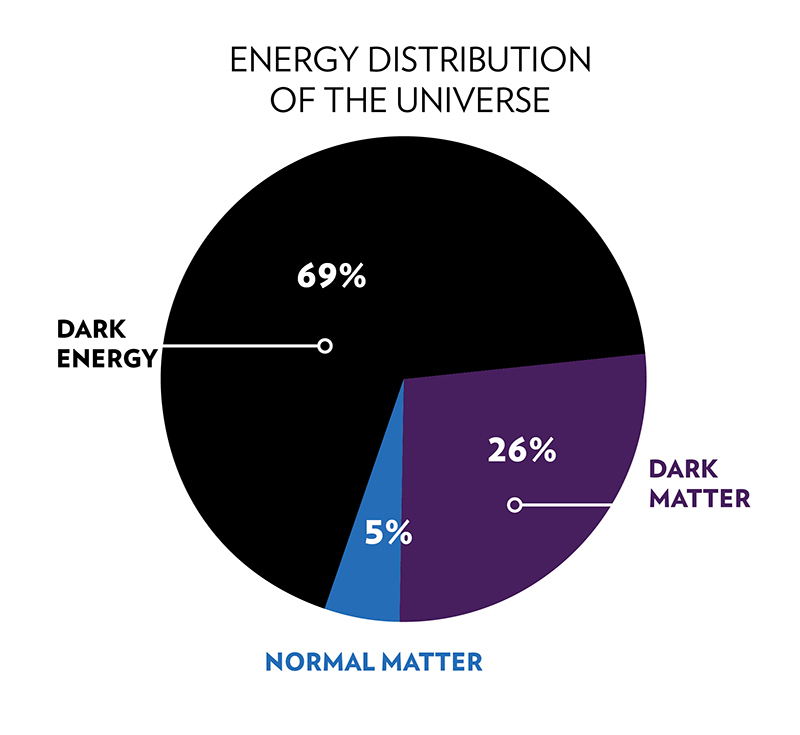
Most of the Universe is dark. The protons, neutrons and electrons that make up the stars, planets and us represent only a small fraction of the mass and energy of the Universe. The rest is dark and mysterious. X-rays can help reveal the secrets of this darkness. X-ray astrophysics is crucial to our understanding not only of the Universe we see, but the quest to determine the physics of everything.

  • Dark Energy

    At the close of the 20th century, our perception of the Universe was jolted. Instead of slowing down after the Big Bang, the expansion of the Universe was found to be accelerating. Was the cosmic acceleration due to Einstein’s cosmological constant, a mysterious form of “dark energy,” or perhaps a lack of understanding of gravity? The answer is still out there. By studying clusters of galaxies, X-ray astronomy is tackling this question using powerful techniques that are independent of other methods currently being employed or proposed for the future.

  • Dark Matter

    The next chunk of the Universe’s budget is another unknown: dark matter. Of all of the material we know about because we can see its gravitational effects, about 85% is composed of matter that emits no light and is radically different from material found in planets and stars. X-rays can be used to study the effects of dark matter in a variety of astronomical settings, and thus probe the nature of this mysterious substance that pervades the Universe.


Humans still have monkey feet

August 21, 2013

Humans may have split from chimpanzees at least 7 million years ago and  left the trees to become ground-dwellers sometime after that. By 4 million years ago humans had developed bipedalism. Since the 1930’s the prevailing view has been that the evolution of human bipedalism has led to – or has been enabled by – human feet functioning very differently to those of other apes, “due to the development of arches in the mid-foot region and the supposed rigidity of that on the outside edge of the foot“.

But it now appears that human feet are not that unique and not so different to those of our ape cousins.

“Our limbs, however, did not adapt to life on the ground anywhere near as much as those of other ground-dwelling animals such as horses, hares and dogs. Our tests showed that our feet are not as stiff as originally thought and actually form part of a continuum of variation with those of other great apes.”

Karl T. Bates et al, The evolution of compliance in the human lateral mid-foot, Proc. R. Soc. B 22 October 2013 vol. 280, no. 1769, 2013.1818

rspb.royalsocietypublishing.org/lookup/doi/10.1098/rspb.2013.1818

Abstract:Fossil evidence for longitudinal arches in the foot is frequently used to constrain the origins of terrestrial bipedality in human ancestors. This approach rests on the prevailing concept that human feet are unique in functioning with a relatively stiff lateral mid-foot, lacking the significant flexion and high plantar pressures present in non-human apes. This paradigm has stood for more than 70 years but has yet to be tested objectively with quantitative data. Herein, we show that plantar pressure records with elevated lateral mid-foot pressures occur frequently in healthy, habitually shod humans, with magnitudes in some individuals approaching absolute maxima across the foot. Furthermore, the same astonishing pressure range is present in bonobos and the orangutan (the most arboreal great ape), yielding overlap with human pressures. Thus, while the mean tendency of habitual mechanics of the mid-foot in healthy humans is indeed consistent with the traditional concept of the lateral mid-foot as a relatively rigid or stabilized structure, it is clear that lateral arch stabilization in humans is not obligate and is often transient. These findings suggest a level of detachment between foot stiffness during gait and osteological structure, hence fossilized bone morphology by itself may only provide a crude indication of mid-foot function in extinct hominins. Evidence for thick plantar tissues in Ardipithecus ramidus suggests that a human-like combination of active and passive modulation of foot compliance by soft tissues extends back into an arboreal context, supporting an arboreal origin of hominin bipedalism in compressive orthogrady. We propose that the musculoskeletal conformation of the modern human mid-foot evolved under selection for a functionally tuneable, rather than obligatory stiff structure.

Liverpool University Press Release:

In a study of more than 25,000 human steps made on a pressure-sensitive treadmill at the University’s Gait Laboratory, scientists at Liverpool have shown that despite having abandoned life in the trees long ago, our feet have retained a surprising amount of flexibility, the type seen in the feet of other great apes, such as orang-utans and chimpanzees, that have remained largely tree-dwelling.

Professor Robin Crompton, from the University’s Institute of Ageing and Chronic Disease, explains: “It has long been assumed that because we possess lateral and medial arches in our feet – the lateral one supposedly being rigid and supported in bone – that our feet differ markedly to those of our nearest relatives, whose mid-foot is fully flexible and makes regular ground contact.

“This supposed ‘uniqueness’, however, has never been quantitatively tested.  We found that the range of pressures exerted under the human mid-foot, and thus the internal mechanisms that drive them, were highly variable, so much so that they actually overlapped with those made by the great apes.”

It has previously been thought that humans who make contact with the ground with the mid-foot region are primarily those that suffer from diabetes or arthritis, both of which can impact on the structure of the feet.  Research showed, however, that two thirds of normal healthy subjects produced some footfalls where the mid-foot touches the ground, with no indication that this is other than an aspect of normal healthy walking.

 Dr Karl Bates, from the University’s Institute of Ageing and Chronic Disease, said: “Our ancestors probably first developed flexibility in their feet when they were primarily tree-dwelling, and moving on bendy branches, but as time passed and we became more and more ground-dwelling animals, some new features evolved to enable us to move quickly on the ground.

“Our limbs, however, did not adapt to life on the ground anywhere near as much as those of other ground-dwelling animals such as horses, hares and dogs. Our tests showed that our feet are not as stiff as originally thought and actually form part of a continuum of variation with those of other great apes.

“We hypothesise that despite becoming nearly exclusively ground dwelling we have retained flexibility in the feet to allow us to cope effectively with the differences in hard and soft ground surfaces which we encounter in long distance walking and running.  The next part of our study will be testing this theory, which could offer a reason why humans can outrun a horse, for example, over long distances on irregular terrain.”

Update on the Dorta-Drinkel paper

August 20, 2013

To “close” the story on my previous posts (here and here), this post at the Chemistry blog brings a kind of “closure” though some more details will no doubt surface.

Prof Dorta has apparently responded recognising that his “just make up an elemental analysis..” comment was “inappropriate”. The Editor of Organometallics has also made a lengthy response – quite unusual for an Editor to be so forthcoming and to “step-up”:

….

Best wishes,

John Gladysz
(on whose desk “the buck stops” for everything, good and bad, at Organometallics)

He also leaves a comment at ChemBark (which itself is worthy of note as an interaction between the Editor of a Peer-reviewed Journal and a blog)

…..

Thus, with respect to the Dorta manuscript and Drinkel thesis, we will be focusing (apart from many other questions) on whether the reported procedures give solvated or unsolvated products (it cannot be both), and then whether the yields given are correct (we have done the calculations both ways, and also looked at the NMR spectra per the group handout).

Quite possibly there has been carelessness and there are clearly some mistakes, but – hopefully –  not much in the way of “underhand behaviour” or misconduct.

The full responses from Prof. Dorta and John Gladysz are over at the Chemistry blog.

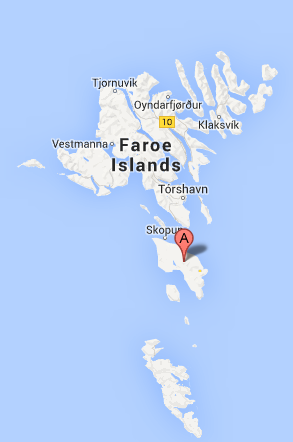
Faroe Islands were colonised 300-500 years before the Vikings

August 20, 2013

Somebody got there before the Vikings did – some 300 and 500 years earlier. Norse settlers reached Iceland in the 9th century and probably reached Greenland around the 11th century. But the archaeological evidence is that some unknown colonists had already reached the Faroes in the 4th- 6th century and again between the 6th -8th centuries. There is a theory that they could have been monks from Ireland (St. Brendan?) but I think it is still highly likely that these early explorers/colonists were sea-faring peoples out of Scandinavia.

Mike J. Church, Símun V. Arge, Kevin J. Edwards, Philippa L. AscoughJulie M. Bond, Gordon T. Cook, Steve J. Dockrill, Andrew J. DugmoreThomas H. McGovernClaire Nesbitt and Ian A. Simpson, The Vikings were not the first colonizers of the Faroe Islands, Quaternary Science Reviews (2013)

dx.doi.org/10.1016/j.quascirev.2013.06.011

Faroe Islands -Google Earth

Faroe Islands -Google Earth

Abstract

We report on the earliest archaeological evidence from the Faroe Islands, placing human colonization in the 4th–6th centuries AD, at least 300–500 years earlier than previously demonstrated archaeologically. The evidence consists of an extensive wind-blown sand deposit containing patches of burnt peat ash of anthropogenic origin. Samples of carbonised barley grains from two of these ash patches produced 14C dates of two pre-Viking phases within the 4th–6th and late 6th–8th centuries AD. A re-evaluation is required of the nature, scale and timing of the human colonization of the Faroes and the wider North Atlantic region.

Durham University Press Release:

The Faroe Islands were colonised much earlier than previously believed, and it wasn’t by the Vikings, according to new research.

New archaeological evidence places human colonisation in the 4th to 6th centuries AD, at least 300-500 years earlier than previously demonstrated. 

The research, directed by Dr Mike J Church from Durham University and Símun V Arge from the National Museum of the Faroe Islands as part of the multidisciplinary project “Heart of the Atlantic”, is published in the Quaternary Science Reviews.

The research challenges the nature, scale and timing of human settlement of the wider North Atlantic region and has implications for the colonisation of similar island groups across the world.

Sandoy, Faroes - Google Maps

Sandoy, Faroes – Google Maps

The Faroes were the first stepping stone beyond Shetland for the dispersal of European people across the North Atlantic that culminated on the shores of continental North America in the 11th century AD, about 500 years before Columbus made his famous voyage.

The research was carried out on an archaeological site at Á Sondum on the island of Sandoy. 

Analysis showed an extensive windblown sand deposit containing patches of burnt peat ash from human activity, dating human settlement to pre-Viking phases. These ash spreads contained barley grains which were accidentally burnt in domestic hearths and were then spread by humans onto the windblown sand surface during the 4th-6thcenturies and 6th-8th centuries, a common practice identified in the North Atlantic during this period to control wind erosion.

Lead author Dr Mike Church, from Durham University’s Department of Archaeology, said: “There is now firm archaeological evidence for the human colonisation of the Faroes by people some 300-500 years before the large scale Viking colonisation of the 9th century AD, although we don’t yet know who these people were or where they came from.

“The majority of archaeological evidence for this early colonisation is likely to have been destroyed by the major Viking invasion, explaining the lack of proof found in the Faroes for the earlier settlement. This also raises questions about the timing of human activity on other islands systems where similarly evidence may have been destroyed.”

Co-author, Símun V Arge from the National Museum of the Faroe Islands, said: “Although we don’t know who the people were that settled here and where they came from, it is clear that they did prepare peat for use, by cutting, drying and burning it which indicates they must have stayed here for some time.

Clean air legislation reinstated the global warming suppressed by industrial pollution

August 20, 2013

A fascinating post at WUWT:

The story so far;

  1. The earth was warming naturally after the Little Ice Age (1350 – 1850).
  2. Along came the industrial revolution. Dust and aerosol pollution covered large parts of the earth and blocked out the Sun. This caused a gradually increasing suppression of the global warming that was occurring as the industrialisation of the world proceeded. This suppression reached a maximum during the 1970’s.
  3. Then came clean air legislation around the world, cleaned up the atmosphere and the Earth basked in the sunlight again.

Global warming was rediscovered.

And now as the LIA temperature recovery is coming to a natural end, global temperatures will decrease again.

Well it is a settled science after all.

Shocker: Global warming may simply be an artifact of clean air laws

global-dimming-brightening

Figure 1 from Wild et al 2012 showing radiation balance differences due to aerosols (via WUWT)


BRICS is losing BIS as the financial crisis bites

August 20, 2013

Emerging markets have the fundamental problem that their own domestic markets – while promising – are not large enough yet to raise the finances needed to drive their entire economies. They are critically dependent upon foreign investment. And now as funds return to the dollar, India, Brazil, South Africa and other emerging markets are feeling the global financial heat – and some of the heat is intense enough to cause some currency meltdowns.

The Indian economy is shrinking in real terms. Currency controls are on the way though the Indian government is – as usual – doing too little too late. Sovereign ratings of these countries are likely to be degraded which will reduce foreign investment further and raise the cost of foreign borrowing. A vicious downward spiral could ensue.

BRICS is losing BIS.

Economic Times:

A fierce selloff in many emerging currencies shows no sign of abating as the expected withdrawal of US monetary stimulus prompts investors to shun markets seen as riskier because of funding deficits, slowing economies and inflation. 

The rupee fits that bill, as do the Indonesian rupiah, the South African rand and theBrazilian real. The rupiah plunged to four-year troughs on Monday while the rand lost another 1 percent to bring year-to-date losses to almost 17 percent against the dollar. 

Brazil’s real extended last week’s fall of more than 5 percent fall to trade at its weakest level since March 2009 even as the central bank sold nearly $3 billion worth of currency swaps, which are derivatives that mimic an injection of dollars in the futures market. Like the rupee, it has been hammered by doubts over the efficacy of policy actions to stem the rout. 

The rupee and the real, respectively, have been the worst performers in Asia and Latin America since late May when the Fed first signalled that it may begin winding down its monetary stimulus this year. India’s currency has lost 13 percent against the dollar this year while the real has plunged 15 percent in the same period. 

A decline in the Fed’s bond purchases will push government debt yields higher, which should raise the attractiveness of the dollar and dollar-denominated assets. In Brazil, the currency weakness has complicated policymakers’ efforts to rein in inflation, leading many investors to bet the central bank may speed up the pace of monetary tightening next week.  

In India, the rupee’s sell-off threatens to drive Asia’s third-largest economy towards a full-blown crisis. 

“Our primary concern is that the policy authorities still don’t ‘get it’ – thinking this is a fairly minor squall which will simmer down relatively quickly with fairly minor actions,” Robert Prior-Wandesforde, an economist at Credit Suisse in Singapore, wrote in a note on the Indian currency on Monday. 


Sea level dropped in 2010/11 but only because it rained in Australia!

August 19, 2013

Wonders will never cease! If we just make sure that more moisture is trapped in clouds and that it rains more over land we can prevent sea level rise and even cause sea level to fall

Sea level is rising to catastrophic levels because of global warming and that, of course, is due the our using fossil fuels – or so the global warming theology would have us believe. But sea levels dropped by 0.7mm in 2010/2011. But not to worry. The catastrophe theory remains intact. This was just due to it raining too much over land in Australia and the tropics that year.

A new paper but an old tired song:

John T. Fasullo, Carmen Boening, Felix W. Landerer and R. Steven Nerem, Australia’s unique influence on global sea level in 2010–2011, Geophysical Research Letters, DOI: 10.1002/grl.50834

AbstractIn 2011, a significant drop in global sea level occurred that was unprecedented in the altimeter era and concurrent with an exceptionally strong La Niña. This analysis examines multiple datasets in exploring the physical basis for the drop’s exceptional intensity and persistence. Australia’s hydrologic surface mass anomaly is shown to have been a dominant contributor to the 2011 global total and associated precipitation anomalies were among the highest on record. The persistence of Australia’s mass anomaly is attributed to the continent’s unique surface hydrology, which includes expansive arheic and endorheic basins that impede runoff to ocean. Based on Australia’s key role, attribution of sea level variability is addressed. The modulating influences of the Indian Ocean Dipole and Southern Annular Mode on La Niña teleconnections are found to be key drivers of anomalous precipitation in the continent’s interior and the associated surface mass, and sea level responses.

PhysOrg recites the dogma:

When enough raindrops fall over land instead of the ocean, they begin to add up. New research led by the National Center for Atmospheric Research (NCAR) shows that when three atmospheric patterns came together over the Indian and Pacific oceans, they drove so much precipitation over Australia in 2010 and 2011 that the world’s ocean levels dropped measurably. Unlike other continents, the soils and topography of Australia prevent almost all of its precipitation from running off into the ocean. 

The 2010-11 event temporarily halted a long-term trend of rising sea levels caused by higher temperatures and melting ice sheets. 

Now that the atmospheric patterns have snapped back and more rain is falling over tropical oceans, the seas are rising again. In fact, with Australia in a major drought, they are rising faster than before.

“It’s a beautiful illustration of how complicated our climate system is,” says NCAR scientist John Fasullo, the lead author of the study. “The smallest continent in the world can affect sea level worldwide. Its influence is so strong that it can temporarily overcome the background trend of rising sea levels that we see with climate change.”

….. As the climate warms, the world’s oceans have been rising in recent decades by just more than 3 millimeters (0.1 inches) annually. This is partly because the heat causes water to expand, and partly because runoff from retreating glaciers and ice sheets is making its way into the oceans.

But for an 18-month period beginning in 2010, the oceans mysteriously dropped by about 7 millimeters (about 0.3 inches), more than offsetting the annual rise.

Fasullo and his co-authors published research last year demonstrating that the reason had to do with the increased rainfall over tropical continents. They also showed that the drop coincided with the atmospheric oscillation known as La Niña, which cooled tropical surface waters in the eastern Pacific and suppressed rainfall there while enhancing it over portions of the tropical Pacific, Africa, South America, and Australia.

But an analysis of the historical record showed that past La Niña events only rarely accompanied such a pronounced drop in sea level. ….

When sea level rises it is due to global warming. But when it falls it is due to too much rain over Australia. Nothing to do with the standstill in global temperatures for the last 17 years of course!

As I posted a month or so ago

Sea levels in the past have been 10 m higher than today and 150 m lower than today.

Alarmism will have us believe that +5 cm ±15 cm in sea level that may actually happen by 2100 will threaten the very existence of humanity!

new paper from Nils-Axel Mörner.

SEA LEVEL CHANGES PAST RECORDS AND FUTURE EXPECTATIONS

……. The Earth’s rate of rotation records a mean acceleration from 1972 to 2012, contradicting all claims of a rapid global sea level rise, and instead suggests stable, to slightly falling, sea levels.Best estimates for future sea level changes up to the year 2100 are in the range of +5 cm ±15 cm

UK also following US instructions in detaining partner of the journalist linked to Snowden

August 19, 2013

The subservience of European security services to their US counterparts seems complete.

It was not so long ago that we had the story 

…. about France and Portugal and Austria kowtowing to demands made – no doubt – by US “intelligence” while forcing down the Bolivian President’s plane yesterday, suggests that this subservience of their European counterparts still continues. The quality of the US “intelligence” that Snowden was on the plane was clearly very “strain’d”. The “constraining” of intelligence” to suit a political purpose will be with us for a long time and the poodle-like behaviour of the European countries is sometimes embarrassing to observe.

It transpired later that Germany was also complicit in the massive US surveillance. Snowden has since been granted a years asylum in Russia and it is to be expected that US dissatisfaction and irritation is running high. And today we have the story of how the UK security services detained the partner of the journalist associated with Snowden while he was en route from Berlin to Brazil. He was detained, questioned for 9 hours, had his lap-top and memory sticks confiscated – all under powers available from terrorist legislation.  It does seem that the UK – like France and Portugal and Austria – was merely following instructions from across the Atlantic. One wonders what new revelations from Snowden’s material the US NSA is so paranoid about.

Reuters: 

British authorities used anti-terrorism powers on Sunday to detain the partner of a journalist with close links to Edward Snowden, the former U.S. spy agency contractor who has been granted asylum by Russia, as he passed through London’s Heathrow airport.

The 28-year-old David Miranda, a Brazilian citizen and partner of U.S. journalist Glenn Greenwald who writes for Britain’s Guardian newspaper, was questioned for nine hours before being released without charge, a report on the Guardian website said.

A British Metropolitan Police Service spokesman said a 28-year-old male had been detained at Heathrow airport under provisions of the 2000 Terrorism Act. That law gives British border officials the right to question someone “to determine if that individual is a person concerned in the commission, preparation or execution of acts of terrorism.”

The invocation of terrorism legislation is more than a little far-fetched but was probably a quick, convenient way for the compliant UK security services to satisfy the US demands. I am just a little surprised that it did not just give rise to a case of “extraordinary rendition” with Miranda being hustled onto a plane bound for the US.

“But measuring rainfall is very tricky,” – Kerry Emanuel

August 19, 2013

It’s the tail wagging the dog, or the cart before the horse as the IPCC prepares to publish its report.

It’s the brave new world of Global warming – though global temperatures have been still or have declined slightly over the last 17 years. But it is 95% certain – says the IPCC –  that carbon dioxide is the cause and the world has warmed by 0.8 °C since the 1950’s. But that 95% is plucked from the air. But they are certain – from their models that the world will warm by upto 4°C in the next 100 years — and that carbon dioxide is the cause! We know the cause but we don’t know the effects!

The local effects are elusive.

“But measuring rainfall is very tricky,” said Kerry Emanuel

Reuters: 

Experts surer of manmade global warming but local predictions elusive

Climate scientists are surer than ever that human activity is causing global warming, according to leaked drafts of a major U.N. report, but they are finding it harder than expected to predict the impact in specific regions in coming decades. ….

…. Drafts seen by Reuters of the study by the U.N. panel of experts, due to be published next month, say it is at least 95 percent likely that human activities – chiefly the burning of fossil fuels – are the main cause of warming since the 1950s.

But they will merely ignore the real observation that global temperatures have not increased for at least 17 years.

“We have got quite a bit more certain that climate change … is largely manmade,” said Reto Knutti, a professor at the Swiss Federal Institute of Technology in Zurich. “We’re less certain than many would hope about the local impacts.”

And gauging how warming would affect nature, from crops to fish stocks, was also proving hard since it goes far beyond physics. “You can’t write an equation for a tree,” he said.

How exactly the certainty increased when temperatures did not go up while carbon dioxide concentration continued to increase is of no consequence – apparently. How certainty increases when the models are diverging more and more from reality is another mystery.

The IPCC report, the first of three to be released in 2013 and 2014, will face intense scrutiny, particularly after the panel admitted a mistake in the 2007 study which wrongly predicted that all Himalayan glaciers could melt by 2035. Experts say the error far overestimated the melt and might have been based on a misreading of 2350.

The new study will state with greater confidence than in 2007 that rising manmade greenhouse gas emissions have already meant more heatwaves. But it is likely to play down some tentative findings from 2007, such as that human activities have contributed to more droughts. ….

Drew Shindell, a NASA climate scientist, said the relative lack of progress in regional predictions was the main disappointment of climate science since 2007.

“I talk to people in regional power planning. They ask: ‘What’s the temperature going to be in this region in the next 20-30 years, because that’s where our power grid is?'” he said.

“We can’t really tell. It’s a shame,” said Shindell. Like the other scientists interviewed, he was speaking about climate science in general since the last IPCC report, not about the details of the latest drafts.

WARMING SLOWING

The panel will try to explain why global temperatures, while still increasing, have risen more slowly since about 1998 even though greenhouse gas concentrations have hit repeated record highs in that time, led by industrial emissions by China and other emerging nations.

An IPCC draft says there is “medium confidence” that the slowing of the rise is “due in roughly equal measure” to natural variations in the weather and to other factors affecting energy reaching the Earth’s surface.

Scientists believe causes could include: greater-than-expected quantities of ash from volcanoes, which dims sunlight; a decline in heat from the sun during a current 11-year solar cycle; more heat being absorbed by the deep oceans; or the possibility that the climate may be less sensitive than expected to a build-up of carbon dioxide.

“It might be down to minor contributions that all add up,” said Gabriele Hegerl, a professor at Edinburgh University. Or maybe, scientists say, the latest decade is just a blip.

Or maybe the Anthropogenic Global Warming meme is just plain wrong.

The main scenarios in the draft, using more complex computer models than in 2007 and taking account of more factors, show that temperatures could rise anywhere from a fraction of 1 degree Celsius (1.8 Fahrenheit) to almost 5C (9F) this century, a wider range at both ends than in 2007.

The low end, however, is because the IPCC has added what diplomats say is an improbable scenario for radical government action – not considered in 2007 – that would require cuts in global greenhouse gases to zero by about 2070.

Temperatures have already risen by 0.8C (1.4F) since the Industrial Revolution in the 19th century.

Experts say that the big advance in the report, due for a final edit by governments and scientists in Stockholm from September 23-26, is simply greater confidence about the science of global warming, rather than revolutionary new findings.

SEA LEVELS

“Overall our understanding has strengthened,” said Michael Oppenheimer, a professor at Princeton University, pointing to areas including sea level rise.

An IPCC draft projects seas will rise by between 29 and 82 cm (11.4 to 32.3 inches) by the late 21st century – above the estimates of 18 to 59 cm in the last report, which did not fully account for changes in Antarctica and Greenland.

The report slightly tones down past tentative findings that more intense tropical cyclone are linked to human activities. Warmer air can contain more moisture, however, making downpours more likely in future.

“There is widespread agreement among hurricane scientists that rainfall associated with hurricanes will increase noticeably with global warming,” said Kerry Emanuel, of the Massachusetts Institute of Technology.

“But measuring rainfall is very tricky,” he said.
Fallout from the Dorta – Drinkel paper

August 18, 2013

When publishing a paper based on her thesis, Professor Reto Dorta apparently “instructed” Emma Drinkel to “make up an elemental analysis” which – to her credit – she did not. But the “instruction” was inadvertently left in the supplemental information to the paper (which itself was rather sloppy editing and by her but his responsibility as the corresponding author).

Apparently since the news came out in ChemBark and RetractionWatch and other sites, Emma Drinkel’s reputation and career are severely threatened and the attention and “hounding” she has received has caused much distress. Quite probably much of the criticism is the usual anonymous abuse in the blogosphere and quite unjustified.

But what is missing as far as I am aware is any “explanation” from Prof. Reto Dorta who wrote the “instruction” and was the senior author and – presumably – her supervisor. Though it was a very long time ago since I was subject -academically – to the whims and the power of a supervisor, I know how difficult it is to resist a supervisor’s instructions. Was he in the habit of giving such “instructions” to his students?

Synthetic Remarks carries an admirable post entitled “In Defense of Emma with an email from Emma’s mother which does not need any commentary.

From: Mary-Anne Drinkel [mailto:xxxxa@xxxx.co.uk]
Sent: 15 August 2013 21:04
To: Fredrik von Kieseritzky ‘xxx@xxx.com’
Subject: Emma Drinkel – the Dorta Affair

Dear Dr Kieseritzky

I hope you don’t mind me contacting you, but I would just like to thank you for your comment on ChemBark. My name is Mary-Anne Drinkel, and I am mother of Emma. We are very proud of our daughter she has worked hard and conscientiously to earn her first class degree at Durham, her PhD at Zurich, and presently her Post doctorate work in Brazil- we know that fabricating data would be alien to her. I cannot believe that her good reputation, built up over these years can be destroyed in a week. I know nothing of the academic community, but the hostile and aggressive comments left on the blog sites are unbelievable. I don’t know if Reto Dorta was careless or has done a very bad thing, but I do know that Emma is the innocent party in this affair. How many PhD thesis could withstand the hostile scrutiny that Emma’s has been subjected to, with these bloggers determined to find evidence of wrongdoing – boasting about who broke the news first.

Emma’s husband has a new industry position in Switzerland, and they will be moving back to Europe very soon; this means Emma will be applying for jobs – she fears this affair will affect her chances, as she would be honest with prospective employers about her situation. They had decided to leave the academic world long before this episode because the competitiveness and political environment of university life was not for them. Emma is devastated that her good name at Durham and Zurich University will be forever tarnished by this affair.

My husband and I have felt so sad and so helpless as these events have developed – when I saw your comment that was sympathetic to Emma’s plight, it was the first bit of humanity I had witnessed in the whole affair, and I am grateful to you for that. Emma will get through this, she is resilient and has the support of her husband, family and friends – but we feel so angry that Emma has been subjected to this through no fault of her own.

Once again thank- you,

Best wishes,

Mary-Anne Drinkel