Stopping the light fantastic

August 7, 2013

The speed of light in a vacuum (c) is the immutable constant. Every shadow in the world is proof absolute that it can be prevented from reaching some places (by prior reflection and absorption). But light can also be slowed-down and stopped and even stored.

Light propagates at speeds less than (c) in different media. 

In 1999, Danish physicist Lene Vestergaard Hau led a combined team from Harvard University and the Rowland Institute for Science which succeeded in slowing a beam of light to about 17 meters per second, and researchers at UC Berkeley slowed the speed of light traveling through a semiconductor to 9.7 km/s in 2004. Hau later succeeded in stopping light completely, and developed methods by which it can be stopped and later restarted.This was in an effort to develop computers that will use only a fraction of the energy of today’s machines.

Back in 2007, Lene Hau showed that light could be “stopped” and then “restarted” a little distance away.

LeneHau.jpg

Lene Hau (image photonics.com)

CAMBRIDGE, Mass., Feb. 8, 2007 — By converting light into matter and then back again, physicists have for the first time stopped a light pulse and then restarted it a small distance away. This “quantum mechanical magic trick” provides unprecedented control over light and could have applications in fiber-optic communication and quantum information processing. 

In quantum networks, information optically transmitted over the network is converted into matter, processed, and then converted back into light. The physicists at Harvard University hope that their discovery could provide a possible way to do this, since matter, unlike light, can easily be manipulated. Their findings were published this week in the journal Nature.  

“We demonstrate that we can stop a light pulse in a supercooled sodium cloud, store the data contained within it, and totally extinguish it, only to reincarnate the pulse in another cloud two-tenths of a millimeter away,” said Lene Vestergaard Hau, Mallinckrodt Professor of Physics and of Applied Physics in Harvard’s Faculty of Arts and Sciences and School of Engineering and Applied Sciences.

But now comes evidence that it can be “stopped” and stored for a whole minute – and maybe even longer.

Georg Heinze, Christian Hubrich, Thomas Halfmann. Stopped Light and Image Storage by Electromagnetically Induced Transparency up to the Regime of One MinutePhysical Review Letters, 2013; 111 (3) DOI: 10.1103/PhysRevLett.111.033601

Abstract: The maximal storage duration is an important benchmark for memories. In quantized media, storage times are typically limited due to stochastic interactions with the environment. Also, optical memories based on electromagnetically induced transparency (EIT) suffer strongly from such decoherent effects. External magnetic control fields may reduce decoherence and increase EIT storage times considerably but also lead to complicated multilevel structures. These are hard to prepare perfectly in order to push storage times toward the theoretical limit, i.e., the population lifetime T1. We present a self-learning evolutionary strategy to efficiently drive an EIT-based memory. By combination of the self-learning loop for optimized optical preparation and improved dynamical decoupling, we extend EIT storage times in a doped solid above 40 s. Moreover, we demonstrate storage of images by EIT for 1 min. These ultralong storage times set a new benchmark for EIT-based memories. The concepts are also applicable to other storage protocols.

Hugues de Riedmatten writes in Physics:

A solid-state device can now store light coherently for up to one minute.

The ability to store light while keeping its quantum coherence properties (e.g., entanglement) plays an important role in quantum information science. It makes it possible to build quantum memories for light, which could become crucial elements in many quantum information processing schemes based on the use of photons, from quantum communication networks to quantum computing protocols. A critical parameter for applications is the duration over which light can be stored. For example, the distribution of quantum bits over complex quantum information networks, and their storage for further manipulation, might require quantum memories with storage time from a few seconds to a few minutes. Writing in Physical Review Letters, Georg Heinze at the University of Darmstadt, Germany, and colleagues report an important step towards this goal by demonstrating a solid-state coherent optical memory capable of storing a classical light pulse, and even a full image, for a duration of more than one minute—the longest light-storage time reported in any system to date.
For charities, charity begins at home

August 7, 2013

There are very few charities and NGO’s that command my unquestioning admiration. There are many where the stated objectives are something I would like to support. But in most cases their objectives do not withstand too much scrutiny. And whenever I try to do some background checks I end up finding that a political agenda lies behind the apparently worthy objective. Distortion of data to suit a political “cause” is all too common. In some cases they have merely become advocacy groups where their ends justify their means. Greenpeace, Friends of the Earth and the World Wildlife Fund – for many of their projects – have embraced coercion and are no longer trustworthy. Even the main stream organisations like the Red Cross in Sweden or Save the Children – for example – have had their share of scandals and cases of embezzlement of funds.

I am always amazed at how little of what is contributed by the general public ends up being disbursed on the ground. There are people with “sticky fingers” at every step of the “charity money trail”.

This in the Guardian only goes to support my view that many of the so-called charities have become organisations where the primary goal is to take care of their own. Once upon a time a charity-worker was one who commanded some admiration for his care for those in need.. No longer. For charities and many NGO’s, top executives – and staff in general – get salaries at such high levels that it can no longer be assumed that altruism plays any part.

Even with charities it seems that Greed – not Altruism – is the name of the game.

Leading charities have defended the income of their chief executives after research revealed that the number receiving six-figure salaries at Britain’s 14 biggest foreign aid charities has risen by nearly 60%, from 19 to 30, over the past three years.

The number of staff on salaries of more than £60,000 at charities – which form the 50-year-old Disasters Emergency Committee (DEC) and co-ordinate disaster relief during global emergencies – increased by 16%, to 192, between 2010 and 2012, the Daily Telegraph reported. Eleven of the executives were paid more than the prime minister’s salary of £142,500 a year in 2013, while some senior staff at some charities had pay rises despite falling revenues and donations.

William Shawcross, the chairman of the Charity Commission, said trustees of the charities should assess pay to judge if it is appropriate. “It is not for the commission to tell charities how much they should pay their executives. That is a matter for their trustees,” he told the newspaper. “However, in these difficult times, when many charities are experiencing shortfalls, trustees should consider whether very high salaries are really appropriate, and fair to both the donors and the taxpayers who fund charities. Disproportionate salaries risk bringing organisations and the wider charitable world into disrepute.”

…. The top earners whose pay increased included Sir Nicholas Young, the chief executive of the British Red Cross, who has received a 12% pay rise to £184,000 since 2010, despite a 1% fall in donations and a 3% fall in revenues.

Justin Forsyth, the chief executive of Save the Children, received £163,000 last year, while Anabel Hoult, its chief operating officer, was paid £168,653. Revenue at the charity has fallen by 3% since 2010, although donations are significantly up. A Save the Children spokesman said the charity paid competitive wages benchmarked against two external salary surveys. “We want to save more children’s lives. We can’t – and shouldn’t – compete with salaries in the private sector, but we need to pay enough to ensure we get the best people to help our work to stop children dying needless deaths.”

The salary of Chris Bain, the director of the Catholic aid charity Cafod, increased by 9% between 2010 and 2012, from £80,000 to £87,000. Over the same period donations and revenue rose 16% and 24% respectively. A Cafod spokesman said its director’s pay “remains much lower than any of his counterparts in the biggest non-governmental organisations, and has only risen in recent years in line with the increase for other Cafod members of staff”.

Richard Miller, the director at ActionAid, saw his pay rise by 8% to nearly £89,000 a year, while revenues and donations fell by 11%. Janet Convery, ActionAid’s director of communications, said: “Richard Miller’s salary is well below the market rate for a chief executive of a major development charity.”

The top paid executive at Christian Aid was Loretta Minghella, a former chief executive of the Financial Services Compensation Scheme, who was paid £126,072 this year, up from £119,123 in 2011. A Christian Aid spokesman said the charity had a “strict policy that requires us to set salaries at or below the median of other church-based and/or international development agencies”.

Yemen a clear target in US drone sights

August 6, 2013

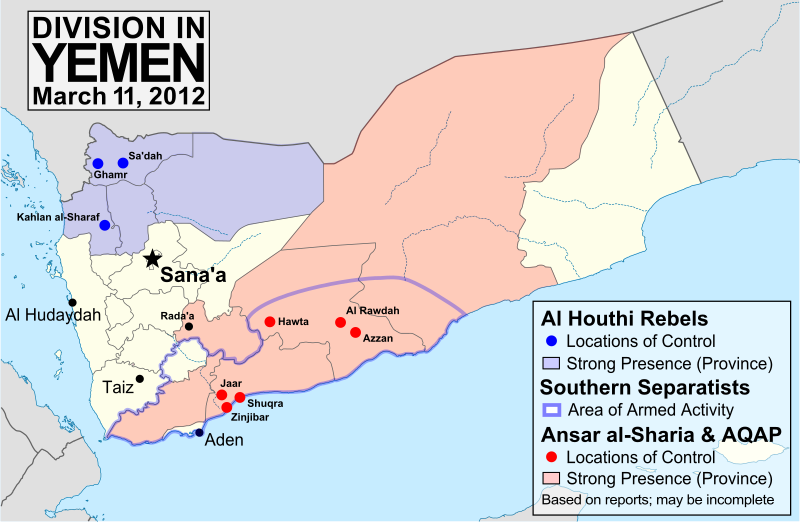
Perhaps it is all connected to the current global alert and threats of terrorist actions supposedly emanating from Yemen, but there certainly seems to be a major US operation ongoing in Yemen.

File:Yemen division 2012-3-11.svg

Yemen Divisions – wikipedia

UPDATE 2:

Drone strikes kill eight suspected militants in Yemen on Thursday 8th August

UPDATE!

Another 7 were killed in Yemen by US drone attacks on Wednesday, 7th August.

============================================

In the last 10 days since July 27th , there have been at least 4 drone attacks killing 17 people in Yemen.

  • July 27th: 6 killed in Abyan province
  • July 30th: 3 killed in drone attack on a car in Shabwa
  • August 1st: 4 killed in drone attack in Habramawt
  • 5th August: 4 killed on Tuesday when two unmanned aircraft fired four missiles at two vehicles in Wadi Abidah district. 

According to the Washington-based New America Foundation, the US killer drone attacks in Yemen almost tripled in 2012. 

The advantage with drone attacks is that they are impersonal, supposed to be clinically accurate, relatively cheap and put no personnel from the attacking side at risk. The downside is that they pre-empt any due process, are subject to the accuracy of very fallible intelligence gatherers and are inherently inhumane being “untouched by human hands”. And the civilians and children who frequently are killed on the ground get brushed under the carpet of “collateral damage”.

All those who have been killed recently in Yemen are said to have been affiliated with Al Qaeda.

But the dead cannot deny their alleged guilt and we will never know.

Apocalypse delayed – Himalayan researchers reverse earlier predictions of water shortages

August 6, 2013

I sense that some of the alarmism and the apocalyptic futures always associated with global warming hysteria are beginning to moderate.

Earlier predictions of water shortages due to the shrinkage of Himalayan glaciers are being reversed by new research which now predicts increased water flow in two Himalayan watersheds.

W. W. Immerzeel, F. Pellicciotti & M. F. P. Bierkens, Rising river flows throughout the twenty-first century in two Himalayan glacierized watersheds, Published online 04 August 2013, Nature Geoscience  (2013) doi:10.1038/ngeo1896

EnergyWire comments:

One of the big unknowns of climate change predictions — and one that has led to considerable contention — lies in knowing the future of water runoff from the Himalayas. The snow- and ice-rich region supplies water for billions of people in Asia and is sometimes referred to as the Earth’s “Third Pole.”

For years, scientists struggled to understand how precipitation will change in these mountains (ClimateWire, Oct. 24, 2011). They have also had difficulty determining how much glacier melt from the mountains contributes to water supply. 

A study out yesterday in Nature Geoscience by Walter Immerzeel, a physical geographer at Utrecht University, suggests that, in at least two major Himalayan watersheds, river flows and runoff should rise until 2100.

“We show that the peak in meltwater is later than we previously thought, which in combination with a projected increase in precipitation results in an increase in water availability until the end of the century,” he said.

The two watersheds Immerzeel reports on in the paper are those of the Baltoro and Langtang glaciers, which feed the Indus and Ganges rivers, respectively. In the Baltoro watershed, this is largely due to more glacier runoff from melt. In the Langtang, increased precipitation drives the extra runoff.

Immerzeel and his co-authors used the output of the latest global climate models from the Coupled Model Intercomparison Project (CMIP5) to look at temperature and precipitation projections. They combined that data with a hydrologic model of glacier responses to climate change.

They found that in both watersheds, runoff from glaciers should increase until the 2040s or 2060s, later than previous estimates, depending on which climate scenarios are applied.

….. In the paper, Immerzeel points out that his new finding contradicts previous work he has published, suggesting that runoff in the Indus and Ganges basin would decrease. At least for now, this is good news for people and farmers who rely on that water, he said.

“Strong increases in water demand are projected in the Indus as the food production needs to grow to feed the quickly rising population,” Immerzeel said. “An increased water availability from the mountains may help to sustain this growing demand.”

Abstract: Greater Himalayan glaciers are retreating and losing mass at rates comparable to glaciers in other regions of the world. Assessments of future changes and their associated hydrological impacts are scarce, oversimplify glacier dynamics or include a limited number of climate models. Here, we use results from the latest ensemble of climate models in combination with a high-resolution glacio-hydrological model to assess the hydrological impact of climate change on two climatically contrasting watersheds in the Greater Himalaya, the Baltoro and Langtang watersheds that drain into the Indus and Ganges rivers, respectively. We show that the largest uncertainty in future runoff is a result of variations in projected precipitation between climate models. In both watersheds, strong, but highly variable, increases in future runoff are projected and, despite the different characteristics of the watersheds, their responses are surprisingly similar. In both cases, glaciers will recede but net glacier melt runoff is on a rising limb at least until 2050. In combination with a positive change in precipitation, water availability during this century is not likely to decline. We conclude that river basins that depend on monsoon rains and glacier melt will continue to sustain the increasing water demands expected in these areas.

Asymmetric reversal of the Sun’s magnetic field is under way – NASA

August 6, 2013

The sun’s magnetic field reverses roughly every 11 years at solar maximum. We are now approaching solar maximum of solar cycle 24 (SC 24) but this magnetic reversal is strongly assymetric according to NASA:

“The sun’s north pole has already changed sign, while the south pole is racing to catch up,” says Scherrer. Soon, however, both poles will be reversed, and the second half of Solar Max will be underway.”

The North pole of the sun switched polarity in mid-2012 which seemed early at the time since solar maximum was not expected till the fall of 2013. It is difficult to imagine that there will not be consequences for the Earth but what those consequences might be is not a “settled science”.

Certainly geomagnetic reversals on Earth have more to do with the flow patterns in the earth’s liquid core and have quite different time periods. The time span between geomagnetic reversals on the Earth vary between 0.1 and 1 million years with an average of 450,000 years.

The latest one, the Brunhes–Matuyama reversal, occurred 780,000 years ago. However,a study published in 2012 by a group from the German Research Center for Geosciences suggests that a brief complete reversal occurred only 41,000 years ago during the last glacial period. The reversal lasted only about 440 years with the actual change of polarity lasting around 250 years.

From Dr. Leif Svalgaard’s research page:

Solar magnetic reversal cycle

The NASA press release says:

August 5, 2013:  Something big is about to happen on the sun.  According to measurements from NASA-supported observatories, the sun’s vast magnetic field is about to flip.

“It looks like we’re no more than 3 to 4 months away from a complete field reversal,” says solar physicist Todd Hoeksema of Stanford University. “This change will have ripple effects throughout the solar system.”

Read the rest of this entry »

“Plastic” beer losing ground in the US

August 5, 2013

Many of the mass produced US beers are – to my unsophisticated taste – little better than coloured dish water.

It is high time for a Campaign for Real Ale in the US.

From the Washington Post

Alcohol consumption in the US (Gallup)

Fairly stunning data from Gallup on Americans’ declining taste for beer compared to wine and hard liquor.

There are some interesting demographic internals, too. Back in the early nineties 71 percent of the 18-29 cohort preferred beer. Just 41 percent of today’s youth cohort says beer is their favorite, as do only 43 percent of 30 to 49 year olds. In other words, a cohort of beer lovers lost their taste for it as they became middle aged and was replaced by a new youth cohort that doesn’t like beer that much either.

What will be interesting to see is whether today’s young people follow their elders in becoming more beer-averse as they age.


Internet chatter leads to US diplomatic lockdown

August 5, 2013

Following my post a few days ago, it would seem that others also question the US Global Terror Alert.  I discern a faint whiff of alarmism and a strong smell of “CYA”.

Reblogged from Bloomberg

Warning to Americans: Be Afraid, Very Afraid

By Jeffrey Goldberg Aug 5, 2013 2:40 AM GMT+0200

Jeffrey Goldberg is a Bloomberg View columnist. He is the author of “Prisoners: A Story of Friendship and Terror” 

It seems as if al-Qaeda, or its Arabian Peninsula branch, has succeeded in terrorizing the United States of America again, but this time without – as of this writing – detonating an ounce of C4. It doesn’t strike me as a wise idea to preemptively shutter 21 different American embassies across the Middle East and North Africa in response to NSA-collected terrorist chatter. What message does this post-Benghazi, “don’t say we didn’t tell you” move send to the citizens of the Middle East, who, it is our hope, understand the United States to be a powerful and fearless country dedicated to openness and to the defeat of fanaticism? We have already muddied any message of fearlessness by turning our embassies into bunkers. Now, we are admitting that these bunkers aren’t safe. What next? Virtual embassies on Facebook? Ambassadors who never leave Washington?

The Administration tells us that the heightened threat of al-Qaeda terror extends through the end of the month. Is the State Department going to keep its diplomatic fortresses closed through September 1? Late this afternoon, State announced that 19 diplomatic posts are going to stay closed until August 10; others, including those in Baghdad, and Kabul, of all places, are scheduled to reopen Monday. It is unclear if these closings will be extended, or if the reopening embassies and consulates will again be closed. It could be that many of our diplomats — who, by the way, are still living in the target countries, just in less secure locations, generally, than embassy compounds – will not be at work for awhile. 

It is plausible that the intelligence community is fearful of this weekend in particular, because, as Bloomberg’s Nicole Gaouette and David Lerman have noted, Sunday is the Muslim holiday known as the Night of Power, and al-Qaeda-type extremists sometimes mark important holidays on the Muslim calendar by trying to kill people. So after the holiday passes, things could return to normal. It will be interesting to watch how the State Department manages this crisis – and, this time, it is being managed directly out of Washington. Usually, diplomatic posts are allowed to make their own judgments about security, independent of State Department headquarters. Not any more.

It will also be interesting to watch whether State clarifies its travelers’ alert to the American public. A couple of days ago, the department issued a warning to American travelers that was notable both for its implied dread and its maddening vagueness: “Terrorists may elect to use a variety of means and weapons and target both official and private interests,’ the warning reads. “U.S. citizens are reminded of the potential for terrorists to attack public transportation systems and other tourist infrastructure. Terrorists have targeted and attacked subway and rail systems, as well as aviation and maritime services. U.S. citizens should take every precaution to be aware of their surroundings and to adopt appropriate safety measures to protect themselves when traveling.”

As a public service, let me translate this warning for you: “Dear U.S. citizen: So, it turns out that al-Qaeda has not been defeated. In fact, its operatives want to kill you. Mainly, they want to kill you if you happen to be in one of the following 21 countries. Also, by the way, they want to kill you in the U.S., but right now let’s not talk about that, and focus on the immediate threat. We don’t know where, when or how al-Qaeda is going to try to kill you – probably August, if it makes you feel any better. In the past, al-Qaeda terrorists have targeted planes, trains, and automobiles, as well as large buildings, and small buildings. Also, boats. Our suggestion is that you not leave your hotel. And stay out of the lobby! Lobbies are dangerous. Actually, come to think of it, al-Qaeda has also targeted hotels in the past, so maybe you should just leave your hotel now, but through the kitchen, or the service entrance. But try to avoid people, and also places where there are people, once you have left your hotel. If you want to come home, please do so, but just be very careful at the airport. Thank you for your attention to this matter.”

In truth, the State Department is in a tough spot: If it doesn’t publicly issue warnings, and something dreadful, God forbid, does happen, the Obama Administration will be blamed by opportunists for not telling Americans they were in danger. But perhaps there is a way to issue these warnings in way that doesn’t fear-monger, and in a way that helps Americans make informed decisions. And perhaps there is a way to manage diplomatic security so as to avoid conveying to the world the idea that al-Qaeda can unhinge us quite so easily.

Satellite data clearly shows global cooling from 1984 – 2006

August 4, 2013

Brightness temperatures derived from the Meteosat data show a planetary trend of global cooling of upto  2K/decade since 1984.

One wonders why this data has not been publicised earlier.

In general, the Atlantic Ocean, Africa and Europe show a negative temperature trend, varying between zero and -2 K/decade.

Andries Rosema, Steven Foppes and Joost van der Woerd, Meteosat Derived Planetary Temperature Trend 1982-2006Energy & Environment, Volume 24, Number 3 – 4 / June 2013, 381-396, doi:10.1260/0958-305X.24.3-4.381

The paper is behind a paywall at the Journal but a pdf version is available (via climategate.nl): Rosema et al Meteosat data 1984-2006

From the author’s conclusions:

The amazing finding of the present study is that we do not observe global warming in the period 1982-2006, but significant cooling. …

The satellite data are from a reliable origin supported by the European meteorological community. Their accurate calibration has received due attention and efforts from Eumetsat. Our processing of these data has been simple and straight forward, involving only noon and midnight image composition, averaging and a filter to eliminate cloud effects. We have created similar planetary temperature change images for the unfiltered, 10, 20 and 30 day filtered data, clearly showing convergence towards the longer filters, indicating that cloud influences were effectively removed. 

Moreover, we do observe significant temperature increase at some locations which are due to human interventions, and which are quantitatively in line with the theoretically expected effects of these interventions. Therefore we believe the observed planetary temperature decrease for most of the hemisphere to be real.

The cloud filtered temperature change patterns, in figure 2c, indicate that the largest decrease occurs in the more cloudy regions of the hemisphere: the tropics and the temperate zones, while in the desert belt the temperature decrease is much smaller. This suggests that cloudiness changes could be the mechanism behind the observed global cooling since 1982: an increase in cloudiness would decrease global radiation and increase rainfall and evapotranspiration. Both effects tend to decrease the surface temperature.

While their conclusions about cloud cover as the determining mechanism are plausible – but as yet unproven – their general observations are quite significant:

In general, the Atlantic Ocean, Africa and Europe show a negative temperature trend, varying between zero and -2 K/decade. Remarkable, is a large area in southern Africa, mainly Zimbabwe and Mozambique, where the temperature decrease is even larger and in the range of -2 to -3 K. Also note the temperature decrease of Lake Chad and Lake Nasser, probably due to an increase in their surface areas. There are also some spots that show a substantial temperature increase, in particular in SE Iraq (figure 3a) and NW Tanzania (figure 3b).

They see a general reduction of temperature everywhere except in two small areas of Iraq and Tanzania:

  1. SE Iraq- An exceptional location which shows a strong temperature increase of some 5K in the period of 20 year. This increase took mainly place in the period 1993-1995 and reflects the draining of the marshes at the confluence of the Ephrata and Tigris under the regime of Sadam Hussein.
  2. NW Tanzania, south of Lake Victoria. There is a temperature increase of 1.3 K in 20 year. This location is in a strongly developing mining area. Decrease in vegetation cover and reduced  evapotranspiration may have caused this temperature increase.

ABSTRACT
24 year of Meteosat hourly thermal infrared data have been used to study planetary surface temperature change. Thermal infrared radiation in the 10.5-12.5mm spectral window is not affected by CO2 and only slightly by atmospheric water vapor. Satellite thermal infrared data have been converted to brightness temperatures as prescribed by Eumetsat. Hourly brightness temperature images were then composed to corresponding noon and midnight temperature data fields. The resulting data fields were cloud filtered using 10, 20 and 30 day maximum temperature substitution. Filtered data were subsequently averaged for two 10 yearly periods: 1986-1995 and 1996-2005. Finally the change in brightness temperature was determined by subtraction. In addition nine locations were selected and data series were extracted and studied for the period 1982-2006. Our observations point to a decrease in planetary temperature over almost the entire hemisphere, most likely due to an increase of cloudiness. Two small areas are found where a considerable temperature increase has occurred. They are explained in terms of major human interventions in the hydrological balance at the earth surface.

VitroGro, Tissue Therapies and QUT’s “inadvertent” data falsification?

August 4, 2013

The mysterious goings-on at the  whistle-blower fracas at the Queensland University of Technology seem to run quite deep. The mystery is apparently compounded by commercial interests. The elements include a company spun-off from QUT (Tissue Therapies), University staff owning stock in the company, the company raising start-up money, listed on the stock exchange and having a value entirely dependent upon the prospects for one breakthrough product (VitroGro).

The latest revelation suggests that the whistle- blowers, Luke Cormack and another – whose identity is protected but was “inadvertently” revealed by the University Vice Chancellor –  have been spied upon. Cormack was given “counselling” organised by the University – which counselling was never confidential. The contents of these discussions were apparently reported by the counselor to the University authorities!! Seems to be a remarkable absence of ethical standards at the University and – more particularly – with the counselor. Perhaps it was all “inadvertent”.

A summary of the story is here in the Courier-Mail.

His colleagues had discovered a cheaper and more reliable way to grow human tissue, with huge implications for biology and medicine. Cormack’s research concerning stem cells aimed to build on their findings.

But no matter what he tried, his cells refused to grow. He later failed his PhD.

The key question is whether VitroGro has real prospects or is just hype. It is supposed to be used in healing wounds by helping cells to grow. If VitroGro’s potential benefits have knowingly been hyped by the “inadvertently” manipulated data, then there is a risk that this is all a start-up scam.

Business start-up scams depend upon inflating the apparent value of a start-up company by promoting perceptions of a bright future such that investment money can be attracted.

Read the rest of this entry »

Twitter effectively accepts that it is a publisher and responsible for content

August 3, 2013

I have no doubt in my mind that social media such as Facebook, Twitter and LinkedIn are – in fact – publishers. They benefit from the advertising revenues raised on the back of their “reach” and must be responsible – and accountable – for the content they publish.

The abuse of a number of women on Twitter in the UK has now led the head of Twitter UK to personally apologise and for Twitter to now take a number of steps to prevent this kind of abuse. It is a tacit admission of responsibility for their content and completely undermines their previous stand that they are not a publisher. Even though Twitter is “requesting” its users to exercise restraint, their “commitment” makes it clear that Twitter is taking responsibility – even if only implicitly – for ensuring that their users exercise the proper restraint.

A well deserved pat on the back for Twitter (assuming they don’t back away from this commitment and later try to pin the blame on irresponsible users).

Tony Wang apology (Twitter UK)

Tony Wang apology (Twitter UK)

BBCThe boss of Twitter UK has said sorry to women who have experienced abuse on the social networking site. Tony Wang said the threats were “simply not acceptable” and pledged to do more to tackle abusive behaviour.

The apology came as Twitter updated its rules and confirmed it would introduce an in-tweet “report abuse” button on all platforms, including desktops. Police are investigating eight allegations of abuse including bomb and rape threats made against women.

Two people have been arrested in relation to Twitter rape threats against Labour MP Stella Creasy and feminist campaigner Caroline Criado-Perez, who received the threats after a campaign to have Jane Austen on the new £10 note.

Three female journalists said they were subjected to bomb threats on the site.

The revelations sparked a backlash online, with a petition calling for Twitter to add a “report abuse” button to tweets attracting more than 124,000 signatures. In a series of tweets, Twitter UK general manager Mr Wang said: 

  • “I personally apologize to the women who have experienced abuse on Twitter and for what they have gone through. The abuse they’ve received is simply not acceptable”.
  • “It’s not acceptable in the real world, and it’s not acceptable on Twitter”.
  • “There is more we can and will be doing to protect our users against abuse. That is our commitment.”

In an earlier message posted on its blog, Twitter’s senior director for trust and safety Del Harvey and Mr Wang said the company had clarified its anti-harassment policy in light of feedback from customers.

They said: “It comes down to this: people deserve to feel safe on Twitter.”

The company has clarified its guidance on abuse and spam – reiterating that users “may not engage in targeted abuse or harassment”.

The “report abuse” button already available on the iOS Twitter app and mobile site will also be rolled out to the main website and Android app from September, Twitter said.

Ms Harvey and Mr Wang wrote in their blog: “We want people to feel safe on Twitter, and we want the Twitter rules to send a clear message to anyone who thought that such behaviour was, or could ever be, acceptable.”