Looking for the Entwives – new Berkeley model predicts forests will march polewards because of global warming

May 7, 2013

It is the Age of the Models.

Where physical experiments and real data are obsolete. Where experiments are virtual and data-sets are generated by Monte Carlo methods. Where a room with a computer is called a lab. Where outputs of one model become the inputs of another model – never to be sullied by real observations or data. Where the garbage in is never questioned and the garbage out  takes the place of reality.

When you have a model who needs data!

This is a press release (marketing bumf)  from Berkeley Labs to get publicity for a new paper: “Boreal carbon loss due to poleward shift in low-carbon ecosystems,”  published on Nature Geoscience’s website on May 5, 2013.

And when the Ents start marching Saru-Mann is doomed! (apologies to JRR T).

Press Release: 

…. New Berkeley Lab research offers a way to envision a warmer future. It maps how Earth’s myriad climates—and the ecosystems that depend on them—will move from one area to another as global temperatures rise.

The approach foresees big changes for one of the planet’s great carbon sponges. Boreal forests will likely shift north at a steady clip this century. Along the way, the vegetation will relinquish more trapped carbon than most current climate models predict.

Boreal ecosystems encircle the planet’s high latitudes, covering swaths of Canada, Europe, and Russia in coniferous trees and wetlands. This vegetation stores vast amounts of carbon, keeping it out of the atmosphere where it can contribute to climate change.

Scientists use incredibly complex computer simulations called Earth system models to predict the interactions between climate change and ecosystems such as boreal forests. These models show that boreal habitat will expand poleward in the coming decades as regions to their north become warmer and wetter. This means that boreal ecosystems are expected to store even more carbon than they do today. ….

But the Berkeley Lab research tells a different story. The planet’s boreal forests won’t expand poleward. Instead, they’ll shift poleward. The difference lies in the prediction that as boreal ecosystems follow the warming climate northward, their southern boundaries will be overtaken by even warmer and drier climates better suited for grassland.

And that’s a key difference. Grassland stores a lot of carbon in its soil, but it accumulates at a much slower rate than is lost from diminishing forests.

“I found that the boreal ecosystems ringing the globe will be pushed north and replaced in their current location by what’s currently to their south. In some places, that will be forest, but in other places it will be grassland,” says Charles Koven, a scientist in Berkeley Lab’s Earth Sciences Division who conducted the research.

“Most Earth system models don’t predict this, which means they overestimate the amount of carbon that high-latitude vegetation will store in the future,” he adds.

Treebeard the Ent

Wow! paraphrasing Dr. Koven — “All other models are crap. Mine is the real thing”.

Koven’s results come from a new way of tracking global warming’s impact on Earth’s mosaic of climates. The method is based on the premise that as temperatures rise, a location’s climate will be replaced by a similar but slightly warmer climate from a nearby area. The displaced climate will in turn shift to another nearby location with a slightly cooler climate. It’s as if climate change forces warmer climates to flow toward cooler areas, making everywhere warmer over time.

This approach can help determine where a given climate is going to in the future, and where a given climate will come from.

Koven applied this approach to 21 climate models. He used simulations that depict a middle-of-the-road climate change scenario, meaning the range of warming by the end of this century is 1.0°C to 2.6°C above a 1986 to 2005 baseline. …..

….. In general, he found that climates move toward the poles and up mountain slopes. In parts of South America, warmer climates march westward up the Andes. In the southern latitudes, warmer climates head south.

dancing tree woman i entwives and other beauties av

An Entwife? (from http://www.myspace.com)

But the most dramatic changes occur in the higher latitudes. Here, boreal ecosystems will have to race poleward in order to keep up with their climates. They’ll also be encroached by warmer climates from the south. By the end of this century, a forest near Alberta, Canada will have to move 100 miles north in order to maintain its climate. And it will gain a climate that is now located 100 miles to the south.

Forests can’t adapt this quickly, however, meaning that in the short-term they’ll be stressed. And in the long-term they’ll be forced to move north and give up their southern regions to grassland.

Only one of the Earth system models shows this precipitous loss of carbon in southern boreal forests. Koven says that’s because most models don’t account for random events such as fire, drought, and insects that kill already-stressed trees. His “climate analogue” approach does account for these events because they’re implicit in the spatial distribution of ecosystems.

In addition, Earth system models predict carbon loss by placing vegetation at a given point, and then changing various climate properties above it.

“But this approach misses the fact that the whole forest might shift to a different place,” says Koven.

So it is climate model outputs as input to his model to give Dr. Koven his marching boreal forests.  Garbage in and Garbage out. But not a word about the Entwives and where they are to be found.

Somehow I find JRR  T is a lot more readable  — and much more convincing.

Faking the rythm: infantile academic spat at Rutgers University

May 7, 2013

Oh Good Grief!

As if the field of psychology did not have enough scandal and fakery already.

A childish spat between academics at Rutgers and infantile behaviour by Robert Trivers, a Professor of Anthropology who ought to know better. His opponent is William Brown, now a Senior Lecturer at the University of Bedfordshire.  But in this infantile academic spat it does seem as if the “establishment” are circling the wagons. I suspect that Robert Trivers, and Nature and other psychology heavyweights will prevail — but only to the further discredit of the discipline and its narcissistic  “star performers”.

Can’t they just both be spanked — in public? or put in the stocks?

A study featured in Nature in 2005 has drawn suspicion from university officials and one of its authors.

Nature: 

Few researchers have tried harder than Robert Trivers to retract one of their own papers. In 2005, Trivers, an evolutionary biologist at Rutgers University in New Brunswick, New Jersey, published an attention-grabbing finding: Jamaican teenagers with a high degree of body symmetry were more likely to be rated ‘good dancers’ by their peers than were those with less symmetrical bodies. The study, which suggested that dancing is a signal for sexual selection in humans, was featured on the cover of this journal (W. M. Brown et al. Nature 438, 1148–1150; 2005).

But two years later, Trivers began to suspect that the study data had been faked by one of his co-authors, William Brown, a postdoctoral researcher at the time. In seeking a retraction, Trivers self-published The Anatomy of a Fraud, a small book detailing what he saw as evidence of data fabrication. Later, Trivers had a verbal altercation over the matter with a close colleague and was temporarily banned from campus. 

An investigation of the case, completed by Rutgers and released publicly last month, now seems to validate Trivers’ allegations. Brown disputes the university’s finding, but it could help to clear the controversy that has clouded Trivers’ reputation as the author of several pioneering papers in the 1970s. For example, Trivers advanced an influential theory of ‘reciprocal altruism’, in which people behave unselfishly and hope that they will later be rewarded for their good deeds. He also analysed human sexuality in terms of the investments that mothers and fathers each make in child-rearing. …. 

In 2008, Trivers sought to retract the paper, but found the editors at Nature reluctant to do so. The paper remains unretracted, although a spokeswoman for Nature says that the case is under “active consideration”. (Information available to Nature’s research-manuscript editors is not generally shared with its reporters.) ….

…. Last year, the investigation concluded that there was “clear and convincing” evidence of fabrication by Brown, who it alleged had altered overall asymmetry measures of dancers to support the notion that better dancers were more symmetrical. The report was not published for more than a year, at which point Trivers posted it online. Rutgers has sent a copy to the NSF’s inspector-general, who is reviewing it to determine what action, if any, to take. ……

Brown, now a psychologist at the University of Bedfordshire, UK, denies fabricating the data. He criticizes the Rutgers investigation for comparing his data set with the one from Trivers’ group rather than the original hard copies of the source data.

Reality bites as EU politicians slowly back away from costly energy policy

May 7, 2013

Reuters reports that EU politicians are to meet at a summit to reassess energy policy in the post-fracking world  (and  – but this is not to be admitted under pain of being shunned – a post-global-warming reality). I just note that politicians will be the most adept at changing direction aand taking credit for moving away from global warming orthodoxy. Many scientists will find their own exit strategies but many will find it difficult to find the rationale to move away from what has become their religion and their livelihood. The least adept at embracing the new reality will the “climate bureaucrats” whose comfortable existence depends upon the global warming religion continuing in force. And all those who have milked the EU subsidy regime for all its worth will not be pleased but they will just move on to the next scam.

(Reuters) – EU heads of state and government will seek ways to limit the impact of energy costs on European competitiveness at a summit this month, a draft document seen by Reuters showed.

European industry says it is disadvantaged because of the price it pays for energy compared with the United States, where the shale gas revolution has drastically lowered costs.

The document ahead of the May 22 EU summit, which has energy and taxation on the agenda, calls for examination of the impact of energy prices and costs and action to limit the effects.

One option is developing the European Union’s own shale gas resources, although this is not mentioned directly. Instead, the draft refers to safe and sustainable development of “indigenous sources of energy”.

Europe’s very different geography and land ownership would make it hard for the European Union to rival the United States in shale gas, but the executive European Commission is working on a framework to guide prospectors.

The leaders are expected to urge the Commission to analyze energy prices and costs in member states “with a particular focus on the EU’s competitiveness” against global rivals.

The draft also points to massive investment costs in boosting power generation and networks as likely to drive up energy prices.

Arguments over energy costs have featured prominently in political debate ahead of German elections and played a part in blocking a Commission proposal to boost carbon prices on the EU market.

The Emissions Trading Scheme (ETS), where carbon prices have sunk to record lows, is not on the draft agenda, but it could be debated on the sidelines of the summit, EU sources have said.

Efforts to repair that market are also a focus of attention for the European Parliament.

“Climate science” now hunting for cooling effects – and finds the brightness of clouds

May 6, 2013

How is it that – for a settled science – all these new “cooling” mechanisms are suddenly being found? Could it have something to do with trying to rescue climate models which have failed to predict the slowdown in global warming? “Climate science” is now hunting for previously unidentified cooling effects to explain the warming that has not happened.

This time it is the brightness of clouds! Apparently manmade pollution in the form of organics can enhance the formation of clouds which happen to be brighter from above and which reflect more of the suns radiation. Voilà! An as yet unidentified cooling effect.

But this conclusion comes not from measurements but from yet another model!

From the University of Machester (via Alpha Galileo):

Organic vapours affect clouds leading to previously unidentified climate cooling

University of Manchester scientists, writing in the journal Nature Geoscience, have shown that natural emissions and manmade pollutants can both have an unexpected cooling effect on the world’s climate by making clouds brighter.

Clouds are made of water droplets, condensed on to tiny particles suspended in the air. When the air is humid enough, the particles swell into cloud droplets. It has been known for some decades that the number of these particles and their size control how bright the clouds appear from the top, controlling the efficiency with which clouds scatter sunlight back into space. A major challenge for climate science is to understand and quantify these effects which have a major impact in polluted regions.

The tiny seed particles can either be natural (for example, sea spray or dust) or manmade pollutants (from vehicle exhausts or industrial activity). These particles often contain a large amount of organic material and these compounds are quite volatile, so in warm conditions exist as a vapour (in much the same way as a perfume is liquid but gives off an aroma when it evaporates on warm skin).

The researchers found that the effect acts in reverse in the atmosphere as volatile organic compounds from pollution or from the biosphere evaporate and give off characteristic aromas, such as the pine smells from forest, but under moist cooler conditions where clouds form, the molecules prefer to be liquid and make larger particles that are more effective seeds for cloud droplets.

“We discovered that organic compounds such as those formed from forest emissions or from vehicle exhaust, affect the number of droplets in a cloud and hence its brightness, so affecting climate,” said study author Professor Gordon McFiggans, from the University of Manchester’s School of Earth, Atmospheric and Environmental Sciences.

“We developed a model and made predictions of a substantially enhanced number of cloud droplets from an atmospherically reasonable amount of organic gases.

“More cloud droplets lead to brighter cloud when viewed from above, reflecting more incoming sunlight. We did some calculations of the effects on climate and found that the cooling effect on global climate of the increase in cloud seed effectiveness is at least as great as the previously found entire uncertainty in the effect of pollution on clouds.”

  • ‘Cloud droplet number enhanced by co-condensation of organic papers,’ by Gordon McFiggans et al, will be published in Nature Geoscience on Sunday 5 May 2013.

Randy Andy FRS

May 5, 2013

Either the Royal Society has sold a Fellowship or perhaps they believe that HRH Prince Andrew, the Duke of York will bring great credit to the Society and the scientific community. A remarkable vote where only a “Yes” vote was permitted. No doubt we will hear that there was a clear consensus in favour and that his elevation was supported by – wait for it –  all those who supported him!

To put it mildly, Randy Andy has a rather spotted biography.

Either way it does little credit to the Royal Society or its Fellows.

The Guardian: 

After more than 350 years of largely happy association with assorted royalty Britain’s pre-eminent scientific institution, the Royal Society, faces unprecedented dissent from members after Prince Andrew was elected to become a fellow.

While the objections to the prince mainly centre on his slightly chequered career as a royal, a small number among the 1,450 or so Royal Societyfellowship are asking the wider question of whether it is time for an institution based on science to end the practice of honouring people on the basis of heredity.

The controversy has been fuelled by the way the prince was elected to be a royal fellow, a status he shares with Princes Philip, Charles and William, Princess Anne and the Duke of Kent, while the Queen is the organisation’s patron. The ballots sent out to ordinary fellows provided only one box to tick, supporting the measure. Those opposed had to write “no” themselves or otherwise mark or spoil the paper. … 

Unchanged seasonal variation shows that Carbon dioxide concentration increase is probably not due to fossil fuel combustion

May 5, 2013

Carbon dioxide concentration in the atmosphere varies seasonally with the May peak being about 6 ppm higher than the October low. These are very regular and are a reflection of biogenic and chemical interactions from plants, the soil and the oceans

This concentration is the net result following all the mechanisms by which carbon dioxide is produced and absorbed. Since 1960 the mean concentration has risen about 25% from about 320 ppm to just under 400 ppm now (399 as of yesterday) but the seasonal variation has remained virtually unchanged during this time.

from wikipedia

from wikipedia

This is not new and analyses the 25 year period from 1997 but I have only just come across it.

SOURCES AND SINKS OF CARBON DIOXIDE

CO2 seasonal variation

CO2 seasonal variation

The constancy of seasonal variations in CO2 and the lack of time delays between the hemispheres suggest that fossil fuel derived CO2 is almost totally absorbed locally in the year it is emitted. This implies that natural variability of the climate is the prime cause of increasing CO2, not the emissions of CO2 from the use of fossil fuels.

The annual increase of CO2 in the atmosphere is in sharp contrast with the annual change in the seasonal variations (last 25 years)

The mean values are:
Annual CO2 increase = 1.572 ± 0.013 ppm per year
Seasonal CO2 increase = -0.001 ± 0.013 ppm per year

The general assumption is that about 40% of man-made carbon dioxide shows up as this increase with the remainder being absorbed by the enhanced action of sinks.

The justification for this conclusion is supported by measurements of the falling proportion of  13C  in the atmosphere which is taken to signal the appearance of CO2 from fossil fuel emissions. …… 

The correlation of changes in δ13C with ENSO events and the comparison with a simple model of a series of cascades suggest that the changes in δ13C in the atmosphere have little to do with the input of CO2 emissions from the continuous use of fossil fuels.

Even though the combustion of fossil fuels only contributes less than 4% of total carbon dioxide production (about 26Gt/year of 800+GT/year), it is usually assumed that the sinks available balance the natural sources and that the carbon dioxide concentration – without the effects of man – would be largely in equilibrium.  (Why carbon dioxide concentration should not vary naturally escapes me!). It seems rather illogical to me to claim that sinks can somehow distinguish the source of carbon dioxide in the atmosphere and preferentially choose to absorb natural emissions and reject anthropogenic emissions! Also, there is no sink where the absorption rate would not increase with concentration.

Carbon dioxide emission sources (GT CO2/year)

  • Transpiration 440
  • Release from oceans 330
  • Fossil fuel combustion 26
  • Changing land use 6
  • Volcanoes and weathering 1

Carbon dioxide is accumulating in the atmosphere by about 15 GT CO2/ year. The accuracy of the amounts of carbon dioxide emitted by transpiration and by the oceans is no better than about 2 – 3% and that error band (+/- 20GT/year)  is itself almost as large as the total amount of emissions from fossil fuels.

SOURCES AND SINKS OF CARBON DIOXIDE

Conclusions:

During the 1977 to 2001 time period analysed:
Changes in the isotope ratio are discontinuous. The temporal peaks in 13C appear to correlate with the CO2 concentration changes. Further the temporal peaks in 13C and the CO2 peaks correlate with ENSO events.
The yearly increases of atmospheric CO2 concentrations have been nearly two orders of magnitude greater than the change to seasonal variation which implies that the fossil fuel derived CO2 is almost totally absorbed locally in the year that it is emitted.
A time comparison of the SIO measurements of CO2 at Mauna Loa with the South Pole shows a lack of time delay for CO2 variations between the hemispheres that suggests a global or equatorial source of increasing CO2. The time comparison of 13C measurements suggest the Southern Hemisphere is the source. This does not favour the fossil fuel emissions of the Northern Hemisphere being responsible for ther observed increases.
All three approaches suggest that the increase of CO2 in the atmosphere may not be from the CO2 derived from fossil fuels. The 13C data is the most striking result and the other two approaches simply support the conclusion of the first approach.

Baboons can tell “more” from “less” – but that is still a long way from counting

May 4, 2013

Being able to distinguish between “more” and “less” is – most likely – a capability that is a pre-requisite for the evolutionary development of the ability to count which itself must lead to the invention of numbers. Recent experiments with baboons demonstrates that they have a clear ability to make quite complex more/less distinctions.

Allison M. Barnard, Kelly D. Hughes, Regina R. Gerhardt, Louis DiVincenti, Jenna M. Bovee and Jessica F. Cantlon.Inherently Analog Quantity Representations in Olive Baboons (Papio anubis). Frontiers in Comparative Psychology, 2013 DOI: 10.3389/fpsyg.2013.00253

From the University of Rochester press release:

… Now a new study with a troop of zoo baboons and lots of peanuts shows that a less obvious trait—the ability to understand numbers—also is shared by man and his primate cousins.

“The human capacity for complex symbolic math is clearly unique to our species,” says co-author Jessica Cantlon, assistant professor of brain and cognitive sciences at the University of Rochester. “But where did this numeric prowess come from? In this study we’ve shown that non-human primates also possess basic quantitative abilities. In fact, non-human primates can be as accurate at discriminating between different quantities as a human child.”

“This tells us that non-human primates have in common with humans a fundamental ability to make approximate quantity judgments,” says Cantlon. “Humans build on this talent by learning number words and developing a linguistic system of numbers, but in the absence of language and counting, complex math abilities do still exist.” ……

……… The baboons’ choices, conclude the authors, clearly relied on this latter “more than” or “less than” cognitive approach, known as the analog system. The baboons were able to consistently discriminate pairs with numbers larger than three as long as the relative difference between the peanuts in each cup was large. Research has shown that children who have not yet learned to count also depend on such comparisons to discriminate between number groups, as do human adults when they are required to quickly estimate quantity. 
Studies with other animals, including birds, lemurs, chimpanzees, and even fish, have also revealed a similar ability to estimate relative quantity, but scientists have been wary of the findings because much of this research is limited to animals trained extensively in experimental procedures. The concern is that the results could reflect more about the experimenters than about the innate ability of the animals. ……..

……… To rule out such influence, the study relied on zoo baboons with no prior exposure to experimental procedures. Additionally, a control condition tested for human bias by using two experimenters—each blind to the contents of the other cup—and found that the choice patterns remained unchanged.

A final experiment tested two baboons over 130 more trials. The monkeys showed little improvement in their choice rate, indicating that learning did not play a significant role in understanding quantity.

“What’s surprising is that without any prior training, these animals have the ability to solve numerical problems,” says Cantlon. The results indicate that baboons not only use comparisons to understand numbers, but that these abilities occur naturally and in the wild, the authors conclude. …….

Book Burning to promote climate science!

May 3, 2013

Dr. Craig Clements and Dr. Alison Bridger demonstrating their methods for the advancement of science.

SJSU_bookfire

Drs. Bridger and Clements of San Jose State University burning a book to advance their cause

From WUWT

Fifty shades of fraud in Flanders

May 3, 2013

Following on from the publicity surrounding the Diedrik Stapel case, a new survey of medical researchers in Flanders confirms that fraud is fairly prevalent. This takes the form of making up data, manipulating data to make it match a hypothesis, plagiarism, double publishing (self-plagiarism), withholding undesirable research results, undeserved authorships or dividing research into as many separate science articles as possible (salami slicing). The article by Reinout Verbeke and Joeri Tijdink was produced with the support of the Pascal Decroos Fund for Investigative Journalism. One in twelve medical scientists admits to making up or ‘massaging’ data in order for it to match a hypothesis. And almost six in twelve see such fraudulent practices happening around them. They identify high publication pressure as one of the causes. Ivan Oransky of Retraction Watch points out that for the medical research fraternity the high rewards from pharmaceutical companies can also play a role.

In November and December 2012 Belgian  science journalist Reinout Verbeke (editor of Eos Magazine) spread an anonymous survey on fraud and pressure to publish among scientists of the Medical Science faculties of all Flemish universities. ……..  Psychiatrist and researcher Joeri Tijdink (VU University Medical Center Amsterdam) collaborated on the survey. He did another sounding in 2011 in the Netherlands, before the scandal surrounding Diederik Stapel had broken out – the social psychologist who had made up data and experiments. For years nobody had been on to him. Stapel and his unsuspecting doctoral students and co-authors even made top magazines with their fictitious studies. Luckily though, such large-scale fraud is rather rare. ……..

Fifty shades of fraud

Fifty shades of fraud

The results of the Flemish survey are striking. Of the 315 participating scientists, four (1.3%) admit to having made up data at least once in the last three years. If what they say is true, this probably concerns fraud that is still undiscovered. 23 respondents (7.3%) admit to having selectively removed data or results to make research match a hypothesis, so-called ‘data massaging’. Overall, about 8% of the Flemish medical scientists admits to recently having made up and/or massaged data. The figures are worse than the international average. A meta-analysis of 18 scientific studies on fraud by Daniele Fanelli showed that on average 2% of all scientists (from different fields of study) admitted to having done similar practices at least once (PloS ONE, 2009). Why are the results among Flemish respondents even worse? “That doesn’t surprise me, because we are talking about medical scientists”, says American journalist and fraud expert Ivan Oransky from RetractionWatch. com. “Cooperating with the pharmaceutical industry gains researchers financial rewards. That could pressurise scientists to cut corners.” André Van Steirteghem, a pioneer in reproductive medicine and secretary of the Committee on Publication Ethics (COPE), thinks there is something else at play. “There’s is a significant lack of openness on fraud and malpractice at Flemish universities. This survey asked scientists about their perceptions for the very first time. They were able to vent their feelings. I think that explains the high figures in Flanders.” We can even suspect malpractices in Flanders to be more wide-spread still. “Surveys have their limits”, says Daniele Fanelli. “Many cheaters won’t admit to having done it, or will falsely assume they have a clean conscience.” …… 

Scientific American reports on this story here.

“Bearing children has largely become the province of the lower classes”

May 2, 2013

The Daily Mail runs an article today about why the middle class are not breeding any more. It is not difficult to get a faint whiff of eugenics. But I can’t help feeling that some level of eugenics is not necessarily all bad as we move from natural selection to a world where artificial selection (IVF, surrogacy, sperm banks etc.) is increasing. And of course, even the availability of abortion on demand is in itself a form of selection.

  • Educated women deferring motherhood for so long they’re no longer fertile
  • Bearing children ‘has largely become the province of the lower classes’ 
  • TV historian Dr Lucy Worsley is poster girl for intentionally childless women

…. as author and demographic expert Jonathan Last observes in his controversial book What to Expect When No One’s Expecting:

‘The bearing and raising of children has largely become the province of the lower classes. It’s a kind of reverse Darwinism where the traditional markers of success make one less likely to reproduce.’

If “lower class” were a genetic trait then the middle and higher classes should fear extinction in due course. Fortunately “class” is just relative and subjective so no matter what the demographics are, distinctions of class will be introduced into any population that exists. But what is more interesting to consider is the fact that women with a higher level of education (which says nothing about native intelligence) have fewer children. This seems to be a global phenomenon. Data from 2010 in the extract below.

The full table is here. Primary School Enrollment and Total Fertility Rates, Latest Year (2000-2010)

Primary School Enrollment and Total Fertility Rates for Selected Countries, Latest Year 2000 – 2010

Rank Country

Primary School Enrollment

Total Fertility Rate

Percent

Number of children
per woman

1 Japan

100.0

1.3

2 Spain

99.8

1.5

3 Iran

99.7

1.8

4 Georgia

99.6

1.6

5 United Kingdom

99.6

1.9

…
181 Equitorial Guinea

53.5

5.3

182 Guinea-Bissau

52.1

5.7

183 Djibouti

40.1

3.9

184 Sudan

39.2

4.2

185 Eritrea

35.7

4.6

Note: Rankings are based on a list of 185 countries for which primary enrollment data are available.
Source: EPI from UNESCO

Fertility rates tend to be highest in the world’s least developed countries. When mortality rates decline quickly but fertility rates fail to follow, countries can find it harder to reduce poverty. Poverty, in turn, increases the likelihood of having many children, trapping families and countries in a vicious cycle. Conversely, countries that quickly slow population growth can receive a “demographic bonus”: the economic and social rewards that come from a smaller number of young dependents relative to the number of working adults.

For longer term population stability the goal is to reach replacement-level fertility, which is close to 2 children per woman in places where mortality rates are low. Industrial countries as a group have moved below this level. Some developing countries have made progress in reducing fertility, but fertility rates in the least developed countries as a group remain above 4 children per woman.

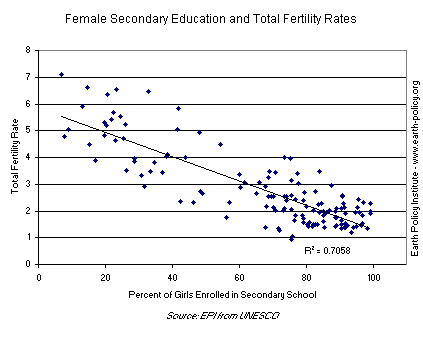
The trends with secondary education are also very clear:
Female Secondary Education and Total Fertility Rates

Of course the level of development in a country dominates and fertility rates around the world are reducing and converging. Whether this trend will continue even when all female children enjoy secondary education remains to be seen. The UK case where nearly all children do get secondary education would suggest that those with higher (university) education continue to show a declining fertility. But the real test of this hypothesis will only come when education levels around the world have equalised and fertility rates all lie around the same level.

So is the human population “dumbing down”? Not really. Education level is not intelligence. To what extent intelligence is a hereditary trait is uncertain. While it would seem that evolution should favour increasing intelligence, even this is not crystal clear. It is certainly a perception I have that “successful” people tend to be more intelligent but high intelligence does not ensure success. And success in life correlates with wealth but not so well with number of offspring.  “Success”, however we define it,  is not a genetic trait. There have been some suggestions that there may be some optimum level of intelligence for the genetic success of the species and that hunter-gatherers were actually somewhat more intelligent than we are now. Perhaps humans can be “too clever by half”!

But for some time to come, as the developing world catches up with the developed world, we can surely conclude that less-educated parents will have the higher fertility. Whatever that may mean for the long term evolution of humans, and that will be the result of the level to which we intentionally apply genetic selection.

Related: “Selection” lies in the begetting and evolution is just a result