How much of “social-priming” psychology is just made-up?

May 11, 2013

There is a whole industry of social psychologists specialising in – and getting funded for – studying “social priming”. The more astonishing or contra-intuitive the result the more attention, the more publicity and the more funding the researcher seems to get. But it seems that many (maybe most) of these study results are irreproducible. It is not implausible that priming does (should) affect subsequent behaviour but social psychologists seeking fame through astonishing results (often, it seems, made-up results) have not helped their own cause. The list of questionable “social priming” results is getting quite long:

    • Thinking about a professor just before you take an intelligence test makes you perform better than if you think about football hooligans.
    • people walk more slowly if they are primed with age-related words
    •  A warm mug makes you friendlier.
    • The American flag makes you vote Republican.
    • Fast-food logos make you impatient
    • lonely people take longer and warmer baths and showers, perhaps substituting the warmth of the water for the warmth of regular human interaction

Attention-grabbing results seem to be common among social psychologists of all kinds. A made-up result which says that “the smarter a man is, the less likely he is to cheat on his partner” generates the expected headlines and spots on TV talk shows. Diedrik Stapel made up data to prove that “meat eaters are more selfish than vegetarians”. Dirk Smeesters claimed that “varying the perspective of advertisements from the third person to the first person, such as making it seem as if we were looking out through the TV through our own eyes, makes people weigh certain information more heavily in their consumer choices” and that “manipulating colors such as blue and red can make us bend one way or another”. But Smeesters too has now admitted cherry picking his data. A raft of retractions followed and is still going on.

Nature: 

A paper published in PLoS ONE last week1 reports that nine different experiments failed to replicate this example of ‘intelligence priming’, first described in 1998 (ref. 2) by Ap Dijksterhuis, a social psychologist at Radboud University Nijmegen in the Netherlands, and now included in textbooks.

David Shanks, a cognitive psychologist at University College London, UK, and first author of the paper in PLoS ONE, is among sceptical scientists calling for Dijksterhuis to design a detailed experimental protocol to be carried out indifferent laboratories to pin down the effect. Dijksterhuis has rejected the request, saying that he “stands by the general effect” and blames the failure to replicate on “poor experiments”.

An acrimonious e-mail debate on the subject has been dividing psychologists, who are already jittery about other recent exposures of irreproducible results (see Nature 485, 298–300; 2012). “It’s about more than just replicating results from one paper,” says Shanks, who circulated a draft of his study in October; the failed replications call into question the under­pinnings of ‘unconscious-thought theory’. ….

….. In their paper, Shanks and his colleagues tried to obtain an intelligence-priming effect, following protocols in Dijksterhuis’s papers or refining them to amplify any theoretical effect (for example, by using a test of analytical thinking instead of general knowledge). They also repeated intelligence-priming studies from independent labs. They failed to find any of the described priming effects in their experiments. ……

……. Other high-profile social psychologists whose papers have been disputed in the past two years include John Bargh from Yale University in New Haven, Connecticut. His claims include that people walk more slowly if they are primed with age-related words.

Bargh, Dijksterhuis and their supporters argue that social-priming results are hard to replicate because the slightest change in conditions can affect the outcome. “There are moderators that we are unaware of,” says Dijksterhuis.

But Hal Pashler, a cognitive psychologist at the University of California, San Diego — a long-time critic of social priming — notes that the effects reported in the original papers were huge. “If effects were that strong, it is unlikely they would abruptly disappear with subtle changes in procedure,” he says. ….

CHE: 

This fall, Daniel Kahneman, the Nobel Prize-winning psychologist, sent an e-mail to a small group of psychologists, including Bargh, warning of a “train wreck looming” in the field because of doubts surrounding priming research. He was blunt: “I believe that you should collectively do something about this mess. To deal effectively with the doubts you should acknowledge their existence and confront them straight on, because a posture of defiant denial is self-defeating,” he wrote.

……. Pashler issued a challenge masquerading as a gentle query: “Would you be able to suggest one or two goal priming effects that you think are especially strong and robust, even if they are not particularly well-known?” In other words, put up or shut up. Point me to the stuff you’re certain of and I’ll try to replicate it. This was intended to counter the charge that he and others were cherry-picking the weakest work and then doing a victory dance after demolishing it. He didn’t get the straightforward answer he wanted. “Some suggestions emerged but none were pointing to a concrete example,” he says.

Social psychology and social psychologists have some way to go to avoid being dismissed out of hand as charlatans.

We were lowly scavengers long before we became noble hunter-gatherers

May 10, 2013

There has always been an aura of romance about our ancient hunter-gatherer forbears. The term “noble savage” ( “bon sauvage”) only dates back to 1672 but the concept gained ground in the 18th and 19th centuries and the idea of “nature’s gentlemen” flourished in the sentimentality of that time. Jean M Auel’s hugely successful Earths Children series also paints a picture of rather noble hunter-gatherers. Hunters are of course intrinsically heroic and appending “gatherers” to their description does not take too much away. The heroic stature is only dissipated when we become fully settled agriculturists – mere farmers – in the Holocene. Farmer’s don’t conjure up images of nobility and heroism and of course when humans became traders they also get greed and deviousness added to their image.

But there is no perceived nobility or honor in scavenging. It is the image of the hyena versus that of the lion. But long before we became hunter-gatherers we were scroungers and scavengers. New archaeological findings indicates that we were hunter-scavengers some 2 million years ago. And we were scavengers before that and scroungers when we first split from the chimps.

Ferraro JV, Plummer TW, Pobiner BL, Oliver JS, Bishop LC, et al. (2013) Earliest Archaeological Evidence of Persistent Hominin Carnivory. PLoS ONE 8(4): e62174. doi:10.1371/journal.pone.0062174

My imagined time-line for the various phases of human development then becomes:

  • 8 million YBP           Human Chimpanzee divergence – Scroungers
  • 4 million YBP           Bipedalism – Scavengers
  • 2 million YBP           Stone tools – Hunter-scavengers
  • 600,000 YBP          Archaic Human – Neanderthal divergence
  • 200,000 YBP          Hunting teams, herd followers  Hunter-nomads
  • 60,000    YBP          Semi-permanent dwellings, Hunter-gatherers
  • 11,500     YBP          Settled agriculture Farmers
  • 5,000       YBP          Mercantile expansions Merchant-soldiers

“Moral Turpitude” at University of New Hampshire

May 10, 2013

“Moral Turpitude” at the University of New Hampshire which does not amount to “moral delinquency of a grave order” can still lead to dismissal. Seems to me like playing with words to be able to apply some common sense. But the UNH use of “to grieve” may be innovative if a little odd.

The University of New Hampshire has terminated the employment of a Professor for “moral turpitude”. The University press release (my emphasis):

After an extensive review of the facts, Provost John Aber has determined that it is appropriate to terminate the employment of Marco Dorfsman, associate professor of Spanish, effective May 17, 2013. Professor Dorfsman admitted to intentionally lowering the student evaluations of another faculty member. This serious breach of ethical standards constitutes moral turpitude that cannot be tolerated at UNH.

Provost Aber’s determination was informed by the recommendation of the Professional Standards Committee (PSC) of the Faculty Senate. The PSC members unanimously agreed that Professor Dorfsman’s conduct constituted moral turpitude and “evinces a gross disregard for the rights of others, is a clear and intentional breach of duties owed to others and to the university by virtue of employment at UNH and membership in the profession, in which such an act is considered contrary to the accepted and expected rules of moral behavior, justice, or honesty, and evokes condemnation.” The PSC’s recommendation contained a range of possible sanctions.

The provost’s decision reinforces UNH’s commitment to upholding and teaching ethical behavior. Professor Dorfsman’s conduct disregarded the rights of his colleague, undermined the evaluations submitted by our students (a prime source of data for employment decisions for all instructors), and corrupted an important process by which our faculty’s teaching effectiveness is measured.

If Professor Dorfsman decides to grieve the provost’s dismissal decision, the case will be decided by an arbitrator.

“To grieve” obviously has a rather special meaning at UNH. Clearly it cannot just mean “to sorrow” but must (also) mean “to contest”  or “to pursue a grievance” which is not an action I normally associate with “grieving”. I wonder how – if he decides to contest the dismissal – he is expected to demonstrate his grieving. Perhaps there is a threshold of proof of pain or sorrow or hurt or grief that he must first attain?

The CHE reports that “last year the university agreed to a new contract with its faculty union that eased the standard of discipline to allow the institution to fire professors who demonstrate moral turpitude”. This use of “moral turpitude” was introduced last year instead of “moral delinquency of a grave order”:

After a long stalemate, the University of New Hampshire has agreed to a new contract with its faculty union that lowers the threshold for the university to take disciplinary action against professors, according to Foster’s Daily Democrat. The sticking point in the contract talks stemmed from a 2009 incident in which a professor was convicted of indecent exposure, yet later allowed by an arbitrator to keep his job. Administrators had sought to fire the professor, but the arbitrator ruled that his crime, while morally delinquent, did not rise to the old contract’s standard of “moral delinquency of a grave order.” The faculty union objected to the university’s attempt to rewrite the contract, saying that the proposed disciplinary provisions were too broad. The language in the new contract has been changed to allow the university to fire professors who demonstrate “moral turpitude,” therefore easing the disciplinary standard, according to the newspaper.

Financial Times accused of lying and shoddy journalism

May 10, 2013

Despicable when a newspaper of the stature of the Financial Times has to resort to this kind of shoddy journalism.

This is from Svenska Dagbladet (my free translation):

You are an Embarrassment Financial Times!

It must be deplored that some reporters cold-bloodedly invented information about the new WTO Director Roberto Azevedo.

The day after the World Trade Organization had chosen the Brazilian diplomat as new head a major article was published in the prestigious Financial Times. It began with a detailed description of how Azevedo appeared  when he came out of the WTO headquarters in Geneva at 18.30 on Tuesday night to meet a large press contingent. “He came out of the headquarters and met an expectant press gang outside,” writes the paper’s two reporters. The report continues on how Azevedo was quiet and did not say anything. But his happy facial expressions and his smile revealed that he had been elected.  A smile that was also used in the title:

The FT Headline: “Sealed with a smile: how Brazil got its man Azevêdo into the WTO”

By Claire Jones in London and Joseph Leahy in São Paulo Last updated: May 8, 2013 9:26 pm

The Brazilian candidate betrayed his success with a smile.

Just after 6.30pm local time on Tuesday evening, Roberto Azevêdo made his way out of the World Trade Organisation’s Geneva headquarters to find an expectant press pack gathered outside.

The Brazilian ambassador to the WTO remained silent. But his cheery expression was a giveaway: minutes earlier, Mr Azevêdo had been told he had secured the nomination to replace Pascal Lamy. With that, he capped an almost five-month campaign by Brazil that saw him visit 47 countries and join President Dilma Rousseff in key meetings with global leaders as she lobbied on his behalf. … 

The Svenska Dagbladet continues:

Not just embarrassing, it was just not true.

Azevedo did not come out of the WTO headquarters.

Nor was he silent, nor did he smile and  he certainly did not meet any press contingent. He was not even there!.

He sat and waited nervously with Brazil’s UN delegation several kilometers away.

The only one who received the news at WTO headquarters was Brazil’s deputy ambassador Estanislau Amaral.

I know this along with all the other journalists with certainty because we were there.  We saw Amaral hurrying out, spoke briefly with him, saw him go off in his official car. No Azevedo in sight. Moreover a picture of Azevedo was sent on Twitter at that moment  was sitting in his office in a completely different part of town with his wife Maria.

The FT journalists were not even there.

One sat in London, Claire Jones, and one in Sao Paulo, Joseph Leahy.  They invented the story that implied their presence and to provide a personal touch.  Not a very good journalistic idea for a magazine that should be concerned about its credibility and its reputation.

They could learn from what happened with journalists at Bloomberg this week. Two journalists in Prague published an article on the Czech National Bank one minute ahead of an embargo. It caused Bloomberg’s news director in Washington to hit the roof, take the next plane to Prague and and fire them on the spot.  Journalistic reliability is “extremely important” was the explanation.

Solar Cycle 24 double peak now clearly evident

May 9, 2013

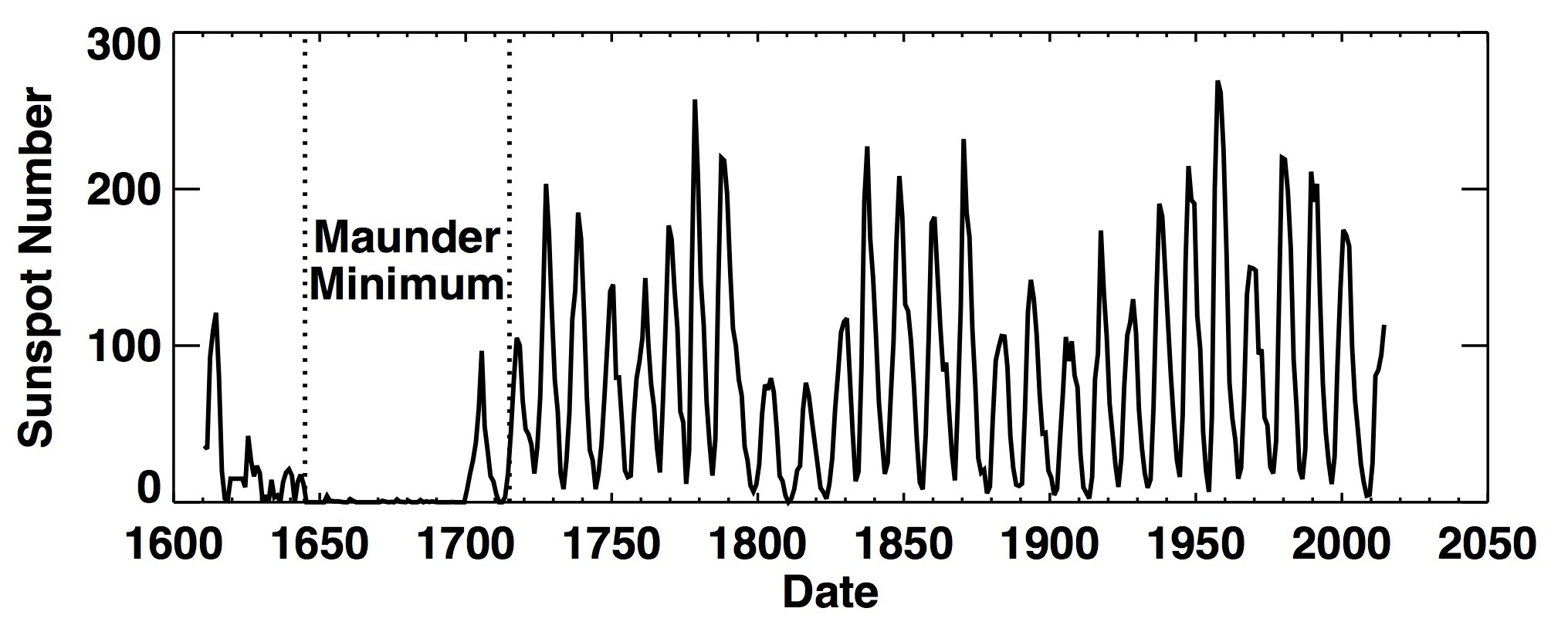
Already in March there were signs that this Solar Cycle 24 would exibit a double peak. NASA’s latest sunspot prediction for Solar Cycle 24 as of 1st May 2013 clearly shows that the sunspot activity is into its “double peak for this Cycle. A double peak was also evident in Cycles 22 and 23 and also in Cycles 5 and 14. The levels for SC24 are still going to be the lowest for 100 years and predictions for SC 25 are that they will be even lower still. Most second peaks have been somewhat smaller than the first – though not in SC5 – and seem to add around 6 months to the cycle time.

If this is indeed a double peak then I expect that solar maximum will perhaps be a few months delayed from the NASA prediction of Fall 2013. End 2013 now seems more likely.

SC24 may 2013

The Dalton minimum spanned Solar Cycles 5 and 6 from 1790 to 1820.  The Maunder Minimum from 1645 to 1715 preceded the numbering of Solar Cycles (Solar Cycle 1 started in 1755). The likelihood that SC 24 and 25 may be similar to SC 5 and 6 is growing and so is the likelihood that we will see 2  – 3 decades of global cooling. It is more likely that for the next 20- 30 years this Landscheidt Minimum will resemble the Dalton Minimum period, but if SC25 is a very small cycle then we may even approach the conditions of the Little Ice Age during the Maunder Minimum. Landscheidt’s prediction was that this minimum would last from 2000 to 2060 and the global temperature stand-still for the last 15 years gives greater credence to his forecasts.

NASA: The Sunspot Cycle —

The Maunder Minimum

Early records of sunspots indicate that the Sun went through a period of inactivity in the late 17th century. Very few sunspots were seen on the Sun from about 1645 to 1715 (38 kb JPEG image). Although the observations were not as extensive as in later years, the Sun was in fact well observed during this time and this lack of sunspots is well documented. This period of solar inactivity also corresponds to a climatic period called the “Little Ice Age” when rivers that are normally ice-free froze and snow fields remained year-round at lower altitudes. There is evidence that the Sun has had similar periods of inactivity in the more distant past. The connection between solar activity and terrestrial climate is an area of on-going research.

India’s plummeting birth rates illustrate the coming population decline

May 9, 2013

Fertility rates are dropping sharply across the world and simple arithmetic tells us that by 2100 world population will be steady or declining slightly. In fact, rather than facing a population explosion and food shortages we will be facing the demographic challenges of a stable or declining population together with an increase in longevity. A new flexibility in the patterns of working will be needed as the populations in work reduce in proportion to those beyond retirement age. Retirement age itself will have to increase.

Yet it seems to me that the utterly alarmist, Malthusian, catastrophe scenarios for world population put forward in the 1970’s and 80’s by the Club of Rome, Ehrlich and other doom-mongers still prevail as “conventional wisdom” – even though it has long been established that their basic assumptions were plain wrong. For some reason environmentalists are the most ardent deniers of what the arithmetic says. They are the first to proclaim the dangers of population explosions yet are extremely loth to abandon catastrophe scenarios they have espoused when they are shown to be exaggerated or false.

I was therefore glad to see the subject getting attention in GeoCurrents where Martin W Lewis addresses and presents the sharply falling fertility rates around the world and in the various States in India. His maps are particularly well put together. The average fertlity rate in India is now down to 2.5 but many of the States fall well below the “replacement rate” of 2.2. The variation of fertility rates is impacted by the “usual suspects”; GDP, female literacy, proportion of urban dwellers, life expectancy, the Human Development Index (HDI) and the availability of electricity. But as Lewis shows there is also a striking correlation between fertility and TV ownership (seems plausible) and between fertility rates and the exposure of women to the media (also very plausible).

India’s Plummeting Birthrate: A Television-Induced Transformation?

…. It can be deceptive, however, to view India as an undivided whole. As shown on the map posted here, fertility figures for half of India are actually below replacement level. Were it not for the Hindi-speaking heartland, India would already be looking at population stabilization and even decline. All the states of southern India post TFR figures below 1.9. A number of states in the far north and the northeast boast similarly low fertility levels, including West Bengal, noted for its swarming metropolis of Calcutta (Kolkata).

(from GeoCurrents)

India’s geographical birthrate disparities, coupled with the country’s admirable ability to collect socio-economic data, allow us to carefully examine ideas about fertility decline. The remainder of this post will do so through cartography, comparing the Indian fertility-rate map with maps of other social and economic indicators. ……. 

……

Some scholars have argued that recent fertility decreases in India and elsewhere in the Third World are more specifically linked to one technological innovation: television. The TV hypothesis is well-known in the field, discussed, for example, in the LiveScience article on the African population explosion mentioned above. In regard to India, Robert Jensen and Emily Oster argue persuasively that television works this magic mostly by enhancing the social position of women. As they state in their abstract:

This paper explores the effect of the introduction of cable television on women’s status in rural India. Using a three-year, individual-level panel dataset, we find that the introduction of cable television is associated with significant decreases in the reported acceptability of domestic violence towards women and son preference, as well as increases in women’s autonomy and decreases in fertility. We also find suggestive evidence that exposure to cable increases school enrollment for younger children, perhaps through increased participation of women in household decision-making. We argue that the results are not driven by pre-existing differential trends.

As it turns out, the map of television ownership in India does bear a particularly close resemblance to the fertility map. Two anomalously low-fertility states with low levels of female education, Andhra Pradesh and Jammu and Kashmir, score relatively high on TV penetration, as does West Bengal, which lags on several other important socio-economic indicators. The correlation is far from perfect: Mizoram ranks higher on the TV chart than its fertility figures would indicate, whereas Odisha and Assam rank lower. Odisha and Assam turn out to be a bit less exceptional in a related but broader and more gender-focused metric, that of “female exposure to media.” These figures, which include a television component, seem to provide the best overall correlation with the spatial patterns of Indian fertility.

(from GeoCurrents)

Cheers (hic)! Champagne research at the University of Reading.

May 9, 2013

Back in 2009, Dr Jeremy Spencer from the University of Reading published a paper in the British Journal of Nutrition about how drinking champagne was good for your heart.

image – LiveScience

Research from the University of Reading suggests that two glasses of Champagne a day may be good for your heart and circulation. The researchers have found that drinking Champagne wine daily in moderate amounts causes improvements in the way blood vessels function. …… 

….. Dr Jeremy Spencer, from the Department of Food and Nutritional Sciences said: “Our research has shown that drinking around two glasses of Champagne can have beneficial effects on the way blood vessels function, in a similar way to that observed with red wine. We always encourage a responsible approach to alcohol consumption, but the fact that drinking Champagne has the potential to reduce the risks of suffering from cardiovascular diseases such as heart disease and stroke, is very exciting news.” 

University of Reading

Four years on he is now Professor of Nutritional Biochemistry and Medicine and – presumably – many cases of champagne later, he has just published another paper on the benefits of champagne in improving memory and holding back dementia .

New research shows that drinking one to three glasses of champagne a week may counteract the memory loss associated with ageing, and could help delay the onset of degenerative brain disorders, such as dementia.

Scientists at the University of Reading have shown that the phenolic compounds found in champagne can improve spatial memory, which is responsible for recording information about one’s environment, and storing the information for future navigation. …. 

….. Professor Jeremy Spencer, Department of Food and Nutritional Sciences, University of Reading, said: “These exciting results illustrate for the first time that the moderate consumption of champagne has the potential to influence cognitive functioning, such as memory.  Such observations have previously been reported with red wine, through the actions of flavonoids contained within it. 

“However, our research shows that champagne, which lacks flavonoids, is also capable of influencing brain function through the actions of smaller phenolic compounds, previously thought to lack biological activity. …

The paper is published in Antioxidants and Redox Signalling.

I have a very clear “vision” of what Professor Spencer’s lab might look like. A lot more genteel than a pub or a bar — since it’s champagne! I don’t suppose Prof. Spencer has much difficulty in recruiting post-grads and post-docs (whose alcohol consumption capacity is legendary and insatiable). The Department of Food and Nutritional Sciences boasts that it has over 100 PhD and MPhil students!

We currently have over 100 PhD and MPhil students, who each belong to one or more of our 3 research groups:

  • Food and Bioprocessing Sciences
  • Food Microbial Sciences
  • Human Nutrition

Since 1998, we have enjoyed a 97-100% pass rate. Sponsorship comes from research councils, Government departments, the European Union, charities, industry, the Reading Endowment Trust Fund and overseas scholarships.

Note — a 97 – 100% pass rate!

Snapshot of the world economy

May 9, 2013

Nothing much new here but some nice graphics.

Growth is shifting to Africa but the African economy is not sufficiently large as yet to act as the motor for the world.

Figure 1. World: 2013 GDP Growth Forecast

World: 2013 GDP Growth Forecast (IMF)


GDP Per Capita vs Median Age

GDP Per Capita vs Median Age (FT Data)


Sense and nonsense : The Aquatic Ape Theory

May 9, 2013

The Aquatic Ape Theory is one that the mainstream loves to lampoon and ridicule (here and here for example). For the first time in some 50 years a conference on the subject is being currently held in London — much to the disgust of main-stream evolutionists.

But for all the ridicule, the fact remains that we do not yet have a satisfactory explanation for how modern humans came to shed their fur, developed bi-pedalism and developed a layer of fat under our skins. The “consensus” theory that climate change caused forests to change to savannahs and forced primates to leave the trees, walk on two legs to use their hands, start running to catch prey,  discard their fur to stay cool and develop sweat glands to get rid of the heat generated, actually has almost as many holes as the Aquatic Theory.

Maybe some integration of these theories is necessary. Or perhaps there is a better theory waiting to be found. In any event, I have a natural suspicion of all science which has to invoke a “consensus” to justify itself.  But more importantly I just like the idea of some idyllic, aquatic interlude in our ancient past.

But whatever the truth of it,  Elaine Morgan is always entertaining and well worth listening to. As she puts it  “You cannot stave off the Aquatic Theory to protect a vacuum. … History is strewn with cases when we have all got it wrong!”

Peer review for funding is different to that for publication

May 8, 2013

I note that battle lines are being drawn in the US between the parties concerning peer review and the NSF. The Republicans are questioning a number of NSF grants and demanding some justification of the review process for funding awards.  The Democrats are taking this as an heretical attack on SCIENCE. But I also note that one important distinction is not being drawn.

Choosing projects for funding from the public purse is fundamentally a political process and requires justification in simple terms to the providers of that funding (the taxpayer). While peer review – for all its faults – may be used to select projects the reviewers cannot escape the responsibility to justify their selections to the funders (and not just to the funding organisation – NSF – set up to channel the funds). Of course the NSF would prefer that they have complete freedom in disbursing the funds allocated to them in any way they please – but that won’t wash. The acceptance of public funds demands public accountability.

Peer review for publication is a very different thing. This should be in – engineering terms – a “Quality gate”. It should be a check of the quality of the work done and its independence. But here reviewers also carry  a “fiduciary” responsibility which is not always met. The reviewers carry an obligation of trust and ethical propriety not only to the journals they serve but also to the readers and subscribers of that journal. Where funding is involved this “fiduciary” responsibility extends to the providers of the funds. Unlike reviewers for funding selection who – I think – must be able to justify their choices to a wider audience than the “in-crowd”, the publication reviewer does not need to provide explanations for his opinions. But his opinions cannot be secret opinions – and that requires that such reviewers not be anonymous and that their opinions be available. Journal editors have the final responsibility for what is published or not. But reviewers should not escape being held responsible and accountable for their share of such decisions. They cannot escape from ownership and consequences of their own opinions and judgements on which decisions to publish or reject may be based.

Financial auditors cannot escape their fiduciary responsibilities (though they often escape accountability). Can the scientific community continue to take – or appear to take –  less responsibility than the financial community? Accountability is quite another matter.

ScienceInsider: 

The new chair of the House of Representatives science committee has drafted a bill that, in effect, would replace peer review at the National Science Foundation (NSF) with a set of funding criteria chosen by Congress. For good measure, it would also set in motion a process to determine whether the same criteria should be adopted by every other federal science agency.

The legislation, being worked up by Representative Lamar Smith (R-TX), represents the latest—and bluntest—attack on NSF by congressional Republicans seeking to halt what they believe is frivolous and wasteful research being funded in the social sciences. Last month, Senator Tom Coburn (R-OK) successfully attached language to a 2013 spending bill that prohibits NSF from funding any political science research for the rest of the fiscal year unless its director certifies that it pertains to economic development or national security. Smith’s draft bill, called the “High Quality Research Act,” would apply similar language to NSF’s entire research portfolio across all the disciplines that it supports.

Nature: 

In a brief 15-minute speech today, US President Barack Obama championed independence for the peer-review process, in front of an audience of elite researchers at the 150th annual meeting of the National Academy of Sciences in Washington DC.

“In order for us to maintain our edge, we’ve got to protect our rigorous peer review system,” Obama said. His support comes on the heels of draft legislation, dated 18 April, that ScienceInsider reports is being discussed by the chairman of the US House of Representatives Science Committee, Lamar Smith (Republican, Texas). That legislation would overhaul peer review of grants submitted to the National Science Foundation (NSF) and require the NSF director to certify each funded project as benefitting the economic or public health of the United States.