Criegee intermediates further unsettle climate science

April 26, 2013

Far from being a “settled” science, global warming in particular and “climate science” in general are looking decidedly shaky these days!

What is not in doubt is that clouds and their formation are of critical importance for our climate. But clouds can both “warm” and “cool”. They can attenuate the sun’s radiation that reaches the earth during the day and they can prevent the radiation of heat  from the earth into space during the night. They can absorb some of the sun’s radiation and transfer that heat into the atmosphere and radiate some of it back into space as well. The net effect of clouds is uncertain. Solar effects themselves can affect the formation of clouds (Svensmark’s theory) as has been confirmed recently by experiments at CERN. Current climate models speculate that carbon dioxide can affect the moisture levels and therefore increase clouds in the atmosphere. But no mechanisms are known and these assumptions are more fanciful than based on any evidence. Moreover the assumed enhanced warming due to the increased moisture (positive forcing) is even more fanciful since it is also not known as to whether any such extra moisture results and whether any exists as clouds. Computer models – in the absence of any known mechanisms for such forcing – merely assume some “net, resultant” level of the forcing which (of course) causes warming and can be attributed to carbon dioxide. These assumptions about the forcing due to carbon dioxide effectively presuppose the forcing and are little more than “fudge factors”.

But even the chemistry of and the chemical reactions in the upper atmosphere are uncertain. A new paper  provides new evidence of how Criegee intermediate molecules in the atmosphere could help in aerosol and cloud formation and contribute to cooling in the atmosphere.

A  Criegee intermediate is a carbonyl oxide with two free radical centres which act independently of each other. These molecules could help to break down sulfur dioxide and nitrogen dioxide in the atmosphere and their existence formation of Criegee biradicals was first postulated in the 1950s by Rudolf Criegee. 

Rudolf Criegee (1902-1975) was a German chemist. He studied in Tübingen, Greifswald, and Würzburg and received his doctorate at Würzburg in 1925. He proposed a reaction mechanism for ozonolysis in 1953. The Criegee intermediate and the Criegee rearrangement are named after him. In this context, his research on cyclic reactions and cyclic rearrangement-mechanisms led him, independently of the Nobel-Prize winning work of R.B.Woodward and R.Hoffmann (Woodward-Hoffmann rules), to the same conclusions as theirs, but he failed to publish his findings in time.

File:Carbonyl oxide (Criegee zwitterion).svg

Carbonyl oxide (Criegee zwitterion): wikipedia

The new paper is published in Science:

Direct Measurements of Conformer-Dependent Reactivity of the Criegee Intermediate CH3CHOO, Craig A Taatjes et al, Science 12 April 2013: Vol. 340 no. 6129 pp. 177-180 DOI: 10.1126/science.1234689

Abstract: Although carbonyl oxides, “Criegee intermediates,” have long been implicated in tropospheric oxidation, there have been few direct measurements of their kinetics, and only for the simplest compound in the class, CH2OO. Here, we report production and reaction kinetics of the next larger Criegee intermediate, CH3CHOO. Moreover, we independently probed the two distinct CH3CHOO conformers, syn- and anti-, both of which react readily with SO2 and with NO2. We demonstrate that anti-CH3CHOO is substantially more reactive toward water and SO2 than is syn-CH3CHOO. Reaction with water may dominate tropospheric removal of Criegee intermediates and determine their atmospheric concentration. An upper limit is obtained for the reaction of syn-CH3CHOO with water, and the rate constant for reaction of anti-CH3CHOO with water is measured as 1.0 × 10⁻¹⁴ ± 0.4 × 10⁻¹⁴ centimeter3 second−1.

From the Manchester University Press Release:

Scientists have discovered further evidence for the existence of new molecules in the atmosphere that have the potential to off-set global warming by reacting with airborne pollutants.

Researchers from The University of Manchester, Bristol University, Southampton University and Sandia National Laboratories in California have detected the second simplest Criegee intermediate molecule – acetaldehyde oxide – and measured its reactivity.

Intermediates are molecules that are formed during a chemical reaction and react further to produce the final chemicals of the reaction. Criegee intermediates – carbonyl oxides – were first identifies by the team in January last year and shown to be powerful oxidisers, reacting with pollutants such as nitrogen dioxide and sulphur dioxide.

The authors, whose latest study is again published in the journal Science, believe Criegee intermediates have the potential to cool the planet by converting these pollutants into sulphate and nitrate compounds that will lead to aerosol and cloud formation.

Professor Carl Percival, who led the Manchester team in the University’s School of Earth, Atmospheric and Environmental Sciences, said: “We have carried out the first ever studies on the second simplest Criegee intermediate and were able to show that it also reacts extremely quickly with sulphur dioxide to produce sulphates under experimental conditions.

“We can therefore say that the reaction of these intermediates with sulphur dioxide will have a significant impact on sulphuric acid production in the atmosphere if they follow the pattern established by these two studies.

He continued: “One of the main questions from our first study was if this increased reactivity would be observed for other Criegee intermediates, so with these findings we now have additional evidence that Criegee intermediates are indeed powerful oxidisers of pollutants such as nitrogen dioxide and sulphur dioxide.

“What this study suggests is that the biosphere could have a significant impact on aerosol production and thus potentially climate cooling via the formation of Criegee intermediates. The next steps will be to carry out modelling studies to quantify the impact of Criegee intermediates on climate and to quantify the level of alkene present in various environments.”

The formation of Criegee intermediates or biradicals was first postulated by the German chemist Rudolf Criegee in the 1950s but, despite their importance, it had not been possible to study the chemicals in the laboratory. The detection of the molecules was made possible through a unique apparatus that uses light from a third-generation synchrotron facility at the Lawrence Berkeley National Laboratory.

The latest study has also revealed which of the two isomers of acetaldehyde oxide is the most reactive. Isomers are molecules that contain the same atoms but arranged in different combinations, while conformational isomerism refers to the way the atoms of a molecule are rotated around a single chemical bond.

“In this new paper we have been able to show that the reactivity depends on the conformer of acetaldehyde oxide in a dramatic way,” said Professor Percival. “The ‘anti’ conformer is much more reactive than the ‘syn’ conformer, which we believe more likely to be formed in the atmosphere. This enabled us to measure the rate coefficient for reaction with water for the first time; the removal, via reaction with water, is of vital importance if we want to understand the role of Criegee intermediates in the atmosphere.”

Sandia combustion chemist Craig Taatjes, the lead author on the paper, added: “Observing conformer-dependent reactivity represents the first direct experimental test of theoretical predictions. The work will be of tremendous importance in validating the theoretical methods that are needed to accurately predict the kinetics for reactions of Criegee intermediates that still cannot be measured directly.”

Related: 

Criegee Intermediates Found to Have Big Impact On Troposphere

Offsetting Global Warming: Molecule in Earth’s Atmosphere Could ‘Cool the Planet’


“Irreproducible results and spurious claims” in neuroscience

April 26, 2013

The practice of science in today’s “publish or die” world together with the headlong pursuit of funding leaves me somewhat cynical.

My gut feeling has always been that it is the “social sciences” which are plagued most by the “irreproducible study” sickness but it seems to be prevalent across many more disciplines than I would have thought. Poor studies in neuroscience – it would seem – are followed by “meta-studies” to summarise the poor studies and are in turn followed by analysis to prove that the studies are not significant. And poor studies with irreproducible results would seem to be the norm and not the exception.

Gary Stix blogs at The Scientific American:

Brain Lobes : image Scientific American

New Study: Neuroscience Research Gets an “F” for Reliability

Brain studies are  the current darling of the sciences, research capable of garnering  tens or even hundreds of millions in new funding for ambitious new projects, the kind of money that was once reserved only for big physics projects.

Except the house of neuroscience, which attracts tens of thousands of attendees each year to the annual meeting of the Society for Neuroscience, may be built on a foundation of clay. Those are the implications of an analysis published online  April 10 in Nature Reviews Neuroscience, which questions the reliability of much of the research in the field.

The study—led by researchers at the University of Bristol—looked at 48 neuroscience meta-analyses (studies of studies) from 2011 and found that their statistical power reaches only 21 percent, meaning that there is only about a one in five chance that any effect being investigated by the researchers—whether a compound acts as an anti-depressant in rat brains, for instance—will be discovered. Anything that does turn up, moreover, is more likely to be false. …..

John Ioannidis of Stanford University School of Medicine, says ….. “Neuroscience has tremendous potential and it is a very exciting field. However, if it continues to operate with very small studies, its results may not be as credible as one would wish. A combination of small studies with the high popularity of a highly-funded, bandwagon-topic is a high-risk combination and may lead to a lot of irreproducible results and spurious claims for discoveries that are out of proportion.”

Update: Moses Chao, a former president of the Society for Neuroscience and a professor of cell biology at New York University Medical School, got back to me with a comment after I posted the blog, which is excerpted here:

“I agree that many published papers in neuroscience  are based upon small effects or changes.  One issue is that many studies have not been blinded.  There have been numerous reports in my field which have not been reproduced, some dealing with small molecule receptor agonists.  This has set back progress.  The lack of reproducibility is one of the reasons that pharmaceutical companies have reduced their effort in neuroscience research. But irreproducibility also applies to other fields, such as cancer…

“Gender neutrality” idiocy in Sweden

April 26, 2013

This is Sweden — (of course) where “gender neutrality” is a religion which transcends realities. Kill the inequality by enshrining the inequality. Vive la différence!

It seems to me that those lacking in intelligence often try to compensate by jumping onto some “politically correct” bandwagon without realising quite how illogical or irrational or ludicrous their pronouncements are. I suppose I am a little square but I take the position that being stupid may be genetic but intentionally displaying that stupidity is the height of obscenity.

I wonder if this “warrior for gender neutrality” – a certain Camille Trombetti –  has at least the intelligence to realise that she has just managed to define a new third gender of transsexual  “freaks” who need to be separated from other “normal” people.

Oh well! I suppose even these mentally disadvantaged must be protected in a caring and compassionate society.

The Local (SE): A Stockholm high school is set to open a third changing room for transsexual pupils and those who don’t want to define themselves as being male or female, a move believed to be the first of its kind in the country.

“It’s for people who aren’t comfortable being divided into gender stereotypes,” Camille Trombetti, who sits on the student council at Södra Latin gymnasium, told The Local. 
She said management at the central Stockholm high school at first welcomed the idea. 
“They were very positive and welcoming but we had to figure out how to do it practically,” said Trombetti, who underlined that the student council has long pushed to expand the rights of LGBT students.

How do they plan to identify who can use the new changing room? The next step could be to ensure that all such “freaks” be registered and bear a clearly visible identifying symbol – a yellow star perhaps.

Or why not have separate changing rooms for

  • women,
  • gay women,
  • women who would like to be men,
  • men who would like to be women,
  • gay men and
  • men.

Would that cover everybody to achieve “gender parity”?

And what should we do about short people?

Light blogging

April 20, 2013

I’m off on an assignment in Asia and blogging will be light for the next week or so.

business on the beach

I wish


The climate is a-changin

April 20, 2013

The winds of climate are changing direction – again.

Forty years ago “climate scientists” were sure we were entering a new ice age and even that we could have triggered the end of the current inter-glacial.

For forty years we have seen the growth of the global warming meme and the demonisation of carbon dioxide and of all things “fossil”.

A new economy based on the expensive and premature cessation of the use of fossil fuels took shape. All alternatives to fossil fuel – no matter how expensive or impractical – were worthy of subsidy. By invoking a connection to global warming any science project could attract funds. A fascist and authoritarian “environmental” politics gained ground.  The politicians had a new “label” for introducing taxation in the name of controlling climate (!). Vast new revenue streams of taxes and subsidies and carbon credits were created in the name of protecting the planet. In fact the penalty for not being “politically correct” on climate was seen as being so disadvantageous that every product – from toothpaste to children’s toys to aircraft and weapons – had to show that it was “climate-smart”. Meaningless new parameters like “carbon footprint” entered the vocabulary. No self-respecting newspaper or scientist or politician or business could afford to be heretical with respect to the new religion of the day.

But the Earth and the Sun and the resulting climate pay little attention to the puny efforts of man and dance to their own music. When an ice age is to come it will come and when the ice sheets are to retreat the earth will warm and humanity’s best option is to adapt to the changes as they come. If we understand anything about the Sun and its cycles, an ice age will surely come – whether in 10 or 10,000 years.  And we should concentrate on having the wherewithal to cope when it does. To attempt to control the climate has more than a hint of arrogance. We might as well try to ask the Sun to shine a little less brightly or for a little longer!

But for the last 17 years (or 12 or 18 depending upon how religious one is) global warming has stalled. Now vast amounts of a “new” fossil fuel – shale gas –  have been discovered and its utilisation is changing the economic landscape. “Global warming” was renamed to be “climate change”. The money making (for some) revenue schemes and subsidy-milking for unnecessary and expensive renewable energy have been revealed for the scams they are. Heretical views are being expressed again.

The climate winds are changing:

  1. The Great Green Con no. 1: The hard proof that finally shows global warming forecasts that are costing you billions were WRONG all along   
  2. A sensitive matter
  3. Spiegel Stops Believing…”Hot Debate Over Climate: How Reliable Are The Prognoses?” Growing Doubts Over Models! 

  4. Global warming: time to rein back on doom and gloom?
  5. Climate scientists struggle to explain warming slowdown 

  6. Mother Of German Green Weeklies, Die Zeit, Shocks Readers…Now Casts Doubt On Global Warming!

Climate forcing: Missing water must be hiding in the deep ocean

April 19, 2013

Clive Best points out that NASA data shows quite clearly that water vapour in the atmosphere has been decreasing quite significantly especially since about 1998 while carbon dioxide has continued rising. All the wonderful climate models (settled science after all) take it for granted that increased water vapour in the atmosphere is a key forcing caused by increasing carbon dioxode.

I wonder where the water went?

Presumably hiding along with all the missing heat in the deep oceans!

And causing the sea level to increase no doubt.

The fact is that we can’t account for the lack of water in the atmosphere and it is a travesty that we can’t.

H2O decreasing while CO2 rises !

Posted on April 18, 2013 by Clive Best

Dire predictions of global warming all  rely on positive feedback from  water vapor. The argument goes that as surface temperatures rise so  more water will evaporate from the oceans thereby amplifying temperatures because H2O itself is a strong GHG.  Climate models all assume net amplification factors of between 1.5 and 6. But in the real world has the water content of the atmosphere actually been increasing as predicted?

NASA have just released their latest NVAP-M  survey of global  water content derived from satellite data and radio-sondes over the period from 1988 to 2009. This new data is explicitly intended for climate studies . So lets take a look at the comparison between actual NVAP-M atmospheric H2O levels and those of CO2 as measured at Mauna Loa. I have extracted all the daily measurement NVAP-M data and then calculated the global average. Figure 1 shows the running 30 day average of all the daily data recorde between 1988 and 2009 inclusive. The 365 day (yearly) running average is also shown. Plotted on the right hand scale are the Mauna Loa CO2 concentration data in red over the same period.

Fig1: Total precipitative H2O (running 30 day average) compared to Mauna Loa CO2 data in red. The central black curve is a running 365 day average.

Fig1: Total precipitative H2O (running 30 day average) compared to Mauna Loa CO2 data in red. The central black curve is a running 365 day average.

There is indeed some correlation in the data from 1988 until 1998, but thereafter the two trends diverge dramatically. Total atmospheric water content actually falls despite a relentless slow rise in CO2. This fall in atmospheric H2O also coincides with the observed and now widely accepted stalling of global temperatures over the last 16 years. All climate models (that I am aware of) predict exactly the opposite, so something is clearly amiss with theory. Is it not now time for “consensus” climate scientists perhaps to have a rethink ?

more to follow…

  1. My thanks to Ken Gregory for help with the  data. The conversion from NetCDF was a bit of a nightmare !
  2. NASA NVAP-M data is available here. Thanks to NASA Water Vapor Project-Measures (NVAP-M) team.

Anthony Watts in a comment does point out that sensor degradation or failure would need to be eliminated. (But I wonder why sensor integrity would not have been checked by NASA before the data was published as data)

“Leaders” who can’t lead

April 18, 2013

Many, many years ago when I was first appointed a “manager”, my boss told me (and I don’t know if he was quoting someone):

Those who can lead , lead;
those who can’t lead, follow;
and those who think they can lead but can’t, blame others”

File:Congress-Graph.png

President Obama has a Democratic majority in the Senate to help him and a Republican majority in the House to carry along with him.  History will judge how much he accomplished during his terms but it is pretty clear – so far – that he takes few risks and has not been very successful in carrying his opponents towards any vision that he can communicate. For a US President I think “leadership” is manifested in being able to carry the country towards his vision even with the Senate and the House under the control of his opponents. That he has his own supporters with him is hardly any evidence of his leadership abilities. But there are 53 Democrats in the Senate . Yet he couldn’t even get all his own Democrats to stick their necks out, let alone the 7 Republicans he needed to get to the 60 required to make the cut.

Yesterday every single one of his proposals on gun control (nine in all) “failed to make the cut” in the Senate. Even the fairly innocuous measure of background checks on those wishing to purchase firearms was defeated. Inevitably the blame game began with an angry Obama blaming the Senate and the NRA and proclaiming that it was a shameful day for Washington.

Personally I think the US needs additional gun controls but that is not my point here. President Obama may prove to be an adequate administrator, but a leader he is not. He may well be one who thinks he can lead but can’t and so just ends up blaming others. A “follower” who ends up travelling in the wrong direction has few grounds for complaint.

Washington Post: 

President Obama’s ambitious effort to overhaul the nation’s gun laws in response to December’s school massacre in Connecticut suffered a resounding defeat Wednesday, when every major proposal he championed fell apart on the Senate floor.

It was a stunning collapse for gun-control advocates just four months after the deaths of 20 children and six adults in Newtown led the president and many others to believe that the political climate on guns had been altered in their favor. …… 

…..  One by one, the Senate blocked or defeated proposals that would ban certain military-style assault rifles and limit the size of ammunition magazines.

But the biggest setback for the White House was the defeat of a measure to expand background checks to most gun sales. The Senate defied polls showing that nine in 10 Americans support the idea, which was designed to keep guns out of the hands of criminals and the mentally ill.

“All in all, this was a pretty shameful day for Washington,” a visibly angry Obama said as he delivered his response to the nation.

The president was flanked by Newtown families, a scowling Vice President Biden and former congresswoman Gabrielle Giffords (D-Ariz.), who was shot in 2011 in Tucson and limped from the Oval Office to join Obama in the Rose Garden. ….. 

Too many coincidences? 70 feared dead in Waco explosion after Boston marathon bombs

April 18, 2013

April 18th today.

Update 2! The Waco blast is more likely to have resulted from an industrial fire. Coincidences do happen.

A case of cum hoc ergo propter hoc perhaps.

Update! Upto 70 15 feared dead

=============================

The name “Waco” had not entered my consciousness for many, many years until a TV commentator brought it up after the Boston Marathon bombs on April 15th. He pointed out that it was close to the 20th anniversary of  the Waco siege ending (April 19th  1993) and the 18th anniversary of the Oklahoma bombing (April 19th, 1995) and that it was Patriots Day and Income Tax day and that some form of anti-government, domestic, fanatic, loony-right group could be implicated.

Two letters containing ricin have also been intercepted (one to a Senator and one to the President) but the previous ricin laters were sent in 2003 and 2004 by a “Fallen Angel” – but not in April. Fallen Angel was never caught.

It was all pure speculation  and I dismissed it as yet another “conspiracy theory” (though there are so many of these, that statistics says that some few of these probably must be true).

But I woke up this morning to news reports about a massive explosion at a fertiliser factory in (or near) Waco and that another explosion was expected and that 70 people were feared dead. Fertiliser plants are no strangers to explosions  and “powder” borne explosions can be particularly devastating, and yet … .

To have “Waco” enter my consciousness twice in just 3 days seems weird – and my clear perception is that this is too much of a coincidence:

News.com.au: 

  • Explosion at fertiliser plant north of Waco,Texas
  • Up to 70 people believed to have died  
  • Several people, including children, trapped in buildings

The grim death toll was given by a senior doctor at West hospital following the blast, and reported by local station KHTX, but has yet to be confirmed by other officials.

While West’s Emergency Medical Services Director Dr George Smith was cited as saying as many as 60 or 70 people died, doctors at Hillcrest Medical Centre in Waco said none of the 66 injured taken there had died.

Babies and the elderly are among those injured in the blast, with homes within a four-block radius of the fertiliser plant flattened and several more on fire.

Getting confusing – Sweden’s Social Democrats are not the Sweden Democrats – or are they?

April 17, 2013

In Sweden the Sweden Democrats is a  (relatively) new anti-immigrant party with neo-nazi and skinhead roots which is growing in support and has managed to win seats in Parliament. Apart from being anti-immigrant and of blaming all problems in any area on immigration their Parliamentarians have mainly distinguished themselves by regularly getting involved in scandals (old-fashioned hooliganism and drug and alcohol abuse) and subsequently resigning.

Sweden’s Social Democrats on the other hand was founded in 1889, has its roots in the labour movement and was till 2003 the dominant party of Government through the 20th century. It is the party of Tage Erlander and Olof Palme and the largest party in the country and can be credited for most of the social advances made in Sweden. For a left-leaning party they have been remarkable in being very pragmatic and supportive of private manufacturing industry. It is currently in opposition but ought – in the normal course of affairs – to return to power in the 2014 elections.

Unless they can snatch defeat from the jaws of victory.

Right now they seem to be keen on showing the world all their dirty washing and looking for ways to lose the next election.

It is still a party where party decisions are made in back rooms (no longer smoke-filled) by the few who exert the real political power. Within the party it is old fashioned power politics which matter and there is little trace of any real democracy. Lately the twists and turns over getting rid of Mona Sahlin as leader, appointing Håkan Juholt in a coup and then replacing him after a media campaign with Stefan Löfven, indicates that the internal antagonists have been well matched with the advantage shifting between the right/left and the left/left wings of the party. (All the factions are left of centre of course but the field is wide)!

But during the last week the party has shown itself as being particularly inept and the “dirt” from the battle for power has manifested itself as seeming to be racist and anti-immigrant! They appointed an immigrant to their governing board and then the internal fight began and the unfortunate Omar Mustafa was forced to resign less than a week later. But the double whammy for the Social Democrats is that in addition to their dirty washing becoming visible they now look exactly like the party they love to hate – the covertly racist and overtly anti-immigrant Swedish Democrats!

(If I were to be very cynical it could even seem that the Social Democrats are trying to win some of the anti-immigrant vote back from the Sweden Democrats).

 The Local: Embattled Social Democrat Omar Mustafa, who also chairs Sweden’s Islamic Association (Islamiska förbundet), resigned from all his duties with the party on Saturday night, bowing to calls from within the party that he leave the governing board.

“The party leadership believes that having a mandate within the party and within Muslim civil society is incompatible. The party leadership’s view isn’t only regrettable, it’s also a frightening signal to Muslims and other Social Democrats who are people of faith,” he wrote in an open letter. 

“I therefore feel that the party leadership doesn’t have confidence in me and have forced me to resign from all my duties in the party.”

Mustafa, 28, was chosen to sit on the governing board of the left-of-centre opposition party at last weekend’s party congress. Mustafa’s announcement came following a Saturday night crisis meeting among Social Democrats in Stockholm who had previously lobbied to have him included in the party’s governing board.

“Knowing what we know now and considering how events unfolded, the situation became unsustainable. I therefore urged him to resign,” Veronica Palm, chair of the Social Democrats in Stockholm, told TT.  Palm explained that she and her colleagues had nominated Mustafa to the Social Democrats’ governing board because he’d “done a good job” for the party in Stockholm.

The Local continues in its next article:

.. Demonstrator Malika Moor has supported the Social Democrats for 36 years, but said she wouldn’t vote for the party today.

“I don’t understand why it’s come to this. It might be because his name is Omar, because he’s an immigrant, or a Muslim. I really want the Social Democrats to explain this to us,” she told TT.

Meanwhile, 29 active Social Democrats signed an open letter published on Tuesday in the Svenska Dagbladet (SvD) newspaper taking issue with the party’s management of the situation.

According to the authors, it’s unacceptable that someone elected at a party congress should be forced to resign due to unfounded criticism from party colleagues and media hype.

They demand the party leadership distance itself from the accusations directed toward Mustafa and express their confidence in him. The authors also want those who published the unfounded accusations to apologize.

“We state with sorrow and anger that Mustafa was forced to leave the party’s governing board,” they wrote.

Chaos of climate models only shows that “we don’t know what we don’t know”

April 17, 2013

I spent a large part of my early career in mathematical modelling (of combustion systems and of heat flow) and have a very clear idea of what models can do and what they can’t. Models after all are used primarily to simplify complex systems which are otherwise intractable. They are – always – severely limited by the assumptions and simplifying approximations that have to be introduced. Models are a powerful tool for investigation but are only as good as their most inaccurate assumption. But they are a tool primarily for investigation — and can be dangerous when used for decision making based on their imperfect predictions. The spectacular failures of mathematical models of the global economy are a case in point. It is worth noting that in spite of the great strides made in weather forecasting  for example – much of which is empirical – the simple statement that “tomorrows weather will be like today’s”  is as correct – statistically – as the most complex model running on some super-computer somewhere.

It has therefore always amazed me that so-called “scientists” would be so certain about their approximate models of climate systems – which are perhaps as complex, chaotic and “unknown” systems as any one could study. It has been a boon for politicians looking for new ways of raising revenue. It has been exploited by the alarmists since the alarmist predictions cannot be tested. The wide spread of results from climate models is rarely mentioned.

When reality does not match model forecasts it is time to back off and rethink the models and hopefully they will be better next time. And it is time to back track from all the political decisions made on the basis of patently incomplete and inaccurate models.

The simple reality about climate is that rather than being a “settled science”

  • we don’t know the impact of solar effects on climate
  • we don’t know the impact of clouds or even if they are net “warmers” or net “coolers”
  • we don’t know how much of the earth’s radiative energy balance is dependent upon carbon dioxide
  • we don’t know how much carbon dioxide is absorbed  by the oceans and living things
  • we don’t know the impact of aerosols and particles in the atmosphere
  • we don’t know the role of the oceans in transporting heat around the globe
  • we don’t know how much heat is stored in the oceans and how it varies
  • we don’t know the impact of solar effects on cloud formation
  • we don’t know what triggers ice ages, and
  • we don’t know what we don’t know.

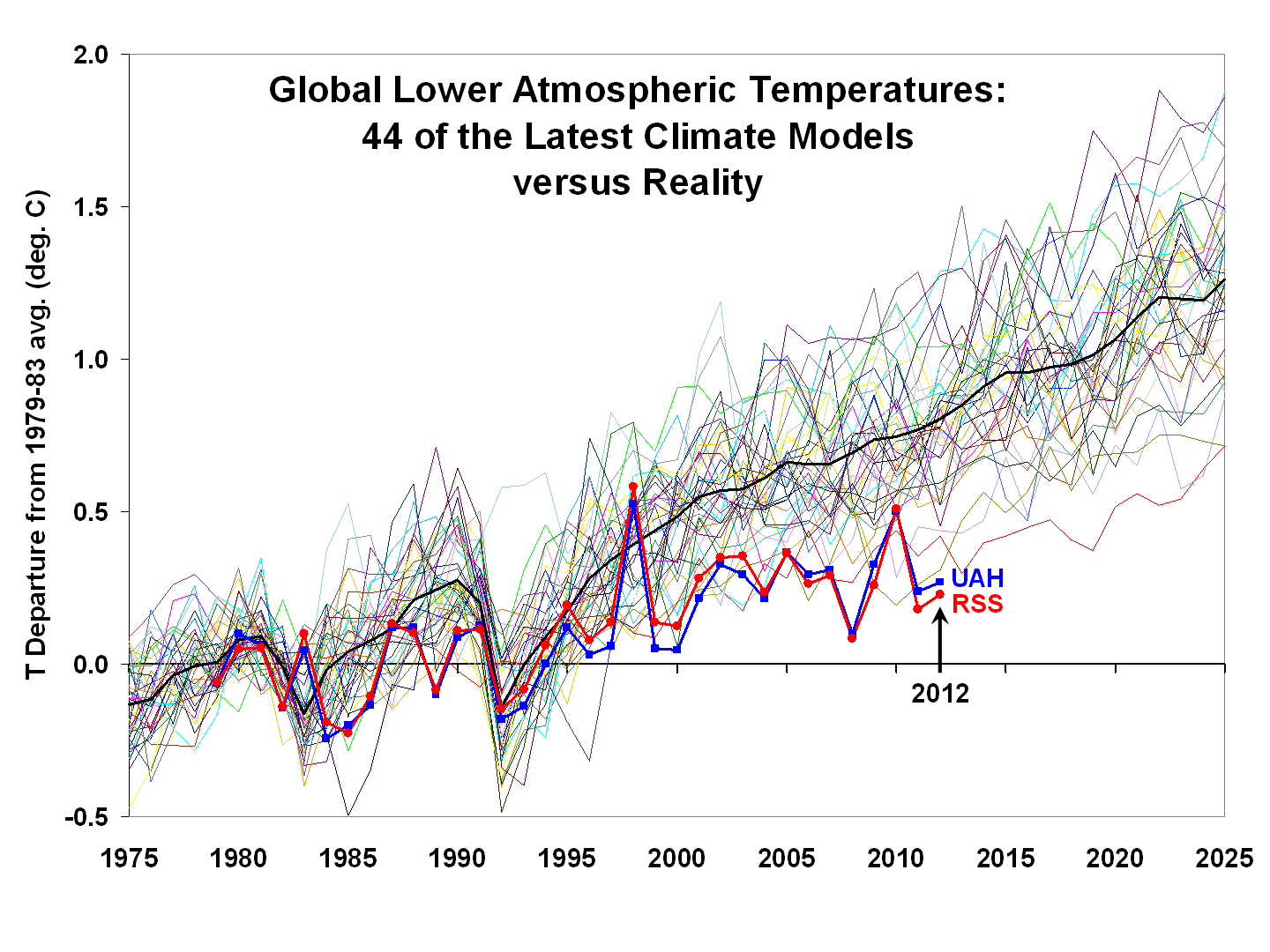
This from Dr. Roy Spencer and the ridiculously wide spread of the model results and the obvious deviation of reality from model results are particularly striking:

Global Warming Slowdown: The View from Space

Since the slowdown in surface warming over the last 15 years has been a popular topic recently, I thought I would show results for the lower tropospheric temperature (LT) compared to climate models calculated over the same atmospheric layers the satellites sense.

Courtesy of John Christy, and based upon data from the KNMI Climate Explorer, below is a comparison of 44 climate models versus the UAH and RSS satellite observations for global lower tropospheric temperature variations, for the period 1979-2012 from the satellites, and for 1975 – 2025 for the models:

CMIP5-global-LT-vs-UAH-and-RSS

CMIP5-global-LT-vs-UAH-and-RSS

Clearly, there is increasing divergence over the years between the satellite observations (UAH, RSS) and the models. The reasons for the disagreement are not obvious, since there are at least a few possibilities:

……… 

The dark line in the above plot is the 44-model average, and it approximately represents what the IPCC uses for its official best estimate of projected warming. Obviously, there is a substantial disconnect between the models and observations for this statistic.

I find it disingenuous for those who claim that, because not ALL of individual the models disagree with the observations, the models are somehow vindicated. What those pundits fail to mention is that the few models which support weaker warming through 2012 are usually those with lower climate sensitivity.

So, if you are going to claim that the observations support some of the models, and least be honest and admit they support the models that are NOT consistent with the IPCC best estimates of warming.