Record ice levels in the Baltic Sea

April 5, 2013

The stubborn high pressure and the late spring have given the highest level of ice coverage for this time of year in the Baltic Sea since records began in the 1960’s.

Svenska Dagbladet reports: The stubborn high pressure has set a new record late date of maximum ice extent. On 29 the March, 176,000 square kilometers of the Baltic Sea surface were covered by ice.

The previous record was on 25th March 2008 when 49,000 square kilometers was present.

Swedish Ice report 

STSN42 ESWI 0310514/3/13


BAY OF BOTHNIA IN THE ARCHIPELAGOS UP TO 80 CM FAST ICE. AT SEA OFF THE FAST ICE EDGE IN THE WE STERN AND NORTHERN PARTS, A 15 NAUTICAL MILES WIDE AREA WITH ALTERNATING 10 – 30 CM LEVEL ICE. JUST WEST OF FARSTUGRUNDEN AND IN THE BAY OF SKELLEFTEA THERE ARE LEADS WITH OPEN WATER. EAST OF THERE, NORTH OF THE LATITUDE THROUGH BJUROKLUBB, MOSTLY 30-70 CM VERY CL OSE DRIFT ICE WITH HEAVY RIDES AND CRACKS. RIDGES, DIFFICULT TO PASS OCCUR OFF RAAHE AND FURTHER NORTHWARDS PASSING NAHKIAINEN. SOUTH OF BJUROKLUBB THE DRIFT ICE IS 30-60 CM THICK WITH RIDGES AND CRACKS. OFF THE SWEDISH COAST MOSTLY THIN LEVEL ICE AND SINGLE HEAVY FLOES. ……. 

Climate sensitivity – 10 years on and Pat Michaels et al get their due

April 5, 2013

Back in 2002 a paper in Climate Research by Pat Michaels and his colleagues seriously questioned the sensitivities assumed in the exaggerated IPCC projections for global temperature but the paper was considered heretical and its authors were castigated by the global warming orthodoxy. So Pat Michaels and his colleagues would be more than entitled to an “I told you so” and even some more derisory nose-thumbing at the IPCC.

As Michaels and Knappenberger write at Cato:

Getting Our Due

In the Diary feature of this week’s The Spectatorrational optimist Matt Ridley has a collection of rather random observations from his daily life that have him thinking about (or maybe wishing for since Old Man Winter has been slow to loose his grip in the U.K. and Western Europe, much like he has across the Eastern U.S.) anthropogenic global warming.

What has his attention is that global warming just doesn’t seem to be going according to plan. And for those who have bought into that plan, their plan-driven actions are starting to make them look foolish.

But it’s not as if we haven’t “told you so”—a fact that Ridley draws attention to in the closing segment of his article. ……. 

What we determined in our 2002 study was that the amount of global warming projected by the end of this century was most likely being overestimated.  When we adjusted the climate model projections to take into account and better match the actual observations, our best estimate of the amount of warming we expected from 1990 to 2100 was about 1.8°C (3.2°F), which was in the lower end of the IPCC projected range, and which Ridley correctly noted, we termed as “modest.”

Further, we anticipated the slowdown in the warming rate. ….. 

…… Now, more than 10 years later, more and more evidence is piling in that we were right, including several recent papers that apply a technique not all that dissimilar in theory than our own (e.g. Gillett et al., 2012; Stott et al., 2013).

So even though we still are largely ostracized, at least we rest assured that we were pretty much on target—and some people are starting to take notice.

Revised 21st century temperature projectionsPatrick J. Michaels, Paul C. Knappenberger, Oliver W. Frauenfeld and Robert E. Davis, Climate Research, Vol. 23: 1–9, 2002

Abstract: Temperature projections for the 21st century made in the Third Assessment Report (TAR) of the United Nations Intergovernmental Panel on Climate Change (IPCC) indicate a rise of 1.4 to 5.8°C for 1990–2100. However, several independent lines of evidence suggest that the projections at the upper end of this range are not well supported. Since the publication of the TAR, several findings have appeared in the scientific literature that challenge many of the assumptions that generated the TAR temperature range. Incorporating new findings on the radiative forcing of black carbon (BC) aerosols, the magnitude of the climate sensitivity, and the strength of the climate/carbon cycle feedbacks into a simple upwelling diffusion/energy balance model similar to the one that was used in the TAR, we find that the range of projected warming for the 1990–2100 period is reduced to 1.1–2.8°C. When we adjust the TAR emissions scenarios to include an atmospheric CO2 pathway that is based upon observed CO2 increases during the past 25 yr, we find a warming range of 1.5–2.6°C prior to the adjustments for the new findings. Factoring in these findings along with the adjusted CO2 pathway reduces the range to 1.0–1.6°C. And thirdly, a simple empirical adjustment to the average of a large family of models, based upon observed changes in temperature, yields a warming range of 1.3–3.0°C, with a central value of 1.9°C. The constancy of these somewhat independent results encourages us to conclude that 21st century warming will be modest and near the low and of the IPCC TAR projections.

Red Euro, Blue Euro

April 5, 2013

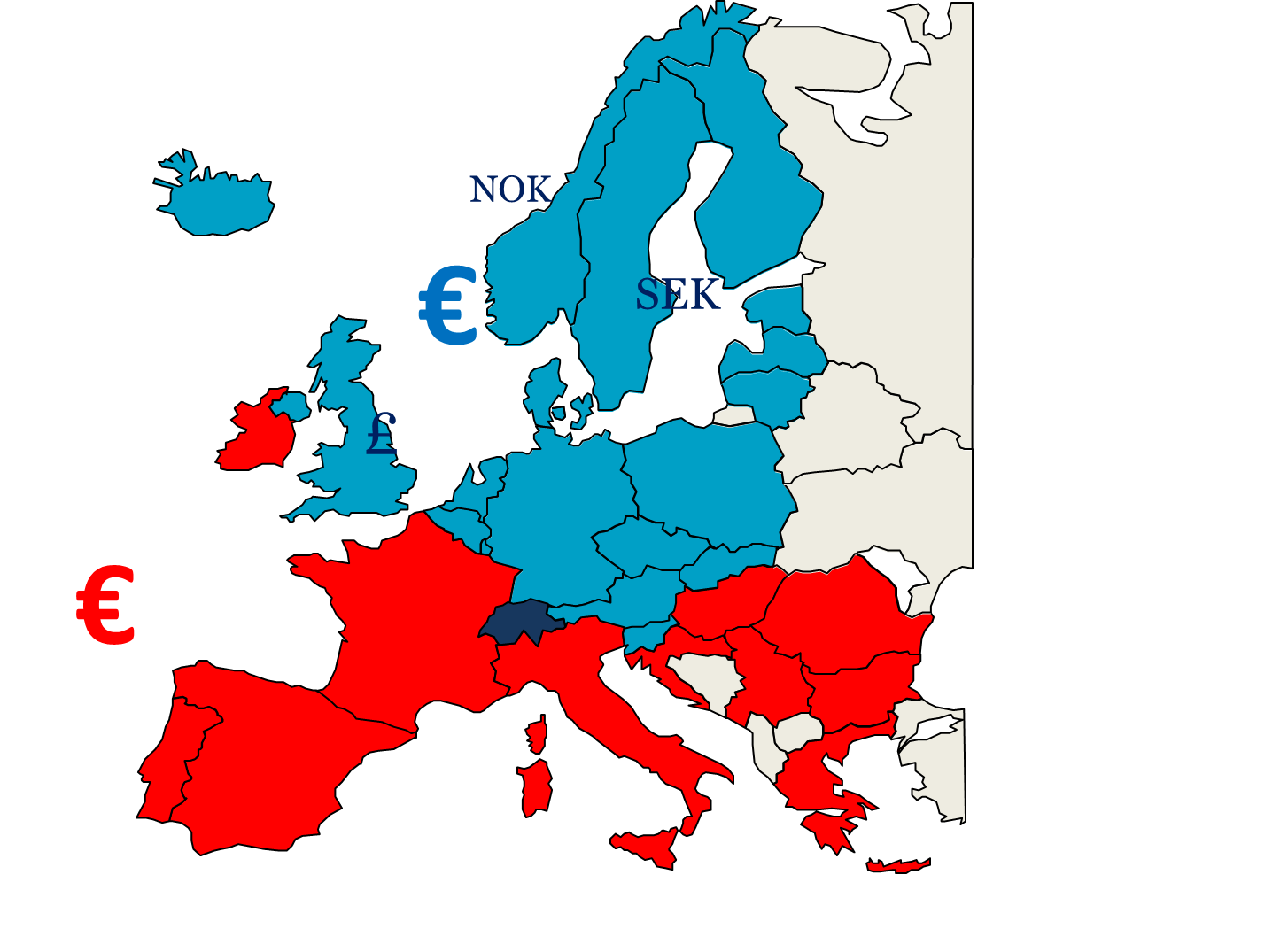
The two-€ Europe is effectively here and it is advisable to keep any savings far away from the Red Euro zone:

Spreading Red Euro

Spreading Red Euro

Coral reef not so sensitive to global warming after all (if it ever was)

April 5, 2013

Another “climate sensitivity” to join the long list of global warming exaggerations. A coral reef has recovered from a severe “bleaching” event in just 12 years to a level that was thought to require many decades. In fact the assumption that the cause of the severe disturbance in in 1998 was due to global warming is itself looking very shaky. After all, if it was due to global warming (rather than some local temperature or other event) then why on earth did it reverse in 1998? Or is it just a coincidence that no global warming has been observed since that time?

Polar bear numbers are increasing, clouds may “cool” more than they “heat”, the earth’s green cover is increasing, the Antarctic has more ice than it ever had and the Arctic ice variability is not unprecedented and glaciers are not melting at any greater rate than the pre-industrial rate. It is becoming increasingly clear that the “sensitivity” of the global climate to carbon dioxide has been grossly exaggerated.

Location of Reef building corals

Location of Reef building corals (Photo credit: Wikipedia)

“Recovery of an isolated coral reef system following severe disturbance”, by J. P. Gilmour, L. D. Smith, A. J. Heyward, A. H. Baird and M. S. Pratchett  published online at Science on Friday, 5th April, 2013.

Abstract: Coral reef recovery from major disturbance is hypothesized to depend on the arrival of propagules from nearby undisturbed reefs. Therefore, reefs isolated by distance or current patterns are thought to be highly vulnerable to catastrophic disturbance. We found that on an isolated reef system in north Western Australia, coral cover increased from 9% to 44% within 12 years of a coral bleaching event, despite a 94% reduction in larval supply for 6 years after the bleaching. The initial increase in coral cover was the result of high rates of growth and survival of remnant colonies, followed by a rapid increase in juvenile recruitment as colonies matured. We show that isolated reefs can recover from major disturbance, and that the benefits of their isolation from chronic anthropogenic pressures can outweigh the costs of limited connectivity.

PhysOrg writes: Scott Reef, a remote coral system in the Indian Ocean, has largely recovered from a catastrophic mass bleaching event in 1998, according to the study published in Science today. The study challenges conventional wisdom that suggested isolated reefs were more vulnerable to disturbance, because they were thought to depend on recolonisation from other reefs. Instead, the scientists found that the isolation of reefs allowed surviving corals to rapidly grow and propagate in the absence of human interference. Australia’s largest oceanic reef system, Scott Reef, is relatively isolated, sitting out in the Indian Ocean some 250 km from the remote coastline of north Western Australia (WA). Prospects for the reef looked gloomy when in 1998 it suffered catastrophic mass bleaching, losing around 80% of its coral cover. The study shows that it took just 12 years to recover. Spanning 15 years, data collected and analysed by the researchers shows how after the 1998 mass bleaching the few remaining corals provided low numbers of recruits (new corals) for Scott Reef. On that basis recovery was projected to take decades, yet within 12 years the cover and diversity of corals had recovered to levels similar to those seen pre-bleaching.

Climate studies a “science” is not

April 4, 2013

That climate is a subject for study is obvious. That it can be called a “discipline” is questionable but allowable. But any claim that it is settled and understood, let alone fanciful claims that we can control it, are just arrogant nonsense. When the study of climate might  get to be a “science” lies some few centuries in the future – if ever. Climate studies may be a discipline but a “science” it is not.

As with many articles in RealClearPolitics this by Robert Tracinski is trenchant, concise, precise and extremely well written. But RCP has not often been known to break with the global warming orthodoxy and I was surprised to find this there.

Very well worth reading.

The End of an Illusion

Many years ago, I remember thinking that it would take many years to refute the panicked claims about global warming. Unlike most political movements, which content themselves with making promises about, say, what the unemployment rate will be in two years if we pass a giant stimulus bill—claims that are proven wrong (and how!) relatively quickly—the environmentalists had successfully managed to put their claims so far off into the future that it would take decades to test them against reality.

But guess what? The decades are finally here.

…….. So basically, all that the global warming advocates really have, as the evidentiary basis for their theory, is that global temperatures were a little higher than usual in the late 1990s. That’s it. Which proves nothing. The climate varies, just as weather varies, and as far as we can tell, this is all well within the normal range. …..

……

So here’s the state of play of climate science a third of a century into the global warming hysteria. They don’t have a reliable baseline of global temperature measurements that would allow them to say what is normal and natural and what isn’t. Their projections about future warming are demonstrably failing to predict the actual data. And now they have been caught, yet again, fudging the numbers and manipulating the graphs to show a rapid 20th-century warming that they want to be true but which they can’t back up with actual evidence.

A theory with this many holes in it would be have been thrown out long ago, if not for the fact that it conveniently serves the political function of indicting fossil fuels as a planet-destroying evil and allowing radical environmentalists to put a modern, scientific face on their primitivist crusade to shut down industrial civilization.

But can’t we all just stop calling this “science” now? 

Full article here

When the law is an ass

April 4, 2013

“‘You were present on the occasion…and, indeed, you are the more guilty of the two, in the eye of the law; for the law supposes that your wife acts under your direction.

“‘If the law supposes that,’ said Mr. Bumble, squeezing his hat emphatically in both hands, ‘the law is a ass — a idiot. If that’s the law, the law is a bachelor; and the worst I wish the law is, that his eye may be opened by experience — by experience.'”  Oliver Twist, Charles Dickens

Of course any society can make any law it likes to ensure the proper functioning of that society. And such laws are nothing more than rules made by the majority of that time for the functioning of the society of that time. Systems of law are thus just exercises in pragmatism for the current time. But there is an implied “sanctity” and “immutability”  to systems of law which is neither justified nor rational. They are never laws in the sense of the Natural Laws which are not time-dependent and where compliance is inherent in the formulation of the law. Even the laws of God depend upon which religion one chooses to follow and when that religion was invented. The Big Ten as handed down to Moses no longer all apply. Times change, societies change and the laws of man (and those of God as formulated by man) must follow – but they don’t. It should not be beyond the wit of man to make such laws subject to the common sense of the time. Perhaps every law made by man should also have a term of validity. But that would be asking too much. And time and time again “the law is an ass” in its formulation or in its application!

“It is a rule of evidence deduced from the experience of mankind and supported by reason and authority that positive testimony is entitled to more weight than negative testimony but by the latter term is meant negative testimony in it’s true sense and not positive evidence of a negative, because testimony in support of a negative may be as positive as that in support of an affirmative…” Blackburn v. State, 254 Pac. 467, 472 (Ariz. 1927)

Just 3 examples from today’s news.

  1. The Independent: A Dutch appeals court has lifted a ban on an organisation which lobbies for the legalisation of sex between adults and children, after finding that the group was not breaking any laws in The Netherlands. ….. an appeals court in Leeuwarden has ruled that the group, which claims it does not promote sexual abuse and insists it is “a platform for discussion of paedophilia”, could not be outlawed because its existence did not threaten society, the Dutch News website reported.
  2. (Reuters) Amnesty International has condemned a reported Saudi Arabian court ruling that a young man should be paralyzed as punishment for a crime he committed 10 years ago which resulted in the victim being confined to a wheelchair. The London-based human rights group said Ali al-Khawaher, 24, was reported to have spent 10 years in jail waiting to be paralyzed surgically unless his family pays one million Saudi riyals ($270,000) to the victim.
  3. RollingStone: …. Despite the passage in late 2012 of a new state ballot initiative that prevents California from ever again giving out life sentences to anyone whose “third strike” is not a serious crime, thousands of people – the overwhelming majority of them poor and nonwhite – remain imprisoned for a variety of offenses so absurd that any list of the unluckiest offenders reads like a macabre joke, a surrealistic comedy routine. Have you heard the one about the guy who got life for stealing a slice of pizza? Or the guy who went away forever for lifting a pair of baby shoes? Or the one who got 50 to life for helping himself to five children’s videotapes from Kmart? How about the guy who got life for possessing 0.14 grams of meth? ….

Delta Airlines sues US Ex-IM for supporting Boeing sales to foreign airlines

April 4, 2013

I think Delta doth protest too much and is clutching at straws. Loss of jobs at Boeing is of much more consequence to the US economy than Delta’s dubious claim of loss of competitiveness against foreign airlines.

Of course the real problem is that Delta is weak competitively. Its costs are too high and its service is too inferior. By the end of trading session, Delta Air Lines, Inc. shares slumped 8.06% to US$14.94 with more than 41.03 million shares traded, compared to its average volume of 12.11 million shares. Delta Air Lines’s unit revenues increased only 2% in March, and most of it came from its trans-Atlantic and Latin offerings.  Delta were expecting a March growth of 4 – 5%. And they are more than a little worried by the US Air merger with American Airlines.

(Reuters)Delta Air Lines Inc has sued the Export-Import Bank of the United States over loan guarantees given to support purchases of Boeing Co’s widebody planes by certain foreign airlines, according to a court filing.

Delta are claiming that Ex-Im bank’s guarantees (to Boeing) and/or buyers credits (to foreign airlines) for aircraft sales to foreign airlines, including Emirates Airlines, Etihad Airways and Korean Air Co Ltd, amount to subsidies and would cause a loss of competitiveness and adverse economic effects on Delta and its employees.

Ex-Im Bank, a government agency, provides loan guarantees and direct loans to help companies maintain and create jobs.

In a complaint filed in federal court in Washington D.C. late on Wednesday, Delta said one of the types of exports that Ex-Im Bank subsidizes is the export of aircraft by U.S. manufacturers, especially ones made by Boeing.

“In 2012, the bank’s total exposure to outstanding financial commitments was $106.6 billion. About 46 percent of this amount was for air transportation loans and loan guarantees, more than the three next largest industrial sectors combined,” Delta said in the filing.

Delta said the Ex-Im Bank loan guarantees help lower the cost of capital for foreign airline companies.

“These foreign airlines will recoup their investment in their new aircraft faster or reduce ticket prices on competing routes without adversely impacting their relative rate of return on those investments,” Delta said in the filing.

Delta argued that unsubsidized U.S. airlines will be forced to respond by “reducing their prices and reducing or altogether eliminating their capacity to serve those routes where they compete with bank-subsidized foreign airlines.”

I don’t think I will be buying any Delta stock any time soon.


Middle managers are like monkeys

April 3, 2013

Middle managers are the ones with the fewest “degrees of freedom”. They have the least space to escape from pressure from their superiors because of the demands from their subordinates. Conflict situations in the work place  can generally be avoided by those at the lowest hierarchical levels and can be unilaterally resolved by those at the highest. But those in the middle have no place to run. It seems to be an inherent characteristic of all human organisations. Which is why conventional wisdom tells us that it is middle managers who are subjected to the highest levels of stress and run the highest risk of stress-related disabilities.

Now a new paper shows that it is an organisational characteristic which can also be observed in the hierarchical structure of troops of monkeys. Monkeys in the middle experience the greatest stress. Perhaps it is in our genes? How we (or monkeys) organise  is a natural consequence of the need to cooperate. And it is probably our genes which have given us the propensity to cooperate.

Katie L. Edwards, Susan L. Walker, Rebecca F. Bodenham, Harald Ritchie, Susanne Shultz. Associations between social behaviour and adrenal activity in female Barbary macaques: Consequences of study designGeneral and Comparative Endocrinology, 2013; 186: 72 DOI: 10.1016/j.ygcen.2013.02.023

From the Manchester University press release:

A study by the universities of Manchester and Liverpool observing monkeys has found that those in the middle hierarchy suffer the most social stress. Their work suggests that the source of this stress is social conflict and may help explain studies in humans that have found that middle managers suffer the most stress at work.

Female Barbary macaques at Trentham Monkey Forest

Female Barbary macaques at Trentham Monkey Forest

Katie Edwards from Liverpool’s Institute of Integrative Biology spent nearly 600 hours watching female Barbary macaques at Trentham Monkey Forest in Staffordshire. Her research involved monitoring a single female over one day, recording all incidences of social behaviour. These included agonistic behaviour like threats, chases and slaps, submissive behaviour like displacing, screaming, grimacing and hind-quarter presentation and affiliative behaviour such as teeth chatter, embracing and grooming. 

The following day faecal samples from the same female were collected and analysed for levels of stress hormones at Chester Zoo’s wildlife endocrinology laboratory.  

Katie explains what she found: “Not unsurprisingly we recorded the highest level of stress hormones on the days following agonistic behaviour. However, we didn’t find a link between  lower stress hormone levels and affiliative behaviour such as grooming.”  

She continues: “Unlike previous studies that follow a group over a period of time and look at average behaviours and hormone levels, this study allowed us to link the observed behaviour of specific monkeys with their individual hormone samples from the period when they were displaying that behaviour.”  

Another key aspect of the research was noting where the observed monkey ranked in the social hierarchy of the group. The researchers found that monkeys from the middle order had the highest recorded levels of stress hormones.  

Dr Susanne Shultz, a Royal Society University Research Fellow in the Faculty of Life Sciences at The University of Manchester oversaw the study: “What we found was that monkeys in the middle of the hierarchy are involved with conflict from those below them as well as from above, whereas those in the bottom of the hierarchy distance themselves from conflict. The middle ranking macaques are more likely to challenge, and be challenged by, those higher on the social ladder.”  

Katie says the results could also be applied to human behaviour: “It’s possible to apply these findings to other social species too, including human hierarchies. People working in middle management might have higher levels of stress hormones compared to their boss at the top or the workers they manage. These ambitious mid-ranking people may want to access the higher-ranking lifestyle which could mean facing more challenges, whilst also having to maintain their authority over lower-ranking workers.”   

The research findings have been published in the journal General and Comparative Endocrinology.   
Swarm of 482 earthquakes (so far) in Iceland

April 2, 2013

Something to watch closely over the next few days. Could a new island be forming?

UPDATE2: 04 Apr 18:57 GMT

The aviation colour code for Hekla volcano has been changed from yellow to green as no further signs of unrest have been detected since it was changed to yellow. The activity in North Iceland has been decreasing today. The activity could still continue for a some time with intense activity in between.

UPDATE: A M5.5 earthquake occurred at 00:59 on 2nd April 2013 about 15 km east of Grímsey island offshore North Iceland. The earthquake was felt at Grímsey, Húsavík, Raufarhöfn, Mývatnssveit, Akureyri and Sauðarkrókur. Several hundruds aftershocks have been detected following the mainshock. The source region is located on a fault system that reaching from Öxarfjörður to the north of Grímsey, the so called Grímsey lineament. Another M4.7 earthquake followed this morning at 08:56 and was located about 7.5km northwest of the night’s main event.

Earthquake sequences are common in this area. It is impossible to predict the further development of the seismic activity and how it might influence faults in its vicinity. Further large events can not be excluded.

==========================================

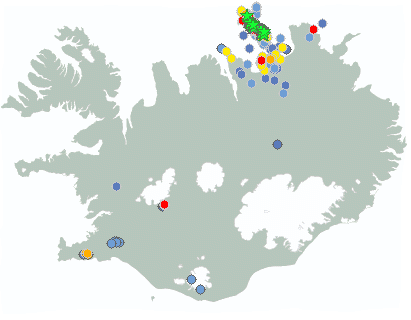
The Iceland earthquake swarm has now reached a count of 482 according to the Icelandic Met Office.

  • Magnitude less than 1 in all:  39
  • Magnitude 1 to 2 in all:  173
  • Magnitude 2 to 3 in all:  232
  • Magnitude more than 3 in all:  38
  • Total: 482 (upto 712 on 3rd April)
Earthquakes during last 48 hours.  at 04 Apr 19:50 GMT

Earthquakes during last 48 hours. at 04 Apr 19:50 GMT

From Earthquake Report:

Update 10:49 UTC : We have added a Google Earth screenshot to the image series. This Google earth image shows very clearly the many volcanic bubbles at the ocean floor, a result of the separating diverging plates. The 2 tectonic plates are pullling away from each other  (left plate to the West, right plate to the East. This kind of phenomenon is also occurring in the Oceans all over the world. New life (in other words new magma) is added this way to the tectonic plates. The plates are melting away again below ie. the deep trenches of the Pacific Ocean.

Update 10:12 UTC : The Icelandic seismological Bureau wrote : At 00:59 an earthquake about 5.5 occurred, 15 km east of Grímsey. the earthquake was felt in substantial part of central north Iceland. Following the this event at 1:13 another earthquake 4,3 was observed 16 km east of Grímsey and at 08:55 an earthquake 4,7 at same location. Substantial aftershock activity has been observed and still continues. More activity can be expected.

This earthquake is part of a strong swarm at a well know location in the Ocean. The location of the swarm is a relatively shallow ridge area (the zigzagging ridge creates the transform-like earthquakes) . A ridge is a location where 2 tectonic plates are pulling away from each other. Fresh magma will have an easier job to reach the seabed and hot volcanic vents are often found on these locations. A new island in such an area is almost a certainty in the geological future. A pity that there are no permanent ROV’s in this location, we might see some submarine fireworks!
At the time of writing this article, we have counted 314 earthquakes in less than 48 hours!

Screen Shot 2013-04-02 at 12.48.02

Swarm area on Google Earth

Indian surrogate mother dies after delivery of child for a Norwegian couple

April 2, 2013

UPDATE – from the Norwegian press

The surrogate mother bore twins but one of them died after birth.

The Norwegian Embassy in India confirmed that preparations were underway for the other child to be taken to Norway.

The surrogate mother was apparently paid 31,000 Norwegian Kronor (about $6,000) (corrected below)

================================

This report in the Svenska Dagbladet today is disturbing not because there is anything inherently wrong with surrogacy but because it smacks of exploitation – of wealth being used to pass on the risks of childbirth to a “poor” surrogate mother. There are some very gray ethics involved in a “rich” Norwegian couple exploiting the poverty of a “poor” surrogate mother who dies – especially in doing something not permitted in Norway. No doubt the surrogate was paid the “going rate” for surrogacy (about $6,000). But I doubt the surrogate had made any real assessment of the risk of losing her life or that the “contract” had a clause to cover for the death of the surrogate.

Svenska DagbladetAn Indian woman who was the surrogate for a Norwegian couple died shortly after birth. The woman, who was married and had children of  her own developed Hepatitis E during the pregnancy. 

“Pregnancy and childbirth is unpredictable for us all. Unforseen things can happen and the surrogate contract and the parties should take this into account”, says anthropologist Kristin Engh Førde.

Surrogates are not allowed in Norway and Norwegians make use of egg donation abroad.

The article does not report on the condition of the baby nor on the condition of the surrogate’s own children.

I hope the Norwegian couple get their child — but what is their responsibility for those other children?

I am not sure if the quote from anthropologist Kristin Engh Førde is meant to imply – and I hope it does not – that it is the responsibility of every surrogate mother to accept the risk of dying and contract accordingly.

Would the surrogate have died if she had been giving birth at a Norwegian hospital? Would her Hepatitis E have been treated in time?

Mortality rates are generally low, for hepatitis E is a “self-limiting” disease. …  However, during the duration of the infection (usually several weeks), the disease severely impairs a person’s ability to work, care for family members, and obtain food. Hepatitis E occasionally develops into an acute, severe liver disease, and is fatal in about 2% of all cases. Clinically, it is comparable to hepatitis A, but in pregnant women the disease is more often severe and is associated with a clinical syndrome called fulminant hepatic failure. Pregnant women, especially those in the third trimester, suffer an elevated mortality rate from the disease of around 20%.