Does the solar cycle impact the global economic cycle?

April 2, 2013

That weather and climate are affected by solar cycles is highly likely even if it is not part of the mainstream climate theories (though I think it is patently obvious). That climate and weather affect food production is clear and that this must impact the economic cycle is not so far fetched. Yet it has never been part of mainstream economic thinking that there will be a connection from the solar cycle to global economic cycles. Back in 1801 William Herschel observed the apparent connection between the sunspot cycles and the price of wheat. Since then many economists have returned at regular intervals to studying the link between the 11 year sunspot cycle and the behaviour of the global economic cycle. It is becoming increasingly clear that the economic cycle is not unconnected with solar cycles but the mechanisms are far from clear.

Mikhail Gorbanev an economist at the IMF has a fascinating new paper that became available last month at the University of Munich. He does add this Caution though!

Caution: This research is not in the “mainstream” of the economic thought. Read at your own risk!

Sunspots, unemployment, and recessions, or Can the solar activity cycle shape the business cycle?,” MPRA Paper 40271, University Library of Munich, Germany. (pdf Gorbanev Business Cycle and solar cycles MPRA_paper_40271)

Gorbanev shows some interesting correlations and  goes on to predict that “For other advanced economies, the upcoming solar maximum also suggests higher chances of recessions. The 3-year period when the recessions are most likely to occur in the G7 countries would run from early 2013 till end-2015”.

Whether there will be a sharp increase in US unemployment after the solar maximum remains to be seen. But it is not so unlikely that the world economy has another 2 – 3 tough years ahead!
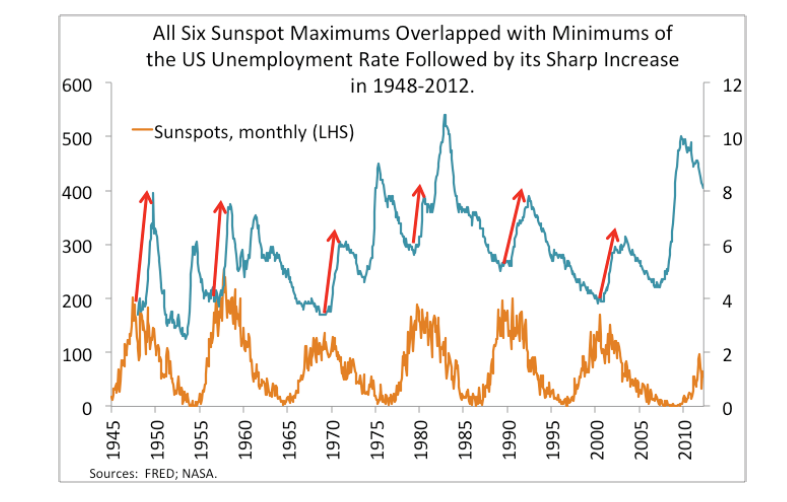
 

Sunspot cycles and US unemployment (Gorbanev 2012)

Sunspot cycles and US unemployment (Gorbanev 2012)

Abstract 

 Over the last 77 years (from 1935), all 7 cyclical maximums of the solar activity overlapped closely with the US recessions, thus predicting (or triggering?) 8 out of 13 recessions officially identified by NBER (including one “double-deep” recession). Over the last 64 years (from 1948), all 6 maximums of the solar activity were preceded by minimums of the US unemployment rate, and the spikes in the unemployment rate followed with lags of 2-3 years. On the world scale, over the last 44 years (for which the data is available), all 4 maximums of the solar activity overlapped with minimums of the unemployment rate in the G7 countries, followed by its spikes within 2-3 years. From 1965, when consistent recession dating is available for all G7 countries, nearly 3/5 of the recessions started in the 3 years around and after the sunspot maximums. Was it a mere coincidence or a part of a broader pattern? This paper explores the correlation between the solar activity cycles (as measured by the number of sunspots on the sun surface) and the timing of recessions in the US and other economies. It finds out that the probability of recessions in G7 countries greatly increased around and after the solar maximums, suggesting that they can cause deterioration in business conditions and trigger recessions. This opens new approach for projecting recessions, which can be applied and tested with regard to the next solar maximum in 2013.

James Hansen’s exit strategy unfolding as he retires from NASA

April 2, 2013

It was just last week that I asked “Are global warmists preparing exit strategies?”, about warmists in general and about James Hansen in particular.

And today the New York Times reports that Hansen is to retire from NASA – ostensibly to free his hands as an activist. But it has been his association with NASA which has given him the pondus he has had in the global warming priesthood. He has been an embarrassment to NASA for some time but he is 72 and is surely ripe for retirement. I suspect he actually did resign (rather than being required to resign) and his “exit strategy” is playing out. It will allow him to fade quietly out of the alarmist picture he helped create before it is erased completely.

New York Times: James E. Hansen, the climate scientist who issued the clearest warning of the 20th century about the dangers of global warming, will retire from NASA this week, giving himself more freedom to pursue political and legal efforts to limit greenhouse gases.

….. At the same time, retirement will allow Dr. Hansen to press his cause in court. He plans to take a more active role in lawsuits challenging the federal and state governments over their failure to limit emissions, for instance, as well as in fighting the development in Canada of a particularly dirty form of oil extracted from tar sands.

“As a government employee, you can’t testify against the government,” he said in an interview.

Dr. Hansen had already become an activist in recent years, taking vacation time from NASA to appear at climate protests and allowing himself to be arrested or cited a half-dozen times.

But those activities, going well beyond the usual role of government scientists, had raised eyebrows at NASA headquarters in Washington. “It was becoming clear that there were people in NASA who would be much happier if the ‘sideshow’ would exit,” Dr. Hansen said in an e-mail.

When hockey sticks are not robust …

April 1, 2013

I had almost got the 1st of April out of my system but I could not resist noting that when things are not “robust” they break and the broken pieces don’t stay put.

This gets classified as misconduct.

The Marcott Filibuster

Marcott et al:  ” … 20th century portion of our paleotemperature stack is not statistically robust, cannot be considered representative of global temperature changes, and therefore is not the basis of any of our conclusions”.

Not robust

Not robust

Global warming will contaminate signals and cut internet speeds

April 1, 2013

Over the coming years we can all expect to spend more time staring at our download dialog boxes, waiting for our music or our videos to buffer and clicking away impatiently as we wait for our web pages to reload.

And it will not be the OS or our internet service providers who are to blame. It will be the effects of global warming.

As global warming sets in and the seas warm the performance of all the undersea cables that are a critical part of global connections will be affected. A significant part of voice and data signals are transmitted through these cables and many communications services companies are entirely dependent on them. As the seas warm they will absorb increasing amounts of carbon dioxide from the atmosphere and turn acidic. While fish and all marine life have evolution to fall back upon and will adapt to the changing conditions, undersea cables being inanimate and unable to reproduce will suffer. Firstly the increasing temperature itself will cause the component fibres in the undersea cable to expand; both in length and in diameter. Secondly the acidic environment will cause them to corrode and distort.

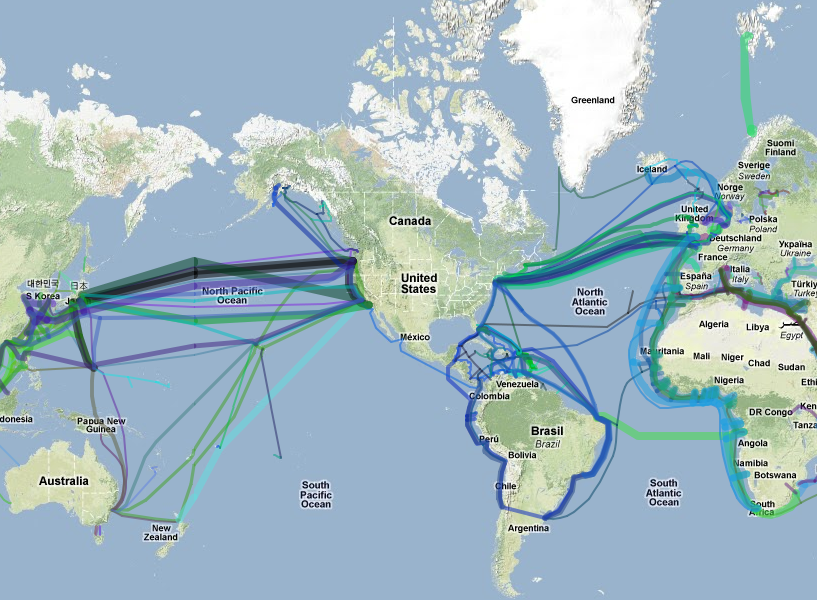
Undersea Cable Map – The Big Picture (www.ritholtz.com)

These cables, which connect land-based transmission terminal stations across continents, are laid for tens of thousands of kilometres along the seabed. It is well known that these thick optic fibre cables can be disrupted due to many natural phenomena, such as temperature, earthquakes, extreme turbidity, current, or by coming in contact with fishing vessels or being attacked by marine life ranging from plankton to sharks.

It has now been shown conclusively by research at the International Marine Cable Research Centre (IMCRC) that increasing global temperatures will lead not only to the slowing down of signals as the marine cables expand in length, but that the integrity of signals being carried will suffer as the cable distortions lead to intertwined parallel signals getting mixed up with each other.

Just having cables in parallel cannot solve this problem. Global warming will affect all the cables. Longer cables will be affected most. Scientists at the IMCRC have modelled the performance under deteriorating conditions and calculate that these cables could become completely unusable as quickly as within 1,000 years. “We are working on an innovative solution”, said Dr. Peter Sellers, Director of the IMCRC. The International project to find a solution is being led by Dr. Martin Strangelove of the University of Pennsylvania who says, A drastic problem requires a drastic solution. We are now working on ways in which we can trigger a new ice age as a comprehensive global solution. Not only will undersea temperatures reduce but in many places alternative cables could be placed on the surface of the newly created ice sheets”.

(XPI – 1st April 2013)

Boston marathon winning times fail as a proxy for global warming temperature rise

March 31, 2013

I am not sure whether to call this “bad science” or to be generous and call it “trivial science”.

There is a new paper in PLOS ONE (open access) from “researchers” at Boston University:

Effects of Warming Temperatures on Winning Times in the Boston Marathon by Abraham J. Miller-Rushing, Richard B. Primack, Nathan Phillips and Robert K. Kaufmann, PLoS ONE 7(9): e43579. doi:10.1371/journal.pone.0043579

The only conclusions of any little value in this paper are that

  • Boston marathon winning times fail – so far – as a proxy for global warming temperature rise, and
  • if global warming increases Boston temperatures by about 5.8°C there is a 95% chance that the effect on winning time may be detectable!

Of course they could simply have reported that the variability of temperatures on race day drowned out the effects – if any – of any global temperature change. But that would have been too simple, too truthful and would not have helped towards publication.

The findings of this so-called “research” are:

  1. Higher temperatures and higher headwinds on the day of the race increase winning times for the marathon. Who would think otherwise? I would not have thought that weather conditions on any other day than race day would have much impact. Collecting this data is mildly useful but it is all readily available. Trivial.
  2. If temperatures do not increase relative to temperature variability on race days, the effects of warming on marathon times may not be detectable. However, at some point temperature increases may be large enough to affect marathon times. Amazing! So what exactly was the point of this work? Trivial.
  3. In summary, despite the well-known effect of temperature on marathon performance, we found that warming trends in Boston have not caused winning times to slow over time because of high variability in temperatures on race day. So race day temperature overrides any effects – due to global warming or anything else – on average annual temperatures. Obvious and Trivial.
  4. …. our models indicate that if race starting times had not changed and average race day temperatures continue to warm by 0.058°C/yr, a high-end estimate, we would have had a 95% chance of detecting a consistent slowing of winning marathon times by 2100. If average race day temperatures warm by 0.028°C/yr, a mid-range estimate, we would have had a 64% chance of detecting a consistent slowing of winning times by 2100. So your model says that if global warming increases race day temperatures above and beyond the natural daily variability then you have some chance of detecting this effect in the winning times! By modelling high rates of global warming  (5.8°C per century) you can force the race day temperatures to show an underlying increase such that there is a 95% chance that the effect on winning times could be detected.  The Boston marathon itself provides no evidence of global warming so far. Wow!! This is not just trivial but borders on “idiot science”.

The effects of global warming clearly cannot be detected in the results of the Boston marathon. In the paper their Figure 2 and Table 1 are fairly trivial but of passing interest. The rest of their modelling efforts (input and output) are just garbage.

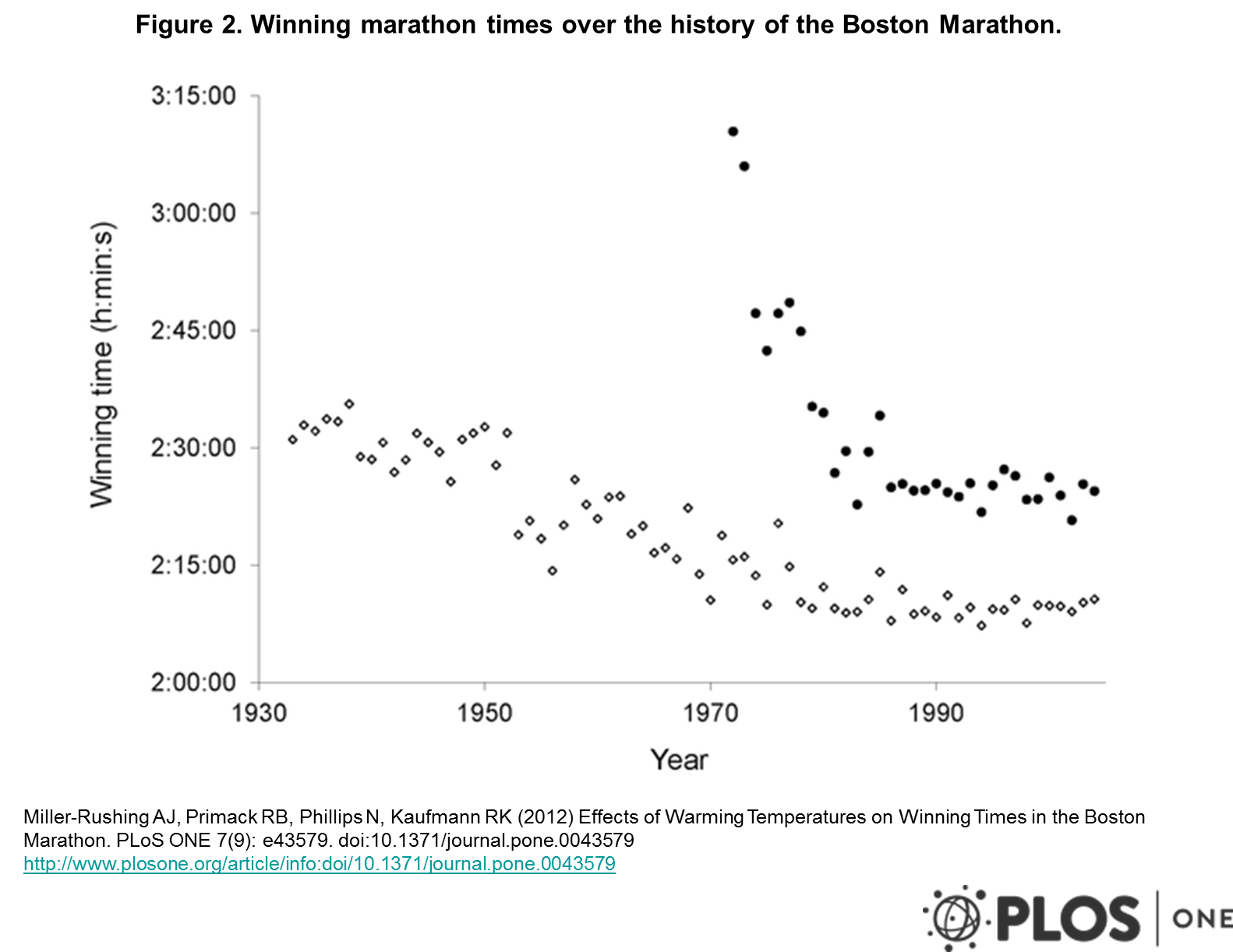
Miller-Rushing et al Figure 2

Open diamonds represent men’s times from 1933–2004. Closed circles represent women’s times from 1972–2004. Women’s running times improved rapidly in the first 14 yr of women’s participation in the marathon. From 1983 to 2004, the differences between men and women’s winning times held relatively constant at an average of 15 min 47 s.

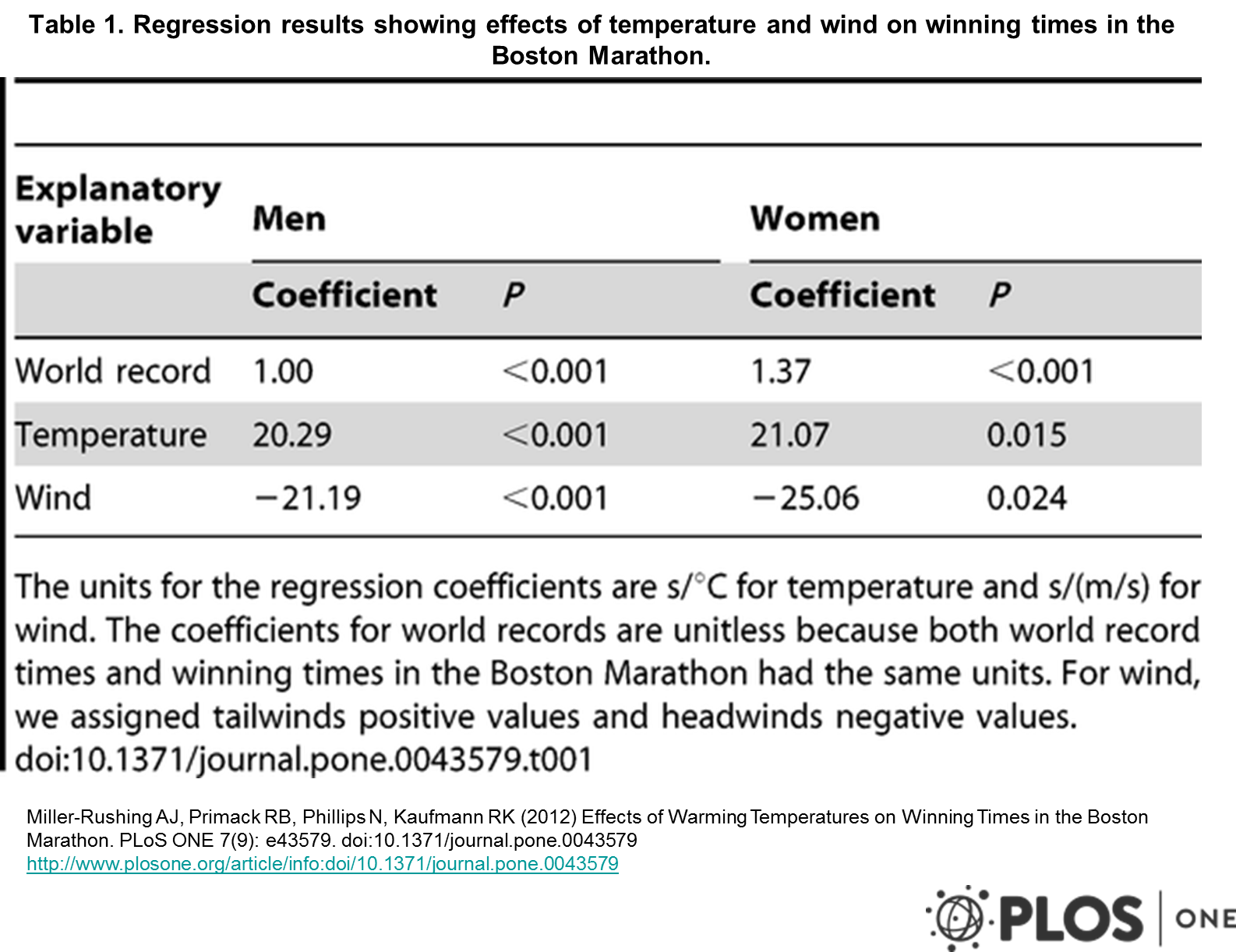
Table 1. Regression results showing effects of temperature and wind on winning times in the Boston Marathon.

Table 1. Regression results showing effects of temperature and wind on winning times in the Boston Marathon.

AbstractIt is not known whether global warming will affect winning times in endurance events, and counterbalance improvements in race performances that have occurred over the past century. We examined a time series (1933–2004) from the Boston Marathon to test for an effect of warming on winning times by men and women. We found that warmer temperatures and headwinds on the day of the race slow winning times. However, 1.6°C warming in annual temperatures in Boston between 1933 and 2004 did not consistently slow winning times because of high variability in temperatures on race day. Starting times for the race changed to earlier in the day beginning in 2006, making it difficult to anticipate effects of future warming on winning times. However, our models indicate that if race starting times had not changed and average race day temperatures had warmed by 0.058°C/yr, a high-end estimate, we would have had a 95% chance of detecting a consistent slowing of winning marathon times by 2100. If average race day temperatures had warmed by 0.028°C/yr, a mid-range estimate, we would have had a 64% chance of detecting a consistent slowing of winning times by 2100.

On balance I shall just classify this as Trivial Science bordering on Bad Science

Summer time and it’s -12° C outside

March 31, 2013

Sweden -58N

We changed to summer time last night. And when I rose at 0600 today –  Easter Sunday –  (5 am according to my body clock) it was all of -12°C outside!

SMHI defines spring in Sweden as the first day – after 15th February – of 7 continuous days with temperatures between 0 and 10 °C. The “normal” onset of Spring is as below:

  • Malmö: 22nd February
  • Stockholm: 16th March
  • Östersund: 11th April
  • Kiruna: 1st May

Admittedly I am at a latitude of 58.7057° N.

At 58.7 °N spring should have come around 12th March and we are going to be around 3 weeks late (at least).

There is much clearing and spring cleaning to be done but I am not the most enthusiastic gardener in the world. The sun is warm and we should get up to an air temperature of +5°C today. But I have no intention of digging through the remaining frozen snow or risk frostbite while clipping the bushes. I shall have another cup of coffee and wait for time and natural variation to do their work.

I could do with a bit of real global warming – and not that which comes from a mathematical model.

Climate science on “negative watch”

March 30, 2013

Graphic: The Economist

The almost 20 year pause in global warming while emissions of carbon dioxide have continued to increase can no longer be ignored. Following The Economist’s article earlier this week, more of the main steam media are beginning to question if climate science is as “settled” as some would like us to believe. I would go a little further than The Australian and say that “climate science” and not just “climate sensitivity”  is now on “negative watch” if not as yet “downgraded”. While it is encouraging that some sanity may be returning to the debate as evidenced by the greater interest from the main stream media to question global warming orthodoxy (Die Welt, Jyllands Posten, Der Spiegel, The Telegraph, Daily Mail), they are already a little late. “Climate Science” has actually been at “junk” levels since Copenhagen and Climategate and is only just beginning to creep up from there!

The Australian:

DEBATE about the reality of a two-decade pause in global warming and what it means has made its way from the sceptical fringe to the mainstream.

In a lengthy article this week, The Economist magazine said if climate scientists were credit-rating agencies, then climate sensitivity – the way climate reacts to changes in carbon-dioxide levels – would be on negative watch but not yet downgraded.

Another paper published by leading climate scientist James Hansen, the head of NASA’s Goddard Institute for Space Studies, says the lower than expected temperature rise between 2000 and the present could be explained by increased emissions from burning coal.

For Hansen the pause is a fact, but it’s good news that probably won’t last.

International Panel on Climate Change chairman Rajendra Pachauri recently told The Weekend Australian the hiatus would have to last 30 to 40 years “at least” to break the long-term warming trend. 

But the fact that global surface temperatures have not followed the expected global warming pattern is now widely accepted.

Research by Ed Hawkins of University of Reading shows surface temperatures since 2005 are already at the low end of the range projections derived from 20 climate models and if they remain flat, they will fall outside the models’ range within a few years.

“The global temperature standstill shows that climate models are diverging from observations,” says David Whitehouse of the Global Warming Policy Foundation.

“If we have not passed it already, we are on the threshold of global observations becoming incompatible with the consensus theory of climate change,” he says.

Whitehouse argues that whatever has happened to make temperatures remain constant requires an explanation because the pause in temperature rise has occurred despite a sharp increase in global carbon emissions. ….. 


The return of Eugenics

March 30, 2013

It is the association of the practice of Eugenics with Adolf Hitler and his Nazis and the stigma which that brings which makes it – at least overtly – politically incorrect and tabu. But it was formally practiced by many governments through the 1900’s and as late as 1975 in Sweden.  But Hitler was also a vegetarian, a teetotaler and a non-smoker. So something more than a “Hitler connection” is needed when discussing eugenics. This recent tweet from Richard Dawkins  together with all the recent developments in genetics and IVF and pre-natal screening got me to wondering as to why there is a perception in some quarters that eugenics is “evil”.

Richard Dawkins@RichardDawkins  “Eugenics”: What’s wrong with a nonrandom choice of a gene your child COULD have got from you at random, anyway, by normal genetic lottery? 9:18 AM – 17 Mar 13

Definition oeugenicsnoun [treated as singular]

the science of improving a population by controlled breeding to increase the occurrence of desirable heritable characteristics.

The application of eugenics included genetic screening, birth control, promoting differential birth rates, marriage restrictions, segregation, compulsory sterilization, forced abortions or forced pregnancies and genocide. But the history of the practice of eugenics goes back to infanticide in pre-historic times and we apply it every day without any objections in the management of domestic and wild animals. In the days when we were hunter gatherers – it is thought – infanticide was commonly prevalent:

Joseph Birdsell believed that infanticide rates in prehistoric times were between 15% and 50% of the total number of births, while Laila Williamson estimated a lower rate ranging from 15% to 20%. Both anthropologists believed that these high rates of infanticide persisted until the development of agriculture during the Neolithic Revolution. Comparative anthropologists have calculated that 50% of female newborn babies were killed by their parents during the Paleolithic era. Decapitated skeletons of hominid children have been found with evidence of cannibalism.

The Hitler and the Nazi connotation is certainly part of it but is it primarily the application of coercive measures which today gives eugenics its unsavoury reputation? As practiced in the early 20th century eugenics was applied to humans pretty much as it was for animals – effectively by promoting certain types of matings, preventing others and culling unwanted individuals. I suspect that it is not just the Hitler connection and the coercive treatment of humans which is so objectionable but also that groups of humans were treated en masse as animals for the sake of improvement of the herd.

In today’s world it is perfectly acceptable for couples using IVF to choose – so far as is possible – desirable genetic characteristics of the sperm or egg donor or both. Genetic pre-natal screening can and does lead to abortions if certain criteria are met or others are found wanting. It is effectively culling before birth. Potential surrogate mothers are genetically screened before selection. Genocide and mass rape still take place in conflict situations (Kosovo, Rwanda…) but are universally condemned. We find it perfectly acceptable however that these choices be made by individuals or couples about “their” child. It is taken to be a proper expression of individual rights – though the consequences are mainly borne by the child yet to be born (or not born). But we would find it quite unacceptable today if any government or society would impose these choices on any individual.

It would seem therefore that eugenics is here to stay. As a preventative health measure it is already acceptable if practiced voluntarily by the individuals involved. Selective breeding practiced voluntarily by individuals is also acceptable but is unacceptable if imposed by coercive decree. Enforced sterilisation of those considered mentally or physically defective was a major part of the Eugenics programs in Europe and the US and Australia but the sterilisation of the mentally ill is much rarer now. It seems inevitable that as physical or behavioural or mental characteristics can be connected to specific genes or groups of genes that these characteristics will become part of the criteria for selecting sperm or eggs or for continuing with a pregnancy or not. And even if “voluntary” individual eugenics is already in place today, I am afraid that it is not unthinkable that governments and societies will once again insist on specifying the criteria to be used to improve the common condition. I conclude therefore that it cannot be eugenics which is evil but it is the manner in which it is practiced which can.

Upto130 years of global warming — but March is immune!

March 29, 2013

No comment!

Der Spiegel

Germany Faces Coldest March Since 1883

Complaining about the weather has reached epidemic proportions in northern Germany this “spring.” And with good reason. With Easter just around the corner, meteorologists are telling us this could end up being the coldest March in Berlin and its surroundings since records began in the 1880s. …… Meteorologists are keeping close tabs on thermometers to determine whether this March will go down as the coldest ever — since records began in the 1880s. And wiseacres on the streets of Berlin have not yet tired of noting that Easter promises to be colder than last Christmas.

The Guardian: 

Britain set for coldest March since 1962

This weekend’s great Easter getaway will be accompanied by some of the coldest March weather in decades, with temperatures in the UK set to drop to their lowest levels since 1962.

Met Office figures show that from 1 March to 26 March the UK mean temperature was 2.5C (36.5F) – three degrees below the long-term average.

This makes it the joint fourth coldest in the UK, in records going back to 1910. The coldest March in the UK was in 1962, at 1.9C (35.4F).

Real Science:

US Second Coldest March Since 1969 (So Far)

US temperatures are forecast to be far below normal for the rest of the month, so it is difficult to determine where March 2012 will end in the rankings. Possibly the coldest in 44 years.


Soyuz docks with ISS in record time

March 29, 2013

An update to my previous post.

Deutsche Welle:

A Soyuz capsule carrying three astronauts has docked at the International Space Station, just six hours after blasting off. Typically, manned Soyuz flights to the ISS last more than two days.

Russian cosmonauts Pavel Vinogradov and Alexander Misurkin and US astronaut Chris Cassidy took the express route to the International Space Station overnight Thursday, docking in the early hours of Friday morning.

They will join three other crew members and remain on board for five months.

“It’s such a beautiful sight, hard to believe my eyes,” the 59-year-old Vinogradov, making his third visit to space, said in footage broadcast on NASA TV.