Lula’s legacy in Brazil being badly tarnished by new corruption scandals

November 25, 2012

Influence peddling and other forms of political corruption are not of course restricted to Brazil or just to the developing countries. It is just a lot more sophisticated in the US and japan and Europe. But more mud is being flung and a great deal of it is now sticking to former President Lula’s period of office in Brazil.

Reuters reports:

Brazilian President Dilma Rousseff, moving quickly to nip a new scandal in the bud, ordered the dismissal on Saturday of government officials allegedly involved in a bribery ring, including the country’s deputy attorney general.

Read the rest of this entry »

“Green” subsidies increase energy prices which leads to fewer jobs

November 23, 2012

It should have been and should be patently obvious that subsidy regimes are largely counter productive, but such is the power of self-righteous, environmental correctness – which is the modern face of fascism – that many more jobs will be lost and much more tax-payer’s money squandered before sanity will prevail again. Further job losses in the UK were announced by Tata Steel just as the government announced plans to triple the burden on consumers for further nonsense subsidies for “green” power.

Read the rest of this entry »

The India “Diwali night” photograph – that wasn’t

November 23, 2012

I received this 5 times by email.

The picture purports to be from NASA of Diwali night as seen from space. (This year Diwali was on 13th November).

It is indeed from NASA, it is from space and it is at night. But it is not on a Diwali night and is actually a composite picture of night illumination over many years to try and show population increase. Even the colours are not real. It was circulated widely at this time last year as well. But as Robert Johnson of Business Insider points out:

The photo is an overlay of shots highlighting India’s burgeoning population over several years. The white lights were the only illumination visible before 1992. The blue lights appeared in 1992. The green lights in 1998. And the red lights appeared in 2003.

Current speculation suggests the lights are a result of the Hindu celebration Diwali, or the celebration of lights, held from mid-October to mid-November, but NASA was unable to confirm what time of year the shots were taken.

…. NASA says there are no more recent versions available.

India composite – image ngdc.noaa.gov

original image:

high res image

European Parliament defeats alarmist scare-mongering that shale gas will “destroy the future of mankind”

November 22, 2012

Rational thinking still can prevail over alarmist hyperbole.

It is heartening to see that the European Parliament – which is not my favourite institution – has rejected a moratorium on the exploitation of shale gas and has approved the right of each member state to decide for itself on shale gas exploitation. It has been “green” fanaticism and the environmentalists propensity for myopic adhesion to ideology which has caused Europe to forget the simple reality that “the lower the cost of energy the greater the growth”.

On 20th November the EU Parliament debated reports

Read the rest of this entry »

“Undiscovery” of Sandy Island in the Coral Sea – or “Now you see it, now you don’t”

November 22, 2012

There are no good antonyms in English for the verb “discover”. In this particular case where an island was apparently “discovered” a long time ago, which was then included on many maps and which is now found not to exist, such words as “loss” or “concealment” or “miss” or “cover up” don’t quite fit.

But in this age of satellite imagery and GPS it is more than a little surprising that such an “error” – if error it was – could survive for so long!

I suspect that a clever hoaxer  – once upon a time – invented the island, introduced it into some reference map and is now laughing his socks off !!!!

So an “undiscovery” it is.

BBC reports:

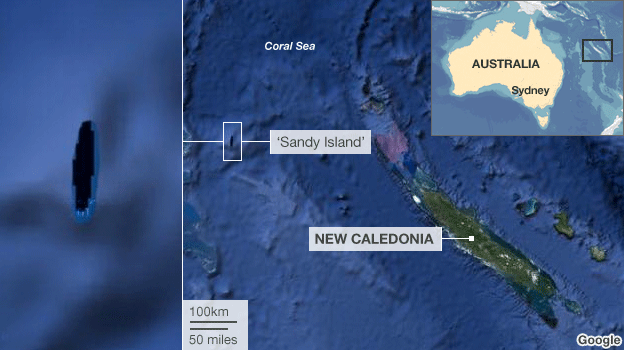
A South Pacific island, shown on marine charts and world maps as well as on Google Earth and Google Maps, does not exist, Australian scientists say.

The supposedly sizeable strip of land, named Sandy Island on Google maps, was positioned midway between Australia and French-governed New Caledonia.

Sandy Island – “Now you see it now you don’t” image BBC/Google

But when scientists from the University of Sydney went to the area, they found only the blue ocean of the Coral Sea.

The phantom island has featured in publications for at least a decade.

Scientist Maria Seton, who was on the ship, said that the team was expecting land, not 1,400m (4,620ft) of deep ocean.

“We wanted to check it out because the navigation charts on board the ship showed a water depth of 1,400m in that area – very deep,” Dr Seton, from the University of Sydney, told the AFP news agency after the 25-day voyage.

“It’s on Google Earth and other maps so we went to check and there was no island. We’re really puzzled. It’s quite bizarre. ……

…… Australia’s Hydrographic Service, which produces the country’s nautical charts, says its appearance on some scientific maps and Google Earth could just be the result of human error, repeated down the years.

A spokesman from the service told Australian newspapers that while some map makers intentionally include phantom streets to prevent copyright infringements, that was was not usually the case with nautical charts because it would reduce confidence in them. ….  ….. while most explorers dream of discovering uncharted territory, the Australian team appears to have done the opposite – and cartographers everywhere are now rushing to undiscover Sandy Island for ever.

Flu vaccines are “over-promoted and over-hyped” and of limited effectiveness

November 21, 2012

I am rather suspicious of the enthusiasm with which influensa vaccination programs are pushed by some (including the WHO). The manufacture and sale of flu vaccines is enormously lucrative. Just in the UK the program costs £120 million every year. Worldwide just influensa vaccine sales are an estimated $4 – 5 billion. The total vaccines market is expected to grow from about $30 billion in 2012 to about $40 billion in 2015! For adult vaccines the biggest growth comes from public health programs pushing influensa vaccines:

Driving that growth is an increasing acceptance of adult vaccines and the public health focus on flu prevention, ……  world sales of adult vaccines reached $12.5B in 2010, up from $10.1B in 2009 largely on strong growth of influenza vaccines. ….

….. Most vaccine revenues are earned by five companies: Sanofi Pasteur, GlaxoSmithKline, Merck & Co., Pfizer, and Novartis. They held nearly 80% of the market as of 2010.

The names of the members of the committees which recommend wholesale flu vaccinations are often shrouded in secrecy and often  – when revealed – are found to have unhealthy ties to the manufacturers of the vaccines.

Something smells!

The Independent takes up the issue:

The flu vaccine given to millions of people each year in Britain is “over-promoted” and “over-hyped” and the protection it offers against the seasonal illness has been exaggerated, scientists claim. Flu causes thousands of deaths, mainly among the elderly, in the UK each year but the vaccine is of limited effectiveness, especially for older people. One expert told The Independent the Government should be held accountable for “wasting taxpayer’s money” on the annual £120m national vaccination campaign. ….

… A report published by the Centre for Infectious Disease Research and Policy (CIDRAP) at the University of Minnesota, US, says the misperception that existing flu vaccines are highly effective has become a barrier to developing new and better vaccines. It also risks undermining public trust in mass immunisation campaigns if Governments fail to tell the truth about the vaccine. ….

…… Flu vaccine has to be re-formulated every year on the basis of an educated guess by experts who attempt to match it with the strains of the rapidly mutating flu virus likely to be circulating that season.

A 2010 review by the highly respected Cochrane Collaboration, an international network of experts, concluded that the vaccine had little impact in years, like the winter of 2011-12, when the vaccine and the viruses were mismatched.

On average, flu vaccine shortened the illness by about half a day but did not reduce the number of people hospitalised, it said. …….

Retired High Court judge accuses Danish government of corruption over wind turbines

November 21, 2012

The Danish love of wind turbines  – sometimes bordering on the irrational – is well known. That is also why they have the highest prices for electricity in Europe. That Denmark is also considered one of the least corrupt countries in the world is taken for granted. But apparently things are not always what they seem. The Copenhagen Post carries a remarkable article by Peter Rørdam, a retired High Court judge which offers a peek behind the scenes at chicanery in the wind industry/government nexus. The article is reproduced below:

The Copenhagen Post

The myth of Denmark as a corruption-free country

It’s a widely held conception that Denmark is one of the world’s least corrupt countries. The message is always warmly received, but this isn’t the same as saying that Denmark is free of corruption.

Read the rest of this entry »

How to use your CV to “control” the subsequent interview

November 20, 2012

Over the last 15 years or so I have often found myself advising employment seekers – from young graduates to potential Managing Directors – about how to write and structure their CVs. It has often occurred to me that in the heat of trying to write down everything that might conceivably be of some interest to somebody, the purpose and objectives of the CV are sometimes forgotten by the authors. Many CV writing guides are often focused on format. Some may even include something about content but most usually take the “purpose” for granted. In the overwhelming majority of cases the objectives of submission of a CV is to be first selected for an employment interview and then to form the basis or the starting point for the interview itself.

(Scroll to bottom of post for “Writing your CV” pdf)

Read the rest of this entry »

Potsdam Institute for the World Bank showcases alarmism at it its very worst

November 19, 2012

 Just in time for the COP 18 meetings in Doha, the Potsdam Institute has produced – for the World Bank – the most apalling mish-mash of baseless fear-mongering I have seen for a long time (one could say that being from Potsdam it is only to be expected).  Much about increasing emissions but nothing about the broken link between carbon dioxide and temperature. This is Alarmism at its worst.

Why a 4°C warmer world must be avoided (Summary pdf)


“Selection” lies in the begetting and evolution is just a result

November 19, 2012

Recently I posted about two  papers by Gerald Crabtree who suggested that perhaps human intelligence peaked as hunter-gatherers, and

“that we are losing our intellectual and emotional capabilities because the intricate web of genes endowing us with our brain power is particularly susceptible to mutations and that these mutations are not being selected against in our modern society”.

Apparently it is not politically correct to suggest that humanity might be on a “degenerative” evolutionary path for intelligence and Crabtree’s speculations have been the subject of indignant criticism:

Why Gerald Crabtree’s speculations about declining human intelligence are wrong: ….  But like Sanford, Crabtree fails to analyse the problem correctly. In particular, neither show any understanding of quantitative genetics (this is the area of genetics that deals with lots of genes acting on a trait). But unlike young earth creationist Sanford, Crabtree doesn’t even bother to present any data to indicate that an intellectual decline has actually happened.

Discussions and arguments about “intelligence and race” or the “future evolution of intelligence”  or “what intelligence is” or whether “intelligence is selected by natural selection” are fascinating but – in evolutionary terms – are largely irrelevant. Evolution is not a force of change. It is the consequences of a response to change, a result – a report-card of what has happened before.

What counts for evolution – both for what has happened before and for what will happen in the future –  is which inheritable traits lead to the most begetting. It is in the begetting of offspring that all “selection” lies. This applies both with natural and with artificial selection. All other traits which happen to be present in the individual organisms being reproduced and which are inheritable are only carried along with the ride.

Read the rest of this entry »