“for your own good” is the most arrogant phrase there is

July 10, 2011

The height of arrogance is when I am told by someone else that I should do something or not do something “for your own good”.

Be it a doctor or a lawyer or an environmental campaigner or a civil servant or a politician or a government,  the phrase raises my hackles.

It presumes too much.

It does not convince.

It is dictatorial.

It imposes one person’s values on someone else.

It is a denial of the subject’s most deep-seated and fundamental value of deciding what constitutes “good”.

I am inclined to think that the most fundamental human characteristic is that

any – and every – human can determine what is “good”

The needs of others and surrounding society and definitions of basic human rights can circumscribe this but cannot – by diktat – take away this fundamental value which is I think integral to being an individual. By corollary any entity which cannot decide what is good and then distinguish between “good” and “bad” does not then qualify for the label “human individual”.

This leads me to paraphrase Descartes’

“cogito ergo sum” (I think, therefore I am)  

to be instead:

I decide what is “good” and can distinguish that which is “bad”.

Therefore I am.

Jatinder Ahluwalia tries to whitewash himself

July 8, 2011

Retraction Watch has an update on Jatinder Ahluwalia. Though reviews by Imperial College (where he scammed himself to a PhD) and the University of East London (where he is currently employed) have yet to be concluded, Ahluwalia is busy trying to whitewash himself.

RetractionWatch

If you’ve been wondering what’s happening in the case of Jatinder Ahluwalia, the University of East London researcher who has been found guilty of faking data as a graduate student at Cambridge and of misconduct at University College London, so have we.

We last reported, in February, that Imperial College London, where Ahluwalia earned his PhD, was repeating his key experiments “in light of new information received.” Today, an Imperial spokesperson tells Retraction Watch that those repeat experiments are complete, and “the results are currently being reviewed by the College.” We look forward to hearing the results of that review, of course.

A reminder that Ahluwalia’s current institution, the University of East London, is also reviewing his work. We’ve heard nothing from UEL, despite several requests. That’s consistent with the idea that the university has placed a gag order on its faculty and administration, although we haven’t confirmed that either.

In fact, we’re hearing a lot of rumors about this case, many of them left as anonymous comments, and while we appreciate any tips, we do our best to confirm verifiable facts before posting, even in comments. So if anyone has documentation of what’s going on, we’d welcome it.

We’ve also seen Ahluwalia apparently take a page out of the Anil Potti playbook, using social media and setting up a blog to extol his own virtues. Various sites discuss his papers and charitable donations, and he also has a Twitter feed that has a lot to say about the weather. Oddly, none of them mention the misconduct findings.

Colder winters to come and solar influence on climate beginning to get its due

July 7, 2011

The BBC reports on a new paper in Environmental Research Letters which actually brings solar influence back into the climate picture.

“We show that some predictive skill may be obtained by including the solar effect” says this new paper.

Yes Indeed!

But how was the sun’s influence ever discarded in climate models??

Britain is set to face an increase in harsh winters, with up to one-in-seven gripping the UK with prolonged sub-zero temperatures, a study has suggested. The projection was based on research that identified how low solar activity affected winter weather patterns.

“We could get to the point where one-in-seven winters are very cold, such as we had at the start of last winter and all through the winter before,” said co-author Mike Lockwood, professor of space environment physics at the University of Reading.

Using the Central England Temperature (CET) record, the world’s longest instrumental data series that stretches back to 1659, the team said that average temperatures during recent winters had been markedly lower than the longer-term average.

“The mean CET for December, January and February for the recent relatively cold winters of 2008/09 and 2009/10 were 3.50°C and 2.53°C respectively,” they wrote.

“Whereas the mean value for the previous 20 winters had been 5.04°C.

“The cluster of lower winter temperatures in the UK during the last three years had raised questions about the probability of more similar, or even colder, winters occurring in the future.” 

Professor Lockwood was keen to point out that his team’s paper did not suggest that the UK and mainland Europe was about to be plunged into a “little ice age” as a result of low solar activity, as some media reports had suggested.

M Lockwood et al 2011 Environ. Res. Lett. 6 034004 doi: 10.1088/1748-9326/6/3/034004

The solar influence on the probability of relatively cold UK winters in the future

M Lockwood, R G Harrison, M J Owens, L Barnard, T Woollings and F Steinhilber

Abstract: Recent research has suggested that relatively cold UK winters are more common when solar activity is low (Lockwood et  al 2010 Environ Res Lett 5 024001). Solar activity during the current sunspot minimum has fallen to levels unknown since the start of the 20th century (Lockwood 2010 Proc. R. Soc. A 466 303–29) and records of past solar variations inferred from cosmogenic isotopes (Abreu et al 2008 Geophys Res Lett. 35 L20109) and geomagnetic activity data (Lockwood et al 2009 Astrophys. J. 700 937–44) suggest that the current grand solar maximum is coming to an end and hence that solar activity can be expected to continue to decline. Combining cosmogenic isotope data with the long record of temperatures measured in central England, we estimate how solar change could influence the probability in the future of further UK winters that are cold, relative to the hemispheric mean temperature, if all other factors remain constant. Global warming is taken into account only through the detrending using mean hemispheric temperatures. We show that some predictive skill may be obtained by including the solar effect.

The BBC report continues:

Depiction of the 1683 Thames' frost fair (Getty Images)

Depiction of the 1683 Thames' frost fair (Getty Images)

Professor Lockwood said it was a “pejorative name” because what happened during the Maunder Minimum “was actually nothing like an ice age at all”.

“There were colder winters in Europe. That almost certainly means, from what we understand about the blocking mechanisms that cause them, that there were warmer winters in Greenland,” he observed. “So it was a regional redistribution and not a global phenomenon like an ice age. It was nothing like as cold as a real ice age – either in its global extent or in the temperatures reached. “The summers were probably warmer if anything, rather than colder as they would be in an ice age.” He added that the Maunder Minimum period was not an uninterrupted series of cold, harsh winters.

Data from the CET showed that the coldest winter since records began was 1683/84 “yet just two year later, right in the middle of the Maunder Minimum, is the fifth warmest winter in the whole record, so this idea that Maunder Minimum winters were unrelentingly cold is wrong”.

He explained that a similar pattern could be observed in recent events: “Looking at satellite data, we found that when solar activity was low, there was an increase in the number of blocking events of the jetstream over the Atlantic. “That led to us getting colder weather in Europe. The same events brought warm air from the tropics to Greenland, so it was getting warmer. “These blocking events are definitely a regional redistribution, and not like a global ice age.  

Renewable Energy follies: Subsidies discourage maintenance

July 6, 2011

A key problem with subsidising “renewable energy” is that the economics become so distorted that developers/owners focus first on maximising the extraction of subsidies and not on the long-term operation of the plant or the production of power. As soon as payback is achieved the focus is on generating revenues while minimising  expenditure on operation and maintenance (O & M). Inevitably such plants are abandoned as soon as the O & M costs approach the level of revenues. Whereas conventional power plants (coal, gas, hydro and nuclear) have a design life of 30 – 40 years and often carry out maintenance to extend this lifetime, subsidised “renewable energy” plants have a lifetime of less than 10 years and often even less.

For example grants for construction and high tariffs were used for many years to encourage sugar producers in India and Brazil and other countries to build power plants burning bagasse (the waste matter left after crushing sugar-cane to extract juice). But the consequence was that sugar producers could generate more revenue by producing power rather than sugar – especially when the sugar price was low. Sugar producers built power plants which were larger than they needed themselves and based solely on the level of grant that could be extracted. Access to the grid was guaranteed. But again many of these plants were abandoned as soon as the O & M costs became too onerous. Effectively the developers had recovered all the investment (which was mainly grant money anyway) and more from the allowed 16 – 20% rate of return (which in practice was more like about 30-50% ) of the supposed investment. As plants were “cashed out” and abandoned, the grid just had to absorb the disturbances – which were not negligible.

The subsidies in Europe for wind and solar power are encouraging the same behaviour. In Germany the almost profligate subsidy regime has encouraged the implementation of less than serious power projects by less than serious developers. The game has been the extraction of subsidies not of generating power. In Germany wind turbine and photo-voltaic solar cell plants popped up everywhere. Farmers and shop-keepers and schools all have became power generators. Grid stability has been weakened to cope with the plethora of small plants cutting in and out of the grid. The obscenely high feed-in tariffs in Spain have encouraged solar plants to burn more gas than permitted and pass off the power generated as being “renewable power” at the high tariff. But as the subsidy regime weakens and tariffs reduce and grants are scaled down, the likelihood of these plants being abandoned is increasing. Certainly there is no incentive to spend any money on maintenance.

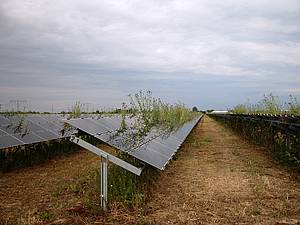
P. Gosselin at NoTricksZone has this about a pv solar plant (2.7 MW) after less than 2 years:

Weed-Covered, Neglected Solar Park: 20 Acres, $11 Million, Only One And Half Years Old! 

solar plant weeds

Over the next few years we shall see many more solar and wind power plants in Europe where money will not be spent on maintenance unless it is absolutely necessary for the generation of short-term (subsidised and inflated) revenues. Long-term maintenance will just not happen. And when the O & M costs become too onerous the plants will simply be abandoned. No doubt bankruptcies will be arranged when the plants are cashed-out such that there is no recourse to the developers/owners for any remaining liabilities.

Subsidies just don’t work for their intended purpose in power generation – but they are short-term gold mines for some developers.

Plagiarist with a recently rescinded PhD appointed EU Commissioner for Research

July 5, 2011

The number of German politicians who have plagiarised for their doctorates grows. After zu Guttenberg, the story of Sylvana Koch-Mehrin and Jorgo Chatzimarkakis is building up into another dirty little tale.

EU politicians are less than impressive. The level of corruption and scams along with the level of arrogance of the EU politicians in Brussels is almost legendary. From my experiences I am fairly certain that the level of political corruption in Europe is significantly higher than for example in India – but far more sophisticated and difficult to find.

The distinct impression is of pigs feeding in a trough.

Pigs feeding from the EU trough

From Professor Debora Weber-Wulff’s blog:

Sylvana Koch-Mehrin had her doctorate rescinded by the University of Heidelberg for containing over 30% plagiarism in May 2011, and now in June she has been named EU commissioner for research, Spiegel Online reports.

This means that she is in the committee that determines research policy for the EU. She had been an alternate for the committee, her fellow FDP politician, Jorgo Chatzimarkakis (his dissertation is currently at 71% plagiarism, but he is contesting the plans of the University in Bonn to rescind his doctorate as well) had the main seat. They have now changed places.

What does this say about research in Germany? What message does this give to the general populace about the importance of research? Plagiarists determining research policy? If today was April 1 I would have considered this an April Fool’s joke, but it is unfortunately true.

Poor Germany, all of your good researchers do not deserve this.

Update: A petition has been started requesting that she step down immediately.  It is online in English, German, and French. If you feel so inclined, please sign. There are already almost 2000 signatures – on day 1 of the petition.

I just signed this petition and I am signer #8325.

Earthquakes July 5th

July 5, 2011

Following up from the red warning from Weather Action today’s news brings

Earthquake shakes Melbourne 

6.5 magnitude earthquake hits New Zealand’s lower North Island

Powerful 5.4 magnitude earthquake hits Western Japan

Generally the number of earthquakes during the period warned about was at the heightened level apparent for the last few months but nothing extraordinary was apparent.

Quakes today:

2.7  2011/07/05 09:30:20   60.138  -150.048 32.8  KENAI PENINSULA, ALASKA

3.7  2011/07/05 09:16:29  -38.336   145.821 21.0  NEAR THE SOUTHEAST COAST OF AUSTRALIA

 4.7  2011/07/05 06:39:06   38.331   144.294 45.1  OFF THE EAST COAST OF HONSHU, JAPAN

 2.6  2011/07/05 03:49:53   38.428  -118.735 5.2  NEVADA

 5.3  2011/07/05 03:36:25  -38.597   175.688 161.3  NORTH ISLAND OF NEW ZEALAND

 2.6  2011/07/05 03:24:54   59.906  -141.828 18.2  SOUTHEASTERN ALASKA

3.3  2011/07/05 03:22:07   39.928  -111.816 1.3  UTAH

2.7  2011/07/05 02:46:47   38.424  -118.740 2.7  NEVADA

3.3  2011/07/05 02:37:16  -38.404   145.888 0.0  NEAR THE SOUTHEAST COAST OF AUSTRALIA

3.6  2011/07/05 02:30:30   38.423  -118.742 3.5  NEVADA

2.5  2011/07/05 01:53:52   36.267  -120.765 7.8  CENTRAL CALIFORNIA

 4.6  2011/07/05 01:32:14  -38.361   145.817 9.9  NEAR THE SOUTHEAST COAST OF AUSTRALIA


Reducing sulphur emissions caused post-1970 global warming!!!!

July 5, 2011

Whether warming or cooling it would seem that anthropogenic effects and man’s burning of coal is responsible.

“The post 1970 period of warming, which constitutes a significant portion of the increase in global surface temperature since the mid 20th century, is driven by efforts to reduce air pollution in general and acid deposition in particular”.

That’s the conclusion of a new paper from the “peer-reviewed” literature confirming the obvious that global temperatures have plateaued since 1998.

Reconciling anthropogenic climate change with observed temperature 1998–2008

Robert K. Kaufmann, Heikki Kauppi, Michael L. Mann, James, H. Stock

pnas. 201102467

PDF from WUWT

And though the paper cuts off  data in 2008 this temperature stability certainly continues till 2010 and it seems – on my own empirical observations  – even in 2011.

As the paper title shows this real stabilisation of temperatures which is not predicted by any climate model and which may well be a precursor of a few decades of global cooling is of some concern to the Anthropogenic Global Warming enthusiasts. The presumption is that the model results are supreme and that reality must be reconciled by invoking further anthropogenic effects.

Needless to say any global cooling is not acknowledged since that would be heretical and instead short-term anthropogenic factors (sulphur emissions from coal burning in China)  are blamed for this cessation of global warming!!

Given the widely noted increase in the warming effects of rising greenhouse gas concentrations, it has been unclear why global surface temperatures did not rise between 1998 and 2008. We find that this hiatus in warming coincides with a period of little increase in the sum of anthropogenic and natural forcings. Declining solar insolation as part of a normal eleven-year cycle, and a cyclical change from an El Nino to a La Nina dominate our measure of anthropogenic effects because rapid growth in short-lived sulfur emissions partially offsets rising greenhouse gas concentrations. As such, we find that recent global temperature records are consistent with the existing understanding of the relationship among global surface temperature, internal variability, and radiative forcing, which includes anthropogenic factors with well known warming and cooling effects.

The conclusion is formulated to avoid any semblance of heresy and to ensure publication no doubt.

The finding that the recent hiatus in warming is driven largely by natural factors does
not contradict the hypothesis: “most of the observed increase in global  average temperature since the mid 20th century is very likely due to the observed increase in anthropogenic greenhouse gas concentrations (14)”. As indicated in Figure 1, anthropogenic activities that warm and cool the planet largely cancel after 1998, which allows natural variables to play a more significant role. ……   

The post 1970 period of warming, which constitutes a significant portion of the increase in global surface temperature since the mid 20th century, is driven by efforts to reduce air pollution in general and acid deposition in particular, which cause sulfur emissions to decline while the concentration of greenhouse gases continues to rise. 

That reality is being acknowledged is heartening but relying on the anthropogenic effects effects of coal burning alone (carbon dioxide emissions causing warming and sulphur emissions causing cooling) with only a passing reference to solar effects is not just naive – it is denying the obvious.

Related:

http://wattsupwiththat.com/2011/07/04/a-peer-reviewed-admission-that-global-surface-temperatures-did-not-rise-dr-david-whitehouse-on-the-pnas-paper-kaufmann-et-al-2011/

Tepco shares rise sharply on reports of planned break-up and nationalisation

July 4, 2011

Tepco shares rose almost 20% today as reports on Sunday described government plans to break-up the Japanese utility and to nationalise its nuclear plant assets.

Market Watch:


Senior members of Japan’s government have been involved in secret plans to break up the operator of the beleaguered Fukushima Daiichi nuclear power plant, according to reports. 

The plan would see the nuclear operations of Tokyo Electric Power Co. JP:9501 +19.82%  come under government control, said Reuters, citing a report Sunday in a local paper.

The plan has been devised by Deputy Chief Cabinet Secretary Yoshito Sengoku, said Reuters, citing the Mainichi daily. The newspaper said its information was from unnamed sources.

As well as nationalizing the nuclear business, the plan would see Tepco sell its power distribution business, said Reuters. Power-generation operations that use thermal and hydraulic power plants would remain as the company’s business. 

The plan would shred Tepco’s size, according to the reports, leaving it with 1.6 trillion yen ($19.8 billion) in power industry assets compared to its current 7 trillion yen.

The reports state that Sengoku has met several times with Tepco Chairman Tsunehisa Katsumata, and has informed Katsumata about the plans.

Also Sunday, The Wall Street Journal said the company has restarted the use of contaminated water to cool the reactor cores at Fukushima, one week after an initial attempt was suspended because of leaks. Tepco is hoping to achieve a cold shutdown, lowering the fuel rods’ temperature to below 100 degrees Celsius, by January.

Related:

https://ktwop.wordpress.com/2011/03/29/tepco-leadership-in-disarray-as-share-price-drops-to-47-year-low-and-government-considers-nationalisation/

https://ktwop.wordpress.com/2011/03/30/tepco-stocks-are-on-their-way-to-losing-all-value/

Signs that the Japanese recovery is beginning

July 4, 2011

Having a very strong belief in the resilience of Japan and the Japanese in the face of natural disasters, I have – paradoxically – been anticipating that the Great 2011 earthquake and tsunami will actually lead to a wave of infrastructure spending which can actually lead to a new spurt of economic growth. If political changes are also forthcoming this could be a wave of sustainable growth. 

Now 3 months after the quake and tsunami the first signs are visible that the recovery is beginning. There is a long way yet to go but I remain convinced that over the next 2 or 3 years we will see Japan re-emerging as a significant motor driving the world economy.

Bloomberg:


Japan’s industrial production rose at the fastest pace in more than 50 years, led by carmakers as they restored operations at plants after a record earthquake and tsunami on March 11.

Factory output increased 5.7 percent in May from April, the biggest gain since 1953, the Trade Ministry said in Tokyo today. The median estimate of 30 economists surveyed by Bloomberg News was for a 5.5 percent gain.

Output in the transportation industry advanced 36 percent from the previous month as automakers including Toyota Motor Corp. and Nissan Motor Co. restarted production lines. Manufacturers said they plan to increase output 5.3 percent this month and 0.5 percent in July, according to a survey of companies included in today’s report.

“The report shows that the auto industry is a strong driving force” in boosting production, said Hiroaki Muto, a senior economist at Sumitomo Mitsui Asset Management Co. in Tokyo. “The post-quake shock is running its course and production is undergoing a V-shaped recovery.”

The output report follows data this week showing that retail sales rose 2.4 percent in May from April, in a sign that consumer demand is rebounding.

Business World:


THE AUTOMOBILE INDUSTRY foresees a more stable supply situation at the very least following reports that Japanese parts production has picked up following March’s deadly earthquake and tsunami. Timing of a return to full output, however, remains uncertain given power shortages caused by the shutdown of the Fukushima nuclear plant, industry officials said.

Japan’s Ministry of Economy, Trade and Industry last week said industrial production rose by 5.7% month-on-month in May from 1.6% in April, with transport equipment among the sectors leading growth. Inventory was said to have similarly increased by 5.1% in May from previous month on improved production of electronics parts and devices, among others.


DSK case collapsing: Was this just French politics to kill his Presidential aspirations?

July 1, 2011
French Finance Minister Christine Lagarde (L) ...

French Finance Minister Christine Lagarde (L) talks with International Monetary Fund's Managing Director Dominique Strauss-Kahn (R):Image via Wikipedia

The New York Times broke this story and it makes me wonder if the anti- DSK faction in France were behind all of this just to get him out of the running for French President and – incidentally – to replace him with a Sarkozy-friendly Christine Lagarde at the IMF. With the internecine nature of French politics  reality is often much more convoluted than the most fanciful conspiracy theories. Perhaps Sarkozy  – who loves devious political machinations – was behind all of this?

The sexual assault case against Dominique Strauss-Kahn is on the verge of collapse as investigators have uncovered major holes in the credibility of the housekeeper who charged that he attacked her in his Manhattan hotel suite in May, according to two well-placed law enforcement officials. …. 

Since her initial allegation on May 14, the accuser has repeatedly lied, one of the law enforcement officials said. Senior prosecutors met with lawyers for Mr. Strauss-Kahn on Thursday and provided details about their findings, and the parties are discussing whether to dismiss the felony charges. Among the discoveries, one of the officials said, are issues involving the asylum application of the 32-year-old housekeeper, who is Guinean, and possible links to people involved in criminal activities, including drug dealing and money laundering. …. 

The revelations are a stunning change of fortune for Mr. Strauss-Kahn, 62, who was considered a strong contender for the French presidency before being accused of sexually assaulting the woman who went to clean his luxury suite at the Sofitel New York.

Prosecutors from the office of the Manhattan district attorney, Cyrus R. Vance Jr., who initially were emphatic about the strength of the case and the account of the victim, plan to tell the judge on Friday that they “have problems with the case” based on what their investigators have discovered, and will disclose more of their findings to the defense. The woman still maintains that she was attacked, the officials said.

“It is a mess, a mess on both sides,” one official said.

According to the two officials, the woman had a phone conversation with an incarcerated man within a day of her encounter with Mr. Strauss-Kahn in which she discussed the possible benefits of pursuing the charges against him. The conversation was recorded.

That man, the investigators learned, had been arrested on charges of possessing 400 pounds of marijuana. He is among a number of individuals who made multiple cash deposits, totaling around $100,000, into the woman’s bank account over the last two years. The deposits were made in Arizona, Georgia, New York and Pennsylvania.

The investigators also learned that she was paying hundreds of dollars every month in phone charges to five companies. The woman had insisted she had only one phone and said she knew nothing about the deposits except that they were made by a man she described as her fiancé and his friends.

In addition, one of the officials said, she told investigators that her application for asylum included mention of a previous rape, but there was no such account in the application. She also told them that she had been subjected to genital mutilation, but her account to the investigators differed from what was contained in the asylum application.