Rolls Royce settles with Qantas for over $100 million

June 22, 2011

Qantas has reached a settlement with engine maker Rolls-Royce over last year’s mid-air disintegration of a the Trent 900 engine, which temporarily forced the grounding of its entire fleet of A380s. The terms of the agreement have not been revealed but will give Qantas a $100 million (A$95 million) boost in profits. For Rolls Royce the cost of the Qantas settlement is therefore likely to be somewhat greater and my guess would be in the region of $110 million.

My estimate made in November 2010 that Rolls Royce would face a hit of around $300 million for direct costs and in settlement costs seems to be not far off the mark. The cost to Rolls Royce of loss of future sales remains intangible and perhaps only temporary.

The Telegraph:

Alan Joyce, the Qantas chief executive, said the terms of the agreement are confidential, but said the settlement’s profit and loss impact would amount to a A$95m boost to the Australian airline’s bottom line.

Mr Joyce said the settlement marks an end to the legal proceedings Qantas launched against Rolls-Royce in the Federal Court of Australia in December.

In November, a Rolls-Royce Trent 900 engine on a Qantas A380 disintegrated shortly after takeoff from Singapore, forcing the plane to make an emergency landing.

The Australian Transport Safety Bureau’s interim report on the A380 incident said a manufacturing defect in an oil pipe deep within one of the engines led to an oil leak, which sparked a fire. The fire caused a disintegration of one of the engine’s giant turbine discs, sending pieces of it shooting through the plane’s wing and raining onto the ground below.

The engine explosion was the most significant safety issue an A380 had ever faced since it began passenger flights in 2007, and prompted intense scrutiny of Rolls-Royce engines. 

The settlement will help Qantas recover from the millions it lost following the incident. The airline was forced to temporarily ground its entire fleet of A380s for a series of inspections, and Joyce said the plane damaged by the explosion won’t return to service until February.

“Qantas and Rolls-Royce have had a long and successful commercial partnership spanning several decades,” the airline said in a statement. “Qantas looks forward to a continued strong relationship with Rolls-Royce on the basis of the settlement announced today.”

The compensation payment helped boost the airline’s expected underlying pretax profit for the year to June 30 to between A$500 million (£326m) and A$550 million (£359m), up from A$377 million (£246m) a year ago.

…… Qantas shares rose 0.8 per cent to AU$1.84 in afternoon trading.

This leaves Rolls Royce the task of settling with Airbus and some less costly settlements with Lufthansa and Singapore Airlines.

My estimate is that it will take another 2 to 3 quarters for most of these costs to have worked their way through Rolls Royce’s accounts. However RR will have to bear an increased and continuing service cost regime for some time to come for the Trent 900.

The Trent 1000  for the Dreamliner is still a long way off from generating real revenues for Rolls Royce.

The wrecked engine after the plane landed in Singapore.

The wrecked Trent 900 engine after the Qantas plane landed in Singapore.Photo: AFP

It could be time to buy Rolls Royce again.

Longest Day

June 21, 2011

The Summer Solstice is today (at about 1800 local time).

At this latitude (58° 43′ 0″ N), sunrise is at 0346 and sunset is at 2211 giving us the longest day of the year – even though the official Midsommar holiday in Sweden will be celebrated on Friday and Saturday (when the day will be about a minute shorter).

But we are expecting a good deal of rain and the number of hours of sunshine and temperatures – maximums of about 18 °C – will not break any records.

from eclipsetraveler.com

Wikipedia: In modern Sweden, Midsummer’s Eve and Midsummer’s Day celebration are held on the Friday and Saturday between 19 June and 26 June. It is one of the most important holidays of the year in Sweden, and probably the most uniquely Swedish in the way it is celebrated. The main celebrations take place on the Friday, and the traditional events include raising and dancing around a huge maypole. Before the maypole is raised, greens and flowers are collected and used to cover the entire pole.

Hoisting and dancing around a maypole  (majstång or midsommarstång) is an activity that attracts families and many others. People dancing around the pole listen to traditional music and some even wear traditional folk costumes. In addition, many wear crowns made of wild springs and wildflowers on their heads. The year’s first potatoes, Sour herring, Chives, Sour Cream, Beer, Snaps and the first strawberries of the season are on the menu. Drinking songs (Snapsvisor) are also important at this feast, and many drink heavily. When Sweden got its National day (6 June), discussions were held about making Midsummer the Swedish national day because of the strong civil celebration on this day.

Because Midsummer was thought to be one of the times of the year when magic was strongest, it was considered a good night to perform rituals to look into the future. Traditionally, young people pick bouquets of seven or nine different flowers and put them under their pillow in the hope of dreaming about their future spouse. In the past it was believed that herbs picked at Midsummer were highly potent, and water from springs could bring good health. Greenery placed over houses and barns were supposed to bring good fortune and health to people and livestock; this old tradition of decorating with greens continues, even though most don’t take it seriously. To decorate with greens was called att maja (to may) and may be the origin of the word majstång, maja coming originally from the month May. Other researchers say the term came from German merchants who raised the maypole in June because the Swedish climate made it impossible to find the necessary greens and flowers in May, and continued to call it a maypole. Today, however, it is most commonly called  a “midsommarstång”  (literally midsummer’s pole).

In earlier times, small spires wrapped in greens were erected; this probably predates the maypole tradition, which is believed by many to have come from the continent in the Middle Ages. Others argue that some form of Midsummer pole occurred in Sweden during the pre-Christian times, and was a phallic fertility symbol, meant to impregnate the earth, but as there were no records from those times it cannot be proven, and this idea might just be a modern interpretation of the pole’s form. The earliest historical mention of the maypole in Sweden is from the Middle Ages. Midsummer was, however, linked to an ancient fertility festival which was adapted into St. John’s Day by the church, even though it retained many pagan traditions, as the Swedes were slow to give up the old heathen customs. The connection to fertility is naturally linked to the time of year. Many young people became passionate at Midsummer, and this was accepted, probably because it resulted in more childbirths in March which was a good time for children to be born.

Midsommarstång on Gålö, Sweden: image Wikipedia

UK to outsource wind farms to Ireland

June 20, 2011

From the ever-reliable Guardian comes the story of high level diplomatic activity to get Ireland to be the wind-power producer for the UK.

I wonder if this means that all the UK taxpayers subsidies for wind power will also then flow to Ireland?

Ireland’s unspoiled, windswept west coast could become the focus of a new wave of wind farm construction in the wake of a high-level diplomatic meeting to be held tomorrow in London.

UK deputy prime minister Nick Clegg, Taoiseach Enda Kenny and other senior members of the British-Irish Council will gather to discuss a plan to expand electricity grid connections throughout the British Isles. In particular, they want to build new inter-connectors to link the electricity grids of Ireland and Britain in order to transmit power from new windfarms in Ireland to England.

The aim of the plan, created by the British government, is to open up remote regions that could provide Britain with more power generated by wind farms, as well as by tide and wave plants, and so reduce its reliance on fossil fuels.

Republic of Ireland, Kerry county, Dingle peninsula, Sleahead beach

Sleahead beach on the Dingle peninsula in Kerry, Ireland, which fierce winds make suitable for turbines. Photograph: Hemis/Alamy

“The west coast of Ireland has some of the fiercest winds in Europe,” said Charles Hendry, the UK energy minister, who will be attending the meeting. “They whip in off the Atlantic which makes it is an ideal location for wind farms. However, the Irish market for electricity is less than a tenth of that of Britain. That means that companies cannot afford to build wind farms in Ireland because there is no market for their power. We want to put that right.”

The construction of wind farms in Ireland that would supply power to neighbouring countries could help to put the UK back on track in its use of clean, renewable energy. Britain has recently been criticised for falling short of its targets for constructing wind power plants and for cutting its carbon emissions. Importing clean power could help to resolve the problem.

Landscheidt Minimum could be a grand solar minimum lasting till 2100

June 20, 2011

It is noticeable that the upsurge of evidence that a solar minimum – and maybe a grand minimum – is upon is causing many of the global warming enthusiasts to try and rationalise the effects of the sun. Suddenly they begin to acknowledge that the sun may have some small effect on climate but rush to point out that the solar influence on climate is not yet understood (indeed!) and in any case it will be much too small to be significant compared to the effects of man.

The belated acknowledgement of the possible influence of the sun is welcome but  the belief that man made effects can overcome the power of the sun is just arrogant.

hockeyschtick

Dr. Cornelis de Jager is a renowned Netherlands solar physicist, past General Secretary of the International Astronomical Union, and author of several peer-reviewed studies examining the solar influence upon climate. In response to the recent press release of three US studies indicating the Sun is entering a period of exceptionally low activity, Dr. de Jager references his publications of 2010 and prior indicating that this Grand Solar Minimum will be similar to the Maunder Minimum which caused the Little Ice Age, and prediction that this “deep minimum” will last until approximately the year 2100. 

“The new episode is a deep minimum. It will look similar to the Maunder Minimum, which lasted from 1620 to 1720…This new Grand Minimum will last until approximately 2100.”


Related: 

  1. http://www.scostep.ucar.edu/archives/scostep11_lectures/de%20Jager.pdf 
  2. Solar activity and its influence on climate  
  3. Major Drop In Solar Activity Predicted: Landscheidt Minimum is upon us and a mini-ice age is imminent

Rio Tinto wins battle for Riversdale coal as major shareholder Tata Steel accepts offer

June 16, 2011

I had posted back in December last year about the battle for the acquisition of 13 billion tons of coking and steam coal reserves with Riversdale in Mozambique.

Riversdale Mining Ltd. has 13 billion metric tonnes of known coking and thermal coal reserves in its Benga and Zambeze projects in Mozambique. A global battle is now hotting up for the acquisition of Riversdale . International Coal Ventures Ltd., an Indian state-run joint venture, is studying an offer for Riversdale Mining Ltd. to counter a A$3.9 billion ($3.9 billion) bid from Rio Tinto Group.

The largest share holder was Tata Steel and they have now decided to exit. Hindustan Times reports


After months of speculation, steel major Tata Steel on Thursday said it had sold off its entire 26.27% stake in Australian mining firm Riversdale, facing a takeover from giant Rio Tinto, for Australian $1.06 billion (approximately Rs4,940 crore). It is a rich exit, as the Tatas have doubled their investment in a 4 year period.

Rio Tinto, which had made an open offer to the shareholders of Riversdale in March that had been repeatedly extended to a final deadline that now closes on Friday, sees its shareholding go up from 73.20% to almost 99.7%. 

The British-Australian group had said it planned to delist Riversdale from the Australian bourses and Tata Steel, which had for long maintained that it wanted to remain invested in the company, said on Thursday that it finally decided to sell the stake in the absence of a pact with Rio.

“Tata Steel has decided it would not want to hold its equity investment in Riversdale Mining Ltd which is proposed to be delisted, without any joint venture agreement with the majority shareholder in unlisted Riversdale Mining Ltd,” Tata said in a statement to the Bombay Stock Exchange.

“The sale represents around 100% appreciation of value in less than 4 years since its first investment,” it said.

Even as more shale gas becomes available and “peak gas” becomes less and less likely, the value of coal assets is also increasing. Shale gas may well lead to a move back to fossil energy and the future availability of gas does not seem to hurt the value of coal.

Now IPCC becomes just a lobby for Greenpeace!

June 16, 2011

There seems to be an incestuous relationship between the IPCC and a number of advocacy groups with the parties lobbying for each other. In the latest episode the IPCC has become the vehicle for publishing conclusions from a Greenpeace advocacy report on renewables:

The Independent:

Climate change panel in hot water again over ‘biased’ energy report 

The world’s foremost authority on climate change used a Greenpeace campaigner to help write one of its key reports, which critics say made misleading claims about renewable energy, The Independent has learnt. 

The Intergovernmental Panel on Climate Change (IPCC), set up by the UN in 1988 to advise governments on the science behind global warming, issued a report last month suggesting renewable sources could provide 77 per cent of the world’s energy supply by 2050. But in supporting documents released this week, it emerged that the claim was based on a real-terms decline in worldwide energy consumption over the next 40 years – and that the lead author of the section concerned was an employee of Greenpeace. Not only that, but the modelling scenario used was the most optimistic of the 164 investigated by the IPCC.

Critics said the decision to highlight the 77 per cent figure showed a bias within the IPCC against promoting potentially carbon-neutral energies such as nuclear fuel. One climate change sceptic said it showed the body was not truly independent and relied too heavily on green groups for its evidence. 

Yesterday, after the full report was released, the sceptical climate change blog Climate Audit reported that the 77 per cent figure had been derived from a joint study by Sven Teske, a climate change expert employed by Greenpeace, which opposes the use of nuclear power to cut carbon emissions.

Last night, the IPCC said it had been made clear that the 77 per cent figure was only one of the estimates made from the models and that Mr Teske was just one of 120 researchers who had worked on the report. John Sauven, executive director of Greenpeace UK, said: “Exxon, Chevron and the French nuclear operator EDF also contribute to the IPCC, so to paint this expert UN body as a wing of Greenpeace is preposterous.” But Mark Lynas, a climate change writer in favour of using nuclear and renewables to combat global warming, said: “It is stretching credibility for the IPCC to suggest that a richer world with two billion more people will use less energy in 2050. Campaigners should not be employed as lead authors in IPCC reports.”

The IPCC must urgently review its policies for hiring lead authors – and I would have thought that not only should biased ‘grey literature’ be rejected, but campaigners from NGOs should not be allowed to join the lead author group and thereby review their own work. There is even a commercial conflict of interest here given that the renewables industry stands to be the main beneficiary of any change in government policies based on the IPCC report’s conclusions. Had it been an oil industry intervention which led the IPCC to a particular conclusion, Greenpeace et al would have course have been screaming blue murder.

Climate Audit: IPCC WG3 and the Greenpeace Karaoke

The basis for this claim is a Greenpeace scenario. The Lead Author of the IPCC assessment of the Greenpeace scenario was the same Greenpeace employee who had prepared the Greenpeace scenarios, the introduction to which was written by IPCC chair Pachauri.

The public and policy-makers are starving for independent and authoritative analysis of precisely how much weight can be placed on renewables in the energy future. It expects more from IPCC WG3 than a karaoke version of Greenpeace scenario.

It is totally unacceptable that IPCC should have had a Greenpeace employee as a Lead Author of the critical Chapter 10, that the Greenpeace employee, as an IPCC Lead Author, should (like Michael Mann and Keith Briffa in comparable situations) have been responsible for assessing his own work and that, with such inadequate and non-independent ‘due diligence’, IPCC should have featured the Greenpeace scenario in its press release on renewables.

Everyone in IPCC WG3 should be terminated and, if the institution is to continue, it should be re-structured from scratch.

“Only way out of the Eurocrisis is for Greece to leave the Euro”

June 16, 2011

Dagens Industri’s panel of finance and economy experts have a bleak view of Greece remaining within the Euro. Emergency loans will be necessary anyway but in the long term, they feel, Greece has to leave the Euro not only for their own sake but also for preventing a collapse of the EMU.

The only way out of the euro crisis is with Greece’s exit from EMU, says Dagen Industi’s expert panel. But only after a lengthy process with more emergency loans to avoid the risk of a new financial meltdown a la Lehman Brothers in 2008.

“Greece is actually already bankrupt. Market prices speak for themselves. The country would not survive a day without an emergency loan from the European Union and IMF” said Marie Giertz, chief economist at Länsförsäkringar.

A new global financial crisis threatens if Greece does not get emergency loans and are forced to suspend payments to private lenders, including German and French banks, warns the European Central Bank ECB and the large rating agencies. Germany and others complain that European taxpayers cannot just continue to sponsor Greece’s debt tangle with never-ending emergency loans.

Cecilia Skingsley, chief analyst of Swedbank’s foreign exchange and fixed income trading, believes that the new emergency loan is the solution only for the short term. But that Greece must eventually leave the EMU. “With a further loan program maybe the market calms for a while. Then in a few years we realize again that this is not sustainable. Therefore I think that Greece must leave the monetary union. In return, they may get a little waiver of some of the emergency loans from the EMU ” said Cecilia Skingsley.

Jan Häggström, chief economist at Handelsbanken, points out that the euro country taxpayers have to bear the Hellenic liabilities no matter how it goes. The alternative to providing further emergency loans is credit losses in the European banking system, which in turn would require government bailouts. “In the end somebody has to write this down and it is not unlikely that Greece will have to leave the euro, but that is further ahead in time” says Jan Häggström.

Greece, in principle, needs to step out of the EMU in order not to drag down other crisis countries into a major depletion of their treasuries, reasons Tomas Pousette, chief economist at SBAB. “Otherwise it is difficult to see why, for example, Portugal should endure ten years of very tough fiscal policy while Greece simply chops off their debt. For a Greece outside the EMU, debt would be burdened by high interest rates and bankruptcies would threaten the country’s banking sector. But the country would also get a chance to revive its tourist industry with its own, lower, exchange rate “, says Tomas Pousette.

An inconvenient solar minimum..

June 15, 2011

Solar science and the possibility that a Maunder-like Minimum may be approaching seems to have caught the fancy of the MSM — Al Gore notwithstanding.

  1. The Telegraph New Little Ice Age in store? 
  2. Sydney Morning Herald Quiet sun: drop in solar activity may signal second ‘Little Ice Age’ on Earth
  3. Fox News Global Warming Be Damned, We Might Be Headed for a Mini Ice Age
  4. International Business Times The Sun’s inactivity leading to second Little Ice Age, to Offset Global Warming?
  5. MSNBC Solar forecast hints at a big chill
  6. The Christian Science Monitor A sun with no sun spots? What that could mean for Earth and its climate
  7. Discovery News IS THE SUN ABOUT TO FIZZ OUT?
  8. ABC News Goodnight Sun: Sunspots May Disappear for Years
  9. New Scientist Sluggish sun may ‘sit out’ next solar cycle
  10. Arizona Daily Star Fewer sunspots could help offset global warming
Most of these publications are generally fairly uncritical adherents of whatever seems to be in vogue and have usually been very vocal in supporting the AGW creed. But it is nevertheless interesting to see how they have all picked up this news — as if they are bored with and tired of repeating the same old AGW story-line and are just waiting for a new star to follow.
Perhaps the political tide is turning, ……

Gaddafi gets tickets for the Olympics

June 15, 2011

Update – 15th June!!

After the furore yesterday Mark Adams, the IOC’s director of communications, said that Libya would not be given any printed tickets “until the current situation becomes clearer”. “To be absolutely clear, no tickets have been printed or paid for,” he said.

14th June — Is escaping from Libya as part of an Olympics delegation part of some new exit strategy? I put this down to stupidity rather than corruption though both are endemic within the IOC (and FIFA). But the lack of collective intelligence within the IOC can sometimes be inexplicable.

The Telegraph reports:

The Libyan regime has successfully requested close to 1,000 tickets to events at the London Olympics and the country’s attendance at the Games is being co-ordinated by the Gaddafi family.

The Libyan Olympic Committee is headed by Muhammad Gaddafi and the Government now fears a major diplomatic embarrassment over the attendance of regime figures.

The decision to grant Libya the valuable tickets will infuriate the million Britons who have missed out on attending over-subscribed events.

Government sources warned of a diplomatic crisis last night after it emerged that Col Gaddafi himself may try to disrupt the event as a publicity coup if he remains in power in 2012.

The organisers of the London Games are obliged to sell Libya tickets, after the International Olympic Committee failed to expel the regime despite international condemnation of its bloody crack-down on opponents.

Major Drop In Solar Activity Predicted: Landscheidt Minimum is upon us and a mini-ice age is imminent

June 15, 2011

The stunning announcement made at the annual meeting of the American Astronomical Society exceeded the expectations from the advance publicity!

The results of new studies were announced today (June 14) at the annual meeting of the solar physics division of the American Astronomical Society, which is being held this week at New Mexico State University in Las Cruces. 

The results of three separate studies seem to show that even as the current sunspot cycle (SC24) moves toward the solar maximum, the sun could be heading into a more-dormant period, with activity during the next 11-year sunspot cycle (SC25) greatly reduced or even eliminated.

The indicators have been  growing for some time that we are in for a a new solar minimum – the Landscheidt minimum – which could be similar to the Dalton Minimum and may even approach the Maunder Minimum. This could mean a cooling period for the earth of 20 – 30 years or for as long as 60 – 70 years. In any event the signs will be unambiguous and inescapable within a decade.

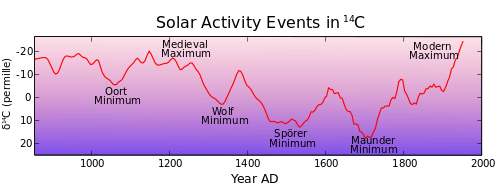
It is reasonable to assume that climatic conditions over the next 20 – 30 years will resemble those prevailing between 1790 and 1820. But SC24 has a way to go yet and it could be that solar activity for SC24 and 25 will be even lower than during the Dalton minimum and perhaps closer to the Spörer minimum but perhaps not as deep as the Maunder minimum.

But in either case the solar activity to come following the Modern maximum may well resemble the 500 years of decline in solar activity which followed the Medieval maximum.

Solar activity events recorded in radiocarbon. Present period is on left. Values since 1950 not shown: Wikipedia

The three papers are: 

  1. “Large-Scale Zonal Flows During the Solar Minimum — Where Is Cycle 25?” by Frank Hill, R. Howe, R. Komm, J. Christensen-Dalsgaard, T.P. Larson, J. Schou & M. J. Thompson.
  2. “A Decade of Diminishing Sunspot Vigor” by W. C. Livingston, M. Penn & L. Svalgard.
  3. “Whither Goes Cycle 24? A View from the Fe XIV Corona” by R. C. Altrock.

 Spacedaily reports:

Major Drop In Solar Activity Predicted

As the current sunspot cycle, Cycle 24, begins to ramp up toward maximum, independent studies of the solar interior, visible surface, and the corona indicate that the next 11-year solar sunspot cycle, Cycle 25, will be greatly reduced or may not happen at all.

“This is highly unusual and unexpected,” Dr. Frank Hill, associate director of the NSO’s Solar Synoptic Network, said of the results. “But the fact that three completely different views of the Sun point in the same direction is a powerful indicator that the sunspot cycle may be going into hibernation.”

Hill is the lead author on one of three papers on these results being presented this week. Using data from the Global Oscillation Network Group (GONG) of six observing stations around the world, the team translates surface pulsations caused by sound reverberating through the Sun into models of the internal structure.

One of their discoveries is an east-west zonal wind flow inside the Sun, called the torsional oscillation, which starts at mid-latitudes and migrates towards the equator. The latitude of this wind stream matches the new spot formation in each cycle, and successfully predicted the late onset of the current Cycle 24.

“We expected to see the start of the zonal flow for Cycle 25 by now,” Hill explained, “but we see no sign of it. This indicates that the start of Cycle 25 may be delayed to 2021 or 2022, or may not happen at all.”

In the second paper, Matt Penn and William Livingston see a long-term weakening trend in the strength of sunspots, and predict that by Cycle 25 magnetic fields erupting on the Sun will be so weak that few if any sunspots will be formed. Spots are formed when intense magnetic flux tubes erupt from the interior and keep cooled gas from circulating back to the interior.

For typical sunspots this magnetism has a strength of 2,500 to 3,500 gauss (Earth’s magnetic field is less than 1 gauss at the surface); the field must reach at least 1,500 gauss to form a dark spot.

Using more than 13 years of sunspot data collected at the McMath-Pierce Telescope at Kitt Peak in Arizona, Penn and Livingston observed that the average field strength declined about 50 gauss per year during Cycle 23 and now in Cycle 24.

They also observed that spot temperatures have risen exactly as expected for such changes in the magnetic field. If the trend continues, the field strength will drop below the 1,500 gauss threshold and spots will largely disappear as the magnetic field is no longer strong enough to overcome convective forces on the solar surface.

Moving outward, Richard Altrock, manager of the Air Force’s coronal research program at NSO’s Sunspot, NM, facilities has observed a slowing of the “rush to the poles,” the rapid poleward march of magnetic activity observed in the Sun’s faint corona. Altrock used four decades of observations with NSO’s 40-cm (16-inch) coronagraphic telescope at Sunspot.

“A key thing to understand is that those wonderful, delicate coronal features are actually powerful, robust magnetic structures rooted in the interior of the Sun,” Altrock explained. “Changes we see in the corona reflect changes deep inside the Sun.”

Altrock used a photometer to map iron heated to 2 million degrees C (3.6 million F). Stripped of half of its electrons, it is easily concentrated by magnetism rising from the Sun. In a well-known pattern, new solar activity emerges first at about 70 degrees latitude at the start of a cycle, then towards the equator as the cycle ages. At the same time, the new magnetic fields push remnants of the older cycle as far as 85 degrees poleward.

“In cycles 21 through 23, solar maximum occurred when this rush appeared at an average latitude of 76 degrees,” Altrock said.

“Cycle 24 started out late and slow and may not be strong enough to create a rush to the poles, indicating we’ll see a very weak solar maximum in 2013, if at all. If the rush to the poles fails to complete, this creates a tremendous dilemma for the theorists, as it would mean that Cycle 23’s magnetic field will not completely disappear from the polar regions (the rush to the poles accomplishes this feat). No one knows what the Sun will do in that case.”

All three of these lines of research to point to the familiar sunspot cycle shutting down for a while. “If we are right,” Hill concluded, “this could be the last solar maximum we’ll see for a few decades. That would affect everything from space exploration to Earth’s climate.”

That last may be the understatement of the century!!!

A photo of a sunspot taken in May 2010, with Earth shown to scale. The image has been colorized for  aesthetic reasons. This image with 0.1 arcsecond resolution from the Swedish 1-m Solar  Telescope represents the limit of what is currently possible in te

A photo of a sunspot taken in May 2010, with Earth shown to scale.This image with 0.1 arcsecond resolution from the Swedish 1-m Solar Telescope represents the limit of what is currently possible in terms of spatial resolution. CREDIT: The Royal Swedish Academy of Sciences, V.M.J. Henriques (sunspot), NASA Apollo 17 (Earth)