Shocking! Study claims IKEA is confusing customers into submission!

January 24, 2011

Alan Penn is Professor of Architectural and Urban Computing at The Bartlett School of Graduate Studies, University College London, and Director of the VR Centre for the Built Environment. He has studied IKEA’s London store and draws the (un)remarkable conclusion that the layout has been cunningly designed – horror of horrors – to get customer’s to buy more.

Duh!!

(I hate that word but cannot find a better one)

The Scotsman reports:

IKEA Wembley store

Study claims Ikea’s ‘maze’ is selling ploy

Professor Alan Penn, director of the Virtual Reality Centre for the Built Environment at University College London, studied the Swedish firm’s north London store and came to the conclusion that their success, in part, is down to confusing their customers into submission by designing their stores like a maze.

Unlike John Lewis stores, which have a grid layout to create an open and accessible environment, Ikea stores require customers to enter and follow a path through the entire store to reach the exit.

“It is so well done and so cunningly done that I have little doubt that it is intentional,” said Penn, whose team has previously studied retail strategies and monitored how consumers respond.
In his study of the Ikea store in Brent, Penn found that the weaving yellow path quickly leaves customers disorientated. It only takes minutes before they have no idea where the exit lies, he found. Although all stores are required to include shortcuts for fire regulations, he said these were always positioned outside the customer’s normal field of vision.
Penn said the only comparable shopping environment he knew of was the Bazaar in Isfahan, a medieval Iranian marketplace. “The way to the exit is always behind you,” he said.

Obviously  John Lewis and other proper UK stores would not stoop to such despicable tactics ! In the words of one of the comments to this article:

I do think it is important for customers to stand up to the evil nordic fascist monsters who run Ikea.

Footnote from the Wall Street Journal:

Swedish furniture giant IKEA, the world’s No. 1 furniture retailer by sales, said Friday it benefited from cash-strapped consumers trading down in a continued challenging economic climate, as it reported higher sales and net profit for fiscal 2010. The company, famous for its low-cost ready-to-assemble furniture, said net profit for the fiscal year to Aug. 31 rose 6.1% to EUR2.7 billion. Revenue rose 7.7% to EUR23.1 billion.

Prices were unchanged in fiscal 2010 although Ohlsson said the company has been able to reduce prices by 2.6% in the current fiscal year and sees the possibility of further prices cuts next fiscal year. IKEA’s improved supply chain is key to maintaining low prices while also bucking the trend of other retailers by boosting margins. Gross margin rose to 46.1% from 44.6% a year earlier.

I wonder who funded this study? A competitor to IKEA? or could it be IKEA?

IKEA is still a privately held company – so I won’t be buying shares after this study – but I would if I could.

Related: https://ktwop.wordpress.com/2010/08/28/the-ikea-phenomenon/

New study confirms Himalayan glaciers will not disappear any time soon

January 24, 2011
This NASA image shows the formation of numerou...

Glacial lakes, Bhutan: Image via Wikipedia

Reuters reports:

(Reuters) – Some Himalayan glaciers are advancing despite an overall retreat, according to a study on Sunday that is a step toward understanding how climate change affects vital river flows from China to India.

“Our study shows there is no uniform response of Himalayan glaciers to climate change and highlights the importance of debris cover,” scientists at universities in Germany and the United States wrote in the study of 286 glaciers.

The findings underscore that experts in the U.N.’s Intergovernmental Panel on Climate Change (IPCC) were wrong to say in a 2007 report that Himalayan glaciers could vanish by 2035 in a headlong thaw. The panel corrected the error in 2010.

The report said that 58 percent of glaciers examined in the westerly Karakoram range of the Himalayas were stable or advancing, perhaps because they were influenced by cool westerly winds than the monsoon from the Indian Ocean.

Science News says:

Glaciers largely stable in one range of Himalayas

Dirk Scherler of the University of Potsdam, Germany, and his colleagues report in the January 23 Nature Geoscience. ……. but in Karakoram, 58 percent of studied glaciers were stable or slowly expanding up to 12 meters per year…..

The new findings are consistent with what Kenneth Hewitt of Wilfrid Laurier University in Waterloo, Ontario, has observed, and point to the fact “that the picture of climate change effects in high Asia is much more complicated than most people realize.”

Indeed, for much of the past century Karakoram’s glaciers were in retreat. A 2005 paper by Hewitt described a turnaround that commenced only in the late 1990s. In the new study, Scherler’s team looked for factors that might affect the responsiveness of Himalayan glaciers to regional warming. A rocky blanket quickly emerged as a major one.

D. Scherler, B. Bookhagen and M.R. Strecker. Spatially variable response of Himalayan glaciers to climate change affected by debris cover. Nature Geoscience (in press, online January 23, 2011). DOI: 10.1038/NGEO1068.

Sea of Okhotsk: The saga continues…..

January 23, 2011

From Itar-Tass today:

from Itar-Tass

VLADIVOSTOK, January 23 (Itar-Tass) – An unusually strong ice nipping in the Sakhalin Bay of the Sea of Okhotsk impedes the efforts of the Admiral Makarov and the Krassin icebreakers to lead to clear waters The Bereg Nadezhdy transport refrigerator and the Sodruzhestvo floating factory.

The fishery ships got stuck in the ice December 31, 2010, and the caravan did not manage to move a single mile forwards since Saturday morning. It is still mired at a distance about 30 miles away from the areas of open floating ice, the Far-Eastern Shipping Line said.

The rescue operation is multi-stage and complicated, as the Admiral Makarov and the Krassin will first have to free the refrigerator from the ice trap, after which they will have to return for the floating factory, deadlocked in the ice together with the 348 crewmembers aboard.

Awaiting the caravan at the edge of the ice shield are the icebreaker Magadan and the tanker Viktoria. The latter will have to refuel the two icebreakers before they start the voyage back into the ice-packed spaces of the sea.


Global cooling indicators are increasing

January 23, 2011

The conditions in the relatively thin, chaotic surface layer of atmosphere surrounding the earth within the earth-sun system are what we call climate in the long term over large geographic regions and what we call weather in the short term over small geographic regions. I am convinced that these conditions are dominated by the sun and that the primary vehicles for transporting energy around the earth’s surface (and which is decisive for the chaotic boundary layer) are the oceans. The energy carrying capacity of the atmosphere is small compared to that of the oceans.

The major ocean cycles which seem to be most relevant are the Atlantic Multidecadal Oscillation (AMO) and the Pacific Decadal Oscillation (PDO). The El Niño-Southern Oscillation (ENSO) seems to be superimposed on the major cycles which which may even derive from ENSO and the deep ocean circulation patterns. The major cycles also contain sub-cycles such as the Nothern Atlantic Oscillation (NAO) or the Southern Oscillation Index (SOI). There are other minor cycles such as the Arctic Oscillation Index (AO) and the Antarctic Oscillation (AAO).

The indicators that we are in a period of 20 – 30 years of global cooling are increasing:

1. The quiet sun is perhaps the most important indicator we have that we are entering (or have entered) a global cooling period. The period 2000 – 2030 could well be similar to that during the Dalton Minimum between 1790 – 1820.

Image Attachment

graphics credit: sc25.com

2. There have been regular periods of warming and cooling in the past.

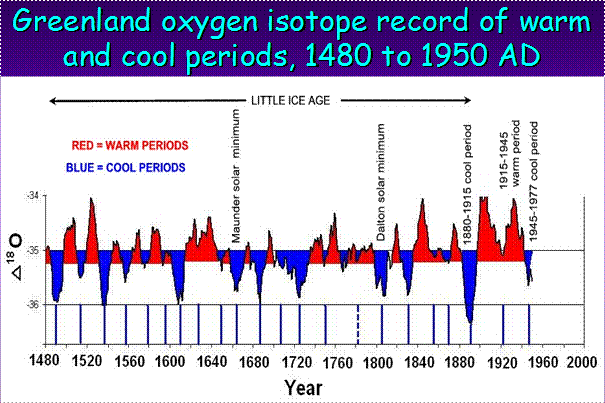
Alternating periods of warm and cooler weather have been with us as far back as our climate records go. Some of the past cooler periods have been more severe than others, like the Sporer, Maunder and Dalton Minimums. Professor Don Easterbrook has documented some 20 such cool periods over the last 500 years

Figure 1

graphic: Don Easterbrook

3. Taking just the main ocean cycles, the AMO is a 66 year cycle.

AMO peaks occurred on May 1878 and November 1944. The next peak is forecasted to occur in April 2011. The last trough occurred in January 1978, and the next trough is expected to occur in June 2044. As we see here, the length of a complete cycle is about 66.5 years.

The AMO went positive in 1994 and actually peaked in July 2010 and is now on its way down. It should go negative sometime in 2015 and remain negative till about 2048.

4. The Pacific Decadal Oscillation (PDO) has a shorter cycle of about 60 years.

graphic: digitaldiatribes.files.wordpress.com

The PDO cycle is not quite as long as AMO. Because the periods differ, their peaks and troughs will vary relative to each other. This has an interesting long-term result in terms of warming and cooling. The PDO had a peak in the function in October 1929 (about 15 years prior to AMO). The next peak occurred May 1990 (about 21 years prior to the anticipated AMO peak). The period here is about 60.5 years.

PDO has gone negative since September 2007  and will remain in negative territory probably for the next 30 years. For about 2 decades the PDO and the AMO will both be negative (but as can be seen above the amplitude of the short term variations are so large that short periods in the positive region are perfectly possible and inevitable, even while the long term average is negative or vice versa.)

5. ENSO and the efects of La Niñas and El Niños.

Returning to Matti Vooro’s article:

During negative or cool phases of PDO and AMO, there are more La Niñas than during the positive phases. This contributes to more cold winters and colder years during negative PDO. During positive or warm phases of PDO and AMO, there are significantly more El Niños. This is why there is more warming when the PDO is positive. The current negative or cool PDO and the La Niña are why we have had all the recent cold weather. The La Niña’s may have directly contributed to the Red River Flooding of 2009 and the recent flooding in Australia and Brazil.

…. The AMO is affected by ENSO cycles, especially El Ninos, so we saw a brief warming of AMO during 2010. Climate history shows that global cooling was strongest when both the PDO andAMO were both simultaneously in the negative or cool mode – like in 1964-1976 and again 1916 to 1923. The AMO cycles have been quite variable. During its last cycle it was in the negative or cool mode for 30 years (1964-1994] and its cycle seems to be related to the Meridional Overturning Circulation [MOC] and the changes in the Atlantic Thermohaline Circulation [THC]. There are a number of estimates when it will again go negative. My best estimate is about 2015 based on the most frequent past intervals of around 20 years and the cooler waters that feed the MOC from the Southern Oceans. Once it does go negative, the global temperature anomalies may drop further until about 2030, the Arctic temperature may cool further and the Arctic ice extent should increase again.

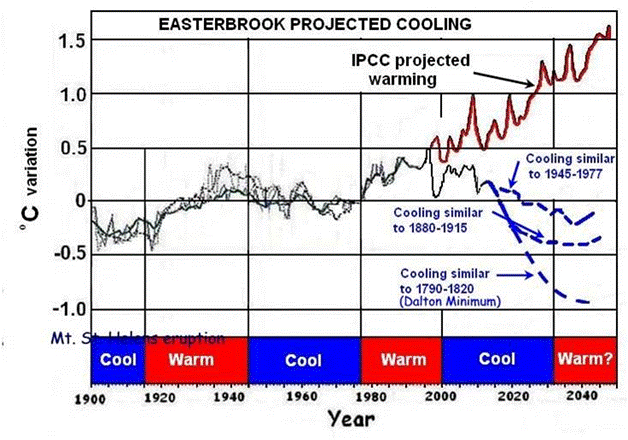
Professor Easterbrook has made a global forecast for temperature:

The IPCC projections are no longer credible but it must be borne in mind that these projections had little to do with actually bringing science to make the best forecast possible but instead were focused on poltical objectives; it seems mainly to redistribute wealth and to demonise CO2 so as to drive the carbon trading market.

That global cooling is upon us seems more and more likely and I apprehend that Easterbrooks’s lowest curve will materialise and show that the current Landscheidt minimum will be comparable to the Dalton minimum.


Cold Fusion: Another fraud or a breakthrough?

January 22, 2011

In March 1989, Stanley Pons and Martin Fleishmann claimed to have achieved cold fusion at room temperature but their experiment could not be reproduced.

File:Igloo.jpg

Cold fusion lab (igloo) under construction : image wikipedia

While cold fusion is considered highly improbable, it is not impossible and there remains a nagging suspicion (hope?) that some “miracle”, perpetual machine may suddenly appear in the most unlikely place and perhaps even outside main-stream science.

Physorg reports on another claim this time from Bologna, Italy:

Despite the intense skepticism, a small community of scientists is still investigating near-room-temperature fusion reactions. The latest news occurred last week, when Italian scientists Andrea Rossi and Sergio Focardi of the University of Bologna announced that they developed a cold fusiondevice capable of producing 12,400 W of heat power with an input of just 400 W. Last Friday, the scientists held a private invitation press conference in Bologna, attended by about 50 people, where they demonstrated what they claim is a nickel-hydrogen fusion reactor
. Further, the scientists say that the reactor is well beyond the research phase; they plan to start shipping commercial devices within the next three months and start mass production by the end of 2011.

Rossi and Focardi say that, when the atomic nuclei of nickel and hydrogen are fused in their reactor, the reaction produces copper and a large amount of energy. The reactor uses less than 1 gram of hydrogen and starts with about 1,000 W of electricity, which is reduced to 400 W after a few minutes. Every minute, the reaction can convert 292 grams of 20°C water into dry steam at about 101°C. Since raising the temperature of water by 80°C and converting it to steam requires about 12,400 W of power, the experiment provides a power gain of 12,400/400 = 31. As for costs, the scientists estimate that electricity can be generated at a cost of less than 1 cent/kWh, which is significantly less than coal or natural gas plants……….

…… Rossi and Focardi’s paper on the nuclear reactor has been rejected by peer-reviewed journals, but the scientists aren’t discouraged. They published their paper in the Journal of Nuclear Physics, an online journal founded and run by themselves, which is obviously cause for a great deal of skepticism. They say their paper was rejected because they lack a theory for how the reaction works. According to a press release in Google translate, the scientists say they cannot explain how the cold fusion is triggered, “but the presence of copper and the release of energy are witnesses.”

http://www.physorg.com/news/2011-01-italian-scientists-cold-fusion-video.html

But not everybody is dismissing this latest claim.

Steven Krivit of the New Energy Times describes why he believes that the Rossi and Focardi LENR device is probably real and is an advancement on the Piantelli process.

But there seems to be a vested interest here and I remain unconvinced.

Especially since they claim that they cannot fully explain what happens but are going to be producing “commercial units” anyway it sounds like a scam. They will probably sell some units to the gullible  before they disappear from view.

Just another fraud.

“Set a thief to catch a thief”?

January 22, 2011

Earlier posts have dealt with the case of Jatinder Ahluwalia – a pharmacologist – who was found to have deceived his colleagues and probably sabotaged other’s research whose paper published in Nature was retracted. Ahluwalia was then at University College London but is now employed at the University of East London.

Retraction Watch now points out that he has published a new paper – not on pharmacology this time but about plagiarism! The paper appears in Bioscience Education, “Students Turned Off by Turnitin? Perception of Plagiarism and Collusion by Undergraduate Bioscience Students.”

Ahluwalia and his co-author, Andrew Thompsett, did the study

to provide qualitative data on the perceptions of plagiarism and collusion of final year Pharmacology students.

That he is no longer at UCL is understandable but that he is employed in the position he has at the University of East London is less understandable – not least from the perspective of the University. East London University has a history going back to 1898 as an educational institution but only became a University in 1992. It is the 3rd largest university in London in terms of student numbers and the 18th largest in the United Kingdom. But it ranks around 108th of the UK’s 115 Universities. I have difficulty to see how this University (which clearly needs to improve its ranking) could enhance its reputation by employing Ahluwalia. But perhaps Ahluwalia is a good teacher even if his reputation as a researcher in his own field is irrevocably tarnished.

The subject of his latest publication being more a social study rather than hard-core pharmacology is also understandable. And unlike many other sociologists he may have some unique qualifications to study plagiarism.

The paper itself is somewhat negative about a particular commercial product (Turnitin) and therefore of some benefit to its competitors – and that itself rings some alarm bells.

Unfortunately for Turnitin,

The results from the pilot study suggested that students did not find Turnitin (UK) easy to use neither did they perceive it as a useful learning tool.

But some questions also arise as to the the publishing Journal’s wisdom of publishing such a study  – which could be considered  “negative advertising” – and by such an author. Especially since they say that one of their objectives is to disseminate “good practice”.  Even consumer magazines are wary of reviewing just one product in isolation without also subjecting competing products to the same tests. From their website:

Bioscience Education is an online, bi-annual electronic journal owned and published by the Centre for Bioscience. Its aims are to promote, enhance and disseminate research, good practice and innovation in tertiary level teaching and learning within the biosciences disciplines.

Set a thief to catch a thief is a well tried concept but it does require some modicum of common sense.

How many ways to add up to any number? Sequence of partition numbers found to be fractal

January 21, 2011
Ferrer partitioning diagrams showing the parti...

Ferrer partitioning diagrams: Image via Wikipedia

The sequence of partition numbers grows fast. But a general formula for calculating the number of partitions for any number n has been elusive.

Emory mathematician Ken Ono and colleagues will be announcing results today that include a finite, algebraic formula for partition numbers thanks to discovering that the sequence of partitions is fractal.

Partition numbers: In number theory, a partition of a positive integer n is a way of writing n as a sum of positive integers. Two sums that differ only in the order of their summands are considered to be the same partition. In number theory, the partition function p(n) represents the number of possible partitions of a natural number n, which is to say the number of distinct (and order independent) ways of representing n as a sum of natural numbers.

Partition numbers

A EurekAlert press release appeared today, entitled: New math theories reveal the nature of numbers and people are already whispering “Fields Medal”.  Obviously, like most press releases, this one is full of hyperbole and ridiculous sentences like, “the team was determined go beyond mere theories”, but the actual work being discussed is fascinating says one maths blogger.

PhysOrg writes:

The work of 18th-century mathematician Leonhard Euler led to the first recursive technique for computing the partition values of numbers. The method was slow, however, and impractical for large numbers. For the next 150 years, the method was only successfully implemented to compute the first 200 partition numbers. In the early 20th century, Srinivasa Ramanujan and G. H. Hardy invented the circle method, which yielded the first good approximation of the partitions for numbers beyond 200. They essentially gave up on trying to find an exact answer, and settled for an approximation.

Ramanujan also noted some strange patterns in partition numbers. In 1919 he wrote: “There appear to be corresponding properties in which the moduli are powers of 5, 7 or 11 … and no simple properties for any moduli involving primes other than these three.”

The legendary Indian mathematician died at the age of 32 before he could explain what he meant by this mysterious quote, now known as Ramanujan’s congruences.

In 1937, Hans Rademacher found an exact formula for calculating partition values. While the method was a big improvement over Euler’s exact formula, it required adding together infinitely many numbers that have infinitely many decimal places.

On Friday, Emory mathematician Ken Ono will unveil new theories that answer these famous old questions.

Ono and his research team have discovered that partition numbers behave like fractals. They have unlocked the divisibility properties of partitions, and developed a mathematical theory for “seeing” their infinitely repeatingsuperstructure. And they have devised the first finite formula to calculate the partitions of any number.

“Our work brings completely new ideas to the problems,” says Ono, who will explain the findings in a public lecture at 8 p.m. Friday on the Emory campus. “We prove that partition numbers are ‘fractal’ for every prime. These numbers, in a way we make precise, are self-similar in a shocking way. Our ‘zooming’ procedure resolves several open conjectures, and it will change how mathematicians study partitions.” …….. “We found a function, that we call P, that is like a magical oracle,” Ono says. “I can take any number, plug it into P, and instantly calculate the partitions of that number. P does not return gruesome numbers with infinitely many decimal places. It’s the finite, algebraic formula that we have all been looking for.”

Indian Environment Ministry challenges IPCC and CO2 conclusions

January 21, 2011
Cropped from image of Jairam Ramesh the Indian...

Jairam Ramesh: Image via Wikipedia

That there is little love lost between Rajendra Pachauri and the Indian Minister of Environment Jairam Ramesh is no secret. (Pachauri made the ill-advised and stupid remark about “voodoo science” regarding Ramesh and the Ministry’s claims debunking the IPCC ststements on Himalyan glaciers). Now according to the Hindustan Times the Ministry of Envirionment has produced a paper concluding that solar effects on clouds represent about half the warming effects attributed to CO2:

India has once again challenged the UN’s climate science body – the Intergovernmental Panel on Climate Change (IPCC) — through a new scientific paper. The Environment ministry sponsored paper says that human induced global warming is much less than what the R K Pachauri headed IPCC had said. The cause is reduced impact of Galactic Cosmic Rays (GCRs) on formulation of low clouds over earth in the last 150 years, says a paper by U R Rao, former chairman of Indian Space Research Organisation, released by Environment minister Jairam Ramesh. ….

Analyzing the data between 1960 and 2005, Rao found that lesser GCRs were reaching the earth due to increase in solar magnetic field and thereby leading to increase in global warming. “Consequently the contribution of increased CO2 emission to be observed global warming of 0.75 degree Celsius would only be 0.42 degree Celsius, considerably less than what predicted by IPCC,” the paper said to be published in Indian Journal Current Science had said. This is about 44 % less than what IPCC had said.

Ramesh in 2009 had released a similar scientific paper saying that the IPCC’s claim that most Himalayan glaciers will melt by 2035 was wrong. A few months later, after a review the IPCC regretted the error. If Ramesh latest bid gets globally recognition, it can alter the rules of UN run climate negotiations of 200 nations.

Impact of GCRs on global warming had been highly controversial since 1998, when Henrik Svensmark of Danish National Space Center said it was causing global warming. A decade later a joint European study debunked the claim, saying there was no co-relation. …

“I just want to expand scientific debate on impact of non-Green House Gases on climate change,” Ramesh said, when asked whether he was again challenging the IPCC. “Science is all about raising questions.”

International climate science is mainly western driven and collaborates the view of the rich world that gases such as Carbon Dioxide (CO2) are the main contributor for global warming. Any scientific work challenging the view has been debunked as work of a sceptic.

“Climate science is much more complex than attributing everything to CO2,” said Subodh Verma, climate change advisor in the Environment ministry.

And, its first impact has come from IPCC chairperson R K Pachauri, who has told the government, that impact of GCRs on global warming will be studied in depth in the fifth assessment report to be published in 2013-14. In its earlier four assessment reports, IPCC had not studied the impact of GCRs in detail.

The Global Warming establishment does not much like this paper. But they have now been reduced to claiming that everything – even directly conflicting evidence – supports the theory of man-made CO2 on global warming:

V Ramanathan of US based Scripps Institute of Oceanography at University of California said the Rao’s paper strengthens the case for greenhouse a primary driver for global warming. “The observed rapid warming trends during the last 40 years cannot be accounted for (by) the trends in GCRs,” he said, in his comments on Rao’s paper.

Science is indeed all about asking questions.

It seems to have been forgotten that anyone who  is not a sceptic deep down  is not – and can not be – a scientist.

Ships and crew safe but Sea of Okhotsk rescue suspended for bad weather

January 20, 2011

The Okhotsk saga continues: http://www.itar-tass.com/eng/level2.html?NewsID=15874433&PageNum=0

MOSCOW, January 20 (Itar-Tass) – The operation to rescue the Shore of Hope refrigerator ship and the Sodruzhestvo mother ship, ice-nipped in the Sea of Okhotsk, has been suspended as weather conditions have deteriorated, sources from the press service of the Russian Transport Ministry report.

According to the source, the operation to get the ships out of a heavy ice zone by the Admiral Makarov and the Krasin icebreakers began at 21:30 Moscow time on Wednesday.

“However, the deterioration of weather conditions (a cyclone is hovering over Sakhalin, and there is no transport connection) has suspended the active phase of the operation to get the ships out of ice,” the source said, adding that an abnormally bad weather is characterized by zero visibility, the strengthening of winds and ice compression.

Now the ships are relatively safe, and nothing threatens the crews, the sources said. As soon as weather conditions improve, the active phase will be resumed.

No “peak” gas in sight as IEA doubles estimates of gas reserves

January 20, 2011
United States shale gas plays

Image via Wikipedia

Known reserves of Natural gas were  thought to be sufficient for 60 to 120 years. Now with shale gas being produced in large quantities, the IEA has revised known reserves upwards to 250 years — and they could be further revised upwards.

Yet another scare scenario of resource depletion bites the dust!!

From the BBC:

The world may have twice as much natural gas than previously thought, according to the rich nations’ think tank the International Energy Agency (IEA). The world may have 250 years of gas usage at current levels thanks to “unconventional gas” from shale and coal beds, Anne-Sophie Corbeau, senior gas expert at the IEA told BBC News.

Estimates may even be revised upwards. Studies are underway into newly-recoverable sources, Ms Corbeau said. But she stressed that the totals were highly uncertain, and depended on price, technology and the accessibility of supplies.

“The gas story is huge,” she told BBC News. “A few years ago the United States was ready to import gas. In 2009 it had become the world’s biggest gas producer. This is phenomenal, unbelievable.” The US achieved the change through a technological breakthrough in which firms found a way of using tiny explosions to free gas previously trapped in a common rock – shale.

Miss Corbeau said other nations were now rushing to replicate the US success by exploiting gas currently trapped in various types of rock where it was thought to be impossible to access.

She said conventional natural gas supplies were assured for 60 years – with maybe a further 60 years if engineers could get to other supplies. She admitted there is great uncertainly about how much unconventional gas is possible to exploit, but said the best estimate is that new sources will stretch gas supplies to 250 years at current levels.

“The resources are really huge,” she said.

“We probably have 920 trillion cubic metres – that is more than 300 times the current annual demand for gas. “Not all of this will be recoverable, but any country that develops new gas supplies will have a global impact on gas availability and price, as gas markets are all inter-connected.”