Mount Bromo in the Tengger Caldera ejects ash cloud – disrupts Bali flights

January 28, 2011

From AFP:

JAKARTA — Several international flights to and from the resort island of Bali were cancelled or diverted Thursday to avoid dangerous ash spewing from an Indonesian volcano, officials said.

Ash from rumbling Mount Bromo, a popular attraction in East Java province, had spread to the island popular with foreign tourists and surfers.

“We received information from Darwin that the ash from Bromo has reached 18,000 feet (5,500 metres) in the southeast direction and has affected some parts of Bali,” transport ministry spokesman Bambang Ervan told AFP.

Mount Bromo (Indonesian: Gunung Bromo), is an active volcano and part of the Tengger massif, in East Java,Indonesia. At 2,329 metres (7,641 ft) it is not the highest peak of the massif, but is the most well known. The volcano belongs to the Bromo Tengger Semeru National Park. The name of Bromo is derived from the Javanese pronunciation of Brahma, the Hindu god of creation.

File:Mtbromo.jpg

The Tengger massif in Java at sunrise, showing the volcanoes Mt. Bromo (large foreground crater, smoking) and Mt. Semeru (background, smoking) : Wikipedia

In recent times Mt. Bromo erupted in 2004 (2 deaths) and also in November 2010 when Mt. Merapi was erupting.

Last week saw eruptions also from Anak Krakatau. Anak Krakatau has grown at an average rate of five inches (13 cm) per week since the 1950s. This equates to an average growth of 6.8 metres per year. The island is still active, with its most recent eruptive episode having begun in 1994.

European commission extends carbon market freeze indefinitely

January 27, 2011

And about time too.

A raft of countries (including Japan, Australia, Canada and the United States) have already shelved cap and trade schemes.

Of course the fundamental fraud that is carbon trading goes much deeper than just the  recent thefts of credits. Hopefully it will never be revived!

image wattsupwiththat.com

The Guardian:

The European commission’s emergency suspension last week of trading in carbon allowances to put a halt to rampant theft of credits by hackers has been extended indefinitely until countries can prove their systems are protected from further fraud.

While the suspension had been expected to end last night, Brussels now says that the freeze in trades had been imposed to give the commission executive some breathing space to figure out what to do.

“The suspension last week was only a transitional measure to give the commission and member states the time to assess the situation and decide the way forward,” the commission’s climate spokeswoman, Maria Kokkonen, said. “Okay, this hurts, but it must hurt in order to make things more secure, more robust. Evolution through crisis.”

A total of 30 countries that participate in the Emissions Trading Scheme, Europe’s flagship climate change policy, must now send assessments of the situation performed by independent monitors. On 19 January, the commission suspended “spot” trading in allowances after up to 2m permits worth around €30m were stolen by computer hackers. Brussels said that half the participating countries were not sufficiently secure. Permits went missing in Austria, the Czech Republic and Greece.

The never ending wonders of Carbon

January 27, 2011

Not just all life as we know it and coal and diamonds and graphite and carbon nanotubes and now the new wonder-world of  graphene.

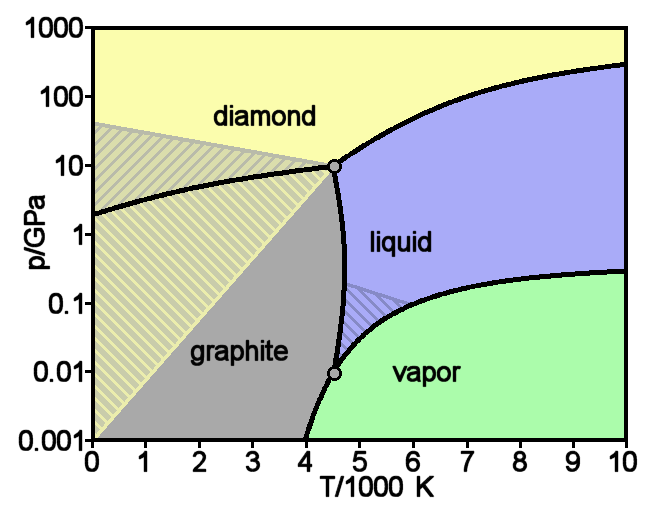
Carbon also has the highest melting and sublimation point of all elements. At atmospheric pressure it has no melting point as its triple point is at 10.8 ± 0.2 MPa and 4600 ± 300 K, so it sublimates at about 3900 K.

File:Carbon basic phase diagram.png

Theoretical phase diagram of carbon: Wikipedia

Evidence is mounting that a new crystal form of carbon – body-centered tetragonal (bct) – something between diamond and graphene must exist. Simulations show that it must. It is now up to experimentalists to prove it.

Image: From "Ab Initio study of the formation of transparent carbon under pressure," by Xiang-Feng Zhou et al., in Physical Review B, Vol. 82, No. 13; October 29, 2010

From Scientific American:

Now evidence is mounting that there is yet another crystal structure to add to carbon’s catalogue of wonders: a material that could find applications in mechanical components whose hardness varies depending on the pressure to which they are exposed.

This new type of carbon was first observed in 2003, when researchers placed graphite, a stacking of chicken-wire-shaped networks of carbon atoms, under high pressure at room temperature. Under this “cold” compression, the graphite began to assume a hybrid form, between that of graphene and of diamond, but its exact nature was unknown.

Two computer simulation studies now suggest that cold-compressed graphite contains crystals of a structure called body-centered tetragonal, or bct, in addition to another type called M carbon. In bct, groups of four atoms are arranged in a square. The squares are stacked in an offset manner, and each square forms chemical bonds with four squares in the layers above and four below. A team led by Hui-Tian Wang of Nankai University in Tianjin, China, showed that during cold compression the transition to bct carbon results in a release of energy, which means it is likely to happen in the real world.

A Japanese and American team also conducted a simulation in which bct carbon produced x-ray patterns similar to those seen in the 2003 study. …. Whether bct carbon exists or can be synthesized in its pure form “is still a task for experimentalists to test.” 

Vladimir Nabokov vindicated – about butterflies

January 27, 2011
Polyommatus icarus 5

Polyommatus blue: Image via Wikipedia

Vladimir Nabokov (yes, he of Lolita fame) lived in Cambridge, Massachusets from 1942 to 1948 and while teaching at Wellesley he was curator of lepidoptery at Harvard University’s Museum of Comparative Zoology. His career in entomology was almost as distinguished – but not as lucrative – as his career in literature. In his spare time he composed chess problems. But his work in all these fields was characterised by his “love of detail and contemplation and symmetry”.

In 1945 he published a theory of butterfly evolution claiming that butterflies came to the New World in five waves of migration, through Asia across the Bering Strait into Alaska and then southward through North and then South America (much as humans migrated). Other butterfly experts scoffed at the idea. Nabokov’s theory was not taken seriously until after his death in 1977. Then, in the past decade, gene-sequencing technology finds that Nabokov was right all along and ironically during his life  “Nabokov never accepted that genetics or the counting of chromosomes could be a valid way to distinguish species of insects, and relied on the traditional (for lepidopterists) microscopic comparison of their genitalia”.

Now his theory stands vindicated by work  reported in a new paper in the Proceedings B of the Royal Society:

Phylogeny and palaeoecology of Polyommatus blue butterflies show Beringia was a climate-regulated gateway to the New World by Roger Vila, Charles D. Bell, Richard Macniven, Benjamin Goldman-Huertas, Richard H. Ree, Charles R. Marshall, Zsolt Bálint, Kurt Johnson, Dubi Benyamini and Naomi E. Pierce  doi:10.1098/rspb.2010.2213 Proc. R. Soc. B

Abstract: ….. By integrating molecular phylogeny, historical biogeography and palaeoecology, we test a bold hypothesis proposed by Vladimir Nabokov regarding the origin of Neotropical Polyommatus blue butterflies, and show that Beringia has served as a biological corridor for the dispersal of these insects from Asia into the New World. We present a novel method to estimate ancestral temperature tolerances using distribution range limits of extant organisms, and find that climatic conditions in Beringia acted as a decisive filter in determining which taxa crossed into the New World during five separate invasions over the past 11 Myr. Our results reveal a marked effect of the Miocene–Pleistocene global cooling, and demonstrate that palaeoclimatic conditions left a strong signal on the ecology of present-day taxa in the New World. …..

From Neatorama:

There were several plausible hypotheses for how the butterflies might have evolved. They might have evolved in the Amazon, with the rising Andes fragmenting their populations. If that were true, the species would be closely related to one another.

But that is not what Dr. Pierce found. Instead, she and her colleagues found that the New World species shared a common ancestor that lived about 10 million years ago. But many New World species were more closely related to Old World butterflies than to their neighbors. Dr. Pierce and her colleagues concluded that five waves of butterflies came from Asia to the New World — just as Nabokov had speculated.

“By God, he got every one right,” Dr. Pierce said. “I couldn’t get over it — I was blown away.”

Dr. Pierce and her colleagues also investigated Nabokov’s idea that the butterflies had come over the Bering Strait. The land surrounding the strait was relatively warm 10 million years ago, and has been chilling steadily ever since. Dr. Pierce and her colleagues found that the first lineage of Polyommatus blues that made the journey could survive a temperature range that matched the Bering climate of 10 million years ago. The lineages that came later are more cold-hardy, each with a temperature range matching the falling temperatures.


Measurement standards which can no longer be touched or seen or felt….

January 27, 2011

I have a sense of loss.

The Royal Society was home to a conference on 24th and 25th to consider how to bring the kilogram – the last of the seven base units of measurement – into line with the other six. This meeting was to discuss proposals of defining the kilogram in terms of the “fundamental” constants and to move away from using a lump of metal stored very carefully as the standard of mass.  The first General Conference on Weights and Measures was held in 1889 and meets every 4 years. The 24th Conference will be held in October this year and will table a proposal for the new definition of the kilogram. Then by the 25th Conference in 2015 the new definition may be adopted.

And when this happens there will no longer be any standard of measure left which can be seen or touched or felt. There will no longer be a King’s foot to refer to or an “Iron Ulna of our Lord the King” to signify a yard or some standard stones stored carefully to represent mass. The Mètre des Archives gave way to the International Prototype Metre.  The Imperial Standard Yard like the IPM was the distance between markings on specified bars of metal carefully stored. By 2015 all these standard definitions may be based only on the “fundamental constants” of nature (in the hope that they will truly remain constant across the reaches of space and time).

The International System of Units (SI) defines seven units of measure as a basic set from which all other SI units arederived. These SI base units and their physical quantities are:

  • metre for length
  • kilogram for mass
  • second for time
  • ampere for electric current
  • kelvin for temperature
  • candela for luminous intensity
  • mole for the amount of substance.
The seven SI base units and the interdependency of their definitions: for example

The seven SI base units and the interdependency of their definitions: for example

There used to be a time when measurements could be easily related to. Length and mass (weight) and light and temperature were all given units which were of practical and everyday use.

A candle-power was the light from one candle, a foot was a foot, an inch was either the width of your thumb or the distance from the tip of your index finger to the first knuckle, and a grain was the mass of a barley-corn. Water froze at zero °C and it boiled at one hundred divisions higher at 100 °C. Alternatively Daniel Fahrenheit set zero ° F to be the coldest stable temperature he could reach with a particular brine solution (ice, water and ammonium chloride which is a frigorific mixture) and he set 100 °F to the temperature of his wife’s armpit. Later others set the boiling point of water  to be exactly 180 divisions higher than the zero at 212 °F. This resulted in normal body temperature now becoming 98.6 °F instead of the 100. The point at which water freezes then happened to be 32 divisions higher than the zero. A comfortable temperature – inside or out – was 80 °F while 60 °F was chilly and 100 °F was on a hot day. A year was set by the seasons and the sun and the month was set by the moon. An average day was set by the sun rising and setting and this day was divided up – arbitrarily – into days and nights of 12 parts each and each part was further divided into 60 and 60 again – probably first by the Babylonians. It is only in our times that we have needed to split the second and anachronistically these further subdivisions of the second follow the metric system with milliseconds and microseconds and nanoseconds. A mile used to be 1000 paces (2 steps with a pace being a left step and a right step) of a standard Roman legionary.

But science and industry have moved on. Machines and instruments and medicine and electronics and computers and going to the moon can no longer manage with the old rules and measures of  everyday living.

From the purpose of the meeting at the  Royal Society:

From the origins of the metric system, when the metre was a fraction of the arc of the Paris meridian and the kilogram the weight of a cubic decimetre of water, the ultimate goal has been a system of measurement based on invariant quantities of nature. After more than 200 years we are now within reach of achieving this. While the kilogram is still defined as the mass of a Pt-Ir cylinder kept in a vault in Sèvres, serious plans now exist to redefine the kilogram by fixing the numerical value of the Planck constant h; and the ampere, kelvin and mole by fixed numerical values for e, k and NA. With the metre already being defined by the speed of light and the second by an atomic microwave transition, but likely soon to be redefined by an optical transition of much higher frequency, we shall have at last achieved what the savants of the 18th century had sought.

Today all the units except the kilogram are defined by natural constants:

  1. The metre is the length of the path travelled by light in vacuum during a time interval of 1/299 792 458 of a second with the speed of light in a vacuum being the natural constant. (And I can’t help wondering if this will remain constant under changing gravity conditions or the changing state of the expanding – or contracting – universe).
  2. The second is the duration of 9 192 631 770 periods of the radiation corresponding to the transition between the two hyperfine levels of the ground state of the caesium 133 atom at rest at a temperature of 0 K.
  3. The ampere is that constant current which, if maintained in two straight parallel conductors of infinite length, of negligible circular cross-section, and placed 1 metre apart in vacuum, would produce between these conductors a force equal to 2 × 10⁻⁷newton per metre of length.
  4. The kelvin, unit of thermodynamic temperature, is the fraction 1/273.16 of the thermodynamic temperature of thetriple point of water having the isotopic composition defined exactly by the following amount of substance ratios: 0.000 155 76 mole of2H per mole of 1H, 0.000 379 9 mole of 17O per mole of 16O, and0.002 005 2 mole of 18O per mole of 16O.
  5. The mole is the amount of substance of a system which contains as many elementary entities as there are atoms in 0.012 kilogram of carbon 12 where unbound atoms of carbon 12, at rest and in their ground state, are referred to.
  6. The candela is the luminous intensity, in a given direction, of a source that emits monochromatic radiation of frequency 540 × 1012 hertz and that has a radiant intensity in that direction of 1/683 watt per steradian.

The plan is to base the kilogram on the Planck constant .

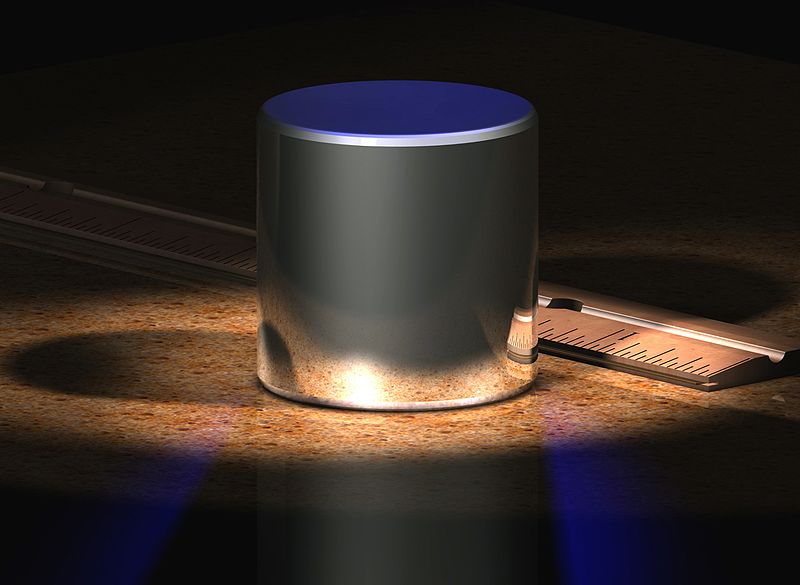
File:CGKilogram.jpg

A computer-generated image of the International Prototype kilogram (IPK): Wikipedia

Physics World reports

In the current system, the kilogram, ampere, kelvin and the mole are all linked to exact numerical values of the mass of the international prototype kilogram in Paris, the permeability of the vacuum, the triple-point temperature of water, and to the molar-mass of carbon-12 respectively. The plan is to change all that so that these four units are linked to exact numerical values of the Planck constant, the charge of the electron, the Boltzmann constant and to the Avogadro constant respectively.

All of this is no doubt a great advance and necessary but I have difficulty to relate to the new definitions. I cannot invoke any image of 9 192 631 770 periods of a radiation or the 299 792 458th part of a second and I feel that something is being lost……

DAVOS 2011 kicks-off today: 35 heads of state, 2500 delegates

January 26, 2011

http://www.weforum.org/

wef

35 heads of state and over 2,500 delegates are expected to attend.

If the WEF’s guidelines are followed there will be at least one woman for every four men!!

http://blogs.ft.com/rachmanblog/2011/01/davos-trying-to-solve-the-worlds-problems-in-four-days/

The WEF Chinese delegation will total over 60 people this year and the Indian will again be significant with 130 delegates. India will be launching an India Inclusive campaign to stress the benefits of economic progress and the growth of a vibrant middle-class and average incomes, while minimising the political impact of increasing disparities in wealth, as the new entrepreneurs of India globalise their operations – Tata, Ambanis, Mittals, Mahindra, Bhartis, Godrejs are all names we are becoming increasingly familiar with on a world stage. Chinese participation is up fivefold in the last decade, Indian up fourfold.
The G20 is very well represented too. All countries have president/prime minister or ministerial representation here except Argentina, with the latter’s central banker as its representative.

Euro bail-out bond: Asia to the rescue with record demand

January 26, 2011

The Telegraph reports:

Asian and Middle-East investors have thronged to buy the first issue of AAA-rated bonds by the eurozone’s new bail-out fund, marking a key moment in the evolution of Europe’s monetary union.

The auction of €5bn (£4.3bn) of five-year bonds to fund the first stage of the Irish loan package was nine times subscribed, reflecting appetite for bonds ranked with core German or French debt but offering higher returns. The yield was 2.89pc, compared with 2.31pc for Bunds.

The outcome was not in doubt after Japan said it would buy 20pc of this month’s total issue by the European Financial Stability Facility (EFSF), and China emerged as a white knight for EMU debt. Asian investors bought 38pc of the issue.

“It is the biggest order book ever. We will check before notifying the Guinness Book of Records but nobody can remember anything like that in the world,” said Klaus Regling, head of the EFSF. Ralf Umlauf from Helaba said the auction was “a step in the direction of a eurobond”.

The demand came from over 500 investors and totalled over $ 60 billion (about €45 billion).


Once again: Qantas + RR engine + B747 = return to base

January 26, 2011

The Rolls Royce Engine Syndrome (RES) strikes again.

This time – one very thirsty engine

Qantas

Another drama ... A Qantas 747 was forced to return to Bangkok yesterday. image: http://www.news.com.au

Flight QF2 carrying 352 passengers was about 30 minutes into its flight from Bangkok International Airport when one of its engines began “consuming fuel more quickly than normal” a Qantas spokesman said.
It was forced to return to Bangkok where it landed safely about 7pm local time (11pm AEST). Affected passengers are expected to spend a second night in temporary accommodation with Qantas scrambling to send a replacement engine from Sydney for the troubled Boeing 747 today.
“As far as possible we will try and get passengers who need to return to Sydney urgently on other flights but that will be dependent on availability on other airlines,” the spokesman said.

“It was not actually an engine failure, (the pilots) did not shut the engine down they just reduced the thrust.” However one passenger on the flight says the engine “blew”.

The spokesman said there were no other replacement Qantas aircraft available in Bangkok.

Read more: http://www.news.com.au/travel/news/another-engine-problem-for-qantas/story-e6frfq80-1225994833407#ixzz1C7bLqCgl

The strange and murky case of Silvia Bulfone-Paus: 12 retractions so far …..

January 25, 2011

Twelve papers where Sylvia Bulfone-Paus was the senior author have been retracted.

Silvia Bulfone-Paus: image retraction watch

That itself is sufficiently unusual and remarkable. But the story seems to go back a long way. Retraction Watch has been following the story.

In September 2010 Nature carried the story of a formal investigation which had started in July 2010 of scientific misconduct being carried out at the Research Center Borstel in Germany (Forschungszentrum Borstel, Leibniz Gemeinschaft, Deutsche Forschungsgemeinschaft, Medizinischen Fakultäten der Universitäten Lübeck und Kiel). The story however was not about the investigation but about a destabilising influence:

But events around such an investigation in Germany have taken a troubling and damaging turn from such good practice in the past few months. An unknown agitator using the presumed pseudonym Marco Berns is engaged in an e-mail and Internet offensive against two biomedical researchers whom he accuses of scientific fraud.

Berns’s libellous messages are targeted at dermatologist Ralf Paus and immunologist Silvia Bulfone-Paus, a married couple who both hold joint positions at the University of Manchester, UK, and the University of Lübeck, Germany.

The trial-by-Internet is disturbing a formal investigation, organized by the Research Center Borstel in Germany and begun in July, into some of the pair’s publications.

“Marco Berns” and his accomplice (or alter ego?) “Martin Frost” were posting articles on the internet since at least the end of 2009 and had also been subjected to “cease and desist” demands from lawyers representing the Research Centre. Some of these articles questioned Sylvia Bulfone-Pause’s use of academic titles among other wrong doings.

It does seem that the formal investigation started in July 2010 partly – if not wholly – because of the allegations which had been made by Berns and Frost in 2009. Formally the reason for the investigation was that Bulfone-Pause herself had reported some manipulation of data in papers published about research carried out under her supervision but how and when such manipulation had been discovered is not very clear.

In any case the investigation was completed and the results were published by the Research Centre on 2nd December 2010.

The Commission concludes that scientific misconduct (has ocurred) within the laboratory group “Immunobiology” for years. In 6 out of 8 of the analyzed publications in which, the two former research assistants, Dr. E. Bulanova and Dr. V. Budagian, recorded as first authors, manipulation of images found that the manipulation of the reproduction of scientific results. Data corruption within the meaning of “independent inventors” of results are not available. Given the primary responsibility of the first authors in data collection and data presentation in a scientific publication, these two first authors of these publications (bear the) main responsibility for scientific misconduct.

The blame was put squarely on Drs. Bulanova and Budagian – both Russian – and as their supervisor, Bulfone-Paus received a firm slap on the wrist:

The 6  publications complained of (were) produced under the senior authorship of Prof. Dr. Bulfone-Paus………  The Commission considers that this a lack of supervision which must be expected from the senior author / group leader, even if the first author of the offending publications are experienced scientists. The senior author / research group leader, therefore, carries a key responsibility for the scientific wrongdoings within their work group.

Nature reported:

An external investigation, launched in July and chaired by Werner Seeger, a biomedical researcher at the University of Giessen, Germany, found that two former postdocs with the centre’s immunology group were guilty of using pictures of protein blots from unrelated experiments to support their findings on signalling in cells involved in allergic reactions such as asthma. The pair’s supervisor, Silvia Bulfone-Paus, who chairs the centre’s immunology and cell biology department, bears “substantial responsibility” for the manipulations, the committee found, but added that they found no evidence of data fabrication.

The three Directors of the Research Centre are Prof. Dr. Dr. S. Bulfone-Paus, Prof. Dr. U. Schaible and Prof. Dr. P. Zabe. And the elusive Martin Frost continued his writings implying that the Russian scientists could actually just be scapegoats for the more senior authors involved and that some of their wrongdoing could be traced back to 1999!!

Now the six retractions have grown to be 12 papers so far.

This story is not over yet……..

Another perversion of science: Confirmation bias in the name of global warming dogma is also scientific misconduct

January 25, 2011

A new paper has been published in Ecology Letters

Ran Nathan, Nir Horvitz, Yanping He, Anna Kuparinen, Frank M. Schurr, Gabriel G. Katul. Spread of North American wind-dispersed trees in future environmentsEcology Letters, 2011; DOI: 10.1111/j.1461-0248.2010.01573.

In this paper the authors have assumed that climate change will cause changes to CO2 concentration and wind speed. They have assumed also that increased CO2 will “increase fecundity and advance maturation”. They have then modelled the spread of 12 species as a function of wind speed.

So far so good – they have actually modelled only the effect of wind speed  which they assume will reduce due to climate change.

Their results basically showed no effect of wind speed:

“Future spread is predicted to be faster if atmospheric CO2 enrichment would increase fecundity and advance maturation, irrespective of the projected changes in mean surface windspeed”.

And now comes the perversion!

From their fundamental conclusion that wind speed has no effect and that therefore any CO2 increase resulting from climate change will enhance the spread of the trees, they invoke “expected” effects to deny what they have just shown:

“Yet, for only a few species, predicted wind-driven spread will match future climate changes, conditioned on seed abscission occurring only in strong winds and environmental conditions favouring high survival of the farthest-dispersed seeds. Because such conditions are unlikely, North American wind-dispersed trees are expected to lag behind the projected climate range shift.”

This final conclusion is based on absolutely nothing  and their modelling showed nothing and yet this paper was accepted for publication. I have no problem that a result showing “no effect of wind speed” be published but suspect that it needed the nonsense, speculative conclusion to comply with current dogma.

Science Daily then produces the headline: Climate Change Threatens Many Tree Species

when the reality is

This study Shows No Effect of Wind Speed But Yet We Believe that Climate Change Threatens Many Tree Species

“Our research indicates that the natural wind-driven spread of many species of trees will increase, but will occur at a significantly lower pace than that which will be required to cope with the changes in surface temperature,” said Prof. Nathan. “This will raise extinction risk of many tree populations because they will not be able to track the shift in their natural habitats which currently supply them with favorable conditions for establishment and reproduction. As a result, the composition of different tree species in future forests is expected to change and their areas might be reduced, the goods and services that these forests provide for man might be harmed, and wide-ranging steps will have to be taken to ensure seed dispersal in a controlled, directed manner.”

Whether the perversion is by the authors themselves anticipating what is needed to get a paper published or whether it is due to pressure from the Journal Ecology Letters or by their referees is unclear.

Abstract:

Despite ample research, understanding plant spread and predicting their ability to track projected climate changes remain a formidable challenge to be confronted. We modelled the spread of North American wind-dispersed trees in current and future (c. 2060) conditions, accounting for variation in 10 key dispersal, demographic and environmental factors affecting population spread. Predicted spread rates vary substantially among 12 study species, primarily due to inter-specific variation in maturation age, fecundity and seed terminal velocity. Future spread is predicted to be faster if atmospheric CO2 enrichment would increase fecundity and advance maturation, irrespective of the projected changes in mean surface windspeed. Yet, for only a few species, predicted wind-driven spread will match future climate changes, conditioned on seed abscission occurring only in strong winds and environmental conditions favouring high survival of the farthest-dispersed seeds. Because such conditions are unlikely, North American wind-dispersed trees are expected to lag behind the projected climate range shift.

In essence this paper is only based on belief and the results actually obtained are denied. It seems to me that denying or twisting or “moulding” results actually obtained to fit pre-conceived notions is not just a case of confirmation bias but comes very close to scientific misconduct.