Tasting Sour – Add a dash of protons

November 26, 2010
Schematic drawing of a taste bud

Taste bud: image via Wikipedia

Each taste bud on human or animal tongues contain around 50 receptor cells. Each of the receptor cells then reacts to one of the 5 primary tastessour and salty are detected with ion channels while sweet, bitter and umami (savoury) are detected by G protein coupled receptors. There is some debate as to whether there is a sixth primary taste that distinguishes fat content. At one time it was thought that different parts of the tongue responded to different tastes but it is now clear that all tastes are detected by all parts of the tongue.

New research has studied the mechanism by which sour is detected.

Rui B. Chang, Hang Waters, Emily R. Liman: A proton current drives action potentials in genetically identified sour taste cellsProceedings of the National Academy of Sciences, 2010; DOI:10.1073/pnas.1013664107

Science Daily has the story:

Neurobiology researchers at the University of Southern California have made a surprising discovery about how some cells respond to sour tastes.

Sour is the sensation evoked by substances that are acidic, such as lemons and pickles. The more acidic the substance, the more sour the taste. Acids release protons. How protons activate the taste system had not been understood. The USC team expected to find protons from acids binding to the outside of the cell and opening a pore in the membrane that would allow sodium to enter the cell. Sodium’s entry would send an electrical response to the brain, announcing the sensation that we perceive as sour.

Instead, the researchers found that the protons were entering the cell and causing the electrical response directly.

The finding is to be published in the Proceedings of the National Academy of Sciences (PNAS). “In order to understand how sour works, we need to understand how the cells that are responsive to sour detect the protons,” said senior author Emily Liman, associate professor of neurobiology in the USC College of Letters, Arts and Sciences.

“In the past, it’s been difficult to address this question because the taste buds on the tongue are heterogeneous. Among the 50 or so cells in each taste bud there are cells responding to each of the five tastes. But if we want to know how sour works, we need to measure activity specifically in the sour sensitive taste cells and determine what is special about them that allows them to respond to protons.”

Liman and her team bred genetically modified mice and marked their sour cells with a yellow florescent protein. Then they recorded the electrical responses from just those cells to protons. The ability to sense protons with a mechanism that does not rely on sodium has important implications for how different tastes interact, Liman speculates. “This mechanism is very appropriate for the taste system because we can eat something that has a lot of protons and not much sodium or other ions, and the taste system will still be able to detect sour,” she said. “It makes sense that nature would have built a taste cell like this, so as not to confuse salty with sour.”

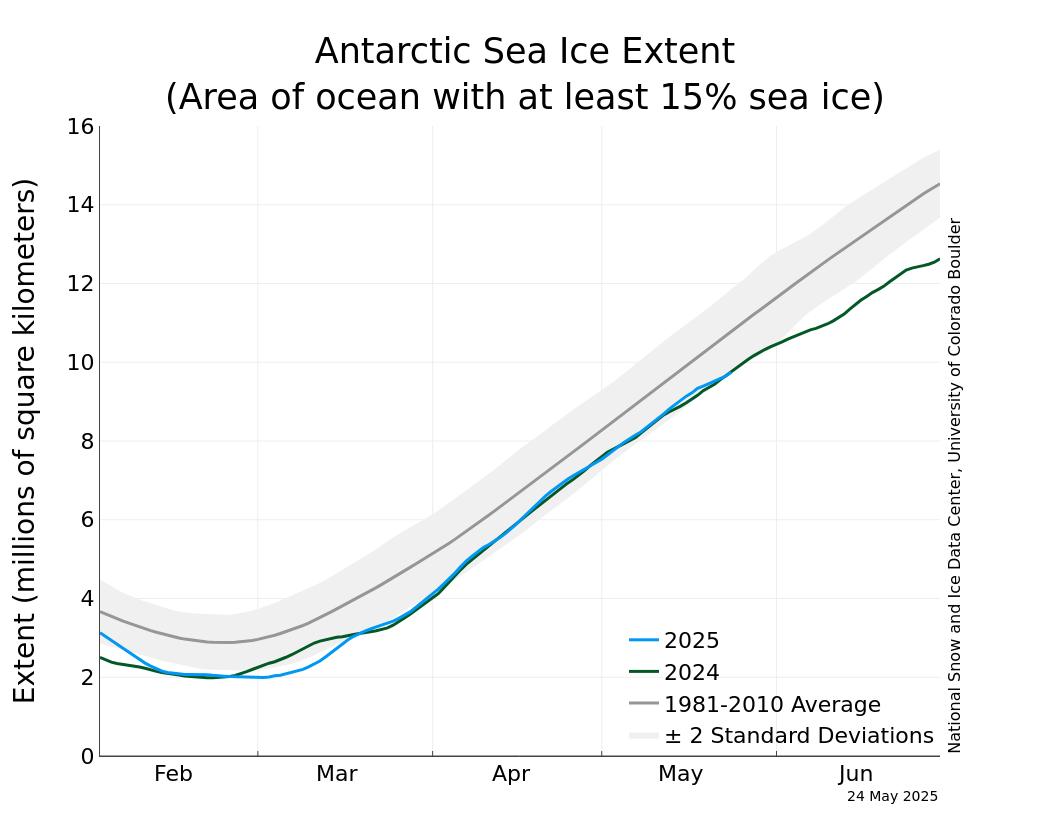
Antarctic sea ice extent almost 3 SD’s higher than “average”

November 25, 2010

Source:

http://nsidc.org/data/seaice_index/images/daily_images/S_stddev_timeseries.png

The Southern Hemisphere is coming into summer but seems significantly cooler (and wetter in Australia) than usual.

The ice extent in the Antarctic is reducing much slower than normally and currently the sea ice extent is about 1.3 million sq. km or 9%  or 3 Standard Deviations higher than the 1979 – 2000 average.

The Pacific Oscillation – or La Nina – is probably responsible.

Boeing 787 Dreamliner further delayed to fix electrical problems

November 25, 2010
2nd Boeing 787 First Flight

2nd Boeing 787 first flight: Image via Wikipedia

Flightblogger reports:

In the 15 days since ZA002, Boeing’s second of six 787 flight test aircraft, suffered a fire in its aft electrical equipment bay, forcing a fleet-wide halt in certification testing, the airframer is days, if not hours, away from releasing its findings of its investigation and disclosing the impact to the aircraft’s first delivery, say company and industry sources.

An additional delay to the 787’s entry into service with All Nippon Airways is now a virtual certainty, the length of that delay, however, is yet unknown.
While some analysts have suggested the 787’s first delivery could slip to 2012, an additional delay of more than nine months, Boeing’s previous six delays have never shifted the schedule more than six months at a time. A six month slide beyond today’s February 2011 plan would place handover to ANA around August of 2011, more than three years after its original target.

The fire, which happened while on approach to Laredo, Texas, and its root cause, revealed an Achillies heel in the 787’s electrical system that must be resolved before the Dreamliner can enter service.

Boeing says its first 787 delivery will slide due to software and minor hardware changes to the electrical system, an assessment the company says will be completed within “the next few weeks.”

The airframer needs to implement changes to the software that manages and protect power distribution on the aircraft, as well as a minor hardware change to the P100 distribution panel to prevent foreign object debris (FOD) ingestion.

“We have successfully simulated key aspects of the on-board event in our laboratory and are moving forward with developing design fixes,” says 787 vice president and general manager Scott Fancher

Boeing says foreign debris “most likely” caused the November 9 fire aboard ZA002 that has halted 787 certification operations.

Lowest November temperature since 1995, negative NAO drives frigid polar air over Sweden

November 25, 2010

Last night the temperature in Northern Sweden dropped to -37 Celsius, the coldest temperature recorded for a November day since 1995.

Bitter winter on the way: expert

24th November 2010 - Photo Fredrik Sandberg / Scanpix


“This year’s winter can be just as cold and snowy as last year. Now, as then, there is a weather phenomenon that causes cold air from the polar regions to plummet over us”,

writes the Svenska Dagbladet

The North Atlantic Oscillation is in a negative phase (NAO-).Before last year’s winter this had not occurred in years. The default mode instead was of the NAO  in a positive phase with the warm southwest winds, which resulted in mild, almost snow-free winters in northern Europe.

“Now it looks like last winter. If it continues, it means bitter cold. But you never know when the weather turns, “said meteorologist and researcher Per Kållberg at SMHI to Sydsvenskan. Meteorologists around the world are now discussing if the negative phase will continue. It started in December 2009 and has persisted since then, which is the longest period in over 40 years. Nikkaluokta in northern Lapland had  minus 36.6 degrees yesterday – the season’s lowest temperature so far, according to SMHI. It is also the lowest November temperature in Sweden since 1995.

The bitterly cold and long winter last year followed by the early start to this winter is, of course,  only weather – not climate.

But I expect in Cancun next week all the “believers” will be chanting their mantra of 2010 being a very warm year. Common sense will be notably absent of course.


Haiti cholera death toll revised up to 2,000, elections this weekend

November 25, 2010

The UN has has released revised information about the cholera outbreak in Haiti. What they are reporting now is what others were reporting already last week:

http://www.un.org/apps/news/story.asp?NewsID=36853&Cr=haiti&Cr1=

A baby and other patients suffering from acute diarrhoea lie on the floor of St. Nicholas Hospital in Haiti: photo UN

The number of reported cases of cholera in Haiti is now approaching 50,000, but health experts have cautioned that the figure could be higher because data on the epidemic has not been received from some rural communities, a United Nations relief official said today. Nigel Fisher, the UN Humanitarian Coordinator for Haiti, said that epidemiologists in the Pan-American Health Organization (PAHO) – the regional arm of the World Health Organization (WHO) – estimate that the number of cases could be as high as 70,000.

The experts have said that the disease might have claimed as many as 2,000 people, with some fatalities in remote areas going unreported. Speaking via a video link from the capital, Port-au-Prince, Mr. Fisher told a news conference in New York that PAHO epidemiologists have also revised their projections of the spread of the disease and now anticipate that cases could rise to 200,000 over the next three months. The experts had earlier estimated that the number of cases could rise to that figure in six months.

“This epidemic is moving faster,” Mr. Fisher said.

Meanwhile, general elections will proceed on Sunday as planned, despite the cholera outbreak and the recent streets protests in the country, Edmond Mulet, the Special Representative of the Secretary-General and head of the UN Stabilization Mission in Haiti (MINUSTAH), told the same press briefing.

Operational Biosurveillance had reported similar figures last week and now says:

  • In some areas of Haiti, we have confirmation that in-patient statistics are under-reported by as much as 400%. In many areas of Haiti, we are documenting outbreaks that are not being accounted for in the official statistics.  We therefore estimate the upper bound of estimated total (subclinical and clinically apparent) case counts to be nearly 375,000.
  • It is likely the elections will facilitate the spread of the epidemic due to population mixing.

“Be Afraid”:15,000 gather for Cancun jamboree, down from Copenhagen’s 45,000

November 24, 2010
The cub scout salute

"Be Afraid" :Image by anyjazz65 via Flickr

After the cold shower at Copenhagen, the UN Climate groupies are gathering in 5 days at Cancun in Mexico for their next jamboree. Unlike Baden-Powell’s scouts whose motto was to “Be Prepared” the motto in Cancun is “Be Afraid” and their symbol is the Hockey Stick. But the number of attendees at 15,000 is expected to be just a third of the 45,000 at Copenhagen.

In the run-up to Cancun, the public relations exercises have started. The scare stories are proliferating. The objective is to strike fear into the hearts of the non-believers. They are couched in scientific terms but they all have one simple message:

“Be Afraid”

It is perhaps worth noting that in the history of mankind not one of the soothsayers’ prophecies of doom have yet come to pass. In the scientific age and since Malthus, prophecies of impending catastrophe have always been coated with the semblance of rationality and scientific rigour. Whether prognosticating catastrophe due to population growth or due to depletion of resources ( food, oil, coal, metals, animals, plants,……..), they have all been wrong. But in almost every case a few people have gained economic advantage by spreading fear. That climate change happens and will continue to happen is both inevitable and obvious. The idea that man can have more than a very minor part to play in climate – whether intentionally or unintentionally – is a more recent phenomenon of the last 100 years. Before that catastrophes were caused by angry or avenging Gods. Change was then effected by assuaging the angry Gods or by mobilising some other more beneficial God. Of course there were certain individuals – priests, shamans, witch-doctors and their favoured Kings, chieftains and merchants – who always claimed special understanding of the problems and exclusive access to the required God and took benefit from that. These days the angry Gods have been replaced by Divine Computer Models and the scientists and politicians who see a benefit in the forecasts (sometimes pre-determined) of the models.

But Cancun is not really about science. It is about money – for those expecting to make a windfall from carbon trading or for nations looking for funding or for “idealists” looking to redistribute wealth or politicians looking to win their next election.

As I write this I have a foot of snow outside my window which came last night. This is going to be a long and cold winter just as we had last year. But it is just weather not climate. I have no doubt the weather in Cancun will be much warmer and much more salubrious next week. But it is just weather not climate.

“Be Afraid”

Qantas to fly one A380 again on Saturday, Rolls Royce may limit Trent 900 thrust

November 23, 2010

Qantas will have one A380 ready to fly again on Saturday 27th, 23 days after the engine explosion on QF32. Bloomberg reports:

Chief Executive Officer Alan Joyce will be on the first flight, which will go to London from Sydney via Singapore, he said at a media briefing today. The carrier will conduct further inspections with Airbus, regulators and engine-maker Rolls-Royce Group Plc before resuming other routes, it said in a statement.

The carrier will have four 450-seat A380s in service before Dec. 25, including two new ones, Joyce said. The airline is also due to receive two superjumbos next year. Joyce said it is too early to estimate the cost of the disruption caused by grounding the A380s or to comment on whether the carrier will seek compensation.

The Financial Times reports that Rolls Royce are likely to restrict the operating regime of the Trent 900 by limiting the maximum thrust that can be used,

Reports in Australia said Rolls-Royce was about to impose new guidelines on users of its Trent 900 engines stipulating that they cannot be operated at above 70,000 pounds of thrust.

Downgrading thrust to 70,000 pounds would knock out Qantas’s A380 services from Sydney and Melbourne to Los Angeles, a worrying development for the Australian airline that dominates the Pacific route.

“72,000 pounds of thrust is needed for the Pacific route,” a Qantas spokesman said. The airline would not comment on reports that at 70,000 pounds of thrust, Qantas A380s would be forced to fly to Los Angeles less than half full. It said the voluntary suspension on the Pacific route remains “until further operational experience is gained or possible additional changes are made to engines”.

“Pilots still have access to maximum certified thrust [of 72,000 pounds] if they require it during flight. It is not a manufacturer’s directive,” the company added.

Al Gore does a U-turn and admits the obvious

November 22, 2010

From Wattsupwiththat:

Former Vice President Al Gore has admitted that his “support for corn-based ethanol in the United States was “not a good policy”, weeks before tax credits are up for renewal.”

Gore was the tie-breaking vote in the Senate mandating the use of ethanol in 1994.

From Reuters:

“It is not a good policy to have these massive subsidies for (U.S.) first generation ethanol,” said Gore, speaking at a green energy business conference in Athens sponsored by Marfin Popular Bank.

“First generation ethanol I think was a mistake. The energy conversion ratios are at best very small.

“It’s hard once such a programme is put in place to deal with the lobbies that keep it going.”

He continues (admitting more of the obvious):

“One of the reasons I made that mistake is that I paid particular attention to the farmers in my home state of Tennessee, and I had a certain fondness for the farmers in the state of Iowa because I was about to run for president.”

He never did get a Nobel prize for his vote in 1994, so

………..  don’t make the mistake that he has had an epiphany on climate change:

Read the whole post at:

http://wattsupwiththat.com/2010/11/22/gore-admits-the-obvious-us-corn-ethanol-was-not-a-good-policy/

Borobodur courtyard reopened but 90% of ash remains to be removed

November 22, 2010
Borobudur temple view from northeast plateau, ...

Borobudur temple view from the northeast: image via Wikipedia

The Borobodur site was closed to the public after the eruptions of Mount Merapi began on Oct. 26. The temple complex was partly reopened for tourists over the weekend. Yogyakarta airport is now open. The Jakarta Globe reports:

Officials are concerned the acidic soot will hasten the wearing of the temples, Borobudur in particular, which is covered in up to 3 centimeters of ash. “Since Nov. 11, we’ve taken emergency action to keep Borobudur clear of ash by cleaning up 72 stupas and the main stupa, and wrapping them in plastic,” Junus Satrio Atmojo, the Culture and Tourism Ministry’s head of historical and archeological sites, said Saturday.

The government has allocated a total of Rp 600 million ($67,200) to clean up the Buddhist temples of Borobudur, Pawon and Mendut, as well as the Hindu temple complex of Prambanan, he said. “Cleaning up Borobudur and the three other temples requires that we be extra careful and work step by step to prevent the ash lodging in the pores of the rock surface,” Junus said.

“It’s not a question of hiring more people to help clean up, but of the equipment that we need to buy.” That includes Rp 248 million for Borobudur. “Cleaning up Borobudur and the three other temples requires that we be extra careful and work step by step to prevent the ash lodging in the pores of the rock surface,” Junus said. “It’s not a question of hiring more people to help clean up, but of the equipment that we need to buy.”

“Our experience from the Aceh tsunami in 2004 tells us that cultural heritage and historical buildings are always the last to be budgeted for in the disaster recovery fund, and that’s why we need outside donors,” he said.

“Donors don’t necessarily have to give us cash. We’d be grateful for items such as plastic sheets, hoses, baking soda and anything else we can use to clean the monuments.”  Junus added that Unesco, which lists Borobudur as a world heritage site, had only been able to offer sending an expert to gauge the damage, as it had no experience dealing with volcanic clean-ups. “We politely declined, as we have plenty of Indonesian experts,” he said.

Temple officials have reopened the Borobudur yard and the first of the temple’s nine levels to the public, but the rest of the site remains closed for cleaning.

“That’s because we haven’t been able to remove all the volcanic ash covering the temple,” Iskandar M Siregar, head of technical services for Borobudur management, said on Saturday. “We’re using brooms and dust pans to clean it up, so we can’t go any faster,” he said. “So far, we’ve collected 20 cubic meters of ash.” Iskandar said this represented less than a tenth of the total volcanic ash at the site.

He also rebuffed calls to wait for the rains to wash away the ash, pointing out that this would only complicate matters. “That’s because the ash would wash into the temple’s drainage system and damage it,” he said.

Clean-up crews are trying as much as possible not to use mechanical equipment, which could damage the rock surface of the temple, he said.
“We have to hurry because the ash has a corrosive character, that accelerates the weathering of the stupas and stones,” Iskandar said.

Rolls Royce shares, time to sell? Trent 900 hit will last at least 18 months

November 22, 2010

In the first half of 2010 Rolls Royce had revenues of £5.421 billion with a PBT of £465 million (8.6%) of revenues. Cash position was strong with net cash for the period at £915 million. But it looks less impressive considering the order backlog of £58.4 billion. How much of the net cash was due to order down-payments is not clear. Orders received during the period were £5.9 billion (and backlog was virtually unchanged) and this would have provided net cash of around £550 million. So operating cash flow (excluding financial posts) was probably only £350 million.

The Trent 900 debacle will probably eat up at least £200 million – and perhaps more – over the next 12 -18 months. The immediate effect will also be the loss of some expected orders and 22 A380s – bought by Qatar Airways, Kingfisher, Etihad and Air Austral – are yet to decide whether to use the Trent 900 or the rival GP7200 made by the GE / Pratt & Whitney Alliance. Any loss of market share will be difficult to recover. To sell the 100 additional engines that will be needed to recover the costs of this fix will take a few years. Even though all the costs will not be incurred in this quarter, some significant provision will have to be made this year (and it will be a real warning sign if such provision is not made).

The financial and technological position of Rolls Royce is strong and they should be able to make the fix and weather the storm. But profits will be hit hard for at least the next 12 months and perhaps even longer if Trent 900 sales suffer or if the Trent 1000 is further delayed.

Until the Trent 1000 is established in the Dreamliner (which depends on the Boeing 787 coming into service through next year), Rolls Royce share value is capped and with a big downside. It is perhaps time to sell and it could be time to re-enter in about 12 months if some of the major uncertainties are resolved by then.

ROLLS-ROYCE Share Graph

ROLLS-ROYCE Share Graph: graphs.lse.co.uk