IBM is second largest private employer in India

August 18, 2010

In 2006 IBM had 53,000 employees in India which grew to 73,000 employees in 2007. Since then, the company has maintained that it is a global company and geographic numbers do not have any meaning in that context. In 2010 IBM employees in India exceeded 100,000 and may be as many as 130,000.

IBM still employs the most people in the US but almost one in three of IBM’s total workforce of over 400,000 is now in India.

http://www.accessnorthga.com/img/stories/205230/ibm-india_medium.jpg

The Times of India reports that

The fact that IBM has over one lakh (100,000)  people on its rolls in this country is one of India Inc’s best-kept secrets.
Tata Consultancy Services is the largest private sector employer in the country. It had 163,700 employees as on June 30.

No one in US-headquartered IBM will admit that it employs such a large number of people in India — for fear of a backlash at home. There’s been rising anger in the US over the transfer of `American jobs’ to lower cost havens, particularly India. Faced with an economic slowdown and a politically-damaging high employement rate, Barack Obama himself has begun to sound jingoistic. He has issued barely-veiled threats against US companies that ship out work and promised candies to those who stay patriotic.Even as an IBM spokesperson declined comment when contacted, a source within the company said that in a couple of years, the India employee strength could cross that in the US, where it employs about 1,55,000 people, and where the pace of hiring is substantially slower than in India. IBM globally has a little over 4,00,000 employees. So, close to 1 in 3 of its employees is already an Indian.

Its staff strength is more than four times that of India’s biggest private sector company, Reliance Industries, which employs about 23,000 people. It is bigger than the combined employee base of the two Tata Group’s crown jewels, Tata Steel (81,000) and Tata Motors (24,000).

A cross-section of industry analysts and manpower recruitment firms TOI spoke with not only put IBM’s India workforce (including that of its wholly-owned subsidiary IBM Daksh) at over one lakh, some even went to the extent of saying it might be 1.3 lakh — well over Infosys’ 1.14 lakh as on June 30. Infosys is India’s second largest IT firm by revenue and third, it now transpires, by employees.

Since 2007, the company has stopped disclosing the geographic break-up of its employee numbers. The last time it provided figures was in 2007, when it said it had 73,000 employees in India. Since then, the company has maintained that it’s a global company and geographic numbers do not have any meaning in that context.
Read the rest of this entry »

Climate models don’t need the sun – “Venus is similar to Earth” !!!

August 17, 2010

Japanese Spacecraft Approaches Venus

Venus Climate Orbiter “AKATSUKI”

This from NASA Science News:

[Global view of Venus]

Imamura is the project scientist for Akatsuki, a Japanese mission also called the Venus Climate Orbiter. The spacecraft is approaching Venus and will enter orbit on December 7, 2010. Imamura believes a close-up look at Venus could teach us a lot about our own planet.

“In so many ways, Venus is similar to Earth. It has about the same mass, is approximately the same distance from the sun, and is made of the same basic materials,” says Imamura. “Yet the two worlds ended up so different. We want to know why.”

Considering NASA’s own Venus fact sheet and the fact that Venus is about 41 million km closer to the sun it is – in the kindest interpretation – sloppy to permit a statement that “Venus is similar to earth.. approximately the same distance from the sun”.

“By comparing Venus’s unique meteorology to Earth’s, we’ll learn more about the universal principles of meteorology and improve the climate models we use to predict our planet’s future” says Imamura.

Of course the models will no doubt take into account that solar radiation on Venus is about  2688 J while the Earth receives 1365 J or perhaps the models don’t need the sun and will base everything on the heating effects of carbon dioxide.

I would have thought that it is the differences between Venus and Earth which can be revealing and to consider a distance of 41 million km closer to the sun as being negligible does not inspire confidence in any subsequent climate modelling.

Flattening the Mann hockey stick

August 15, 2010

The shape of Mann’ s hockey stick is morphing. The long horizontal handle (obtained by eliminating the MWP)  actually turns out to be sloping and the sharp upturn gets flattened.

WUWT reports a new and important study on temperature proxy reconstructions (McShane and Wyner 2010) submitted into the Annals of Applied Statistics and is listed to be published in the next issue.

A Statistical Analysis of Multiple Temperature Proxies: Are Reconstructions of Surface Temperatures Over the Last 1000 Years Reliable?

BY BLAKELEY B. MCSHANE∗ AND ABRAHAM J. WYNER†
Northwestern University∗ and the University of Pennsylvania†
This paper is a direct and serious rebuttal to the proxy reconstructions of Mann. It seems watertight on the surface, because instead of trying to attack the proxy data quality issues, they assumed the proxy data was accurate for their purpose, then created a bayesian backcast method. Then, using the proxy data, they demonstrate it fails to reproduce the sharp 20th century uptick

FIG 16. Backcast from Bayesian Model of Section 5. CRU Northern Hemisphere annual mean land temperature is given by the thin black line and a smoothed version is given by the thick black line. The forecast is given by the thin red line and a smoothed version is given by the thick red line. The model is fit on 1850-1998 AD and backcasts 998-1849 AD. The cyan region indicates uncertainty due to t, the green region indicates uncertainty due to β, and the gray region indicates total uncertainty.

The Mann Hockey Stick
Multiproxy reconstruction of Northern Hemisphere surface temperature variations over the past millennium (blue), along with 50-year average (black), a measure of the statistical uncertainty associated with the reconstruction (gray), and instrumental surface temperature data for the last 150 years (red), based on the work by Mann et al. (1999). This figure has sometimes been referred to as the hockey stick. Source: IPCC (2001).

The authors conclude that:

“…..we conclude unequivocally that the evidence for a ”long-handled” hockey stick (where the shaft of the hockey stick extends to the year 1000 AD) is lacking in the data.…..Climate scientists have greatly underestimated the uncertainty of proxy based reconstructions and hence have been overconfident in their models.”


Germany: Highest growth rate since Reunification

August 15, 2010

The motor of the European economy is revving up again.

Der Spiegel reports:

Graphic: German growth forecasts for 2010

Germany just posted its strongest quarter of economic growth since reunification in 1990. During the second quarter, an exports boom, increased consumption and government stimulus helped the country chalk up growth of 2.2 percent. Buoyed by a surge in exports and continuing government stimulus programs, Germany’s economy is recovering at a faster pace than most economists expected. During the second quarter, gross domestic product increased by 2.2 percent on the previous quarter, the Federal Statistical Office in Wiesbaden announced on Friday, marking the largest quarterly economic growth since the country’s reunification in 1990.

There has been some criticism of the austerity package being introduced by the German government and of the ending of the stimulus packages. But perhaps the timing is right after all. But whether German growth can prevent a doubel-dip recession in the rest of Europe remains to be seen.

The 5 million unemployed in Germany in 2005 has now reduced and could soon be  less than 3 million.

In addition to benefiting the labor market, the German economic stimulus program also boosted consumer spending. Short-time workers have more disposable income than the unemployed, and as a result, German consumers were hardly forced to cut back during the crisis.

“Hausergate” and the perversion of peer review

August 14, 2010

It would seem that  Marc Hauser fudged or exaggerated or imagined or just plain made up some of the results in at least 3 papers which were published after peer review.

Predictably, Harvard is being very reticent with information but as reported by The Boston Globe the university has assured the world that all necessary corrections will be made. Harvard University confirmed yesterday that it has examined concerns about scientific work by prominent psychology professor Marc Hauser and said it has “taken steps to ensure that the scientific record is corrected’’ in three journal articles for which he was a coauthor.

Also predictably others at Harvard are rationalising and taking a sympathetic view. Greg Laden says: “I know Marc Hauser, and I trust him.”

http://homelessmanspeaks.files.wordpress.com/2008/11/circling-wagons-nov-27-2008.jpg

Hauser himself is taking a year off as penance and to purge himself of his misconduct.

1. A 2002 paper published in the journal Cognition is being retracted by Hauser and two coauthors. The retraction notes that an internal Harvard examination found that the data do not support the findings.

The journal ( or is it magazine) and Elsevier need to now defend their editorial process. Who were the peers and what did they review?

2. Also called into question by the investigation is a 2007 paper in the journal Science. Ginger Pinholster, a spokeswoman for the journal, said that one of the coauthors — Justin Wood, a former graduate student at Harvard who now is an assistant professor of psychology at the University of Southern California — wrote a letter to the journal in late June. According to Pinholster, the letter stated that an internal investigation at Harvard found there were missing field notes and that the team at Harvard had recreated its research as a result. Science has yet to make a formal change to the article.

Did the missing notes ever exist? Time for Science to open up.

3. A 2007 paper in the Proceedings of the Royal Society B has already been corrected, because of missing video records and field notes. Earlier this week, Victoria Millen, publishing editor of the British journal, confirmed that the authors contacted the journal last month and informed it of the investigation. The correction notes that incomplete video records and field notes were collected by “the researcher who performed the experiments,’’ a scientist named David Glynn, who has not responded to multiple e-mail and voicemail messages.

Hausergate and Climategate and all its associated “gates” show that the peer review process is sufficiently perverted and corrupted that it needs an overhaul. It is time for the assenting and dissenting peers to stand up and be counted and not hide behind the skirts of anonymous independance.

The Harvard statement said that in cases like Hauser’s, Harvard reports its findings to federal funding agencies, which do their own reviews.

But Harvard cannot pass the buck.

Arctic melt season seems to be over for 2010

August 13, 2010

From the DMI mean temperatures above 80 degrees North it would seem that the Arctic melt season is over. Temperatures are now clearly below zero. This year it has been about 8 days shorter than the average melt season (green line below) of about 67 days.

Arctic tempereatures

IPCC / GISS: This is fraud !

August 12, 2010

Post by Willis Eschenbach in WUWT

There seems to be no end to the fraud-based advocacy being touted as science and propagated by the IPCC.

Temperatures in Nepal seem to have been particularly crudely “homogenised” by GISS.

IPCC Table 10.2 says: Nepal:  0.09°C per year in Himalayas and 0.04°C in Terai region, more in winter

The black line below is unadjusted temperatures and the red is temperatures after homogenisation. The yellow represents the level of “fudging” that was introduced to convert a cooling trend (in spite of the explosive urbanisation of Kathmandu and the consequent UHI effect) into a “warming” trend.

As Willis Eschenbach puts it

GISS has made a straight-line adjustment of 1.1°C in twenty years, or 5.5°C per century. They have changed a cooling trend to a strong warming trend … I’m sorry, but I see absolutely no scientific basis for that massive adjustment. I don’t care if it was done by a human using their best judgement, done by a computer algorithm utilizing comparison temperatures in India and China, or done by monkeys with typewriters. I don’t buy that adjustment, it is without scientific foundation or credible physical explanation.

This is not just shameless – it is simple fraud.

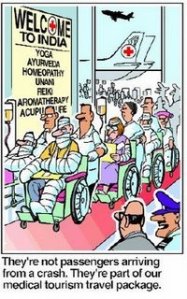
Indian “superbug” report is a scare to hurt medical tourism?

August 12, 2010

The Times of India is not impressed by the report in The Lancet Infectious Diseases Journal which claims that “India also provides cosmetic surgery for Europeans and Americans, and it is likely the bacteria will spread worldwide.”

cartoon from indianmta.blogspot.com

Scientists have tracked down a drug-resistant superbug that infects patients and causes multiple organ failure to Indian hospitals but doctors here see in it the germ of a move to damage the country’s booming medical tourism industry. While the study has the medical world turning its focus on infection control policies in Indian hospitals, the Indian Council of Medical Research has alleged a bias in the report and said it is an attempt to hurt medical tourism in the country that is taking away huge custom from hospitals in the West. “Such infections can flow in from any part of the world. It’s unfair to say it originated from India,” said ICMR director Dr VM Katoch. The superbug NDM-1 (New Delhi metallo-beta-lactamase) is named after the national capital, where a Swedish patient was reportedly infected after undergoing a surgery in 2008.

Senior doctors working in infection control said India lacks policies on antibiotics, infection control and registries for hospital-acquired infections. By the ICMR director’s own admission, India cannot scientifically fight back allegations of being the source of such superbugs, as the country does not have a registry of such hospital-acquired infections.

“Two in every five patients admitted to hospitals acquire infections. This extends the patient’s stay in the hospital, increases the expenses and causes side-effects,” said Dr Dilip Mathai, head of the department of internal medicine, Christian Medical College, Vellore.

The Lancet report  is causing some alarm within the medical tourism fraternity in India and doctors are rushing to defend the business.

But doctors in India said there was little chance this bacteria would infect overseas “health tourism” visitors. “Most of these bacteria are mostly transmitted to ICU patients, those in ventilators or critically ill patients. Since overseas patients come for selective surgeries, chances of them getting these bugs are negligible,” said Dr Monica Mahajan, senior consultant at Delhi-based Max Healthcare. Dr Amit Verma, director of critical care medicine at Fortis said he did not anticipate any major impact to medical tourism in India. The sample size of the study was very small to arrive at a conclusion, he said, adding that the chances of the bacteria becoming a global epidemic was negligible due to the restricted transmission capability of the bacteria.

Somehow the glib statement that “Most of these bacteria are mostly transmitted to ICU patients, those in ventilators or critically ill patients. Since overseas patients come for selective surgeries, chances of them getting these bugs are negligible” does not inspire much confidence!

The pandemic is over but 300 million vaccines were sold for a small fortune

August 11, 2010

The world is no longer in the middle of an H1N1 pandemic, the World Health Organisation has announced. We are now in the “post pandemic period”, Margaret Chan, director-general of the WHO, has announced.

But as reported by the The  Star in Toronto,

Three members of the emergency committee that advised Director General Dr. Margaret Chan on the H1N1 pandemic work at public health agencies in the United States and United Kingdom that have received research funding from pharmaceutical companies or their industry associations, and a fourth member had previously worked as a paid consultant for five different vaccine manufacturers.

The international health authority came under fire in June when a prominent medical journal alleged scientists with undisclosed financial ties to drug manufacturers had helped develop its pandemic strategies.

The article noted that guidelines published in 2004 urged countries to stockpile antiviral medication in advance to avoid scrambling for supplies when an outbreak occurred, but the WHO failed to disclose that three of the committee members who contributed to the document had at one point received funding from companies that manufacture antiviral drugs.

The joint investigation by the BMJ (formerly called the British Medical Journal) and the London-based Bureau of Investigative Journalism also spoke out against the WHO for keeping the lid on the names of its 15-member H1N1 emergency committee.

Over 300 Million vaccines were sold during this alarmist nonsense.

Sounds like fraud.

Misconduct at Harvard or is it scientific fraud?

August 11, 2010

Harvard does not want to say very much but the story was broken by the Boston Globe.

Harvard University psychologist Marc Hauser — a well-known scientist and author of the book “Moral Minds’’ — is taking a year-long leave after a lengthy internal investigation found evidence of scientific misconduct in his laboratory.

Scientist Marc Hauser’s studies include work on the cognitive and evolutionary underpinnings of language.

As reported in Nature:

A 3-year investigation has found evidence of scientific misconduct in publications by prominent Harvard University psychologist Marc Hauser, the Boston Globe reports today.

Hauser’s research, which has frequently been highlighted in newspapers and on television, has addressed the evolutionary roots of human language, mathematical ability, and morality. His 2006 book, Moral Minds, argued that the human brain is programmed to embrace certain moral principles. Earlier this year, Hauser co-authored a study that found no impact of religion on how humans respond to moral dilemmas (for more, see ‘Morals don’t come from God’).

But by then, Hauser’s lab was already the subject of a Harvard University investigation. According to the Globe article, the trouble centers on a 2002 paper published in the journal Cognition (subscription required). Hauser was the first author on the paper, which found that cotton-top tamarins are able to learn patterns – previously thought to be an important step in language acquisition. The paper has been retracted, for reasons which are reportedly unclear even to the journal’s editor, Gerry Altmann.

Two other papers, a 2007 article in Proceedings of the Royal Society B and a 2007 Science paper, were also flagged for investigation. A correction has been published on the first, and Science is now looking into concerns about the second. And the Globe article highlights other controversies, including a 2001 paper in the American Journal of Primatology, which has not been retracted although Hauser himself later said he was unable to replicate the results. Findings in a 1995 PNAS paper were also questioned by an outside researcher, Gordon Gallup of the State University of New York at Albany, who reviewed the original data and said he found “not a thread of compelling evidence” to support the paper’s conclusions.

This sounds more like fraud.

Not for the first time at Harvard and surely not the last.

How many “peers” have been duped along the way?