Today is Volcano day – over 1900 years after Pompeii

August 24, 2010

Dr. Erik Klemetti is reporting from Pompeii.

The eruption of Vesuvius that buried Pompeii – and lead Pliny to write his Letters that birthed volcanology occurred (at least we think) on August 24, 79 A.D. So, eat some olives in memory of those who perished over 1,900 years ago – and hope that Naples is prepared the next time Vesuvius rumbles so that we don’t repeat “Volcano Day”.

Pompeii victim:http://www.nationalgeographic.com/history/ancient/images/sw/pompeii-victim-50657432-sw.jpg

Photo: Cast of Pompeii victim

UK University parents emit twice as much CO2 as Ash Cloud Volcano

August 24, 2010

A new study by the UK’s low cost delivery service for students has found that the average fuel cost in the UK for transporting student belongings to and from university is £192 million per year. In total, parents taking their children’s belongings to and from uni emit 291k tonnes of CO2 every year – twice as much CO2 as Iceland’s Eyjafjallajökull volcano; which grounded flights across the world with a giant ash cloud, emitted every day.

http://topics.nytimes.com/top/news/international/countriesandterritories/iceland/eyjafjallajokull/index.html?inline=nyt-geo


The research, commissioned by low cost student baggage delivery service www.UniBaggage.com asked 1,196 parents if they helped their children move their belongings to and from student housing throughout their three years at university. In the academic year of 2008 – 2009 there were 2,396,050 university students in the UK.

The NYT reports that:

Seismic activity is petering out at the volcano that caused major European air-traffic disruption earlier this year, though the eruption has not yet been declared officially over, the authorities in Iceland said Monday. The most serious problem now is posed by mud flows created when heavy rains mix with ash settled along the top of glaciers close to the Eyjafjallajokull (pronounced EY-ya-fyat-lah-YO-kut) volcano, said Sigurlaug Hjaltadottir, a geophysicist with Iceland’s Meteorological Office.

But Eyjafjallajokull’s bigger sister Katla is still due to erupt at any time.

Solar Flares may dampen radioactive decay on Earth !

August 24, 2010

A detective story from Stanford University News. http://news.stanford.edu/news/2010/august/sun-082310.html

When researchers found an unusual linkage between solar flares and the inner life of radioactive elements on Earth, it touched off a scientific detective investigation that could end up protecting the lives of space-walking astronauts and maybe rewriting some of the assumptions of physics.

BY DAN STOBER

http://www.pcaire.com/images/solar_flares.png

Read the rest of this entry »

“Thank god for BP”:Louisiana fishermen net more cash working for BP

August 24, 2010

There is always a silver lining – for some.

The FT reports:

The white shrimp season officially began this week in Louisiana, and at this time of year 46-year-old Mr Foret, a hardened Cajun shrimper from Houma in the Mississippi delta, would normally be out on the water plying the trade that has kept him and his family since he was 13. But now that he is a BP contractor through the oil company’s Vessels of Opportunity programme, designed to employ local fishermen in the oil spill clean-up operations, he earns more consistent money, and works a lot less than he used to. “BP is a very nice fella, and this is a guaranteed cheque,” he says, pointing to a huge yellow skin or “bladder” on his boat that is used to collect skimmed oil. “I’m sticking with this for as long as I can.”

Captain Michael Owen, better known as the big “O”, has been doing pretty well out of BP. For the past three months, he and his 24-foot fishing boat have been ferrying clean-up workers to parts of the Gulf affected by the oil spill. As a BP contractor, he does not have to worry about securing charter fishing contracts for small parties of tourists visiting the Mississippi delta, the business he ran until the oil spill. Nor does he have to stress over the pressure to find fish – redfish and speckled trout – for his demanding clients. “I’m super happy with BP,” he says. “And I’m not taking a cut [in pay].”

“It takes you three days to make that charter fishing,” says a charter fisherman from Port Sulphur about 30 miles up the road. “Thank god for BP.”

http://www.huffingtonpost.com/2010/08/23/former-gulf-fishermenturn_n_691451.html

Gulf Coast Fisherman

A guide-line for shoe-throwing as a political protest

August 23, 2010

The history of shoe throwing is not very old, and the first such incident in recent history took place against  President George W Bush on his visit to Iraq in 2008. Since then, several political leaders worldwide, including a Chinese premier, have become targets of fancy footwear by people who found it a happy outlet of their resentments. Throwing shoes as an extension of showing the sole of one’s foot or using shoes to insult are forms of protest primarily associated with the Arab world. Pointing ones feet at someone is a general mark of disrespect across most of Asia.

http://dvice.com/pics/bush_shoe_games_main.jpg

Iraqi shoe-throwing reporter becomes the talk of Iraq 14th December 2008

Graduate student arrested for throwing a shoe at Wen February 2, 2009

Shoe-throwing Iraqi journalist has shoe thrown at him 2nd December 2009

Pakistan TV blocked over Zardari shoe-throwing 15th August 2010

Shoe-throwing policeman hailed as ‘hero’ in Kashmir 17th August 2010

Youth Hurls Shoe At Haryana Chief Minister 23rd August 2010

Shoe- throwing has quickly become an unambiguous, easily understood and visible expression of political contempt, dissent and outrage coupled to a helplessness against the “establishment”. It may well characterise a new behavioural pattern for those who consider themselves disenfranchised and down-trodden.

It is time to establish some standard guide-lines for shoe-throwing and shoe-throwers:

1. Do not wear the shoe to be thrown.

2.Carry the shoe to be thrown in a plastic  “smell-proof” bag so as not to annoy your neighbors.

3. Choose a shoe that is not too heavy (no boots or metal studs) and one you will not miss.

4. Choose a light, brightly coloured shoe which shows up well on camera.

5. Arrange for an accomplice to film the event and upload the video quickly to You-tube.

6. Stand within your throwing distance but not too far from an exit. If possible stand at an exit.

7. Do not have your name on the shoe.

8. If using a well known brand, ensure that the brand name is clearly visible.

9. Keep photographs of the shoe taken before it was thrown for possible sale to the press later.

10. Have your “statement of contempt” or any other manifesto available and ready to issue on the web and as a press release.

11. Have one copy of your statement within the shoe to be thrown.

12. Activate your lawyer before the shoe is thrown and have him and a doctor available close to the nearest lock-up or police station.

How can we – if we should – prepare for a new Little Ice Age?

August 22, 2010

It seems that we are in a Solar Cycle Minimum – a Landscheidt Minimum which will perhaps be comparable to the Maunder Minimum.

The last decade has seen flat or declining global temperatures.

The Ocean temperature oscillations could indicate 20 or 30 years cooling ahead of us.

If these are all indicators of a coming Little Ice Age, then it may be time to take some preparatory actions to help humans adapt. I think adaptation to Climate Change when it happens is the key not some mis-guided and futile attempt to prevent the Climate Change from happening (as being proposed by the IPCC and other global warming fanatics).

image: http://t2.gstatic.com/images?q=tbn:TtpOoja-ueuOLM:http://www.wilsonsalmanac.com/images3/frost_fair_C18.jpg

The question which is more for engineers rather than for scientists is “What are the actions that could be taken to prepare and help for such an adaptation?”

Applying Asimov’s Laws of Robotics

August 21, 2010

Isaac Asimov published his first short story about robotics in 1942 and his I Robot in 1950. The three laws of robotics he developed have now become the de facto basis for most science fiction dealing with robots and even in engineering:

First Law: A robot may not injure a human being, or, through inaction, allow a human being to come to harm, unless this would violate a higher order law.
Second Law: A robot must obey orders given it by human beings, except where such orders would conflict with a higher order law.
Third Law: A robot must protect its own existence as long as such protection does not conflict with a higher order law.
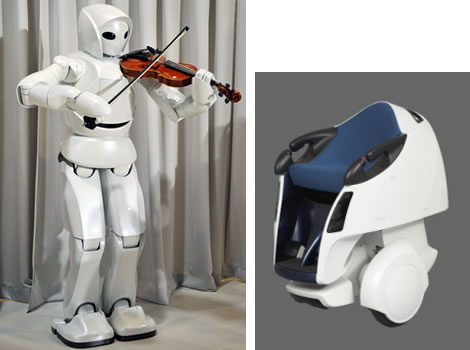
image: http://www.geekalerts.com/u/toyota-robots.jpg

Later as Asimov integrated his Robot series with his Foundation series he added a Zeroth Law:

Zeroth Law: A robot may not injure humanity, or, through inaction, allow humanity to come to harm.

A modern counterpart to Asimov’s fictional character is Eliza. Eliza was created in 1966 by Professor Joseph Weizenbaum of Massachusetts Institute of Technology who wrote Eliza — a computer program for the study of natural language communication between man and machine. She was initially programmed with 240 lines of code to simulate a psychotherapist by answering questions with questions.

Robotics and robot design has now advanced to the stage that engineers are now having to re-look at Asimov’s laws for practical implementation. David Woods, professor of integrated systems engineering at Ohio State University says “The philosophy has been, ‘sure, people make mistakes, but robots will be better — a perfect version of ourselves.’ We wanted to write three new laws to get people thinking about the human-robot relationship in more realistic, grounded ways.” He addresses the practical issues in his article: Beyond Asimov: The Three Laws of Responsible Robotics in IEEE Intelligent Systems by Robin Murphy , David D. Woods, July 2009, pp. 14-20. “Go back to the original context of the stories,” Woods says, referring to Asimov’s I Robot among others. “He’s using the three laws as a literary device. The plot is driven by the gaps in the laws — the situations in which the laws break down. For those laws to be meaningful, robots have to possess a degree of social intelligence and moral intelligence, and Asimov examines what would happen when that intelligence isn’t there.”

“His stories are so compelling because they focus on the gap between our aspirations about robots and our actual capabilities. And that’s the irony, isn’t it? When we envision our future with robots, we focus on our hopes and desires and aspirations about robots — not reality.”

In reality, engineers are still struggling to give robots basic vision and language skills. These efforts are hindered in part by our lack of understanding of how these skills are managed in the human brain. We are far from a time when humans can agree on a universal ethical or moral code and even further away from imbuing such a code into robots.

Woods and his coauthor, Robin Murphy of Texas A&M University, composed three laws that tries to put the responsibility back on humans.

The three new laws that Woods and Murphy propose are:

  • A human may not deploy a robot without the human-robot work system meeting the highest legal and professional standards of safety and ethics.
  • A robot must respond to humans as appropriate for their roles.
  • A robot must be endowed with sufficient situated autonomy to protect its own existence as long as such protection provides smooth transfer of control which does not conflict with the First and Second Laws.

Woods admits that one thing is missing from the new laws: the romance of Asimov’s fiction — the idea of a perfect, moral robot that sets engineers’ hearts fluttering.

Wind Power Sector struggles

August 21, 2010

Wind Power is still a long way from being commercial and is  still critically dependent upon subsidies. Austerity packages resulting from the financial crisis have sharply reduced subsidy programs and there have been a spate of cancelled and delayed projects. There is also some disillusionment evident as wind turbines demonstrated their weaknesses during the last cold winter when many had to be shut down in Europe for fear of ice on the turbine blades. The requirement for back-up power and the instability they add to the grid has not helped either. The Spanish support for renewables has dried up as the financial crisis has hit hard.

An injection of realism and common sense to the the use of renewable energy is long overdue. Wind and Solar and tidal and geothermal energies all have their place but they will not – and cannot – provide the base load power generation that coal, nuclear and hydro power have provided.

The FT reports that shares in Vestas Wind Systems lost more than a fifth of their value on Wednesday after the world’s largest wind turbine manufacturer slumped to its second consecutive quarterly loss and cut its profit guidance for the year.

image: http://www.pcdistrict.com/modules/productcatalog/product_images/132027-Windmill-3D-Screensaver.jpg

image. http://37signals.com/svn/images/dutch_windmill.jpg

Vestas warned that some expected orders from Europe and the US had been delayed as banks take longer to approve financing and deficit-laden governments review their support for wind power. Analysts highlighted regulatory uncertainty in Spain, which recently cut subsidies for renewable energy as part of its fiscal austerity programme, and the US, where legislation to promote clean energy has stalled on Capitol Hill. Low natural gas prices, caused in part by the surge in supplies from newly exploited US shale gas reserves, was another factor deterring investment in more costly renewable energy, analysts said.

New wind power installation in the US declined by more than two-thirds in the first half and fell below new coal power capacity for the first time in five years.

Increasing whiskey production can save the environment

August 21, 2010

By-products from distilling whiskey produce a biofuel with 30% more power output than ethanol !

Using samples from the Glenkinchie Distillery in East Lothian, researchers at Edinburgh Napier University have developed a method of producing biofuel from two main by-products of the whisky distilling process – “pot ale”, the liquid from the copper stills, and “draff”, the spent grains. The new method developed by the team produces butanol, which gives 30% more power output than the traditional biofuel ethanol. It is based on a 100-year-old process that was originally developed to produce butanol and acetone by fermenting sugar. The team has adapted this to use whiskey by-products as a starting point and has filed for a patent to cover the new method. It plans to create a spin-out company to commercialise the invention. Butanol is superior to ethanol — with 25 – 30% t more energy per unit volume. The biofuel can also be introduced to unmodified engines with any gasoline blend, whereas ethanol can only be blended up to 85 percent and requires engine modification.

Read more:http://solveclimate.com/blog/20100817/scottish-scientists-develop-whisky-biofuel

Professor Martin Tangney, who directed the project said that using waste products was more environmentally sustainable than growing crops specifically to generate biofuel. “What people need to do is stop thinking ‘either or’; people need to stop thinking like for like substitution for oil. That’s not going to happen. Different things will be needed in different countries. Electric cars will play some role in the market, taking cars off the road could be one of the most important things we ever do.”

“The production of some biofuels can cause massive environmental damage to forests and wildlife. So whisky powered-cars could help Scotland avoid having to use those forest-trashing biofuels,” said Dr Richard Dixon, of WWF Scotland.

“DRINK IT and then DRIVE IT” has a nice ring to it and  is something I could enjoy supporting.

Hausergate: An utter lack of ethics

August 19, 2010

Fiction passed of as science

Further revelations in The Chronicle of Higher Education provides sordid details about the Hauser paper published in 2002 in Cognition and which is now being retracted. But the pattern of behaviour described is that of an accomplished liar well-versed in creating bogus data. To become such an accomplished inventor of data must have taken years of practice.

For how long has Hauser been passing off works of fiction as works of science?

Hauser’s hectoring tone towards his research assistants to try and force his false interpretations on them are also very revealing. The author of Moral Minds exhibits an utter lack of ethics.

Rather than getting a year off to write another work of fiction should he not be required to return all the salary and grant money he has enjoyed as the fruits of his inventiveness?

Where are all the peers who have recommended his being published?

Document Sheds Light on Investigation at Harvard 1

An internal document, however, sheds light on what was going on in Mr. Hauser’s lab. It tells the story of how research assistants became convinced that the professor was reporting bogus data and how he aggressively pushed back against those who questioned his findings or asked for verification.

Read the rest of this entry »