Posts Tagged ‘global warming’

Oh Rapture! Global Warming doomsday will come in 2047 (if Apophis does not come first)

October 10, 2013

Rapture in 2047!.

A peer reviewed paper in Nature that Camping would be proud of!

Global Warming “science” is now reduced to this. An end-of-the-world prediction from Global Warmists for 2047 now must be added to the long list of Doomsday predictions none of which – so-far – have come to pass.

Camilo Mora, Abby G. Frazier, Ryan J. Longman, Rachel S. Dacks, Maya M. Walton, Eric J. Tong, Joseph J. Sanchez, Lauren R. Kaiser, Yuko O. Stender, James M. Anderson, Christine M. Ambrosino, Iria Fernandez-Silva, Louise M. Giuseffi, Thomas W. Giambelluca. The projected timing of climate departure from recent variabilityNature, 2013; 502 (7470): 183 DOI: 10.1038/nature12540

AP:Starting in about a decade, Kingston, Jamaica, will probably be off-the-charts hot — permanently. Other places will soon follow. Singapore in 2028. Mexico City in 2031. Cairo in 2036. Phoenix and Honolulu in 2043.

And eventually the whole world in 2047.

  • Harold Camping predicted the ending of the world and the Day of Rapture – three times – and has now retired in confusion.
  • Teacher Wang predicted the end of the world on 11th May 2011.
  • The Mayan Doomsday should have happened in 2012.
  • A prediction by Kenton Beshore is that Rapture will occur no later than 2021
  • Another Doomsday has been predicted for 13th April 2036 when asteroid Apophis could hit earth.
  • Global Warming Doomsday (this prediction) is set for 2047.
  • If that does not occur then Isaac Newton’s prediction based on his studies of the Bible is set for 2060.
  • According to James Kasting, Carbon dioxide levels in the atmosphere will not support life in the year 500,000,000.
  • So-called scientists have attempted to use statistics and the Doomsday Argument to calculate when Doomsday will come based on how many people have lived and how many are left to live!
  • A list of predicted Doomsday dates (past and future) is here.

But this Global Warming Doomsday is real.

A Press Release from on High has been issued:

“WE are living and dying in difficult times” said GOD. “WE can no longer support four establishments just for humanity. There are many other priorities in the Universe WE need to consider and address.

The cost of maintaining a separate Hell and the increasing cost of Energy is getting prohibitive – especially since the liability for maintaining high temperatures stretches through Eternity. WE are therefore merging Purgatory with Heaven and Hell with Earth.  The mergers will be completed by 2047. The regions on Earth with the greatest number of Sinners will be heated up to Hell-like temperatures first and by 2047 the entire Earth would have reached the status of Hell. Wind-power and solar-power are insufficient to this Purpose. We shall be making increased use of Fossil Fuels and Greenhouse Power.

Since the majority of those living are Sinners and destined for Hell anyway, this will also ease the logistics of moving the few Worthy humans to Heaven”.

An intrepid journalist from AP (SB) asked the Lord whether a new Glacial Age on earth could subvert His Plans. “That is not a problem” said God. “We have arranged for temperature to be a cyclic parameter just like politics. Increasing temperatures and reducing temperature shall only form a circular process. Infinite heat can be equated to infinite cold. We shall arrange that when Glaciation is necessary It shall be perceived by gullible Global Warmists as the burning Fires of Hell”.

2013 was a “good” year for the cryosphere – but could it be the beginning of the end of this interglacial?

October 8, 2013

According to the NSIDC – which is an important part of orthodox officialdom – 2013 was a better year for the cryosphere since:

“This summer, Arctic sea ice loss was held in check by relatively cool and stormy conditions. As a result, 2013 saw substantially more ice at summer’s end, compared to last year’s record low extent. The Greenland Ice Sheet also showed less extensive surface melt than in 2012. Meanwhile, in the Antarctic, sea ice reached the highest extent recorded in the satellite record”.

What makes for “good” or “bad” depends upon what the fears are. If global warming is the fear then – as the NSIDC states – it was a good year. But if a cooling cycle or even a coming ice age is the fear then the increasing ice extent, the short summer, the extended winter last year and the increased snow cover in the Northern Hemisphere are all just early warning signs of what is to come.

We don’t know if we are in:

  1. a run-away global warming period (as the global warming orthodoxy will have us believe), or
  2. a series of global warming and cooling cycles, each about 20 – 30 years long and responding to the decadal ocean cycles, or
  3. the beginning of the end of this interglacial (which is overdue).

The global warming pause of the last 17 – 18 years suggests that “run-away” global warming is unlikely. The slight decrease in global temperatures over the last 7 – 8 years is not conclusive but is also evidence that the effect of increasing carbon dioxide on global temperature is far from certain. Even if it exists it is very small  and is clearly not yet properly understood. Catastrophe scenarios may attract funding but reduce the credibility of the doom-sayers.

If we are just in a regular cooling cycle then the increasing ice level is nothing to be afraid of. Even if 2 or 3 decades of cooling give us another Little Ice Age, it will be followed by a warming cycle. It will not necessarily mean the start of the end of the current interglacial. But it will mean 20 – 30 years of cooling and the increased use of fossil fuels will be required. Fracking and methane hydrate recovery from the deep sea will be needed along with the continued – and increased – mining of coal. Wind and solar energy can play their little part in the niches that they are suitable for. Nuclear energy will have to make a come-back.

But if the Earth is now responding – by mechanisms unknown – to the Milankovitch cycles – and has started its many thousands year journey into glacial conditions, then we would be well served by developing the strategies and technologies for prospering in such times. We will gradually lose habitat in the North to growing ice sheets but we will gain new habitat as the sea level sinks. But these changes will take place over many generations (50 – 100) and we will have time to adapt. One lost generation – as the last 20 years of global warming hysteria will be – will be of little consequence. Humans have lived and prospered through glacial conditions before and will again. One big difference will be the availability of affordable and abundant energy which gives us the ability – not to stop the advance of the ice sheets – but to be able to continue to access resources and minerals under the ice sheets. We may even have colonies living on top of the shallower ice sheets. But there will also be new opportunities. The increase of habitat as the sea levels drop (by upto 150m) will be in exceptionally fertile areas for food production. Mineral and energy resources currently under the sea will become even more accessible. As with the last glacial period it will probably be a period in which human ingenuity is challenged and innovation will flourish.

The coming of a new glacial period will be no catastrophic change. We will have plenty of time to adapt. And in the 1,000 or 2,000 years it will take to establish glacial conditions, humans will probably have found new frontiers and established new colonies in space. And in 50 or 100 generation humans will continue to evolve. The humans coming out of the next glacial will not be quite like us.

IPCC = International Promotion of Global Warming

September 28, 2013

It is quite wrong to think of the IPCC as some august body looking objectively at Climate Change and what causes climate to change. They only operate as a PR agent – under the cloak of consensus science – for the Global warming hypothesis. Global cooling hypotheses or – in fact – any hypotheses other than carbon dioxide being the controller of global temperature are given short shrift. Even real observations and all global cooling trends are ignored. Global warming models take precedence over real data. The Sun is ignored. Climate sensitivities is apparently too new a topic to be considered.

They do not just cherry pick data; they just ignore it when they represent inconvenient truths. The last 17 years with no global warming are merely dismissed as being for too short a period. But then the IPCC has only been in operation for 25 years. The IPCC has not looked up from its computer models to realise that for most of its life it has seen no global warming.

If the IPCC was really looking at climate change and not just promoting the idea of global warming they might have shown some interest in the climate trend-break which seems to have occurred about 15 years ago. But a trend-break would be heretical. Their dismissal yesterday of the last 15 – 18 years was disgraceful. How, after such real observations, they are more certain than ever that global warming continues and that carbon dioxide is the culprit, is not rational and can only be “wishful thinking” (to put the best interpretation on it).

(data below generated using woodfortrees interactive database)

Global temperatures since 1850

Global temperatures since 1850

And how their certainty about carbon dioxide being the prime culprit can be increased with the reality of temperatures declining in the last 15 or so years  boggles rationality. Except of course that their certainty is based on climate models and cannot be bothered by real observations.

CO2 and global temperatures 1998-2013

CO2 and global temperatures 1998-2013

IPCC will ignore hiatus in global warming until it has gone on for 30 years!

September 27, 2013

I have been watching the IPCC press conference and it seems to me that they were very much on the defensive:

  1. they felt that had no option but to mention the hiatus in global warming,
  2. they decided to underplay its significance along a number of fronts
    • the period was too short
    • hiatus was not significant untill it had existed for 30 years
    • 1998 was a very special El Nino year
    • the intervening period had other factors (volcanic activity for example) which could have contributed to cooling
  3. they have rejected the very high sea level rise scenarios but assign no probability because there is no consensus
  4. they are following the line that “it is not important to know where we are now because we are certain about where we will end up in 20 or 30 years”
  5. sensitivities is an emerging subject and there is no consensus
  6. it is still correct to follow the one dimensional greenhouse gas view of global warming.

All in all a rather predictable performance  with a clear task of “protecting the models”.

IPCC still cooking it’s books to cover-up the inconvenient truths

September 27, 2013

The 95% probability/certainty of global warming being due to human activity is based on a show of hands and not on any evidence or statistical analysis of data. What it actually says is that 95% of all global warming believers, believe.

Late last night the IPCC delegates in Stockholm were still messing around preparing their 30 page political summary of their AR5 report to be released today.

The political summary of AR5 is primarily a CYA effort to protect the posteriors of the policy makers (mainly political figures, bureaucrats and activists) in the face of a long row of broken models and broken hypotheses. The IPCC has forgotten that natural variability is a euphemism for unknown mechanisms which cannot be calculated or predicted. It is going to be interesting to see just how the summary report will cover-up, deny or ignore the long string of inconvenient facts:

  • Global temperatures have not risen for 17-18 years while CO2 has kept on increasing. 
  • Global temperatures have been declining for the last 11 years. 
  • None of the IPCC’s computer models have predicted the warming hiatus or the cooling over the last decade.
  • Global wildfires are lower than normal. 
  • Rainfall patterns (and the Indian monsoon) continue within the bounds of known natural variability. 
  • Food and grain production is at an all-time high. 
  • Flood frequency and flood levels have not been at unprecedented levels. Just more people live in flood-plains today than before. 
  • CO2 in the atmosphere reached the magic level of 400 ppm (albeit for just a few hours) and nothing happened.
  • How much of the CO2 concentration increase is due to carbon dioxide from fossil fuel. combustion is unclear but fossil fuel emissions are only 5% of global carbon dioxide emissions. 
  • The absorption and release of carbon dioxide by the oceans is unknown and the error margin is greater than the total amount released by fossil fuels.
  • CO2 absorption mechanisms do not care where the CO2 being absorbed came from.
  • The sensitivity of global temperature to CO2 concentration has been grossly exaggerated by the computer models.
  • Carbon dioxide concentration is more likely to follow global temperature (due to subsequent changes in emission and absorption rates) than to lead it.
  • Sea ice levels are increasing at both poles with the Antarctic at record high levels.
  • Polar bear populations are thriving and increasing.
  • Sea levels are continuing to rise at just the historical levels due to the recovery from the last glacial and are not accelerating due to industrialisation or the use of fossil fuels.
  • Oceans are still strongly alkaline and any increase in acidity is within known natural variability.
  • Coral reefs have shown themselves to be self-healing when damaged and are not showing any signs of ocean acidification.
  • Climate models have grossly underestimated solar effects because the mechanisms are unknown.
  • Sunspot activity in SC24 is well down from SC 23 and is not unlike the period of the dalton minimum during SC5 and SC6.
  • Clouds and moisture in the atmosphere have a much bigger impact on global warming and cooling than CO2 in the atmosphere.
  • Cloud formation is linked to sunspot activity and cosmic rays.
  • Global warming and cooling follow solar effects via the oceans in long decadal cycles.
  • The number of hurricanes and tornadoes are at historically low levels.
  • Heat released from the earth’s interior by tectonic and volcanic activity is not known.
  • A Little Ice Age is more likely than further Global Warming and a global cooling cycle lasting 20-30 years may have begun.
  • This interglacial is due (within c. 1000 years) to come to an end.

There is more we don’t know that we don’t know about the climate than the IPCC would like to admit. And for policy makers, activists and bureaucrats who have followed misguided policies for the last 25 years it is no longer possible to admit that they have been making “certain” predictions in an ocean of uncertainty. They have replaced scientific objectivity by “consensus science” where the validity of a hypothesis is based on how many believe and not on evidence. The 95% probability/certainty of global warming being due to human activity being touted by the IPCC is based on a show of hands of believers, and not on any evidence or statistical analysis of data.

Finally, the BBC begins to get it, and maybe even the Washington Post

September 24, 2013

From the BBC 10 o’clock News on September 23rd

BBC News 23rd September

BBC News 23rd September

Washington Post September 23rd

Antarctic sea ice hit 35-year record high Saturday

The comments are quite entertaining as well.

I am not getting my hopes up but little shoots of sanity are always welcome.

Nature hypes the IPCC

September 24, 2013

It could not have escaped anybody’s notice that the summary of the IPCC’s 5th Assessment Report (AR5) is due out at the end of this week in Stockholm on 27th September. The hype around this release is building up and by all the usual suspects. And the prime suspect is Nature. It has released a special issue on the 25 years of the IPCC. But nearly all these usual outlets are all in a state of denial or cover-up or both.

The IPCC faces a dilemma. Should they mention that while carbon dioxide keeps increasing global temperatures have been at a standstill and their fantasised link between fossil fuel combustion and global temperature seems to be broken. Not likely since the usual suspects have far too much invested in this hypothesis. Should they just ignore that global warming has stalled for the last 17 years and lose even more of their fast evaporating credibility. Or should they mention it and then enter into an orgy of contortion to show that their models are still valid because the missing heat has been swallowed by the Monsters of the Deep. It looks like they will choose the latter since the contortions have already begun.

The simple but inconvenient truth is that the IPCC has misled and wasted the world’s resources for  25 years.

Nature Special Issue

OUTLOOK FOR EARTH: A NATURE SPECIAL ISSUE ON THE IPCC
This Nature special issue explores the Intergovernmental Panel on Climate Change (IPCC) – an international body of hundreds of scientists and policy experts that regularly assesses the state of knowledge about how climate is changing, what impacts that will have, and how nations can mitigate the problem. A graphical introduction chronicles the history of the IPCC and how climate science has evolved over the past 25 years. One news feature examines the latest research on rising sea levels and another profiles Ottmar Edenhofer, a leader of the IPCC’s upcoming report on mitigation. In a Commentary, Elliot Diringer proposes that individual actions by nations to tackle the causes of climate change can set the stage for international action. And K. John Holmes looks at the history of large-scale environmental assessments.
Image credit: Carl De Torres


FEATURES

Outlook for Earth

As the IPCC finalizes its next big climate-science assessment, Nature looks at the past and future of the planet’s watchdog.

25 years of the IPCC

A graphical tour through the history of the Intergovernmental Panel on Climate Change and the science that underlies it.

Rising tide

Researchers struggle to project how fast, how high and how far the oceans will rise.

The climate chairman

Getting hundreds of experts to agree is never easy. Ottmar Edenhofer takes a firm, philosophical approach to the task.

COMMENT

A patchwork of emissions cuts

Home-made national approaches can be effective for climate-change mitigation if countries agree on rules and build trust, says Elliot Diringer.

Pushing the climate frontier

The first large-scale environmental surveys, carried out on the US arid lands, hold scientific lessons for policy-making still relevant today, explains K. John Holmes.


Simple truths are becoming highly inconvenient for the IPCC

September 21, 2013

The simple truths are

  1. Global temperatures exhibit no warming for the last 17-18 years, and
  2. Carbon dioxide concentrations in the atmosphere have increased continuously during the same period  noting that man made carbon dioxide emissions constitute about (at most) 5% of all carbon dioxide emissions.

The tag of “Denier” is now shifting to the Global Warmists who are denying that there is a hiatus in “global warming”. And to those who deny that the causal link between carbon dioxide concentration and global warming – which itself is highly speculative – is now clearly broken.

The Global Warming brigade are now putting pressure on the IPCC and “learned” journals to conceal, cover up, explain away and generally deny these two simple truths for the upcoming release (in parts) of the AR5 report. It is a full-court denialist press to try and ensure that AR5 is not treated as scrap even before it is released.

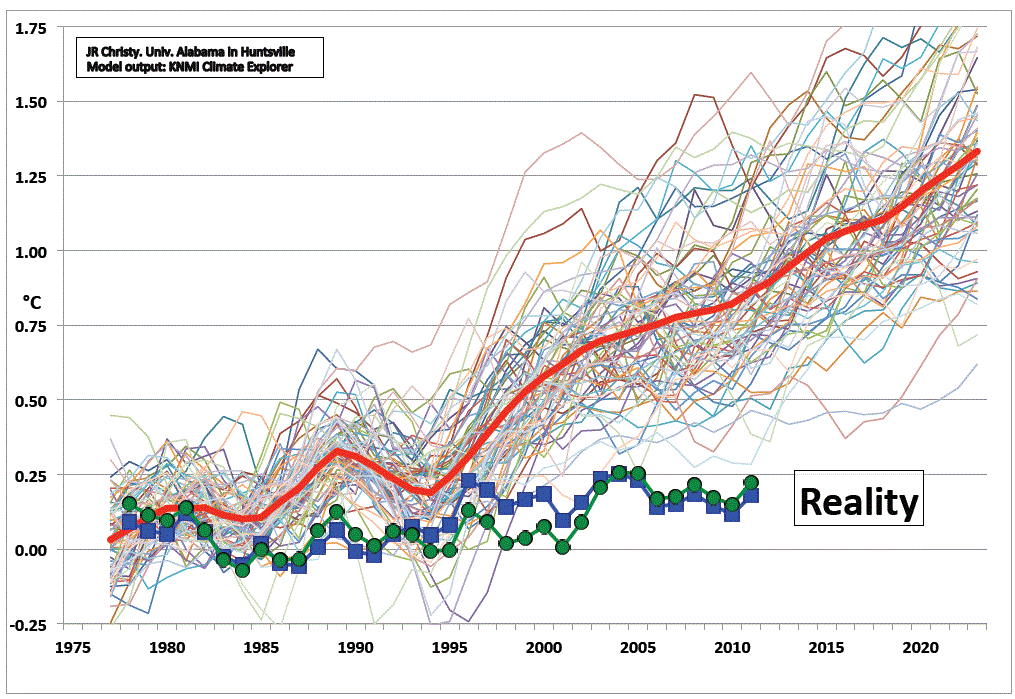
The reality of global temperatures is increasingly diverging from increasingly discredited climate models. In fact the reality of global temperature measurements since about 1978 would not provide any convincing evidence that any concern regarding “global warming” was justified.

Climate Models versus Reality

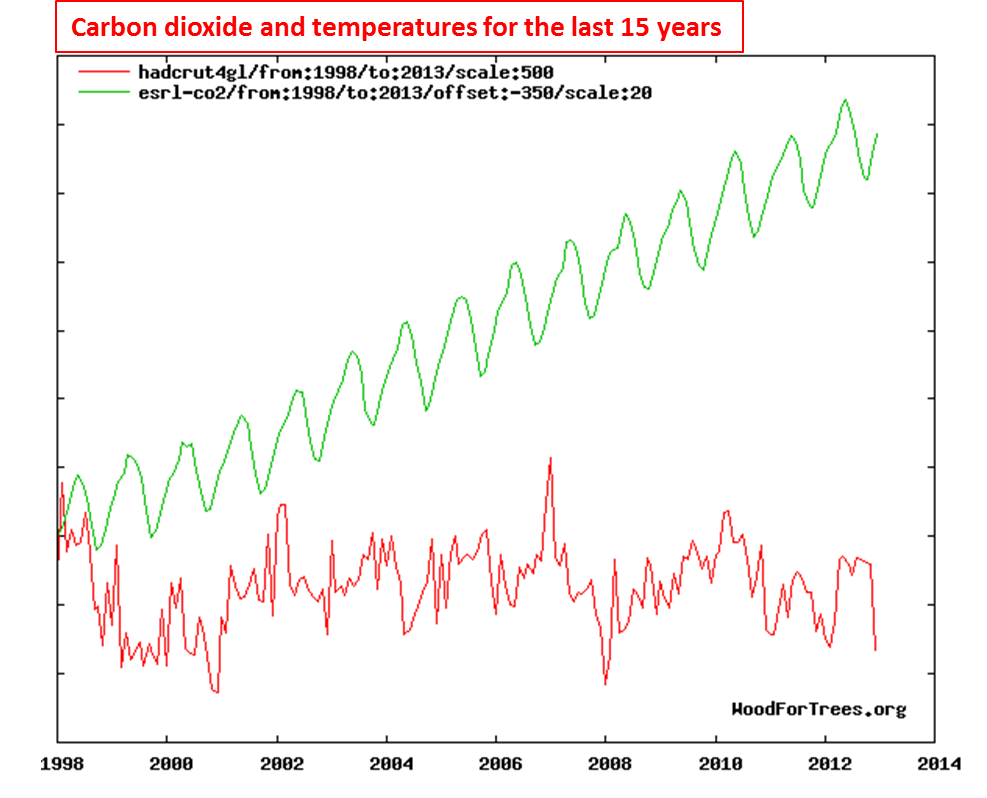
Not only are temperatures not increasing as the models  – and their religious adherents – would like but atmospheric concentrations of carbon dioxide have continued to increase unabated.

Global temparature and carbon dioxide – last 17 years

The two simple truths lead to two simple – but inescapable – conclusions

  1. There is no evidence that “global warming” is an irreversible phenomenon. There is no evidence either that global warming or global cooling are anything other than “natural” variations of climate.
  2. Carbon dioxide concentration in the atmosphere is not strongly indicated – if at all – as anything but a very small component of the very many which affect global temperature. The man made contribution to global carbon dioxide emissions itself  is about 5% of all carbon dioxide emissions.

Hurricanes hardly (h)ever happen!

September 11, 2013

Irresistable.

Lack of hurricanes helps climate change skeptics

Hurricanes have been largely absent this year.

For the first time in 11 years, August came and went without a single hurricane forming in the Atlantic. The last intense hurricane (Category 3 or above) to hit the United States was Hurricane Wilma, in 2005. According to Phil Klotzbach, head of Colorado State University’s seasonal hurricane forecast, accumulated cyclone energy is 70 percent below normal this year.

Hurricanes have become a major part of the public relations campaign for radical action on climate change. After Hurricane Sandy hit the Eastern Seaboard last fall, the left quickly dubbed it a “Frankenstorm,” and nearly fell over itself attempting to claim that the intensity of the storm was a result of greenhouse gas emissions.

That’s not so surprising. Despite decades of effort, the environmental movement has largely failed to persuade the American public to accept the draconian restrictions that stopping climate change would entail, and linking hurricanes to climate change may be their best chance to change all that.

A look at the science, however, tells a somewhat different story. While the overall number of recorded hurricanes has increased since 1878 (when existing records begin), this is at least partly due to an improved ability to observe storms rather than an increase in the number of storms.

…… Similarly, the increase in damages from storms over time has less to do with their increased frequency or intensity than with the fact that we have gotten richer. Had Hurricane Sandy swept through New Jersey 100 years ago, it would have done far less damage simply because, back then, there was less of value to destroy. These days Americans are not only wealthier, but we are more inclined to build closer to the water, due to subsidized flood insurance. When University of Colorado professor Roger Pielke looked at the numbers, he found that correcting for these factors completely eliminated the supposed increase in hurricane damage.

Unsurprisingly, then, a leaked draft of the Fifth Assessment Report of the United Nations’ Intergovernmental Panel on Climate Change (due to be released later this month) downgraded the likelihood of a connection between past temperature rises and extreme weather events. According to the report, there is “low confidence” in any association between climate change and hurricane frequency or intensity. …….

Read the article

Arctic Ice is increasing, Antarctic ice is high and breaking records, warming is missing while Carbon dioxide is still increasing —

It must be difficult for a rational being to believe in the global warming hypothesis — it requires an abundance of faith and a minimum of critical thinking!!

The sun, the clouds and the climate

September 5, 2013

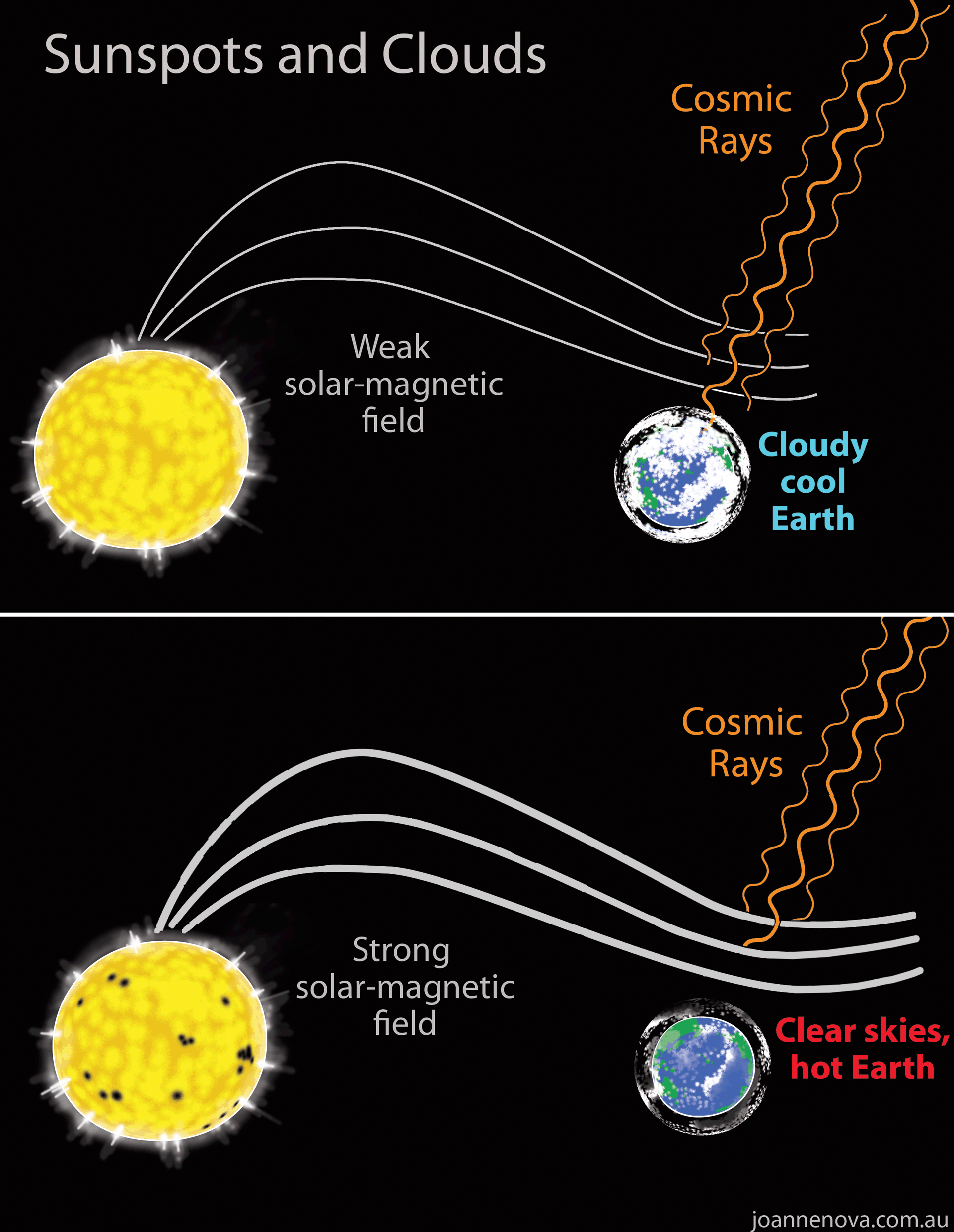
The Svensmark theory is that variations in the Sun’s electromagnetic  behaviour leads to varaiations of the cosmic ray flux reaching earth which in turn impacts cloud formation on earth and that connects to global warming or cooling.  A more active sun leads to fewer cosmic rays which gives fewer clouds and more warming on earth.

Graphic from Jonova

The CLOUD experiments at CERN have shown that cosmic rays can in fact lead to cloud formation. Now Svensmark and his colleagues have published further evidence from the SKY2 experiments which confirm the connection.

H. Svensmark, Martin B. Enghoff and Jens Olaf Pepke Pedersen, Response of cloud condensation nuclei (>50 nm) to changes in ion-nucleation,   Physics Letters A 377 (2013) 2343–2347,

Full paper is available here: svensmark et al 2013

Abstract: In experiments where ultraviolet light produces aerosols from trace amounts of ozone, sulfur dioxide, and water vapor, the relative increase in aerosols produced by ionization by gamma sources is constant from nucleation to diameters larger than 50 nm, appropriate for cloud condensation nuclei. This result contradicts both ion-free control experiments and also theoretical models that predict a decline in the response at larger particle sizes. This unpredicted experimental finding points to a process not included in current theoretical models, possibly an ion-induced formation of sulfuric acid in small clusters.

The Technical University of Denmark has issued a Press Release:

Danish experiment suggests unexpected magic by cosmic rays in cloud formation

Researchers in the Technical University of Denmark (DTU) are hard on the trail of a previously unknown molecular process that helps commonplace clouds to form. Tests in a large and highly instrumented reaction chamber in Lyngby, called SKY2, demonstrate that an existing chemical theory is misleading.

Back in 1996 Danish physicists suggested that cosmic rays, energetic particles from space, are important in the formation of clouds. Since then, experiments in Copenhagen and elsewhere have demonstrated that cosmic rays actually help small clusters of molecules to form. But the cosmic-ray/cloud hypothesis seemed to run into a problem when numerical simulations of the prevailing chemical theory pointed to a failure of growth. 

Fortunately the chemical theory could also be tested experimentally, as was done with SKY2, the chamber of which holds 8 cubic metres of air and traces of other gases. One series of experiments confirmed the unfavourable prediction that the new clusters would fail to grow sufficiently to be influential for clouds. But another series of experiments, using ionizing rays, gave a very different result, as can be seen in the accompanying figure. 

The reactions going on in the air over our heads mostly involve commonplace molecules. During daylight hours, ultraviolet rays from the Sun encourage sulphur dioxide to react with ozone and water vapour to make sulphuric acid. The clusters of interest for cloud formation consist mainly of sulphuric acid and water molecules clumped together in very large numbers and they grow with the aid of other molecules.

Atmospheric chemists have assumed that when the clusters have gathered up the day’s yield, they stop growing, and only a small fraction can become large enough to be meteorologically relevant. Yet in the SKY2 experiment, with natural cosmic rays and gamma-rays keeping the air in the chamber ionized, no such interruption occurs. This result suggests that another chemical process seems to be supplying the extra molecules needed to keep the clusters growing. 

“The result boosts our theory that cosmic rays coming from the Galaxy are directly involved in the Earth’s weather and climate,” says Henrik Svensmark, lead author of the new report. “In experiments over many years, we have shown that ionizing rays help to form small molecular clusters. Critics have argued that the clusters cannot grow large enough to affect cloud formation significantly. But our current research, of which the reported SKY2 experiment forms just one part, contradicts their conventional view. Now we want to close in on the details of the unexpected chemistry occurring in the air, at the end of the long journey that brought the cosmic rays here from exploded stars.”

Simulating what could happen in the atmosphere, the DTU’s SKY2 experiment shows molecular clusters (red dots) failing to grow enough to provide significant numbers of “cloud condensation nuclei” (CCN) of more than 50 nanometres in diameter. This is what existing theories predict. But when the air in the chamber is exposed to ionizing rays that simulate the effect of cosmic rays, the clusters (blue dots) grow much more vigorously to the sizes suitable for helping water droplets to form and make clouds. (A nanometre is a millionth of a millimetre.)