Posts Tagged ‘global warming’

Reality check: Increasing sea ice making it difficult to reach Antarctic stations

May 12, 2015

This is reality – not a forecast from a a mathematical model.

news.com:

THE size and power of ships needed to break through Antarctica’s increasing sea ice levels is a worry for the global research community.

IN recent years countries including Australia have battled to reach their stations on the frozen continent, making resupply missions time consuming and expensive, Australian Antarctic Division spokesman Rod Wooding said.

“We’re noticing that the sea ice situation is becoming more difficult,” he told reporters on Monday.The sea ice through the Southern Ocean and around Australia’s Mawson Station usually breaks up for a couple of months a year allowing ships to enter the bay but that did not happen in 2013-14.“We had to get fuel in by helicopter which is inadequate for the long-term sustainability of the station,” Dr Wooding said.“Other national programs have had similar problems: the French in particular, Japanese also.”

The problem has been the main driver for a meeting of more than 50 international experts, convening in Hobart until Wednesday, to try and nut out a plan to accurately forecast sea ice levels.Meteorologists along with ice and Antarctic experts will take part in a series of workshops, looking at trends in satellite imagery and the environment.“One of the things that Antarctic programs will need to understand going forward is what sort of ice breaking capability we’re going to need to get through the ice in these areas,” Dr Wooding said.“Australia is currently in a tender process for a new ice breaker … and it’s important in understanding what sort of ice breaker we might need … to have a good understanding of likely sea ice conditions.”The

re is no single reason why sea ice levels are increasing but Hobart-based expert Tony Worby said it tends to gather around icebergs and wind patterns also play a part.“We know sea ice extent is increasing, there was a record maximum in September 2014,” Prof Worby said. “It’s quite hard to forecast but whatever effort we put in to improving our ability to forecast sea ice will ultimately pay dividends in terms of savings for national programs.”

Sunshinehours also points out that current Antarctic sea ice extent is the highest measured for this time of year. (In fact the global sea ice extent is the 3rd highest ever measured for this day of the year).

Antarctic_Sea_Ice_Extent_Zoomed_2015_Day_130_1981-2010

from sunshinehours


Adjusted (fiddled) data showing global warming to be investigated

April 26, 2015

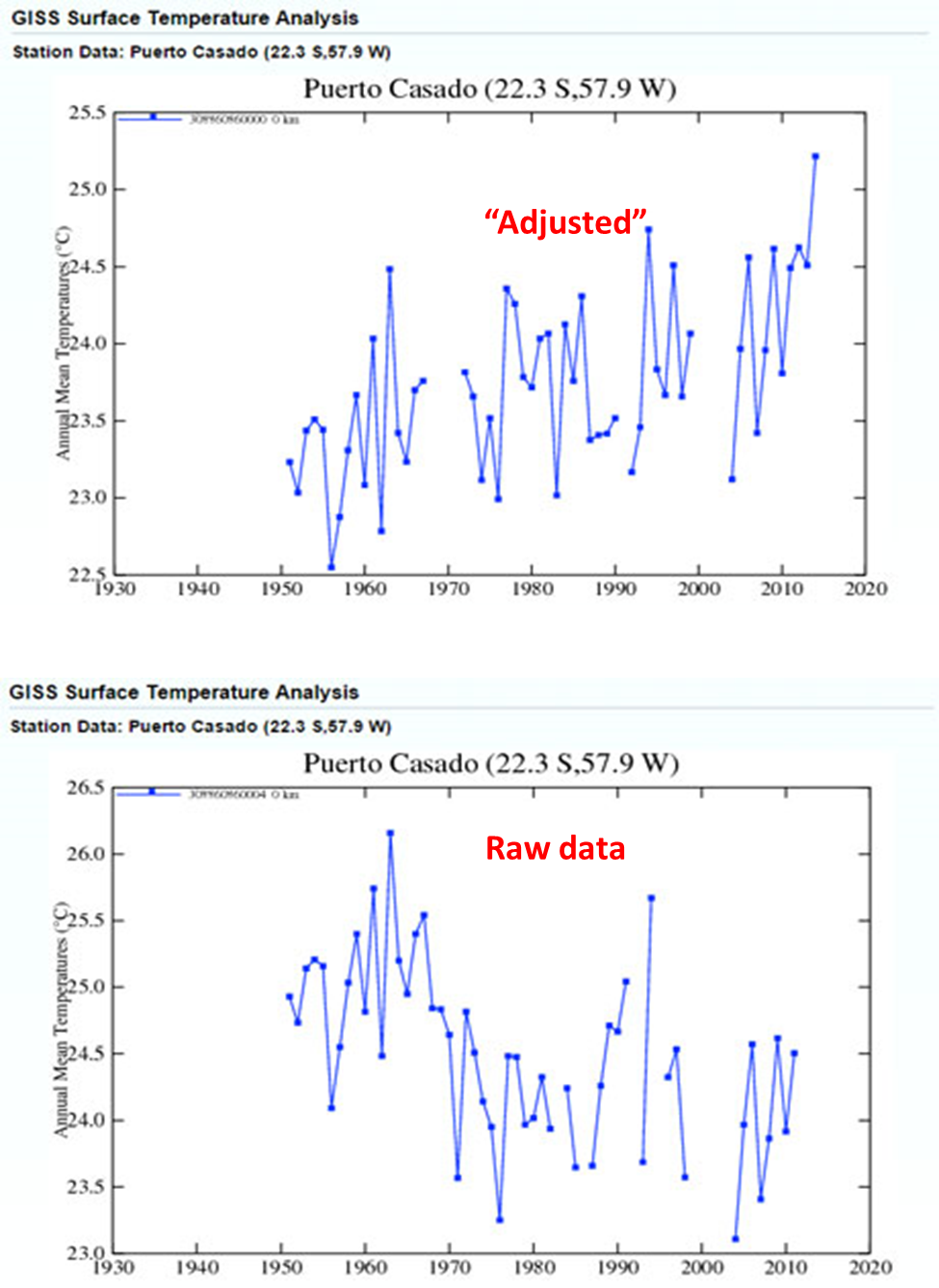
“Global” temperature is necessarily a construct. It is “calculated” by taking raw temperature data as measured at particular locations, massaging this data according to algorithms devised by those calculating the “global temperature, applied to areas where there are no measurements by some other algorithms (oceans, poles, forests and deserts), adjusting past data and then coming up with a “global” temperature.

Raw data is never used without “adjustment”. Remarkably the adjustments invariably cool the past. Every year, data from the past is further adjusted! The trends and results presented represent more the adjustment algorithms used rather than the parameters themselves. As this example of “adjustment” of raw data from Puerto Casada to convert an actually measured cooling trend into an adjusted warming trend illustrates

Cooling the past: Puerto Casada From raw to adjusted data

Cooling the past: Puerto Casada From raw to adjusted data

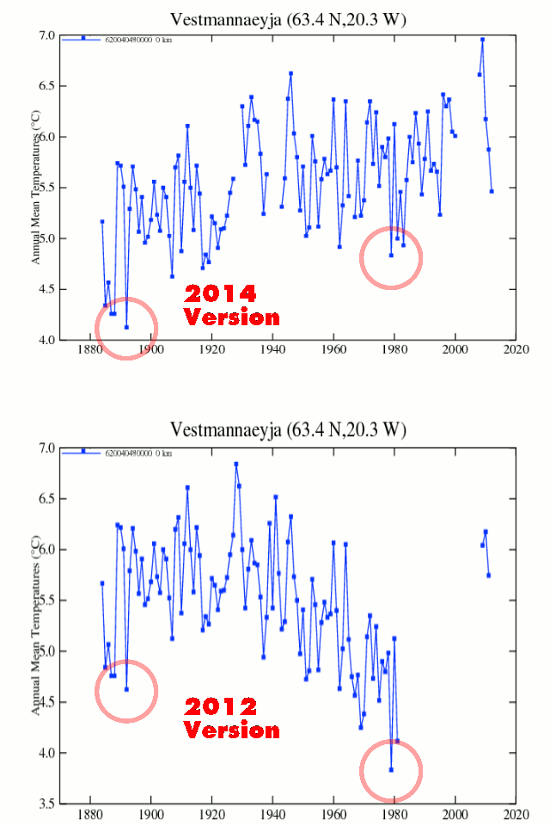
Studies have already shown that, in the US, Australia, New Zealand, the Arctic and South America, in far too many cases, temperatures have been adjusted to show a stronger and clearer warming trend than is justified by the raw data.

As RealScience shows with this more dramatic example from Vestmanneyja

vestmannaeyja

https://stevengoddard.files.wordpress.com/2015/01/vestmannaeyja.gif?w=640

An investigation now to be carried out by an international team is to establish a full and accurate picture of just how much of the published record has been adjusted in a way which gives the impression that temperatures have been rising faster and further than was indicated by the raw measured data.

Christopher Booker writes in the Daily Telegraph:

…. something very odd has been going on with those official surface temperature records, all of which ultimately rely on data compiled by NOAA’s GHCN. Careful analysts have come up with hundreds of examples of how the original data recorded by 3,000-odd weather stations has been “adjusted”, to exaggerate the degree to which the Earth has actually been warming. Figures from earlier decades have repeatedly been adjusted downwards and more recent data adjusted upwards, to show the Earth having warmed much more dramatically than the original data justified.

So strong is the evidence that all this calls for proper investigation ………  The Global Warming Policy Foundation (GWPF) has enlisted an international team of five distinguished scientists to carry out a full inquiry into just how far these manipulations of the data may have distorted our picture of what is really happening to global temperatures. 

The panel is chaired by Terence Kealey, until recently vice-chancellor of the University of Buckingham. His team, all respected experts in their field with many peer-reviewed papers to their name, includes Dr Peter Chylek, a physicist from the National Los Alamos Laboratory; Richard McNider, an emeritus professor who founded the Atmospheric Sciences Programme at the University of Alabama; Professor Roman Mureika from Canada, an expert in identifying errors in statistical methodology; Professor Roger Pielke Sr, a noted climatologist from the University of Colorado, and Professor William van Wijngaarden, a physicist whose many papers on climatology have included studies in the use of “homogenisation” in data records.

Their inquiry’s central aim will be to establish a comprehensive view of just how far the original data has been “adjusted” by the three main surface records: those published by the Goddard Institute for Space Studies (Giss), the US National Climate Data Center and Hadcrut, that compiled by the East Anglia Climatic Research Unit (Cru), in conjunction with the UK Met Office’s Hadley Centre for Climate Prediction. All of them are run by committed believers in man-made global warming.

Since “global” temperature – by definition – is a calculated construct it is inevitable that data must be “applied” in some way to make this calculation.

But no matter what the calculation method, rewriting history is suspect. When the data of the past keeps being adjusted, and adjusted again, and always systematically downwards, and when all the adjustments invariably cool the past more than the present, then the apparent trend in global temperature has little to do with any definition of global temperature and is merely a trend of the adjustments.

Warm snow

April 17, 2015

Protesting Global Warming at the University of Colorado.

ffcu facebook page

ffcu facebook page

Daily Caller:

Global warming activists should probably start planning their protests for the summer because the second climate rally — within just days of a major one in Canada — has been buried in snow.

Student activists with Fossil Free CU have camped out the University of Colorado, staging a “sit in” meant to show the Board of Regents the group’s commitment to getting the school to divest its endowment of fossil fuel holdings.

The group’s Facebook page shows students braving the elements to convince the Board of Regents to ditch fossil fuels to fight global warming. Unfortunately for them, the “Gore effect” has kicked in and may blunt their arguments that the world is catastrophically warming.

The “Gore effect” has made its mark this year on several protests, including a major one last week in Quebec City where thousands of demonstrators marched through snow and frigid weather. Earlier this year, a divestment protest at Yale University was cancelled due to “unfavorable weather conditions and other logistical issues,” according to organizers.

That AGW is a religion and a matter of faith – which ignores reality – is apparent. Alarmism and the antics of the unthinking acolytes indicates that there is something to be said for the notion that evolution is causing the dumbing-down of the human race. Alarmism is quite simply the subordination of actions to fear – which is my definition of cowardice. We probably reached peak intelligence as hunter-gatherers and the modern “welfare state” is most likely accelerating the decline.

If “intelligence” is an inherited characteristic – as it seems at least partially to be –  then it is only a matter of simple arithmetic that unless the “more intelligent” reproduce at a higher rate than those of “less intelligence” then the “average intelligence” of the population will inevitably decrease.

Fossil Fuels Will Save the World (Really)

March 17, 2015

Matt Ridley has an opinion piece in the WSJ which says many things far better than I can.

The environmental movement has advanced three arguments in recent years for giving up fossil fuels: (1) that we will soon run out of them anyway; (2) that alternative sources of energy will price them out of the marketplace; and (3) that we cannot afford the climate consequences of burning them.

These days, not one of the three arguments is looking very healthy. In fact, a more realistic assessment of our energy and environmental situation suggests that, for decades to come, we will continue to rely overwhelmingly on the fossil fuels that have contributed so dramatically to the world’s prosperity and progress. …….

The article is well worth reading. Fossil Fuels Will Save the World Ridley WSJ

Ground zero is that fossil fuels will eventually be replaced only when a cheaper, more reliable source of energy (electricity production) is found. There is no foreseeable “peak” for fossil fuels and availability is not a constraint. Solar and wind technologies have small, clear niches which they can well fill but practical and affordable energy storage is needed before they can be any significant source of our energy consumption. And Li-ion batteries will not cut it. As Ridley points out they provide about 1% of our energy consumption today while fossil fuels still reign supreme at about 87%. Nuclear power could make a severe dent in fossil fuel consumption, but only if the costs and the construction time due to the regulatory process can be drastically reduced – and that does not seem likely as long as alarmists and doom-sayers hold sway. (I estimate that around 30% of the capital cost of nuclear plants is unnecessary and due to CYA regulations which are driven by fear). Small, safe, pre-approved, modular, fifth-generation nuclear power plants could take-off but that requires many alarmists to give up their faith.

(As an aside, I observe that climate and energy politics have become the politics of fear, but I am an optimist and I expect the pendulum will swing to return to energy politics based on courage. It is a form of cowardice which drives energy politics today where I take cowardice to be actions subordinated to fear and courage to be fears subordinated to purposeful actions).

Perhaps fusion (probably hot rather than cold) will come – but a breakthrough is not in sight (though by definition breakthroughs are never generally in sight). We can fantasise that we will someday be able to tap into the gravitational energy of the solar system (which would be solar energy in another form). I don’t doubt that some new, cheap, energy source or energy conversion technique will appear – but until then fossil fuels will provide the basis for human development. And if we are on our way into a new ice age it is fossil fuel which will ensure our survival.

I dismiss the hypothesis – and it is still only a hypothesis – that man-made emissions of carbon dioxide are of any significance for “global temperature”. In fact the carbon dioxide concentration in the atmosphere (and man-made emissions are a tiny contributor to that) has a very small effect on “global temperature”. Instead it is “global temperature” which has a very large effect on carbon dioxide concentration through the balance of absorption and emission from the oceans and from the biosphere. Carbon dioxide concentration lags rather than leads “global temperature”. The sun and clouds and ocean currents and winds (also driven by the sun) dwarf any effects of carbon dioxide. The hypothesis looks broken considering that over the last 18 years man-made carbon dioxide emissions have increased sharply but “global temperature” has been static. Even the assumed “global warming” that is supposed to have taken place over the last 100 years are to a significant extent “manufactured” by “adjusting” temperature data and choosing weighting and averaging algorithms which are biased to show a pre-determined result. There is a shortage of “science” and far too much confirmation bias in what passes for “climate science” these days.

Fossil fuel use still growing and will provide over 80% of global energy in 2035

February 20, 2015

The BP Energy Outlook for 2035 is out.

  • In absolute terms total energy usage will grow 37%.
  • Two-thirds of the increase in demand is met by fossil fuels. Roughly one-third of the increase in energy demand is provided by gas, another third by oil and coal together, and the final third by non-fossil fuels.
  • In 2035 fossil fuels will still provide 81% of the world’s energy (down from 86% in 2013).

It is fortunate that man-made carbon dioxide emissions are of little significance for global warming since man-made carbon dioxide emissions will increase by over 50% in the next 20 years. But it is unfortunate that the global warming/extreme climate lobby will continue to waste precious resources in attacking something quite irrelevant. So far a massive increase in emissions has caused no global warming for over 18 years. perhaps the fanaticism will decline after another 20 years (probably when the current crop of “climate scientists” have retired).

BP Energy Outlook 2035

BP Energy Outlook 2035

Even BBC admits that Arctic ice shows “modest growth”

December 15, 2014

I rely on the BBC for factual news and even consider their opinion pieces as being of high quality except when politically correct subjects are involved. Then the BBC always abides by the “politically correct” view. This actually is what the BBC’s alleged bias consists of; politically correct views which – by and large – tend to be left-leaning, “do-gooding”, self-righteous, sanctimonius views. They do sometimes ignore reports which do not support their “politically correct” memes. But if one makes allowance for the opinion bias, I find the BBC to be one of the most reliable disseminators of news.

The BBC is a strong adherent of the global warming orthodoxy. In the last two weeks they have published their share of alarmist reports in support of the Lima conference. Now that the Lima agreement is virtually devoid of any obligations they have joined the “politically correct” chorus that the Lima agreement is a good step towards Paris! So it is of significance when they start reporting observations – which have been reported for a long time elsewhere – that Arctic sea ice cover is increasing and is now at the same levels as the average for the last 3 decades.

Of course Antarctic sea ice cover is at the highest levels ever recorded (which gets little space at the BBC).

There is just no evidence that the poles are melting (any more than the variations seen normally).

BBCArctic sea ice may be more resilient than many observers recognise.

While global warming seems to have set the polar north on a path to floe-free summers, the latest data from Europe’s Cryosat mission suggests it may take a while yet to reach those conditions. The spacecraft observed 7,500 cu km of ice cover in October when the Arctic traditionally starts its post-summer freeze-up. This was only slightly down on 2013 when 8,800 cu km were recorded.

Two cool summers in a row have now allowed the pack to increase and then hold on to a good deal of its volume. And while the ice is still much reduced compared with the 20,000 cu km that used to stick around in the Octobers of the early 1980s, there is no evidence to indicate a collapse is imminent. …….

……… Indeed, Cryosat’s five-year October average now shows pretty stable volume – even modest growth (2014 is 12% above the five year-average).

UN climate conference in Lima collapses and defers all contentious issues to next meeting

December 13, 2014

The UN climate conferences are an exercise in futility for something quite unnecessary. But they provide an annual jamboree for the “global warming community” of do-gooders, pseudo-scientists, advocacy groups, bureaucrats and politicians. They have been meeting for over 2 decades and have achieved nothing. The ostensible goal is to get the world to reduce carbon dioxide emissions so as to limit global temperature rise. But during the life of these nonsensical meetings, the world’s emissions of carbon dioxide has increased by over 70%. Carbon dioxide concentration in the atmosphere has risen by about 15% and it is uncertain how much of that is due to man-made emissions. But while all this has been going on, global temperature has remained stagnant and may even have decreased slightly.

So one wonders why the UN keeps hosting these incredibly wasteful and pointless meetings. But of course this is because the meetings are not really pointless – they have a hidden agenda. And this agenda is all about the getting of funds and the redistribution of money. And that automatically divides the participant countries into those who will pay and those who will get. The largely parasitic “global warming community” is always on the receiving end and has a vested interest in keeping these meetings and their funding alive indefinitely. Never mind that nothing significant is achieved as long as their funding continues.

The conference in Lima has been no different. It has all been about rich countries putting money (which countries and how much?) into a pot which other so-called developing countries can dip into (who, when and how much?). It is inevitable that the fringe elements supporting the redistribution of wealth, from the creators of wealth to the consumers of wealth (and these fringes are always consumers), are well represented at these conferences. Listening to some lobby groups it sounded like “a conference for the promotion of socialist ideals”. Greenpeace made an utter fool of itself again by their cheap publicity stunt causing damage, pollution and desecration of the Nazca Lines site. John Kerry showed up for a day and made his alarmist speech. Al Gore made a speech on the sidelines noticeable for the number of empty seats.

In any event the Lima conference is now winding down. No major agreements were reached (thank goodness) and a final draft being circulated pushes all contentious issues to the next conference (which at least achieves the purpose of continuing the meetings). One positive is that for the first time since 1992, the favourite – and critical – expression of the countries which seek to get money of “common but differentiated responsibility” is not referred to. Without an agreement on these differentiated responsibilities all talk about who will donate and how much and who will receive and how much becomes entirely meaningless. The latest draft effectively mouths platitudes and leaves each country to set its targets and its own levels of action. This is also a good thing.

Another positive is that countries making pledges of funding for the Global climate fund (target $100 billion and about $10 billion pledges received) are now just transferring or allocating money from their normal Foreign Aid budgets – which therefore cost nothing extra. I was pleased to hear that the pledges have been “ridiculously low”.

“We are disappointed,” said India’s Prakash Javadekar. “It is ridiculous. It is ridiculously low.” Javadekar said the pledges to the green climate fund amounted to backsliding. “We are upset that 2011, 2012, 2013 – three consecutive years – the developed world provided $10bn each year for climate action support to the developing world, but now they have reduced it. Now they are saying $10bn is for four years, so it is $2.5bn,” he said.

If this reluctance to pay for something pointless and ineffective is real and continues, then it could be the return of a much -needed realism and a very good thing for the world.

Reuters:

United Nations climate talks, which ran on into a an extra day on Saturday, are heading for a watered-down deal on limiting global warming, leaving many of the toughest issues for next year’s Paris summit.

Peruvian Environment Minister Manuel Pulgar-Vidal, hosting the talks, told delegates that a new text on Saturday morning to try to break impasses was not perfect, but reflected common ground.

Rich and poor nations were at odds after two weeks of talks in Peru over how to share the burden of curbing rising world emissions and how to raise a promised $100 billion a year by 2020 to help the poor cope with a warmer world.

Latin American and other oil producers are desperately trying to increase oil sales and curb the revenue losses as the oil price has collapsed. They have no great interest in curbing fossil fuel use. Most countries are phasing out subsidies for renewable energy especially as these subsidies will have to increase to keep renewable energy flowing when oil prices are so low.

Senior country representative are now leaving Lima and are leaving their bureaucrats to complete the final communique which will effectively say nothing and defer everything till the Paris meeting next year.

Climate mumbo jumbo lacks scientific temper

December 9, 2014

The Constitution of India actually requires that all citizens develop “scientific temper”. It is a term that is in common usage in India but not often referred to elsewhere. The concept is not new and similar ideas were expressed by Darwin but the term “scientific temper” seems to have been established mainly by Jawaharlal Nehru in his 1946 Discovery of India.

“… the scientific approach, the adventurous and yet critical temper of science, the search for truth and new knowledge, the refusal to accept anything without testing and trial, the capacity to change previous conclusions in the face of new evidence, the reliance on observed fact and not on pre-conceived theory, the hard discipline of the mind—all this is necessary, not merely for the application of science but for life itself and the solution of its many problems.” — Jawaharlal Nehru (1946) The Discovery of India

The questing, skeptical mind that Nehru admired is not so very different from that of Kipling’s narrator

I keep six honest serving-men
  (They taught me all I knew);
Their names are What and Why and When
  And How and Where and Who.
I send them over land and sea,
  I send them east and west;
But after they have worked for me,
  I give them all a rest.

Rudyard Kipling (1902) – Just So Stories

The new Indian government has refocused on promoting scientific temper among children as part of marking the 125th anniversary of Nehru’s birth. But this has also led to a debate about scientific temper and how in India it must coexist with superstition, quackery and pseudo-science (astrology, homeopathy ….).

Scientific temper is thus not a private matter. Article 51A(h) places on all citizens the duty to develop a scientific temper and therefore we cannot be “chalta hai” about these events since social behaviour is impacted by it and a culture of fatalism created by it. We must rally behind the Prime Minister’s call to spread scientific temper. We must revive the debate of the 1980s on the nature of scientific temper. The Prime Minister must give us his views on the relation between scientific temper and astrology. …….

…… It is reported that when Mangalyaan was launched — the satellite which India was able to place in Mars’ orbit in the first attempt, the only country to be able to do so — the Chairman of the Indian Space Research Organisation (ISRO), Dr. Radhakrishnan, went, the day before the launch, to pray at Tirupati for its success. When asked, he is reported to have said that he did not want to leave anything to “chance.” The Mars mission was successful. ………….  Was it the puja at Tirupati or the science at ISRO that worked?

And I observe as the UN meets for its annual climate jamboree in Lima that they still continue to believe in models which are contradicted by data. The global warming acolytes could do well to abandon the mumbo-jumbo and to return to basics with Kipling’s “What and Why and When, And How and Where and Who” and start displaying some scientific temper It is high time for the so-called climate scientists to exhibit 

the refusal to accept anything without testing and trial, the capacity to change previous conclusions in the face of new evidence, the reliance on observed fact and not on pre-conceived theory,

That man-made carbon dioxide has any significant impact on global warming or on climate is a pre-conceived theory and real data contradicts the model predictions based on these pre-conceived theories. There has now been no global warming for over 18 years while man made carbon dioxide emissions have increased by  over 70%.

Antarctic sea ice much thicker than expected

November 25, 2014

The British Antarctic Survey has issued a press release regarding the use of a robot submarine which has been measuring the thickness of Antarctic sea ice. The submarine can operate at upto 30m depth and maps the sea ice from underneath. They found that, on average, the thickness of the ice beneath sea level was much greater than previously thought at 1.4 to 5.5m, with the thickest sea ice measured at 16m. They also encountered a lot of highly deformed ice, where one block had ridden over another, increasing the overall draft.

“We suggest that thick ice in the near-coastal and interior pack may be under-represented in existing in situ assessments of Antarctic sea ice and hence, on average, Antarctic sea ice may be thicker than previously thought.”

No doubt some will contort their theories and themselves to show how increased sea ice thickness and greatly increased ice cover in the Antarctic are perfectly consistent with global warming. I am inclined to the much more parsimonious explanation that increased freezing is always a sign of cooling.

The first detailed, high-resolution 3-D maps of Antarctic sea ice have been developed using an underwater robot. Scientists from the UK, USA and Australia say the new technology provides accurate ice thickness measurements from areas that were previously too difficult to access. …

Now, with the Autonomous Underwater Vehicle (AUV) known as SeaBED, scientists have an invaluable new tool to fill this gap.

While most oceanographic survey instruments look down at the seafloor, SeaBED was fitted with an upward-looking sonar in order to measure and map the underside of sea ice floes. The AUV operated at a depth of 20 to 30 meters and was driven in a lawnmower pattern. These lines of data were merged to form high-resolution 3D bathymetric surveys of the underside of the ice.

Photo

SeaBed vehicle recovery Photo P. Kimball / Woods Hole Oceanographic Institution


The yellow SeaBED robot, which is approximately two meters long and weighs nearly 200 kilograms, has a twin-hull design that gives the robot enhanced stability for low-speed photographic surveys. …….. 
The research was carried out by scientists at the Institute of Antarctic and Marine Science (Australia), Antarctic Climate and Ecosystem Cooperative Research Centre (Australia), Woods Hole Oceanographic Institution (USA) and British Antarctic Survey (UK).

Live Science:

Not only is the amount of sea ice increasing each year, but an underwater robot now shows the ice is also much thicker than was previously thought, a new study reports.

The discovery adds to the ongoing mystery of Antarctica’s expanding sea ice. According to climate models, the region’s sea ice should be shrinking each year because of global warming. Instead, satellite observations show the ice is expanding, and the continent’s sea ice has set new records for the past three winters. At the same time, Antarctica’s ice sheet (the glacial ice on land) is melting and retreating. …….

The findings were published today (Nov. 24) in the journal Nature Geoscience. ….. 

The sea ice growth around Antarctica has averaged about 1.2 percent to 1.8 percent per decade between 1979 and 2012, according to the 2013 Intergovernmental Panel on Climate Change’s Fifth Assessment Report. The increases are concentrated primarily in the Ross Sea in western Antarctica. Sea ice in the nearby Bellingshausen and Amundsen seas has significantly decreased. Researchers suspect these regional differences could result from stronger winds or increased meltwater from the Antarctic ice sheet, or a combination of both factors.

The Little Ice Age was real and it was global

November 22, 2014

Global warmists like to pretend sometimes that the Little Ice Age and the Medieval Warm Period were not real or that they were just some local phenomena. The usually point to the lack of data from the southern hemisphere to support their claims. They certainly don’t like to admit that global cooling or warming events could have been caused by solar effects which were perhaps connected to the level of solar activity (as indicated by sunspots). New work at the University of Gloucestershire shows that not only was the Little Ice Age real but that it was present in both hemispheres. And that it was probably due to solar effects

AlphaGalileo reports:

UK researchers show Little Ice Age was global, wit.h implications for current Global Warming

Under embargo until 20 November 2014 00:01 GMT

A team of UK researchers has shed new light on the climate of the Little Ice Age, and rekindled debate over the role of the sun in climate change. The new study, which involved detailed scientific examination of a peat bog in southern South America, indicates that the most extreme climate episodes of the Little Ice Age were felt not just in Europe and North America, which is well known, but apparently globally. The research has implications for current concerns over ‘Global Warming’.

Climate sceptics and believers of Global Warming have long argued about whether the Little Ice Age (from c. early 15th to 19th Centuries) was global, its causes, and how much influence the sun has had on global climate, both during the Little Ice Age and in recent decades. This new study helps clarify those debates.

The team of researchers, from the Universities of Gloucestershire, Aberdeen and Plymouth, conducted studies on past climate through detailed laboratory examination of peat from a bog near Ushuaia, Tierra del Fuego. They used exactly the same laboratory methods as have been developed for peat bogs in Europe. Two principal techniques were used to reconstruct past climates over the past 3000 years: at close intervals throughout a vertical column of peat, the researchers investigated the degree of peat decomposition, which is directly related to climate, and also examined the peat matrix to reveal the changing amounts of different plants that previously grew on the bog.

The data show that the most extreme cold phases of the Little Ice Age—in the mid-15th and then again in the early 18th centuries—were synchronous in Europe and South America. There is one stark difference: while in continental north-west Europe, bogs became wetter, in Tierra del Fuego, the bog became drier—in both cases probably a result of a dramatic equator-ward shift of moisture-bearing winds.

These extreme times coincide with periods when it is known that the sun was unusually quiet. In the late 17th to mid-18th centuries it had very few sunspots—fewer even than during the run of recent cold winters in Europe, which other UK scientists have linked to a relatively quiet sun.

Professor Frank Chambers, Head of the University of Gloucestershire’s Centre for Environmental Change and Quaternary Research, who led the writing of the Fast-Track Research Report, said:

“Both sceptics and adherents of Global Warming might draw succour from this work. Our study is significant because, while there are various different estimates for the start and end of the Little Ice Age in different regions of the world, our data show that the most extreme phases occurred at the same time in both the Northern and Southern Hemispheres. These extreme episodes were abrupt global events. They were probably related to sudden, equator-ward shifts of the Westerlies in the Southern Hemisphere, and the Atlantic depression tracks in the Northern Hemisphere. The same shifts seem to have happened abruptly before, such as c. 2800 years ago, when the same synchronous but opposite response is shown in bogs in Northwest Europe compared with southern South America.

“It seems that the sun’s quiescence was responsible for the most extreme phases of the Little Ice Age, implying that solar variability sometimes plays a significant role in climate change. A change in solar activity may also, for example, have contributed to the post Little Ice Age rise in global temperatures in the first half of the 20th Century. However, solar variability alone cannot explain the post-1970 global temperature trends, especially the global temperature rise in the last three decades of the 20th Century, which has been attributed by the Inter-Governmental Panel on Climate Change (IPCC) to increased concentrations of greenhouse gases in the atmosphere.”

Professor Chambers concluded: “I must stress that our research findings are only interpretable for the period from 3000 years ago to the end of the Little Ice Age. That is the period upon which our research is focused. However, in light of our substantiation of the effects of ‘grand solar minima’ upon past global climates, it could be speculated that the current pausing of ‘Global Warming’, which is frequently referenced by those sceptical of climate projections by the IPCC, might relate at least in part to a countervailing effect of reduced solar activity, as shown in the recent sunspot cycle.”