Posts Tagged ‘Solar Cycle 24’

A quiet sun flexes its muscles

February 17, 2011

Update: February 18th 0700 CET

http://www.spaceweather.com/

A CME hit Earth’s magnetic field at approximately 0100 UT on Feb. 18th (8:00 pm EST on Feb. 17th). The impact was not as strong as expected considering the cloud’s X-class origin.

Solar Cycle 24 is generally exhibiting a very low level of activity but the sun occasionally does flex its muscles just to show what it is capable of.

http://solarcycle24.com/

Geomagnetic Storm Watch – From the Space Weather Prediction Center: February 16, 2011 — The calm before the storm. Three CMEs are enroute, all a part of the Radio Blackout events on February 13, 14, and 15 (UTC). The last of the three seems to be the fastest and may catch both of the forerunners about mid to late day tomorrow, February 17.

http://www.swpc.noaa.gov/

February 17, 2011 — The first interplanetary shock, driven by the CME from Sunday, is expected any time. Soon thereafter, the shock from Monday evening’s R3/CME is due. Look for G1-G2 (and maybe periods of G3 if the following shock compresses and enhances the CME magnetic field). Geomagnetic storming should persist 24- 48 hours. Back at the Sun, Region 1158 is still hot and fast-growing, Region 1161 is producing small flares.

image NOAA

3-day Solar-Geophysical Forecast issued Feb 16 22:00 UTC

Solar Activity Forecast: Solar activity is expected to be moderate with a chance for an isolated major flare for the next three days (17-19 February). Region 1158 is expected to produce more M-class flares and still has the potential for producing an M5 or greater x-ray event. There is a chance for isolated M-class activity from Region 1161.

Geophysical Activity Forecast: The geomagnetic field is expected to be predominately quiet on day one (February 17). An increase to unsettled to active conditions, with a chance for minor storm periods is expected late on day one into day two (18 February). The increased activity is forecast due to the expected arrival of the CME associated with the X2 flare that occurred on 15/0156Z. Day three (19 February) is expected to be quiet to active as the disturbance subsides.


Solar Cycle 24 forecast reduced yet again

February 10, 2011

We had a reduced forecast from NASA just a month ago and it has reduced yet again.

The peak is now expected in July 2013 but this could well slip a month or two. This Landscheidt Minimum continues to look like a Dalton Minimum.

December 2010 forecast smoothed sunspot number maximum of 64 in June 2013

January 2011 forecast smoothed sunspot number maximum of 59 in June/July 2013

February 2011

Current prediction for the next sunspot cycle maximum gives a smoothed sunspot number maximum of about 58 in July of 2013. We are currently two years into Cycle 24 and the predicted size continues to fall.

The latest forecasts for sunspot number and 10.7 Radio flux and Ap progression are here: http://www.swpc.noaa.gov/SolarCycle/

Related:

https://ktwop.wordpress.com/2010/12/23/is-the-landscheidt-minimum-a-precursor-for-a-grand-minimum/

Global cooling indicators are increasing

January 23, 2011

The conditions in the relatively thin, chaotic surface layer of atmosphere surrounding the earth within the earth-sun system are what we call climate in the long term over large geographic regions and what we call weather in the short term over small geographic regions. I am convinced that these conditions are dominated by the sun and that the primary vehicles for transporting energy around the earth’s surface (and which is decisive for the chaotic boundary layer) are the oceans. The energy carrying capacity of the atmosphere is small compared to that of the oceans.

The major ocean cycles which seem to be most relevant are the Atlantic Multidecadal Oscillation (AMO) and the Pacific Decadal Oscillation (PDO). The El Niño-Southern Oscillation (ENSO) seems to be superimposed on the major cycles which which may even derive from ENSO and the deep ocean circulation patterns. The major cycles also contain sub-cycles such as the Nothern Atlantic Oscillation (NAO) or the Southern Oscillation Index (SOI). There are other minor cycles such as the Arctic Oscillation Index (AO) and the Antarctic Oscillation (AAO).

The indicators that we are in a period of 20 – 30 years of global cooling are increasing:

1. The quiet sun is perhaps the most important indicator we have that we are entering (or have entered) a global cooling period. The period 2000 – 2030 could well be similar to that during the Dalton Minimum between 1790 – 1820.

Image Attachment

graphics credit: sc25.com

2. There have been regular periods of warming and cooling in the past.

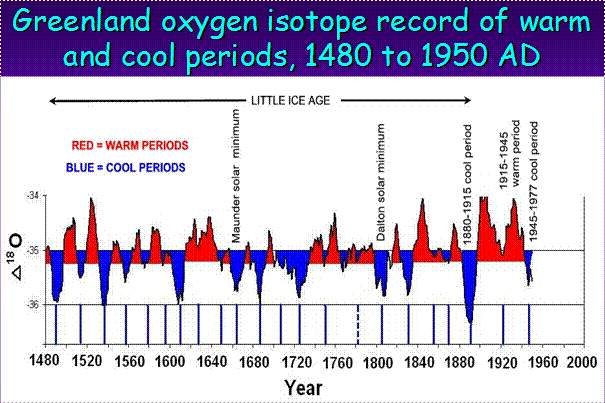
Alternating periods of warm and cooler weather have been with us as far back as our climate records go. Some of the past cooler periods have been more severe than others, like the Sporer, Maunder and Dalton Minimums. Professor Don Easterbrook has documented some 20 such cool periods over the last 500 years

Figure 1

graphic: Don Easterbrook

3. Taking just the main ocean cycles, the AMO is a 66 year cycle.

AMO peaks occurred on May 1878 and November 1944. The next peak is forecasted to occur in April 2011. The last trough occurred in January 1978, and the next trough is expected to occur in June 2044. As we see here, the length of a complete cycle is about 66.5 years.

The AMO went positive in 1994 and actually peaked in July 2010 and is now on its way down. It should go negative sometime in 2015 and remain negative till about 2048.

4. The Pacific Decadal Oscillation (PDO) has a shorter cycle of about 60 years.

graphic: digitaldiatribes.files.wordpress.com

The PDO cycle is not quite as long as AMO. Because the periods differ, their peaks and troughs will vary relative to each other. This has an interesting long-term result in terms of warming and cooling. The PDO had a peak in the function in October 1929 (about 15 years prior to AMO). The next peak occurred May 1990 (about 21 years prior to the anticipated AMO peak). The period here is about 60.5 years.

PDO has gone negative since September 2007  and will remain in negative territory probably for the next 30 years. For about 2 decades the PDO and the AMO will both be negative (but as can be seen above the amplitude of the short term variations are so large that short periods in the positive region are perfectly possible and inevitable, even while the long term average is negative or vice versa.)

5. ENSO and the efects of La Niñas and El Niños.

Returning to Matti Vooro’s article:

During negative or cool phases of PDO and AMO, there are more La Niñas than during the positive phases. This contributes to more cold winters and colder years during negative PDO. During positive or warm phases of PDO and AMO, there are significantly more El Niños. This is why there is more warming when the PDO is positive. The current negative or cool PDO and the La Niña are why we have had all the recent cold weather. The La Niña’s may have directly contributed to the Red River Flooding of 2009 and the recent flooding in Australia and Brazil.

…. The AMO is affected by ENSO cycles, especially El Ninos, so we saw a brief warming of AMO during 2010. Climate history shows that global cooling was strongest when both the PDO andAMO were both simultaneously in the negative or cool mode – like in 1964-1976 and again 1916 to 1923. The AMO cycles have been quite variable. During its last cycle it was in the negative or cool mode for 30 years (1964-1994] and its cycle seems to be related to the Meridional Overturning Circulation [MOC] and the changes in the Atlantic Thermohaline Circulation [THC]. There are a number of estimates when it will again go negative. My best estimate is about 2015 based on the most frequent past intervals of around 20 years and the cooler waters that feed the MOC from the Southern Oceans. Once it does go negative, the global temperature anomalies may drop further until about 2030, the Arctic temperature may cool further and the Arctic ice extent should increase again.

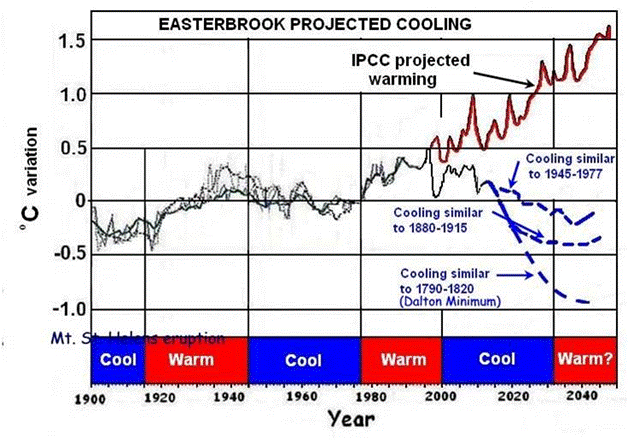
Professor Easterbrook has made a global forecast for temperature:

The IPCC projections are no longer credible but it must be borne in mind that these projections had little to do with actually bringing science to make the best forecast possible but instead were focused on poltical objectives; it seems mainly to redistribute wealth and to demonise CO2 so as to drive the carbon trading market.

That global cooling is upon us seems more and more likely and I apprehend that Easterbrooks’s lowest curve will materialise and show that the current Landscheidt minimum will be comparable to the Dalton minimum.

Solar Cycle 24 is unusually quiet but not unprecedented

December 29, 2010

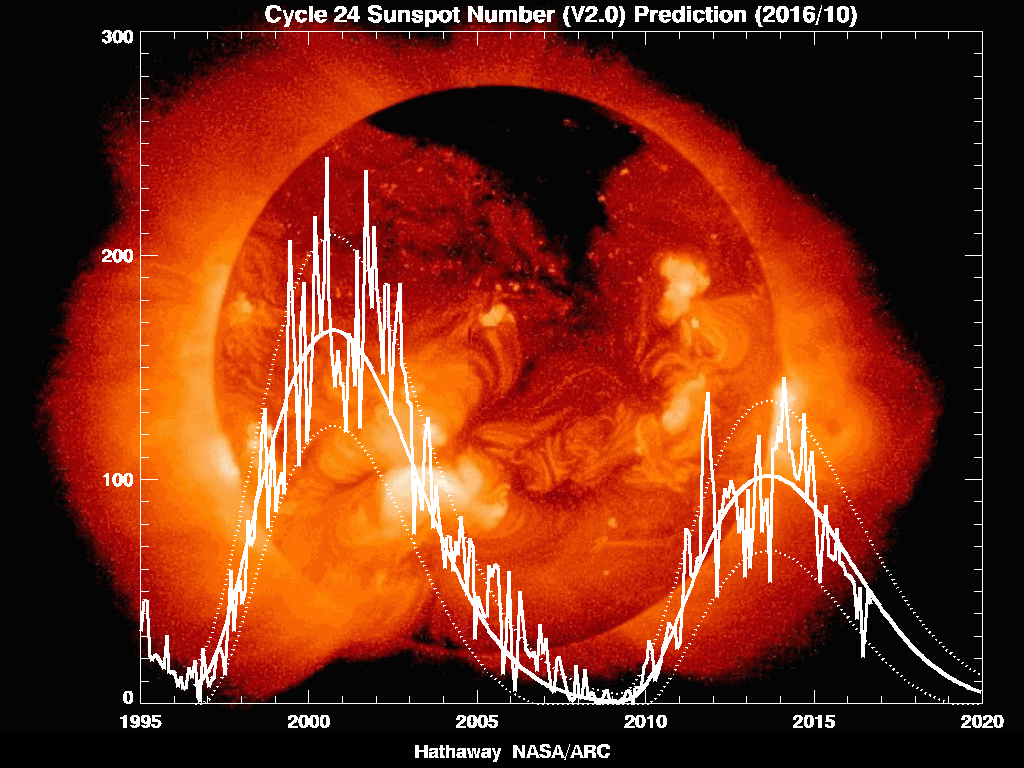
NASA has made a new reduced forecast for the peak sunspot number and the time of occurrence of the peak of Solar Cycle 24. The peak number has been reduced from 90 to 64 and the time of the peak is unchanged at June 2013.

I have superimposed the development of the forecast peak and time of the peak on the base forecast. This is not any criticism of the forecast. It only emphasises that the forecasts are about something which is not very well understood. So far the forecast development is only in the direction of reducing sunspot numbers and delays in the time of attaining the peak. As the peak actually approaches the forecasts should stabilise but there is still some room for further reduction. It is not inconceivable that the SC24 will not peak till early 2014 and will only achieve peak sunspot numbers around 55. Solar cycle 24 could well have a length of 150+ months instead of the nominal 132 months.


SC24 forecast development superimposed on NASA forecast (http://solarscience.msfc.nasa.gov/images/ssn_predict_l.gif)

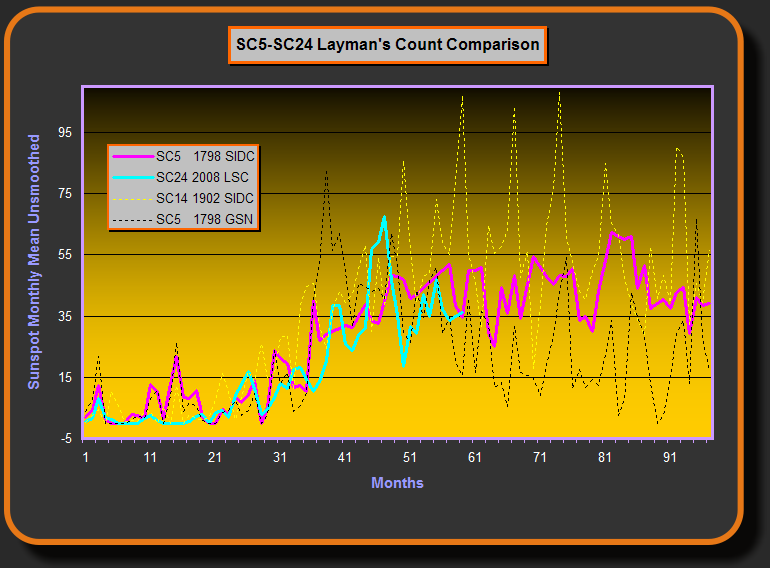
That SC24 represents a very quiet sun and that taken together with SC23 this Landscheidt minimum represents a behaviour similar to the period leading up to the Dalton minimum is quite clear insofar as sunspot number is concerned. But the length of Solar Cycle 23 and its extended quiet period also has precedence.

Further similarities to SC4 and 5 were reported in

Agee, Ernest M., Emily Cornett, Kandace Gleason, 2010: An Extended Solar Cycle 23 with Deep Minimum Transition to Cycle 24: Assessments and Climatic Ramifications. J. Climate, 23, 6110–6114.
doi: 10.1175/2010JCLI3831.1

The extended length of solar cycle 23 and the associated deep quiet period (QP) between cycles 23 and 24 have been examined using the international sunspot record from 1755 to 2010. This study has also introduced a QP definition based on a (beginning and ending) mean monthly threshold value of less than 10 for the sunspot number. Features addressed are the length and intensity of cycle 23, the length of the QP and the associated number of spotless days, and the respective relationships between cycle intensity, length, and QP. The length of cycle 23 (153 months) is second only to cycle 4 (164 months), with an average of 132.5 months for the 11-yr cycle. The length of the QP between cycles 23 and 24 ranks eighth, extending from October 2005 through November 2009 (but subject to continued weakness in cycle 24). The number of spotless days achieved within this QP was 751 (and for all days within the transition from cycle 23 to cycle24, a record number of 801 spotless days had been observed through May 2010). Shortcomings of solar-convection-model predictions of sunspot activity and intensity are also noted, including the failure in the initial predictions of cycle-24 onset.

It would not be too surprising if SC24 only reached levels which were  lower than the Dalton minimum and perhaps even approaching the lows of the Maunder minimum.


The Sun moves to its own music

October 6, 2010

Totally impervious to vulgar 10:10 videos, biodiversity 10.10 campaigns, 0% interest rates and other goings-on on Earth, the Sun moves to its own music.

It was spotless again.

Spotless Sun 5th October 2010: NASA image

Sunspot numbers and 10.7 flux continue to be significantly lower than forecast (and the forecast for Cycle 24 were pretty low to begin with).

2010/10/05 08:00 Today was spotless although Locarno managed to see two groups. The specks were tiny and would be on the fringe of visibility on the original Wolf 64x telescope on a perfect day. What could be old area 1106 may be returning in the next two days.

Yesterday’s adjusted F10.7 flux figures recorded a high of 76.6 (81.4) and a low of 74.7 (78.8), unbelievably low.

F10.7 Radio Flux (including September 2010)

That we are in a solar minimum (the Landscheidt minimum) seems clear but whether it will be a grand minimum remains to be seen.

sc5 sc24 comparison

sc5,sc14 comparison with sc24

And the sun will surely impact our climate — but how?

And in any case the sun gets no feedback and it does not much care.