Archive for January, 2014

Thank goodness for Prince Charles

January 31, 2014

I am a fairly sceptical sort – on most things and not just about global warming. I am not impressed by ungrounded statements and I tend to dislike appeals to authority.

He is generally quite harmless and now getting frustrated with his mother’s refusal to abdicate. But I also rely on Prince Charles as the ultimate non-authority on everything he cares to open his mouth about. Among other things he believes in Kabbalistic teachings, herbal medicine and homeopathy. He was an avid fox hunter (now banned and he is therefore against it) and seems to approve of Robert Mugabe!

So I do not mind being called a headless chicken, and since it is from Prince Charles, I can take it as an accolade.

The Guardian (where else):

Climate change sceptics are ‘headless chickens’, says Prince Charles

“It is baffling, I must say, that in our modern world we have such blind trust in science and technology that we all accept what science tells us about everything – until, that is, it comes to climate science,” 

It does not take much to baffle him, and in any case it is best as a future King of England that he not think too much for himself.

Rosling’s health, wealth and statistics

January 31, 2014

Hans Rosling’s tour de force: 200 countries, 200 years, 4 minutes.

This is not new and I think I first saw it about 3 years ago.

But it is worth looking at not just for the content but also for the power of the presentation.

Just a reminder that the world is feeding more people than ever before, we are living longer than ever before, and things are not as black as some alarmists would have us think. And by 2100 total population will be declining.

The glass is more than half-full.

A much longer (20 minutes) presentation is also well worth watching.

Neanderthal genes are everywhere

January 30, 2014

Neanderthal genes are everywhere

We seek them here, we seek them there,

We met them often – but when? And where?

They are in our skins and in our hair,

Neanderthal genes are everywhere

From, Sriram Sankararaman et al, The genomic landscape of Neanderthal ancestry in present-day humansNature, 2014; DOI:10.1038/nature12961

Harvard Press ReleaseRemnants of Neanderthal DNA in modern humans are associated with genes affecting type 2 diabetes, Crohn’s disease, lupus, biliary cirrhosis and smoking behavior. They also concentrate in genes that influence skin and hair characteristics. At the same time, Neanderthal DNA is conspicuously low in regions of the X chromosome and testes-specific genes.

Coal is still king in Svalbard

January 29, 2014

Svalbard, ranging in latitude from 74°N to 81°N,  is about as close as you can come to the “top of the world”. The mining of coal would not normally be thought of in the Arctic and that close to the North Pole but the Svalbard economy is dominated by coal mining. The population of Svalbard had increased by two percent, to 2,158 at the end of 2012.

CIA Factbook: The settlements on Svalbard are essentially company towns. The Norwegian state-owned coal company employs nearly 60% of the Norwegian population on the island, runs many of the local services, and provides most of the local infrastructure. There is also some hunting of seal, reindeer, and fox. Goods such as alcohol, tobacco, and vehicles, normally highly taxed on mainland Norway, are considerably cheaper in Svalbard in an effort by the Norwegian government to entice more people to live on the Arctic archipelago. By law, the Norwegians collect only enough taxes to pay for the needs of the local government. None of tax proceeds go to Norway.

Svalbard

Svalbard

Science Nordic reports:

The economy of Svalbard, the Norwegian arctic archipelago that lies between the country’s mainland and the North Pole, is still dominated by coal even as its value dwindles and employment in the mines drops. …

Tourism, a college and polar and space research activities have yet to make this community independent of coal. This has been verified by a recent analysis of Svalbard’s socio-economic status by the Norwegian Institute for Urban and Regional Research (NIBR).

“Coal mining has always been the mainstay here, and it still is,” says researcher Steinar Johansen, who wrote the report with his colleague Hild Marte Bjørnsen. ….. In addition to all who are directly employed by the local coal company, Store Norske, mining requires a number of sub-venders, and services need to be provided to family members who move to Svalbard’s little town, Longyearbyen, at the chilly latitude of 78° N. …

But can the Svalbard community surive without coal? Not without major changes, according to the researchers.

Tthe statue of the coal miner in the town of Longyearbyen is a reminder of who – or what – really dominates the economy. (Photo: Georg Mathisen)

From graphene to borophene

January 29, 2014

Technology development waves

The discovery of graphene is leading to a new excitement in materials research. I have a notion that technology advances take place in step waves, where each step is both enabled and constrained by the materials available. Each time a new material (or material family is discovered), technology development starts very fast and then tapers off until another material comes along and ignites a new development wave.

Boron is Carbon’s neighbour in the periodic table and the discovery of graphene has ignited studies to see if a similar variation of boron would be possible.

Boron is a Group 13 element that has properties which are borderline between metals and non-metals (semimetallic). It is a semiconductor rather than a metallic conductor. Chemically it is closer to silicon than to aluminium, gallium, indium, and thallium. Crystalline boron is inert chemically and is resistant to attack by boiling HF or HCl. When finely divided it is attacked slowly by hot concentrated nitric acid.

Boron, Symbol: B, Atomic number: 5, Atomic weight: 10.811, solid at 298 K

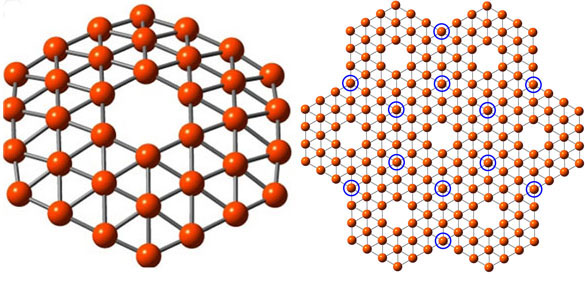
“Boron has one fewer electron than carbon and as a result can’t form the honeycomb lattice that makes up graphene. For boron to form a single-atom layer, theorists suggested that the atoms must be arranged in a triangular lattice with hexagonal vacancies — holes — in the lattice.”

A new paper shows that borophene is possible – now it just has to be made!

Zachary A. Piazza, Han-Shi Hu, Wei-Li Li, Ya-Fan Zhao, Jun Li, Lai-Sheng Wang.Planar hexagonal B36 as a potential basis for extended single-atom layer boron sheetsNature Communications, 2014; 5 DOI: 10.1038/ncomms4113

Brown University Press Release:

Unlocking the secrets of the B36 cluster
A 36-atom cluster of boron, left, arranged as a flat disc with a hexagonal hole in the middle, fits the theoretical requirements for making a one-atom-thick boron sheet, right, a theoretical nanomaterial dubbed “borophene.” Credit: Wang lab/Brown University

Graphene, a sheet of carbon one atom thick, may soon have a new nanomaterial partner. In the lab and on supercomputers, chemical engineers have determined that a unique arrangement of 36 boron atoms in a flat disc with a hexagonal hole in the middle may be the preferred building blocks for “borophene.”

Researchers from Brown University have shown experimentally that a boron-based competitor to graphene is a very real possibility.

Lai-Sheng Wang, professor of chemistry at Brown and his research group, which has studied boron chemistry for many years, have now produced the first experimental evidence that such a structure is possible. In a paper published on January 20 in Nature Communications, Wang and his team showed that a cluster made of 36 boron atoms (B36) forms a symmetrical, one-atom thick disc with a perfect hexagonal hole in the middle.

“It’s beautiful,” Wang said. “It has exact hexagonal symmetry with the hexagonal hole we were looking for. The hole is of real significance here. It suggests that this theoretical calculation about a boron planar structure might be right.”

It may be possible, Wang said, to use B36 basis to form an extended planar boron sheet. In other words, B36 may well be the embryo of a new nanomaterial that Wang and his team have dubbed “borophene.”

“We still only have one unit,” Wang said. “We haven’t made borophene yet, but this work suggests that this structure is more than just a calculation.” ……..

Wang’s experiments showed that the B36 cluster was something special. It had an extremely low electron binding energy compared to other boron clusters. The shape of the cluster’s binding spectrum also suggested that it was a symmetrical structure. ……..

…… That structure also fits the theoretical requirements for making borophene, which is an extremely interesting prospect, Wang said. The boron-boron bond is very strong, nearly as strong as the carbon-carbon bond. So borophene should be very strong. Its electrical properties may be even more interesting. Borophene is predicted to be fully metallic, whereas graphene is a semi-metal. That means borophene might end up being a better conductor than graphene.

“That is,” Wang cautions, “if anyone can make it.”

AbstractBoron is carbon’s neighbour in the periodic table and has similar valence orbitals. However, boron cannot form graphene-like structures with a honeycomb hexagonal framework because of its electron deficiency. Computational studies suggest that extended boron sheets with partially filled hexagonal holes are stable; however, there has been no experimental evidence for such atom-thin boron nanostructures. Here, we show experimentally and theoretically that B36 is a highly stable quasiplanar boron cluster with a central hexagonal hole, providing the first experimental evidence that single-atom layer boron sheets with hexagonal vacancies are potentially viable. Photoelectron spectroscopy of B36 reveals a relatively simple spectrum, suggesting a symmetric cluster. Global minimum searches for B36 lead to a quasiplanar structure with a central hexagonal hole. Neutral B36 is the smallest boron cluster to have sixfold symmetry and a perfect hexagonal vacancy, and it can be viewed as a potential basis for extended two-dimensional boron sheets.

Parsing Obama’s SOTU on climate matters: A paean to shale gas

January 29, 2014

Obama’s SOTU address will be spun in many different ways but I felt it was a remarkable paean to gas. Climate change is undeniable but he took care not to call it global warming. Not a lot of alarmism as he praised the effects of using gas. He avoided mentioning the words “fracking” or “shale”. It was all “natural” gas. He tried to give some credit to solar energy but only as an afterthought. Besides, his implication was that gas is not really a fossil fuel!

The entire section is just GAS! Gas! Gas! 

Extracts from Obama’s speech in blue. My comments in red.

“Now, one of the biggest factors in bringing more jobs back is our commitment to American energy.  The all-of-the-above energy strategy I announced a few years ago is working, and today, America is closer to energy independence than we’ve been in decades.

Yes. Entirely due to fracking and shale gas and shale oil. The effect of renewables has been negligible.

One of the reasons why is natural gas – if extracted safely, it’s the bridge fuel that can power our economy with less of the carbon pollution that causes climate change.  Businesses plan to invest almost $100 billion in new factories that use natural gas.  I’ll cut red tape to help states get those factories built, and this Congress can help by putting people to work building fueling stations that shift more cars and trucks from foreign oil to American natural gas.  My administration will keep working with the industry to sustain production and job growth while strengthening protection of our air, our water, and our communities.  

A tribute to shale fracking – without saying so.

And while we’re at it, I’ll use my authority to protect more of our pristine federal lands for future generations.

Except if there is shale gas to be found.

It’s not just oil and natural gas production that’s booming; we’re becoming a global leader in solar, too.  Every four minutes, another American home or business goes solar; every panel pounded into place by a worker whose job can’t be outsourced. 

Really! Pounding a solar panel into place!!!!! And not one of those homes gives up its connection to the grid.

Let’s continue that progress with a smarter tax policy that stops giving $4 billion a year to fossil fuel industries that don’t need it, so that we can invest more in fuels of the future that do.

Like shale gas – which as we all know – cannot be called fossil energy.

And even as we’ve increased energy production, we’ve partnered with businesses, builders, and local communities to reduce the energy we consume.  When we rescued our automakers, for example, we worked with them to set higher fuel efficiency standards for our cars.  In the coming months, I’ll build on that success by setting new standards for our trucks, so we can keep driving down oil imports and what we pay at the pump.

And while he was speaking it was 17°F with light snow in Washington and fossil fuels were heating the city.

Taken together, our energy policy is creating jobs and leading to a cleaner, safer planet.  Over the past eight years, the United States has reduced our total carbon pollution more than any other nation on Earth. 

True and entirely due to the use of gas.

But we have to act with more urgency – because a changing climate is already harming western communities struggling with drought, and coastal cities dealing with floods. 

Forget that we had less storms in 2013 than ever before. And Califiornia’s drought is due to climate change. Schwarzenegger said so and he should know.

That’s why I directed my administration to work with states, utilities, and others to set new standards on the amount of carbon pollution our power plants are allowed to dump into the air. 

The EPA will be my palace police. And of course if we reduce carbon (dioxide) emissions all droughts and storms and ice melting will miraculously cease!!

The shift to a cleaner energy economy won’t happen overnight, and it will require tough choices along the way.  But the debate is settled.  Climate change is a fact. 

Oh my!. Climate change is settled – ( He never said it was global warming)!

And when our children’s children look us in the eye and ask if we did all we could to leave them a safer, more stable world, with new sources of energy, I want us to be able to say yes, we did.”

Meaningless rhetoric. Just how his children’s children will get to look him in the eye is a little unclear. When was the last time you looked into the eyes of a grandparent and blamed them or praised them for the state of the world?

Sochi Winter Olympics: Champions of Corruption

January 28, 2014

A new site defines the Champions of Corruption at the Sochi Winter Games.

The site asserts:

sochi champions of corruption

Athletes are not the only people who compete in Sochi. Officials and businessmen also took part in the Games and turned them into a source of income. The Anti-Corruption Foundation honored the most distinguished money siphoners in five different sports

Classic Embezzlement, Arkady Rotenberg  

Verbal Freestyle, Vladimir Putin 

Ecological Multi-Sport, Vladimir Yakunin 

Pair Contract, Alexander Tkachyov and Roman Batalov 

Figure Lending, Vladimir Potanin

The site is ostensibly anti-corruption but the objectives are clearly political:

The AustralianAlexei Navalny, an anti-corruption campaigner who ran for mayor of Moscow last September, has used the site to combine data gathered during his own investigations with media accounts and other activists’ reports. According to Mr Navalny’s Encyclopaedia of Spending, the athletes are not the only people who compete: “Officials and businessmen also took part in the Games and turned them into a source of income.”

His site honours five “champions of corruption”, including President Vladimir Putin, who is accused of lying about the cost of the project when he claimed it was $US6.5 billion. Mr Putin has rejected the claims.

Flatulent cows blow up their shed

January 28, 2014

One cow was treated for burns

Reuters

Methane gas from 90 flatulent cows exploded in a German farm shed on Monday, damaging the roof and injuring one of the animals, police said.

High levels of the gas had built up in the structure in the central German town of Rasdorf, then “a static electric charge caused the gas to explode with flashes of flames,” the force said in a statement.

One cow was treated for burns, a police spokesman added.

Flatulence Tax - graphic BBC

NZ Flatulence Tax – graphic BBC

The EU’s green sickness: Competitiveness and shale gas at Davos

January 28, 2014

It is my contention that the spread of perverse “Green” energy policies in Europe are partly responsible if not for the financial crisis itself, certainly for its prolongation and for slowing down the recovery. It is also my contention that it is the deadening and oppresive inertia that is represented by the “obese” and self-preserving nature of the EU bureaucracy in Brussels which has prevented individual countries in Europe from taking fast corrective actions when needed.

It is now energy costs for industry (and not just labour policies) which is increasing the competitiveness divide between Europe and the US. It seems that this competitiveness – or lack of it – was of some passing interest at Davos:

CNBC

One of the biggest themes at Davos this year — and one that was not there last year — was “competitiveness.” You encountered it whether in the public sessions in the Congress Center, or in the private sessions, and at the various dinners in the hotels strung along the Davos Platz.

This particular rivalry pits the United States head-on against Europe. And, no question — at Davos this year, the United States was judged the clear winner, much to the dispirit of the Europeans trudging back along the icy, snowy streets of this mountain village.

Of course, competitiveness among nations gets measured in many different ways. …… But this year at Davos, it was calibrated along only one axis — energy. And that measure is creating great angst for European industry. …… It all comes down to shale gas and the energy revolution it has triggered in the United States. As a result of the rapid advance of shale technology, the United States now has an abundance of low-cost natural gas — at one-third the price of European gas. European industrial electricity prices are twice as high as those in some countries and are much higher than those in the United States. To a significant degree, this is the result of a pell-mell push toward high-cost renewable electricity (wind and solar), which is imposing heavy costs on consumers and generating large fiscal burdens for governments. In Germany, it was further accentuated by the premature shutdown of its existing nuclear industry after the 2011 Fukushima nuclear accident in Japan. 

All this puts European industrial production at a heavy cost disadvantage against the United States. The result is a migration of industrial investment from Europe to the United States — what one CEO called an “exodus.” It involves, not only energy-intensive industries like chemicals and metals, but also companies in the supply chains that support such industries. …….. a senior European official declared that Europe needs to wake up to the “strategic reality” that shale gas in the United States is a “total game changer.” Without a change in policies at both the European and national levels, he warned, Europe “will lose our energy intensive industries — and we will lose our economy long term.” ……..

And the first signs of a potential change of policy abruptly emerged in both Brussels and Berlin during Davos week. European policy makers, struggling with already high unemployment, have begun to visualize the further job loss that will result from shutting down European plants. They have also started to pay attention to the 2.1 million jobs in in the United States supported by the unconventional oil and gas revolution.

In Brussels, coinciding with the first day of Davos, the European Commission released a new policy paper on energy and climate. It reiterated the commitment to substantial growth in renewable electricity and a “low-carbon economy.” But, for the first time, it put heavy emphasis on the price of such policies and called for a “more cost-efficient approach” to renewables. ….. Despite the fervent opposition to shale gas in some quarters in Europe, it pointedly included shale gas as among the domestic low-carbon energy sources that member countries can pursue.

……… A similar message resounded at exactly the same time from Berlin. Sigmar Gabriel, the social democratic minister of economy and energy in Germany’s coalition government, called for reform in Germany’s Energiewende — or “energy turn” policy — which has heavily subsidized the rapid growth in renewable electricity. He warned that the “anarchy” in renewable energy and its costs in Germany had to be reined in. ……… Up until now, the Energiewende in its present form has been sacrosanct, supported not just by the Greens but all across the political spectrum. Gabriel — and Chancellor Angela Merkel — aim to maintain the commitment, but reduce subsidies, focus more on costs, and, as Gabriel said, “control the expansion of renewable energy.”

His comments reflect the recognition that, if the course remains unchanged, Germany could be facing what Gabriel called “a dramatic deindustrialization.” ………. Exports are responsible for over 50 percent of German GDP, compared to 27 percent for China, which is generally considered to be the workshop of the world.

Gabriel’s comments stirred up criticism from environmentalists; indeed, they may seem strange words coming from the leader of the Social Democrats (the SPD). But the Social Democrats are very close to the trade unions, for which loss of competitiveness translates into loss of jobs.

In 2 decades of green profligacy, I estimate the “jobs lost” by the ” growth prevented” to be around 17 million just within the EU.

US “sells” Norway Ambassadorship to an uninformed hotelier

January 27, 2014

The uglier side of “democracy”.

That generous donors to the US political parties are rewarded with Ambassadorships is common knowledge. The smaller and “less important” countries are usually the destination for these bought positions unless a very large donation is made. $6.2 million can buy an Ambassadorship to France or Monaco.

And now Norway knows precisely how unimportant it is considered by Obama’s establishment as George Tsunis, a rich Greek-American hotelier and a very generous donor to the Democratic Party made an idiot of himself at the Senate confirmation hearings. After all he can’t do much harm sitting in Oslo!!!

He thought Norway was a Republic and didn’t know which parties were in the coalition ruling Norway. It would have been pointless asking him the name of the King. An ignorant person is a correct description – at least about Norway. He does apparently know something about running a hotel. It does not say much for his knowledge (and perhaps also his intelligence) but it does not say much either for the briefings he must have received from the State Department. A member of the Greek Orthodox church now going to be an expert in a Lutheran country!!

Or did the career diplomats deliberately make sure he was not briefed properly because they wanted to showcase his ignorance? 

George Tsunis at US Senate in Jnuary 2014 - source screen grab - The Local

George Tsunis at US Senate in Jnuary 2014 – source screen grab – The Local

Future US envoy displays total ignorance of Norway

The US’s next ambassador to Norway has committed a jaw-dropping diplomatic blunder before he even begins, describing politicians from the Progress Party, which has seven ministers, as “fringe elements” that “spew their hatred” in a US Senate hearing.

Asked by Senator John McCain what he thought it was about the “anti-immigration” Progress Party that appealed to Norwegian voters, Greek American businessman George Tsunis seemed unaware of the party’s role in the ruling coalition. 
“You get some fringe elements that have a microphone and spew their hatred,” he said in the pre-appointment hearing. “And I will tell you Norway has been very quick to denounce them.” 
McCain interrupted him, pointing out that as part of the coalition, the party was hardly being denounced. 
“I stand corrected,”  Tsunis said after a pause.  “I would like to leave my answer at… it’s a very,very open society and the overwhelming amount of Norwegians and the overwhelming amount of people in parliament don’t feel the same way.”
The blunder came after a faltering, incoherent performance from Tsunis, in which he made a reference to Norway’s “president”, apparently under the impression that the country is a republic rather than a constitutional monarchy. 
Tsunis founded the hotel management company Chartwell Hotels, which operates properties for InterContinental Hotels, and other major hotel groups. He is one of the leading figures in the Greek-American establishment, and is heavily involved in the Greek Orthodox Church. 
He donated $267,244 to the Democratic party in the 2012 election cycle, and $278,531 in 2010, making him one of the party’s top individual donors. 
His ineptitude has also been noticed in the US (but he was confirmed anyway).

billmoyers.com:

The State Department is filled with veteran foreign service officers with years of experience in international relations. Most of them are products of elite universities, where they studied subjects like conflict resolution or international trade theory. Many are multilingual, and all have deep expertise on the political scenes of various countries.

Yet they routinely watch as deep-pocketed political donors with little or no foreign service experience are appointed to serve as America’s ambassadors overseas. The practice is so common that a pair of international relations scholars at the University of Pennsylvania were able to put prices on various plumb ambassadorships. According to The New York Times, “the study found that political ambassadors who had made campaign donations of $550,000, or bundled contributions of $750,000, had a 90 percent chance of being posted to a country in Western Europe.” The best postings — in France or Monaco — could cost up to $6.2 million in direct contributions. ….

Other Norwegian media described Tsunis as having “trampled through the salad bowl,” according to Olivier Knox at Yahoo NewsKnox added that Tsunis wasn’t the first to fumble the hearing:

McCain, already flummoxed by the apparent inability of Obama’s choice to be ambassador to Hungary to list strategic US interests there, closed his questioning with a bit of sarcasm: “I have no more questions for this incredibly highly qualified group of nominees.”