Archive for the ‘Aviation’ Category
January 11, 2012
SAS – which used to be one of my favourite airlines – needs new owners with access to larger markets and with financial muscle.
Lufthansa was – and still is – the most likely buyer. But in the last 2 days the rumors of interest from Qatar have been driving up the SAS share price. Of course the rumors have been denied.
 But SAS is unsustainable as it is and something is due to happen with SAS ownership this year. And my guess would be that the clear fit and benefits would point to Lufthansa rather than Quatar.

Tags:Business and Economy, Lufthansa, Qatar, SAS
Posted in Aviation, Business | Comments Off on Will SAS be acquired by Qatar or Lufthansa?
December 28, 2011
The long running saga for the purchase of 126 combat aircraft for the Indian Air Force (worth in excess of 11 Billion $) is coming to a head between the 2 short listed – the Eurofighter Typhoon (UK, Germany, Italy and Spain) and the French Rafale. In April, Boeing’s F/A-18 Super Hornet, Lockheed Martin’s F-16IN Super Viper, the MiG Corporation’s MiG-35 and Saab’s Gripen NG were eliminated after the technical evaluation leaving Dassault’s Rafale to compete with the Eurofighter built by a 4-country consortium. The winner is likely to sell a further 80 – 100 aircraft in a second phase. One requirement that the suppliers will be judged on is the extent to which technology transfer will take place and the extent to which Indian industry can become sub-suppliers. Rumours in the Defence Ministry are indicating a decision in the first half of January 2012.
The political support for the Eurofighter has reached its peak with a joint letter written by the leaders of the four supplier countries to the Indian Government welcoming India as a “fifth partner country”.
(more…)
Tags:Dassault Rafale, Eurofighter Typhoon, Eurofighter versus Rafale, India, Indian Air Force, Indian MRCA competition, MMRCA
Posted in Aviation, Defense, India | 4 Comments »
October 31, 2011
The protracted process for the $10 billion (which will become $15 billion) contract for the supply of 126 fighter aircraft (MMRCA – Medium Multi-Role Combat Aircraft) to the Indian Air Force is coming into its final lap. Eurofighter Typhoon and Dassault’s Rafale made the short list and have been asked to submit their “best and final offers”. The financial bids will be opened on November 4th. The contract is expected to contain an option for an additional 63 aircraft.
MSN India reports:
With the decision of the defence ministry to open the financial bids early next month of the two finalists in the IAF?s medium multi role combat aircraft (MMRCA) tender, IAF can now hope to acquire the first lot of 18 aircraft by end-2014 or mid-2015, depending on when the contract is signed.
The ministry completed the formalities last week and sent letters Monday to representatives of Eurofighter and Rafale for opening the bids on the afternoon of Friday, November 4. The representatives would authenticate the tender packets as their own and as submitted by them earlier, in the presence of senior ministry officials, and then they would be opened by one of the designated officers. …
Although the ministry’s initial assessment was that the deal could be worth around $10 billion, the Rafale and Eurofighter should cost somewhere around $15 billion. … it was only in 2007 that a Request for Proposals (RFP), or tender, was issued to these two European companies as well as US Lockheed Martin for the F-16 Super Viper and Boeing for F/A-18 Super Hornet, Swedish Saab for the Gripen and Russia’s Rosoboronexport for Mig 29M2, later designated Mig 35.

Eurofighter Typhoon for Indian contract? image: defpro.org
The bids are valid till the end of December so the final contract could be awarded by then. But this is India and Dassault for Rafale and the Cassidian European consortium for the Eurofighter could always be asked to extend the validity or to renew their bids.
But it does seem that the long tendering and contracting process which began in 2007 is finally coming to an end.
My guess is that the Eurofighter Typhoon will be chosen.
Tags:best and final offers, Dassault Rafale, Eurofighter Typhoon, India, Indian Air Force, Indian MRCA competition
Posted in Aviation, Defense, India, Technology | 2 Comments »
October 25, 2011
Ryanair apparently considers that the use of sticky tape to fix cracks in aircraft is a routine technical issue. It begs the question as to how often Ryanair fixes its mechanical problems on aircraft with string and sticky tape.
Ryanair flight forced to land after crew fixed pilot’s window with sticky tape
A Ryanair flight carrying 200 people was forced to turn back to Stansted after sticky tape used to ‘patch up’ the pilot’s window came loose.
The Irish Aviation Authority (IAA) said the tape was being used merely as an extra precaution to secure a new window seal.
But the pilot made the decision to terminate the flight after the tape became loose and started making flapping noises. One passenger, Anthony Neal from Kent, told The Sun: ‘We were kept in the dark, and were terrified. I could see guys taping in the windscreen with what looked like duct tape or gaffer tape. ‘We were in the sky, then the pilot said due to damage on the windscreen, we were going to have to turn back.’
Ryanair has insisted that normal procedures had been followed and that there was no danger to passengers or crew. A spokesman said: ‘We do not comment on routine technical issues. All Ryanair flights operate in accordance with approved safety standards.’
Tags:Duct tape, Irish Aviation Authority, London Stansted Airport, Ryanair, sticky tape fix, string and sticky tape repairs
Posted in Aviation, Engineering | Comments Off on Ryanair redefines “low cost” with a sticky tape fix
August 5, 2011
Ryanair has its points but caring for its passengers is not one of them. From The Local:
A furious Swedish family has blasted a Ryanair cabin crew after a passenger slipped into cardiac arrest and was just offered a sandwich and soda.
“We want Ryainair to apologise,” disgruntled passenger Billie Appleton told the Aftonbladet newspaper. Appleton’s stepfather, 63-year-old Per-Erik Jonsson, fell ill during the flight back to Sweden from England on Sunday and at one point went into cardiac arrest. According to Appleton, staff onboard were hopelessly ill-equipped to treat him.
“They said he had low blood pressure and gave him a sandwich and a soda. And they made sure he paid for it,” she told the newspaper. The incident occurred about an hour into the flight to Sweden when Jonsson broke into a cold sweat and asked his wife for some water. Suddenly his wife realised that Jonsson had lost consciousness and while she alerted staff, Appleton, a nurse, intervened. “He didn’t respond when I tried to shake him. But after I slapped him in the chest, he began breathing again,” she said, adding that staff only reacted when she shouted for a doctor and that he needed oxygen.
Their diagnosis, according to Appleton, was that it was a blood pressure problem and that he should have something to eat. She claimed that once the situation had stabilised, the only attention they got from the crew was when they asked for payment for the food and drink.
Tags:a sandwich and a soda, Cardiac arrest, Ryanair, treatment of passengers
Posted in Aviation, Behaviour, Ethics | Comments Off on A sandwich and a soda (paid for) is Ryanair’s treatment for a heart attack!
June 23, 2011
Two days ago:
21st June: A Russian plane exploded into flames after crashing on a highway just short of its airport, killing 44 and leaving eight survivors fighting for their lives, officials said Tuesday.
The RusAir Tupolev 134 was trying to land at its destination of Petrozavodsk in the Karelia region of northwestern Russia in bad weather but failed to make the runway and instead hurtled onto a road 1.25 miles away.
The impact of the landing blasted parts of the plane and corpses of the passengers several hundred meters distant as the burning wreckage blazed in the night sky.
“The plane sustained a hard landing two kilometres from Petrozavodsk,” the emergencies ministry said in a statement on its website. “Forty-four people were killed and eight people injured.”

The wreckage of Tu-134 plane, belonging to the RusAir airline, is seen on a highway near the city of Petrozavodsk Tuesday, June 21, 2011. Photo AP
But today’s Haaretz reports that:
Nuclear experts killed in Russia plane crash helped design Iran facility.
The five Russian scientists were among 44 killed earlier this week; no official investigation of foul play has been opened, though Iranian nuclear experts have in the past been involved in similar accidents.
The five nuclear experts killed in a plane crash in northern Russia earlier this week had assisted in the design of an Iranian atomic facility, security sources in Russia said on Thursday.
The experts – who included lead designers Sergei Rizhov, Gennadi Benyok, Nicolai Tronov and Russia’s top nuclear technological experts, Andrei Tropinov – worked at Bushehr after the contract for the plant’s construction passed from the German Siemens company to Russian hands.
The five were employed at the Hydropress factory, a member of Russia’s state nuclear corporation, and one of the main companies to contract for the Bushehr construction.
While sabotage is not being mentioned officially as a reason for the crash it is not far away from the thoughts of the investigators.
Israeli covert activities have previously been blamed by the Iranian government for the death of two of their nuclear scientists.
Tags:Aviation accidents and incidents, Bushehr, conspiracy theory, Iran, Iran nuclear program, Russia
Posted in Aviation, Nuclear Power, Russia | 3 Comments »
June 22, 2011
Qantas has reached a settlement with engine maker Rolls-Royce over last year’s mid-air disintegration of a the Trent 900 engine, which temporarily forced the grounding of its entire fleet of A380s. The terms of the agreement have not been revealed but will give Qantas a $100 million (A$95 million) boost in profits. For Rolls Royce the cost of the Qantas settlement is therefore likely to be somewhat greater and my guess would be in the region of $110 million.
My estimate made in November 2010 that Rolls Royce would face a hit of around $300 million for direct costs and in settlement costs seems to be not far off the mark. The cost to Rolls Royce of loss of future sales remains intangible and perhaps only temporary.
The Telegraph:
Alan Joyce, the Qantas chief executive, said the terms of the agreement are confidential, but said the settlement’s profit and loss impact would amount to a A$95m boost to the Australian airline’s bottom line.
Mr Joyce said the settlement marks an end to the legal proceedings Qantas launched against Rolls-Royce in the Federal Court of Australia in December.
In November, a Rolls-Royce Trent 900 engine on a Qantas A380 disintegrated shortly after takeoff from Singapore, forcing the plane to make an emergency landing.
The Australian Transport Safety Bureau’s interim report on the A380 incident said a manufacturing defect in an oil pipe deep within one of the engines led to an oil leak, which sparked a fire. The fire caused a disintegration of one of the engine’s giant turbine discs, sending pieces of it shooting through the plane’s wing and raining onto the ground below.
The engine explosion was the most significant safety issue an A380 had ever faced since it began passenger flights in 2007, and prompted intense scrutiny of Rolls-Royce engines.
The settlement will help Qantas recover from the millions it lost following the incident. The airline was forced to temporarily ground its entire fleet of A380s for a series of inspections, and Joyce said the plane damaged by the explosion won’t return to service until February.
“Qantas and Rolls-Royce have had a long and successful commercial partnership spanning several decades,” the airline said in a statement. “Qantas looks forward to a continued strong relationship with Rolls-Royce on the basis of the settlement announced today.”
The compensation payment helped boost the airline’s expected underlying pretax profit for the year to June 30 to between A$500 million (£326m) and A$550 million (£359m), up from A$377 million (£246m) a year ago.
…… Qantas shares rose 0.8 per cent to AU$1.84 in afternoon trading.
This leaves Rolls Royce the task of settling with Airbus and some less costly settlements with Lufthansa and Singapore Airlines.
My estimate is that it will take another 2 to 3 quarters for most of these costs to have worked their way through Rolls Royce’s accounts. However RR will have to bear an increased and continuing service cost regime for some time to come for the Trent 900.
The Trent 1000 for the Dreamliner is still a long way off from generating real revenues for Rolls Royce.

The wrecked Trent 900 engine after the Qantas plane landed in Singapore.Photo: AFP
It could be time to buy Rolls Royce again.
Tags:Airbus A380, Qantas, Rolls-Royce Trent 900, Trent 1000, Trent 900 engine failure
Posted in Aviation, Business, Engineering, Technology | 1 Comment »
May 25, 2011
Once again the blind belief in computer models has closed down parts of European air space. Observations and measurements are given less weight than computer models which are at best crude approximations of a chaotic system. The unthinking belief in approximations to reality merely because they are generated by computer models denies the sapience in homo sapiens!!
BBC:
Most flights have resumed across the UK after a day that saw thousands of passengers affected by an ash cloud from the erupting Icelandic volcano. Air traffic control company Nats said harmful concentrations of ash dispersed from UK airspace overnight. But some flights within the UK and a number to Germany will be cancelled.
As one blogger puts it:
Airline managers are complaining that last year, officials did not do enough to check the actual conditions in the air, instead relying too heavily on computer models showing where the ash was supposed to be. Yet, despite the experience, the International Air Transport Association (IATA) is saying that it is “astonishing and unacceptable” that a British aircraft that is supposed to check actual conditions has been unable to fly.
The disruption arises in part from “volatile winds” which are said to be carrying clouds of volcanic ash down from Iceland over the northern British Isles. But those same winds which caused the rough weather yesterday must also have dispersed the ash.
Without real data, however, forecasters are unable to provide accurate information on ash density and particle size, relying instead on weather patterns and computer modelling to give a rough approximation of conditions. And, with no clear guidance as to closure rules, the only significant difference between this year and last is that the weather conditions are more changeable, allowing more favourable estimates of ash dispersion to be made.
Climate Realists: We know that the Met Office doesn’t bother much with evidence, witness Prof John Mitchell’s unguarded remarks at the Downing College Conference:
People underestimate the power of models. Observational evidence is not very useful,… Our approach is not entirely empirical.
Tags:Alarmism, computer models, Grímsvötn, Volcanic ash, weather
Posted in Alarmism, Aviation, European Union | 1 Comment »
April 27, 2011

Eurofighter Typhoon: Image via Wikipedia
The Indian $10 billion MMRCA order for 126 fighter aircraft now lies between the Eurofighter Typhoon and Dassault’s Rafale. They have been invited to the Indian MoD for further discussions on their commercial bids on April 28. The commercial bids are to expire tomorrow.
These two vendors seem to have have made the shortlist and the other four – Lockheed Martin F16, Boeing F/A 18, MiG-35 and Saab Gripen IN have been left out. Saab confirmed that they have been informed that they have not made the shortlist. (Svenska Dagbladet).
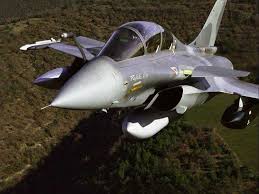
Dassault's Rafale: Dassault
Under the Indian system of procurement, the top two qualifying vendors will be invited for commercial negotiations and the one which offers the best terms (lowest price) will be eventually selected.
Related: Indian MMRCA decision in two weeks – Eurofighter Typhoon still leads
Tags:Dassult Rafale, Eurofighter Typhoon, India MMRCA
Posted in Aviation, Defense, India | 3 Comments »
March 28, 2011
Xinhua News:

March 25, 2011 MA600 aircraft in Luoyang City of central China's Henan Province. (Xinhua/Li Qiaoqiao)
One of China’s new generation of short-haul passenger aircraft, the MA600, was put into use Saturday at a civil aviation training base in southwest China’s Sichuan Province.
The “Modern Ark” 600 was delivered in December last year to the Civil Aviation Flight University of China (CAFUC) by its manufacturer, the Xi’an Aircraft International Corporation (XAIC), which is based in northwestern China’s Shaanxi Province.
CAFUC ordered two MA600 aircraft at the China International Aviation and Aerospace Exhibition, which was held in the city of Zhuhai in Guangdong Province in November 2010.
The MA600 is an upgraded version of the company’s MA60 passenger aircraft and can carry 50 to 60 passengers. The aircraft has been updated with a more comfortable cabin and other design improvements.
“The MA600 also features better performance in regards to safety and fuel efficiency,” said Wang Kaiyin, an official with the CAFUC. The turboprop aircraft has a range of 2,450 km.
Tags:Aircraft, China, short haul aircraft, Xian MA 600
Posted in Aviation, China | 2 Comments »


 The k2p blog