Archive for the ‘Climate’ Category
May 7, 2012
A new paper in Nature Geoscience shows that solar grand minima do indeed cause cooling of the climate in Europe. Around 2800 years ago, one of these Grand Solar Minima, the Homeric Minimum, caused a distinct climatic change in less than a decade in Western Europe. The forcing mechanisms still remain unclear but the evidence that solar effects are significant and cannot be ignored are mounting and persuasive. Now as we enter (or have already entered) a new solar minimum it remains to be seen as to whether this (Landscheidt?) Minimum will be a grand minimum to compare with the Maunder Minimum. In any event a period of global cooling seems likely.
In contrast, the evidence for any anthropogenic effects on climate is still non-existent though political and alarmist theories abound. There is as yet no direct evidence that man-made carbon dioxide emissions has any significant effect on global warming.
Regional atmospheric circulation shifts induced by a grand solar minimum by Celia Martin-Puertas, Katja Matthes, Achim Brauer, Raimund Muscheler, Felicitas Hansen, Christof Petrick, Ala Aldahan, Göran Possnert & Bas van Geel
Nature Geoscience (2012) doi:10.1038/ngeo1460
(more…)
Tags:climate change, Homeric Minimum, Landscheidt Minmum, Maunder Minimum, Pre-Roman Iron Age, solar effects on climate, Solar minimum, Solar variation
Posted in Alarmism, Climate, Solar science | 12 Comments »
April 18, 2012
Climate models – at best – are gross over-simplifications of the chaotic layer of atmosphere around the earth in which climate and weather manifest themselves. Solar effects, the effects of clouds, of volcanoes, of aerosols, of sulphur compounds, of ocean currents and of the winds can only be crudely modelled. There is no evidence that man-made carbon dioxide has any significant impact on weather or climate. No one really knows when and how ice ages come and go. The models use fudge factors galore and each only represents the imperfect understanding, the prejudices and the biases of the modeller. And yet IPCC and governments have got so caught up in their own smug rhetoric about the science being “settled” that they prefer to believe the model results even when they are “inconsistent with reality”.
P Gosselin reports on a new article by Michael Odenwald in the magazine “Focus” (in German).
(more…)
Tags:climate change, climate models, global warming, IPCC, Jochem Marotzke, Max Planck Institute
Posted in Alarmism, Climate | Comments Off on Director of Max Planck Institute admits that climate models are “inconsistent with observations”
April 16, 2012
A settled science? Global warming was going to melt all the Himalayan glaciers by 2035, polar bears were going to be exterminated and emperor penguins populations were going to be devastated. But the climate models are proving to be just the wishful thinking of an alarmist creed.
1. The Guardian: The glaciers flowing between the towering peaks of the Karakoram range on the Pakistan-China border have grown in size in the last decade, according to new research. The impact of climate change on the ice in the greater Himalaya range has been controversial because of an unfounded claim by the United Nations’ climate science panel over the rate of melting in the region. However the melting of vast volumes of ice into the sea in most other parts of the world has been clearly demonstrated. In March, scientists showed that far less ice was being lost across the Himalayas than had been estimated from sparse ground surveys on the remote slopes.
The new study shows that glaciers in one important part of the mountain range are growing. “We provide a detailed glacier-scale evaluation of mass changes in the central Karakoram,” said Julie Gardelle, at CNRS-Université Grenoble, who led the research published in Nature Geoscience on Sunday. …
2. Polar bear populations have never been as large as they are now.
3. Emperor penguin populations are twice the size they were once thought to be.
It is time for the climate brigade and their hangers-on to develop a little humility and acknowledge that the chaotic, turbulent layer around the earth which creates our climate is far from being understood.
Time to ditch some of the models.
Tags:climate change, Glacier, growing glaciers, Himalayas, Karakoram
Posted in Alarmism, Climate | Comments Off on Settled science? Karakoram glaciers, polar bear and emperor penguin numbers are all growing – not disappearing
April 6, 2012
The Polargate investigation being conducted by the Department of the Interior’s Office of Inspector General “is looking into allegations of scientific misconduct related to a 2006 report by wildlife researchers Charles Monnett and Jeffrey Gleason, who described seeing dead polar bears floating in Arctic waters. The apparently drowned bears raised concerns about the effect of melting ice in the Arctic, and they were mentioned in Al Gore’s movie An Inconvenient Truth.”
Now NPR reports that new witnesses are being questioned in this 3 year old investigation:
(more…)
Tags:Al Gore, Charles Monnett, Inconvenient Truth, Inspector General, National Marine Mammal Laboratory, Polar bear, Polar bear numbers, polargate, polargate investigation
Posted in Alarmism, Climate, scientific misconduct, Wildlife | Comments Off on Polargate investigation questions new witnesses
April 2, 2012
This new paper just reinforces my view that man-made carbon dioxide is insignificant with regard to climate. But I wonder how this finding is somehow going to be attributed to anthropogenic carbon dioxide.

Painting of Challenger by William Frederick Mitchell - Wikipedia
A new study combining data from the HMS Challenger (1872 – 1876) with the the modern data set of the Argo Programme shows that ocean warming 135 years ago was significantly faster than that in the last 50 years.
“… the magnitude of the temperature change since the 1870s is twice that observed over the past 50 years. …. This implies that the time scale for the warming of the ocean is not just the last 50 years but at least the last 100 years.”
… the 100-year timescale of ocean warming implies that Earth’s climate system as a whole has been gaining heat for at least that long.
Dean Roemmich, W. John Gould, John Gilson. 135 years of global ocean warming between the Challenger expedition and the Argo Programme. Nature Climate Change, 2012; DOI: 10.1038/nclimate1461
Summary: The ocean’s dominant role over the atmosphere, land, or cryosphere comes from its high heat capacity and ability to remove heat from the sea surface by currents and mixing. The longest interval over which instrumental records of subsurface global-scale temperature can be compared is the 135 years between the voyage of HMS Challenger (1872–1876) and the modern data set of the Argo Programme(2004–2010). Argo’s unprecedented global coverage permits its comparison with any earlier measurements. This, the first global-scale comparison ofChallenger and modern data, shows spatial mean warming at the surface of 0.59 °C±0.12, consistent with previous estimates of globally averaged sea surface temperature increase. Below the surface the mean warming decreases to 0.39 °C±0.18 at 366 m (200 fathoms) and 0.12 °C±0.07 at 914 m (500 fathoms). The 0.33 °C±0.14 average temperature difference from 0 to 700 m is twice the value observed globally in that depth range over the past 50 years, implying a centennial timescale for the present rate of global warming. Warming in the Atlantic Ocean is stronger than in the Pacific. Systematic errors in the Challenger data mean that these temperature changes are a lower bound on the actual values. This study underlines the scientific significance of the Challenger expedition and the modern Argo Programme and indicates that globally the oceans have been warming at least since the late-nineteenth or early-twentieth century.
And if warming in the last 50 years was just half the rate of warming over the last 100 years it follows that warming in the first 50 years was 3 times greater than the rate in the second 50.
Tags:Argo Programme, climate change, HMS Challenger, Ocean warming
Posted in Climate, Oceans, Science | Comments Off on Ocean warming over last 135 years twice as great as over last 50 years
March 13, 2012
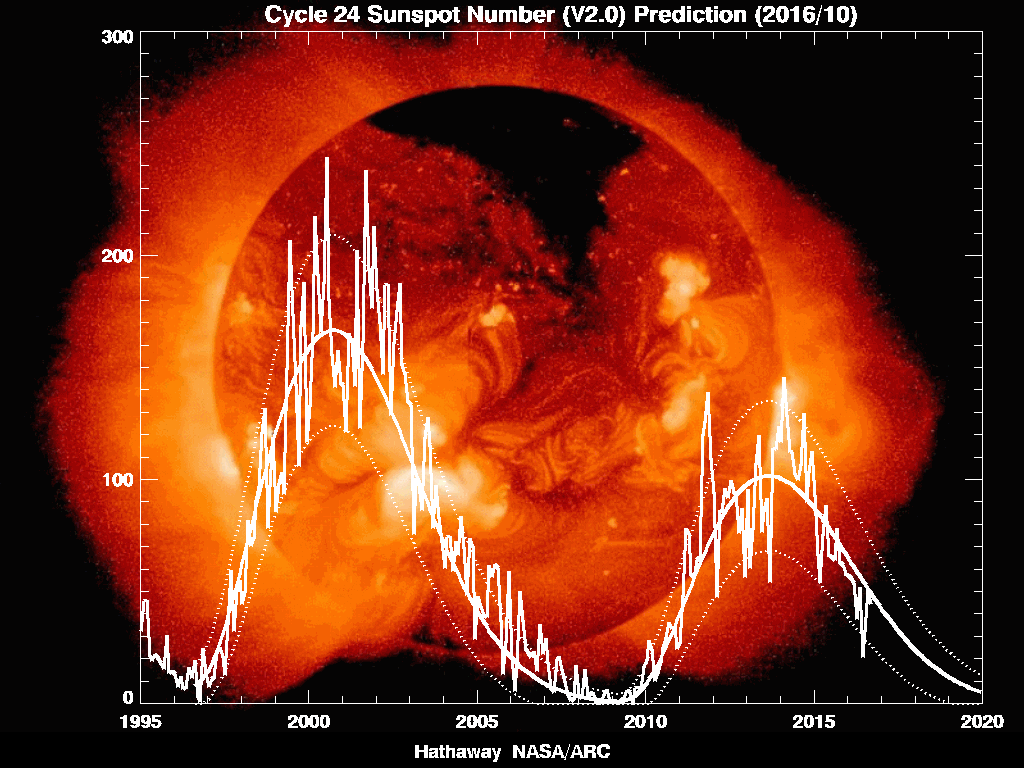
David Hathaway has a new forecast for solar cycle 24:
The current prediction for Sunspot Cycle 24 gives a smoothed sunspot number maximum of about 59 in early 2013. We are currently over three years into Cycle 24. The current predicted size makes this the smallest sunspot cycle in about 100 years.

SC24 forecast: updated 2nd March 2012
SC25 will likely be even smaller and it now remains to be seen if this Landscheidt Minimum is closer to a Dalton Minimum or a Maunder Minimum.
(more…)
Tags:David Hathaway, Landscheidt Minimum, Prediction, SC 24, SC25, solar cycle, Solar Cycle 24
Posted in Climate, Solar science | Comments Off on Solar Cycle 24 NASA forecast update
March 10, 2012
A recent post by John O’Sullivan reminded me that it is time for the next solar minimum that is on its way to be named after the man who predicted it. Theodor Landscheidt (born in 1927 in Bremen, Germany, died on May 20, 2004) was an author and amateur climatologist. In 1989, Landscheidt forecast a period of sunspot minima after 1990, accompanied by increased cold, with a stronger minimum and more intense cold which should peak in 2030 which he described as the “Landscheidt Minimum”.
The sun goes through its cycles as it will and at its own pace and we continue to struggle to try and decipher the various cycles that exist, what causes them and what effects they have on the earth. Some of the cycles known or hypothesised to exist are the:
- 11 year sunspot cycle
- 22 year magnetic cycle
- 87 year Gleissberg cycle
- 166 year “unnamed” cycle
- 210 years Suess or de Vries cycle
- 2,300 years Hallstat cycle
- 6000 years Xapsos and Burke cycle
Landscheidt’s paper is here: New Little Ice Age instead of Global Warming?
(more…)
Tags:Dalton minimum, Landscheidt Minimum, Little Ice Age, Maunder Minimum, solar cycle, Solar variation, Theodor Landscheidt
Posted in Climate, Science, Solar science | Comments Off on Solar cycles and the Landscheidt minimum
March 8, 2012
The evidence for the obvious mounts. The sun comes first and dominates and then come the oceans which provide the vehicle for distributing solar effects around the globe. The mythical effect of anthropogenic carbon dioxide on climate has yet to be supported by any direct evidence. Instead, the direct evidence observations of the last 12 years is that increasing carbon dioxide concentration in the atmosphere has been accompanied by a decline of “global” temperature.
A new paper by Jan-Erik Solheim (Department of Physics and Technology, University of Tromsø), Kjell Stordahl (Telenor Norway, Fornebu), Ole Humlum (Department of Geosciences, University of Oslo; Department of Geology, University Centre in Svalbard).
The long sunspot cycle 23 predicts a significant temperature decrease in cycle 24
Preprint: Accepted for publication in Journal of Atmospheric and Solar-Terrestrial Physics February 9, 2012
Abstract. Relations between the length of a sunspot cycle and the average temperature in the same and the next cycle are calculated for a number of meteorological stations in Norway and in the North Atlantic region. No significant trend is found between the length of a cycle and the average temperature in the same cycle, but a significant negative trend is found between the length of a cycle and the temperature in the next cycle. This provides a tool to predict an average temperature decrease of at least 1.0 “C from solar cycle 23 to 24 for the stations and areas analyzed. We find for the Norwegian local stations investigated that 25-56% of the temperature increase the last 150 years may be attributed to the Sun. For 3 North Atlantic stations we get 63-72% solar contribution. This points to the Atlantic currents as reinforcing a solar signal.
Tags:Atlantic Ocean, Norway, solar, solar cycle, Solar cycle 23, Solar Cycle 24
Posted in Climate, Norway, Solar science | Comments Off on Norway: “25–56% of the temperature increase the last 150 years may be attributed to the Sun”
March 4, 2012
P. Gosselin reports on his blog that Norwegian scientists are already predicting that La Niña may come back for a 3rd year.
(Related: La Niña will last well into 2011 and could extend into 2012)
It wasn’t all that long ago when a number of climate scientists were projecting the Earth would soon fall into an almost permanent, increasing El Niño mode, where the surface temperatures of the equatorial Pacific would always be like what we saw in 1998 – all man-made.
Today a number of German-language papers are reporting that Norwegian scientist Tore Furevik of the Bjerknes Centre of the University of Bergen says he expects the opposite to happen at least this year. Furevik says that La Niña may come back for third straight year. “The situation is simlar to the previous year,” he says.
Die Welt here writes that “there are no signs that La Nina is going to disappear anytime soon” and that according to Norwegian experts “it will occur even more strongly than in 2011″.
The Wiener Zeitung of Vienna, Austria adds:
The La Niña phenomena has been persisting since 2010 and there are no signs of it going away. We had this strong cooling in 2010 and instead of getting warmer, we stayed in a long cold phase’, said Furevik. “And it appears as if an even stronger La Niña will occur.’”
Furevik’s La Niña forecast contradicts the experts’ forecast, where an ensemble of models show the trend towards an El Niño for the 2nd half of the year:

Tags:El Niño-Southern Oscillation, La Nina, Pacific Ocean, University of Bergen
Posted in Climate, Oceans | Comments Off on La Niña may come back for a third straight year


 The k2p blog