Archive for the ‘Climate’ Category

Net effect of clouds on climate is strongly cooling and not of warming

September 21, 2011

During daytime clouds shadow the earth from the sun’s radiation and have a cooling effect while at night they act as a blanket and decrease the radiation away from earth into space. For anybody who has desperately sought the shade on a warm day or has observed the absence of frost after a cloudy night, this might seem a pretty obvious and a rather trivial statement.

The alarmists’ view of global warming assumes that the net effect of clouds is to warm the earth’s climate and that it is one of the “positive feedbacks” for warming. But a new paper in September’s Meteorological Applications severely undermines these assumptions by showing that this feedback is strongly negative. To put the magnitude of this cooling effect into perspective, the net cooling effect of clouds is put at -21W/sq.m while the much-touted effect of a doubling of carbon dioxide concentration in the atmosphere is supposed to be only +1.2W/sq.m.

When this is coupled to the recent support for Svensmark’s hypothesis  on solar effects for cloud formation from the CERN cloud experiment, and the lack of warming over the last decade  while carbon dioxide has been increasing, it only emphasises that:

  1. the science of how climate varies is a long way from being settled, and
  2. the magnitude of carbon dioxide effects on climate are extremely small, and
  3. the effect of man-made emissions on the atmospheric concentration of carbon dioxide is miniscule

Whether directly by incoming radiation or indirectly by the formation of clouds or through the transport of heat by the oceans and the winds, it is the sun which is the predominant forcing. Climate models which ignore solar effects and do not have the sun at their centre are fatally flawed.

Allan, R. (2011) Combining satellite data and models to estimate cloud radiative effect at the surface and in the atmosphere, Meteorological Applications, 18 (3). pp. 324-333, ISSN 1469-8080, DOI: 10.1002/met.285

Abstract: Satellite measurements and numerical forecast model reanalysis data are used to compute an updated estimate of the cloud radiative effect on the global multi-annual mean radiative energy budget of the atmosphere and surface. The cloud radiative cooling effect through reflection of short wave radiation dominates over the long wave heating effect, resulting in a net cooling of the climate system of − 21 Wm−2. The short wave radiative effect of cloud is primarily manifest as a reduction in the solar radiation absorbed at the surface of − 53 Wm−2. Clouds impact long wave radiation by heating the moist tropical atmosphere (up to around 40 Wm−2 for global annual means) while enhancing the radiative cooling of the atmosphere over other regions, in particular higher latitudes and sub-tropical marine stratocumulus regimes. While clouds act to cool the climate system during the daytime, the cloud greenhouse effect heats the climate system at night. The influence of cloud radiative effect on determining cloud feedbacks and changes in the water cycle are discussed. 

New computer simulations to find new excuses for recent lack of global warming

September 19, 2011

The lack of any global warming over the last decade while carbon dioxide emissions have been increasing is extremely worrying to the global warming orthodoxy. Recently “peer-reviewed” papers have attempted to find excuses for this lack of warming. Sulphur emissions from coal plants in China it has been suggested have been cooling the earth! The effects of soot in the atmosphere have also been blamed for reality and measurements not corresponding to the (sometimes fanciful) results of climate models. Needless to say it would not be politically correct to accept that solar influences – through clouds for example – may be so powerful as to make any anthropogenic effects quite insignificant with regard to climate.

One school of global warming believers believe that the missing heat is being hidden like some Loch Ness monster in the deep oceans and will come back to haunt us in due course. Of course measurements can not find this “hidden” deep ocean heat. It is far too well hidden for that. But the “unhidden” measurable ocean heat content (upto a depth of 700m) also confirm the flattening out of global warming.

As Bob Tisdale had pointed out in WUWT: Global Ocean Heat Content Is Still Flat

Figure 1 is a time-series graph of the NODC Global Ocean Heat Content Anomalies from the start of the dataset (1st Quarter of 1955) to present (2nd Quarter of 2011).

Figure 1: Global Heat content

And as many are aware, Climate Model Projections of Ocean Heat Content anomalies did not anticipate this flattening. Figure 2 compares the ARGO-era (2003 to present) NODC Global Ocean Heat Content anomalies to the GISS Model-E Projection of 0.7*10^22 Joules per year. The linear trend of the observations is approximately 7% of the trend projected by the model mean of the GISS Model-E.

Figure 2 - Ocean heat content:measurements compared to models

But the heat cannot hide from the speculative computer models of our intrepid global warmers. And since they cannot find this heat they have instead programmed a super-computer to tell us that it exists and will appear again in a decade or two. A new paper entitled Deep oceans can mask global warming for decade-long periods is to be published online on September 18 in Nature Climate Change. The title itself illustrates the defense. The  National Center for Atmospheric Research/University Corporation for Atmospheric Research has issued a press release which states:

Yet emissions of greenhouse gases continued to climb during the 2000s, and satellite measurements showed that the discrepancy between incoming sunshine and outgoing radiation from Earth actually increased. This implied that heat was building up somewhere on Earth, according to a 2010 study published in Science by NCAR researchers Kevin Trenberth and John Fasullo. 

The two scientists, who are coauthors on the new study, suggested that the oceans might be storing some of the heat that would otherwise go toward other processes, such as warming the atmosphere or land, or melting more ice and snow. Observations from a global network of buoys showed some warming in the upper ocean, but not enough to account for the global build-up of heat.

And when there are no measurements to back up some speculation a new computer model is deployed:

The study, based on computer simulations of global climate, points to ocean layers deeper than 1,000 feet (300 meters) as the main location of the “missing heat” during periods such as the past decade when global air temperatures showed little trend. The findings also suggest that several more intervals like this can be expected over the next century, even as the trend toward overall warming continues.

“We will see global warming go through hiatus periods in the future,” says NCAR’s Gerald Meehl, lead author of the study. “However, these periods would likely last only about a decade or so, and warming would then resume. This study illustrates one reason why global temperatures do not simply rise in a straight line.”

The simulations, which were based on projections of future greenhouse gas emissions from human activities, indicated that temperatures would rise by several degrees during this century. But each simulation also showed periods in which temperatures would stabilize for about a decade before climbing again. For example, one simulation showed the global average rising by about 2.5 degrees Fahrenheit (1.4 degrees Celsius) between 2000 and 2100, but with two decade-long hiatus periods during the century.

During these hiatus periods, simulations showed that extra energy entered the oceans, with deeper layers absorbing a disproportionate amount of heat due to changes in oceanic circulation. The vast area of ocean below about 1,000 feet (300 meters) warmed by 18% to 19% more during hiatus periods than at other times. In contrast, the shallower global ocean above 1,000 feet warmed by 60% less than during non-hiatus periods in the simulation.

“This study suggests the missing energy has indeed been buried in the ocean,” Trenberth says. “The heat has not disappeared, and so it cannot be ignored. It must have consequences.”

This is plain speculation. And it looks to me that these simulations are only done for the sake of rescuing previous computer models which are beginning to be shining examples of GIGO. Even super-computers can only produce rubbish when the models are developed by zealots. And as Bob Tisdale comments:

An explanation for why Global Ocean Heat Content Is Still Flat. … I’d like to see some supporting observations, otherwise this is just speculation for something that Trenberth is doggedly trying to explain away. My question is; show me why some years the deep ocean doesn’t mask global warming. It’s not like that big heat sink was suddenly removed.

Nobel laureate resigns from American Physical Society because of its stand on global warming

September 14, 2011

In October last year Professor Hal Lewis resigned from the American Physical Society because “It is of course, the global warming scam, with the (literally) trillions of dollars driving it, that has corrupted so many scientists, and has carried APS before it like a rogue wave”.

Yesterday another high profile member (Nobel prize winner for physics in 1973  Dr. Ivar Giaever) also resigned for much the same reason.

WUWT:

Nobel prize winner for physics in 1973 Dr. Ivar Giaever resigned as a Fellow from the American Physical Society (APS) on September 13, 2011 in disgust over the group’s promotion of man-made global warming fears. 

Here’s the resignation letter:

From: Ivar Giaever [ mailto:giaever@XXXX.com]
Sent: Tuesday, September 13, 2011 3:42 PM
To: kirby@xxx.xxx
Cc: Robert H. Austin; ‘William Happer’; ‘Larry Gould’; ‘S. Fred Singer’; Roger Cohen
Subject: I resign from APS
Dear Ms. Kirby
Thank you for your letter inquiring about my membership. I did not renew it because I can not live with the statement below:
“Emissions of greenhouse gases from human activities are changing the atmosphere in ways that affect the Earth’s climate. Greenhouse gases include carbon dioxide as well as methane, nitrous oxide and other gases. They are emitted from fossil fuel combustion and a range of industrial and agricultural processes.
The evidence is incontrovertible: Global warming is occurring.
If no mitigating actions are taken, significant disruptions in the Earth’s physical and ecological systems, social systems, security and human health are likely to occur. We must reduce emissions of greenhouse gases beginning now”.
In the APS it is ok to discuss whether the mass of the proton changes over time and how a multi-universe behaves, but the evidence of global warming is incontrovertible? The claim (how can you measure the average temperature of the whole earth for a whole year?) is that the temperature has changed from ~288.0 to ~288.8 degree Kelvin in about 150 years, which (if true) means to me is that the temperature has been amazingly stable, and both human health and happiness have definitely improved in this ‘warming’ period.Best regards,
Ivar Giaever
Nobel Laureate 1973PS. I included a copy to a few people in case they feel like using the information.
Ivar Giaever
XXX XXX
XXX
USA
Phone XXX XXX XXX
Fax XXX XXX XXX  

The supposedly “settled” science is looking decidedly wobbly.  And any science justifed on the basis of a “consensus” is fundamentally suspect .

Another harsh winter is expected as La Niña returns

September 9, 2011

Yesterday the NOAA finally confirmed that  La Niña was back. 

The Indian monsoon has been reasonably good and we can expect  greater evaporation leading to increased rains in the Western Pacific and in Australia. There should be less rain in the Eastern Pacific on the western coast of S. America (coastal Chile and Peru) but increased rain on the east coast in southern Brazil and  northern Argentina. Dry conditions should persist in the Southern US but the Northern hemisphere can now expect another harsh winter for the third year in a row. Forecasters are beginning to warn about this and local authorities are preparing to stock adequate amounts of salt and grit.

Sweden: Forecasters promise another harsh winter 

While Swedes are still enjoying the relatively clement weather of early autumn, weather experts are already forecasting another freezing winter to follow the last two. ”It is true that they generally follow each other,” said meteorologist Lisa Frost from the Swedish Meteorological and Hydrological Institute (SMHI) to daily Aftonbladet.
According to experts, the last two winters have been the coldest for the last few decades and statistics from the institute all point to cold winters coming in threes. …. The three extremely cold winters 1940-43, during the war, were followed by four very clement winters. Since then, the weather would seem to have followed this 3.5 year pattern.

Scotland: New bid to avoid repeat of winter road chaos 

The Scottish Government has called in the Red Cross to help prepare for the possibility of another harsh winter. In a bid to avoid a repeat of last year when motorists were stranded for hours on snow- bound motorways, transport minister Keith Brown has called a ‘Get Ready For Winter’ week next month.

Ireland: Heavy snow promised in Ireland  

The Irish Government has told Irish households to stock up on disposable barbecues to avoid disasters during the freezing weather promised for the forthcoming winter. After studying the last two years bitterly cold winters and the situations which arose the Government has advised that citizens should have “some barbecue trays” to hand in case they get snowed in.

UK: Forecaster Predicts Early Winter Snowfall For Ireland And Britain 

A long range weather forecaster is predicting an early start to winter 2011-2012 for many regions of the United Kingdom and Ireland.  James Madden of Exacta Weather says heavy snowfalls are likely in places as soon as late October and early November.

US: Resurgent La Niña may enhance snowfall for northern Colo. ski areas this winter 

… the Climate Prediction Center (CPC) at the National Oceanic and Atmospheric Administration (NOAA ) has issued a La Niña Advisory. This means La Niña conditions are likely to drive weather trends this winter. … “At this time, the Climate Forecast System (CFS) models are predicting an episode rivaling the same strength as last winter, but that forecast may change quite a bit as we get closer to the winter.”

Last winter, a moderate La Niña in the Pacific Ocean helped generate conditions just right for continuous massive snowfall in the Rocky Mountains of central and northern Colorado.

Related: Newborn La Niña: An Illustrated Guide

Remote Sensing: A case of editorial cowardice in the face of bullying from the orthodoxy

September 3, 2011

If this had been the middle ages there would have been witch-hunts and burnings at the stake (but of course it would then have been during the Medieval Warm Period).

Spencer and Bracewell had their paper On the Misdiagnosis of Climate Feedbacks from Variations in Earth’s Radiant Energy Balance published in the Journal Remote Sensing. The paper was refereed in the normal way and gained a lot of attention because it went against global warming orthodoxy. The global warming cabal were not amused and their blogs were full of objections to the paper. (This was all before the CERN CLOUD experiments).

The Editor-in-Chief of the Journal – a certain Wolfgang Wagner – obviously faced a lot of heat from the members of the global warming orthodoxy for publishing such heresy. He was clearly threatened by having the flow of scientific articles to his new journal throttled. But he could not retract the paper – not having any basis for doing so. Instead he has resigned in a blaze of publicity saying that the paper should not have been published!! Where peer review failed to find any fault with the paper, the editor has resorted to grandstanding to attack the paper.

It seems a simple case of the high priests of a religion threatening to excommunicate the poor little editor-in-chief of this new journal who has caved in on the basis of blog comments (and no doubt some irate telephone calls). A simple case of editorial cowardice.

The full story is detailed in these posts:

Editor-in-chief of Remote Sensing resigns over Spencer & Braswell paper

Critiques and responses 

Comment On The Resignation of Wolfgang Wagner

The pseudoscience of climate wars: climate does not control human violence

August 29, 2011

A welcome paper after last weeks nonsense where a new “scientific field” was created to study the effects of climate on human conflict. This paper claimed – by playing rather silly numbers games – that conflict was linked to the El Niño cycles. What passes for science: Mindless number games show El Niño correlates with civil war! Correlations do not necessarily indicate causality. It is not difficult to find correlations between entirely unrelated parameters. The El Niño – civil war correlation fulfils all the requirements of a pseudoscience.

The “Climate Wars” pseudoscience is clearly shown up by Dr. Bruno Tertrais in a new paper in The Washington Quarterly • 34:3 pp. 1729, The Climate Wars MythDOI: 10.1080/0163660X.2011.587951.

He writes:

The first decade of the 21st century was the hottest since the beginning of the Industrial Revolution….. Think tanks have enthusiastically embraced this new field of research, and militaries around the world are now actively studying the possible impact of a warming planet on global security. Books with titles such as Climate Wars predict a bleak future. 

A well-known French consultant claims that a five degree Celsius increase in average global temperature would generate no less than a ‘‘bloodbath.’’ Former World Bank economist Lord Nicholas Stern the author of the 2006 ‘‘Stern Report’’ on the possible economic impact of climate change even declares that failing to deal with climate change decisively would lead to ‘‘an extended world war.’’ 

However, there is every reason to be more than circumspect regarding such dire predictions. History shows that ‘‘warm’’ periods are more peaceful than ‘‘cold’’ ones. In the modern era, the evolution of the climate is not an essential factor to explain collective violence. Nothing indicates that ‘‘water wars’’ or floods of ‘‘climate refugees’’ are on the horizon. And to claim that climate change may have an impact on security is to state the obviousbut it does not make it meaningful for defense planning.

… if there was any significant link between warfare and warming, the number of conflicts should have been rising in the past two decades. It has not quite the contrary. Since the end of the Cold War, the total number of wars, after having steadily increased since 1945, has diminished. Statistics published by the Stockholm International Peace Research Institute (SIPRI), which come from work done at the Uppsala University, clearly show such a decrease. 

Some of the most catastrophic scenarios of climate change-induced conflict just do not stand up to scrutiny. … 

He concludes:

There are indeed, it seems, some causal links between climate and warfare. But they are of a seasonal nature: ‘‘nations address seasonal climate change in terms of where they fight, rather than through when or whether disputes occur.  . . . Fighting moves to higher latitudes in the summer, and lower latitudes during the cooler months of the year.’’ 
The stakes of climate change are important and that is why this area should not be the object of intellectual fantasies or fashions. It is appropriate for defense and security planners to monitor the evolution of the scientific and political debate on its possible consequences. But there is no objective reason today to list climate change as a key issue for defense and security planning.

Read the whole paper

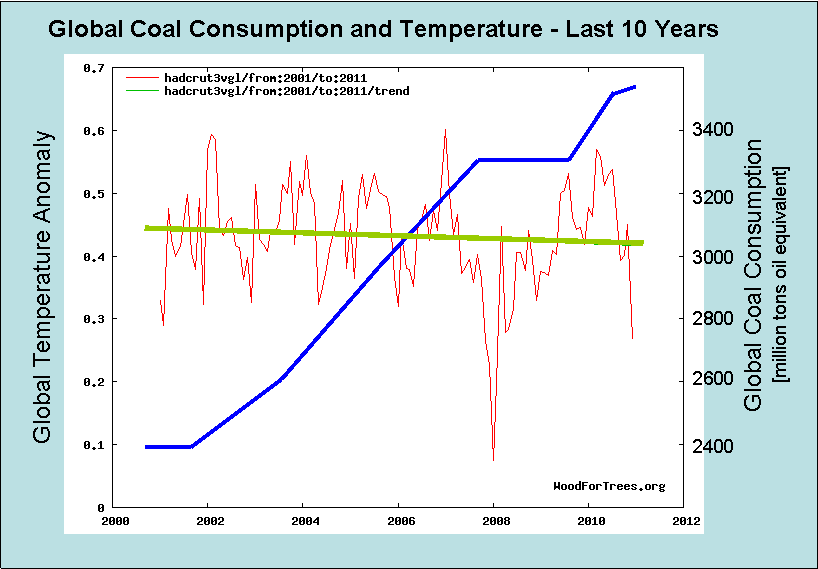
Coal consumption increases almost 50% in 10 years and has no impact on global temperature

August 26, 2011

There is a clear disconnect between global coal consumption (and therefore carbon dioxide emissions) and global temperatures.

Of course we must take into account that these are only real data over the last 10 years and are not generated by computer models and have not been validated by the IPCC!!

Quote of the week at WUWT 22nd May 2011

“People underestimate the power of models. Observational evidence is not very useful,” adding, “Our approach is not entirely empirical.” John Mitchell, principal research scientist at the UK Met Office

P Gosselin at NoTricksZone has the “heretical” story:

Global Coal Consumption Jumps Almost 50% – Yet Global Temps Drop! 

recently released BP report here shows that global coal consumption has risen over the last 10 years by almost 50%. So wouldn’t you think that all those millions of tons of emitted CO2 (food for plants) as a result would drive the global temperatures up? Have temperatures risen along with all that extra coal burning?

No they haven’t. In fact they’ve dropped slightly over the same period. So go figure!

Coal consumption and global temperature: http://notrickszone.com

In the above chart the blue line shows global coal consumption, data taken here, Review of World Energy. According to the report, India and China alone are responsible for 90% of the world’s coal consumption increase, while renewable energy in the 2 countries plays nary a role. According to BP figures, global CO2 emissions rose 5.8% in the year 2010. ……..

Read source report

“It’s the Sun, stupid” > Svensmark vindicated: CERN shows cosmic rays do influence cloud formation

August 25, 2011

The much awaited results from the CLOUD experiments at CERN have now been published in Nature and show that cosmic rays can influence cloud formation – as Henrik Svensmark has hypothesised. This mechanism – ultimately dependent upon the sun – is far more credible as an explanation of the climate variations seen in recent times than dubious computer models based on implausible forcings due to carbon dioxide in the atmosphere.

Cloud formation may be linked to cosmic rays Kirkby, J. et alNature 476, 429-433 (2011).

Nigel Calder (via GWPF) writes:

Long-anticipated results of the CLOUD experiment at CERN in Geneva appear in tomorrow’s issue of the journal Nature (25 August). The Director General of CERN stirred controversy last month, by saying that the CLOUD team’s report should be politically correct about climate change (see my 17 July post below). The implication was that they should on no account endorse the Danish heresy – Henrik Svensmark’s hypothesis that most of the global warming of the 20th Century can be explained by the reduction in cosmic rays due to livelier solar activity, resulting in less low cloud cover and warmer surface temperatures.

Willy-nilly the results speak for themselves, and it’s no wonder the Director General was fretful.

Henrik Svensmark (born 1958) is a physicist at the Danish National Space Center in Copenhagen who studies the effects of cosmic rays on cloud formation. His work presents hypotheses about solar activity as an indirect cause of global warming; his research has suggested a possible link through the interaction of the solar wind and cosmic rays. His conclusions have been controversial as the prevailing scientific opinion on climate change considers solar activity unlikely to be a major contributor to recent warming, though it is thought to be the primary driver of many earlier changes in climate.

I cannot do any better than reproduce Nigel Calder’s explanation of the CERN experimental results:

Jasper Kirkby of CERN and his 62 co-authors, from 17 institutes in Europe and the USA, announce big effects of pions from an accelerator, which simulate the cosmic rays and ionize the air in the experimental chamber. The pions strongly promote the formation of clusters of sulphuric acid and water molecules – aerosols of the kind that may grow into cloud condensation nuclei on which cloud droplets form. What’s more, there’s a very important clarification of the chemistry involved.

(more…)

What passes for science: Mindless number games show El Niño correlates with civil war!

August 25, 2011

Even making allowance for the fact that it is August when “silly season” stories come to the fore, this nonsense  does not bring much credit to the authors, Columbia University, Nature or the sponsors of the “study” who include the U.S. EPA, the brother of George Soros and the Environmental Defense Fund. Gullible journalists who are short of copy and create headlines from this kind of junk science are plentiful.

Civil conflicts are associated with the global climate Solomon M. Hsiang, Kyle C. Meng & Mark A. Cane, Nature 476, 438–441 (25 August 2011) doi:10.1038/nature10311 

pdf version here


The Guardian leads –

Climate cycles linked to civil war, analysis shows

Cyclical climatic changes double the risk of civil wars, with analysis showing that 50 of 250 conflicts between 1950 and 2004 were triggered by the El Niño cycle, according to scientists.

Researchers connected the climate phenomenon known as El Niño, which brings hot and dry conditions to tropical nations and cuts food production, to outbreaks of violence in countries from southern Sudan to Indonesia and Peru.

Solomon Hsiang, who led the research at Columbia University, New York, said: “We can speculate that a long-ago Egyptian dynasty was overthrown during a drought. This study shows a systematic pattern of global climate affecting conflict right now. We are still dependent on climate to a very large extent.”

JunkScience gives it short shrift:

Weather causes war, a new study claims. So should we limit CO2 emissions and give peace a chance? Make love not CO2?

The study published in this week’s Nature claims to correlate El Niño Southern Oscillation (ENSO) cycles with wars around the world during 1950-2009. The study’s intended implication, then, is that if only we can stop climate change (i.e., limit CO2 emissions), peace will be at hand.

The study’s major problem, however, is that even if there is a statistical correlation (pardon the redundancy) between ENSO events and wars, the study authors failed to examine any of the actual socio-political circumstances surrounding the wars. To insinuate weather cycles as a cause of or contributor to war simply because they can be correlated is to mindlessly exalt numerology over socio-political reality. 

Next ENSO cycles are real and result in actual weather phenomena. Extrapolating the actuality of ENSO to the dubious hypothesis of catastrophic manmade global warming, is yet another leap of faith. The goal of this research is to link CO2 emissions with national security. That is, we don’t just have to wish for world peace anymore; we can stop burning fossil fuels, cooling our homes, driving SUVs, eating meat, etc. It is merely a ploy to tug at the consciences of conservatives who, as a tribe, otherwise generally oppose Al Gore-ism.


Discovery of Icelandic ocean current unsettles “settled” climate theories

August 23, 2011

So much for settled science.

A new paper overturns previous thinking that the East Greenland Current was the main source of the Atlantic Meridional Overturning Circulation (AMOC). The newly discovered North Icelandic Jet (NIJ) is now thought to dominate the return of dense water south through gaps in the Greenland-Scotland Ridge to keep the “great ocean conveyor belt” moving.

Kjetil Våge, Robert S. Pickart, Michael A. Spall, Héðinn Valdimarsson, Steingrímur Jónsson, Daniel J. Torres, Svein Østerhus & Tor Eldevik. Significant role of the North Icelandic Jet in the formation of Denmark Strait overflow waterNature Geoscience, 21 August 2011 DOI:10.1038/ngeo1234

graphic by Reuters

 Science Daily reports:

ScienceDaily (Aug. 21, 2011) — An international team of researchers, including physical oceanographers from the Woods Hole Oceanographic Institution (WHOI), has confirmed the presence of a deep-reaching ocean circulation system off Iceland that could significantly influence the ocean’s response to climate change in previously unforeseen ways. 

The current, called the North Icelandic Jet (NIJ), contributes to a key component of the Atlantic Meridional Overturning Circulation (AMOC), also known as the “great ocean conveyor belt,” which is critically important for regulating Earth’s climate. As part of the planet’s reciprocal relationship between ocean circulation and climate, this conveyor belt transports warm surface water to high latitudes where the water warms the air, then cools, sinks, and returns towards the equator as a deep flow.

Crucial to this warm-to-cold oceanographic choreography is the Denmark Strait Overflow Water (DSOW), the largest of the deep, overflow plumes that feed the lower limb of the conveyor belt and return the dense water south through gaps in the Greenland-Scotland Ridge.

For years it has been thought that the primary source of the Denmark Overflow is a current adjacent to Greenland known as the East Greenland Current. However, this view was recently called into question by two oceanographers from Iceland who discovered a deep current flowing southward along the continental slope of Iceland. They named the current the North Icelandic Jet and hypothesized that it formed a significant part of the overflow water.

Now, in a paper published in the Aug. 21 online issue of the journal Nature Geoscience, the team of researchers — including the two Icelanders who discovered it — has confirmed that the Icelandic Jet is not only a major contributor to the DSOW but “is the primary source of the densest overflow water.” ……..