Archive for the ‘Development’ Category

Without immigration OECD populations will be in decline and in crisis

January 17, 2014

In times of high unemployment the anti-immigration voices are raised very high everywhere and especially in many European countries. Much of the sentiment is rooted in racist views whether against those of Asian or African or East European origin. In Japan it is seen as threatening the homogeneity of the country. But what every politician well knows – but which some will not dare to admit for fear of losing their populist base – is that  without net immigration in, OECD countries will face an increasing crisis of declining populations, declining labour force and an increase in the  proportion of the aged. They are all very well aware that expanding the working population to at least match the increase in the “aged” proportion is critical to maintaining the standard of welfare and health care that they have become accustomed to. Increasing the retirement age – which is already on the table as trial balloons – is unavoidable because even with immigration the proportion of the working population relative to the “aged” is in decline.

In OECD countries fertility rates are already well below the replacement level of 2.1 per woman. It is higher only in Israel, Iceland and New Zealand, and in India, South Africa and Indonesia. China is already down at 1.6 and India is down to 2.63 and declining fast.

The Local

France’s fertility rate has fallen below the symbolic level of two babies per woman and 2013 saw the slowest population growth in the country for well over a decade, new data revealed this week.

The 280,000 births in 2013 marked a 1.3 percent decline from 2012 with France’s fertility rate falling from 2.03 children per woman in 2010 to 1.99 children last year, according to the France’s national statistics agency INSEE. …… 

Despite the drop in the birth rate, France remains second only to Ireland when it comes to Europe’s most fertile nations. Women in Ireland, where the population is 4.6 million, had on average 2.01 children each in 2013.

These figures stand in stark contrast to Germany and Portugal, which had the lowest fertility rates on the continent. Germany recorded a rate of 1.38 per woman, followed by Portugal with 1.28 offspring per woman.

Korea, Hungary, Spain and Japan are the other countries where fertility rates are less than 1.4.

Fertility rates (2010 data) by country is here: OECD Total fertility rates 1970, 2010

Statistics are from the OECD Library:

Total fertility rates in OECD countries have declined dramatically over the past few decades, falling on average from 2.7 in 1970 to 1.7 children per woman of childbearing age in the 2000s. In all OECD countries, fertility rates declined for young women and increased at older ages. A modest recovery in total fertility rates started in the early 2000’s, to an average level of 1.7 in 2010. The total fertility rate is below its replacement level of 2.1 in most OECD countries except Israel, Iceland and New Zealand, and in India, South Africa and Indonesia.

The last few years have seen various trends emerge in fertility rates. A drop in fertility rates has occurred, for example in Australia, New Zealand, Spain and the United States, while rates have continued to rise in Iceland, Israel, Sweden, and Switzerland. The increase in fertility stopped in many other countries. The effect of the economic downturn is as yet unknown, but persistent economic uncertainties can impact downward the number of children women may have over their reproductive life.

OECD Fertility trends
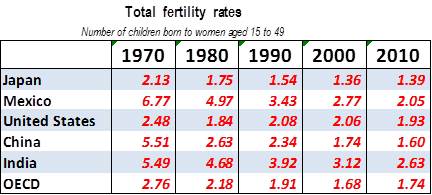
OECD Fertility trends

OECD fertility table

The difference between the decline in fertility rates between India and China is of particular interest. While some of the difference is due to different rates of development, most of the difference can be attributed to the draconian one-child policy in China. But that is now being relaxed as the coming decline in the Chinese population becomes obvious..

The shortages of the proportion of working population – unless immigration is used to mitigate the shortfall – is inevitable and will really begin to bite over the next twenty years or so.

The inexorable numbers – 10:10:10:100 is inevitable around 2100

December 4, 2013

10:10:10:100 by 2100

The “success” of a species is generally taken to be indicated by its population though it is of course possible to have quantity without much quality of life. In general however, an increasing population of any species does indicate the sufficiency of food, the ability of the species to withstand competition from other species and the ability to breed successfully in the prevailing conditions. And so it is for humans. Based on population, modern humans have never been as successful as they currently are. And in spite of all the doom-sayers and the alarmists, the fact remains that more humans are being fed and housed and are achieving some large part of their aspirations than ever before. They are living longer than ever before  and their life expectancy is still increasing – currently by about 2 -3 months every year.

However  just looking at the crude birth rate (number of births per 1000 of population) might lead one to a conclusion that there was a catastrophic decline in the human species.

Crude Birth Rate / 1000 of population

Crude Birth Rate / 1000 of population

Birth rates have declined from about 37/1000 in 1950 to less than 15/1000 now and are projected to be around 10/1000 by 2100. For any other species that would be a catastrophic decline. But of course that conclusion would be quite wrong when applied to humans. The mortality rate of humans has also declined drastically as medical and public health advances have been made. And human ingenuity has maintained food and material supplies such that life expectancy has increased in spite of a booming population.

Birth and mortality rates

Birth and mortality rates

The fact that population and life expectancy have increased simultaneously is a clear indicator that the quality of life has not deteriorated. There may be problems of equitable distribution but there is no shortage of food or other resources – and no prospect of any catastrophic shortages occurring. All other indicators tell the same story. Infant mortality, poverty and malnourishment are all at all-time lows and declining even if these can be lower still. The real GDP per capita is increasing. Leisure time (time not spent on the requirements for survival) is increasing and for more people than ever before. The age of space exploration and the potential for access to new sources of raw materials and even real estate has already begun.

There are many who rail against the consumer society and materialism but generally do so from a position of some comfort. There are others who moan the loss of spirituality and yearn for a return to a simpler life but they too are not quite ready to return to the trees. There is no shortage of doom-mongers and alarmists who merely keep pushing their doomsdays into the future where they cannot be disproved.

It is a question of attitude. There are those who would prefer to be governed by fear (the precautionary principle) and there are others who would move forward in spite of their fears.

But the reality is that the human species – with all its warts and threats and self-inflicted problems – is thriving.

Population and life expectancy WPP2012

Population and life expectancy WPP2012

It is not a forecast or an objective but merely the inexorable arithmetic of demographics which leads to the inevitability of 10:10:10:100 around the year 2100.

10 billion population, 10 births per 1000 of population, 10 deaths per 1000 of population and a life expectancy at birth of 100 years.

I prefer to see the glass half-full rather than the glass half-empty.

Moment of truth approaches for India’s Mars Orbiter Mission

November 28, 2013

When everything is for the first time,achievements are incremental and there are very many critical “moments of truth” to meet and overcome. But now comes a very large “moment of truth” as ISRO prepares to inject the Mars Orbiter spacecraft into its Trans Mars Trajectory.

India’s Mars Orbiter (Mangalyaan) is currently in its final orbit around the earth and is scheduled to fire its 440 Newton liquid engine at 0049 hours IST on Sunday morning ( 1919 GMT Saturday 30th November).  It entered its final Earth orbit yesterday which has an orbital period of 5575 minutes (just under 4 days) and it should be approaching apogee later tonight (early hours of Friday morning) and the next engine burn will take place at perigee. Currently apogee is about 193,000 km from earth and perigee is around 350km.

The spacecraft must first be manoeuvred into the right attitude using its thrusters for the firing of its main engine which must then be fired to impart the correct change of velocity (delta-vee). Both, an incorrect attitude and/or an incorrect delta-vee are potential sources of error. Three mid-course corrections are planned  (the first on December 11th) but the margin of error allowable is still extremely small. Too low a velocity change could leave the craft in earth orbit or put it into a heliocentric orbit which does not get close enough to Mars. Too high a delta-vee would also put the craft into a heliocentric orbit which would eventually decay into the sun. I believe there is no chance of achieving a velocity high enough to escape the sun. And even if the velocity change is correct but the direction is too far in error then just another orbital path around the sun would result.

NDTV:“The trans-Mars injection- we are planning to depart on December 1, 2013 early hours of 00:49 hours IST and we are going to burn a liquid engine for duration of roughly 23 minutes which will impart an incremental velocity of 648 metres per second consuming a fuel of 198 kgs,” ISRO Scientific Secretary V Koteswara Rao told reporters in Bangalore.

K. Radhakrishnan, ISRO Chairman. (For the) trans-Mars injection and its insertion into the Martian orbit, the firing of the liquid engine is done in a closed loop mode. Here, a precision accelerometer is used to estimate the incremental velocity added as the liquid engine burns and when the accelerometer gives a feedback that the required incremental velocity added to the spacecraft has been achieved, the burning of the liquid engine is automatically terminated. So, minor variations in the performance of the liquid engine will not matter because we are cutting off its burning based on the delta-v that is achieved. That is why we call it closed loop of firing. … The spacecraft’s propulsion system, i.e., the 440 Newton liquid engine, will complete its first phase of operations on December 1. It has to be re-started for its operation on September 24 (2014).

MOM Trans Mars Injection ISRO

MOM Trans Mars Injection ISRO

ISRO: This voyage is achieved by a combination of navigation and propulsion technologies, governed by the gravity of Sun and Mars, and assisted by the 440 N Liquid engine. Further fine tuning of the trajectory is achieved using the Attitude and Orbit Control Thrusters during the Trajectory Correction maneuvers planned en route.

… on December 11, we plan to have one small firing for mid-course correction of the spacecraft. There may be one more mid-course correction during the helio-centric phase, and subsequently, a fortnight before the spacecraft’s arrival near Mars, there will be one more mid-course correction. So there will be three mid-course corrections between December 1, 2013 and September 24, 2014. 

Mangalyaan is eventually to be placed into a Martian orbit, with a periapsis height of 365 km, apoapsis height of 80,000 km and an orbital period of about 77 hours.

So on Saturday I shall have as many of my fingers crossed as I can manage. I suspect there will be many others doing the same across India.

Androids will dream of this electric “J”

November 22, 2013
Android on a Kawasaki J

Android on a Kawasaki J

It will never go into production.

It’s electric (note the artistic and symbolic flashes of green), but they are sticking to a NiMH battery rather than a lithium-ion fire hazard.

It’s what some androids will dream of instead of electric sheep.

It’s the Kawasaki J-concept motor cycle being displayed at the 2013 Tokyo Motor Show.

DigitalTrends: The Kawasaki J technically has three wheels, but in Sport Mode the two front wheels are pushed together, and the entire machine hunkers down to lower the center of gravity. In Comfort Mode, the stance is raised and the front wheels separate, giving the ride a more upright position that is, well, more comfortable.

Instead of handlebars, steering is accomplished with two levers, one attached to each of the front wheels. It’s a decidedly Steampunk mechanism, compared to the bike’s Cyberpunk styling.

In three-wheeled Comfort Mode, the J concept looks like a scooter used by mall cops in the futuristic Grid city from Tron. In maximum-attack Sport Mode, it looks completely otherworldly.

Powering the Kawasaki J is an electric motor hooked to a nickel-metal hydride (NiMH) battery pack. The packaging advantages of an electric powertrain were probably needed to accomplish the J’s transformation stunt. Note that it doesn’t use the lithium-ion batteries that are found in most electric cars and plug-in hybrids.

The Kawasaki J looks awesome on the show stand, and it won’t be going anywhere else. Kawasaki has no plans to put it into production. That’s just as well; it’ll save owners from having to try to explain it to their neighbors.

The first string? Man-made, twisted, fibre, cords at least 90,000 years ago

November 22, 2013

The man in question may well have been Neanderthal. Fibre artefacts rot easily and the oldest remains found of a man-made, twisted, fibre “cord” or “string” dates from only about 30,000 years ago. A new paper describes perforations in upto 90,000 year old, stone and tooth artefacts as well as shells from Abri du Maras and other Neanderthal sites in France, indicating they had once been threaded on “strings” and worn as pendants.

This post has beeen shifted to 6,000 Generations

China relaxes highly successful one-child policy

November 15, 2013

It was no doubt authoritarian and draconian and there may well be many unforeseen emotional and psychological side-effects to come for many generations, but the bottom line is that the Chinese one-child policy has done the trick insofar as population numbers is concerned. The Chinese population will reach its peak of just under 1.4 billion around 2020 and will then decline dropping to less than 1 billion by 2100. Around 2020, India’s population will exceed the Chinese population and will continue to increase until about 2060 reaching a peak of about 1.7 billion. Then by 2100 the India population will have declined to about 1.5 billion.

ReutersChina unwrapped its boldest set of economic and social reforms in nearly three decades on Friday, relaxing its one-child policy and further freeing up markets in order to put the world’s second-largest economy on a more stable footing.

The sweeping changes helped dispel doubts about the leadership’s zest for the reforms needed to give the economy fresh momentum as three decades of breakneck expansion shows signs of faltering.

The chart below is based on an analysis of the World Population Prospects 2010 and not on the latest 2012 projections. However the numbers and trends are largely the same.

WPP2010 Population projections till 2100

WPP2010 Population projections till 2100

Even if fertility rates now increase much more than predicted, the Chinese government now has a tried and tested – if disliked – population control method to fall back on. An increased fertility rate is now absolutely necessary to avoid a major aging challenge after about 2050 when the ratio of the working population to the supported population could reach crisis levels.

India’s frugal Mars orbiter mission completes 3rd burn in earth orbit

November 9, 2013

There has been some criticism  (within and outside India) from the usual suspects about the frugally-engineered, Indian, Mangalyaan Mars Orbiter mission as “being too expensive” for a developing country like India. I tend to discount these voices which merely continue the long, retrograde and shameful tradition of the Luddites. Some of these voices are of those who would like humankind to return to the trees. Others are of those who feel threatened by the idea of “backward nations” moving into space.

Reaching Mars is not that easy. More missions have failed than have succeeded. The full list of Mars missions is here. There are many crucial steps left for the Mangalyaan mission to achieve and success is far from assured.

TOI: India’s Mars Rover Mission (MOM) named ‘Mangalyaan’ is the 42nd mission aimed at understanding Mars. Out of the 41 missions so far, 25 have been declared failures and only 16 have been a success. Even the latest Phobos-Grunt/Yinghuo-1 launched by Russia/China was a failure as it got stranded in the earth’s orbit. 

Close on the heels of ‘Mangalyaan’ being sent into space by India, the United States (US) is also gearing up for the MAVEN mission to be launched on November 18, 2013. The mission is intended to be a step towards ‘unravelling the planetary puzzle about Mars’. The US is also gearing up for the Mars Rover 2020 mission to understand ‘Martian atmosphere’.

Underlying all missions is the vision of Mars one day being inhabited by humans. And that vision transcends the petty and mean criticism of those who can only see a “glass half empty”.

Last night the 3rd of five rocket burns was completed to lift the earth orbit of Mangalyaan from 40,186 km to 71,636 km (apogee). The fourth and fifth burns are planned for November 11th and 16th to raise the apogee to 100,000 km and then to 192,000 km. The 6th burn will be to leave Earth’s orbit and  insert the spacecraft into a trajectory towards Mars. The Trans-Mars injection is expected around 12.42 AM on December 1st.

ISRO: The third orbit raising manoeuvre of Mars Orbiter Spacecraft, starting at 02:10:43 hrs(IST) on Nov 09, 2013, with a burn time of 707 seconds has been successfully completed. The observed change in Apogee is from 40186km to 71636km.

ISRO’s Mission Profile.

The Launch Vehicle – PSLV-C25 will inject the Spacecraft into an Elliptical Parking Orbit with a perigee of 250 km and an apogee of 23,500 km. With six Liquid Engine firing, the spacecraft is gradually maneuvered into a hyperbolic trajectory with which it escapes from the Earth’s Sphere of Influence (SOI) and arrives at the Mars Sphere of Influence. When spacecraft reaches nearest point of Mars (Peri-apsis), it is maneuvered in to an elliptical orbit around Mars by firing the Liquid Engine. The spacecraft then moves around the Mars in an orbit with Peri-apsis of 366 km and Apo-apsis of about 80000 km. 

The mission consists of following three phases:

1. Geo Centric Phase
The spacecraft is injected into an Elliptic Parking Orbit by the launcher. With six main engine burns, the spacecraft is gradually maneuvered into a departure hyperbolic trajectory with which it escapes from the Earth’s Sphere of Influence (SOI) with Earth’s orbital velocity + V boost. The SOI of earth ends at 918347 km from the surface of the earth beyond which the perturbing force on the orbiter is mainly due to the Sun. One primary concern is how to get the spacecraft to Mars, on the least amount of fuel. ISRO uses a method of travel called a Hohmann Transfer Orbit – or a Minimum Energy Transfer Orbit – to send a spacecraft from Earth to Mars with the least amount of fuel possible. 

2. Helio Centric Phase
The spacecraft leaves Earth in a direction tangential to Earth’s orbit and encounters Mars tangentially to its orbit. The flight path is roughly one half of an ellipse around sun. Eventually it will intersect the orbit of Mars at the exact moment when Mars is there too. This trajectory becomes possible with certain allowances when the relative position of Earth, Mars and Sun form an angle of approximately 44o. Such an arrangement recur periodically at intervals of about 780 days. Minimum energy opportunities for Earth-Mars occur in November 2013, January 2016, May 2018 etc. 

3. Martian Phase
The spacecraft arrives at the Mars Sphere of Influence (around 573473 km from the surface of Mars) in a hyperbolic trajectory. At the time the spacecraft reaches the closest approach to Mars (Periapsis), it is captured into planned orbit around mars by imparting ∆V retro which is called the Mars Orbit Insertion (MOI) manoeuvre. The Earth-Mars trajectory is shown in the above figure. ISRO plans to launch the Mars Orbiter Mission during the November 2013 window utilizing minimum energy transfer opportunity.

Frugal engineering for India’s Mars mission

November 6, 2013

India has been struggling to bridge the gap to more developed nations without necessarily having to follow exactly the same path as that followed by other nations. Especially to achieve the development objectives in less time than it has taken those who did it first. Doing more with less is the name of the game and “Frugal engineering” (or “frugal innovation”) is defining a new paradigm for development.

There may perhaps not be any better example of the dictum that necessity is the mother of invention than can be found in India. Whether it is a refrigerator, ECG device or an automobile, Indian engineers have brought innovative products to market by designing them outside-in. …….

It may seem a contradiction, but some infrastructure gaps in India have positively affected Indian innovation: they have forced entrepreneurs and companies to adopt technologies that make relying on existing infrastructure (creaking and unreliable as it is in many ways) simply irrelevant. Indian engineers have invented a battery-powered, ultra-low-cost refrigerator resistant to power cuts; an automatic teller machine for rural areas; and even a flour mill powered by a scooter. People in the West, with its constant access to electricity, have little motivation to pursue such innovations. The Indian mobile phone industry is the poster child for leapfrogging over infrastructural constraints. A limited fixed-line infrastructure created an opportunity for mobile phones to reach many more people. Mobile telephony is also relatively cheap, sharable, and easily repaired. And thus, a new frontier of global innovation opened in India. …… 

The Indian mission to Mars which launched yesterday is another example of frugal engineering at work.

Hindustan Times:

India’s successful Mangalyaan launch is as much a financial accomplishment as a technical milestone. The entire Mars mission has cost the Indian Space Research Organisation a mere around Rs. 450 crore ($75 million) and took 15 months to put together. Much of the Martian price tag is for ground stations and relay upgrades that will be used for other Isro projects. The actual satellite costs a mere $25 million ( Rs. 153 crore), says Pallav Bagla of Science magazine. Comparison: Nasa’s similar MAVEN Mars project will cost 10 times more and will take three times longer.

Isro is widely cited as an example of “frugal engineering” …..  A US state department scientific adviser once said that Isro had reduced satellite assembly costs to a tenth of Nasa’s.

Isro’s accomplishments are remarkable given its tiny budget: $700 million ( Rs. 4,270 crore) in 2012-13. Despite a space programme whose financial base is the ninth largest, India is generally rated the world’s number six space power.

Of this, only 7% is allotted for planetary exploration. Isro’s prime directive has and continues to be the finding of technical means to support socio-economic goals such as education, medicine, water and disaster management.

Isro also defrays government support through a commercial arm, Antrix. Through the sale of satellite imagery, satellite launches and so on, Antrix earned a pre-tax Rs. 2 billion in 2010 alone. …..

Chinese Li-Fi development moves faster than in Europe

October 22, 2013

“Light Fidelity” – Li- Fi  for using light from LED’s as a data carrier instead of radio frequencies was coined at the University of Edinburgh:

PhysOrg: Li-Fi is a term referring to “light fidelity” coined by Prof. Harald Haas from the University of Edinburgh and refers to a type of visible light communication (VLC) technology that delivers a networked, mobile, high-speed communication solution. He set up a private company, PureVLC, to continue exploring the technology.

But now it seems that the Chinese have developed this technology a lot faster than Prof. Haas’ company and could be closer to commercial application than the originators.

Xinhua: 

Successful experiments by Chinese scientists have indicated the possibility of the country’s netizens getting online through signals sent by lightbulbs (LiFi), instead of WiFi.

Four computers under a one-watt LED lightbulb may connect to the Internet under the principle that light can be used as a carrier instead of traditional radio frequencies, as in WiFi, said Chi Nan, an information technology professor with Shanghai’s Fudan University, on Thursday.

A lightbulb with embedded microchips can produce data rates as fast as 150 megabits per second, which is speedier than the average broadband connection in China, said Chi, who leads a LiFi research team including scientists from the Shanghai Institute of Technical Physics of the Chinese Academy of Sciences.

With LiFi cost-effective as well as efficient, netizens should be excited to view 10 sample LiFi kits that will be on display at the China International Industry Fair that will kick off on Nov. 5 in Shanghai.

The current wireless signal transmission equipment is expensive and low in efficiency, said Chi. 

“As for cell phones, millions of base stations have been established around the world to strengthen the signal but most of the energy is consumed on their cooling systems,” she explained. “The energy utilization rate is only 5 percent.”

Compared with base stations, the number of lightbulbs that can be used is practically limitless. Meanwhile, Chinese people are replacing the old-fashioned incandescent bulbs with LED lightbulbs at a fast pace.

“Wherever there is an LED lightbulb, there is an Internet signal,” said Chi. “Turn off the light and there is no signal.”

However, there is still a long way to go to make LiFi a commercial success.

“If the light is blocked, then the signal will be cut off,” said Chi.

More importantly, according to the scientist, the development of a series of key related pieces of technology, including light communication controls as well as microchip design and manufacturing, is still in an experimental period.

Prof. Haas and his company are not very amused and expressed some skepticism.

PhysOrg again: 

As for reactions to the report from China, a spokesperson, according to the BBC, said they thus far had not seen any evidence such as videos or photos in support of the claims. PureVLC spokesman Nikola Serafimovski said they did not know how valid was the report “without seeing more evidence.”

In 2011, Haas demonstrated how an LED bulb equipped with signal processing technology could stream a high-definition video to a computer. Haas performed the first public demonstration of visible light communications live at TED Global, where he showed an angle poise lamp fitted with an LED bulb transmitting high-definition video displayed on a screen. When he interrupted the light with his hand, the video froze and it was then restored when he removed his hand.

“Wicked” Greenpeace casting a dark shadow over the world

October 14, 2013

Wicked Green Pirate: image by http://nowio.deviantart.com/

Greenpeace and Friends of the Earth have become merely destructive movements. And their self-righteous beliefs in their world-view seem to justify any means. Not just piracy and drug-running, now Greenpeace have also been labelled “wicked” for their opposition to Golden rice. Patrick Moore – who was a co-founder of Greenpeace – called their opposition to GM crops in general and Golden rice in particular a “crime against humanity”.

And now the UK Secretary for the Environment, Owen Paterson called them “wicked” saying “they could be condemning millions of people in the developing world to a premature death”.

BBCOpponents of the development of a type of genetically modified (GM) rice enriched with vitamin A are “wicked”, the environment secretary has said.

In an interview with the Independent, Owen Paterson said they could be condemning millions of people in the developing world to a premature death.

Mr Paterson backed a letter from international scientists calling for the rapid development of “golden rice”. ….  Mr Paterson told the newspaper: “It’s just disgusting that little children are allowed to go blind and die because of a hang-up by a small number of people about this technology.

“I feel really strongly about it. I think what they do is absolutely wicked. There is no other word for it.”

Mr Paterson did not specify any particular groups in his interview but also said opponents of GM technology were “casting a dark shadow over attempts to feed the world”. ……

 ….. Meanwhile, in a letter to US journal Science, a group of leading academics accused Western non-governmental organisations of fuelling opposition to the development of GM technologies. They wrote: “If ever there was a clear-cut cause for outrage, it is the concerted campaign by Greenpeace and other non-governmental organisations, as well as by individuals, against golden rice.”

Environmental campaigners such as Greenpeace and Friends of the Earth have said there are more effective solutions to vitamin A deficiency.

The Independent adds:

In the strongest attack yet on the anti-GM lobby Mr Paterson told The Independent that NGOs such as Greenpeace and Friends of the Earth that oppose GM technology were “casting a dark shadow over attempts to feed the world”.